PART 3
For several seconds, I couldn’t move.
Ninety-six thousand dollars.
Seven transactions.
And a meeting to transfer my ownership shares.
I stared at Sofia, wondering whether I’d heard her correctly.
“Transfer my shares?” I repeated.
She nodded, her face pale.
Mrs. Whitmore, there’s an appointment scheduled for
tomorrow morning with a representative
from an investment group.
The notes say the majority
shareholder has approved a restructuring.
I looked at Adam.
My son was staring at the marble floor.
“Adam,” I said quietly, “look at me.”
He didn’t.
“Look at me.”
Slowly, he raised his head.
For thirty-five years, I’d known that face.
I’d kissed his forehead when he was sick. I’d wiped tears from his cheeks after his first heartbreak. I’d stood beside him at his wedding and told him how proud his father would have been.
Now I was looking at a stranger wearing my son’s face.
“What have you done?”
His mouth opened.
Nothing came out.
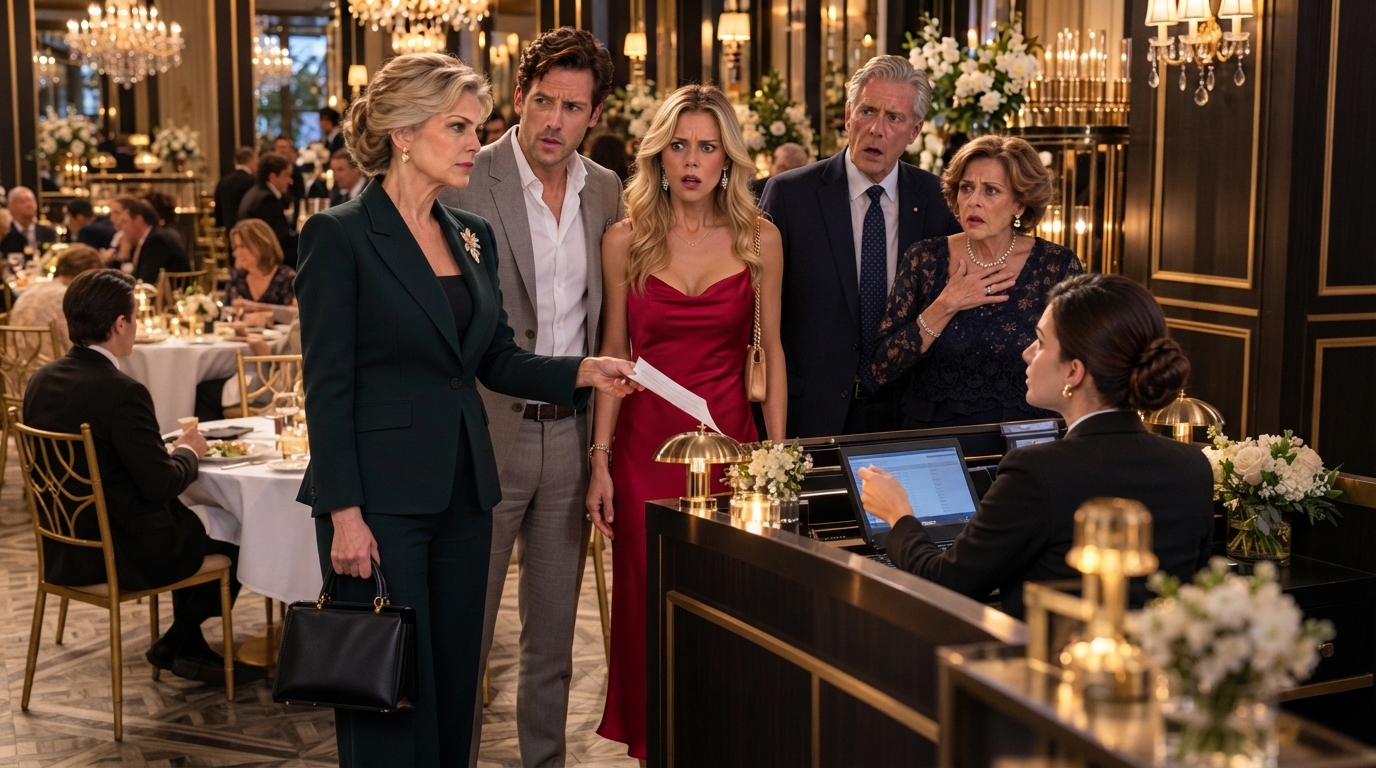
Vanessa stepped forward.
“Margaret, you’re making this much bigger than it needs to be.”
I turned toward her.
“Your husband has apparently used my account without permission, presented a document bearing a signature I didn’t write, and arranged a meeting concerning a business he doesn’t own. Which part am I exaggerating?”
Her cheeks reddened.
“Adam said everything had been arranged.”
“With whom?”
She glanced at Graham.
That was when I noticed something.
My son’s father-in-law was no longer looking arrogant.
He was frightened.
And frightened people often reveal more than angry ones.
“Graham,” I said, “what do you know about tomorrow’s meeting?”
He adjusted his expensive watch.
“Business matters are complicated, Margaret.”
I smiled faintly.
“Then explain them slowly. I have the evening free.”
Celeste grabbed his arm.
“Don’t answer her.”
I looked at Sofia.
“Please contact our security director. And call Mr. Bennett.”
Mr. Bennett was Bellavita’s general counsel.
He’d worked with my late husband for almost twenty years.
Sofia nodded and stepped into the office.
Adam finally spoke.
“Mom, please. Can we talk privately?”
I looked at him.
“That’s what I asked you to do three weeks ago when I invited you to Mother’s Day dinner.”
He flinched.
“You could have called me, Adam. You could have told me you needed help. Instead, you brought your wife’s family here and tried to charge thirty-eight thousand dollars to my account.”
His eyes filled.
“Mom—”
“And apparently that was only the beginning.”
The restaurant’s security director, Marcus Reed, arrived within minutes.
He was a tall, broad-shouldered man in his early fifties who had worked for our company for eleven years.
“Mrs. Whitmore,” he said, “is everything all right?”
“No, Marcus. I need you to preserve the relevant security footage and transaction records. There may have been unauthorized financial activity.”
He nodded immediately.
I turned toward Sofia.
“Has tonight’s charge been processed?”
“No, ma’am.”
“Good. Don’t process it.”
Vanessa gave an irritated laugh.
“This is ridiculous. We’re standing here being treated like criminals because of a misunderstanding.”
I looked at her.
“Then you should welcome an investigation.”
Her expression changed.
Graham suddenly reached for the folded document in my hand.
“That belongs to us.”
I stepped back.
“No, Graham. It bears my name and a signature I dispute. It stays with management for review.”
Marcus moved closer.
“Sir, please don’t interfere.”
Graham withdrew his hand.
For the first time that evening, nobody was laughing.
Mr. Bennett arrived forty minutes later.
By then, the private reception had been canceled, and the relatives had quietly left after providing their contact information.
Only Adam, Vanessa, Graham, and Celeste remained.
Mr. Bennett examined the purported authorization.
Then he looked at me.
“Margaret, did you sign this?”
“No.”
“Did you authorize Adam to charge expenses to the Founder’s Reserve account?”
“No.”
“Did you approve any transfer of ownership?”
“Absolutely not.”
He nodded.
Then he turned to Adam.
“Where did you obtain this document?”
Adam swallowed.
“Vanessa handled the paperwork.”
Vanessa spun toward him.
“Excuse me?”
He looked miserable.
“You said everything was legitimate.”
Her eyes flashed.
“Don’t you dare put this on me.”
Graham slammed his palm against the counter.
“Enough!”
Everyone went silent.
He looked at Mr. Bennett.
“We were told Adam had authority to act for his mother.”
Mr. Bennett folded his hands.
“Who told you that?”
Graham hesitated.
“Adam.”
My son looked as though someone had struck him.
“Dad, you said—”
Graham cut him off.
“Don’t call me that right now.”
I stared at them.
And suddenly, I understood that I was watching four people decide who would carry the blame.
Not one of them had asked whether I was all right.
Not one had apologized for leaving me alone on Mother’s Day.
Not one had expressed concern about what had been taken.
They were only worried about consequences.
Mr. Bennett asked Sofia to retrieve the transaction records.
She returned with a printed report.
I sat at a nearby table while he reviewed it.
The first entry was dated eight months earlier.
A private dinner.
$4,800.
The second was a corporate reception.
$12,600.
Then a wine-tasting event.
A holiday celebration.
A luxury catering order.
Another private gathering.
And a $21,400 event that appeared to have been billed to my Founder’s Reserve account.
Together, the entries totaled approximately ninety-six thousand dollars.
My hands tightened around the report.
Every one of those events had been associated with Adam or Vanessa.
I looked at my son.
“Did you attend all of these?”
He nodded.
“Most of them.”
“And you thought I was paying?”
He stared at the floor.
“Vanessa said the membership included family benefits.”
I looked at her.
She folded her arms.
“It does include benefits.”
“Not unlimited spending,” I replied.
She shrugged.
“Your company makes millions. What’s the difference?”
The words landed harder than I expected.
What’s the difference?
I thought about my husband, Charles.
The man who had spent twenty-three years building our restaurant business.
He’d started as a dishwasher when he was seventeen.
Worked his way into management.
Saved every dollar he could.
When we purchased Bellavita’s parent company, we’d taken a frightening risk.
I handled the finances.
Charles managed operations.
We worked weekends.
Missed vacations.
Ate dinner at our desks.
And sometimes lay awake at night wondering whether we’d be able to make payroll.
After Charles died, I’d kept the company going because it was more than an investment.
It was the work of our lives.
And Vanessa had just reduced it to something she believed her family could use without consequence.
I looked at her.
“The difference is that it belongs to someone else.”
Mr. Bennett turned to the final page.
His expression changed.
“Margaret, I need to show you something.”
He slid the paper toward me.
Attached to the account records was a note from an outside consultant.
It referenced a proposed sale of a controlling interest in Whitmore Hospitality Holdings.
The prospective purchaser was listed as Price Capital Partners.
I looked up.
“Graham.”
He said nothing.
“Price Capital Partners?”
He cleared his throat.
“That’s one of my businesses.”
I stared at him.
“You were planning to purchase my company?”
“An investment,” he corrected.
“Using a document I never signed?”
His face reddened.
“Adam assured us you wanted to retire.”
I looked at my son.
“Did I tell you that?”
He shook his head.
“Not exactly.”
I felt something inside me break.
Not loudly.
Not dramatically.
It was a quiet, final fracture.
Because I’d spent years telling Adam that someday I hoped he’d become involved in the business.
I’d offered him training.
Introduced him to our managers.
Encouraged him to learn the operations.
But he preferred the lifestyle associated with ownership to the work required to earn responsibility.
Now he’d apparently decided he could skip the learning and take the company itself.
“Adam,” I whispered, “your father would be devastated.”
His eyes filled.
“Mom, please don’t say that.”
“Why?”
He looked at me.
“Because I know.”
I stood.
“Mr. Bennett, I want an independent forensic review of every transaction connected to my membership and any proposed ownership changes.”
He nodded.
“I’ll arrange it.”
“I also want all questionable authorizations suspended pending verification.”
“Understood.”
I looked at Marcus.
“Please make sure the records and footage are preserved.”
“Yes, ma’am.”
Then I turned toward Adam.
“You’re not authorized to use my membership or represent me in any business matter.”
He stared at me.
“Mom—”
“Effective immediately.”
Vanessa stepped forward.
“You can’t just cut us off!”
I looked at her.
“Watch me.”
She opened her mouth.
I continued.
“And for the record, Vanessa, I haven’t cut anyone off from anything they own. I’m withdrawing access to what belongs to me.”
Her face turned crimson.
Celeste began crying.
“This is Mother’s Day!”
I looked at her.
“Yes, Celeste. I noticed.”
She sniffed.
“You’re destroying a family celebration.”
I stared at the woman who’d laughed at me for eating alone.
“No. Your family tried to turn my money into its celebration.”
Then I picked up my handbag.
And walked toward the exit.
Outside, the Boston night air felt cool against my face.
I stood beneath the restaurant’s awning.
Cars passed.
People laughed on the sidewalk.
Somewhere nearby, a little girl was carrying a bouquet of pink flowers.
I watched her hand them to an elderly woman.
The woman smiled and hugged her.
And suddenly, tears filled my eyes.
Not because of the money.
Not even because of the attempted transfer.
But because I’d spent Mother’s Day alone while my son celebrated someone else’s mother with money he believed he could take from me.
That was the part I couldn’t make myself forget.
“Margaret?”
I turned.
Sofia stood in the doorway.
She held a small white box.
“Chef Antonio asked me to give you this.”
I looked down.
Inside was a slice of lemon cake.
My favorite.
A handwritten note rested on top.
Happy Mother’s Day, Mrs. Whitmore. Thank you for always treating us like family.
I covered my mouth.
Sofia smiled gently.
“Everyone here knows what you and Mr. Whitmore did for this place.”
My eyes filled.
“Thank you, sweetheart.”
She hesitated.
Then she said something that stayed with me.
“Mrs. Whitmore, being alone at a table doesn’t mean nobody loves you.”
I looked at her.
And for the first time that evening, I cried.
The following morning, Mr. Bennett called before eight.
“Margaret, are you sitting down?”
I looked at the coffee in my hand.
“I am now.”
He sounded grave.
“We’ve begun reviewing the records.”
“And?”
“The transactions are only part of the problem.”
My stomach tightened.
“What else?”
He paused.
“There’s a document purporting to give Adam authority over your shares.”
I closed my eyes.
“Another forged signature?”
“We’re investigating that. But Margaret, there’s something more.”
I waited.
“The proposed sale price is significantly below the company’s estimated value.”
“How far below?”
“Potentially several million dollars.”
I gripped the phone.
Then he said the words that made my blood run cold.
“And according to the documents, Adam was supposed to receive a personal payment after the transaction closed.”
I stared at the wall.
“How much?”
Mr. Bennett hesitated.
“Seven hundred and fifty thousand dollars.”
My son had apparently been willing to help sell my life’s work for a fraction of its value.
And in return, he expected three-quarters of a million dollars.
I looked at the framed photograph of Charles on my mantel.
Then I whispered, “I want to know everything.”
PART 4
Three days later, I sat in a conference room overlooking downtown Boston.
Across from me were Mr. Bennett, an independent forensic accountant named Daniel Foster, and my personal attorney, Evelyn Price.
On the table lay a stack of documents nearly four inches thick.
Every page represented something I wished I’d never had to learn.
Daniel opened the first folder.
“Mrs. Whitmore, we’ve identified several irregularities.”
I nodded.
“Tell me.”
He explained that the disputed restaurant charges had been entered using my membership number and documentation that appeared to authorize Adam to act on my behalf.
Some charges had been processed as hospitality expenses.
Others had been entered as private events.
The review also uncovered communications suggesting that Vanessa had repeatedly represented herself as acting with my approval.
I looked at the dates.
Christmas.
Thanksgiving.
Birthdays.
Anniversaries.
Celebrations I hadn’t been invited to.
My account had apparently been used to entertain people who considered me an inconvenience.
Daniel continued.
“The proposed sale is more serious.”
He placed another document in front of me.
Price Capital Partners had prepared a preliminary agreement to acquire a controlling interest in Whitmore Hospitality Holdings.
The proposed purchase price was far below the valuation range prepared by our independent advisers.
The papers also described a separate consulting payment to Adam.
Seven hundred and fifty thousand dollars.
I stared at the figure.
“Did Adam sign anything?”
Daniel nodded.
“Several preliminary documents.”
“Did Graham?”
“Yes.”
“And Vanessa?”
“She’s copied on much of the correspondence.”
I looked at Mr. Bennett.
“Was any ownership actually transferred?”
“No. The proposed transaction never closed, and the company records still reflect your controlling ownership. We’re taking steps to prevent anyone from relying on the disputed documents.”
I exhaled.
For the first time in days, I felt a little relief.
Then Evelyn leaned forward.
“Margaret, we should also discuss your estate plan.”
I looked at her.
“What about it?”
She spoke gently.
“You told me Adam is currently your primary beneficiary.”
I nodded.
“He’s my only child.”
She waited.
I stared at the papers.
Then I whispered, “I know what you’re going to say.”
“I’m not here to tell you whom to love. I’m here to make sure your estate plan reflects your wishes.”
I looked toward the window.
For thirty-five years, I’d assumed everything would eventually go to Adam.
The company.
The properties.
The investments.
The savings Charles and I had built.
I’d never seriously considered another possibility.
Not because Adam had earned those things.
But because he was my son.
And somewhere along the way, he’d begun treating that expectation as ownership.
That evening, Adam came to my house.
He stood on the porch holding a bouquet of white roses.
My favorite flowers.
I almost laughed.
For Mother’s Day, he hadn’t brought me a single flower.
Now that his access to my accounts had been suspended, he had arrived with a dozen.
“Mom,” he said, “please let me explain.”
I stepped aside.
He entered the living room.
For a moment, he looked around at the familiar furniture.
The photographs.
The antique clock Charles had repaired.
The piano Adam had learned to play when he was ten.
Then his eyes landed on his father’s portrait.
He looked away.
I sat in my armchair.
“Go ahead.”
He swallowed.
“Vanessa’s family has been under financial pressure.”
I said nothing.
“Graham’s investment company has debts. He made some bad decisions.”
I waited.
“Vanessa said if we helped him acquire the restaurant group, he could turn things around.”
I looked at him.
“And the seven hundred and fifty thousand dollars?”
His face went pale.
“You know about that?”
“Yes.”
He lowered his head.
“It was supposed to be my commission.”
“Your commission for what?”
He didn’t answer.
“For helping your father-in-law acquire my company?”
He nodded.
I felt my chest tighten.
“Adam, did you understand that the proposed price was far below what the company was worth?”
He hesitated.
Then he whispered, “Graham said the valuation was inflated.”
I stared at him.
“Did you obtain independent advice?”
“No.”
“Did you ask me?”
“No.”
“Did you ask the company’s board?”
“No.”
I leaned back.
“Then you weren’t making a business decision. You were helping someone take advantage of me.”
His eyes filled.
“Mom, I didn’t think of it that way.”
“That’s part of the problem.”
Adam began crying.
“I never meant to hurt you.”
I looked at him.
“Then why did you exclude me from Mother’s Day?”
He stared at his hands.
“Vanessa said her parents would be uncomfortable.”
“Uncomfortable with what?”
He hesitated.
“With you being there.”
I felt something twist inside me.
“Why?”
He wiped his face.
“Because Graham wanted to discuss the reception and the business arrangement.”
I stared at him.
“So you knew they were planning to use my account.”
He closed his eyes.
“Yes.”
The room went silent.
For days, I’d hoped Adam had been misled.
That Vanessa and Graham had manipulated him.
That my son had made one terrible mistake without understanding what was happening.
But now he was admitting he’d known enough to exclude me deliberately.
I looked toward Charles’s portrait.
“Your father worked sixteen-hour days to build that company.”
Adam nodded.
“He missed your baseball games because payroll was due. He sold his car one year so we wouldn’t have to lay off employees. He spent Christmas Eve repairing the restaurant’s heating system.”
Tears ran down my cheeks.
“And you were willing to help someone buy his life’s work for less than it was worth.”
Adam covered his face.
“I’m sorry.”
I waited until he looked up.
Then I asked one question.
“If I hadn’t walked into Bellavita that night, would you have told me?”
He opened his mouth.
Closed it.
Then shook his head.
“No.”
That was the moment I knew my decision.
“I love you, Adam.”
He began crying harder.
“But I don’t trust you.”
He nodded.
“I understand.”
“No,” I said quietly. “I need you to hear what that means.”
He looked at me.
“You will no longer have access to my membership accounts, business records, or financial information.”
He nodded.
“You will not represent me in any business transaction.”
Another nod.
“And I’m reviewing my estate plan.”
His face changed.
“Mom…”
I held up my hand.
“I haven’t decided every detail. But I will no longer assume that being my son entitles you to everything your father and I worked for.”
He stared at me.
“You’re disinheriting me?”
“I’m making decisions about my property while I’m alive.”
He began shaking his head.
“Mom, please.”
I looked at him.
“Do you understand what hurts most?”
He wiped his face.
I continued.
“It isn’t that you wanted money. It’s that you were willing to take from me while pretending I didn’t matter.”
He began crying.
I let him.
For years, I’d rushed to comfort him whenever he was upset.
But this time, I couldn’t remove the consequences of his choices simply because seeing him hurt was painful.
The investigation continued for several months.
The restaurant group cooperated with the relevant authorities and financial institutions.
The disputed transactions were reviewed.
Some charges were reversed or recovered.
Other losses required civil proceedings.
The attempted ownership transfer never took effect.
The evidence concerning the questionable authorizations and financial representations was referred to investigators.
I won’t pretend every person involved faced immediate punishment.
Real legal proceedings take time.
And not every allegation results in a conviction.
But the records were preserved.
The accounts were secured.
And my company remained under my control.
Graham’s investment firm eventually collapsed under the weight of its debts.
Celeste sold several luxury possessions.
The extravagant lifestyle Vanessa’s family had displayed at Bellavita turned out to be supported by far less financial security than they wanted anyone to know.
And Adam learned that a borrowed appearance of wealth can disappear much faster than genuine trust can be rebuilt.
Six months after Mother’s Day, Vanessa filed for divorce.
Adam told me during a brief phone call.
“She says I ruined everything.”
I sat beside my living room window.
“What do you think?”
He sighed.
“I think we both made terrible decisions.”
I nodded.
“That’s a beginning.”
He hesitated.
“Mom, can I come see you?”
I looked at the calendar.
“I have an appointment tomorrow. Perhaps next week.”
There was a pause.
Then he said, “Okay.”
For the first time in his adult life, Adam didn’t argue when I set a boundary.
It was a small thing.
But small things matter.
I changed my estate plan the following autumn.
I worked with Evelyn to create arrangements that reflected my actual priorities.
A portion of my wealth would support my needs throughout retirement.
Another portion would benefit my grandchildren through carefully managed trusts.
And a significant share would eventually support a charitable foundation dedicated to hospitality education.
I named it the Charles Whitmore Foundation.
Its purpose was simple.
To provide scholarships and training opportunities for young people who wanted to build careers in restaurants, hotels, and hospitality management.
People like Charles.
People who started with very little.
People who understood the value of work.
When I signed the foundation documents, I cried.
But they were different tears.
For the first time since Mother’s Day, I felt I was creating something rather than defending myself against someone else’s greed.
The following spring, I visited Bellavita for the foundation’s first scholarship dinner.
This time, I wasn’t alone.
Sofia greeted me at the entrance.
“Mrs. Whitmore!”
She hugged me.
“You look wonderful.”
I smiled.
“So do you.”
She had recently been promoted to general manager.
I was proud of her.
Not because she’d protected my account that Mother’s Day.
But because she’d demonstrated the judgment and professionalism the business needed.
Inside the dining room, twelve scholarship recipients waited with their families.
Some were teenagers.
Others were adults changing careers.
One young woman had worked two jobs to support her younger siblings.
A young man had spent years washing dishes while attending night classes.
As I listened to their stories, I thought about Charles.
How much he would have loved that evening.
When it was time for me to speak, I stood beside the podium.
“Thirty years ago,” I began, “my husband and I believed that restaurants could be more than places where people eat.”
I looked around the room.
“They could be places where people build careers, support families, and find opportunities.”
Several people smiled.
I continued.
“Tonight, we honor people who understand that success isn’t simply about what you receive. It’s about what you contribute.”
My voice trembled.
Then I looked toward Charles’s photograph displayed beside the stage.
“And I hope my husband would be proud.”
The room filled with applause.
I cried openly.
For once, I didn’t care who saw.
After the ceremony, Sofia approached me.
“Mrs. Whitmore, there’s someone here who’d like to speak with you.”
I turned.
Adam stood near the entrance.
He wore a simple gray suit.
No expensive watch.
No designer shoes.
No Vanessa.
Just my son.
He looked nervous.
“Mom.”
I stared at him.
“Adam.”
He glanced toward the scholarship recipients.
“I heard about the foundation.”
I nodded.
“It’s been a wonderful evening.”
He swallowed.
“Can I tell you something?”
I hesitated.
Then I gestured toward an empty table.
We sat down.
He looked around the restaurant.
“I used to come here and think about what I’d inherit.”
My chest tightened.
He continued.
“I’d look at the chandeliers, the dining room, the wine collection, and imagine all of it belonging to me.”
I said nothing.
He looked down.
“But tonight, I watched those students receive their scholarships.”
His voice broke.
“And I realized Dad didn’t build this place so I could feel rich.”
Tears filled my eyes.
“He built it because he loved the work,” Adam whispered. “And because he wanted to create something that mattered.”
I nodded.
“Yes.”
Adam wiped his face.
“I didn’t understand that before.”
I looked at him.
“Do you understand it now?”
He nodded.
“I’m trying.”
He reached into his jacket.
For a moment, I stiffened.
But he didn’t pull out a document.
He pulled out an envelope.
Inside was a check.
Three thousand dollars.
I stared at it.
“What’s this?”
He swallowed.
“The first payment.”
“Toward what?”
“Toward what I owe.”
I looked at him.
“Adam, the financial review is still being handled through the proper channels.”
“I know.”
He nodded quickly.
“I’m working with the attorneys. This isn’t meant to replace any legal obligation.”
He looked at the check.
“I just wanted you to know I’ve started.”
I stared at my son.
He continued.
“I got a job managing operations for a small catering company. It’s not glamorous.”
I smiled faintly.
“Most honest work isn’t glamorous.”
He laughed through his tears.
“I know that now.”
For a long moment, we sat in silence.
Then he whispered, “I miss you, Mom.”
My eyes filled.
“I miss you too.”
He looked up hopefully.
“Does that mean you forgive me?”
I took a slow breath.
“Adam, forgiveness isn’t a switch I can flip because you brought me a check.”
He nodded.
“I know.”
“But I see that you’re making an effort.”
His eyes filled.
“And I hope you continue.”
He reached across the table.
I took his hand.
Not because everything was fixed.
But because I still loved him.
And because I wanted to leave room for the possibility that he could become someone I trusted again.
A year later, another Mother’s Day arrived.
I woke early.
The sun streamed through my bedroom curtains.
I made coffee.
Watered the flowers on my balcony.
And looked at the photograph of Charles beside my bed.
“Well,” I whispered, “we made it through another year.”
I smiled.
Then my phone rang.
Adam.
For a moment, I simply stared at the screen.
Then I answered.
“Good morning.”
“Happy Mother’s Day, Mom.”
My eyes filled.
“Thank you, sweetheart.”
He hesitated.
“I know you might already have plans.”
I smiled.
“I do, actually.”
“Oh.”
I could hear the disappointment in his voice.
Then I continued.
“I’m having lunch at Bellavita with Sofia and several of the scholarship recipients.”
He laughed softly.
“That sounds nice.”
“It will be.”
There was a pause.
Then he asked, “Could I take you for coffee afterward?”
I looked toward Charles’s photograph.
And smiled.
“Yes, Adam. I think that would be lovely.”
That afternoon, I sat at Bellavita surrounded by people who genuinely wanted me there.
Sofia brought flowers.
The scholarship recipients signed a card.
Chef Antonio prepared my favorite pasta.
And when dessert arrived, the staff surprised me with a small lemon cake.
On top, written in delicate chocolate letters, were the words:
Happy Mother’s Day, Margaret.
I looked around the table.
At the smiling faces.
At the young people whose futures were beginning to unfold.
At the restaurant Charles and I had built.
And I felt something I hadn’t experienced the previous Mother’s Day.
Peace.
Not because my family had become perfect.
Not because every wrong had been repaired.
But because I’d stopped measuring my worth by whether my son chose to include me.
Later that afternoon, Adam met me at a quiet café.
He arrived on time.
Carrying a small bouquet of daisies.
No expensive gift.
No dramatic apology.
Just flowers.
“These reminded me of the ones Dad used to bring you,” he said.
I smiled.
“He always bought daisies.”
Adam nodded.
“I remember.”
We sat together for almost two hours.
We talked about ordinary things.
His job.
The weather.
A book I’d been reading.
He asked about the foundation.
I asked whether he was taking care of himself.
For once, neither of us mentioned money.
And when it was time to leave, Adam hugged me.
“Happy Mother’s Day, Mom.”
I held him for a moment.
“Thank you, sweetheart.”
Then he stepped back.
“I love you.”
I looked into his eyes.
“I love you too.”
And I meant it.
But this time, love didn’t mean forgetting.
It didn’t mean handing him access to my accounts.
It didn’t mean pretending the betrayal hadn’t happened.
It meant hoping he continued becoming a better man while allowing myself to remain safe.
People sometimes ask what happened to the thirty-eight-thousand-dollar reception.
I tell them it was canceled before the charge went through.
Then they ask about the ninety-six thousand dollars.
I explain that the questionable transactions were investigated and addressed through financial and legal channels.
And eventually, someone always asks the same question.
“Did you really change your will?”
Yes.
I did.
Not because I wanted revenge.
But because I finally understood that an inheritance should never be treated as a reward someone can collect while the owner is still alive.
My husband and I worked too hard for that.
We sacrificed too much.
And our legacy deserved more than becoming the solution to someone else’s reckless spending.
Adam is still my son.
I will always love him.
But he is no longer the automatic owner of everything I possess.
And perhaps that was the lesson he needed most.
Last week, I visited Charles’s grave.
I brought daisies.
I sat beside his headstone and told him about the foundation.
About Sofia’s promotion.
About the students receiving scholarships.
And about Adam slowly rebuilding his life.
Then I smiled.
“You know, Charles, I think you’d be proud of what we’ve done.”
The wind moved gently through the trees.
I looked down at the flowers.
And remembered the woman I’d been that first Mother’s Day.
Sitting alone.
Feeling forgotten.
Wondering whether she’d somehow failed as a mother.
I wish I could go back and tell her something.
I’d tell her that being excluded from a family dinner doesn’t mean she has no family.
That being treated as an inconvenience doesn’t mean she has no value.
And that a mother’s love is not a blank check her children can cash whenever they please.
I’d tell her that the people who truly respect you don’t need access to your bank account to show it.
They show it in the way they speak to you.
The way they include you.
The way they honor your boundaries.
And the way they behave when they believe you have nothing left to give them.
I stood slowly and brushed the grass from my skirt.
Then I touched Charles’s headstone.
“Happy Mother’s Day to me,” I whispered with a smile.
And as I walked toward my car, I thought about that moment at Bellavita when Adam read my membership number aloud.
He thought he was accessing an account.
He thought he was claiming a privilege.
He thought he was taking advantage of an elderly widow who would never question him.
But what he didn’t realize was that the woman he had dismissed as an embarrassment was still the woman who owned the company, controlled her future, and had every right to decide what happened to the legacy she’d built.
My son thought Mother’s Day was the perfect opportunity to spend my money without me. Instead, it became the day I stopped allowing anyone to confuse my love with permission to take what was mine.
And that was the greatest gift I ever gave myself.
THE END THANK YOU FOR READING !!!