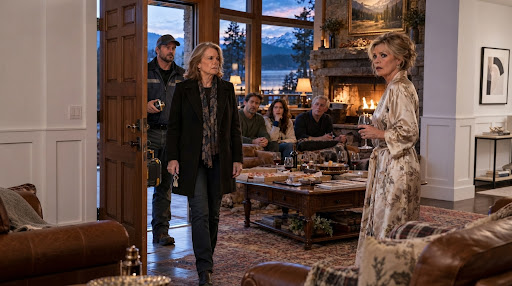
PART 3
For a moment, nobody moved.
Larry stood beside my kitchen counter with
my expensive wine in his hand,
looking as though he wished
he could swallow the words he’d just spoken.
Brenda stared at him.
“You idiot,” she whispered.
I turned toward her.
“What did you just call your husband?”
She pressed her lips together.
“Nothing.”
“No, Brenda. I heard you. And I heard what Larry said.”
I looked at the phone in my hand.
“Jason, are you still there?”
“Yes, Mom.”
“Where did Sarah get a copy of my will?”
Silence.
Then my son spoke so quietly I almost missed it.
“I gave it to her.”
Something inside me sank.
I had spent thirty-eight years raising Jason.
I’d held him through fevers, helped him with homework,
paid for his college education,
and stood beside him when his first business failed.
After his father died,
Jason was the one person I trusted with everything.
My emergency contacts.
My medical information.
The location of my important documents.
And yes, a copy of my estate plan.
I’d given it to him because I believed a responsible adult
should know where to find things if something happened to his mother.
I hadn’t imagined he’d hand it to his wife so
she could start treating my property like an inheritance she’d already collected.
“Why?” I asked.
Jason exhaled.
“Sarah said she wanted to understand how the estate would be divided between the kids.”
I closed my eyes.
“Jason, your children are eight and eleven. Why would Sarah need to examine my will?”
“She said we needed to plan for their future.”
“And you believed her?”
He didn’t answer.
Brenda suddenly stepped forward.
“This is getting ridiculous. Sarah didn’t steal anything. She was only preparing for what everyone knows is eventually going to happen.”
I looked at her.
“What exactly is going to happen, Brenda?”
She folded her arms.
“You’re sixty-eight, Diane. You can’t pretend you’ll live forever.”
The room went completely silent.
Even Larry looked uncomfortable.
I studied her face.
There was no embarrassment.
No realization that she’d said something cruel.
Only impatience.
As though my continued existence had become an inconvenient delay in her daughter’s financial planning.
“You’re right,” I said quietly.
Brenda blinked.
“What?”
“I won’t live forever.”
She seemed encouraged.
Then I continued.
“But I’m alive today. And while I am, you don’t get to distribute my belongings.”
Her expression hardened.
“Sarah is married to your only son.”
“That doesn’t make her the owner of my house.”
I turned back to my phone.
“Jason, send me the document immediately.”
“Mom—”
“Now.”
Five minutes later, my email notification sounded.
I opened the attachment.
Three pages.
A document titled Quitclaim Deed.
My name appeared as the grantor.
Jason and Sarah were listed as the recipients.
And at the bottom of the final page was a signature that looked remarkably like mine.
Remarkably.
But not perfectly.
The D curved too sharply.
The final stroke of my surname was missing.
And the date was from a Tuesday when I had been recovering from cataract surgery at my sister Margaret’s house.
I enlarged the image.
There was a notary stamp.
A name.
A commission number.
And a signature claiming I’d appeared in person.
I hadn’t.
My fingers went cold.
Brenda watched me carefully.
“Well?”
I looked up.
“Who prepared this?”
She shrugged.
“Ask Sarah.”
“Who notarized it?”
“I don’t know.”
“Who filed it?”
She glanced toward Larry.
He looked away.
I picked up my phone and called my attorney, Evelyn Brooks.
She answered on the second ring.
“Diane? Everything all right?”
“No,” I said. “I believe someone forged my signature on a property deed.”
Her tone changed immediately.
“Where are you?”
“At the cabin.”
“Is anyone threatening you?”
“Not physically.”
“Then don’t confront them further. Send me the document. I’ll check the county records and advise you on the next steps.”
I forwarded the attachment.
Evelyn told me not to assume the deed had legally transferred anything until she examined it.
She also reminded me that the unauthorized occupants had to be dealt with through the appropriate legal process.
I understood.
I wasn’t interested in doing something reckless.
I wanted my home back.
And I wanted the truth.
While I was speaking to Evelyn, Brenda called Sarah.
She walked onto the porch, but the windows were open.
I heard enough.
“Your mother-in-law found the paperwork.”
A pause.
“No, Larry told her.”
Another pause.
Then Brenda said something that made my stomach turn.
“Well, you should have made sure the signature looked better.”
I stood very still.
Larry noticed my expression.
“Diane—”
“Don’t.”
He set the wine bottle down.
For the first time that afternoon, he looked ashamed.
“I didn’t know they were going to file anything.”
I turned toward him.
“But you knew the document existed.”
He nodded.
“Sarah showed it to us.”
“And you believed it?”
He rubbed his forehead.
“She said you were transferring the cabin early.”
I looked around the room.
At the stained sofa cushions.
The dirty dishes.
The scratches on my cherrywood table.
The empty wine bottles.
“You believed I’d given this place away, so you helped yourselves to everything inside it?”
Larry said nothing.
That silence told me more than another excuse could have.
The locksmith inspected the damaged back-door hardware and gave me a written estimate.
I thanked him and asked him not to change the locks until my attorney confirmed it was lawful to do so.
Then I photographed the condition of every room.
The kitchen.
The bedrooms.
The stained carpets.
The missing decorative pieces.
I even photographed the refrigerator, which was packed with food Brenda and her relatives had brought for what was apparently going to be a month-long vacation.
When I reached the master bedroom, I stopped.
My mother’s quilt was gone.
It had been folded at the foot of my bed for almost twenty years.
Hand-stitched blue and white squares.
A tiny embroidered rose in one corner.
My mother had made it during the winter before she died.
I turned toward Brenda.
“Where’s my quilt?”
She looked confused.
“What quilt?”
“The blue and white one from my bedroom.”
“Oh.”
She waved her hand.
“I gave it to my sister. She loved the pattern.”
I stared at her.
“You gave away my mother’s quilt?”
“It was old, Diane.”
I felt tears burn behind my eyes.
“You had no right.”
She sighed.
“Honestly, you’re making everything so emotional.”
I walked past her.
Because if I stayed another minute, I was afraid I’d say something I couldn’t take back.
Outside, I called Evelyn again.
“Please add the quilt to the property inventory,” I said.
Then I sat in my car and cried.
Not because of its monetary value.
Because my mother had made it with her hands.
And Brenda had given it away as casually as someone passing along an unwanted magazine.
By Monday morning, Evelyn had news.
The purported deed had been submitted for recording.
But there were serious problems with the documentation.
The notary information did not match the available commission records, and the circumstances of the supposed signing were inconsistent with my medical and travel records.
Evelyn arranged for a title review and began the necessary legal steps to challenge the document.
She also advised me to report the suspected forgery to the appropriate authorities.
I did.
For the first time in my life, I sat across from an investigator and explained why I believed my own daughter-in-law had attempted to take my property.
The detective asked whether Jason knew.
“I don’t know,” I answered.
And that was the truth.
I wanted to believe my son had simply been foolish.
But I could no longer afford to confuse wanting something to be true with knowing it was.
Jason came to my townhome that evening.
He looked terrible.
His shirt was wrinkled.
His eyes were red.
He stood on my porch holding a folder.
“Mom, can we talk?”
I stepped aside.
He entered and sat at my kitchen table.
The same table where he’d done his homework as a child.
The same table where I’d helped him fill out college applications.
For a moment, I saw the little boy he’d once been.
Then I remembered the forged deed.
“Did you know?” I asked.
He looked down.
“Not at first.”
My chest tightened.
“What does that mean?”
He swallowed.
“Sarah told me you wanted to transfer the cabin into our names because you were worried about estate taxes.”
I stared at him.
“And you didn’t call me?”
He shook his head.
“She said you’d already spoken to your lawyer.”
“Jason.”
His eyes filled.
“I know.”
“No. I don’t think you do.”
I leaned forward.
“Your wife presented a document transferring my property, and you accepted it without speaking to me?”
He wiped his face.
“She told me you wanted it to be a surprise.”
I almost laughed.
“A surprise?”
He looked miserable.
“I realize how stupid that sounds now.”
I sat back.
“Did you sign anything?”
He hesitated.
Then he opened the folder.
Inside were copies of several documents.
One was the deed.
Another was an application for a home-equity loan.
And the third made my blood run cold.
It was a preliminary financing statement listing the cabin as collateral for a business loan Sarah wanted to obtain.
The amount requested was $185,000.
I stared at the page.
“She was going to borrow against my cabin?”
Jason nodded.
“She said the money would help us buy the new house and start her interior design business.”
I looked at him.
“The down payment was supposed to come from the savings account I created.”
“I know.”
“So she intended to use my savings and my cabin?”
His face crumpled.
“Yes.”
For a moment, neither of us spoke.
Then Jason whispered, “Mom, I think Sarah has been lying to me about a lot more than this.”
Over the next hour, he told me everything.
Sarah had accumulated credit-card debt.
She’d borrowed money from friends.
She’d taken out personal loans without telling him.
And she’d been promising her parents that they could eventually retire at my cabin.
She had described the property as a family asset.
Not mine.
The family’s.
As though ownership were simply a matter of who expected to benefit from it.
Jason covered his face.
“I thought we were building something together.”
I looked at my son.
“Jason, I love you.”
He nodded.
“But loving you doesn’t mean I can keep rescuing you from decisions you refuse to question.”
He began crying.
“I know.”
“Do you?”
He looked up.
I continued.
“I was going to give you sixty thousand dollars because I wanted to help your family get started. But I need you to understand something.”
He waited.
“That money was never permission to stop being responsible.”
He lowered his head.
Then he said something I hadn’t expected.
“Mom, I don’t want the money.”
I stared at him.
“I don’t want the cabin either.”
His voice broke.
“I just want to know how I became someone who let this happen to you.”
For the first time that evening, I saw genuine remorse.
Not fear of losing an inheritance.
Not anger over the canceled savings.
Shame.
And perhaps the beginning of accountability.
Two days later, the situation at the cabin changed.
Brenda and Larry received formal notice through the appropriate legal process.
Evelyn had advised them in writing that they had no authority to occupy the property and that the disputed deed did not give them permission to remain.
At first, Brenda threatened to fight.
She called me selfish.
Accused me of destroying her daughter’s marriage.
And claimed I was humiliating the entire family.
But when investigators contacted her about the forged documents, her confidence began to disappear.
Larry called me privately.
“Diane, we want to leave.”
I closed my eyes.
“Then arrange a lawful move-out with Evelyn.”
He hesitated.
“Brenda’s sister still has your quilt.”
My heart tightened.
“Can she return it?”
“Yes.”
“Then please make sure she does.”
There was a long silence.
Then Larry whispered, “I’m sorry.”
I didn’t answer immediately.
Finally, I said, “I hope you understand that an apology doesn’t erase what happened.”
“I do.”
“Good.”
And I ended the call.
The relatives left the cabin the following weekend.
Evelyn coordinated the turnover.
Once possession was lawfully returned, the locksmith changed the locks.
A professional cleaning company documented and repaired the damage.
My realtor walked through the property with me.
We found scratches on the furniture.
A broken lamp.
Missing linens.
And a wine stain on the rug.
But the house was still standing.
My mother’s quilt was back.
And for the first time in weeks, the cabin was quiet.
I stood beside the lake-facing window, holding the quilt against my chest.
Then my phone rang.
It was Evelyn.
“Diane, there’s one more thing you need to know.”
I closed my eyes.
“What now?”
She paused.
“The investigation has uncovered another document bearing your signature.”
I felt my stomach drop.
“What document?”
“A proposed amendment to your estate plan.”
I stared at the lake.
Evelyn continued.
“It appears Sarah wasn’t only trying to take the cabin.”
My hand tightened around the phone.
“Then what else was she trying to take?”
Evelyn’s answer made me sit down.
“Everything.”
PART 4
For a long moment, I couldn’t speak.
Everything.
My cabin.
My savings.
My townhome.
The investments I’d spent forty years building.
The antique furniture I’d inherited from my parents.
The retirement accounts I’d carefully managed after my husband died.
I stared at the lake through the cabin window.
The water was perfectly still.
It seemed impossible that something so peaceful could exist while my family was falling apart.
“What exactly did Sarah do?” I asked.
Evelyn took a breath.
“She appears to have prepared documents purporting to change your estate arrangements and grant herself financial authority.”
I closed my eyes.
“Did she file them?”
“Not all of them. And preparing documents doesn’t make them legally effective. But their existence is serious, especially alongside the deed.”
I sat down.
“How did she get access to my information?”
“That’s something investigators are examining.”
I thought about Jason.
The copies of my will.
The account statements I’d once shared with him.
The emergency folder I kept in my study.
Then I remembered something.
Six months earlier, Sarah had offered to organize my paperwork.
She’d come to my townhome with a label maker and several storage boxes.
She told me it would be easier for Jason if everything was arranged.
I had thanked her.
Made her lunch.
And left her alone in my study while I went to the pharmacy.
I pressed my hand against my forehead.
“Oh, Evelyn.”
“What is it?”
“I think I know when she copied everything.”
The investigation took months.
During that time, I learned more about Sarah’s finances than I’d ever wanted to know.
She had been living far beyond what she and Jason could afford.
Expensive clothes.
Vacations.
Furniture purchased on credit.
A leased luxury SUV.
And a business venture that had never progressed beyond a website and several invoices.
She’d convinced herself that my assets would eventually solve everything.
When the bills became impossible to manage, she’d stopped waiting for an inheritance.
She’d tried to bring it forward.
Investigators obtained records linking Sarah to the preparation of the disputed documents.
They also examined communications between her, Brenda, and a document-preparation service.
The evidence suggested that Sarah had used copied personal information and an imitation of my signature to support the attempted transfer.
The financing application had not been funded.
But the attempt itself had created a serious legal problem.
Sarah was charged with offenses relating to the forged documents and attempted financial fraud.
I didn’t celebrate.
I sat in Evelyn’s office and cried.
Because Sarah wasn’t a stranger.
She was the woman who’d married my son.
The mother of my grandchildren.
Someone I’d welcomed into my family.
And she had treated my life savings as though they were already hers to spend.
Jason separated from Sarah shortly after the investigation began.
It wasn’t my decision.
I didn’t tell him to leave her.
I didn’t threaten to disinherit him unless he did.
I simply told him that I would not continue providing money or access to my property while the situation remained unresolved.
He had to decide what kind of marriage he wanted.
And what kind of man he wanted to become.
One evening, he came to my townhome.
He sat across from me with his hands clasped.
“Mom, I moved out.”
I nodded.
“Are you okay?”
He laughed bitterly.
“No.”
I waited.
He looked toward the window.
“I keep thinking about Dad.”
My chest tightened.
My husband, Robert, had died eight years earlier.
He’d been a quiet man.
A careful man.
The sort of person who checked the tires before a long drive and remembered everyone’s birthdays without needing a calendar.
“What about him?” I asked.
Jason swallowed.
“He used to say that character is what you do when nobody’s watching.”
I nodded.
“He did.”
Jason’s eyes filled.
“I think I stopped paying attention to my own.”
I reached across the table.
He took my hand.
“I’m sorry, Mom.”
I looked at him.
“For what?”
“For letting Sarah speak to you the way she did. For handing over your documents. For assuming that because you’d always helped me, I didn’t have to protect you.”
Tears filled my eyes.
He continued.
“And for letting her family treat Dad’s cabin like it was already theirs.”
I squeezed his hand.
“Jason, you made serious mistakes.”
He nodded.
“But I believe you can learn from them.”
He began crying.
For a long time, we sat together without speaking.
Then I said something I needed him to understand.
“I love you, son. But I won’t confuse love with unlimited access to my money.”
He nodded.
“I understand.”
And for the first time in years, I believed he might.
The legal proceedings eventually concluded.
Sarah accepted responsibility for her role in the fraudulent documents through a plea agreement.
The court imposed penalties, restitution obligations, and supervised conditions.
The disputed deed was legally resolved, and the property records were corrected to confirm my ownership.
Brenda and Larry were not convicted of the same offenses, but their involvement in the unauthorized occupancy and related communications had been examined.
I pursued compensation for documented damage and missing property through the appropriate civil process.
I recovered some of my losses.
Not all.
But enough.
And more importantly, my cabin was mine.
My savings were protected.
My estate documents were reviewed and updated through my own attorney.
I also made changes to how my financial information was stored and who could access it.
For the first time, I realized that protecting my independence required more than saving money.
It required protecting my decisions.
The following spring, I returned to the cabin with my realtor.
The snow had melted.
The lake was blue beneath the morning sun.
The pine trees moved gently in the breeze.
And the house smelled of fresh paint and lemon polish.
A young couple named Hannah and Michael were waiting outside.
They had two children.
A little girl with red boots.
And a boy who carried a stuffed bear everywhere.
They were relocating for Michael’s job at a nearby hospital.
They’d been searching for a long-term rental where their children could attend the local school.
Hannah looked nervous.
“We absolutely love the place,” she said. “But we understand if you’d prefer someone without children.”
I smiled.
“Why would I?”
She glanced toward the living room.
“Some landlords worry about damage.”
I thought about Brenda.
The broken lamp.
The stained rug.
The missing quilt.
Then I looked at the little boy holding his bear.
“Children aren’t the problem,” I said gently. “Respect is what matters.”
Hannah smiled.
They signed the lease that afternoon.
The rent was fair.
The terms were clear.
And for the first time in months, the cabin began serving the purpose I’d intended.
Helping fund my retirement.
Without taking away my independence.
Three months later, Hannah sent me a photograph.
Her children were sitting on the porch, eating watermelon.
Behind them, the lake glittered in the sunlight.
She wrote:
Thank you for giving our family such a beautiful place to call home.
I stared at the message for a long time.
Then I smiled.
Because that was what the cabin had always been meant to provide.
Shelter.
Peace.
A place where people could make memories.
Not a prize for someone waiting for me to die.
My relationship with Jason changed slowly.
There were no dramatic reunions.
No grand speeches.
No magical return to the way things had been.
Trust doesn’t rebuild itself simply because someone apologizes.
It takes time.
It takes consistent choices.
It takes honesty when honesty is uncomfortable.
Jason began working with a financial counselor.
He reviewed his debts.
He sold the expensive SUV.
He rented a modest apartment near his children’s school.
And he stopped treating money as something that would somehow appear whenever he needed it.
He also began attending counseling.
One afternoon, he told me something that made me proud.
“Mom, I realized I’ve spent most of my adult life avoiding conflict.”
I smiled sadly.
“I noticed.”
He laughed.
Then he grew serious.
“I thought keeping everyone happy meant I was being a good husband.”
“And now?”
He looked at me.
“Now I think sometimes being a good person means disappointing someone who’s asking you to do the wrong thing.”
I nodded.
“Your father would have liked hearing that.”
Jason’s eyes filled.
“I wish I’d understood it sooner.”
“So do I.”
But I squeezed his hand.
“At least you understand it now.”
My grandchildren remained the hardest part.
They were innocent.
They hadn’t forged documents.
They hadn’t taken over my cabin.
They hadn’t demanded an inheritance.
They were simply two children caught between adults making painful decisions.
I made sure they knew I loved them.
I attended school plays.
I remembered birthdays.
I took them for ice cream.
And I continued contributing to education savings arrangements that were properly structured for their benefit, without giving their parents unrestricted access.
One Saturday, my granddaughter Emily asked me a question.
“Grandma, why doesn’t Mommy come to your house anymore?”
I felt my heart tighten.
Emily was only nine.
She didn’t need the details of fraud investigations and property disputes.
So I answered carefully.
“Sometimes adults make choices that hurt other people. When that happens, they need time and help to make things right.”
She frowned.
“Are you mad at Mommy?”
I considered my answer.
“I’m sad about what happened.”
She looked down.
“Does that mean you don’t love us?”
I pulled her into my arms.
“Oh, sweetheart. Never.”
She hugged me tightly.
“Promise?”
I kissed her forehead.
“I promise.”
And I meant it.
The mistakes of adults would not become a debt their children had to repay.
A year after the incident, I invited Jason to dinner.
Just the two of us.
I made his favorite meal.
Roast chicken.
Mashed potatoes.
Green beans with garlic.
And apple pie.
The same meal Robert used to request on his birthday.
After dinner, Jason helped me wash the dishes.
Then we sat at the kitchen table with coffee.
“Mom,” he said, “I’ve been meaning to ask you something.”
I looked at him.
“What is it?”
He hesitated.
“Are you going to leave the cabin to someone else?”
I studied his face.
There was no anger.
No expectation.
Just uncertainty.
I took a slow breath.
“Jason, I’ve updated my estate plan.”
He nodded.
“I figured.”
“But I’m not going to discuss every detail.”
He looked surprised.
I continued.
“I want you to understand that my plans may change as my needs change. I’m going to use my money to live comfortably, maintain my health, and enjoy the years I have left.”
He nodded slowly.
“And whatever remains?”
“Will be handled according to the arrangements I’ve made.”
He looked down.
Then he smiled faintly.
“That’s fair.”
I watched him carefully.
“Does that disappoint you?”
He shook his head.
“No.”
“Are you sure?”
He looked at me.
“Mom, I nearly lost you over money that wasn’t mine.”
My eyes filled.
He continued.
“I don’t want to spend the rest of your life thinking about what I’ll get when you’re gone.”
I reached across the table.
He took my hand.
“Good,” I whispered.
“Because I’d much rather have you visit while I’m still here.”
I’m seventy now.
The cabin has wonderful tenants.
The rent arrives every month.
My retirement accounts are secure.
And my mother’s quilt is folded at the foot of the guest bed in my townhome.
Sometimes I take it out and run my fingers over the little embroidered rose.
I remember watching her sew it.
I remember the way she would sit beside the window in winter, working patiently while the radio played.
She never had much money.
But she understood something I’ve only fully appreciated with age.
The things we own are not merely objects.
Some represent years of work.
Some represent sacrifices.
Some hold memories that cannot be replaced.
And some provide the security we need to live without fear.
That cabin represented all four.
I had purchased it with Robert after years of saving.
We’d spent summers there.
Watched sunsets from the porch.
Celebrated anniversaries.
And imagined growing old together.
After he died, I kept it because I couldn’t bear to lose another piece of our life.
Eventually, I decided to rent it because I needed the income.
That was my choice.
And I had every right to make it.
Last month, I drove up to the cabin for a scheduled inspection.
Hannah greeted me with a smile.
The children were playing in the yard.
Michael had repaired a loose porch railing after checking with me first.
The house was clean.
The cherrywood coffee table had been polished.
And there were fresh flowers beside the window.
Hannah handed me a cup of tea.
“We love it here,” she said.
I smiled.
“I’m glad.”
Then she added something that stayed with me.
“We always remind the kids that this is your home, and we’re lucky to live in it.”
I looked around the room.
At the furniture.
The lake.
The sunlight.
And I realized how simple respect could be.
It didn’t require grand gestures.
It didn’t require expensive gifts.
It didn’t require anyone to agree with every decision I made.
It simply required recognizing that something belonging to another person was not yours to take.
Before leaving, I stood alone on the porch.
The lake stretched out beneath the mountains.
The wind smelled of pine needles.
And for a moment, I imagined Robert standing beside me.
He would have been furious about what happened.
Not because he cared more about money than family.
But because he’d worked so hard to make sure I would never have to beg anyone for security.
I smiled sadly.
“You’d be proud of me,” I whispered.
The wind moved through the trees.
And I thought about that afternoon when Brenda opened my door in a bathrobe.
The smug smile.
The wineglass.
The words that had changed everything.
This house will be ours someday anyway.
She had believed that my age made my future less important than hers.
That my property was already an inheritance waiting to be collected.
That my silence meant consent.
And that family gave her permission to take whatever she wanted.
She was wrong.
Because I wasn’t an estate waiting to be divided.
I wasn’t a bank account waiting to be emptied.
And I wasn’t a woman whose usefulness ended when her children became adults.
I was Diane.
A mother.
A grandmother.
A widow.
A woman who had worked, saved, sacrificed, and survived.
And I still had a life to live.
That evening, Jason called while I was driving home.
“Hey, Mom.”
“Hello, sweetheart.”
“How was the cabin?”
“Beautiful.”
He smiled through the phone.
“Good.”
Then he asked, “Want to come over Sunday? The kids are making pancakes.”
I laughed.
“Are they any good?”
“Honestly? Not yet.”
“Then I’d better come supervise.”
He laughed too.
And for a moment, everything felt wonderfully ordinary.
Before hanging up, he said, “Mom?”
“Yes?”
“I’m glad you stood up for yourself.”
My eyes filled.
“Thank you, Jason.”
“I mean it.”
I looked toward the road ahead.
“So do I.”
When the call ended, I drove the rest of the way home with the windows slightly open.
I thought about how much had changed.
And how much I had almost allowed to continue simply because I didn’t want to upset anyone.
But boundaries hadn’t destroyed my family.
The dishonesty had.
The entitlement had.
The belief that love meant unlimited access to my possessions had.
Setting boundaries had simply revealed what needed to change.
And in the end, it gave my son a chance to become a better man.
It gave my grandchildren a chance to learn that respect matters.
And it gave me the freedom to enjoy the years I’d worked so hard to protect.
My daughter-in-law’s family thought my cabin belonged to them because they expected to inherit it someday. But they forgot one very important thing: I wasn’t gone. I was still here. And my life, my home, and my future were still mine to decide.
THE END THANK YOU FOR READING !!!



