PART 2
For several seconds,
I couldn’t hear anything except
the pounding of my own heart.
My father stood beside the first pew,
gripping the polished wood so tightly that his knuckles had turned white.
Admiral Helen Cross remained beside me,
her expression unreadable.
And Daniel,
the man I was supposed to marry in less than five minutes,
had stepped down from the altar and was holding my free hand.
“Sarah,” he whispered, “what’s going on?”
I couldn’t answer.
Because the photograph in Admiral Cross’s hand
had taken me back to the worst day of my life.
The explosion.
The screaming.
The smell of burning metal.
The unbearable weight of debris pressing against my shoulder.
And the three people who never came home.
Sergeant Michael Torres.
Corporal James Bennett.
Specialist Olivia Reed.
Their names had lived inside my chest for two years.
Now the admiral was telling me that someone connected to
my father’s company might have helped the people who killed them.
I turned toward him.
“Dad, tell me she’s wrong.”
He stared at the floor.
“Sarah, please.”
“Tell me!”
Several guests gasped.
My mother stood from the second pew, pressing a trembling hand against her mouth.
My father finally looked up.
“I didn’t know what they were planning.”
My stomach dropped.
“What does that mean?”
He swallowed.
“I didn’t know anyone was going to die.”
The chapel seemed to tilt beneath my feet.
Daniel tightened his grip on my hand.
Admiral Cross spoke calmly.
“Mr. Mitchell, I believe this conversation should continue privately.”
But I couldn’t move.
For two years, I’d wondered why our convoy had been targeted.
Why the attackers seemed to know our route.
Why the explosion occurred at the precise moment our vehicles entered a narrow section of road.
The official investigation had identified an organized extremist attack, but the source of the attackers’ information remained unresolved.
I’d accepted that answer because there was nothing else I could do.
Now my father was standing in front of me, admitting that he knew something.
And he’d chosen my wedding day to tell the truth.
Or perhaps he’d chosen it because someone had finally forced him.
I looked at Daniel.
“I can’t do this right now.”
His expression softened.
“Sarah, we don’t have to.”
I shook my head.
“I mean the wedding.”
He glanced toward the guests.
Then back at me.
“Okay.”
Just one word.
No anger.
No disappointment.
He leaned forward and kissed my forehead.
“We’ll figure this out together.”
That was the moment I almost broke.
Because the man waiting to become my husband was showing me more compassion than the man who’d raised me.
We moved into a small conference room behind the chapel.
Admiral Cross asked one of her aides to remain outside.
My father sat opposite me.
Daniel stayed beside my chair.
My mother stood near the window, crying quietly.
I placed my bouquet on the table.
“Start talking, Dad.”
He rubbed both hands over his face.
“I was a minority partner in a logistics company called Meridian Global Services.”
“I know.”
He nodded.
“We supplied transportation equipment and communications systems to overseas contractors. Most of the work was legitimate.”
“Most?”
His eyes filled.
“My business partner, Richard Vale, began handling a separate contract. He said it involved route assessments for civilian supply movements.”
I stared at him.
“Richard Vale was on that photograph.”
My father nodded.
“He had contacts overseas. People who could obtain transportation schedules, security assessments, and information about road conditions.”
Admiral Cross leaned forward.
“What did he tell you about the source of those records?”
My father hesitated.
“He said they came from subcontractors.”
“And did you believe him?”
“At first.”
I felt my chest tighten.
“What changed?”
My father looked at me.
“After your convoy was attacked, Richard became frightened. He started deleting files. He told me there had been a mistake.”
My mouth went dry.
“What kind of mistake?”
“He said information from one of our contracted systems had been passed to people who weren’t supposed to receive it.”
I stared at him.
“Information about my convoy?”
He began crying.
“I didn’t know that then.”
I pushed back my chair.
“Dad, three people died!”
“I know!”
His voice cracked.
“I know, Sarah.”
I stood.
“No, you don’t.”
My hands were shaking.
“You didn’t see Michael trying to pull Olivia out of the vehicle. You didn’t hear James calling for help. You didn’t wake up in a hospital wondering why you were alive when they weren’t.”
My father covered his face.
“And you certainly didn’t spend months learning how to look in a mirror again.”
He sobbed.
I touched the raised scar along my neck.
“Every time you told me to cover this, I thought you were ashamed of how I looked.”
He didn’t answer.
I stared at him.
“But you weren’t just looking at my scars, were you?”
He slowly lowered his hands.
My voice became a whisper.
“You were looking at what you knew.”
His silence told me everything.
Admiral Cross waited until I sat down again.
Then she opened a thin folder.
“Lieutenant Mitchell, I need to clarify something important. The investigation has not established that your father deliberately assisted the attackers.”
I looked at her.
“But he knew information had been mishandled?”
“He has now acknowledged that he suspected serious wrongdoing after the attack.”
I turned toward him.
“Why didn’t you report it?”
My father looked down.
“Richard threatened me.”
“With what?”
“He said if I told anyone, he’d make sure investigators believed I authorized the transfer.”
I stared at him.
“Did you?”
“No.”
“Did you sign anything?”
My father hesitated.
Admiral Cross looked at him.
“Mr. Mitchell.”
He swallowed.
“I signed a financial authorization connected to the contract.”
I felt sick.
“What did it authorize?”
“Payment for a data-processing service.”
“What data?”
He began shaking.
“I didn’t ask enough questions.”
I closed my eyes.
There it was.
The sentence that had cost me more than he could imagine.
I didn’t ask enough questions.
He had been so concerned with protecting his business, his reputation, and his money that he had refused to look closely at what his partner was doing.
And after three people died, he’d remained silent.
I looked at him.
“You knew there was a possibility that your company was connected to the attack.”
He nodded.
“And you said nothing for two years.”
Tears rolled down his face.
“Yes.”
I stood again.
“I need some air.”
Daniel followed me into the chapel garden.
The afternoon sunlight fell across the stone walkway.
White roses climbed the wooden trellis beside the fountain.
Everything looked exactly as it had when we’d arrived that morning.
The flowers.
The ribbons.
The little sign that read:
WELCOME TO THE WEDDING OF SARAH AND DANIEL.
I stared at it until the letters blurred.
Daniel stood quietly beside me.
Then I whispered, “I thought today would be the first day of something beautiful.”
He took my hand.
“It still can be.”
I shook my head.
“My father knew.”
Daniel said nothing.
“He knew there might be a connection between his company and the bombing.”
I touched my neck.
“And every time he looked at me, he made me feel ugly.”
Daniel turned toward me.
“Sarah.”
I looked up.
“Your scars were never ugly.”
My eyes filled.
He continued.
“They’re part of what you survived. They don’t make you less beautiful, and they don’t make you responsible for what happened.”
I began crying.
“I wanted him to be proud of me.”
Daniel pulled me into his arms.
“I know.”
“I kept thinking if I wore the right dress, if I covered enough of my shoulder, if I looked normal enough, he’d finally stop staring.”
Daniel held me tighter.
“You never needed to change anything.”
I pressed my face against his chest.
For several minutes, neither of us spoke.
Then he whispered, “We can postpone the ceremony. We can go home. We can get married next month or next year.”
I looked up.
“What about everyone waiting inside?”
“They’ll survive.”
I laughed weakly through my tears.
He smiled.
“The only person whose decision matters to me right now is you.”
I took a slow breath.
Then another.
“I still want to marry you.”
His eyes filled.
“Are you sure?”
I nodded.
“But I don’t want my father anywhere near the altar.”
Daniel kissed my forehead.
“Then he won’t be.”
When we returned to the conference room, Admiral Cross was speaking quietly with my father.
She stopped when I entered.
I looked directly at him.
“Dad, I need you to leave.”
My mother gasped.
“Sarah!”
I turned toward her.
“Mom, please.”
She began crying.
“It’s your wedding day.”
“I know.”
My father stood slowly.
“Sarah, I never wanted to hurt you.”
I looked at him.
“But you did.”
He swallowed.
“I was trying to protect the family.”
I shook my head.
“No. You were protecting yourself.”
His face crumpled.
I continued.
“You let me believe my scars embarrassed you. You let me think surviving that bombing made me less worthy of standing beside you.”
He began crying.
“And all that time, you were hiding something that could matter to the families of the people who died.”
He looked down.
I took a breath.
“I don’t know whether I can forgive you.”
He nodded slowly.
“I understand.”
“But today, I’m marrying Daniel. And I refuse to let your shame become the most important thing about my wedding.”
My father wiped his eyes.
Then whispered, “You deserve better than what I’ve given you.”
For the first time, I believed he understood.
But understanding didn’t erase what he’d done.
He walked toward the door.
Before leaving, he turned.
“Sarah?”
I looked at him.
“You were never a disappointment.”
I felt tears rise.
He continued.
“I was.”
Then he left.
Admiral Cross approached me.
“Lieutenant, there’s one more thing.”
I turned.
She held out a small envelope.
“This was included with the material your father brought forward.”
I looked at it.
My name was written across the front.
“What’s inside?”
“A letter from Sergeant Davis.”
My heart stopped.
Davis.
The medic who had dragged me from the wreckage.
The man whose voice I remembered through the smoke.
Stay with me, Lieutenant. Keep your eyes open.
I hadn’t seen him since the military hospital.
He’d been transferred to another assignment before I was well enough to thank him properly.
I opened the envelope.
Inside was a folded letter.
The first line made my hands tremble.
Lieutenant Mitchell, if you’re reading this, I hope you’re standing somewhere beautiful, wearing something that makes you feel like yourself again.
I covered my mouth.
Daniel moved closer.
I kept reading.
I heard you were getting married. I wanted to tell you something I couldn’t say when I pulled you out of that vehicle.
My eyes filled.
You kept asking me to go back for the others.
I remembered.
The smoke.
The pain.
My desperate attempts to crawl toward the burning vehicle.
You were barely conscious, but you were still thinking about your team.
I pressed the letter against my chest.
Then I read the final paragraph.
Whatever anyone tells you about your scars, remember this: you did not fail the people we lost. You fought to stay alive, and you fought for them until you couldn’t move anymore. Don’t let anyone make you ashamed of surviving.
I began sobbing.
Daniel held me.
And Admiral Cross waited silently.
Then I noticed one final sentence written beneath Davis’s signature.
P.S. I hope someone worthy gets to walk beside you today.
I looked at Admiral Cross.
She smiled gently.
“I believe he was right.”
We returned to the chapel twenty minutes later.
The guests were still seated.
The music had stopped.
People looked confused.
But when Daniel and I appeared, a quiet murmur moved through the room.
Admiral Cross stepped beside me.
“Ready, Lieutenant?”
I looked down at my wedding dress.
The scar along my neck was still visible.
So was the raised skin across my shoulder.
For the first time that day, I didn’t wish it were hidden.
I lifted my chin.
“Yes, ma’am.”
The music began again.
Admiral Cross offered her arm.
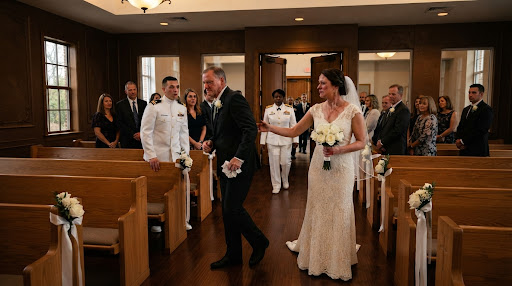
And together, we walked down the aisle.
Not because I needed someone to give me away.
But because I wanted someone beside me who understood that I had already fought my way home.
When we reached the altar, Daniel took my hands.
His eyes were filled with tears.
“You look beautiful,” he whispered.
I smiled.
“Even with the scars?”
His expression became serious.
“Sarah, I’ve never seen you any other way.”
Then he leaned closer.
“And I wouldn’t change a thing.”
For the first time that day, I believed him completely.
But the wedding wasn’t the end of the story.
Because three days later, Admiral Cross called me with news that would change everything I thought I knew about the bombing.
And this time, the name she gave me wasn’t Richard Vale.
It was someone I’d trusted with my life.
PART 4
I was standing in our kitchen when Admiral Cross called.
Daniel was making coffee.
Our wedding flowers sat in a glass vase beside the window.
For three days, we’d tried to enjoy being newlyweds while pretending the investigation wasn’t hanging over us.
But every time my phone rang, my stomach tightened.
I answered.
“Lieutenant Mitchell.”
“Sarah, this is Admiral Cross.”
“Yes, ma’am.”
“I wanted you to hear something directly before it reaches you through official channels.”
I sat down.
Daniel immediately noticed.
“What is it?” he mouthed.
I shook my head.
Admiral Cross continued.
“Investigators have identified a former contractor employee who appears to have played a significant role in the unauthorized transfer of convoy-related information.”
My heart began pounding.
“Who?”
There was a pause.
“Captain Andrew Mercer.”
I stopped breathing.
Andrew Mercer.
My former operations officer.
The man who had helped coordinate our movements overseas.
The man who had visited me in the hospital after the bombing.
The man who had stood beside the memorial photographs of our fallen teammates and told me that nobody could have prevented what happened.
I gripped the phone.
“That’s impossible.”
Admiral Cross spoke gently.
“I understand this is difficult.”
“Andrew was there.”
“Yes.”
“He helped plan our routes.”
“Yes.”
“He knew Michael. He knew Olivia. He knew James.”
“I know.”
I closed my eyes.
“Are you saying he gave our route to the attackers?”
“The evidence indicates he improperly transferred sensitive movement information to an intermediary connected to Meridian’s subcontracting network. Investigators are still establishing what he knew about the ultimate recipients.”
I stared at the wall.
“Why?”
“Financial motives appear to be part of the investigation.”
I felt sick.
Andrew had always complained about money.
His divorce.
His debts.
The expensive house he’d purchased before deployment.
But I never imagined he would compromise operational information.
I whispered, “Did my father know Andrew was involved?”
“Not when he first contacted investigators. His records helped identify the intermediary, and that led to Mercer.”
I covered my face.
Admiral Cross continued.
“Your father’s cooperation has been important. But his earlier failure to report his concerns remains under review.”
I nodded.
“Understood.”
Then she said something I’ll never forget.
“Sarah, I want you to understand that this investigation does not change the courage you showed that day.”
My eyes filled.
“Yes, ma’am.”
“And it doesn’t change who was responsible for the attack itself.”
I swallowed.
“No, ma’am.”
She paused.
“Take care of yourself. We’ll keep you informed through the appropriate channels.”
Then the call ended.
Daniel sat beside me.
I stared at the phone.
“Andrew Mercer.”
He frowned.
“Your operations officer?”
I nodded.
Daniel closed his eyes.
“Oh, Sarah.”
I began shaking.
“He came to the hospital.”
Daniel took my hand.
“He sat beside my bed and told me it wasn’t my fault.”
My voice broke.
“He knew I blamed myself.”
Daniel pulled me close.
“And he let me.”
I began crying.
For two years, I’d replayed the attack in my mind.
Every decision.
Every delay.
Every turn.
I’d wondered whether I’d missed something.
Whether I’d failed to notice danger.
Whether I could have saved the others.
And now I was learning that the information used to target us may have come from someone inside our own operational network.
Someone who had looked me in the eyes afterward.
Someone who had watched me struggle with guilt.
And said nothing.
The investigation lasted many more months.
I wasn’t given every detail.
Some evidence involved sensitive military systems.
Some was protected by the ongoing proceedings.
And some questions took time to answer.
But gradually, the essential facts became clear.
Richard Vale had operated a network of subcontractors that handled logistics information.
Andrew Mercer had improperly provided restricted movement data to a contact within that network.
The information had then been passed through additional intermediaries.
Investigators found evidence that it ultimately reached people connected to the group responsible for the bombing.
The attack itself had been carried out by extremists who deliberately targeted our convoy.
Andrew and Richard had not been physically present at the bombing.
But their actions had helped create the opportunity.
The investigation also examined whether they understood the danger their conduct posed.
The evidence supported serious charges against both men.
My father was investigated for his role in approving payments and for his failure to report what he later suspected.
He cooperated, provided records, and acknowledged his mistakes.
His business suffered.
He lost contracts.
He faced financial and legal consequences.
And his reputation in our hometown changed almost overnight.
For years, he’d cared more about what people thought of him than about what his daughter had survived.
Now the community he had worked so hard to impress knew that he’d concealed information relevant to a deadly attack.
I didn’t celebrate his humiliation.
But I couldn’t protect him from the consequences of his choices.
Not anymore.
The hardest part came when I met the families of the three people we’d lost.
The meeting was arranged through appropriate support channels after investigators were able to share certain findings.
I was terrified.
I’d attended memorial services.
I’d written letters.
I’d spoken to their families before.
But this was different.
Now there were new answers.
And those answers would reopen wounds that had never truly healed.
Michael Torres’s wife, Elena, arrived first.
She carried a photograph of Michael holding their baby daughter.
The little girl had been only six months old when he died.
Now she was nearly three.
Elena hugged me.
“Sarah.”
I held her tightly.
“I’m so sorry.”
She pulled back.
“For what?”
I looked down.
“For everything.”
Elena shook her head.
“You didn’t cause that explosion.”
I began crying.
She took my hands.
“Michael loved serving with you.”
I swallowed.
“He was a good man.”
“He was.”
Her eyes filled.
“And he would be glad you survived.”
Those words broke me.
Because for two years, I’d wondered whether the families secretly resented me for coming home.
Elena hugged me again.
“You don’t have to apologize for being alive.”
James Bennett’s parents arrived next.
His mother carried a small album filled with photographs from his childhood.
She showed me pictures of him at six.
At twelve.
At his high school graduation.
Then she turned to a photograph of James in uniform.
“He was so proud,” she whispered.
I nodded.
“He loved his work.”
His father looked at me.
“Sarah, we heard you tried to go back for him.”
My eyes filled.
“I did.”
He swallowed.
“We know.”
I looked down.
“I couldn’t reach him.”
His father took my hand.
“You were wounded.”
I began crying.
“I should have done more.”
He shook his head.
“No.”
His voice trembled.
“You did what you could.”
For the first time, I let myself believe that might be true.
Olivia Reed’s older sister, Natalie, arrived last.
She looked so much like Olivia that I had to turn away for a moment.
Same dark hair.
Same eyes.
Same gentle smile.
Natalie sat beside me.
“Olivia wrote about you.”
I looked up.
“What?”
She opened a small notebook.
“She kept a journal.”
My throat tightened.
Natalie turned several pages.
Then read aloud.
Lieutenant Mitchell acts tough, but she notices everything. She remembers birthdays. She checks on everyone after difficult days. If I ever have to follow someone into trouble, I hope it’s her.
I covered my mouth.
Natalie began crying.
“She trusted you, Sarah.”
I shook my head.
“I couldn’t save her.”
Natalie reached for my hand.
“You gave her a leader she believed in.”
I closed my eyes.
“And nothing that happened afterward changes that.”
When I returned home that evening, Daniel was waiting on the porch.
He didn’t ask questions.
He simply opened his arms.
I walked into them and cried.
For the people we’d lost.
For the years I’d spent blaming myself.
For the father who had chosen silence.
And for the terrible knowledge that betrayal had helped make the attack possible.
Daniel held me until the sun disappeared behind the trees.
Then he whispered, “You don’t have to carry all of this alone anymore.”
I nodded.
“I know.”
But learning to believe it would take time.
Six months after our wedding, my father wrote me a letter.
It was twelve pages long.
I almost didn’t open it.
For weeks, I’d ignored his calls.
Not because I wanted to punish him.
But because I needed space to understand what he’d done.
Finally, one Sunday morning, I sat at the kitchen table and unfolded the pages.
He began with the words I’d waited years to hear.
Sarah, I was wrong.
I stared at the sentence.
Then kept reading.
He wrote about the first time he saw my scars after the bombing.
How frightened he’d been.
How guilty he’d felt.
How every mark on my skin reminded him that his company might have been connected to the attack.
He admitted that instead of confronting his guilt, he’d turned it into criticism.
He asked me to cover my scars because he couldn’t bear looking at what they represented.
He had convinced himself that if he could make the visible evidence disappear, he could somehow escape the truth.
Then he wrote something that made me cry.
I told myself I was ashamed of the way your scars looked because admitting I was ashamed of my own choices would have required me to change.
I wiped my cheeks.
He continued.
You survived something terrible, and I punished you for reminding me of it.
I closed my eyes.
When you needed a father, I gave you judgment. When you needed comfort, I gave you silence. And when you needed the truth, I hid it.
My hands trembled.
Near the end, he wrote:
I don’t expect forgiveness. I only want you to know that the bravest person in our family was never me. It was the daughter I was too cowardly to look in the eyes.
I folded the letter.
Then sat quietly for a long time.
I didn’t call him immediately.
I needed to understand something first.
An apology can be sincere.
Regret can be real.
But neither erases the consequences of years of cruelty.
My father had hurt me long before the truth about Meridian emerged.
He’d made me feel ashamed of surviving.
He’d turned family photographs into humiliating negotiations.
He’d made my wedding dress a subject of criticism.
And when the moment came to walk me down the aisle, he’d refused because he couldn’t bear the sight of my scars.
I couldn’t pretend that one letter fixed all of it.
So I waited.
I continued therapy.
I spent time with Daniel.
I visited the memorial honoring my fallen teammates.
And slowly, I began separating my father’s guilt from my own healing.
I didn’t need him to forgive himself before I could move forward.
And I didn’t need to forgive him before I was ready.
Almost a year after the wedding, I met Sergeant Davis again.
He had transferred to a medical training command.
When I learned he would be attending a veterans’ event nearby, I asked whether we could meet.
He agreed immediately.
We met at a small café.
The moment he saw me, he smiled.
“Lieutenant Mitchell.”
I laughed.
“Sergeant Davis.”
He stood.
For a moment, neither of us moved.
Then I hugged him.
He held me carefully.
“It’s good to see you standing,” he whispered.
My eyes filled.
“It’s good to be standing.”
We sat down.
For a while, we talked about ordinary things.
His new assignment.
My marriage.
His two children.
Then I grew quiet.
“Davis, can I ask you something?”
“Anything.”
I looked down.
“Do you remember pulling me out?”
His expression changed.
“Yes.”
I swallowed.
“Was I screaming?”
He shook his head.
“You were asking about the others.”
I closed my eyes.
He continued.
“You kept trying to turn around.”
I wiped my cheeks.
“I remember pieces.”
He nodded.
“That’s normal.”
I looked at him.
“Did I make it harder for you?”
He frowned.
“What?”
“Did I fight you when you were trying to save me?”
He leaned forward.
“Sarah, you were trying to get back to your team.”
I looked down.
“I couldn’t save them.”
He waited until I met his eyes.
“Listen to me.”
His voice was steady.
“You were badly injured. You had already done everything you could. The reason I pulled you out was because there was still someone I could save.”
I began crying.
He continued.
“And I’m glad I did.”
I covered my face.
For two years, I’d remembered his hands gripping my vest.
But I’d never understood what that moment had meant to him.
I had always thought of myself as the person who survived when others didn’t.
Davis saw me as someone worth saving.
That difference changed something inside me.
Several months later, the proceedings involving Andrew Mercer and Richard Vale reached their conclusions.
The evidence established serious misconduct involving restricted information and unlawful financial arrangements.
Both men faced substantial legal consequences.
The official findings also clarified the role of the intermediaries who had transmitted information that helped the attackers identify our convoy.
There were still details I would never know.
But the central truth was finally documented.
Our team hadn’t been targeted because I failed to notice an obvious danger.
We had been attacked by people who exploited information they should never have possessed.
The men who improperly handled that information were held accountable.
And the families of Michael, James, and Olivia finally received answers they had waited years to hear.
I visited the memorial after the proceedings ended.
I stood before the three names.
Then I whispered, “We found out.”
The wind moved softly through the trees.
I touched each name.
“I’m sorry it took so long.”
Then I stepped backward.
And for the first time, I didn’t feel as though I needed to apologize for walking away alive.
My father and I eventually met again.
Not at a family dinner.
Not at a holiday celebration.
Not somewhere he could hide behind other people.
We met at a quiet park near my childhood home.
He looked older.
His hair had gone almost completely gray.
He stood when he saw me.
“Sarah.”
“Hi, Dad.”
His eyes moved toward my neck.
For one terrible second, I felt the old instinct to pull my collar higher.
Then I stopped myself.
I stood straight.
My scars were visible.
My father looked at them.
And began crying.
“I am so sorry.”
I nodded.
“I know.”
He swallowed.
“I’ve spent so much time thinking about what I said at your wedding.”
I looked toward the trees.
“So have I.”
He lowered his head.
“I should have been proud to walk beside you.”
I said nothing.
He continued.
“I was afraid people would look at your scars and ask questions I didn’t want to answer.”
My throat tightened.
“I thought you were embarrassed by me.”
He shook his head.
“I was embarrassed by myself.”
I looked at him.
“Dad, that doesn’t make what you did less painful.”
“I know.”
He wiped his eyes.
“I don’t expect you to forget.”
I took a breath.
“I won’t.”
He nodded.
Then I said something I’d been holding inside for years.
“I needed you to love me without asking me to look different.”
His face crumpled.
“I know.”
“I needed you to be proud that I came home.”
He began crying harder.
“And I needed you to tell the truth when you realized people had died because information was mishandled.”
He looked down.
“I failed you.”
I nodded.
“Yes.”
For a long moment, we stood silently.
Then he whispered, “Can I try to be a better father now?”
I looked at him.
“I don’t know what our relationship will look like.”
He nodded.
“But if you want to be part of my life, it has to be built on honesty.”
“I understand.”
“And you will never ask me to hide my scars again.”
His eyes filled.
“Never.”
I took a slow breath.
“Then we can start there.”
Two years after our wedding, Daniel and I renewed our vows.
Not because the first ceremony had been ruined.
It hadn’t.
Despite everything, I still remembered Admiral Cross offering her arm.
I remembered Daniel’s tears.
I remembered the way he looked at me when he promised to love me.
But we wanted a day that belonged entirely to us.
A small ceremony.
Close friends.
Family members who had supported our healing.
And a quiet garden filled with white roses.
I wore a sleeveless dress.
For the first time since the bombing, I chose clothing without wondering how much of my scars it would reveal.
The raised skin along my shoulder was visible.
So was the scar curling up my neck.
I didn’t cover either one.
When I stepped into the garden, Daniel’s face lit up.
He smiled.
Then whispered, “There she is.”
I laughed.
“Who?”
“My wife.”
He took my hands.
“The bravest woman I know.”
I shook my head.
“I’m not brave every day.”
He smiled.
“You don’t have to be.”
Then he kissed me.
And I realized that love wasn’t supposed to demand constant courage.
Sometimes love was simply the place where I could stop being strong.
My father attended the ceremony.
He sat quietly beside my mother.
He didn’t ask to escort me.
He didn’t try to make a speech.
He didn’t insist that his apology entitled him to a place in the center of the day.
He simply watched.
Afterward, he approached me.
“Sarah?”
I turned.
He looked at my dress.
Then at my face.
His eyes filled.
“You look beautiful.”
I smiled softly.
“Thank you, Dad.”
He swallowed.
“And I’m proud of you.”
I felt my throat tighten.
Those words couldn’t erase the past.
But they were a beginning.
I still have scars.
They run along my neck, across my shoulder, and down part of my back.
Some days they ache.
Some mornings I wake from dreams filled with smoke and screaming.
There are moments when I still miss the person I was before the bombing.
But I no longer believe that person was more worthy of love.
I survived.
And survival changed me.
It made me more cautious.
More compassionate.
More aware of how quickly life can disappear.
It also taught me that shame belongs to the people who betray trust, not to the people who bear the wounds of that betrayal.
My father spent years looking at my scars and seeing his own guilt.
Daniel looked at them and saw the woman he loved.
Admiral Cross looked at them and remembered the cost of service.
Sergeant Davis looked at them and remembered someone he was grateful to have saved.
And eventually, I learned to look at them without seeing failure.
Last month, Daniel and I were looking through our wedding photographs.
We found one taken during the first ceremony.
Admiral Cross stood beside me at the entrance to the chapel.
My bouquet was in one hand.
My other arm rested against her sleeve.
My scars were visible above the neckline of my dress.
And I was smiling.
Not the careful smile I used to wear for photographs.
A real one.
Daniel studied the picture.
“That’s my favorite.”
I looked at him.
“Really?”
He nodded.
“Absolutely.”
I smiled.
“Why?”
He touched the photograph.
“Because that’s the moment you stopped letting someone else’s shame decide how you saw yourself.”
I stared at the image.
Then I thought about everything that had happened.
The bombing.
The hospital.
The years of hiding.
My father’s refusal.
The investigation.
The truth.
The families who had finally received answers.
And the people who had helped me find my way back to myself.
I leaned against Daniel.
“You know what I remember most about that day?”
He kissed my forehead.
“What?”
“The moment Admiral Cross offered me her arm.”
Daniel smiled.
I continued.
“My father thought refusing to walk me down the aisle would make me feel small.”
I looked at the photograph.
“But someone else reminded me that I was still worthy of being honored.”
The morning of my wedding, my father looked at my scars and refused to stand beside me.
He believed those marks made me something to be ashamed of.
But the truth was far more painful.
Those scars reminded him of secrets he’d been too afraid to confront.
He wanted me to hide them because he couldn’t bear the questions they raised.
For years, I thought the worst thing about my injuries was that they’d changed how I looked.
Now I understand that the worst thing was how long I allowed other people’s reactions to change how I saw myself.
I survived an explosion that killed three people I loved and respected.
I endured months of recovery.
I carried grief that nearly crushed me.
And I still found the courage to love, to trust, and to build a future.
My scars aren’t decorations.
They aren’t proof that I’m stronger than everyone else.
And they don’t make me a hero simply because they’re visible.
They’re part of my story.
A painful part.
But not the whole story.
Because the woman who walked into that chapel was more than the worst thing that had ever happened to her.
She was a soldier.
A survivor.
A friend.
A daughter learning to set boundaries.
And a woman about to marry someone who loved her without conditions.
My father refused to walk beside me because he couldn’t face what my scars represented.
But Admiral Cross stepped forward.
She offered her arm.
And she reminded me that I had nothing to hide.
The scars my father called shameful were never evidence of my failure.
They were evidence that I had survived something terrible—and that my life was still worth celebrating.
THE END THANK YOU FOR READING !!!