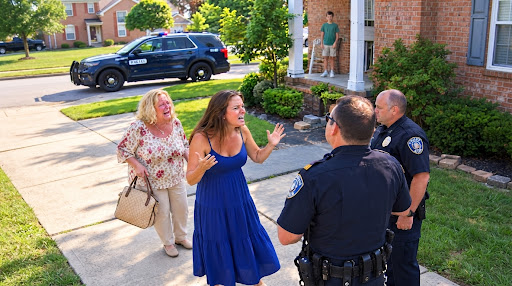
PART 3
Officer Ruiz looked down at the bank statement on my phone,
then slowly raised her eyes toward my mother.
“Mrs. Whitaker, I need you to answer a question.”
My mother clutched her pink overnight bag against her chest.
“What question?”
Did your daughter give you permission to
withdraw money from this account?
Vanessa stopped recording.
For the first time since she’d arrived,
my sister looked uncertain.
My mother glanced at her,
then back at the officers.
“That’s family money.”
Officer Daniels frowned.
“That wasn’t the question, ma’am.”
I stood in my doorway, feeling the cold rain blowing against my bare ankles.
For six years, I had helped my mother financially.
When my father died, she’d told me she was struggling to cover
the property taxes on her house.
I opened a separate savings account in
my name and began setting aside money for her emergencies.
At first, I transferred three hundred dollars a month.
Then five hundred.
Eventually, when my business began doing better, I increased the amount.
I told Mom she could use the money for necessary expenses and that she should let me know when she needed a withdrawal.
For years, the arrangement worked.
Or so I thought.
Three months earlier, while reviewing my statements, I discovered something strange.
There were repeated withdrawals.
Four thousand dollars.
Six thousand.
Another eight thousand.
By the time I investigated, twenty-eight thousand dollars had disappeared.
I initially thought someone had stolen my banking information.
Then I recognized the names on the transactions.
A luxury ballroom.
An event decorator.
A designer boutique.
And a catering company specializing in elaborate quinceañeras.
Every payment was connected to Vanessa’s daughter, Isabella.
When I confronted my mother, she told me she’d only borrowed the money.
“It’s for your niece,” she’d said. “You know how important this birthday is.”
I reminded her that the savings account was supposed to help with emergencies.
She laughed.
“A quinceañera only happens once.”
Then she promised to replace the money.
She never did.
Instead, I revoked the access I’d given her and moved the remaining balance into another account.
That was the money she was now accusing me of stealing.
“Mom,” I said quietly, “tell the officers whose name is on the account.”
She looked away.
Vanessa stepped forward.
“Don’t let her confuse you. She emptied Mom’s savings!”
Officer Daniels held up his hand.
“Ma’am, please stop interrupting.”
I turned the phone toward him.
“The account is mine. I opened it. I funded it. My mother was an authorized user with limited access, which I revoked after discovering the withdrawals.”
Officer Ruiz examined the statement.
“And the twenty-eight thousand dollars?”
“Already spent. On my niece’s party.”
My mother’s face reddened.
“You make it sound like I robbed you!”
I stared at her.
“You took money without asking and promised to return it.”
“Because you always help family!”
I felt something inside me finally go quiet.
Not anger.
Not even surprise.
Just exhaustion.
“Mom, Ethan is family too.”
She blinked.
I continued.
“Where were you on his birthday?”
Her mouth opened.
Then closed.
From behind me, Ethan spoke.
“Grandma?”
I turned.
My son was standing halfway down the stairs in his blue dinosaur pajamas.
He was holding the Lego police car he’d built that afternoon.
His eyes were fixed on my mother.
“Did you forget my birthday because of Isabella’s party?”
My mother looked uncomfortable.
“Oh, sweetheart, don’t be dramatic.”
I felt my jaw tighten.
“He asked you a question.”
She sighed.
“We were busy.”
Ethan swallowed.
“All of you?”
Nobody answered.
His little face crumpled.
“Even Uncle Paul?”
Vanessa crossed her arms.
“Ethan, grown-ups have responsibilities. You can’t expect everyone to drop everything for a pizza party.”
I turned toward her.
“Don’t speak to my son like that.”
She rolled her eyes.
“See? This is exactly why nobody wanted to come.”
The words landed harder than I expected.
But before I could respond, Ethan whispered something that silenced everyone.
“I saved Grandma the biggest piece of cake.”
My mother looked down.
Ethan continued.
“It had a blue flower on it because blue is her favorite color.”
I felt tears burning behind my eyes.
He stared at her.
“I waited until the restaurant closed.”
My mother shifted uncomfortably.
Then she said, “Well, next time perhaps your mother should coordinate better.”
Something inside me snapped.
“There won’t be a next time.”
Officer Daniels stepped between us.
“Mrs. Carter, let’s keep this calm.”
I nodded.
Then I turned to Ethan.
“Sweetheart, please go upstairs. I’ll be there in a minute.”
He hesitated.
“Are they taking you away?”
My heart broke.
“No, baby. Nobody is taking me anywhere.”
He looked at the officers.
Officer Ruiz softened her voice.
“Your mom is okay, buddy. We’re just sorting out a disagreement.”
Ethan nodded.
Then slowly climbed the stairs.
I waited until his bedroom door closed before facing my family again.
“Get off my property.”
My mother gasped.
“Amanda!”
“You heard me.”
Vanessa laughed.
“You can’t throw your own mother out into the rain.”
“She has a house. She has a car. And she has you.”
Mom clutched her bag.
“I raised you.”
I looked at her.
“Yes. And I’ve spent most of my adult life trying to repay a debt you never stop collecting.”
Her face hardened.
“You ungrateful little—”
“Mrs. Whitaker,” Officer Daniels interrupted, “your daughter has asked you to leave. Unless you have documentation establishing a right to occupy this residence, you need to go.”
My mother looked stunned.
For years, she’d treated my house like an extension of her own.
She had an emergency key.
She came over without calling.
She rearranged my kitchen cabinets.
She criticized how I raised Ethan.
And whenever I protested, she reminded me that mothers were entitled to certain privileges.
But standing on my porch, with two police officers watching, she finally realized that entitlement wasn’t the same thing as ownership.
Vanessa grabbed her arm.
“Come on, Mom.”
Then she looked at me.
“You’re going to regret this.”
I met her eyes.
“No, Vanessa. I regret waiting this long.”
After they drove away, Officer Daniels remained on the porch.
“Mrs. Carter, may I ask you something?”
I nodded.
“Has your mother ever actually lived here?”
“No.”
“Received mail here?”
“Not to my knowledge.”
“Paid rent or household expenses?”
“Never.”
He glanced toward the street.
“She claimed she’d been living here for six months.”
I stared at him.
“What?”
Officer Ruiz nodded.
“She told dispatch you had unlawfully locked her out of her primary residence.”
I felt sick.
“My mother owns a house in Cherry Hill.”
“Do you have the address?”
I gave it to them.
Officer Daniels wrote it down.
Then he said, “Tonight, we haven’t established that she resides here. But you should keep copies of your property documents and any messages related to this dispute. If there are allegations about the bank account, those will need to be examined separately.”
I nodded.
“Thank you.”
Officer Ruiz glanced toward the staircase.
“And check on your son.”
My eyes filled.
“I will.”
After they left, I closed the door.
Locked it.
And leaned against it until my knees stopped shaking.
I found Ethan sitting on his bedroom floor.
The Lego police station lay unfinished beside him.
He was staring at the little plastic officers.
“Hey, buddy.”
He didn’t look up.
“Hi, Mom.”
I sat beside him.
For a while, neither of us spoke.
Then he whispered, “Did I do something wrong?”
I felt my heart split.
“No.”
“Then why doesn’t Grandma like me?”
I swallowed.
“Sweetheart, Grandma’s behavior is not your fault.”
He looked at me.
“But she went to Isabella’s birthday planning dinner.”
I blinked.
“What planning dinner?”
He shrugged.
“Isabella told me they had a big dinner last Saturday.”
My stomach tightened.
Last Saturday.
Ethan’s birthday.
“Who was there?”
He began counting on his fingers.
“Grandma. Aunt Vanessa. Uncle Paul. Aunt Denise. All the cousins.”
I stared at him.
“Isabella told you that?”
He nodded.
“She sent me pictures.”
My breath caught.
“Can I see?”
He handed me his tablet.
I opened the messages.
There they were.
Photographs from an expensive restaurant.
My mother raising a glass.
Vanessa smiling beside an enormous pink cake.
Paul holding a menu.
All the cousins crowded around a table.
The date was unmistakable.
Saturday.
Six thirty in the evening.
The exact time Ethan had been sitting in Giovanni’s Pizza, staring at ten empty chairs.
My family hadn’t forgotten.
They’d chosen somewhere else to be.
And nobody had bothered to tell us.
I felt tears sliding down my cheeks.
Ethan touched my arm.
“Mom?”
I forced myself to smile.
“Yes, baby?”
“Maybe my party wasn’t fancy enough.”
I pulled him into my arms.
“No.”
He began crying.
“Maybe next year we can have it somewhere expensive.”
I held him tighter.
“Ethan, listen to me. You don’t have to spend money to make people love you.”
He buried his face against my shoulder.
I kissed his hair.
“And you never have to compete with anyone for a place in this family.”
He whispered, “But I lost.”
I closed my eyes.
“No, sweetheart.”
I held him until his breathing slowed.
Then I said the words I wished someone had said to me when I was a child.
“The people who didn’t show up are the ones who missed something wonderful.”
The next morning, I called my attorney.
Her name was Rachel Bennett.
She had handled the purchase of my house and several contracts for my small accounting business.
When I explained what happened, she went quiet.
“Your mother called the police and claimed you stole her savings?”
“Yes.”
“And the account is solely in your name?”
“Yes.”
“Do you have records showing the original deposits and the disputed withdrawals?”
“Every single one.”
Rachel sighed.
“Good. Preserve everything. Don’t delete messages, and don’t discuss the financial dispute publicly.”
I looked toward the kitchen.
“What about the money?”
“That depends on the account agreement and exactly what access you authorized. We need to review the documents before deciding what recovery options exist.”
I nodded.
“And the police?”
“If anyone contacts you about a formal complaint, let me know. We can make sure your records are presented properly.”
Then Rachel asked another question.
“Why did you change the locks?”
I hesitated.
“Because Mom still had an emergency key.”
“Had she threatened to enter without permission?”
I thought about the messages she’d sent after I refused to pay the quinceañera contribution.
You don’t get to turn your back on this family.
I’ll come over and straighten you out myself.
Remember who helped you buy that house.
I frowned.
That last message had always bothered me.
“Rachel?”
“Yes?”
“My mother keeps claiming she helped me buy my house.”
“Did she?”
“No. I paid the down payment myself.”
“Did she sign any loan documents?”
“No.”
Rachel paused.
“Send me the message.”
I did.
Then she said something that made my stomach tighten.
“Amanda, I want to review your closing documents.”
“Why?”
“Because sometimes people make claims based on paperwork they don’t fully understand. I want to confirm exactly what she’s referring to.”
I stared at the phone.
“Do you think she’s planning something?”
“I don’t know. But given the false residency claim, I’d rather verify the records than guess.”
That afternoon, Rachel called again.
“Amanda, I found something unusual.”
My stomach dropped.
“What?”
“Your mother isn’t on the deed.”
I exhaled.
“Okay.”
“But I want you to look at a document she submitted to the lender during your mortgage application.”
I frowned.
“What document?”
“A gift letter.”
I went still.
“A what?”
“A letter stating she provided you with twenty-five thousand dollars toward your down payment.”
I stared at the wall.
“That never happened.”
Rachel was quiet.
Then she said, “Amanda, the letter appears to bear your mother’s signature.”
I couldn’t speak.
Because suddenly I remembered something.
Eight years earlier, when I was buying my house, my mother had insisted on attending one meeting with the mortgage broker.
She’d said she wanted to make sure I wasn’t being taken advantage of.
I’d been grateful.
I’d thought she was protecting me.
Now I wondered what else she’d done while I wasn’t paying attention.
“Rachel,” I whispered, “I never received twenty-five thousand dollars from my mother.”
“I understand.”
“Then why would she sign a letter saying she gave it to me?”
Rachel paused.
“That’s what we need to find out.”
Before I could answer, another call appeared on my screen.
Uncle Paul.
I hadn’t heard from him since Ethan’s birthday.
I ignored it.
Then a text arrived.
Amanda, we need to talk. Your mother has been telling people she owns half your house.
I stared at the message.
Then another appeared.
And Vanessa knows why.
I felt the room spin.
Because the police visit suddenly looked less like a dramatic attempt to embarrass me.
And more like the beginning of something my family had been planning for a long time.
PART 4
I called Paul immediately.
He answered on the first ring.
“Amanda.”
“What is Mom saying about my house?”
He exhaled.
“She’s telling everyone she helped you buy it and that you owe her money.”
I gripped the phone.
“How much?”
“Twenty-five thousand dollars.”
My stomach tightened.
The exact amount on the gift letter.
“Paul, did Mom ever tell you she gave me that money?”
He hesitated.
“Yes.”
“When?”
“Years ago.”
I closed my eyes.
“What exactly did she say?”
“She said she helped with your down payment because you couldn’t qualify on your own.”
I felt heat rising in my chest.
“That is a lie.”
He was quiet.
Then he said, “I believe you.”
I almost laughed.
“That’s a first.”
He sighed.
“I deserve that.”
I looked toward the hallway.
“Paul, why didn’t you come to Ethan’s birthday?”
There was a long silence.
Then he said, “Vanessa told us the party had been canceled.”
I went still.
“What?”
“She said Ethan was sick.”
My mouth fell open.
“Paul, I sent a reminder the night before.”
“I know.”
“And nobody answered.”
He swallowed.
“Vanessa told us you were upset and didn’t want visitors.”
I stared at the wall.
“Did you call me?”
“No.”
“Did you text Ethan?”
He didn’t answer.
I felt tears rise.
“Then you made a choice.”
He sighed.
“Yes.”
I took a breath.
“Where were you that evening?”
“At the dinner Vanessa arranged.”
“Isabella’s birthday planning dinner.”
“Yes.”
I closed my eyes.
Paul continued.
“Vanessa said the dinner had been booked for months and that there was no point wasting the reservation since Ethan’s party was canceled.”
I shook my head.
“Paul, my son waited for all of you.”
His voice cracked.
“I know that now.”
“He sat there for two hours.”
Paul began crying.
“Amanda, I’m sorry.”
I swallowed.
“Did you even remember it was his birthday?”
“Yes.”
“Then why didn’t you call?”
He had no answer.
And somehow, that silence hurt more than another excuse would have.
Paul came to my house the following afternoon.
I almost refused to let him in.
But he said he had something important to show me.
He arrived carrying a folder.
Inside were printed messages from Vanessa.
One had been sent the morning of Ethan’s party.
Amanda canceled Ethan’s birthday because he’s not feeling well. Don’t bother going to Giovanni’s.
Another followed.
Since everyone’s free, Mom wants us at Isabella’s planning dinner tonight. Six thirty. Don’t mention it to Amanda because she’s being difficult.
I stared at the messages.
My hands began shaking.
Vanessa hadn’t simply forgotten my son’s birthday.
She had deliberately kept everyone away.
“Why?” I whispered.
Paul looked ashamed.
“Mom said you were refusing to contribute to Isabella’s party.”
I blinked.
“But she didn’t ask for the money until a week later.”
Paul shook his head.
“She’d been discussing the contributions privately for months.”
I felt sick.
“She was angry because I wouldn’t give her more money.”
He nodded.
“Vanessa said you were being selfish.”
I stared at the messages.
“Did Mom know Vanessa told everyone the party was canceled?”
Paul looked down.
“Yes.”
My chest tightened.
“Paul.”
He swallowed.
“Mom told us not to interfere. She said you needed to learn that family support goes both ways.”
I sat back.
For several seconds, I couldn’t speak.
My mother had allowed my ten-year-old son to sit in a restaurant waiting for people who had been told not to come.
To teach me a lesson.
A financial lesson.
Using my child.
I looked at Paul.
“Did you know Ethan would be waiting?”
He shook his head.
“No. I thought the party was canceled.”
I nodded slowly.
“But you never checked.”
“No.”
I wiped my cheeks.
“And that’s something you’ll have to live with.”
Paul lowered his head.
“I know.”
Then he pushed another paper across the table.
It was a copy of a message from my mother to Vanessa.
If Amanda won’t pay her share, remind her what I did for that house. She can’t pretend she doesn’t owe me.
I stared at it.
Paul continued.
“Mom has been saying she’ll get the money one way or another.”
I looked up.
“What does that mean?”
“She told Vanessa she might take you to court.”
I felt my stomach twist.
“For money she never gave me?”
Paul nodded.
“She thinks the gift letter proves something.”
I shook my head.
“Paul, even if she had given me money as a gift, that wouldn’t automatically make her an owner.”
“I know.”
“Then why is she doing this?”
He looked exhausted.
“Because Vanessa’s party is costing more than anyone expected.”
I stared at him.
“How much?”
He hesitated.
“Almost seventy thousand dollars.”
I nearly dropped my coffee.
“Seventy thousand?”
He nodded.
“Venue. Catering. Dresses. Decorations. Photographer. Entertainment.”
I stared at the wall.
“And she wants twenty-six hundred dollars from every family member?”
“Yes.”
I did the math.
Even if ten relatives paid, that would cover only part of the expense.
“Where is the rest coming from?”
Paul looked uncomfortable.
“Mom promised to help.”
I closed my eyes.
“With my money.”
He said nothing.
After Paul left, I called Rachel.
I sent her every message.
Every screenshot.
Every bank statement.
And the copy of the gift letter.
She listened carefully.
Then said, “Amanda, the good news is that a gift letter doesn’t transfer ownership of real estate.”
I exhaled.
“But the letter was false.”
“Then we need to establish how it entered the loan file and whether any funds were actually transferred. We’ll review the closing records and speak with the lender if necessary.”
I nodded.
“What about Mom saying I owe her?”
“She can make a claim. That doesn’t mean she can prove it.”
I looked down.
“And the police report?”
“We can provide the account records and explain the dispute. But don’t assume the officers will resolve a complicated banking disagreement on your doorstep.”
I swallowed.
“Okay.”
Rachel paused.
“Amanda, there’s something else I want you to consider.”
“What?”
“Your mother has shown that she’s willing to involve authorities in a family dispute and make claims about your property. Keep communications in writing. Don’t meet her alone to argue about money.”
I nodded.
Then Rachel asked, “How’s Ethan?”
My eyes filled.
“Not good.”
Her voice softened.
“I’m sorry.”
I looked toward the staircase.
“He thinks his birthday wasn’t important enough.”
Rachel was quiet.
Then she said, “That’s the part no bank statement can fix.”
That evening, I sat beside Ethan while he built his Lego police station.
He had finally finished the garage.
A tiny plastic officer stood beside a blue patrol car.
“Mom?”
“Yes, buddy?”
“Is Uncle Paul mad at me?”
I shook my head.
“No.”
“Then why did he come over without saying hi?”
I swallowed.
“He was here to talk about grown-up problems.”
Ethan nodded.
Then asked, “Are they all mad because you didn’t pay for Isabella’s party?”
I stared at him.
“Who told you that?”
He shrugged.
“Isabella.”
My stomach tightened.
“What did she say?”
He looked down.
“She said Grandma told her we were trying to ruin her birthday.”
I closed my eyes.
My son had been carrying that accusation for days.
“Ethan, look at me.”
He raised his eyes.
“You are not responsible for Isabella’s party.”
He nodded.
“And neither am I.”
“But Grandma said family helps family.”
I took a breath.
“Helping family is something people choose to do because they care. It isn’t something they get to demand by hurting someone.”
He thought about that.
Then whispered, “I still wanted Grandma there.”
My heart broke.
“I know, sweetheart.”
He looked down at his Lego pieces.
“I made her a card.”
I swallowed.
“Can I see it?”
He reached beneath his bed and pulled out a folded blue paper.
On the front, in crooked handwriting, he’d written:
THANK YOU FOR COMING TO MY BIRTHDAY, GRANDMA!
Inside was a drawing of himself holding her hand.
Underneath, he’d written:
I love you. You’re the best grandma.
I pressed my lips together.
For several seconds, I couldn’t speak.
Then Ethan whispered, “I didn’t give it to her.”
I pulled him into my arms.
And cried harder than I had in years.
The following Monday, my mother sent a letter through an attorney.
It demanded repayment of twenty-five thousand dollars she claimed to have contributed to my home purchase.
It also demanded that I stop making “false statements” about her financial conduct.
I forwarded it to Rachel.
She reviewed it and responded with a request for documentation.
Proof of the alleged transfer.
Proof of any loan agreement.
Proof of ownership.
And an explanation of the conflicting account records.
My mother couldn’t produce a transfer showing she’d paid my down payment.
The closing records showed the funds had come from my own savings and the proceeds of a small investment account I’d liquidated.
The gift letter had been included in an early mortgage application file, but the lender’s final records showed that the transaction had closed without relying on the supposed gift.
It didn’t give Mom ownership.
And it didn’t establish a debt.
Rachel explained that the false letter raised separate questions about who had prepared it and why, but we didn’t need to resolve every question to establish that the house was mine.
When my mother’s attorney received the records, the demand was withdrawn.
No apology.
No explanation.
Just silence.
For the first time in my life, I didn’t chase after one.
The bank dispute took longer.
Mom had been granted access to the savings account for limited purposes, but the scope of that access mattered.
Rachel helped me review the account agreement and the transaction history.
Some withdrawals had been permitted by the bank’s access arrangements, even though Mom had violated the understanding between us.
That meant recovering the money wasn’t as simple as calling it theft.
I hated that.
But I also understood that the law couldn’t turn every broken family promise into a criminal charge.
We documented everything.
We closed the disputed access.
And through counsel, I requested repayment of the twenty-eight thousand dollars she’d spent.
My mother initially refused.
Then the event planner began demanding final payments for Isabella’s party.
Vanessa called me repeatedly from unfamiliar numbers.
I didn’t answer.
She left messages.
You can’t do this to Isabella.
Mom is sick with worry.
If you loved your niece, you’d help.
I saved them.
Then blocked the numbers.
Because I’d finally learned that guilt was not the same thing as responsibility.
Three weeks later, Vanessa showed up at my office.
She walked past the receptionist carrying an expensive handbag and wearing sunglasses.
I was reviewing invoices when she appeared in my doorway.
“We need to talk.”
I looked up.
“No, Vanessa. We don’t.”
She shut the door.
“You’ve made Mom’s life miserable.”
I stared at her.
“You called the police to my house.”
“Mom was upset.”
“You told them she lived there.”
Vanessa rolled her eyes.
“She practically does.”
“No. She doesn’t.”
My sister crossed her arms.
“Are you really going to destroy Isabella’s birthday over twenty-eight thousand dollars?”
I looked at her.
“Vanessa, you deliberately told our family Ethan’s party was canceled.”
Her face changed.
For one second, she looked surprised.
Then she recovered.
“Who told you that?”
“Paul showed me the messages.”
She scoffed.
“Of course he did.”
I stood.
“Why?”
She looked away.
“Because you were being selfish.”
I stared at her.
“Selfish?”
“You always have money for your house, your vacations, Ethan’s activities. But when Isabella needs something important, suddenly you have boundaries.”
I felt something inside me go cold.
“Ethan needed his family.”
She rolled her eyes.
“He’s ten. He’ll get over it.”
I stared at her.
My sister continued.
“Isabella is turning fifteen. This is a once-in-a-lifetime celebration.”
I took a slow breath.
“So was Ethan’s tenth birthday.”
Vanessa laughed.
“Don’t compare a pizza party to a quinceañera.”
I walked toward the door.
“Get out.”
Her smile vanished.
“Amanda—”
“Get out of my office.”
She stared at me.
“You’re choosing money over family.”
I opened the door.
“No, Vanessa. I’m choosing my son over people who used him to punish me.”
She stood frozen.
Then grabbed her handbag.
“You’ll regret this.”
I looked her in the eyes.
“I already regret letting you treat him like he mattered less.”
She left without another word.
The quinceañera happened six weeks later.
I know because Isabella posted photographs.
The ballroom was beautiful.
Pink flowers covered the tables.
A towering cake stood beneath crystal chandeliers.
Isabella wore a sparkling gown.
She looked happy.
And despite everything, I was glad she had a special day.
She was a child.
She didn’t deserve to carry the consequences of her mother’s choices.
But the celebration wasn’t quite what Vanessa had planned.
Several relatives refused to contribute the demanded amount.
Others gave smaller gifts.
The original entertainment package was canceled.
The guest list was reduced.
And my mother was forced to confront the fact that she couldn’t keep promising money that didn’t belong to her.
The event still took place.
The family survived.
And the world didn’t end because I refused to finance it.
A few days afterward, Isabella sent me a message.
Aunt Amanda, can I ask you something?
I hesitated.
Then replied.
Of course.
Her answer came quickly.
Did my mom really tell everyone Ethan’s party was canceled?
I stared at the screen.
I didn’t want to involve her in adult arguments.
But I also didn’t want to lie.
Yes, sweetheart. That’s what the messages showed.
She took several minutes to respond.
Then wrote:
I’m sorry.
My eyes filled.
You don’t need to apologize for something you didn’t do.
She replied:
Ethan is my cousin. I would’ve gone if I’d known.
I swallowed.
I believe you.
Then she sent another message.
Can I give him his birthday present?
I stared at the screen.
For the first time in weeks, I smiled.
I think he’d like that.
Isabella came over the following Saturday.
Josh, her father, dropped her off and waited outside after asking whether the visit was okay.
She carried a small wrapped box.
Ethan opened the door.
For a moment, they simply stared at each other.
Then Isabella whispered, “Happy late birthday.”
Ethan looked surprised.
“Thanks.”
She handed him the box.
Inside was a Lego spaceship he’d wanted for months.
His face lit up.
“Seriously?”
She smiled.
“Seriously.”
He looked at her.
“Do you want to build it?”
She laughed.
“Sure.”
And just like that, they sat on the living room floor together.
Two children who had been caught in a conflict they never created.
I watched them from the kitchen.
And I realized something.
Protecting my son didn’t mean teaching him to hate everyone connected to the people who hurt us.
It meant showing him that he deserved kindness.
And helping him recognize it when someone offered it sincerely.
My relationship with Paul changed too.
He began calling Ethan.
Not every day.
Not with dramatic promises.
Just simple conversations.
He asked about school.
About baseball.
About the Lego police station.
One afternoon, he asked whether he could take Ethan to a minor league baseball game.
I told him I’d think about it.
Then I spoke to Ethan.
“Would you like to go?”
He hesitated.
“Will Uncle Paul actually come?”
My heart tightened.
“I’ll make sure he confirms before we plan anything.”
Ethan thought for a moment.
Then nodded.
“Okay.”
Paul arrived twenty minutes early.
He brought two tickets.
And he apologized directly to Ethan.
“Buddy, I should have called you on your birthday. I didn’t, and I’m sorry.”
Ethan looked at him.
“Did you forget?”
Paul swallowed.
“No. I made a bad choice.”
My son was quiet.
Then he said, “That hurt my feelings.”
Paul’s eyes filled.
“I know.”
Ethan nodded.
“Okay.”
It wasn’t forgiveness in one magical moment.
But it was a beginning.
And unlike my mother and Vanessa, Paul didn’t demand that Ethan pretend nothing had happened.
My mother waited almost four months before contacting me directly.
She sent a handwritten letter.
I recognized her handwriting immediately.
For a long time, I left it unopened on the kitchen counter.
Then one evening, after Ethan went to bed, I sat beside the window and read it.
She wrote about feeling abandoned after my father died.
About how frightened she’d been of losing financial security.
About how she’d convinced herself that because I’d always helped her, she could use the money whenever she wanted.
She admitted that Vanessa had told the family Ethan’s party was canceled.
And that she’d allowed the lie to continue.
Then she wrote:
I thought if you felt excluded, you’d understand what it was like to disappoint family.
I stared at that sentence.
My mother had deliberately used my child’s birthday to teach me a lesson.
Not because Ethan had done anything wrong.
Not because I had harmed anyone.
But because I’d refused to give her more money.
I continued reading.
Near the end, she wrote:
When Ethan asked me why I didn’t come, I realized I’d hurt someone who had never done anything to me.
My eyes filled.
Then came the words I’d waited months to hear.
I’m sorry, Amanda. Not because you changed the locks. Not because you stopped helping me. I’m sorry because I made my grandson feel unwanted.
I sat quietly.
For the first time, her apology didn’t contain a demand.
She didn’t ask me to send money.
She didn’t tell me I was overreacting.
She didn’t blame Vanessa.
She simply admitted what she’d done.
I folded the letter.
Then placed it in a drawer.
I wasn’t ready to respond.
And I didn’t have to be.
Eventually, my mother began repaying the disputed withdrawals through a written agreement arranged with the help of our attorneys.
The payments were modest.
It would take time.
But the important part wasn’t the amount.
It was that she finally acknowledged the money hadn’t been hers to spend however she pleased.
I didn’t give her another emergency key.
I didn’t restore her banking access.
And I didn’t invite her back into our lives simply because she’d apologized.
Trust wasn’t a door she could open with a few kind words.
It was something she’d have to rebuild.
If Ethan wanted that relationship.
And if she proved she could respect him.
The following spring, Ethan turned eleven.
This time, I didn’t rent a private room at a restaurant.
I didn’t order twenty-four cupcakes.
And I didn’t invite relatives who treated showing up like a financial negotiation.
Instead, Ethan asked for a backyard party.
He wanted hamburgers.
A chocolate cake.
His classmates.
His teacher.
And a few neighbors who had been kind to him throughout the year.
I bought blue balloons.
Hung streamers along the fence.
And set up a long table beneath the maple tree.
By two o’clock, the backyard was filled with laughter.
Children ran across the grass.
Music played from a speaker.
Someone spilled lemonade.
Our dog stole a hamburger bun.
It was chaotic.
Loud.
Imperfect.
And wonderful.
At three thirty, I carried out the cake.
Eleven candles flickered in the afternoon breeze.
Everyone gathered around.
Ethan stood beside me.
His cheeks were pink from running.
His hair was a mess.
And he was smiling.
Not the careful smile he’d worn at Giovanni’s Pizza.
A real one.
The kind that reached his eyes.
Everyone began singing.
I watched my son look around the table.
At his friends.
At his teacher.
At Isabella.
At Uncle Paul, who had asked permission to attend and arrived early to help set up chairs.
Then Ethan leaned toward me.
“Mom?”
“Yes, sweetheart?”
He whispered, “They all came.”
I felt tears rise.
I kissed his forehead.
“Of course they did.”
He looked around again.
Then smiled.
“This is the best birthday ever.”
After the party, when the last guest had gone home, Ethan helped me collect paper plates from the yard.
He was carrying a stack of cups when he suddenly stopped.
“Mom?”
I looked up.
“Yes?”
“Can I ask you something?”
“Anything.”
He hesitated.
“Are you still sad about last year?”
I stared at him.
For a moment, I didn’t know what to say.
Then I answered honestly.
“Sometimes.”
He nodded.
“Me too.”
I walked over and sat beside him on the porch steps.
He leaned against my shoulder.
“But today was better.”
I smiled.
“Yes, it was.”
He looked up.
“Do you think Grandma will come next year?”
My heart tightened.
“I don’t know, buddy.”
He thought about that.
Then said something that surprised me.
“That’s okay.”
I looked at him.
He continued.
“I hope she does. But if she doesn’t, I still have people who love me.”
Tears filled my eyes.
I wrapped my arms around him.
“Yes, sweetheart.”
I kissed the top of his head.
“You do.”
People sometimes ask whether I regret sending my mother one dollar.
I don’t.
But not because it was clever.
And not because it embarrassed her.
That dollar was the first time I’d refused to let my family turn love into an invoice.
For years, I’d believed that being a good daughter meant saying yes.
Yes to unexpected bills.
Yes to financial emergencies.
Yes to demands disguised as obligations.
Yes to my mother’s criticism.
Yes to Vanessa’s entitlement.
And yes to the idea that my son and I should be grateful for whatever attention they decided to give us.
Then I watched Ethan sit in front of ten empty chairs on his tenth birthday.
I watched him save a piece of cake for a grandmother who never came.
I watched him wonder whether his party wasn’t expensive enough to deserve love.
And something inside me changed.
I realized that my greatest responsibility wasn’t keeping my mother happy.
It wasn’t financing Vanessa’s celebrations.
It wasn’t preserving the appearance of a perfect family.
It was protecting the little boy who trusted me to make our home a safe place.
The police came to my door because my mother thought she could frighten me into obedience.
She accused me of stealing money from an account I had funded.
She claimed she lived in a house she had never owned.
And she expected me to surrender because she’d brought two officers and an audience.
But the truth didn’t change just because she said it loudly.
The house was mine.
The financial records existed.
And my son’s heartbreak was real.
I couldn’t undo his tenth birthday.
I couldn’t make those empty chairs disappear.
I couldn’t erase the moment he asked whether he had done something wrong.
But I could make sure he never had to buy his family’s attention.
I could show him that love didn’t require expensive parties.
That boundaries weren’t cruelty.
And that people who genuinely cared would show up without demanding payment first.
That night, after Ethan fell asleep, I walked into the kitchen.
The blue balloons from his eleventh birthday were still tied to the chairs.
A little chocolate frosting remained on the tablecloth.
I smiled when I saw it.
One year earlier, I’d been washing frosting stains out of a tablecloth when the police arrived.
I’d been frightened.
Angry.
Humiliated.
And uncertain whether standing up to my family would destroy everything.
Now I understood.
It hadn’t destroyed my family.
It had shown me which relationships were worth protecting, which needed to change, and which I could no longer allow to control our lives.
I looked at the photograph Ethan’s teacher had taken that afternoon.
My son stood in front of his cake.
Eleven candles glowing.
His friends gathered around him.
His smile bright enough to fill the whole picture.
There were no empty chairs.
No forced apologies.
No demands for money.
Just a little boy celebrating his birthday with people who wanted to be there.
And that was worth more than twenty-eight thousand dollars.
More than a lavish ballroom.
More than every expensive gift my family had ever demanded.
Because my mother had spent years teaching me that family meant sacrifice.
But my son taught me something better.
Family isn’t measured by how much money you give.
It’s measured by who shows up when someone needs to feel loved.
And on the day my son turned eleven, every person who mattered showed up.
THE END THANK YOU FOR READING !!!