PART 3
Dad, please.
Tell me this is some kind of misunderstanding.
Logan’s voice trembled through the phone.
I sat behind the steering wheel,
watching my son stand barefoot in
the driveway of the house
I had helped him keep for four years.
Chelsea stood beside him,
waving the documents in the air.
Even from a distance,
I could see her shouting.
“It’s not a misunderstanding, Logan,” I said quietly.
Every document is legitimate.
Fiona reviewed everything before those notices were delivered.
“Who’s Fiona?”
“My attorney.”
There was silence.
Then Chelsea grabbed the phone.
“Albert, you miserable old man! You planned this!”
I stared through the windshield.
“Good morning, Chelsea.”
“Don’t you dare good-morning me! You can’t just take away our house and car because we asked you to move out!”
“I haven’t taken away your house. I’ve stopped voluntarily paying toward it. And I’ve given you the opportunity to refinance the car.”
“You’re doing this to punish us!”
“No,” I replied. “I’m doing this because I no longer live there, and I need to protect my retirement.”
She laughed bitterly.
“Your retirement? You barely have enough money to buy groceries!”
I glanced at the investment statement on the passenger seat.
Eight hundred thousand dollars.
Thirty-five years of careful saving, conservative investing, and living beneath my means.
Chelsea had never bothered asking about my financial situation.
She simply assumed that because I wore old sweaters and drove a twelve-year-old sedan, I had nothing.
“Then you shouldn’t have any trouble managing without me,” I said.
She screamed something I couldn’t understand.
Logan took the phone back.
“Dad, where are you?”
“Somewhere safe.”
“Can we talk?”
“We are talking.”
“I mean in person.”
I watched him rub his forehead.
For a moment, I saw the little boy who used to run to me when he couldn’t solve his math homework.
Then I remembered the grown man who had stared into his wineglass while his wife humiliated me in front of strangers.
“Not today, Logan.”
“Dad—”
“You have the notices. Read them carefully. If you have questions about the agreements, contact Fiona.”
I ended the call.
For several minutes, I sat without moving.
Then I started my car and drove away.
I expected to feel triumphant.
Instead, I felt tired.
Because there is no satisfaction in watching your own child discover that the person he treated as disposable had been quietly keeping his life together.
My new apartment was on the second floor of a modest building overlooking a small park.
It had one bedroom, a narrow kitchen, and a balcony barely large enough for two chairs.
I loved it.
For the first time in six years, I could eat breakfast wherever I wanted.
I could invite a friend over without asking permission.
I could walk through my own front door without worrying whether someone would be embarrassed to see me.
That morning, I made coffee and sat beside the window.
My late wife, Margaret, used to say that a peaceful home wasn’t necessarily a large one.
“It’s the place where nobody makes you feel like you need permission to exist,” she’d tell me.
I hadn’t understood how important those words were until I lost that feeling in my son’s house.
I took her photograph from the bookshelf.
She was smiling beneath a wide summer hat, her eyes crinkled with laughter.
“I finally listened to you, Maggie,” I whispered.
My phone buzzed.
A message from Logan.
Dad, the bank says we need to qualify for the SUV loan ourselves. Chelsea’s credit isn’t good enough. What are we supposed to do?
I read it twice.
Then replied.
Speak with the lender about your options. Fiona can provide copies of the documents.
Another message arrived.
You know we can’t afford the payments without you.
I stared at the screen.
That was the first honest thing he’d said.
The SUV had been purchased two years earlier.
Chelsea wanted a luxury vehicle because, according to her, their neighbors were beginning to think they were struggling.
I remembered sitting at the dealership while Logan explained that their credit wasn’t strong enough to qualify for favorable financing.
“Dad, it’s temporary,” he’d promised.
I had agreed to be the primary borrower, with a written arrangement requiring Logan to make the monthly payments and refinance the vehicle when he qualified.
But after the first three months, those payments began arriving late.
Then they stopped.
Whenever I asked, Logan promised to catch up.
So I paid.
Month after month.
I told myself I was protecting his credit and keeping the family stable.
In reality, I was protecting him from the consequences of choices he refused to confront.
The lender couldn’t simply erase my responsibility because I wanted out. Fiona had made that clear.
Instead, we negotiated a process under which Logan and Chelsea could apply for refinancing, and if they couldn’t qualify, the vehicle would be sold or voluntarily surrendered according to the lender’s requirements.
I was prepared to cover any remaining legitimate obligation rather than damage my credit.
But I would no longer fund their lifestyle indefinitely.
The mortgage was different.
I wasn’t an owner.
I wasn’t a borrower.
I had simply been sending money every month to help Logan avoid falling behind.
Stopping those voluntary payments didn’t mean the bank would immediately take their house.
It meant Logan and Chelsea would finally have to manage the mortgage they had signed.
And that terrified them.
Two days later, Fiona called.
“Albert, I’ve reviewed the remaining documents.”
I sat straighter.
“Anything unexpected?”
“Not exactly. But there’s something I think you should see.”
She sent me an email.
Attached was a copy of the original business loan agreement.
Six years earlier, Logan had approached me with a plan to start a commercial landscaping company.
He needed sixty-four thousand dollars for equipment, licensing, insurance, and initial operating expenses.
I’d agreed to lend him the money.
Not give it.
Lend it.
We signed a promissory note with a reasonable repayment schedule and a provision allowing me to demand the outstanding balance after a specified default and notice period.
For the first year, Logan made payments.
Then business slowed.
He asked for more time.
I granted it.
Then he stopped paying altogether.
By the time Fiona reviewed the records, the loan had been in default for years.
But that wasn’t what concerned her.
“Albert,” she said, “did you know Logan used his business as collateral for another loan?”
I frowned.
“No.”
“He borrowed from a private financing company eighteen months ago.”
My stomach tightened.
“How much?”
“Approximately ninety thousand dollars.”
I stared at the wall.
“For what?”
“According to the documents we obtained, business expansion.”
I closed my eyes.
Logan had never mentioned expanding.
In fact, he’d told me the company was struggling.
Fiona continued.
“The lender has a security interest in certain business assets. Your older loan is unsecured, so recovery could be difficult if the business fails.”
I nodded slowly.
“Then we proceed carefully.”
“There’s more.”
Something in her voice made me sit forward.
“What?”
“Chelsea contacted my office yesterday.”
I stared at the phone.
“Chelsea?”
“She claimed you had promised to forgive the business loan in exchange for being allowed to live in their house.”
I almost laughed.
“She said what?”
“She also claimed you had agreed to contribute toward the mortgage as rent.”
I looked toward the window.
For six years, I’d cooked their meals, repaired their house, maintained their yard, and paid thousands toward their expenses.
Now Chelsea wanted to reclassify my generosity as a contractual obligation.
“Do we have anything in writing?” I asked.
“Yes,” Fiona replied. “Your bank records, the loan documents, and several messages in which Logan thanked you for helping with the mortgage.”
I exhaled.
“Good.”
“Albert, I need to ask you something.”
“Go ahead.”
“Do you actually want to collect the entire business debt?”
I looked at Margaret’s photograph.
For years, I’d imagined leaving everything to Logan.
I had never wanted to take anything away from him.
But I had finally begun to understand that protecting someone from every consequence can become another way of preventing them from growing up.
“I want him to take responsibility,” I said.
Fiona paused.
“Then let’s pursue a realistic repayment arrangement rather than trying to destroy the business.”
I nodded.
“That sounds right.”
That evening, Logan appeared outside my apartment.
I hadn’t told him where I lived.
He must have found the address through the mail forwarding information he’d seen or asked someone who knew.
When the building intercom rang, I heard his voice.
“Dad, it’s me.”
I hesitated.
Then buzzed him into the lobby.
I met him downstairs.
He looked exhausted.
His shirt was wrinkled.
There were dark circles beneath his eyes.
For a moment, I almost reached out to straighten his collar the way I had when he was a boy.
Instead, I waited.
“Dad,” he whispered.
“Hello, Logan.”
He looked around the modest lobby.
“You live here?”
“Yes.”
“Why didn’t you tell me?”
I studied his face.
“You didn’t ask where I was going.”
His eyes dropped.
He had no answer.
We sat on a bench near the entrance.
For several seconds, neither of us spoke.
Then Logan whispered, “Chelsea thinks you’re trying to ruin us.”
I looked at him.
“What do you think?”
He rubbed his hands together.
“I don’t know anymore.”
I nodded.
“That may be the most honest answer you’ve given me in years.”
He swallowed.
“Dad, we can’t afford everything.”
“I know.”
“Chelsea’s furious.”
“I imagine she is.”
“She says you made promises.”
I looked directly at him.
“Did I promise to pay your mortgage forever?”
“No.”
“Did I promise to make your car payments forever?”
He shook his head.
“Did I forgive your business loan?”
“No.”
I leaned back.
“Then what exactly have I broken?”
He stared at the floor.
After a long silence, he whispered, “Nothing.”
I studied my son.
He was forty years old.
He had a wife, a business, and a beautiful house.
Yet sitting beside me, he looked like a frightened teenager waiting for his father to solve another problem.
“Logan,” I said, “why didn’t you say anything that night?”
He closed his eyes.
I waited.
“Chelsea was angry,” he finally whispered.
“She was often angry.”
“I know.”
“Then why did you let her treat me that way?”
He rubbed his forehead.
“Because every time I defended you, we fought afterward.”
I stared at him.
“So you decided it was easier to let me be humiliated.”
His eyes filled.
“I didn’t think of it like that.”
“But that’s what happened.”
He nodded.
“Yes.”
I looked away.
He continued.
“I kept telling myself you didn’t mind.”
I laughed softly.
“Did you really believe I enjoyed eating Thanksgiving dinner alone?”
His face crumpled.
“Dad—”
“Did you think I liked being told to use the back door?”
He covered his face.
“I was a coward.”
I said nothing.
He looked at me.
“I’m sorry.”
For six years, I’d waited to hear those words.
But now they felt incomplete.
“Logan,” I said quietly, “an apology doesn’t pay a mortgage. It doesn’t rebuild trust. And it doesn’t erase six years of pretending I wasn’t there.”
He nodded.
“I know.”
“Do you?”
He swallowed.
“I want to.”
I looked at him for a long moment.
Then I asked the question that had been troubling me since Fiona’s call.
“What happened to the ninety thousand dollars you borrowed against the business?”
His head snapped up.
The color drained from his face.
“Who told you about that?”
“It’s documented.”
He stared at me.
Then whispered, “Dad, there’s something you don’t know about Chelsea.”
I felt a familiar chill.
“What?”
He looked toward the lobby doors.
Then back at me.
“She doesn’t know the business is almost bankrupt.”
I sat very still.
Logan continued.
“And she thinks you have a lot more money than you’ve admitted.”
My stomach tightened.
“How would she know anything about my savings?”
He hesitated.
Then said the words that changed everything.
“Because three months ago, she went through your papers.”
I stared at my son.
“What papers?”
“The files in the garage.”
My pulse quickened.
Those boxes contained years of financial records.
Old tax returns.
Insurance documents.
Bank statements.
Investment summaries.
I’d always kept them locked in a storage cabinet, but the cabinet had been moved during renovations.
“Why was Chelsea looking through my documents?”
Logan swallowed.
“She said she was trying to organize the garage.”
I shook my head.
“And?”
“She found an old brokerage statement.”
My heart began pounding.
“How old?”
“About two years.”
I stared at him.
That statement would have shown several hundred thousand dollars in investments.
Not the full eight hundred thousand.
But enough to reveal that I was far from broke.
“What did she say?”
Logan looked miserable.
“She said you were hiding money while letting us struggle.”
I closed my eyes.
For six years, I’d been paying toward their mortgage.
Making vehicle payments.
Lending money.
Buying groceries.
Repairing their home.
And Chelsea had decided I was the selfish one.
Logan continued.
“She said if you had that much money, you should help us properly.”
I looked at him.
“Properly?”
He nodded weakly.
“She wanted you to pay off the mortgage.”
I felt something inside me go cold.
“And when I didn’t?”
He looked away.
“She said maybe making you uncomfortable would convince you to contribute more.”
I stared at my son.
Suddenly, the separate dinners made sense.
The back entrance.
The humiliating comments.
The demand that I stay in my room.
They hadn’t merely wanted me gone.
Chelsea had been trying to pressure me into giving them more money.
And when I didn’t, she decided I was no longer welcome.
I took a slow breath.
“Logan, did you know she was doing this?”
His eyes filled.
“I knew she wanted you to help more.”
“That wasn’t my question.”
He swallowed.
“Yes.”
The word landed between us.
I looked at him.
He began crying.
“Dad, I didn’t think she’d actually make you leave.”
I stood.
“Then you should have stopped her before she tried.”
He reached toward me.
“Please.”
I shook my head.
“I need you to go.”
“Dad—”
“Go home, Logan.”
He stared at me.
Then slowly stood.
As he walked toward the door, he turned.
“Are you ever going to forgive me?”
I looked at my son.
“I don’t know.”
His face crumpled.
Then I added, “But for the first time in your life, that isn’t something I can solve for you.”
He left.
And I went upstairs.
That night, I opened my laptop and reviewed every account.
Every beneficiary designation.
Every estate document.
Every financial agreement.
Then I called Fiona.
“There’s one more thing I need to change.”
She listened.
And when I explained what I wanted, she said quietly, “Albert, are you certain?”
I looked at Margaret’s photograph.
“Yes.”
Because I had finally realized that the eight hundred thousand dollars I’d saved wasn’t just an inheritance waiting for my son.
It was the freedom I’d spent thirty-five years earning.
And I wasn’t going to surrender that freedom to people who only remembered I mattered when the bills arrived.
PART 4
The next morning, I walked into Fiona Cartwright’s office carrying a leather folder and a photograph of my late wife.
Fiona greeted me with a firm handshake.
“Albert, you sounded determined on the phone.”
“I am.”
She motioned toward the chair opposite her desk.
“Tell me what you want to do.”
I placed the photograph on the table.
Margaret was standing in our old garden, smiling beside the roses she’d spent years growing.
“Before she died,” I began, “Margaret and I talked about what we’d leave Logan.”
Fiona nodded.
“We wanted him to be secure. We wanted him to have opportunities we never had.”
I looked down.
“But somewhere along the way, I confused helping him with carrying him.”
Fiona waited.
“I paid bills he should have paid. I rescued his business. I ignored how he treated me because I was afraid of losing him.”
My throat tightened.
“And all the while, I was planning to leave him everything.”
Fiona folded her hands.
“What would you like to change?”
I took a breath.
“I want to update my estate plan.”
She nodded.
“I want my assets protected. I want to make sure no one can pressure me into giving away money while I’m alive.”
“That is reasonable.”
“And I want to establish a charitable fund in Margaret’s name.”
Fiona smiled faintly.
“What kind of fund?”
I looked at my wife’s photograph.
“Something that helps older people who have nowhere safe to go.”
For a moment, Fiona said nothing.
Then she asked, “How much would you like to commit?”
I swallowed.
“Two hundred thousand dollars, over time, with the final amount and timing determined after we review my retirement needs.”
She nodded.
“And the rest?”
“I want enough to live comfortably for the rest of my life. Any eventual inheritance for Logan will depend on what I decide later.”
Fiona made a note.
“Then we’ll draft the documents accordingly.”
I leaned back.
For the first time in years, I wasn’t making a financial decision out of guilt.
I was making one because it reflected what I believed.
Over the following weeks, Fiona and I reviewed everything.
My savings.
My investments.
My insurance.
My will.
My powers of attorney.
My beneficiary designations.
I removed Logan from the financial authority I’d previously granted him for emergencies.
Not because I wanted to hurt him.
But because someone who had allowed his wife to search my private documents had not earned the right to manage my affairs.
I appointed an independent professional fiduciary as my primary financial agent, with a longtime friend as an alternate, after discussing the responsibilities and safeguards with Fiona.
I updated my estate plan so that my wishes were clear.
And I made one decision that brought tears to my eyes.
I named the charitable fund after Margaret.
The Margaret Higgins Dignity Fund.
Its purpose would be simple.
To support organizations helping older adults facing housing insecurity, isolation, or financial exploitation.
I couldn’t change the years I’d spent feeling unwelcome in my son’s home.
But perhaps I could help someone else avoid that feeling.
Meanwhile, Logan’s financial situation continued to unravel.
The mortgage wasn’t suddenly foreclosed.
The bank didn’t appear at his door overnight.
But without my monthly contribution, Logan and Chelsea had to confront their actual budget.
And the numbers were ugly.
Their mortgage payment was more than they could comfortably afford.
The SUV payment was enormous.
Their credit card balances were growing.
And Logan’s landscaping business was struggling to cover payroll.
For years, they’d maintained the appearance of wealth.
Expensive dinners.
Designer clothes.
Luxury vacations.
A beautiful house.
A new vehicle.
But beneath the polished surface, their finances were dangerously fragile.
I knew because I’d spent years quietly filling the gaps.
Once I stopped, the gaps became impossible to ignore.
One afternoon, Logan called.
“Dad, we sold the SUV.”
I sat beside my apartment window.
“Did the lender approve the sale arrangements?”
“Yes. We paid the shortfall using some savings and a payment plan.”
I nodded.
“Good.”
He hesitated.
“Chelsea’s furious.”
I said nothing.
“We bought a used sedan.”
“Does it meet your needs?”
“Yes.”
“Then that’s what matters.”
There was a pause.
Then Logan whispered, “Dad, I think I’ve spent most of my adult life trying to look successful instead of actually being responsible.”
I looked out at the park.
“That can be an expensive mistake.”
He gave a sad laugh.
“I’m finding that out.”
A month later, Logan asked whether he could meet me for lunch.
I agreed.
We chose a small diner near my apartment.
When he arrived, he looked different.
His clothes were simple.
His expression was tired but less frantic.
He sat across from me and ordered coffee.
For several minutes, we talked about ordinary things.
The weather.
His business.
An old friend from our neighborhood.
Then he looked at me.
“Dad, Chelsea and I are separating.”
I set down my cup.
“I’m sorry to hear that.”
He shook his head.
“Don’t be.”
I waited.
He rubbed his hands together.
“We’ve been fighting for months. About money. About the house. About everything.”
I nodded.
“That’s difficult.”
He looked down.
“But the worst part is that I finally realized how much of it I allowed.”
I studied him.
He continued.
“I kept telling myself I was keeping the peace.”
I felt my chest tighten.
“But I wasn’t. I was letting her treat you badly because it was easier than standing up to her.”
I looked away.
Logan’s voice cracked.
“I remember Thanksgiving.”
I turned back.
He swallowed.
“You were sitting alone in the kitchen.”
I said nothing.
“I walked past you to get another drink.”
My throat tightened.
He continued.
“You looked up at me and smiled.”
I remembered.
I had been eating turkey from a small plate beside the refrigerator.
Everyone else was laughing in the dining room.
Logan had passed through the kitchen, barely slowing down.
“I thought you were coming to sit with me,” I whispered.
His eyes filled.
“I know.”
I looked down.
He began crying.
“I saw you there, Dad. And I kept walking.”
For a long moment, neither of us spoke.
Then he whispered, “I’m so sorry.”
I stared at my coffee.
It was the first apology he’d given me that wasn’t followed by a request for money.
And somehow, that made it harder to hear.
Logan reached into his jacket and removed an envelope.
My stomach tightened.
“What’s that?”
He placed it on the table.
“A payment.”
I looked at him.
“For the business loan?”
He nodded.
“Five hundred dollars.”
I stared at the envelope.
“I know it’s not much.”
I opened it.
Inside was a cashier’s check.
He continued.
“I met with a financial counselor. We’re working on a repayment plan for the business debt and the other loans.”
I looked at him.
“And the company?”
“I’m restructuring. Selling some equipment. Cutting expenses.”
I nodded.
“Good.”
He swallowed.
“Dad, I don’t expect you to forgive the loan.”
I looked up.
“I don’t expect you to fix my life anymore.”
For a moment, I couldn’t speak.
Then I said quietly, “That’s the first step toward fixing it yourself.”
Chelsea called me the following week.
I almost didn’t answer.
But curiosity got the better of me.
“Albert.”
Her voice sounded strained.
“Chelsea.”
“I hear you’ve been meeting with Logan.”
“Yes.”
She sighed.
“He’s blaming me for everything.”
I looked out the window.
“I doubt that’s entirely true.”
She hesitated.
Then said, “I know I wasn’t always kind to you.”
I remained silent.
She continued.
“But you have to understand, we were under pressure.”
I took a breath.
“Chelsea, everyone experiences pressure. It doesn’t give us permission to humiliate people.”
She exhaled sharply.
“I was trying to protect my marriage.”
“By making me eat alone?”
Silence.
“By telling me to use the back door?”
She didn’t answer.
“By searching my private financial records?”
Her breathing changed.
“Logan told you?”
“Yes.”
She was quiet.
Then whispered, “I thought you were hiding money from us.”
I closed my eyes.
“Chelsea, my savings were never yours to manage.”
“I know that now.”
I waited.
She continued.
“I saw that statement and thought you could solve everything.”
I looked at Margaret’s photograph.
“And when I didn’t?”
She began crying.
“I was angry.”
I nodded.
“I know.”
“I thought if you left, Logan would finally make you help us.”
I felt a cold ache in my chest.
There it was.
The truth.
She hadn’t wanted me gone because I was a burden.
She’d wanted me gone because I wouldn’t become her bank account.
“Chelsea,” I said quietly, “you made a terrible mistake.”
She sobbed.
“I know.”
“And the worst part wasn’t the money.”
She was silent.
“It was teaching my son that treating his father with disrespect was acceptable.”
Her voice broke.
“I’m sorry.”
I closed my eyes.
“I hear you.”
“Can you forgive me?”
I looked out at the trees.
“I hope you learn from what happened.”
Then I ended the call.
I didn’t need to insult her.
I didn’t need revenge.
I simply needed the conversation to be over.
Three months later, Logan sold the house.
It wasn’t a forced sale.
He made the decision after reviewing his finances and realizing the mortgage was too large for his income.
The sale covered the remaining mortgage and transaction costs, leaving him with a modest amount of equity.
He moved into a two-bedroom apartment.
He sold furniture he didn’t need.
He stopped ordering expensive takeout.
He began cooking again.
One evening, he called me.
“Dad, do you remember how you used to make those stuffed mushrooms?”
I smiled.
“Of course.”
“Could you tell me the recipe?”
I looked toward the kitchen.
“Extra garlic.”
He laughed.
“I remember.”
“And don’t rush the onions.”
He was quiet for a moment.
Then whispered, “I miss those dinners.”
I felt tears rise.
“So do I, son.”
Our relationship didn’t heal overnight.
There were awkward conversations.
Long silences.
Moments when old hurt returned unexpectedly.
Sometimes Logan would ask whether he could visit.
Sometimes I said yes.
Sometimes I wasn’t ready.
And for the first time in his life, he accepted my answer without trying to change it.
He stopped asking me for financial help.
Instead, he told me about the decisions he was making.
The bills he’d paid.
The customers he’d gained.
The mistakes he was correcting.
I began to see something I hadn’t seen in years.
My son was learning to stand on his own feet.
And I was learning that loving him didn’t require me to stand underneath him forever.
Six months after I moved out, I received a letter from a local nonprofit organization.
It was addressed to me personally.
Inside was a thank-you note from the director of a transitional housing program for older adults.
Fiona had helped arrange the first contribution from the Margaret Higgins Dignity Fund.
The director wrote about a sixty-nine-year-old woman named Ruth who had recently moved into a safe apartment after spending months sleeping on a relative’s couch.
Ruth had lost her husband.
Her savings were limited.
And her family had made her feel unwelcome.
The program helped her find stable housing, receive financial counseling, and rebuild her confidence.
At the bottom of the letter, Ruth had written a few words.
Thank you for helping me feel like a person again.
I read that sentence three times.
Then I cried.
Not because I was sad.
But because Margaret would have loved it.
She had always believed that dignity mattered more than appearances.
And now, even after her death, her kindness was reaching people she’d never met.
That autumn, Logan invited me to dinner.
Not at a restaurant.
Not at a fancy club.
At his apartment.
When I arrived, he opened the door wearing an apron.
“Dad!”
I smiled.
“Hello, son.”
He stepped aside.
“Come in.”
The apartment was small.
The furniture was mismatched.
There were a few boxes stacked near the hallway.
But it was clean.
Warm.
And filled with the smell of garlic.
I looked toward the kitchen.
“Are those stuffed mushrooms?”
He grinned.
“I tried.”
I laughed.
“That’s brave.”
He led me to the table.
Two plates.
Two glasses.
A simple meal.
No guests.
No expensive decorations.
No separate room where I was expected to disappear.
I sat down.
Logan placed the food in front of me.
Then hesitated.
“Dad?”
“Yes?”
He swallowed.
“I want to say something before we eat.”
I looked at him.
He took a breath.
“For six years, you lived in my house.”
I nodded.
“And I let you feel like you didn’t belong there.”
My throat tightened.
He continued.
“I can’t change that.”
I looked down.
“But I can promise you something.”
I raised my eyes.
“You’ll never have to wonder whether you’re welcome in my home again.”
For a moment, I couldn’t speak.
Then I whispered, “Thank you, Logan.”
He sat across from me.
We ate.
We talked.
We laughed about how badly he’d overcooked the mushrooms.
And for the first time in years, I felt like a father having dinner with his son.
Not a burden.
Not a financial safety net.
Just a father.
Later that evening, Logan asked me something unexpected.
“Dad, can I ask you a personal question?”
I smiled.
“You can ask.”
He hesitated.
“Are you actually doing okay financially?”
I looked at him.
For years, I’d hidden my savings because I believed it would protect our relationship.
But secrecy hadn’t prevented greed.
It had only allowed everyone to make assumptions.
I took a breath.
“Yes, Logan. I’m comfortable.”
He nodded.
“I figured.”
I studied him.
“Does it matter?”
He looked surprised.
Then shook his head.
“No.”
I waited.
He smiled sadly.
“I just wanted to know you were safe.”
For a moment, I stared at him.
Then I felt something loosen inside my chest.
Because that was the question I’d wanted him to ask six years earlier.
Not how much I had.
Not what I could give.
But whether I was okay.
I never told Logan the exact amount.
Not because I wanted to punish him.
But because my finances were still my own.
I had approximately eight hundred thousand dollars when I left his house.
Some of that money would support my retirement.
Some would remain invested.
Some would eventually support the charitable fund.
And whatever remained when I died would be distributed according to the estate plan I had carefully prepared.
I didn’t promise Logan a particular inheritance.
I didn’t use the possibility of money to control his behavior.
I simply let him know that I was financially secure and that I expected him to build a secure life of his own.
For the first time, that was enough.
One Sunday afternoon, I visited the cemetery where Margaret was buried.
The sky was clear.
A warm breeze moved through the trees.
I placed fresh flowers beside her headstone.
Then sat on the bench nearby.
“Well, Maggie,” I whispered, “I finally did something you would’ve approved of.”
I smiled.
“I got my own place.”
The leaves rustled overhead.
“I stopped paying bills that weren’t mine.”
I looked at her name.
“And I started helping people who really needed it.”
My eyes filled.
“Logan’s doing better.”
I paused.
“He’s learning.”
A tear rolled down my cheek.
“And so am I.”
I sat there for a long time.
Thinking about the years we’d spent together.
The sacrifices we’d made.
The dreams we’d shared for our son.
Then I whispered something I’d been afraid to admit.
“I thought being a good father meant giving him everything.”
My voice broke.
“But I think it means teaching him that love and money aren’t the same thing.”
A year after I moved out, I woke up on a quiet Saturday morning.
Sunlight streamed through my apartment windows.
I made coffee.
Watered the plants on my balcony.
And sat down with the newspaper.
There were no footsteps outside my door.
No voices telling me to stay in my room.
No reminders that guests were coming and I should use another entrance.
My phone buzzed.
A message from Logan.
Morning, Dad. Want to come over for dinner tomorrow? I’m making your favorite.
I smiled.
Then replied.
Only if you promise not to burn the mushrooms.
His answer came immediately.
No promises.
I laughed.
And for a moment, I could almost hear Margaret laughing beside me.
People sometimes ask whether I regret withdrawing my financial support.
I don’t.
But not because I enjoyed watching Logan struggle.
I didn’t.
There is nothing pleasant about seeing your child frightened by bills, debt, and uncertainty.
I had spent decades trying to protect him from those things.
But I finally understood that there is a difference between helping someone through a difficult season and financing a lifestyle they refuse to change.
I had confused the two.
And it nearly cost me my dignity.
Chelsea thought my modest clothes meant I was poor.
Logan thought my silence meant I was comfortable being ignored.
Both of them were wrong.
I wasn’t poor.
And I wasn’t comfortable.
I was simply a father who had spent too long believing that keeping everyone else happy was more important than respecting himself.
The eight hundred thousand dollars mattered.
Of course it did.
It gave me security.
It gave me choices.
It allowed me to leave without becoming dependent on anyone.
But the greatest thing it bought wasn’t an apartment.
It wasn’t a charitable fund.
It wasn’t even the ability to stop paying someone else’s bills.
It was freedom.
Freedom to wake up without fear of being unwelcome.
Freedom to say no without explaining myself.
Freedom to love my son without paying for the privilege.
And freedom to spend the years I had left living in a home where I belonged.
I still remember the night Chelsea looked at Logan and said, “He needs to leave this house.”
I remember the silence that followed.
The way my son stared into his glass.
The way the guests pretended not to listen.
And the way I smiled because I finally understood that arguing wouldn’t change anything.
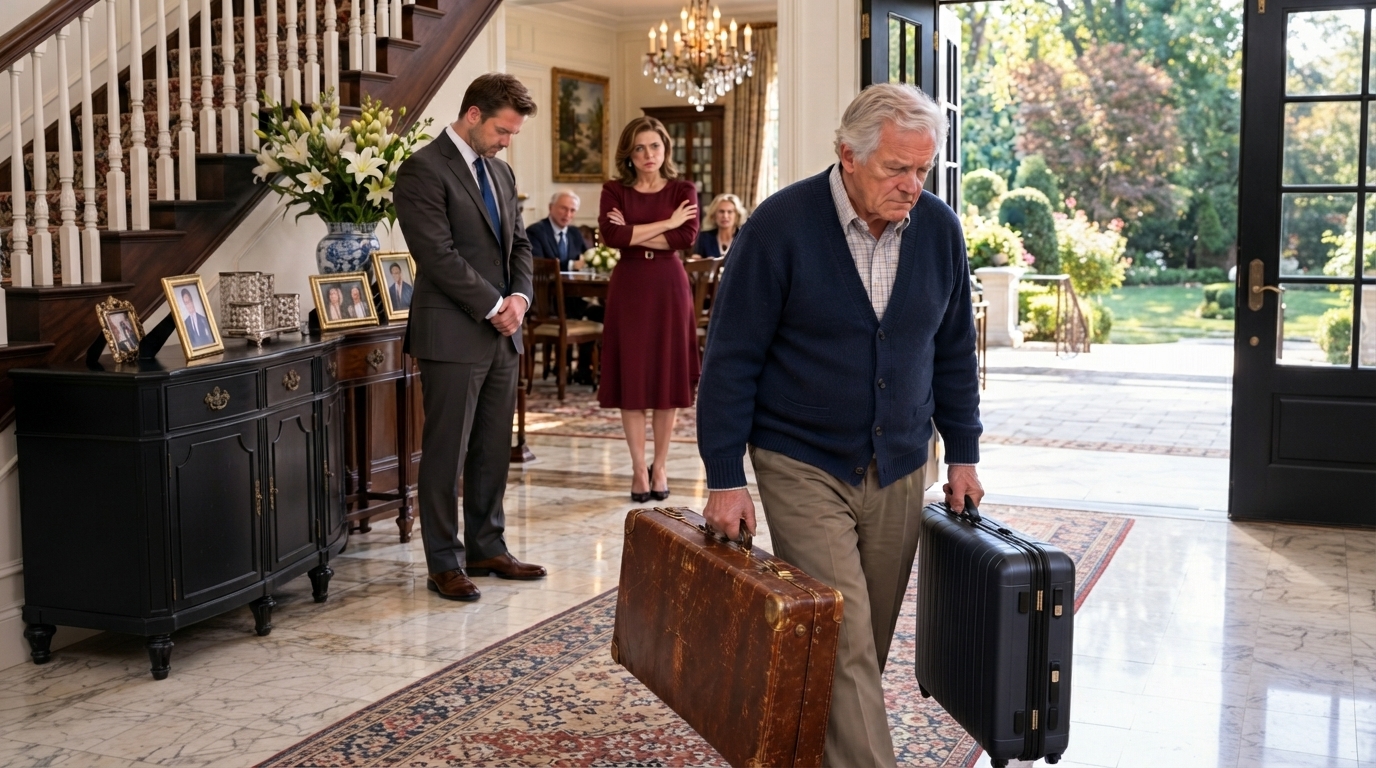
I packed my bags.
Left my key on the counter.
And walked away.
Three weeks later, three envelopes arrived at their door.
They thought those envelopes were punishment.
But they weren’t.
They were boundaries.
Written clearly.
Signed properly.
And delivered without anger.
The first ended my voluntary mortgage contributions.
The second addressed the business debt Logan had ignored.
The third began the process of separating my responsibility for the luxury SUV.
Those papers didn’t destroy my son’s life.
They forced him to see the life he had built.
And eventually, they gave him the opportunity to build something better.
Today, Logan visits me every other Sunday.
Sometimes we cook.
Sometimes we watch baseball.
Sometimes we sit quietly and talk about Margaret.
He still has financial challenges.
His business still requires hard work.
And our relationship still carries scars.
But when he visits, he doesn’t ask how much money I have.
He asks how I’ve been sleeping.
Whether I’ve eaten.
Whether my knee is bothering me.
And whether I’d like to come over for dinner.
Small questions.
Ordinary questions.
The kind that tell a person they matter.
I used to think I needed to leave my son a fortune to prove I loved him.
Now I know better.
The greatest inheritance I could give him wasn’t eight hundred thousand dollars.
It was the lesson that love does not entitle anyone to another person’s money, dignity, or silence.
And the greatest gift I gave myself?
I finally stopped paying to stay somewhere I wasn’t welcome.
I found a home where I could live without asking permission.
And at sixty-eight years old, I discovered something I should have understood long ago.
I wasn’t a burden because I needed a place to belong.
I was a father who deserved to be treated like family.
And this time, I made sure I was.
THE END THANK YOU FOR READING !!!