PART 3
For a long moment, I couldn’t speak.
I sat in my wheelchair inside
Daniel Whitmore’s beautiful office,
staring at a document that appeared to contain my signature.
Except I had never signed it.
The room was so quiet that I could hear the soft ticking of an expensive clock on the wall.
Daniel waited patiently.
Finally, I pointed at the paper.
“Where did Michael get that?”
Daniel folded his hands.
“That’s what our compliance department has been trying to determine.”
I leaned closer.
The document was titled Authorization for Financial Information and
Preliminary Account Review.
It listed my full name.
Helen Margaret Carter.
My date of birth.
My address.
And a signature at the bottom that looked remarkably similar to mine.
But something was wrong.
The capital H curved in a way I hadn’t written since I was a teenager.
And the final letter of Carter had a flourish I never used.
“That’s not my signature,” I whispered.
Daniel nodded.
“Our staff had concerns about its authenticity.”
I looked at him.
“Did Michael get any money?”
“No, ma’am. We did not accept the document as sufficient authorization, and no trust assets were released to him.”
I exhaled shakily.
Daniel continued.
“However, his inquiries raised concerns that someone might be
attempting to obtain control over your financial affairs without your knowledge.”
I stared at the paper.
Six months earlier, Michael had come to my house carrying groceries.
He’d been unusually affectionate.
He’d kissed my forehead.
Asked about my medications.
And insisted that I shouldn’t worry about paying bills.
At the time, I’d been grateful.
My mobility had been deteriorating, and I’d begun relying on a wheelchair for longer distances.
Then he’d asked me something strange.
“Mom, did Dad ever mention any investments outside his regular retirement accounts?”
I’d laughed.
“Your father invested in old fishing rods and broken lawnmowers.”
Michael hadn’t laughed.
He’d asked again.
“Seriously, Mom. Did he leave any other accounts?”
I’d told him no.
Or at least, none I knew about.
Now I understood why he’d been asking.
“Mr. Whitmore,” I said quietly, “how did my son know about this trust?”
Daniel hesitated.
“We don’t know exactly what information he had.”
He opened another folder.
“But he referenced a commercial property holding company connected to your husband’s estate.”
My heart began pounding.
“Commercial property?”
Daniel nodded.
“Your husband owned interests in several small commercial buildings through a holding company. Over time, those interests were sold or transferred into investments managed for the trust.”
I stared at him.
Robert had been an electrician.
A good one.
He’d worked long hours.
Fixed people’s wiring.
Installed ceiling fans.
And occasionally took small jobs on weekends.
We’d lived in the same three-bedroom house for thirty-six years.
He drove an old pickup until the transmission failed.
We took modest vacations.
We clipped coupons.
How could a man who complained about the price of coffee have accumulated millions?
Daniel seemed to understand my confusion.
“Mrs. Carter, your husband was one of our longest-standing private clients. He invested early in several properties that appreciated considerably.”
I swallowed.
“But why didn’t he tell me?”
Daniel looked toward the letter in my lap.
“I believe he wanted to explain that himself.”
I unfolded Robert’s letter.
The paper was thick and cream-colored.
His handwriting tilted slightly to the right, just as it always had.
I could almost hear his voice as I began reading.
My dearest Helen,
If you’re holding this letter, then you’ve found the card I left in my desk.
I hope you never needed it because you were frightened or desperate. I hope you found it while cleaning out old drawers, laughed at my terrible handwriting, and called me an old fool.
But if life has become difficult, I want you to know something.
You are not helpless.
My eyes filled.
I continued.
When we were young, I made a small investment with two men from the electrical company. We purchased a warehouse nobody wanted. Then another building. Then a few more.
I didn’t understand how valuable those investments would become.
Eventually, I realized we had more money than we would ever need.
I stopped reading.
Robert had never told me about any of this.
I looked at Daniel.
“He kept it secret for decades?”
Daniel spoke gently.
“I can’t explain every decision he made, ma’am.”
I nodded.
Then continued reading.
I should have told you everything sooner. I convinced myself I was protecting our simple life. I didn’t want money to change the way people treated us.
And I was afraid it would change Michael.
My breath caught.
I stared at the words.
Our son has always wanted more than he has. More recognition. More comfort. More proof that he’s successful.
I love him, Helen. But I’ve watched him confuse money with love, and I’ve worried about what might happen if he believed our savings belonged to him.
Tears slipped down my cheeks.
So I made arrangements to protect you. The trust is intended to provide for your comfort, medical care, housing, and security.
The assets are yours to benefit from under its terms. They are not Michael’s inheritance to claim while you are alive.
Please don’t feel guilty about using what we built.
And please don’t let anyone convince you that you are a burden.
I pressed the letter against my chest.
Robert.
My stubborn, quiet Robert.
He’d been dead four years.
And somehow, he was still trying to protect me.
Daniel waited while I cried.
When I finally looked up, he offered me a tissue.
“Mrs. Carter, there’s another letter.”
I blinked.
“Another?”
He nodded.
“This one was addressed to the trustee.”
He opened the folder and handed me a copy.
Robert had written it shortly before his death.
It contained instructions about contacting me, reviewing the trust, and making sure I understood the support available to me.
One paragraph stood out.
If Helen ever needs accessible housing, medical assistance, transportation, or full-time care, I want the trustee to help her obtain it without delay, subject to the trust’s terms.
I covered my mouth.
I’d spent the previous night sleeping on my couch because I couldn’t climb the stairs.
I’d been calculating whether I could afford groceries and medication.
And all that time, Robert had left resources specifically intended to help me.
I began crying again.
Not because of the money.
Because I’d been so frightened.
Because I’d believed I had nowhere to go.
Because my own son had looked at me sitting in a wheelchair and decided I was too inconvenient to let inside his house.
Daniel leaned forward.
“Mrs. Carter, I’d like to arrange a meeting with the trust administrator and an attorney who can independently advise you.”
I nodded.
“Can I use some of the money now?”
His expression softened.
“We can review the available distribution procedures today. There are provisions for your immediate support.”
I swallowed.
“I need somewhere safe to live.”
He nodded.
“Then that’s our first priority.”
I looked down at my hands.
“I’m embarrassed to ask.”
Daniel shook his head.
“Please don’t be.”
He paused.
“Your husband established these arrangements for you. Using them for your needs is exactly what he intended.”
For the first time in months, I felt something unfamiliar.
Relief.
That afternoon, Daniel arranged a private car to take me home.
Before I left, he asked whether I had someone I trusted who could help me.
I thought about Michael.
Then Ashley.
Then my grandchildren.
My chest tightened.
Finally, I said, “My niece, Sarah.”
Sarah was my younger sister’s daughter.
She was thirty-seven, a physical therapist, and had always been close to me.
She called every Sunday.
Visited whenever she could.
And never made me feel like an inconvenience.
Daniel nodded.
“Would you like to call her?”
I smiled weakly.
“Yes.”
Sarah answered on the second ring.
“Aunt Helen?”
I began crying.
She immediately became concerned.
“What’s wrong?”
I swallowed.
“Sweetheart, could you come over?”
“Of course. Are you hurt?”
“No.”
I looked at Robert’s letter.
“I’m just having a very strange day.”
Sarah arrived forty minutes after I got home.
She found me sitting at the kitchen table surrounded by papers.
The moment she saw my face, she knelt beside my wheelchair.
“Aunt Helen, what happened?”
I handed her the bank statement.
She read it.
Then read it again.
Her mouth fell open.
“Eight million dollars?”
I nodded.
She stared at me.
“Is this real?”
I laughed through tears.
“Apparently.”
Then I told her everything.
The trust.
Robert’s letter.
Michael’s inquiries.
The suspicious document.
And the humiliating visit to my son’s house.
By the time I finished, Sarah was crying.
“He turned you away?”
I nodded.
She looked furious.
“You were sitting outside his house in a wheelchair?”
I swallowed.
“Yes.”
She stood abruptly.
“I’m going to call him.”
“No.”
She stopped.
I reached for her hand.
“Please.”
She sat beside me.
I took a breath.
“I don’t want another argument today.”
Sarah looked at me.
“Then what do you want?”
I thought about it.
For years, I’d wanted Michael to love me the way he had when he was little.
I’d wanted him to call without needing something.
Visit without checking his watch.
Ask how I was feeling and actually listen to the answer.
But that morning, sitting inside the bank, something had changed.
I no longer wanted to beg.
I looked at Sarah.
“I want to live somewhere I can move around without being afraid of falling.”
She nodded.
“I can help with that.”
“And I want to understand what Michael was doing.”
Sarah squeezed my hand.
“We’ll find out.”
The following morning, my phone rang.
Michael.
I stared at his name.
For a moment, I considered ignoring it.
Then I answered.
“Hello?”
“Mom?”
His voice sounded unusually cheerful.
“Hi, sweetheart.”
He cleared his throat.
“Listen, about yesterday…”
I waited.
“Ashley and I talked.”
My heart gave a small, foolish jump.
Perhaps he’d reconsidered.
Perhaps he felt guilty.
Perhaps he wanted to apologize.
Then he continued.
“We think assisted living might be the best option for you.”
I closed my eyes.
“Michael, I’m already making arrangements.”
He paused.
“What arrangements?”
“Private ones.”
His tone changed.
“Mom, you shouldn’t make decisions without talking to me.”
I looked toward Robert’s letter.
“Why not?”
He sounded irritated.
“Because you’re not thinking clearly.”
I felt cold.
There it was again.
The same suggestion he’d made to the bank.
That I couldn’t manage my own life.
I took a breath.
“Michael, did you contact Pinnacle Private Banking?”
Silence.
Then he laughed.
“What?”
I repeated the question.
His voice sharpened.
“Why would you ask me that?”
I looked at the photocopy of the document.
“Because they showed me something with my name on it.”
The line went completely quiet.
Then Michael whispered, “Mom, what exactly did they tell you?”
And for the first time in my life, I realized my son wasn’t worried about my health.
He was worried about what I knew.
PART 4
I didn’t answer Michael’s question.
Instead, I asked one of my own.
“Did you sign my name to a bank document?”
He exhaled sharply.
“Mom, you’re misunderstanding everything.”
I closed my eyes.
“Then explain it.”
He hesitated.
“I was trying to help.”
I looked around my kitchen.
The peeling wallpaper.
The old refrigerator.
The staircase I could no longer climb.
“Help me do what?”
“Manage your affairs.”
I swallowed.
“Without telling me?”
He sighed.
“Mom, you’re eighty-one.”
I stared at the phone.
“I know how old I am.”
“You’re in a wheelchair.”
“I know that too.”
He lowered his voice.
“And you’ve been confused lately.”
My heart began pounding.
“Confused?”
He continued.
“You forget things.”
I thought about the pharmacy bag I’d carried to his house.
The medications I organized every Sunday.
The bills I still paid on time.
The appointments I scheduled myself.
I had mobility problems.
I sometimes misplaced my reading glasses.
But I wasn’t incapable of making decisions.
“Michael,” I said quietly, “what have I forgotten?”
He hesitated.
Then said, “That’s not the point.”
I felt something inside me break.
Not loudly.
Not dramatically.
Just a quiet snapping of the last thread of trust I’d been holding.
I took a breath.
“I’m going to have an attorney review the document.”
His voice rose.
“Mom, don’t be ridiculous.”
“I’ll speak to you later.”
“Wait!”
I ended the call.
Then I sat there trembling.
Sarah arrived an hour later.
She found me staring at the phone.
“What happened?”
I told her.
Her expression hardened.
“Aunt Helen, you need independent legal advice.”
I nodded.
“I know.”
She sat beside me.
“And we should make sure nobody has access to your accounts or personal documents without your permission.”
I looked at her.
“Do you think Michael would steal from me?”
Sarah hesitated.
“I think we need to find out what he actually did before deciding anything.”
I nodded slowly.
That was one of the reasons I trusted her.
She didn’t tell me what I wanted to hear.
She told me what I needed to consider.
Three days later, I met attorney Margaret Collins.
She was in her early sixties, with silver hair and a calm voice.
Her office was on the ground floor of a small building near the courthouse.
She greeted me warmly.
“Mrs. Carter, please call me Margaret.”
I smiled.
“Then you must call me Helen.”
She laughed.
“Deal.”
We spent nearly two hours reviewing the documents.
Margaret examined the trust information.
The suspicious authorization.
My existing estate documents.
And the correspondence Daniel had provided.
Then she looked at me.
“Helen, I want to separate two issues.”
I nodded.
“First, your husband established a trust that appears to provide substantial financial resources for your benefit. We need to confirm its terms and how distributions are authorized.”
I nodded again.
“Second, someone appears to have submitted a document using a signature you say is not yours.”
My stomach tightened.
She continued.
“That needs careful investigation.”
I swallowed.
“Could Michael go to prison?”
Margaret folded her hands.
“That depends on what happened, what can be proven, and whether any laws were violated. We shouldn’t jump to conclusions.”
I nodded.
“But you should preserve the evidence and avoid confronting him further until we understand the situation.”
I looked down.
“He’s my son.”
Her expression softened.
“I know.”
Tears filled my eyes.
“I don’t want to destroy his life.”
Margaret leaned forward.
“Helen, protecting yourself isn’t the same as destroying someone else.”
I began crying.
She waited.
Then said gently, “You have the right to make your own decisions, regardless of your age or mobility.”
I nodded.
“And if someone has misused your identity, you have the right to address that.”
Over the next several weeks, my life changed in ways I never imagined.
First, I moved.
Sarah helped me find a beautiful single-story house in a quiet neighborhood.
It had wide doorways.
A step-free entrance.
An accessible bathroom.
And a kitchen designed so I could reach the counters from my wheelchair.
There was a small garden outside the living room.
A screened porch.
And a bedroom large enough for my adjustable bed.
When I first rolled through the front door, I began crying.
Sarah looked alarmed.
“Aunt Helen?”
I shook my head.
“It’s beautiful.”
She smiled.
“You like it?”
I looked around.
“I can go everywhere.”
She laughed softly.
“Yes.”
I rolled into the kitchen.
Then the bedroom.
Then the bathroom.
No stairs.
No narrow doorways.
No dangerous corners.
For the first time in months, I didn’t feel trapped inside my own home.
I also arranged for a home health aide to visit several mornings each week.
Her name was Rosa.
She was fifty-four, cheerful, and had a laugh that filled the entire house.
She helped with tasks that were difficult for me.
But she never treated me like a child.
One morning, while helping me prepare breakfast, she asked whether I wanted scrambled eggs.
I smiled.
“Actually, I’d like oatmeal.”
She nodded.
“Oatmeal it is.”
Such a small thing.
But after months of hearing people tell me what was best for me, I nearly cried.
Rosa noticed.
“Everything okay, Mrs. Carter?”
I smiled.
“Yes, dear.”
Then I whispered, “It’s just nice to be asked.”
Meanwhile, Margaret and Daniel worked with the appropriate professionals to review the suspicious document.
They discovered that Michael had submitted the authorization while trying to learn whether he could become involved in managing my finances.
He had also contacted a separate legal services office to ask about guardianship procedures.
That alone wasn’t proof of wrongdoing.
Families sometimes seek guidance when a loved one genuinely needs help.
But Michael had made statements suggesting I couldn’t manage my affairs, even though he hadn’t obtained a professional evaluation supporting that claim.
And the signature remained unexplained.
Margaret recommended that I obtain an independent medical and cognitive assessment.
I agreed.
Not because Michael demanded it.
Because I wanted clear documentation of my abilities.
The evaluation confirmed that although I needed physical assistance, I could understand information, communicate decisions, and manage my affairs with appropriate support.
When Margaret reviewed the results, she smiled.
“Helen, this is important.”
I nodded.
“It means I’m not crazy?”
She laughed gently.
“It means your physical limitations shouldn’t be confused with an inability to make decisions.”
I smiled.
“That sounds much better.”
Then came the discovery that hurt me most.
Michael had been discussing my house with a real estate agent.
My old house.
The one Robert and I had bought thirty-six years earlier.
He’d asked about its market value.
Potential repairs.
And how quickly it could be sold if he obtained authority to act for me.
I stared at the documents.
“He wanted to sell my house?”
Margaret nodded.
“He appears to have explored that possibility.”
I looked away.
I’d raised Michael in that house.
I’d baked birthday cakes in its kitchen.
Helped him with homework at the dining table.
Stayed awake waiting for him to come home from school dances.
Robert had taught him to ride a bicycle in the driveway.
And Michael had been investigating how to sell it while I was still living there.
I began crying.
Margaret offered me a tissue.
I whispered, “Why didn’t he just ask me?”
She didn’t answer.
Because there wasn’t a good answer.
A week later, Michael appeared at my new house.
I was sitting on the screened porch drinking tea.
Rosa answered the door.
Then came outside.
“Mrs. Carter, there’s a man asking for you.”
I looked up.
Michael stood behind her.
His face was pale.
“Mom?”
I stared at him.
He looked around the porch.
Then toward the garden.
“Where did you get this place?”
I took a slow breath.
“Hello, Michael.”
He stepped forward.
“Seriously, Mom. What’s going on?”
I looked at Rosa.
“It’s okay. I’ll speak with him.”
She nodded but remained nearby.
Michael sat across from me.
He looked nervous.
“Did you sell the old house?”
“Not yet.”
He frowned.
“Then how are you paying for this?”
I studied his face.
For a moment, I wanted to tell him everything.
The trust.
The millions.
Robert’s letters.
The beautiful home.
But I remembered how he’d turned me away when he believed I had only two hundred thirty-seven dollars.
So I asked, “Why does it matter?”
He blinked.
“Because I’m your son.”
I nodded.
“Yes.”
“And I should know what’s happening.”
I looked at him.
“Michael, when I came to your house needing somewhere to sleep, you told me your routine was too important to change.”
His face tightened.
“Mom, we already discussed that.”
“No.”
I shook my head.
“We didn’t discuss it. You told me to leave.”
He looked away.
I continued.
“I wasn’t asking you to care for me forever. I needed a safe place for a week or two while I found somewhere accessible.”
He sighed.
“Ashley was overwhelmed.”
I nodded.
“And you?”
He stared at me.
I waited.
Finally, he whispered, “I didn’t know what to do.”
My eyes filled.
“You could have helped me make a plan.”
He looked down.
“You could have called a hotel.”
He said nothing.
“You could have helped me find temporary care.”
His shoulders sagged.
“Mom—”
I swallowed.
“You could have let me sit inside while we figured it out.”
He covered his face.
For the first time, he looked ashamed.
But I wasn’t finished.
“Michael, did you submit a document to Pinnacle Private Banking with my signature?”
His hands dropped.
He stared at me.
Then whispered, “You found out.”
My chest tightened.
I nodded.
“Yes.”
He looked toward the garden.
“I was trying to protect you.”
I shook my head.
“From what?”
He didn’t answer.
“Michael?”
He swallowed.
“Dad left things complicated.”
I stared at him.
“What things?”
He hesitated.
Then said, “I found some old financial papers after he died.”
My heart began pounding.
“What papers?”
“Statements. Property records. Names of companies.”
I leaned forward.
“Where?”
“In a box from his garage.”
I remembered the boxes Michael had taken after Robert’s funeral.
He’d offered to help sort through them.
I’d been grateful.
I hadn’t been able to face Robert’s belongings.
Michael continued.
“I thought Dad had investments.”
I swallowed.
“So you went looking for them.”
He nodded.
“Yes.”
“And when you couldn’t access them, you tried to use my name.”
He stared at the floor.
Finally, he whispered, “I shouldn’t have done that.”
My eyes filled.
“Did you sign the document?”
He didn’t answer immediately.
Then he nodded.
“Yes.”
I closed my eyes.
The admission hurt worse than anything the bank had shown me.
My own son had used my identity without permission.
“Why?” I whispered.
Michael began crying.
He told me his business had been struggling.
He’d invested in a small construction company with a friend.
The company had lost several major contracts.
He’d borrowed money.
Then borrowed more to cover the first loans.
Ashley didn’t know the full extent of the debt.
And Michael had begun panicking.
When he found Robert’s old financial papers, he believed there might be money available.
Money he could use to save his business.
I stared at him.
“How much do you owe?”
He swallowed.
“About two hundred eighty thousand.”
I felt dizzy.
“Michael.”
He covered his face.
“I know.”
I shook my head.
“Why didn’t you tell me?”
He laughed bitterly.
“Because you couldn’t help.”
The words hung between us.
I stared at him.
He seemed to realize what he’d said.
“Mom, I didn’t mean—”
I raised my hand.
“Stop.”
He fell silent.
I looked toward the garden.
The flowers were blooming.
A small bird landed on the fence.
Somewhere inside, Rosa was washing dishes.
I took a slow breath.
“You thought I had nothing.”
Michael looked down.
I continued.
“So you didn’t think I could help you.”
He swallowed.
“And when you thought Dad might have left money, you tried to get control of it.”
He began crying.
“I’m sorry.”
I looked at him.
“Michael, you didn’t just make a financial mistake.”
My voice trembled.
“You treated me like I was already gone.”
He stayed for another twenty minutes.
I told him I loved him.
But I also told him that he needed to cooperate with the professionals reviewing the document.
He needed to seek independent legal advice.
He needed to be honest with Ashley.
And he needed to understand that I would not give him access to my finances.
He nodded through tears.
Before leaving, he stood beside my wheelchair.
“Mom?”
I looked up.
“Do you hate me?”
My heart broke.
“No, sweetheart.”
He began crying.
I reached for his hand.
“But loving you doesn’t mean pretending you didn’t hurt me.”
He nodded.
Then whispered, “I understand.”
I wasn’t sure he did.
Not yet.
But for the first time, he was listening.
PART 5
Six months after I found Robert’s card, I received a letter from Ashley.
It was handwritten.
Three pages.
She began by apologizing for the day I arrived at their house.
She admitted that the guest room hadn’t been under renovation.
It had been empty.
She’d simply been afraid that allowing me to stay would turn into a permanent responsibility.
I sat on my porch reading her words.
My hands trembled.
She wrote that she’d been overwhelmed by the children, Michael’s financial problems, and the pressure of maintaining a lifestyle they could no longer afford.
She admitted that she’d chosen convenience over compassion.
Then she wrote something that made me cry.
I watched you roll away from our house, and I knew we were doing something cruel. I didn’t stop it because I was afraid of making Michael angry. I’m ashamed of that.
I folded the letter.
For a long time, I stared at the garden.
Then I called her.
Ashley answered cautiously.
“Helen?”
“Hello, dear.”
She began crying.
“I’m so sorry.”
I closed my eyes.
“I read your letter.”
She sniffled.
“I meant every word.”
I nodded.
“I believe you.”
There was a pause.
Then she whispered, “Can I bring the children to see you?”
My heart tightened.
I hadn’t seen my grandchildren in months.
I’d missed birthdays.
School events.
Ordinary Sunday afternoons.
I looked toward the little garden.
“Yes,” I whispered.
“I’d like that.”
They came the following Saturday.
My oldest grandson, Ethan, was fourteen.
My granddaughter Lily was eleven.
And little Noah was seven.
The moment they saw me, they ran across the living room.
“Grandma!”
I opened my arms.
They hugged me so tightly that I began laughing and crying at the same time.
Ethan stepped back.
“Grandma, your house is awesome.”
I smiled.
“Thank you, sweetheart.”
Lily looked toward the kitchen.
“Can you actually reach everything?”
I laughed.
“Most things.”
Noah stared at my wheelchair.
Then asked, “Grandma, can you race?”
Ashley looked horrified.
“Noah!”
I burst out laughing.
“Well, I can try.”
Ten minutes later, Noah and I were racing down the wide hallway.
He won.
Mostly because I let him.
At least, that’s what I told him.
After lunch, Lily sat beside me on the porch.
She was unusually quiet.
I looked at her.
“Everything okay, sweetheart?”
She nodded.
Then shook her head.
“Grandma?”
“Yes?”
“Why didn’t you stay with us?”
My heart tightened.
I took a slow breath.
“Your parents weren’t able to have me stay at the time.”
She looked down.
“Dad said you didn’t want to.”
I closed my eyes.
Then I gently took her hand.
“Lily, sometimes grown-ups make mistakes.”
She nodded.
“And sometimes they don’t explain things very well.”
She looked at me.
“Were you sad?”
My eyes filled.
“Yes, sweetheart.”
She leaned against me.
“I’m sorry.”
I kissed her hair.
“You didn’t do anything wrong.”
She hugged me.
And I promised myself that whatever happened between Michael and me, I would never make those children responsible for it.
The investigation into the bank document continued.
Michael eventually acknowledged in writing that he’d signed my name without authorization.
The bank preserved its records.
Margaret advised me about reporting options and protecting my identity.
The matter was referred to the appropriate authorities for review.
I didn’t attempt to influence the outcome.
And I didn’t pay Michael’s debts to make the problem disappear.
That decision was harder than I expected.
Every maternal instinct I had wanted to rescue him.
To write a check.
To solve everything.
To make sure he never suffered.
But I remembered Robert’s letter.
Please don’t let anyone convince you that you are a burden.
And I realized something else.
I couldn’t keep teaching Michael that every mistake would eventually become somebody else’s responsibility.
He was forty-eight years old.
He had a wife.
Three children.
And choices to make.
He needed to face them.
Michael’s business eventually closed.
He sold equipment.
Negotiated repayment arrangements with creditors.
And took a salaried job with a construction supplier.
It was a difficult adjustment.
He’d been proud of owning his own company.
Now he had a supervisor.
A fixed schedule.
And a smaller income.
But for the first time in years, he was earning money without borrowing more to maintain appearances.
Ashley returned to work part-time.
They sold one of their vehicles.
Canceled several expensive memberships.
And began rebuilding their finances.
I heard most of this from Ashley.
Michael rarely called.
When he did, our conversations were awkward.
But I stopped chasing him.
I had spent too many years begging for a place in his life.
If he wanted a relationship with me, he would have to help build one.
One afternoon, Daniel Whitmore called.
“Mrs. Carter, I wanted to let you know that the trust’s annual review is complete.”
I smiled.
“Thank you.”
He continued.
“The portfolio remains well positioned for your needs, subject to normal investment risks and future expenses.”
I nodded.
“That’s good.”
Then he asked, “Are you comfortable in your new home?”
I looked around.
The sunlight fell across the living room floor.
Rosa had placed fresh flowers on the table.
My wheelchair moved easily through the wide doorway.
I smiled.
“Very.”
Daniel sounded pleased.
“Your husband would have been happy to hear that.”
My eyes filled.
“I think so.”
Then I asked something I’d been wondering.
“Daniel, did Robert ever talk about me?”
There was a pause.
Then he laughed softly.
“All the time.”
I smiled through tears.
“What did he say?”
Daniel’s voice softened.
“He said you were the reason he worked so hard.”
I covered my mouth.
“He said you gave him a life worth protecting.”
I began crying.
Daniel waited.
Then added, “He also said you were the only person who could convince him to throw away an old shirt.”
I burst out laughing.
“That sounds like Robert.”
A year after the day Michael turned me away, I received an unexpected visitor.
It was Michael.
He stood at my front door holding a small wooden box.
He looked different.
Thinner.
Older.
His hair had more gray.
And he wasn’t wearing the expensive polo shirts he used to favor.
“Mom?”
I looked at him.
“Hello, Michael.”
He swallowed.
“Could we talk?”
I hesitated.
Then nodded.
“Come in.”
We sat on the screened porch.
He placed the wooden box on the table.
For several minutes, neither of us spoke.
Then Michael looked at me.
“I’ve been going to counseling.”
I nodded.
“I’m glad.”
He swallowed.
“I’ve been trying to understand why I treated you the way I did.”
I waited.
He looked toward the garden.
“I was ashamed.”
My chest tightened.
“Of what?”
“Everything.”
He laughed bitterly.
“My business was failing. I was drowning in debt. I couldn’t admit it to Ashley. I couldn’t admit it to my friends.”
He rubbed his face.
“And when you came to my house needing help, I felt like I was failing at one more thing.”
I looked at him.
“So you sent me away.”
He nodded.
“Yes.”
Tears filled his eyes.
“I told myself you needed professional care. I told myself our house wasn’t suitable.”
He swallowed.
“But the truth is, I didn’t want another problem.”
My eyes filled.
Michael began crying.
“And you weren’t a problem, Mom.”
He covered his face.
“You were my mother.”
I sat quietly.
He continued.
“I’ve thought about that day a thousand times.”
He looked at me.
“You had one suitcase.”
I nodded.
“And your medication.”
My throat tightened.
“You asked for a week.”
I wiped my eyes.
He began sobbing.
“And I couldn’t even let you inside.”
For a long time, neither of us spoke.
Then he whispered, “I’m sorry.”
I looked at him.
This time, the apology felt different.
He wasn’t asking for money.
He wasn’t asking me to fix his problems.
He wasn’t defending himself.
He was finally acknowledging what he’d done.
I took a slow breath.
“Thank you for saying that.”
He nodded.
Then pushed the wooden box toward me.
“Dad made this.”
I stared at it.
It was a small jewelry box made from dark walnut.
Robert had always enjoyed woodworking.
He made shelves.
Picture frames.
Little wooden toys for the grandchildren.
I opened the box.
Inside was a photograph of Michael as a little boy sitting on Robert’s shoulders.
And beneath it was a folded note.
I recognized Robert’s handwriting.
Michael, remember that the measure of a man isn’t how much he owns. It’s how he treats the people who need him.
I stared at the words.
Tears streamed down my face.
Michael whispered, “Dad gave me that when I graduated college.”
I looked up.
“I remember.”
He nodded.
“I put it away because I thought it was old-fashioned advice.”
He swallowed.
“Turns out it was the most important thing he ever told me.”
We talked for nearly three hours.
About Robert.
About the old house.
About Michael’s childhood.
About the mistakes we’d both made.
I told him how frightened I’d been after my mobility declined.
How lonely I’d felt.
How humiliating it was to ask for help and be turned away.
He listened.
He didn’t interrupt.
He didn’t defend Ashley.
He didn’t explain away his choices.
And when I told him that trust would take time to rebuild, he nodded.
“I know.”
Then he said something I hadn’t expected.
“Mom, I don’t want your money.”
I looked at him.
He continued.
“I know you have resources now. I don’t know how much, and I don’t need to.”
I studied his face.
He swallowed.
“I want to be your son again.”
My eyes filled.
I reached across the table.
“Then start by calling me on Sundays.”
He laughed through tears.
“I can do that.”
Our relationship didn’t heal overnight.
Some weeks, Michael called.
Other weeks, he forgot.
Sometimes our conversations were uncomfortable.
Sometimes I remembered the bank document and felt angry all over again.
But gradually, things improved.
He began visiting without asking about finances.
He helped me plant flowers.
Fixed a loose cabinet hinge.
And occasionally brought the grandchildren over for dinner.
One Sunday, he arrived carrying groceries.
I raised an eyebrow.
“What’s all this?”
He smiled.
“Thought I’d make lunch.”
I laughed.
“Since when do you cook?”
He shrugged.
“I’m learning.”
He made grilled cheese sandwiches.
Burned the first batch.
And nearly set off the smoke alarm.
I laughed so hard I cried.
Michael grinned.
“Dad would’ve loved this.”
I nodded.
“He certainly would.”
Eventually, the matter involving the unauthorized bank document reached a formal resolution.
Michael accepted responsibility for his actions and complied with the requirements imposed through the legal process.
I didn’t pretend the incident had never happened.
I kept independent control of my finances.
My attorney helped me update my estate documents and review my future care arrangements.
I also established clear instructions about who could assist me if my health changed.
Those decisions were mine.
Not Michael’s.
Not Ashley’s.
Not Sarah’s.
Mine.
And everyone understood that.
As for the old house, I sold it the following spring.
Not because Michael wanted me to.
Not because I was forced to.
But because I no longer needed a two-story home filled with rooms I couldn’t use.
I hired a real estate agent.
Reviewed the offers.
And chose a family with two young children.
On closing day, I visited one final time.
Sarah drove me.
We entered through the front door.
The house was empty.
Our furniture was gone.
The walls looked strangely bare.
I rolled into the kitchen.
For a moment, I could almost hear Robert humming while making coffee.
I remembered Michael running through the hallway as a little boy.
Birthday parties.
Christmas mornings.
Arguments.
Laughter.
Thirty-six years of ordinary life.
I began crying.
Sarah knelt beside me.
“Aunt Helen?”
I smiled through tears.
“I’m okay.”
She squeezed my hand.
“Are you sure?”
I nodded.
“It’s just hard saying goodbye.”
She looked around.
“You made a lot of memories here.”
I smiled.
“Yes.”
Then I looked toward the staircase.
The stairs I could no longer climb.
And I realized something.
I wasn’t losing my home.
I was leaving a building that no longer fit the life I wanted to live.
Home had moved with me.
That evening, Michael came over.
He brought a framed photograph.
It showed Robert and me standing outside our old house on the day we bought it.
We were young.
Smiling.
Robert had his arm around my waist.
I was holding the keys.
Michael placed the photograph on my mantel.
“I thought you might want this.”
I stared at it.
Then smiled.
“Thank you, sweetheart.”
He looked around my new living room.
“Mom?”
“Yes?”
“Are you happy here?”
I thought about it.
Then nodded.
“Very.”
He smiled.
“Good.”
For a moment, I saw the little boy he’d once been.
The one who brought me dandelions from the yard.
The one who cried when his goldfish died.
The one who used to climb into my lap and tell me I was his favorite person.
I knew that boy was still somewhere inside the man standing before me.
But I also knew love couldn’t erase accountability.
So I hugged him.
And let our relationship continue growing at its own pace.
Two years after I found Robert’s card, my life looks nothing like it did that terrible Sunday.
I live in a beautiful accessible home.
I have the care I need.
I spend afternoons in my garden.
I volunteer with a local organization that helps older adults find transportation and housing resources.
And every Thursday, Sarah comes over for lunch.
Sometimes we talk about books.
Sometimes we watch old movies.
Sometimes we sit on the porch and say almost nothing.
It’s wonderful.
Michael visits regularly now.
He still works for the construction supplier.
His finances are improving.
Ashley and I have rebuilt a cautious relationship.
And my grandchildren have discovered that Grandma’s house is an excellent place for sleepovers.
Noah especially loves the wide hallway.
He insists it’s perfect for wheelchair races.
I keep telling him he’s too fast.
He keeps telling me I need a better engine.
Last month, I found Robert’s original letter while organizing my desk.
I sat beside the window and read it again.
Please don’t let anyone convince you that you are a burden.
I stared at those words for a long time.
Then I looked around my home.
At the flowers.
The photographs.
The wide doorways.
The sunlight.
The life I’d built after believing everything was falling apart.
I smiled.
Robert had left me money.
Yes.
More than I could ever have imagined.
But the greatest gift wasn’t the trust.
It was the reminder that I still had choices.
That my age didn’t make me invisible.
That my wheelchair didn’t make me helpless.
And that needing assistance didn’t make me less deserving of respect.
People sometimes ask whether I would have forgiven Michael if the bank account had contained only two hundred thirty-seven dollars.
I think about that question often.
And my answer is simple.
Forgiveness was never supposed to depend on money.
Neither was love.
I didn’t forgive Michael because he finally discovered I was wealthy.
I began rebuilding our relationship because he acknowledged what he’d done, accepted consequences, and started treating me differently.
And I didn’t need his permission to live well.
I already had that right.
One Sunday afternoon, Michael arrived with the children.
We had lunch on the screened porch.
Afterward, Noah climbed onto the chair beside my wheelchair.
“Grandma?”
I smiled.
“Yes, sweetheart?”
He looked serious.
“When you get really, really old, can you still live here?”
I laughed.
“I’m already pretty old.”
He shook his head.
“No. I mean a hundred.”
I smiled.
“Well, I hope so.”
He thought for a moment.
Then said, “If you need help, you can come to my house.”
My throat tightened.
I looked at Michael.
He was standing in the doorway.
His eyes filled.
Noah continued.
“You can have my room. I’ll sleep on the couch.”
I began crying.
I pulled him into my arms.
“Oh, sweetheart.”
He hugged me.
Then whispered, “Because you’re family.”
I closed my eyes.
For a moment, I remembered that terrible Sunday.
The suitcase on my lap.
The pharmacy bag hanging from my wheelchair.
The closed door.
The humiliation of being turned away.
Then I looked at my grandson.
And smiled.
“Thank you, Noah.”
I kissed his forehead.
“But hopefully, we’ll find a way for everybody to have a comfortable place to sleep.”
He nodded solemnly.
“Okay.”
Then he grinned.
“Can we race now?”
I burst out laughing.
“Only if you give Grandma a head start.”
That evening, after everyone left, I sat alone on the porch.
The sun was setting.
The garden glowed orange and gold.
A warm breeze moved through the trees.
I held Robert’s old banking card in my hand.
The embossed letters had faded slightly.
The corners were worn.
On the back, his handwriting remained.
Emergency access only.
I smiled.
For years, I’d thought an emergency meant a hospital bill.
A broken car.
A sudden expense.
Something money could fix.
But Robert had understood something deeper.
Sometimes the emergency is discovering that the people you depend on won’t help you.
Sometimes it’s realizing you’ve spent too long accepting less than you deserve.
And sometimes it’s the moment you finally decide to take control of your own life.
I placed the card back inside its envelope.
Then looked toward the framed photograph of Robert and me.
“Thank you, darling,” I whispered.
I imagined his familiar smile.
The way he’d wink when he thought he’d done something clever.
The way he’d say, “Well, Helen, I guess we figured it out.”
And I laughed softly.
Because we had.
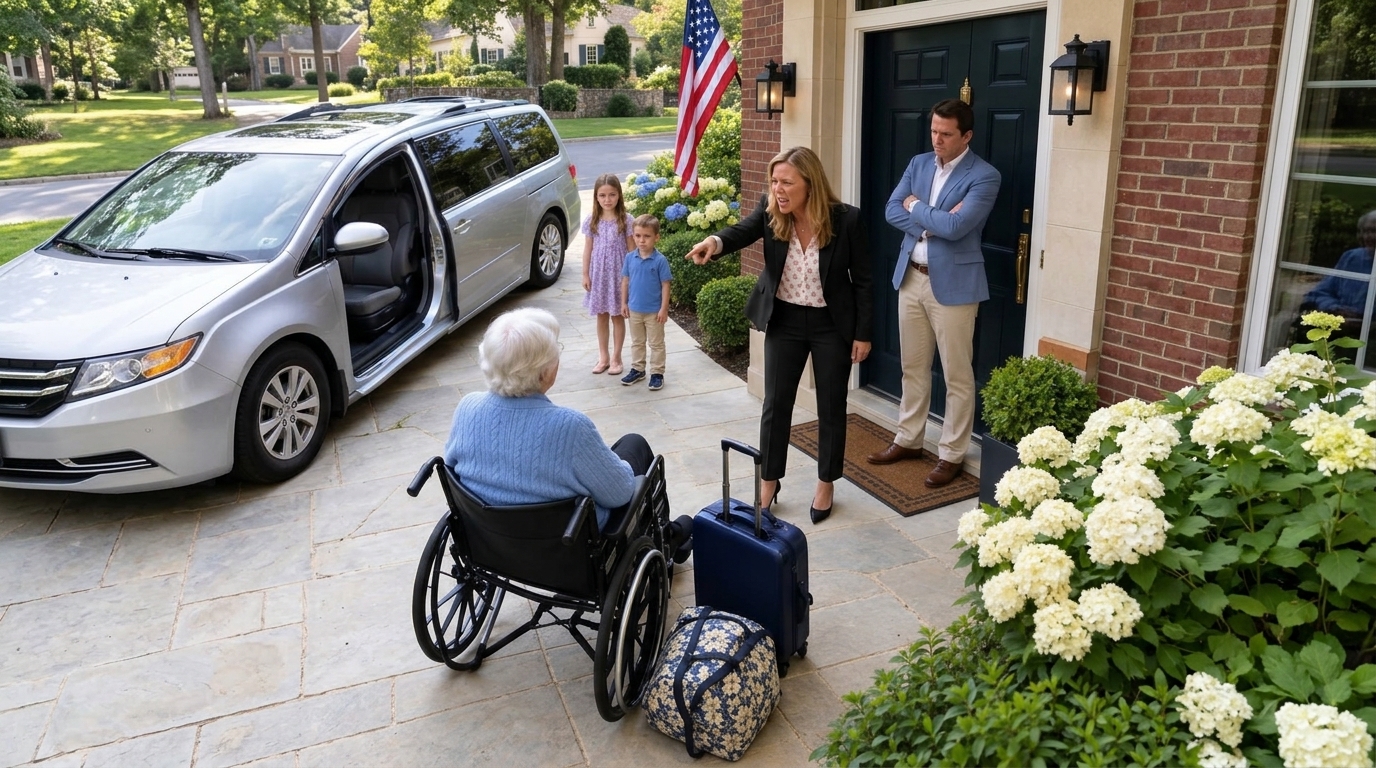
I showed up at my son’s house in a wheelchair, begging for somewhere to stay.
He turned me away.
The next morning, I discovered that my husband had left me a fortune.
But the real surprise wasn’t the money.
It was learning that I could build a good life without begging anyone to make room for me.
I didn’t need a mansion.
I didn’t need expensive jewelry.
I didn’t need people suddenly becoming kind because they thought I was wealthy.
I needed safety.
Independence.
Dignity.
And people who loved me without calculating what they might receive in return.
Today, I have those things.
And if there’s one lesson I hope my family remembers, it’s this:
Never measure an older person’s worth by their bank balance, their physical abilities, or how much help they need.
Because the woman sitting in that wheelchair might have spent a lifetime raising children, building a family, loving someone, and surviving hardships nobody else can see.
She might have more strength than you imagine.
More wisdom than you expect.
And more life left to live than anyone realizes.
I know.
Because that woman was me.
And my story wasn’t over when my son closed his door.
It was only beginning.
THE END THANK YOU FOR READING !!!



