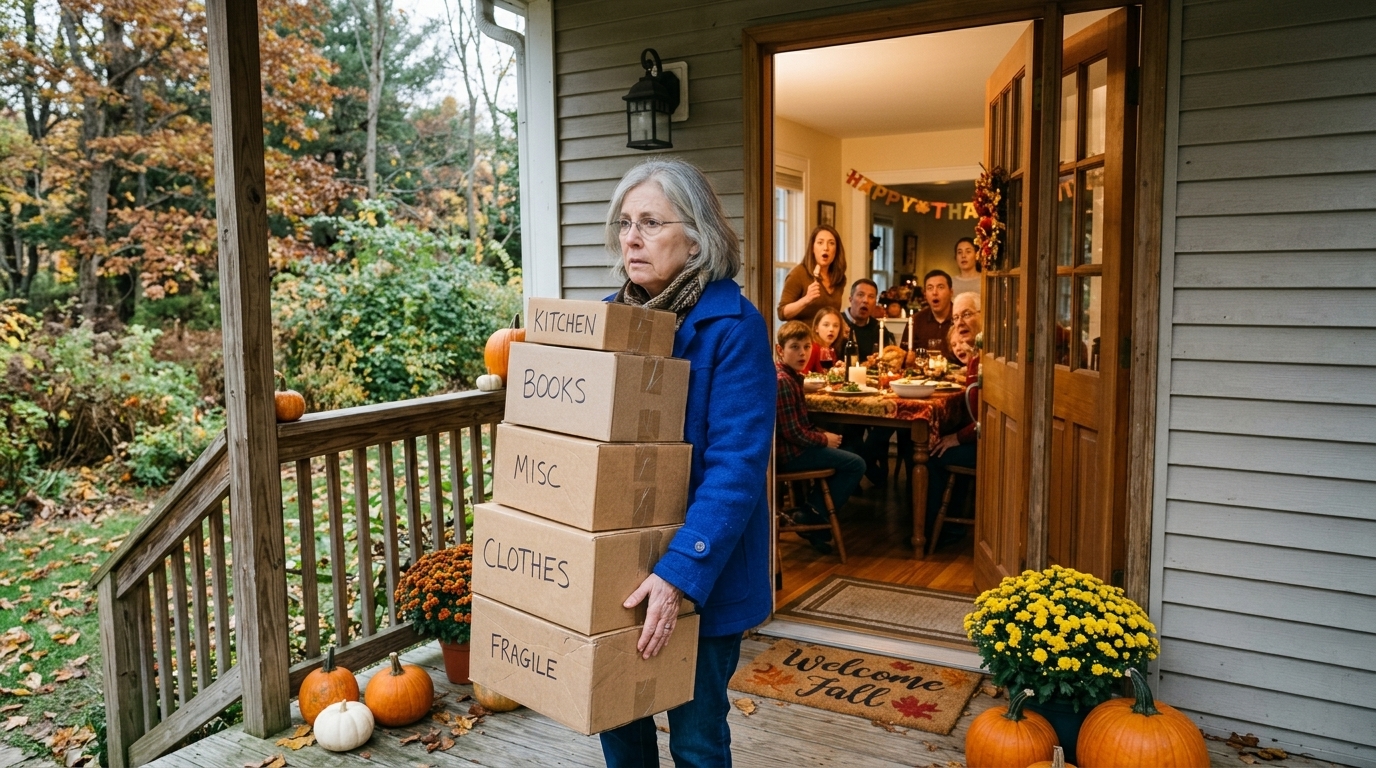
PART 3
I stood in my son’s dining room with four
Thanksgiving pies on the table,
my mother’s gravy boat in Michael’s hands,
and a letter from my dead husband trembling between my fingers.
Across the top, in the familiar slant of his handwriting,
were six words that made my heart nearly stop.
“Eleanor, Michael must never believe her.”
For a moment, I couldn’t hear anything.
Not the television playing football in the living room.
Not the children whispering near the staircase.
Not Melissa’s mother asking what was happening.
All I could see was my husband’s handwriting.
Thomas had been dead for three years.
Three years, two months, and eleven days, to be exact.
I knew because I still counted.
I counted the mornings I woke up reaching for him.
I counted the holidays I spent pretending I was comfortable alone.
I counted the times I picked up the telephone to tell him something before remembering there was nobody waiting at the other end.
And now, standing in the middle of the Thanksgiving dinner I’d been excluded from, I was holding a letter he had apparently written before he died.
A letter someone had hidden from me.
“Grandma?”
My granddaughter, Lily, touched my elbow.
She was sixteen, with her father’s dark eyes and the same stubborn chin Thomas used to have.
“I found the box in the attic,” she whispered. “I was looking for the Christmas decorations. It had your name on it.”
I looked down.
The cardboard box was dusty, but the writing across the lid was unmistakable.
ELEANOR — PERSONAL
Thomas’s handwriting.
I raised my eyes toward Melissa.
She stood beside the kitchen doorway, one hand gripping the back of a dining chair.
“Why,” I asked quietly, “were my husband’s letters in your attic?”
Melissa opened her mouth.
Then closed it.
Michael looked between us.
“Melissa?”
She forced a small laugh.
“Those are probably just old papers from when we helped Mom clean out the house.”
I stared at her.
“Then why weren’t they given to me?”
“Eleanor, this isn’t the time.”
I looked around the table.
Fourteen people.
A roasted turkey.
Crystal glasses.
My mother’s gravy boat.
My sweet potato pies.
And three years of lies sitting between the serving dishes.
“Actually,” I said, “I think this is exactly the time.”
Melissa’s father, Harold, slowly put down his fork.
“Someone needs to explain what’s going on.”
His wife, Patricia, remained standing.
She looked from Melissa to me with growing disbelief.
“Melissa told us Eleanor couldn’t handle family gatherings after Thomas died,” Patricia said. “She said the holidays made her unpredictable.”
I felt something twist inside my chest.
“Unpredictable?”
Patricia’s expression softened.
“She said you became angry whenever anyone mentioned Thomas.”
I looked at my son.
Michael was still holding the gravy boat.
“Is that what you believed?”
He shook his head.
“No. Melissa told me you didn’t want to come because the memories were too painful.”
“And you never asked me?”
His face changed.
“Mom, I called you.”
“Yes,” I whispered. “You called me every November and told me you were keeping Thanksgiving small.”
Michael went completely still.
I continued.
“You said it would just be Melissa and the children. You told me you understood if I wanted a quiet holiday too.”
He looked toward his wife.
“Melissa told me she’d invited you.”
My voice cracked.
“She never did.”
Silence settled over the room.
Then Lily spoke.
“Dad, Grandma asked me last year whether we were having a big Thanksgiving. I told Mom, and she said Grandma was confused.”
Michael closed his eyes.
Melissa snapped, “Lily, that’s enough.”
My granddaughter flinched.
I stepped closer to her.
“No,” I said. “She hasn’t done anything wrong.”
Melissa turned toward me.
“Eleanor, you’re making a scene.”
I almost laughed.
For three years, I’d eaten turkey sandwiches alone while my family celebrated around a table covered with my mother’s dishes.
And somehow, I was the one making a scene.
I carefully unfolded Thomas’s letter.
The first page was dated six weeks before his death.
My hands shook as I began reading.
My darling Eleanor,
If you’re reading this, I hope I had the courage to tell you everything myself. But if I didn’t, there’s something you need to know about the conversations I’ve been having with Melissa.
She has been telling Michael that your grief is making you unstable. She says you forget things, become confused, and sometimes say things you don’t remember.
I don’t believe her.
I’ve watched you care for me through every treatment, every hospital visit, and every difficult night. You’ve been exhausted, but you haven’t lost your judgment.
I’m worried Melissa is trying to convince Michael that you shouldn’t be trusted to make decisions about your own life.
I stopped reading.
My throat had closed.
Thomas had written those words while he was dying.
While I was measuring his medication, washing his sheets, and sitting beside him through nights when he couldn’t sleep.
He had been worried about me.
Even then.
“Mom,” Michael whispered, “what does that mean?”
I looked at Melissa.
She was staring at the floor.
“Ask your wife.”
Melissa’s voice rose.
“Thomas was heavily medicated. He didn’t always know what he was saying.”
I felt a sudden, fierce anger.
“Don’t you dare.”
She looked up.
“Excuse me?”
“Don’t you dare use my husband’s illness to dismiss his words.”
Michael set the gravy boat down.
“Melissa, why would Dad write that?”
She shook her head.
“I don’t know.”
But I could see something in her expression.
Recognition.
Fear.
She knew exactly what Thomas had been talking about.
Patricia approached the table.
“Eleanor, perhaps you should sit down.”
I hadn’t realized my knees were shaking.
She pulled out a chair.
I sat.
Then I reached into the cardboard box.
There were six envelopes.
All addressed to me.
There was also a small notebook, a photograph of Thomas and me standing outside our first house, and a blue velvet pouch.
I recognized the pouch immediately.
My wedding earrings.
Thomas had given them to me on our twenty-fifth anniversary.
I’d searched for them after his funeral.
Melissa had told me they must have been misplaced during the hospital visits.
I opened the pouch.
The earrings were still there.
Tiny pearls surrounded by delicate gold leaves.
I pressed them into my palm.
“Those were missing too,” I whispered.
Michael looked at Melissa.
“Why were Mom’s earrings in our attic?”
Melissa folded her arms.
“I packed everything when we cleaned out the house. I didn’t know what belonged to whom.”
I looked at her.
“Then why was my mother’s gravy boat in your dining room?”
She said nothing.
“And Thomas’s cardigan?”
At the far end of the table, an older man shifted uncomfortably.
He was wearing the green cardigan I’d seen in last year’s Thanksgiving photograph.
Patricia’s brother, Uncle Raymond.
He looked down at the sweater.
“Melissa gave this to me last Christmas,” he said. “She told me it had belonged to her grandfather.”
I stared at the cardigan.
Thomas used to wear it on cold mornings.
There was a tiny repair near the left cuff where I’d sewn a loose thread.
I could see it from across the table.
Raymond stood.
“Mrs. Whitmore, I had no idea.”
He began taking it off.
“Please,” I said gently, “not right now.”
His face reddened.
“I’ll have it cleaned and returned.”
“Thank you.”
Then Michael reached for the second letter.
“Mom, may I?”
I hesitated.
Those letters belonged to me.
But I could see something breaking in my son’s face.
The certainty he’d carried into that room was gone.
I handed him the envelope.
He unfolded it.
His eyes moved across the page.
Then his face drained of color.
“What?” I asked.
He looked at me.
“Dad says Melissa tried to get him to sign paperwork about your house.”
The room went silent again.
I stared at my son.
“What paperwork?”
Michael looked at his wife.
“Melissa?”
She stepped backward.
“That’s not what happened.”
Michael raised the letter.
“Dad says you brought him a document authorizing you to help manage Mom’s finances.”
I felt cold.
Our house had been paid off for twelve years.
Thomas and I had worked nearly four decades to own it outright.
After his diagnosis, he’d insisted that I keep the house no matter what happened.
It was my security.
My home.
The place where I’d raised our son.
I looked at Melissa.
“Did you ask my dying husband to give you control over my finances?”
She stared at me.
Then she said the sentence that changed everything.
“I was trying to protect Michael’s inheritance.”
Nobody moved.
Even the children went quiet.
Michael lowered the letter.
“My inheritance?”
Melissa’s eyes widened.
She seemed to realize what she’d admitted.
“I didn’t mean it like that.”
I stood slowly.
“Then tell us what you meant.”
She looked around the room.
Her father was staring at her.
Her mother had one hand over her mouth.
Michael looked as though he barely recognized his wife.
And Lily stood beside me, holding the cardboard box.
Melissa finally whispered, “I thought Eleanor would waste everything after Thomas died.”
I felt my heart break in a completely different way.
Not because of the accusation.
Because of the years she’d spent treating me as though I were already gone.
I looked at my son.
“Michael, I need to know something.”
He swallowed.
“What?”
“Did you ever believe I couldn’t take care of myself?”
His eyes filled.
“Mom, I thought you were grieving.”
“I was grieving.”
“I know.”
“But grieving doesn’t mean I stopped being your mother.”
He lowered his head.
And for the first time in three years, I saw genuine shame on his face.
I picked up the next envelope.
Then I noticed something written on the back.
If Melissa has hidden these letters, look inside the blue notebook.
I opened it.
On the first page was a list of dates.
Beside each date, Thomas had written a short description.
And at the bottom, underlined twice, were four words.
Ask Michael about June.
I looked at my son.
“Michael, what happened in June?”
He stared at the notebook.
Then he whispered, “That’s when Melissa told me you wanted to sell the house.”
PART 4
I looked at Michael for a long moment.
“Sell my house?”
He nodded slowly.
“Melissa said you were thinking about moving into a retirement community.”
I felt as though someone had struck me.
“Michael, I never said that.”
His eyes moved toward his wife.
“She told me you’d been having trouble managing the stairs.”
I shook my head.
“I still climb those stairs every day.”
“She said you were worried about living alone.”
“Of course I was lonely. Your father had just died.”
My voice cracked.
“But loneliness isn’t the same as wanting to give away my home.”
Melissa stepped forward.
“Eleanor, you were overwhelmed. You don’t remember everything you said.”
I turned toward her.
“Stop.”
She blinked.
“Stop telling me what I remember.”
The room went quiet.
I continued.
“I remember sitting beside Thomas when he couldn’t sleep. I remember the sound of his oxygen machine. I remember the day he asked me to promise I’d keep the garden alive.”
My eyes filled.
“And I remember the morning after his funeral when you came to my house with boxes and told me you were helping.”
Melissa looked away.
“You were helping yourself,” I whispered.
Michael sat heavily in the chair beside me.
He looked at the blue notebook.
“Mom, Dad wrote about the house?”
I nodded.
He turned the pages.
Thomas had been meticulous.
He’d spent forty-two years working as a municipal engineer.
He labeled everything.
Receipts.
Insurance papers.
Warranty information.
Even the instructions for changing the furnace filter.
When he suspected something was wrong, he’d apparently begun documenting it the same way.
One entry described a conversation with Melissa about selling the house.
Another recorded her suggestion that I move into an assisted-living facility.
A third mentioned paperwork she’d brought to the hospital.
And beside one date, Thomas had written:
Melissa says Eleanor agreed. Eleanor says no such thing. I believe my wife.
I pressed my fingers against my lips.
That was Thomas.
Quiet.
Practical.
Unshakably loyal.
He hadn’t always been good with emotional speeches.
But when it mattered, he stood beside me.
Michael turned another page.
Then he stopped.
“What is this?”
I leaned closer.
There was a photocopy of a document.
At the top were the words:
PROPERTY MANAGEMENT AUTHORIZATION
The document listed my name.
My address.
And Melissa as the proposed authorized representative.
The signature line was blank.
I looked at it.
“Thomas never told me about this.”
Michael swallowed.
“Dad must have refused to sign.”
Melissa’s voice became sharp.
“It was just an option!”
Michael looked up.
“An option for what?”
“To help Eleanor!”
“With what?”
Melissa gestured helplessly.
“Bills. Repairs. Financial decisions.”
I stared at her.
“Melissa, I managed the household finances for forty years.”
She flushed.
“I know.”
“Then why did you think I suddenly needed you to do it?”
She didn’t answer.
Michael stood.
“Did you tell me Mom wanted to move because you thought we’d get the house?”
Melissa’s face tightened.
“Michael, don’t be ridiculous.”
“Answer me.”
She looked toward her parents.
Patricia had begun crying.
Harold’s expression was grim.
Finally, Melissa said, “We were struggling financially.”
Michael stared at her.
“What?”
She lowered her voice.
“We were behind on some things.”
I looked around the dining room.
The expensive chandelier.
The new furniture.
The polished silverware.
The elaborate Thanksgiving decorations.
Everything looked perfect.
Apparently, appearances had been more important than honesty.
Michael stepped closer.
“What things?”
Melissa shook her head.
“Not here.”
“Melissa.”
She burst into tears.
“Credit cards! The second mortgage! The business loan!”
Michael froze.
“What second mortgage?”
Her eyes widened.
I could see she’d said too much.
Michael turned toward Harold.
“Did you know about this?”
Harold shook his head.
“No.”
Patricia sat down.
“Oh, Melissa.”
Michael looked at his wife.
“You told me the house was almost paid off.”
“It is.”
“How much do we owe?”
She began crying harder.
Michael repeated the question.
“How much?”
Finally, she whispered, “A hundred and eighty-six thousand.”
The silence that followed was terrible.
Michael gripped the back of a chair.
“We owed ninety thousand last year.”
“I know.”
“What happened to the rest?”
Melissa covered her face.
And for the first time that morning, I realized the Thanksgiving lies were part of something much bigger.
I hadn’t come to their house expecting to uncover financial secrets.
I’d come for my mother’s gravy boat.
And perhaps, if I was being honest, I’d come because I wanted someone to acknowledge that I’d been deliberately excluded.
But now the room was filled with revelations nobody could take back.
Michael stared at his wife.
“Did you borrow more money without telling me?”
Melissa nodded.
“Why?”
“I was trying to keep everything together.”
“By lying?”
She began sobbing.
I looked away.
I didn’t enjoy watching my son’s marriage unravel.
Despite everything Melissa had done, I knew he loved her.
They had two children.
A home.
Years of shared memories.
And whatever happened next would hurt people who had done nothing wrong.
Especially Lily and her younger brother, Ben.
I reached for Michael’s arm.
“Son, this conversation needs to happen privately.”
He looked at me.
“Mom, she’s been lying to everyone.”
“I know.”
His eyes filled.
“I believed her.”
I squeezed his hand.
“I know that too.”
He looked toward the box.
“Dad tried to warn me.”
I nodded.
“But he didn’t get the chance.”
Michael shook his head.
“No. I didn’t give him the chance.”
That sentence made me stop.
“What do you mean?”
He stared at the floor.
“Dad asked me to come by the hospital alone. A few days before he died.”
I felt my stomach tighten.
“He did?”
Michael nodded.
“Melissa said he was confused and upset about the medication. She told me he needed rest.”
My heart sank.
“Did you go?”
He shook his head.
“I called instead. He sounded tired. He said we needed to talk.”
Michael’s voice broke.
“I told him we’d talk when he came home.”
I closed my eyes.
Thomas never came home.
The rest of Thanksgiving dinner fell apart quietly.
Nobody wanted turkey.
Nobody wanted pie.
Patricia began helping the children put away the decorations.
Harold offered to drive Raymond home.
Melissa disappeared upstairs.
Michael sat at the table, reading his father’s letters.
I stayed beside him.
For the first time in three years, my son and I were together on Thanksgiving.
Not because anyone had invited me.
Because the truth had finally opened the door.
After an hour, Michael looked up.
“Mom?”
“Yes?”
“Why didn’t you tell me you worked at Hartley’s?”
I gave a small, sad smile.
“You never asked.”
He looked ashamed.
“I thought you were doing volunteer work at the library.”
“I did that for a while.”
“Why the bakery?”
I looked toward the pies.
“Because I needed somewhere to go in the mornings.”
He waited.
“After your father died, the house was too quiet. I’d wake up at four and lie there listening to the refrigerator hum.”
My voice softened.
“I’d baked all my life. Hartley’s needed someone who could handle the early shift. So I applied.”
Michael stared at me.
“You’ve been working there for three years?”
“Yes.”
“And Melissa’s been ordering pies from you?”
“Every November.”
He looked at the four pies on the table.
I continued.
“I baked the sweet potato pie using your grandmother’s recipe. I made the apple pie the way your father liked it. I added extra cinnamon to the pumpkin because Lily always loved it.”
Michael covered his face.
I felt tears slipping down my cheeks.
“I knew what everyone liked, Michael. I remembered every birthday. Every allergy. Every favorite dessert.”
I swallowed.
“But nobody remembered to ask whether I wanted a place at the table.”
He began crying.
Not quietly.
Not politely.
He cried the way he used to when he was a little boy and something hurt too badly for words.
“Mom, I’m so sorry.”
I reached for him.
He leaned against my shoulder.
And for a moment, he was six years old again.
My little boy.
The one who used to run into the kitchen and ask whether he could lick the cake batter from the spoon.
The one who cried when his father left for business trips.
The one who promised me he’d never move away.
I held him.
But I didn’t tell him everything was fine.
Because it wasn’t.
Before I left, Lily brought me another envelope.
“This was underneath the notebook,” she said.
It was sealed.
On the front, Thomas had written:
For Eleanor, when she needs to remember who she is.
My breath caught.
I slipped it into my purse.
I couldn’t read another letter in that house.
Not yet.
Then I walked toward the dining table.
My mother’s gravy boat sat beside the untouched turkey.
I picked it up carefully.
Michael watched.
“Mom, take whatever belongs to you.”
I looked around.
The cardigan.
The earrings.
The gravy boat.
The letters.
So many pieces of my life had been scattered through this house without my permission.
But I wasn’t going to carry everything out in anger.
“I’ll make a list,” I said. “We can arrange for the rest later.”
Michael nodded.
Then he whispered, “Will you come back?”
I looked at him.
“Not until we understand what happened.”
His eyes filled.
“I know.”
“And Michael?”
“Yes?”
“Don’t ask me to pretend this didn’t hurt.”
He shook his head.
“I won’t.”
When I got home, the house was dark.
I set the gravy boat on the kitchen table.
Then I opened the final envelope.
Thomas’s handwriting filled three pages.
My beautiful Eleanor,
If you’re reading this, I hope you’re sitting somewhere comfortable with a cup of tea. I know you. You’ll be trying to stay strong even when nobody is watching.
You’ve spent your entire life making sure everyone else had enough. Enough food. Enough warmth. Enough love.
But I worry that after I’m gone, you’ll forget you deserve those things too.
Please don’t let anyone convince you that getting older means becoming less important.
You are not a burden.
You are not an inconvenience.
You are the woman who made every house we lived in feel like home.
If Michael loses his way, I hope he finds it again. But you must not spend the rest of your life waiting at a door someone refuses to open.
Build a life that makes you happy.
Make your pies.
Plant your roses.
Laugh with your friends.
And remember that being alone is not the same as being unwanted.
I loved you when we had nothing.
I loved you when we had everything.
And I will love you in every memory you carry.
Always, Thomas.
I read the letter three times.
Then I laid my head on the kitchen table and cried.
For the husband I’d lost.
For the holidays I’d spent alone.
For the son who had believed someone else’s story.
And for the woman I’d almost forgotten I was.
But when I finally lifted my head, I knew something had changed.
I wasn’t going to spend another Thanksgiving waiting for permission to belong.
PART 5
The Monday after Thanksgiving, Michael came to my house.
He arrived at nine in the morning carrying a grocery bag.
When I opened the door, he looked nervous.
“Hi, Mom.”
“Hello, Michael.”
He held up the bag.
“I brought coffee and cinnamon rolls.”
I looked at him.
“From Hartley’s?”
He gave a sad smile.
“Yes.”
I stepped aside.
“Come in.”
He walked into the kitchen and stopped.
My mother’s gravy boat sat on the shelf beside the window.
Thomas’s photograph stood nearby.
The house looked exactly as it always had.
Warm.
Clean.
Filled with the things I’d spent a lifetime collecting.
Michael stared at the table.
“I forgot how much I love this kitchen.”
I poured coffee.
“You used to do your homework right there.”
He smiled faintly.
“And Dad used to make me redo the math problems when I guessed.”
I laughed.
“He certainly did.”
For a few minutes, we talked about ordinary things.
The weather.
The bakery.
Lily’s school.
Ben’s soccer team.
Then Michael set down his cup.
“Mom, I need to tell you what happened after you left.”
I waited.
“Melissa and I had a long conversation.”
I nodded.
“She admitted she’d been telling me you refused our invitations.”
My chest tightened.
“Why?”
Michael looked ashamed.
“She said she didn’t want you coming because she felt judged by you.”
I stared at him.
“Judged?”
He nodded.
“She said whenever you came over, she felt like you were comparing her cooking to yours.”
I almost laughed.
“Michael, I haven’t been invited to cook in your kitchen for years.”
“I know.”
“She used my recipes.”
“I know.”
“She served food in my mother’s dishes.”
He lowered his eyes.
“I know.”
I took a breath.
“Then what exactly was she afraid of?”
Michael was quiet.
Finally, he said, “She was afraid you’d notice how much money we were spending.”
That surprised me.
He continued.
“She wanted everyone to think we were doing better than we were. She thought you’d ask questions.”
I stared at him.
“And she didn’t want me asking those questions either.”
He nodded.
“Exactly.”
Michael explained that he’d begun reviewing their finances.
The situation was worse than he’d realized.
Melissa had accumulated substantial credit card debt.
She’d borrowed against their home.
And she’d used money intended for household expenses to maintain appearances.
Expensive holidays.
Designer furniture.
Lavish parties.
Gifts they couldn’t afford.
She had also borrowed money from her parents without telling Michael.
Patricia and Harold had believed they were helping with temporary expenses.
They hadn’t known about the second mortgage either.
“Mom,” Michael whispered, “I don’t know how I missed it.”
I looked at him.
“Sometimes people don’t see what they’re afraid to find.”
He nodded.
“I trusted her.”
“Of course you did.”
He looked up.
“But I should have trusted you too.”
That hurt.
Because it was true.
I reached across the table.
“Michael, your marriage is your responsibility. I won’t tell you whether to stay or leave.”
He nodded.
“But I will tell you something.”
“What?”
“Never let anyone make you choose between loving your wife and treating your mother with basic respect.”
His eyes filled.
“I know.”
“And never make Lily or Ben feel they have to take sides.”
He nodded again.
“I won’t.”
Over the following weeks, Michael began making changes.
He met with a financial counselor.
He consulted an attorney about the debts.
He and Melissa agreed to separate their finances temporarily while they determined what obligations existed.
They also began marriage counseling.
I didn’t ask for every detail.
Some things belonged between husband and wife.
But Michael called me regularly.
Not to ask for money.
Not to complain about Melissa.
Just to talk.
Sometimes he asked about my day at the bakery.
Sometimes he told me about the children.
Sometimes we sat quietly on the telephone while he drove home from work.
It wasn’t the relationship we’d had before.
But perhaps that was a good thing.
Before, we’d been pretending everything was fine.
Now we were learning how to tell the truth.
Two weeks before Christmas, Patricia called.
I was kneading dough when my phone rang.
“Eleanor?”
“Yes?”
“This is Patricia.”
I wiped flour from my hands.
“Hello.”
She hesitated.
“I hope I’m not bothering you.”
“Not at all.”
She took a breath.
“I wanted to apologize.”
I leaned against the counter.
“Patricia, you didn’t know what was happening.”
“I should have questioned it.”
I said nothing.
“She told us you didn’t want to come. She said you were struggling after Thomas died.”
My throat tightened.
“I was struggling.”
“I know.”
“But I wasn’t refusing my family.”
Patricia’s voice broke.
“I understand that now.”
There was a long silence.
Then she said, “Eleanor, I have something that belongs to you.”
I straightened.
“What?”
“Thomas’s green cardigan.”
I closed my eyes.
“Raymond brought it back.”
“He had it professionally cleaned. He said he wanted you to know he never would have accepted it if he’d understood.”
Tears filled my eyes.
“That’s kind of him.”
Patricia hesitated.
“Could I bring it over?”
I looked around the bakery.
The ovens were humming.
The morning light was beginning to fill the windows.
“Yes,” I said. “I’d like that.”
Patricia arrived the next afternoon.
She carried the cardigan in a garment bag.
When she handed it to me, I pressed the fabric against my cheek.
It still had the tiny repair near the cuff.
My stitches.
My husband’s sweater.
A piece of the life I’d thought was gone forever.
Patricia watched quietly.
Then she said, “I never knew Thomas very well.”
I smiled through my tears.
“He was a good man.”
“I can tell.”
She looked toward the kitchen.
“Melissa said you were difficult.”
I gave a small laugh.
“I suppose I can be.”
Patricia shook her head.
“No. I think you were someone she couldn’t control.”
I looked at her.
She continued.
“Melissa has always struggled when things don’t go the way she expects. I thought marriage and motherhood had helped her grow out of it.”
Her eyes filled.
“Apparently, I was wrong.”
I didn’t know what to say.
Patricia reached for my hand.
“I’m not asking you to forgive her.”
I nodded.
“But I hope you know that what happened wasn’t right.”
“Thank you.”
She squeezed my fingers.
Then she asked, “Would you like to have lunch sometime?”
I stared at her.
The question was so simple.
So ordinary.
And yet, after years of exclusion, it felt enormous.
“I’d like that,” I said.
Christmas came quietly.
Michael invited me to dinner.
This time, he called personally.
He didn’t say Melissa had invited me.
He didn’t ask whether I wanted to be alone.
He simply said, “Mom, I’d really like you there.”
I appreciated that.
But I wasn’t ready.
Not yet.
So I told him the truth.
“Michael, I love you. But I need more time before I can sit at that table again.”
He was quiet.
Then he said, “I understand.”
I expected disappointment.
Maybe frustration.
Instead, he asked, “Could I bring the kids over Christmas morning?”
My heart softened.
“Of course.”
And that’s what we did.
Lily and Ben arrived at ten.
They brought homemade cookies and a small potted rosebush.
Lily hugged me so tightly I could barely breathe.
“Grandma, I’m sorry I didn’t know.”
I held her.
“You have nothing to apologize for.”
She shook her head.
“I should have asked why you never came.”
I pulled back.
“Lily, adults are responsible for telling the truth. Not children.”
Her eyes filled.
I kissed her forehead.
Then Ben handed me a card.
He’d drawn our family standing beside a Christmas tree.
There were five people in the picture.
Michael.
Melissa.
Lily.
Ben.
And me.
At the bottom, he’d written:
GRANDMA BELONGS WITH US.
I had to sit down.
Michael knelt beside my chair.
“Mom?”
I showed him the card.
His eyes filled.
Then he whispered, “He’s right.”
The next several months were difficult for Michael and Melissa.
They continued counseling.
They worked with professionals to understand their finances.
Melissa began working part-time.
She sold some of the expensive furniture she’d purchased.
She stopped hosting elaborate parties.
And slowly, the life she’d worked so hard to make look perfect began becoming something more honest.
But there was one thing she still hadn’t done.
She hadn’t apologized to me.
Not directly.
Not without excuses.
She’d sent messages through Michael.
She’d told Patricia she felt terrible.
She’d even sent flowers.
But every note contained some version of the same explanation.
I was overwhelmed.
I was under pressure.
I didn’t mean for things to go this far.
None of those words acknowledged what she’d actually done.
So I didn’t respond.
I continued living my life.
I worked at Hartley’s.
I planted roses.
I joined a book club.
And every Wednesday, I had dinner with two women from the bakery.
For the first time since Thomas died, I stopped measuring my happiness by whether my son called.
I began building a life that belonged to me.
In April, Melissa finally appeared at my door.
She stood on the porch holding nothing.
No flowers.
No gifts.
No excuses written on a card.
Just herself.
“Eleanor,” she said quietly, “may I come in?”
I studied her.
Then I stepped aside.
We sat at the kitchen table.
For a long moment, neither of us spoke.
Finally, Melissa looked at me.
“I lied to you.”
I waited.
“I told Michael you refused our invitations. I told my parents you didn’t want to come. And I let everyone believe you preferred being alone.”
Her voice shook.
“I knew that wasn’t true.”
I felt my chest tighten.
She continued.
“I also took things from your house after Thomas died. I told myself I was helping pack, but I kept items I wanted.”
Tears filled her eyes.
“And I tried to convince Thomas that you needed help managing your affairs because I wanted access to the house.”
I looked at her.
“Why?”
She swallowed.
“Because I was afraid of losing the life I’d built.”
I waited.
She shook her head.
“And because I was selfish.”
That was the first time she’d said it.
Without blaming grief.
Without blaming stress.
Without pretending it had been a misunderstanding.
“I was cruel to you,” she whispered. “And I made Michael believe you didn’t want him.”
My eyes burned.
Melissa began crying.
“I don’t expect you to forgive me. I just wanted you to hear the truth from me.”
I sat quietly.
Then I said, “Melissa, do you know what hurt the most?”
She shook her head.
“It wasn’t the gravy boat.”
Her eyes filled.
“It wasn’t the cardigan or the earrings.”
I swallowed.
“It was imagining my family sitting around a table, laughing and eating food I’d taught them to make, while I sat alone believing nobody wanted me there.”
Melissa covered her face.
I continued.
“And then learning that you had told everyone I was the one refusing to come.”
She sobbed.
“I know.”
“No,” I whispered. “I don’t think you do.”
She looked up.
“Maybe I never will.”
I nodded.
“That may be true.”
For a while, we sat in silence.
Then she asked, “Is there anything I can do?”
I thought carefully.
“Yes.”
She straightened.
“Tell Lily and Ben the truth in a way they can understand. Don’t make them carry your guilt. And never use me as an excuse again.”
She nodded.
“I will.”
“And Melissa?”
“Yes?”
“Don’t ask me to pretend we’re close.”
Her face fell.
I continued gently.
“Trust has to be rebuilt. It can’t be demanded.”
She wiped her eyes.
“I understand.”
For the first time, I believed she might.
By the following November, things had changed.
Not perfectly.
Not magically.
But enough.
Michael and Melissa were still married.
They had made progress in counseling and were slowly rebuilding their finances.
The children were doing well.
Patricia and I had become friends.
And I was no longer spending every holiday alone.
But I had made one important decision.
I wasn’t waiting for anyone to invite me to Thanksgiving.
I was hosting my own.
Not a grand dinner.
Not fourteen people.
Just a gathering of people who wanted to be there.
I invited my friends from the bakery.
Patricia and Harold.
My neighbor, Mrs. Wilson.
A widower from church named George.
And, after some thought, Michael, Melissa, Lily, and Ben.
I didn’t invite them because I felt obligated.
I invited them because I wanted to.
That distinction mattered.
On Thanksgiving morning, I woke at four thirty.
Old habits.
I put on my apron.
Turned on the oven.
And began preparing the sweet potato pie.
My mother’s recipe.
Extra nutmeg.
A little brown sugar.
A pinch of salt.
The same recipe I’d been making for more than forty years.
As I rolled out the crust, I thought about Thomas.
He used to sneak into the kitchen and steal pieces of dough.
I’d pretend to be angry.
He’d grin.
Then he’d kiss my cheek and tell me I made the best pies in the world.
I smiled at the memory.
For the first time in years, it didn’t hurt quite so much.
At eleven, the doorbell rang.
Michael stood on the porch carrying a large roasting pan.
Lily held flowers.
Ben carried a bag of dinner rolls.
And Melissa stood beside them with a casserole dish.
“Happy Thanksgiving, Mom,” Michael said.
I smiled.
“Happy Thanksgiving.”
He hugged me.
Then Lily rushed into my arms.
Ben followed.
Melissa remained near the doorway.
I looked at her.
“Come in, Melissa.”
Her eyes filled.
“Thank you.”
I stepped aside.
By one o’clock, my kitchen was full.
Patricia was setting the table.
Harold was carving the turkey.
George was telling a story about the time he accidentally cooked a frozen turkey without removing the package of giblets.
Everyone was laughing.
My bakery friends were arguing about whether apple pie or pumpkin pie was better.
Lily was arranging flowers.
Ben was sneaking dinner rolls.
And Michael was standing beside me at the stove.
“Mom?”
“Yes?”
“Can I help with the gravy?”
I looked at him.
Then I smiled.
“Of course.”
I handed him the wooden spoon.
He stirred carefully.
Then he looked toward the counter.
My mother’s white gravy boat sat there.
Clean.
Polished.
The gold rim shining beneath the kitchen light.
Michael picked it up.
For a moment, he simply held it.
Then he said, “I remember Grandma using this.”
I nodded.
“She brought it out every Thanksgiving.”
He smiled sadly.
“She used to tell me not to touch it.”
I laughed.
“She told everyone that.”
Michael looked at me.
“I’m glad it’s home.”
I felt tears gathering.
“So am I.”
When everyone finally sat down, I counted the chairs.
Eleven.
Not fourteen.
Not an enormous gathering designed to impress anyone.
Just eleven people who had chosen to share a meal.
Michael stood.
“Before we eat, I’d like to say something.”
The room quieted.
He looked at me.
“Last year, my mother spent Thanksgiving alone because I believed something that wasn’t true.”
Melissa lowered her eyes.
Michael continued.
“I should have asked questions. I should have called her directly. And I should have made sure she knew she had a place at our table.”
His voice cracked.
“I didn’t.”
I felt tears slipping down my cheeks.
He looked around the room.
“This year, I want to thank Mom for giving us another chance to be a family.”
He raised his glass.
“To Mom.”
Everyone lifted their glasses.
I looked at Michael.
Then at Lily and Ben.
At Patricia.
At my friends.
And finally, at the empty chair near the window.
Thomas’s chair.
I’d placed his photograph beside it.
Not because I couldn’t move forward.
But because moving forward didn’t mean forgetting.
I lifted my glass.
“To the people who make room for us,” I said.
Everyone smiled.
Then I added, “And to remembering that nobody should have to beg for a seat at their own family’s table.”
Michael wiped his eyes.
Melissa nodded quietly.
And we began eating.
After dinner, Lily helped me carry dishes into the kitchen.
She looked at the four pies cooling on the counter.
“Grandma?”
“Yes, sweetheart?”
“Are these the same pies Mom used to order from Hartley’s?”
I smiled.
“Exactly the same.”
She grinned.
“Then they’re the best pies in the world.”
I laughed.
“Your grandfather used to say that.”
Lily looked toward his photograph.
“I wish I remembered him better.”
I placed a hand on her shoulder.
“Then I’ll tell you stories.”
Her eyes brightened.
“Really?”
“As many as you want.”
We carried the pies into the dining room.
And for the first time in four years, I served my own Thanksgiving dessert to my own family.
Nobody had ordered it.
Nobody had paid for it.
Nobody had hidden my name from the guests.
I simply placed the pies on the table.
And everyone knew who had made them.
That night, after the last guest left, I stood alone in the kitchen.
The dishes were washed.
The leftovers were packed.
The tablecloth was folded.
The house was quiet again.
But it was a different kind of quiet.
Not the aching silence of being forgotten.
The peaceful silence that comes after a day filled with laughter.
I took Thomas’s final letter from the drawer.
I’d read it so many times that the folds had begun to soften.
I sat at the kitchen table.
Then I read the sentence that had stayed with me all year.
You must not spend the rest of your life waiting at a door someone refuses to open.
I looked around my kitchen.
At the roses on the windowsill.
At my mother’s gravy boat.
At the photograph of Thomas smiling beside our old Christmas tree.
And I finally understood.
For three years, I’d waited for my son to invite me back into the family.
I’d waited for Melissa to tell the truth.
I’d waited for someone to notice the empty place where I should have been.
But I’d forgotten that I could build a table of my own.
A table where nobody had to earn love.
Where nobody was excluded to protect appearances.
Where grief was allowed.
Where mistakes could be acknowledged.
And where forgiveness didn’t require forgetting.
I folded Thomas’s letter.
Then I whispered, “I did it, sweetheart.”
The house remained quiet.
But for the first time, the quiet didn’t feel empty.
It felt like peace.
Because the greatest thing I recovered that Thanksgiving wasn’t my mother’s gravy boat.
It wasn’t my husband’s cardigan.
It wasn’t even the letters he’d left behind.
It was the belief that I deserved to be loved openly, honestly, and without conditions.
And I would never surrender that belief again.
THE END THANK YOU FOR READING !!!



