PART 3
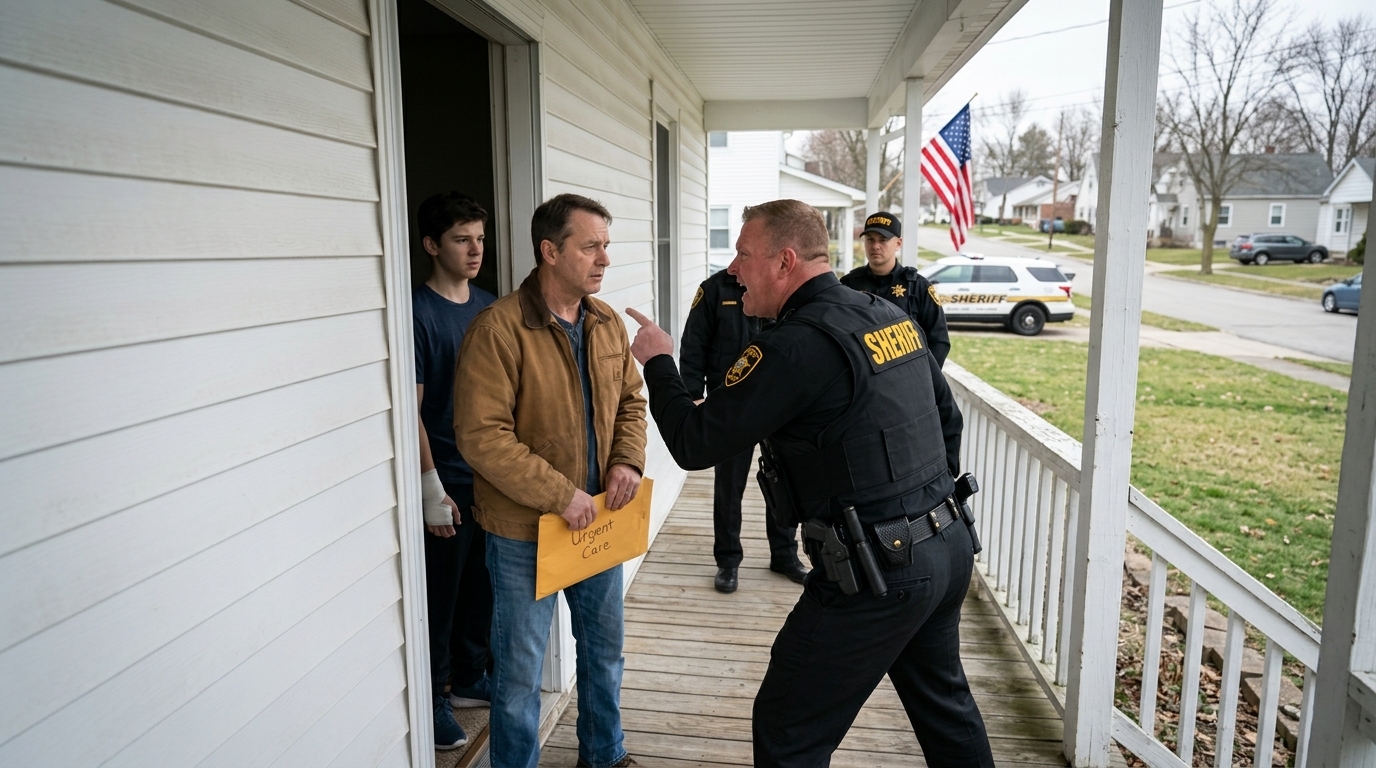
Sheriff Carl Gaines stared at Deputy Susan Parsons as though
she had just betrayed him in front of the entire county.
“What did you say?”
Susan didn’t move.
“I said Drew’s case isn’t the first.”
The Montana wind pushed against the porch railing.
Somewhere behind the house, a loose piece of metal rattled against the shed.
My son stood in the doorway,
his broken arm held carefully against his chest.
I could feel him watching.
For weeks, Drew had been afraid of Neil Gaines.
Now he was watching Neil’s father discover what fear felt like.
Sheriff Gaines took one step toward Susan.
“You’d better explain yourself.”
She looked him directly in the eyes.
“I already explained everything to the state investigators.”
The sheriff’s expression changed.
Not dramatically.
Just enough.
His jaw tightened. His eyes narrowed. The finger he’d been pointing at me slowly lowered.
“What exactly did you give them?”
Susan didn’t answer immediately.
Then she said, “Copies of the reports you ordered me to bury.”
The silence that followed was extraordinary.
One of the other deputies looked away.
The third stared at the porch boards.
And Sheriff Gaines, a man who had spent nearly two decades making people uncomfortable with his silence, suddenly seemed unable to tolerate it himself.
“You’re lying.”
Susan shook her head.
“No, Sheriff.”
“You stole department records.”
“I preserved records that were being improperly withheld.”
His face turned darker.
“You’re finished in this county.”
Susan’s voice remained steady.
“Maybe.”
Then she added, “But I won’t be the only one answering questions.”
I stepped forward.
“Sheriff, you need to leave my property.”
He turned toward me.
“You think this is over?”
“No,” I answered. “I think it’s finally beginning.”
His mouth twisted.
“You have no idea who you’re dealing with.”
I looked at the badge on his chest.
“That’s what you told me three days ago.”
He said nothing.
I continued.
“But I know exactly who I’m dealing with now.”
Gaines looked past my shoulder toward Drew.
For one terrible second, I saw the same contempt in his eyes that his son had shown at school.
Then he smiled.
“Your boy should have learned to stand up for himself.”
I felt Drew move behind me.
My hands remained still.
“He’s learning,” I said.
The sheriff gave a short laugh.
“Doesn’t look like it.”
I stepped slightly to one side.
Not enough to expose Drew.
Just enough for him to see his father’s face.
“Son,” I said quietly, “you don’t have to hide.”
Drew took a breath.
Then another.
He stepped into the doorway.
His cast was covered in signatures from classmates, including a crooked blue heart his little sister had drawn before school.
He looked at Gaines.
For a moment, I thought he wouldn’t speak.
Then he said, “Your son hurt me.”
Gaines rolled his eyes.
“Here we go again.”
Drew swallowed.
“He hurt me because I wouldn’t do his homework.”
My head turned.
That was new.
Drew had told me about the pushing, the threats, and the broken arm.
He hadn’t mentioned homework.
The sheriff looked suddenly interested.
“What homework?”
Drew’s voice trembled.
“Neil made me do his algebra assignments. And his science reports. He said if I stopped, he’d make sure nobody at school talked to me.”
I felt something cold settle in my chest.
Drew continued.
“When I told him I wasn’t doing it anymore, he said he’d teach me a lesson.”
Gaines gave a dismissive snort.
“Kids exaggerate.”
Drew looked straight at him.
“Your son pushed me into the lockers. Then he twisted my arm when I tried to get away.”
The sheriff opened his mouth.
But Drew wasn’t finished.
“And when I screamed, he laughed.”
The wind moved through the porch again.
Drew’s eyes were wet.
“He said I should tell my dad to stop pretending he was some kind of hero.”
My throat tightened.
I had served twenty years in the Army.
I’d spent birthdays overseas.
I’d missed Christmas mornings, school plays, and more ordinary family moments than I wanted to count.
But nothing in those twenty years had prepared me for hearing my son explain how someone had used my service to humiliate him.
Gaines looked at me.
“Are you going to let him keep making accusations?”
I held his gaze.
“I’m going to let him tell the truth.”
Susan stepped forward.
“Sir, I think we should leave.”
Gaines rounded on her.
“Get in the vehicle.”
She didn’t move.
“Now!”
One of the other deputies shifted uncomfortably.
I looked toward the patrol vehicles parked along the road.
“Deputy Parsons,” I said, “do you need me to call the state investigators?”
She gave a small, tired smile.
“They already know I’m here.”
Gaines froze.
“What?”
Susan looked at him.
“Your visit was not part of an official investigation. I informed the state contact when you ordered us to accompany you.”
For the first time, the sheriff appeared to understand that the men and women around him were no longer automatically protecting him.
He looked at the two deputies.
Neither met his eyes.
Then he turned back toward me.
“This isn’t finished.”
I nodded.
“You’re right.”
He marched down the steps.
The others followed.
Susan paused beside me.
“I’m sorry about your boy,” she whispered.
I looked at her.
“Thank you for doing the right thing.”
She swallowed.
“I should have done it sooner.”
Then she walked away.
I stood on the porch until the last patrol vehicle disappeared beyond the bend.
Only then did I turn toward Drew.
He was trembling.
I put my hand on his uninjured shoulder.
“You okay?”
He nodded.
Then shook his head.
And suddenly, he began to cry.
Not quietly.
Not the restrained tears he’d been fighting for weeks.
He broke down against me, his good arm wrapped around my waist.
I held him carefully.
“You’re safe, son.”
He shook his head against my jacket.
“I thought nobody would believe me.”
I closed my eyes.
That sentence hurt more than anything Gaines had said.
“Listen to me, Drew.”
He looked up.
“You never have to earn the right to be protected.”
His lip trembled.
“Even if I can’t fight back?”
“Especially then.”
He looked at his cast.
“I thought you’d be disappointed.”
I felt my heart break a little.
“Disappointed?”
He nodded.
“Because you were a Ranger.”
I crouched so we were eye level.
“Drew, being strong doesn’t mean you never get hurt.”
He looked at me.
“It means you know when to ask for help. It means you tell the truth even when you’re afraid. And it means you don’t become cruel just because somebody else is.”
He wiped his face.
“Was I brave?”
I smiled sadly.
“Braver than you know.”
That afternoon, my phone rang.
The caller identified herself as Special Agent Rebecca Shaw, an investigator working with the Montana Department of Justice.
She had a calm voice and the kind of direct manner I recognized immediately.
“Mr. Mercer, I’m calling about your son’s case.”
My name is Thomas Mercer.
Most people in Milwood Creek called me Tom.
For twenty years, the Army had called me Sergeant Mercer.
But in that moment, none of those titles mattered.
I was simply Drew’s father.
“Yes, ma’am.”
“We’ve received your documentation and additional information from a law enforcement employee.”
I looked toward the kitchen, where Drew was sitting with his younger sister, Emma.
“Deputy Parsons?”
“I’m not able to discuss all of our sources at this stage.”
“Understood.”
She continued.
“We’d like to arrange a formal interview with your son, using an investigator trained to speak with minors.”
I agreed.
Then she said something that made me sit down.
“Mr. Mercer, we have reason to believe there may have been a pattern of similar incidents involving multiple students.”
I stared at the wall.
“How many?”
“We’re still establishing that.”
“Are they all connected to Neil Gaines?”
There was a pause.
“Several allegations involve him.”
I closed my eyes.
Then she continued.
“We’re also reviewing whether complaints were improperly handled by local authorities.”
I thought about the sheriff’s smirk.
His boots on the desk.
The way he’d called my son’s broken arm a joke.
“Agent Shaw,” I said, “I want to be clear about something.”
“I’m listening.”
“I don’t want special treatment because of my military background.”
“That’s not what we’re here to provide.”
“I want the same protection every child in this county deserves.”
Her voice softened.
“That’s exactly what we’re trying to establish.”
After we hung up, I sat at the kitchen table for a long time.
Then I opened my laptop.
I created a folder.
Inside it, I placed every photograph, medical report, school email, and incident record I had collected.
I labeled it:
DREW MERCER — DOCUMENTATION
Then I made a second folder.
OTHER FAMILIES — CONSENTED STATEMENTS
Because by that evening, the phone calls had started.
The first came from a woman named Angela Ruiz.
Her son, Mateo, was sixteen.
She sounded nervous.
“Mr. Mercer?”
“Speaking.”
“My name is Angela. I got your number from Mrs. Parsons.”
I waited.
“My son used to play football with Neil Gaines.”
I leaned forward.
“Used to?”
She took a shaky breath.
“Neil broke two of Mateo’s fingers last year.”
My hand tightened around the phone.
“What happened?”
“He slammed them in a locker.”
I said nothing.
Angela continued.
“The school called it horseplay. The sheriff said the boys needed to work things out.”
I stared at the window.
“Did you file a report?”
“I tried.”
Her voice cracked.
“They told me there wasn’t enough evidence.”
I looked down at Drew’s X-rays.
“Do you still have the medical records?”
“Yes.”
“Would you be willing to speak with the state investigators?”
She hesitated.
“Mr. Mercer, I have two other children.”
I understood immediately.
She wasn’t afraid of paperwork.
She was afraid of retaliation.
“I know,” I said gently.
She began crying.
“My husband works for the county road department. After we complained, his supervisor suddenly changed his schedule. He lost overtime. We couldn’t pay our mortgage that month.”
I sat very still.
“Did anyone tell you the two things were connected?”
“No.”
She swallowed.
“But everyone knew.”
I looked toward the hallway.
Drew was laughing softly at something Emma had said.
The sound made my chest ache.
“Angela,” I said, “you don’t have to decide anything tonight.”
She was silent.
“But if you want to speak to the investigators, I can give you the official contact information. You can ask them about confidentiality and what protections may be available.”
She exhaled.
“Thank you.”
Then she whispered, “I thought we were the only family.”
I closed my eyes.
“So did I.”
The second call came at eight.
The third at nine fifteen.
By midnight, I had spoken with four parents.
Every story was different.
Every story ended the same way.
A frightened child.
An unanswered complaint.
And someone invoking the Gaines name as though it were the final word.
One boy had been shoved down a stairwell.
Another had his backpack thrown into a creek during freezing weather.
A girl who had witnessed Neil threatening a younger student said she’d been warned to keep quiet.
In several cases, parents described school officials minimizing the incidents.
In others, they said law enforcement had discouraged formal complaints.
I didn’t know which allegations investigators would ultimately substantiate.
I didn’t pretend I did.
But I knew enough to recognize a pattern worth examining.
And I knew something else.
Sheriff Gaines had made a serious mistake.
He believed the most dangerous thing about me was my military training.
He was wrong.
The most dangerous thing about me, from his perspective, was that I had finally learned how many people were waiting for someone to listen.
The next morning, Agent Shaw called again.
“Mr. Mercer, I need to ask you something.”
“Go ahead.”
“Have you spoken with other families?”
“Yes.”
She paused.
“Please don’t conduct your own investigation or pressure anyone to participate. If people contact you, direct them to our office.”
I nodded.
“Understood.”
“We need to preserve the integrity of witness statements.”
“I agree.”
Then her tone changed.
“And Mr. Mercer?”
“Yes?”
“We’ve obtained additional school records.”
I waited.
She continued.
“Some of the reports you submitted were not the versions originally filed.”
I felt my stomach tighten.
“What does that mean?”
“It means we’re examining whether certain records were altered after parents submitted complaints.”
I looked down at my son’s photograph on the refrigerator.
His school picture.
Smiling.
Uninjured.
Taken only four months earlier.
“Who altered them?”
“We’re working to determine that.”
I closed my eyes.
Then she added, “There’s something else. We found a reference to your son in a disciplinary meeting that took place before his injury.”
I sat upright.
“What kind of reference?”
“I’m not able to discuss the details yet.”
“Agent Shaw, are you telling me the school knew Drew was being threatened?”
There was a long silence.
Then she said, “We’re investigating exactly what they knew and when.”
After the call ended, I stared at my phone.
For the first time, I understood that the sheriff’s refusal to take a report might have been only the final step in a much longer failure.
And somewhere inside Milwood Creek High School, there were people who already knew it.
PART 4
Monday morning, I drove Drew to school.
He sat beside me in the pickup, staring through the windshield.
His cast rested across his lap.
“Do I have to go?” he asked.
I looked at him.
“No.”
He turned.
“Really?”
“Really.”
He swallowed.
“I don’t want Neil thinking he scared me away.”
I parked near the entrance.
“Drew, going to school isn’t a test of courage.”
He looked down.
“Then what should I do?”
“We’ll decide together. Your safety comes first.”
He thought for a moment.
Then said, “I want to go in.”
I nodded.
“All right.”
Before he opened the door, I stopped him.
“If anything happens, you call me. Immediately.”
He nodded.
“And if someone tells you not to?”
He looked at me.
“I call anyway.”
“Good.”
As he climbed out, I noticed two teachers standing near the entrance.
One of them, Mr. Ellis, the school counselor, walked toward the truck.
“Mr. Mercer?”
I stepped out.
“Yes?”
“Could we speak privately?”
I glanced toward Drew.
Mr. Ellis nodded.
“He can go inside. I’ll make sure he gets to class.”
Drew hesitated.
I gave him a reassuring smile.
“Go ahead, son.”
After he disappeared through the doors, Mr. Ellis lowered his voice.
“I’ve been trying to reach you.”
I frowned.
“About what?”
He glanced toward the building.
“There’s something you need to know about the day Drew was injured.”
My pulse quickened.
“I’m listening.”
Mr. Ellis swallowed.
“Neil wasn’t supposed to be anywhere near your son.”
I stared at him.
“What?”
“Three weeks before the injury, Drew reported repeated threats.”
I felt the blood drain from my face.
“To whom?”
“To me.”
I looked toward the school doors.
“Why didn’t you call me?”
Mr. Ellis’s expression crumpled.
“I tried.”
I said nothing.
“I completed a student safety referral. I recommended separating the boys and notifying their parents.”
“And?”
He looked down.
“The referral was closed.”
“By whom?”
He hesitated.
“Assistant Principal Martin Keene.”
I knew Keene.
A broad-shouldered man who coached youth baseball and appeared in photographs beside Sheriff Gaines at nearly every town fundraiser.
I stared at Mr. Ellis.
“Did Keene tell you why?”
“He said the situation had been resolved.”
“Was it?”
Mr. Ellis shook his head.
“No.”
I took a slow breath.
“Did Drew know you filed the referral?”
“Yes.”
“Then why didn’t he tell me?”
Mr. Ellis looked pained.
“He asked me not to.”
I closed my eyes.
“He thought reporting it would make things worse.”
Mr. Ellis nodded.
“And I told him adults would handle it.”
His voice broke.
“I failed him.”
I looked at the man standing in front of me.
He wasn’t smirking.
He wasn’t making excuses.
He looked genuinely ashamed.
“Then help fix it,” I said.
He nodded.
“I intend to.”
He reached into his briefcase and removed a folded paper.
“I’ve preserved my original notes. I’ve also contacted the state investigators.”
I didn’t take the document.
“Give the originals to them.”
He looked surprised.
I continued.
“I don’t want anyone claiming I interfered with evidence.”
Mr. Ellis nodded.
“You’re right.”
Then he looked toward the building.
“Mr. Mercer, there’s another issue.”
My chest tightened.
“What?”
“The hallway cameras.”
I stared.
“What about them?”
“The school told you there wasn’t any useful footage.”
“Yes.”
He swallowed.
“That’s not entirely true.”
For a moment, I couldn’t speak.
Then I asked, “What do you mean?”
Mr. Ellis glanced around.
“There’s a secondary camera outside the maintenance corridor. It records the hallway near the locker rooms.”
My hands went cold.
“Where Drew was injured?”
He nodded.
“Yes.”
I stared at him.
“Did it record the incident?”
“I don’t know. I don’t have access to the footage.”
“Then why are you telling me?”
“Because I heard Keene tell the security technician to mark the relevant period as unavailable.”
I looked at him.
“Unavailable?”
Mr. Ellis nodded.
“He said there was a technical problem.”
“Was there?”
“I don’t know.”
He took a breath.
“But I know the technician questioned the instruction.”
I stood very still.
“What’s the technician’s name?”
Mr. Ellis shook his head.
“I’ve already provided it to the investigators.”
I nodded.
“Good.”
He looked relieved.
Then I said, “Mr. Ellis, I need you to understand something.”
He met my eyes.
“My son didn’t just break his arm.”
His expression changed.
“He spent weeks believing nobody would protect him.”
Mr. Ellis lowered his head.
“I know.”
“No,” I said quietly. “I don’t think you do.”
He looked up.
I continued.
“He’s fifteen. He should be worrying about homework, soccer practice, and whether a girl likes him.”
My throat tightened.
“Instead, he’s been calculating which hallway is safest and whether asking for help will get him hurt again.”
Mr. Ellis’s eyes filled.
I stepped back.
“Tell the investigators everything.”
“I will.”
“And if you ever see another child in that situation, don’t wait for someone else to do the right thing.”
He nodded.
“I won’t.”
That afternoon, Agent Shaw contacted me.
She confirmed that investigators were reviewing additional electronic records.
She didn’t tell me what they’d found.
But she asked whether Drew would be willing to participate in another interview.
I spoke with my son.
He was sitting at the kitchen table, struggling to write with his left hand.
“Do I have to tell the whole story again?” he asked.
“Maybe some parts.”
He looked exhausted.
“Why?”
“Because investigators are trying to understand what happened.”
He stared at the paper.
“Will Neil get arrested?”
I sat beside him.
“I don’t know.”
He looked disappointed.
I continued.
“But I know the adults involved need to answer for their decisions.”
Drew nodded slowly.
Then he whispered, “I don’t want Neil to hurt anybody else.”
I put my hand on his shoulder.
“Neither do I.”
Two days later, the town exploded.
Not literally.
But it felt that way.
A local newspaper published a report confirming that state authorities were investigating allegations of misconduct connected to the sheriff’s office and the handling of school-related complaints.
The article did not name the children.
It did not declare anyone guilty.
But it described multiple families raising concerns.
And it confirmed that the state was reviewing records.
By lunchtime, everyone in Milwood Creek was talking.
At the diner, people whispered over coffee.
At the hardware store, conversations stopped when deputies walked inside.
At school, students exchanged rumors.
And on Thursday afternoon, the school district announced that Assistant Principal Keene had been placed on administrative leave pending an independent review.
That evening, Daniel Price, the school’s security systems technician, contacted Agent Shaw.
I didn’t learn about it until later.
But what he provided became one of the most important pieces of evidence in the entire case.
Price had been responsible for maintaining the hallway cameras.
On the day Drew was injured, he’d received an instruction to mark a camera malfunction in the maintenance log.
But Price had checked the system.
The camera had been working.
When he questioned the discrepancy, Keene told him to stop asking questions.
Price had refused to falsify the technical report.
Instead, he preserved the original system logs and followed the district’s retention procedures for the recording.
The video remained available when investigators requested it.
And it showed far more than anyone expected.
I saw the recording two weeks later, with Drew’s consent, during a meeting with investigators and a victim advocate.
It was difficult to watch.
The camera showed the hallway outside the locker rooms.
Students moved past carrying backpacks.
A janitor pushed a cart.
Then Drew appeared.
He was walking alone.
Neil Gaines stepped into his path.
Two boys stood behind him.
There was no audio.
But the body language told a terrible story.
Neil reached for Drew’s backpack.
Drew tried to move around him.
Neil blocked him.
Then one of the other boys shoved Drew against the lockers.
Drew raised his hands.
Neil grabbed his right arm.
Twisted it.
And pushed him hard against the metal doors.
Even without sound, I could see the moment my son’s arm broke.
His knees buckled.
He fell.
The other boys backed away.
Neil stood over him.
Then laughed.
I couldn’t breathe.
My hands curled into fists beneath the table.
Agent Shaw noticed.
“Mr. Mercer, we can stop.”
I shook my head.
“No.”
The recording continued.
Drew struggled to stand.
He held his arm against his chest.
Neil pointed toward the hallway.
Drew stumbled away.
Then something happened that made every person in the room go still.
Assistant Principal Keene appeared.
He looked toward Neil.
Then toward Drew.
He spoke to Neil.
The boy shrugged.
Keene looked down the hallway where Drew had disappeared.
And instead of following the injured student, he placed a hand on Neil’s shoulder and guided him toward his office.
I stared at the screen.
“Play that again.”
Agent Shaw hesitated.
“Mr. Mercer—”
“Please.”
She replayed the final thirty seconds.
I watched Keene look directly toward my injured son.
I watched him turn away.
Then I sat back.
For several moments, nobody spoke.
Finally, I asked, “Did he know Drew was hurt?”
Agent Shaw answered carefully.
“We’re reviewing what he observed, what was reported to him, and what actions he took.”
I nodded.
I understood why she couldn’t say more.
But my mind kept returning to that image.
My boy walking away alone.
Holding a broken arm.
While an adult responsible for student safety stood beside the boy who’d hurt him.
The victim advocate gently asked whether I needed a break.
I looked down at my hands.
They were shaking.
For twenty years, I’d trained myself to remain steady under pressure.
But watching my child suffer while someone chose not to help him was a different kind of pain.
“Yes,” I said.
“I think I do.”
Outside the interview room, I stood beside a window overlooking the parking lot.
Snow had begun falling.
Small white flakes drifted through the gray afternoon.
Agent Shaw joined me.
“Mr. Mercer?”
I turned.
“Yes?”
“I know this is difficult.”
I gave a humorless laugh.
“That’s one word for it.”
She nodded.
Then she said, “I want you to understand that the evidence is being reviewed carefully. We aren’t going to rush the process just because the case has attracted attention.”
I looked at her.
“Good.”
She seemed surprised.
I continued.
“I spent twenty years learning that bad decisions made in anger can ruin good operations.”
She nodded.
“I want this done right.”
“We do too.”
I looked through the window.
“Can I ask you something?”
“Of course.”
“Do you think the sheriff knew about the video?”
She paused.
“We’re investigating what information was communicated to him.”
I nodded.
Then she added, “We’ve also obtained communications that may help establish whether anyone tried to influence how the incident was reported.”
I looked at her.
“What kind of communications?”
“I’m not able to share them yet.”
I understood.
But something in her tone told me the investigation had moved beyond one school hallway.
That night, Drew sat beside me on the couch.
Emma had gone to bed.
My wife, Sarah, was folding laundry upstairs.
Drew looked at the television without really watching it.
Then he said, “Dad?”
“Yeah?”
“Did you see the video?”
I turned toward him.
“Yes.”
He stared at his cast.
“Was it bad?”
I took a breath.
“It was hard to watch.”
He nodded.
“I tried to get away.”
“I saw.”
“I didn’t hit him.”
“I know.”
He swallowed.
“Some kids said I started it.”
I put my hand on his shoulder.
“The video doesn’t show that.”
His eyes filled.
“Really?”
“Really.”
He looked at me.
For the first time in weeks, I saw something loosen in his expression.
Not happiness.
Not relief exactly.
Something deeper.
The knowledge that he hadn’t imagined what happened.
That he hadn’t exaggerated.
That he wasn’t responsible for someone else’s cruelty.
Then he asked, “Do you think people will believe me now?”
I pulled him gently against my shoulder.
“Son, the people who mattered should have believed you before they saw a video.”
He began crying quietly.
I held him.
And in that moment, I made myself a promise.
Whatever happened to Sheriff Gaines, Neil, or the school officials, I would never allow the legal case to become more important than Drew’s recovery.
Justice mattered.
But so did the boy sitting beside me.
The next morning, another development shook Milwood Creek.
Sheriff Gaines announced he was taking a temporary leave of absence.
His statement said he wanted to avoid distracting from the investigation.
But the town wasn’t fooled.
The sheriff who had once declared that he decided how things were handled in his county was now waiting to learn what investigators would decide about him.
Then, late Friday afternoon, Agent Shaw called.
“Mr. Mercer, I wanted you to hear this before it becomes public.”
I sat down.
“Go ahead.”
“Neil Gaines has been referred to juvenile authorities in connection with the assault on your son.”
I closed my eyes.
She continued.
“The investigation into the adults’ conduct is ongoing.”
I thanked her.
Then she said, “There’s one more thing.”
I waited.
“Deputy Parsons has provided additional records indicating that your son’s initial complaint may have been deliberately misclassified.”
My chest tightened.
“By the sheriff?”
“We’re still establishing individual responsibility.”
I nodded.
Then she added, “Mr. Mercer, there may be more families who need to be notified.”
I looked toward Drew’s room.
His door was open.
He was talking to a friend on the phone.
For the first time in months, he sounded like a normal teenager.
I closed my eyes.
“Then notify them,” I said.
“Every single one.”
PART 5
The hearing took place six weeks later.
By then, the snow had begun melting along the roads, leaving muddy shoulders and dirty patches of ice beneath the pine trees.
Milwood Creek looked almost ordinary again.
But the town had changed.
People who once lowered their voices whenever Sheriff Gaines entered a room were speaking openly.
Parents attended school board meetings.
Teachers asked questions about student safety procedures.
And the county commissioners had appointed an acting sheriff while the state investigation continued.
Gaines still had supporters.
Some believed he was being unfairly targeted.
Others argued that Neil’s behavior had been exaggerated.
A few insisted the entire situation was political.
I understood that people were entitled to their opinions.
But opinions couldn’t erase X-rays.
They couldn’t change the timestamps on a recording.
And they couldn’t make the school records say something they hadn’t originally said.
The first hearing involved Neil’s juvenile case.
Because he was seventeen, the proceedings were handled differently from an adult criminal trial, and many details remained private.
Drew was not required to sit through every proceeding.
We worked with a victim advocate to make sure he understood his options.
He chose to provide a statement.
The night before, I found him sitting at his desk.
His cast had recently been removed, but his arm was still weak.
He was attending physical therapy twice a week.
A sheet of paper lay in front of him.
“Working on your statement?” I asked.
He nodded.
I pulled up a chair.
“Need help?”
He shook his head.
“I want it to sound like me.”
I smiled.
“That’s a good idea.”
He stared at the paper.
Then asked, “Dad, can I tell you something?”
“Anything.”
He looked down.
“Sometimes I still get scared when I hear somebody laughing behind me.”
My chest tightened.
He continued.
“Even if it’s just kids joking.”
I nodded.
“That makes sense after what happened.”
He swallowed.
“And sometimes I get mad at myself.”
“Why?”
“Because I didn’t fight harder.”
I leaned forward.
“Drew, listen carefully.”
He looked at me.
“You were attacked by someone bigger than you, with other boys standing nearby. You tried to get away. You did nothing wrong.”
His eyes filled.
“But you would have fought.”
I shook my head.
“You don’t know what I would have done at fifteen.”
He looked surprised.
I continued.
“People hear ‘Army Ranger’ and imagine someone who was born knowing how to handle every dangerous situation.”
I smiled faintly.
“That’s not how it works.”
He listened.
“I was scared plenty of times. I made mistakes. I needed help. And I learned that courage isn’t measured by how many punches you throw.”
Drew stared at me.
“Then how is it measured?”
I thought for a moment.
“Sometimes it’s measured by whether you tell the truth when everyone around you wants you to stay quiet.”
He looked at his paper.
Then nodded.
“I think I can do that.”
The next morning, we drove to the courthouse.
Sarah sat beside Drew in the back seat.
She held his hand.
I could see them in the rearview mirror.
My wife had been quiet throughout much of the investigation.
Not because she was indifferent.
Because she was frightened.
Every night, she checked Drew’s bedroom before going to sleep.
Every morning, she asked whether he felt safe going to school.
She had watched her son change from a confident, funny teenager into a boy who flinched when someone raised a hand too quickly.
And she had carried that fear without making it the center of every conversation.
At the courthouse entrance, she touched my arm.
“Tom?”
I turned.
“Yes?”
“Whatever happens today, we go home together.”
I nodded.
“Always.”
The juvenile proceedings were not the public spectacle some people expected.
There were no television cameras inside.
No dramatic confrontation between families.
No triumphant speech.
There were attorneys, carefully reviewed evidence, and a young man whose actions had seriously injured another child.
The video and medical records were part of the case.
So were witness statements.
Neil’s attorney disputed aspects of the allegations and argued for a rehabilitative response rather than the harshest available sanction.
The court considered his age, the seriousness of the injury, and the evidence.
Ultimately, Neil admitted responsibility for the assault as part of the juvenile proceedings.
The court imposed supervision, counseling, restrictions on contact with Drew, and other rehabilitative conditions, along with financial obligations relating to the harm where permitted.
The precise details of the juvenile disposition remained confidential.
But the outcome mattered to us.
Not because it made Neil suffer.
Because, for the first time, someone with authority had formally recognized that what happened to Drew was not a joke.
Afterward, Drew sat on a bench outside the courthouse.
He looked exhausted.
I sat beside him.
“How do you feel?”
He thought for a moment.
“Strange.”
I nodded.
“That’s understandable.”
He looked toward the parking lot.
“I thought I’d feel happy.”
I put my arm around his shoulders.
“Justice doesn’t always feel the way people imagine.”
He was quiet.
Then he said, “I don’t want him to hurt anyone else.”
“I know.”
“But I don’t want his whole life ruined either.”
I looked at my son.
Fifteen years old.
Still recovering.
Still carrying fear he hadn’t deserved.
And somehow, he was able to recognize that another teenager needed to change rather than simply be destroyed.
I squeezed his shoulder.
“That’s a good way to think about it.”
He looked at me.
“Does that mean I’m weak?”
I shook my head.
“No, son.”
I smiled.
“It means you’re becoming the kind of man I hoped you’d be.”
But Neil’s case was only one part of the story.
The investigation into Sheriff Gaines and the handling of complaints continued.
Over the following months, state investigators reviewed department records, school communications, and statements from families and employees.
Some allegations could not be substantiated.
Others were supported by documents and witness accounts.
The state found evidence that certain complaints had been improperly categorized or left incomplete.
Investigators also examined whether public employees had been pressured to alter reports or discourage complaints.
The findings were referred to the appropriate authorities for administrative and legal action.
The school district conducted its own independent review.
Assistant Principal Keene resigned before that process concluded.
The district later announced new procedures requiring written documentation of serious student safety complaints, mandatory parental notification in specified circumstances, and an independent review when an administrator closed a referral involving physical injury.
Mr. Ellis, the counselor, remained at the school.
He spoke with investigators and cooperated with the district review.
Months later, he wrote Drew a letter.
It was short.
He apologized for failing to ensure the safety referral received the attention it deserved.
He did not ask Drew to forgive him.
He simply acknowledged that he should have done more.
Drew read the letter twice.
Then folded it and placed it in his desk drawer.
He never told me whether he forgave Mr. Ellis.
I didn’t ask.
Some decisions belong to the person who was hurt.
Deputy Susan Parsons faced her own difficult months.
She was reassigned during the investigation and subjected to criticism from people who believed she’d betrayed the department.
But she also received support from residents who had quietly admired her willingness to speak.
One evening, she stopped by our house.
Not in uniform.
Just jeans, boots, and a dark jacket.
I met her on the porch.
“Deputy.”
She smiled.
“Susan is fine.”
I nodded.
“Susan.”
She looked toward the yard.
“How’s Drew?”
“Getting better.”
She smiled.
“I’m glad.”
We stood in silence.
Then she said, “I owe you an apology.”
I looked at her.
“For what?”
“For waiting.”
I didn’t answer.
She continued.
“I saw things over the years. Reports that disappeared. Parents who left the office looking defeated. People who stopped coming in because they knew they wouldn’t be heard.”
Her voice trembled.
“I told myself I was just one deputy. That I couldn’t change anything.”
I looked at her.
“And then?”
She swallowed.
“Then I saw Drew’s cast.”
She looked down.
“And I realized I was helping the wrong people by staying quiet.”
I nodded slowly.
“That couldn’t have been easy.”
She gave a tired laugh.
“It wasn’t.”
Then she looked at me.
“But it was necessary.”
I held out my hand.
She shook it.
“Thank you, Susan.”
Her eyes filled.
“You’re welcome.”
Before she left, she asked something that surprised me.
“Do you think the town will ever trust the sheriff’s office again?”
I considered the question.
“Not because someone tells them to.”
She nodded.
“Then how?”
“By seeing people do the right thing consistently, especially when nobody important is watching.”
She looked toward the road.
“That could take years.”
I nodded.
“Then they’d better start now.”
Three months after Drew’s injury, Sheriff Gaines resigned.
The announcement came through the county commissioners’ office.
It was brief.
It cited the ongoing investigations and his decision to step away from public service.
Gaines did not admit every allegation against him.
His attorney maintained that some claims had been exaggerated and that the sheriff had been unfairly criticized.
But his resignation ended his control over the department.
The badge he had once used as a symbol of personal authority was no longer his to wear.
Further proceedings followed.
The county’s administrative review identified serious failures in complaint handling and supervision.
Separate legal inquiries considered whether particular actions violated criminal law.
Those matters moved through their own processes.
I didn’t attend every hearing.
I didn’t give interviews whenever reporters called.
And I didn’t spend my evenings celebrating the sheriff’s downfall.
I had a son to raise.
That mattered more.
One afternoon, a reporter from a regional newspaper called me.
“Mr. Mercer, you’ve become something of a symbol in this county.”
I frowned.
“A symbol of what?”
“Standing up to corruption.”
I looked toward the backyard.
Drew and Emma were tossing a football.
Drew still favored his recovering arm.
“Ma’am,” I said, “I’m just a father who wanted someone to take his son’s injury seriously.”
She paused.
“But your actions helped expose a much larger problem.”
“Other people helped.”
“Who?”
“Deputy Parsons. The families who spoke. The school employees who preserved records. The investigators who did their jobs.”
I looked at Drew again.
“And the kids who were brave enough to tell the truth.”
The reporter was silent.
Then she asked, “Do you consider this a victory?”
I thought about it.
“Ask me when my son can walk into school without looking over his shoulder.”
She didn’t know what to say.
Neither did I.
Because that was the part people didn’t understand.
An investigation could uncover wrongdoing.
A court could impose consequences.
A sheriff could lose his position.
But none of those things instantly repaired the damage done to a child.
Drew still had difficult days.
Sometimes he woke from nightmares.
Sometimes he refused to talk about school.
Sometimes he became angry over small things and then apologized immediately, as though he was afraid that anger made him resemble Neil.
We found him a counselor who specialized in helping teenagers recover from traumatic experiences.
At first, Drew hated the idea.
“I’m not crazy,” he told me.
I sat beside him.
“I know.”
“Then why do I need a counselor?”
“Because you’ve been through something painful, and you deserve help dealing with it.”
He stared at the floor.
“Did you ever talk to someone after the Army?”
I nodded.
“Yes.”
He looked surprised.
“Really?”
“Really.”
“Did it help?”
I thought about the men I’d served with.
The things I’d seen.
The long nights after coming home.
“More than I expected.”
He nodded slowly.
“Okay.”
And he went.
Not because I ordered him.
Because he trusted me enough to try.
Spring came slowly to Montana.
The snow melted from the fields.
The creek behind our property began running high with cold water.
The pines brightened.
And one Saturday morning, I found Drew standing in the garage beside my old pickup.
He was holding a baseball glove.
“Hey, Dad?”
I looked up from the workbench.
“Yeah?”
“Want to throw?”
I stared at him.
His doctor had cleared him for a gradual return to normal activities, but he’d avoided sports since the injury.
“Sure,” I said.
I tried not to sound too excited.
We walked into the backyard.
The grass was still damp.
Emma watched from the porch.
Sarah stood in the kitchen window.
Drew slipped the glove onto his left hand.
Then he tossed me the ball.
I threw it gently.
He caught it.
Threw it back.
We repeated that a few times.
Then he smiled.
“Come on, Dad. I’m not made of glass.”
I laughed.
“All right.”
I threw a little harder.
He caught it cleanly.
His grin widened.
For the next twenty minutes, we played catch.
No speeches.
No discussions about the sheriff.
No questions about the investigation.
Just a father and his son in the backyard.
At one point, Drew missed a throw.
The ball rolled toward the fence.
He jogged after it.
Then stopped.
He looked back at me.
“Dad?”
“Yeah?”
“Do you remember what Sheriff Gaines said?”
I felt my smile fade.
“What part?”
“When he asked what you were going to do about it.”
I nodded.
“I remember.”
Drew looked down at the baseball.
“You didn’t answer him.”
“No.”
He walked closer.
“Why?”
I considered the question.
Then said, “Because I didn’t owe him a warning.”
Drew frowned.
“What do you mean?”
I leaned against the fence.
“When someone wants to intimidate you, sometimes they’re hoping you’ll lose control.”
He listened.
“They want you to yell. Threaten them. Do something foolish.”
I looked toward the road.
“Then they can point at your reaction and make that the story instead of what they did.”
Drew nodded slowly.
“So you stayed quiet.”
“Yes.”
“But you weren’t doing nothing.”
I smiled.
“No, son.”
I took the baseball from his hand.
“I was making sure the right people heard what happened.”
He looked thoughtful.
Then asked, “Were you scared?”
I could have lied.
I could have told him that twenty years as an Army Ranger had made me fearless.
I could have given him the kind of answer people expect from men who’ve worn uniforms and carried weapons.
Instead, I told him the truth.
“Yes.”
His eyes widened.
“Of the sheriff?”
“Of what might happen to you.”
He looked down.
I continued.
“I wasn’t afraid of having a difficult conversation with Carl Gaines. I was afraid that if I handled things badly, you might suffer for it.”
He nodded.
“And I was afraid that even if we did everything right, the people responsible might never face consequences.”
Drew stared at me.
“Then why did you keep going?”
I put my hand on his shoulder.
“Because being afraid doesn’t mean you stop doing what needs to be done.”
He smiled faintly.
“That sounds like something a Ranger would say.”
I laughed.
“Maybe.”
Then I looked at him.
“But it’s something a father should know too.”
He nodded.
We played catch until the sun dipped behind the trees.
That evening, Sarah made meatloaf, mashed potatoes, and green beans.
Emma complained about the green beans.
Drew stole an extra dinner roll.
I told a terrible joke.
Sarah rolled her eyes.
For the first time in months, dinner felt ordinary.
And ordinary had never seemed so beautiful.
Later, after the children went upstairs, Sarah and I sat on the porch.
The sky was turning purple above the pines.
She leaned against my shoulder.
“He’s coming back,” she whispered.
I looked toward Drew’s bedroom window.
“Yeah.”
She squeezed my hand.
“Not all at once.”
“No.”
“But he’s coming back.”
I nodded.
“That’s what matters.”
Several weeks later, the school held an assembly about bullying, reporting threats, and student safety.
Drew was invited to speak.
He declined.
I supported his decision.
He didn’t owe the town his pain.
He didn’t owe anyone a public performance of courage.
But he did agree to help a student committee develop a confidential reporting system and a peer-support program.
It wasn’t dramatic.
It didn’t make the news.
But it mattered.
Because sometimes change begins when one child decides another child shouldn’t have to face the same fear alone.
The following autumn, a new sheriff took office after the county election.
At a public meeting, she promised to rebuild trust through transparent complaint procedures, independent review, and better training.
I listened from the back of the room.
I didn’t applaud immediately.
Promises were easy.
I’d heard plenty of them.
But I hoped she meant every word.
After the meeting, she approached me.
“Mr. Mercer?”
I stood.
“Yes, Sheriff.”
She held out her hand.
“I’m Sheriff Elena Brooks.”
I shook it.
“Nice to meet you.”
She looked serious.
“I know your family went through something no family should experience.”
I nodded.
“We did.”
“I can’t undo what happened.”
“No, ma’am.”
“But I intend to make sure complaints are handled properly.”
I studied her.
“Then you’ll have my support.”
She smiled.
“Thank you.”
I held her gaze.
“And if they’re not?”
Her smile faded slightly.
Then she nodded.
“Then I expect you to hold us accountable.”
For the first time in a long while, I felt something close to hope.
Not because a new sheriff had promised perfection.
Because she understood that authority was supposed to answer to the people it served.
That night, I drove home along the familiar gravel road.
The pickup’s heater rattled.
The mountains were dark against the evening sky.
And the first hints of winter were already settling into the air.
When I pulled into the driveway, Drew was waiting on the porch.
He’d grown taller over the summer.
His shoulders were broader.
His arm had healed.
And the cautious way he’d once moved through the world was gradually disappearing.
“Hey, Dad,” he called.
“Hey, son.”
He came down the steps.
“Can you help me with something?”
“Sure.”
He handed me a folded sheet of paper.
It was a school assignment.
The title read:
WHAT COURAGE MEANS TO ME
I looked at him.
“Want me to read it?”
He nodded.
I unfolded the page.
The first sentence made my throat tighten.
For a long time, I thought courage meant being strong enough that nobody could hurt you.
I kept reading.
Then someone hurt me, and I thought that meant I was weak.
I was wrong.
My dad taught me that courage isn’t about winning every fight. Sometimes it’s about telling the truth when you’re scared. Sometimes it’s about asking for help. And sometimes it’s about refusing to become the kind of person who hurt you.
I swallowed.
The final paragraph was shorter.
My dad served twenty years as an Army Ranger. People think that makes him a hero because he knows how to fight.
But the bravest thing I ever saw him do was walk away from a man who wanted him to lose his temper.
My dad didn’t fight the sheriff.
He fought for me.
I lowered the paper.
For several seconds, I couldn’t speak.
Drew looked nervous.
“Is it okay?”
I stared at him.
Then I pulled him into a hug.
“It’s more than okay, son.”
His voice was muffled against my shoulder.
“You’re not crying, are you?”
I laughed.
“Little bit.”
He laughed too.
We stood there beneath the porch light, father and son, with the cold Montana air moving around us.
And I thought back to the morning everything had begun.
Drew stepping onto the porch with bruises along his jaw.
His backpack hanging from one shoulder.
His eyes fixed on the ground.
I remembered the urgent care clinic.
The X-ray.
The sheriff’s smirk.
The question he’d asked as though the answer were already obvious.
What are you going to do about it?
I had wanted to answer him.
Every part of me had wanted to.
But I’d learned something during twenty years of service.
Strength without discipline can become dangerous.
Anger without judgment can destroy the very thing you’re trying to protect.
And the loudest person in the room is rarely the one with the most control.
So I had stayed quiet.
I had gathered evidence.
I had trusted the process enough to insist it be followed.
And when the local system failed, I had gone to the authorities responsible for examining that failure.
It hadn’t been quick.
It hadn’t been easy.
And it hadn’t erased the pain my son endured.
But it had changed something.
Drew no longer believed that being hurt meant being powerless.
Other families no longer believed they were alone.
And a town that had spent years confusing a sheriff’s personal authority with the law had begun learning the difference.
I folded Drew’s assignment and handed it back.
“Keep this,” I said.
He smiled.
“Why?”
“Because someday, when life gets difficult, I want you to remember what you already know.”
He looked at the paper.
Then at me.
“What’s that?”
I put my hand on his shoulder.
“That you don’t have to be the strongest person in the room to stand up for what’s right.”
He nodded.
Then we went inside.
Sarah was calling us for dinner.
Emma was complaining that Drew had taken her seat.
The house smelled like roasted chicken and fresh bread.
And for once, there was nothing waiting outside our door that needed to be fought.
Just the wind moving through the pines.
The porch light shining across the gravel.
And the quiet knowledge that my son was finally beginning to feel safe again.
Sheriff Gaines once asked me what I was going to do about his son’s cruelty.
I never answered him.
I didn’t have to.
Because the strongest response to a man who believes he’s above the law isn’t a threat. It’s making sure the law finally reaches him.
And the greatest victory wasn’t watching a sheriff lose his badge. It was watching my son find his courage again.
THE END THANK YOU FOR READING !!!



