PART 3
Megan stared at the little blue bank book as though
it had suddenly become something dangerous.
Her fingers trembled against the pages.
“Mom,” she whispered, “what is this?”
I sat quietly across from her at the kitchen table.
The clock above the refrigerator read 1:17 a.m.
Outside, the wind rattled the windows.
Somewhere upstairs,
my granddaughter Lily was sleeping,
probably curled around the stuffed rabbit she’d carried since kindergarten.
For two years, I’d lived beneath this kitchen.
For two years, I’d heard every argument through the ceiling,
every hurried breakfast, every exhausted sigh.
And for two years,
my daughter had believed the woman sleeping in her basement was
one unexpected expense away from becoming homeless.
“Read the first page, sweetheart,” I said.
Megan looked down.
Her eyes moved across the faded writing.
Account opened: June 14, 2011.
That was her wedding day.
Beneath the date were two names.
Ronald and Eleanor Whitmore.
Her father and me.
And beneath those names was a handwritten notation.
For Megan’s future.
She swallowed.
“Dad knew about this?”
I smiled sadly.
“Your father helped me open it.”
Megan looked at the balance again.
$184,600.
Then she turned toward the transaction history.
Every month, there was another deposit.
Nine hundred dollars.
Exactly nine hundred dollars.
The same amount she’d collected from me.
Her lips parted.
“Mom…”
I waited.
“Have you been putting my rent money into this account?”
“Yes.”
“All of it?”
“Every dollar.”
She stared at me.
“Why?”
I folded my hands.
“Because I didn’t need to spend it.”
She shook her head.
“But you lost your house.”
“I lost the building, sweetheart. Not everything your father and I worked for.”
She looked confused.
I understood why.
After the flood, I’d arrived at her house carrying two suitcases, a cardboard box of photographs, and the little jewelry case Ron had given me on our twentieth anniversary.
I hadn’t arrived with expensive furniture.
I hadn’t spoken about investments.
I hadn’t demanded that Megan find me a better place to live.
I’d simply accepted the basement.
But my daughter had mistaken silence for helplessness.
“The flood destroyed our home,” I explained. “But your father and I had savings that weren’t tied to the property. We also had retirement income and an emergency fund.”
Megan stared.
“Then why didn’t you tell me?”
I looked at the kitchen window.
“Because you never asked.”
She flinched.
I hadn’t intended the words to hurt.
But sometimes the truth doesn’t need anger to leave a mark.
“Mom, I thought you had nothing.”
“I know.”
“You let me charge you rent.”
I nodded.
“You gave me an agreement. I signed it.”
She covered her face.
“Oh, God.”
I reached across the table.
“Megan.”
She pulled her hands away.
“No, Mom. Don’t make this easier for me.”
Tears rolled down her cheeks.
“I made you pay nine hundred dollars to live in a basement after your house was destroyed.”
“You were worried about your own bills.”
“That doesn’t excuse it.”
I didn’t answer.
She looked at the account again.
“But this money… Where did the rest come from?”
I leaned back.
“Your father started putting away a little money when you were born. Twenty dollars here. Fifty dollars there. Later, when our finances improved, we contributed more.”
Megan stared at the pages.
“We wanted to give you something when you got married,” I continued. “But your father thought you and Josh should learn to build your own household first.”
She smiled faintly through her tears.
“That sounds like Dad.”
“It does.”
I touched the bank book.
“After he died, I kept saving. Some years the account grew. Other years, I could barely add anything. But I never touched it.”
“Even after the flood?”
“Even then.”
She shook her head.
“Why?”
“Because I had enough to get by. And because I wanted this money available if you ever truly needed it.”
She looked at me.
“Mom, we’ve needed it.”
I nodded.
“I know that now.”
Her expression changed.
“You knew we were struggling?”
“I knew something was wrong.”
“How long?”
“Since the night you handed me that rental agreement.”
She stared at me.
I remembered the trembling fingers.
The dark circles beneath her eyes.
Josh standing against the counter, pretending to read something on his phone.
I’d known there was more behind those two pages than an ordinary rental arrangement.
But I’d never imagined how much.
“Megan,” I said gently, “tell me what happened.”
She looked away.
For a long time, she said nothing.
Then she whispered, “It started before you moved in.”
My stomach tightened.
“What did?”
She wiped her cheeks.
“Josh’s company was restructuring. He didn’t tell me at first. He said everything was fine, but his bonuses stopped.”
I listened.
“We’d bought this house when his salary was much higher. The mortgage was enormous. We were paying for two cars, the children’s activities, and some credit cards.”
She swallowed.
“Then my hospital cut overtime. I kept trying to make everything work.”
I nodded.
“Go on.”
“Josh started using credit cards to cover other bills. He told me it was temporary.”
“Did you know?”
“Not all of it.”
Her voice cracked.
“By the time you came here, we’d already fallen behind on several payments.”
I stared at her.
“So the rent…”
She nodded.
“We needed it.”
I felt something twist inside my chest.
Nine hundred dollars every month.
Twenty-four months.
Twenty-one thousand six hundred dollars.
I had thought I was contributing to the household.
I hadn’t realized my money was helping hold the roof over our heads.
Megan lowered her voice.
“Josh said if we let you stay for free, we’d never catch up.”
I looked toward the staircase.
“And the other rules?”
She closed her eyes.
I waited.
Finally, she whispered, “He wrote most of them.”
My heart sank.
“The laundry schedule?”
She nodded.
“The thermostat?”
Another nod.
“The rule about the grandchildren?”
Megan began crying again.
“He said the basement needed to feel like a separate rental unit. He didn’t want the kids treating it like another living room.”
I looked down at my hands.
For two years, Lily had sneaked downstairs carrying books.
For two years, she’d whispered as though loving her grandmother were something forbidden.
I had never understood why.
Now I did.
“Megan,” I asked quietly, “did you agree with that rule?”
She stared at me.
“No.”
“Then why did you sign it?”
Her shoulders collapsed.
“Because I was afraid.”
“Of what?”
“Of losing everything.”
I waited.
She looked toward the ceiling.
“Josh kept saying we couldn’t afford another person in the house. He said if I didn’t support the agreement, he’d know I cared more about you than our children.”
I felt a cold heaviness settle inside me.
That wasn’t a financial discussion.
That was pressure.
And my daughter had been carrying it alone.
I reached across the table.
“Megan, look at me.”
She did.
“You never had to choose between loving your mother and protecting your children.”
She began sobbing.
I moved around the table and wrapped my arms around her.
For a moment, she was no longer a forty-year-old nurse with a mortgage and two children.
She was the little girl who used to crawl into my bed during thunderstorms.
“I’m sorry, Mom,” she whispered.
I stroked her hair.
“I know.”
“I’m so sorry.”
I held her tighter.
Then she said something that made me freeze.
“There’s something else.”
I pulled back.
“What?”
She looked frightened.
“Josh doesn’t know how bad things really are.”
I stared at her.
“What do you mean?”
She wiped her face.
“He thinks we’re behind two mortgage payments.”
“And?”
“We’re behind four.”
My stomach tightened.
“Four?”
She nodded.
“I’ve been moving money between accounts, trying to keep everything from collapsing.”
I sat down slowly.
“How much do you owe?”
She hesitated.
“Megan.”
Her voice was barely audible.
“Almost thirty-eight thousand dollars to bring everything current, including the mortgage arrears, fees, and other overdue bills.”
I stared at her.
Thirty-eight thousand dollars.
It was a terrible amount to owe.
But not impossible.
Not compared with what sat inside that little blue bank book.
I looked at the account.
Then back at my daughter.
“Why didn’t you tell me?”
She laughed bitterly.
“Because I thought you were poorer than I was.”
I closed my eyes.
There it was.
The saddest misunderstanding of all.
My daughter had been drowning while trying to keep me from noticing.
And I’d been sitting downstairs with the means to help her, believing she needed the dignity of solving her own problems.
We had both mistaken silence for kindness.
I took her hand.
“Tomorrow morning, we’re going to call the mortgage company.”
She stared at me.
“Mom, you don’t have to—”
“I know.”
I squeezed her fingers.
“But we’re going to find out exactly what is owed, what options exist, and what it will take to protect this house.”
Her eyes filled.
“You’re going to help us?”
“Yes.”
She began crying again.
I held up one finger.
“But there will be conditions.”
Her face changed.
“Conditions?”
I nodded.
“Nothing cruel. Nothing unreasonable. But I won’t hand over money while everyone keeps pretending the problem doesn’t exist.”
She swallowed.
“What conditions?”
“First, complete honesty about the finances.”
She nodded.
“Second, Josh needs to know what’s happening.”
Her expression tightened.
“Mom…”
“And third,” I continued, “we need to talk about how this family treats one another.”
She looked down.
I touched the bank book.
“Your father didn’t save this money so anyone could use it to control somebody else.”
Tears filled her eyes.
“He saved it because he wanted you to have security.”
I paused.
“And security means more than a mortgage payment.”
Before Megan could answer, footsteps sounded on the staircase.
We both turned.
Josh stood in the doorway wearing sweatpants and an old T-shirt.
His face was pale.
He looked from Megan to me.
Then to the bank book.
“What’s going on?”
Neither of us spoke.
He stepped closer.
“Why are you both crying?”
Megan wiped her face.
“Josh, we need to talk.”
His eyes moved toward the account balance.
He froze.
Then he looked directly at me.
“Is that…”
He swallowed.
“Is that your money?”
I closed the book.
“Sit down, Josh.”
He didn’t move.
Instead, he stared at the balance again.
And then he said something I would remember for the rest of my life.
“Well, thank God. That means we’re saved.”
I looked at him.
“No, Josh.”
His smile disappeared.
“That means we have a chance.”
PART 4
Josh stood motionless beside the kitchen counter.
“What do you mean, a chance?”
I looked at the chair across from me.
“Sit down.”
He glanced at Megan.
She nodded.
Slowly, he pulled out the chair.
I placed the blue bank book between us.
“This account belongs to me,” I said.
Josh frowned.
“Of course.”
“It was opened by my husband and me for Megan’s future. I have control of it, and I’m willing to discuss using some of it to help this family.”
His shoulders relaxed.
“But,” I continued, “I will not write a check until we understand what happened.”
He stared at me.
“What happened is I lost my job.”
“I know.”
“Then what else is there to understand?”
I looked at Megan.
She was twisting her wedding ring.
“Your wife tells me you’re four months behind on the mortgage.”
Josh turned sharply.
“What?”
Megan began crying.
“I’m sorry.”
He stared at her.
“You told me two.”
“I know.”
“Four?”
She nodded.
Josh stood so suddenly his chair scraped against the floor.
“Why didn’t you tell me?”
Megan flinched.
I raised my hand.
“Sit down, Josh.”
He looked at me.
“This is between my wife and me.”
“Not anymore,” I answered quietly. “Not if you’re asking me to use my savings to rescue the house.”
He opened his mouth.
Then closed it.
I continued.
“Your wife has been carrying financial fear for months. You’ve been unemployed for two weeks. And somehow neither of you knows the full picture.”
Josh rubbed his face.
“I was trying to find another job.”
“That’s understandable.”
“I’ve sent out applications every day.”
“I’m glad.”
He looked at me.
“But that doesn’t change what you owe.”
He sat down.
For a moment, the kitchen was silent.
Then I asked, “How much do you have in savings?”
Josh hesitated.
“Not much.”
“How much?”
“About twelve hundred.”
I nodded.
“Retirement accounts?”
He looked uncomfortable.
“We have some money there.”
“Credit cards?”
Megan answered.
“Twenty-six thousand.”
Josh stared at her.
“Twenty-six?”
She lowered her head.
I felt a familiar ache.
For decades, I’d managed household finances beside Ron.
We had disagreements.
We made mistakes.
There were months when the refrigerator broke and the car needed repairs at the same time.
But we’d promised never to hide bills from each other.
Not because money was more important than marriage.
Because secrecy could turn ordinary problems into disasters.
I looked at both of them.
“We’re going to put everything on paper.”
Josh frowned.
“Tonight?”
“Tomorrow morning,” I said. “Right now, we need to sleep.”
He looked at the bank book.
“Can we at least know how much is there?”
I studied him.
Then opened it.
His eyes widened.
“One hundred eighty-four thousand?”
I nodded.
He leaned back.
“That’s unbelievable.”
I watched his expression.
Relief.
Disbelief.
Then something else.
Calculation.
He looked at Megan.
“We can pay the mortgage, clear the cards, and still have plenty left.”
I closed the book.
“Slow down.”
He looked at me.
“What?”
“That money isn’t a prize you’ve won.”
His face reddened.
“I didn’t mean it like that.”
“I hope not.”
He crossed his arms.
“We’ve been taking care of you for two years.”
The room became very quiet.
Megan looked at him.
“Josh.”
He continued.
“We gave you somewhere to live after the flood.”
I nodded.
“You did.”
“And we’ve had extra expenses.”
“Yes.”
He gestured toward the book.
“So I don’t think it’s unreasonable to expect some help.”
I looked at him for a long moment.
Then reached into my cardigan pocket.
I removed a folded piece of paper.
It was an old receipt.
Actually, twenty-four receipts.
Each one documenting a nine-hundred-dollar rent payment.
I placed them on the table.
“Twenty-one thousand six hundred dollars,” I said.
Josh stared.
“What’s that?”
“My rent.”
He looked away.
I continued.
“I paid it on time every month. I followed your laundry schedule. I didn’t touch your thermostat. I waited until seven to use the kitchen.”
Megan began crying quietly.
“And I spent two years pretending I didn’t know my granddaughter was sneaking downstairs because she wasn’t supposed to visit me.”
Josh’s face changed.
I leaned forward.
“Do you know what hurt most?”
He didn’t answer.
“It wasn’t the rent.”
I swallowed.
“It was being treated like a problem to manage instead of a person who belonged here.”
Megan covered her mouth.
Josh looked down.
I continued.
“Your wife was frightened. I understand that now. But fear doesn’t make every decision acceptable.”
He rubbed his forehead.
“I was under pressure.”
“I believe you.”
“I thought we were going to lose the house.”
“And now you might.”
He looked at me.
“But we still have a choice about how we behave.”
I stood.
“Tomorrow, we’ll deal with the numbers.”
I picked up the bank book.
“Tonight, I’d like everyone to remember that I’m not an emergency fund with gray hair.”
Then I went downstairs.
I didn’t sleep much.
Around three, I heard footsteps above me.
Megan and Josh were talking.
Not shouting.
Talking.
That was something.
At seven, I came upstairs to make coffee.
Lily was sitting at the kitchen table in her pajamas.
She smiled when she saw me.
“Grandma!”
Before I could answer, she jumped down and hugged me.
I held her tightly.
“Good morning, sweetheart.”
She looked toward the basement door.
“Can I come down later?”
I glanced at Megan.
My daughter was standing by the stove.
Her eyes were red.
But she smiled.
“Of course you can.”
Lily blinked.
“Really?”
Megan nodded.
“Grandma’s room isn’t off-limits anymore.”
Lily grinned.
“Can we finish our book?”
I kissed her forehead.
“Absolutely.”
It was a small moment.
But it mattered more than the bank balance.
After breakfast, Megan called the mortgage company.
We spent nearly two hours gathering information.
The representative explained the amount required to bring the loan current, the pending foreclosure timeline, and the options for requesting assistance.
I took notes.
Years earlier, Ron had taught me that the first rule of solving a financial problem was knowing exactly what it was.
Not what you feared.
Not what you hoped.
What the numbers actually said.
By noon, we had a clearer picture.
The mortgage arrears and associated fees were a little over twenty-nine thousand dollars.
Other overdue obligations brought the immediate problem to approximately thirty-eight thousand.
The credit cards were another issue.
But the house itself could still be saved if we acted quickly and followed the lender’s requirements.
Josh sat across from me.
“So you’ll pay it?”
I looked at him.
“I’ll consider helping with the amount necessary to stop the foreclosure, but I want a written agreement.”
He frowned.
“Another agreement?”
I smiled faintly.
“You introduced me to the idea.”
Megan looked down.
Josh flushed.
I continued.
“This one won’t tell anyone when they’re allowed to do laundry.”
Neither laughed.
That was fine.
I wasn’t trying to be funny.
“I want the mortgage brought current through a verified payment arrangement. I want a household budget. I want both of you to know every debt. And I want you to work with a financial counselor.”
Josh looked uncomfortable.
“Do we really need counseling?”
“You’re asking a seventy-two-year-old woman to use her savings to prevent your house from being foreclosed on.”
He looked down.
“Yes, Josh. I think you need help.”
Megan nodded.
“I agree.”
He looked at her.
She held his gaze.
“We can’t keep doing this.”
For the first time, I saw something change between them.
Not forgiveness.
Not yet.
But honesty.
That afternoon, we met with a financial counselor recommended by the credit union.
Her name was Denise Walker.
She was practical, direct, and completely unimpressed by Josh’s explanations about how much money he’d once earned.
She reviewed their income.
Their spending.
Their debts.
And the mortgage.
Then she asked a question that made the room fall silent.
“Why are you carrying payments on two expensive vehicles when one adult is currently unemployed?”
Josh shifted.
“We need transportation.”
“Yes,” Denise replied. “But you may not need two vehicles at those prices.”
Megan looked at him.
“I’ve been saying that for months.”
He stared at the table.
Denise continued.
“Your housing costs were high even before the job loss. The immediate arrears can be addressed, but without a sustainable budget, you’ll be back in the same position.”
I nodded.
Exactly.
Giving them money without changing anything would only postpone the disaster.
For the next three hours, we worked through options.
Selling one vehicle.
Reducing discretionary spending.
Contacting creditors.
Reviewing insurance.
Creating a realistic monthly budget based on Megan’s income and conservative assumptions about Josh’s future employment.
When we finished, Josh looked exhausted.
But something about his expression had changed.
He wasn’t staring at my bank book anymore.
He was staring at the numbers.
His numbers.
His responsibilities.
On the drive home, he said quietly, “I didn’t realize how bad it was.”
Megan looked at him.
“I tried to tell you.”
He swallowed.
“I know.”
She turned toward the window.
He continued.
“I’m sorry.”
She didn’t answer immediately.
Then she whispered, “I needed you to listen.”
He nodded.
“I know.”
I looked out at the passing houses.
For years, I’d believed my daughter had a happy marriage.
Now I understood that happiness couldn’t be measured by the size of a house or the price of a car.
Sometimes a beautiful home was simply a place where people were frightened to tell the truth.
Three days later, I met with my attorney.
Her name was Patricia Sloan.
She’d helped Ron and me with our estate planning years earlier.
I brought the bank book.
The rental agreement.
And the financial documents.
Patricia read everything carefully.
Then looked at me.
“Eleanor, are you certain you want to use this money?”
I nodded.
“I want to help my daughter.”
“That’s understandable.”
She folded her hands.
“But we need to make sure you don’t put your own retirement at risk.”
I smiled.
“That’s why I’m here.”
We discussed the difference between a gift and a loan.
The importance of preserving my own financial security.
The need to document any assistance.
And the fact that money intended for Megan should not automatically become available for anyone else to spend.
Patricia looked at the old rental agreement.
Then shook her head.
“These restrictions were unnecessarily harsh.”
“I know.”
“Why did you accept them?”
I thought for a moment.
“Because I believed my daughter was frightened.”
Patricia looked at me.
“And now?”
“Now I know she was.”
She nodded.
“But that doesn’t mean you have to accept being mistreated.”
I smiled sadly.
“I’ve finally learned that.”
We prepared a plan.
I would help bring the mortgage current, subject to verification of the amount and written safeguards.
The payment would be made directly through the lender’s approved process.
The rest of my savings would remain under my control.
Megan and Josh would follow a budget.
And I would no longer pay rent under an agreement that treated me as an unwelcome stranger.
But there was one more condition.
One I hadn’t mentioned yet.
That evening, I called them into the kitchen.
Josh looked nervous.
Megan sat beside him.
I placed the new documents on the table.
“I’ve decided to help,” I said.
Megan began crying.
Josh exhaled.
“Thank you.”
I raised my hand.
“Before you thank me, there’s something I need to say.”
They waited.
I looked at my daughter.
“I love you. I always will.”
Her eyes filled.
“But I don’t want to spend the rest of my life living in a basement where I have to ask permission to be part of my own family.”
She covered her mouth.
I continued.
“So I’m moving out.”
Megan stared.
“What?”
Josh looked up.
“Moving out?”
I nodded.
“I’ve found a small apartment near the library.”
Megan shook her head.
“Mom, you don’t have to leave.”
“I know.”
“Then why?”
I smiled gently.
“Because I want a front door that’s mine.”
Her tears began falling.
I reached for her hand.
“And I want to visit you because we’re happy to see each other. Not because I have nowhere else to go.”
She began sobbing.
“Mom, please don’t think we don’t want you.”
I squeezed her fingers.
“I know you love me.”
I paused.
“But love has to make room for dignity.”
Josh looked down.
For a long time, nobody spoke.
Then he said quietly, “Eleanor, I owe you an apology.”
I looked at him.
He swallowed.
“I was scared about money. And I took it out on you.”
I waited.
He continued.
“I wrote those rules because I wanted control over something. Everything else felt like it was falling apart.”
His voice cracked.
“That doesn’t make it right.”
“No,” I said.
“It doesn’t.”
He nodded.
“I’m sorry.”
I studied him.
Then answered.
“Thank you for saying that.”
Megan looked at me.
“Will you still come for Sunday dinner?”
I smiled.
“Only if I’m allowed to use the kitchen before seven.”
She laughed through her tears.
And for the first time in two years, the laughter around that table felt real.
But just when I thought the hardest conversation was over, Josh reached into his pocket.
He removed a folded letter.
And placed it in front of me.
“Eleanor,” he said, “there’s something else you should know.”
I stared at the envelope.
It was addressed to him.
From his former employer.
And across the top were three words.
NOTICE OF INVESTIGATION.
PART 5
I looked at the letter.
Then at Josh.
“What investigation?”
He rubbed his hands together.
Megan stared at him.
“Josh, what is that?”
He swallowed.
“My former company is reviewing some expense reports.”
I felt my stomach tighten.
“Why?”
He hesitated.
“Because there were irregularities.”
Megan went pale.
“What kind of irregularities?”
Josh looked at the floor.
I recognized that expression.
It was the face of a man who had spent too long hoping a problem would disappear if he refused to name it.
“Josh,” I said quietly, “tell us the truth.”
He took a breath.
“I used the company credit card for some personal expenses.”
The kitchen went silent.
Megan stared.
“What?”
He closed his eyes.
“It started last year.”
“How much?” she whispered.
He didn’t answer.
I leaned forward.
“How much, Josh?”
“About eight thousand dollars.”
Megan covered her mouth.
I stared at him.
Eight thousand dollars.
Not a fortune compared with the balance in my account.
But enough to change everything.
“Did you repay it?” I asked.
He shook his head.
“Not yet.”
Megan stood.
“Josh!”
He looked at her.
“I was going to!”
“When?”
“I thought my bonus would cover it.”
“You told me your bonus was delayed!”
“I know.”
She stared at him.
“You lied.”
He lowered his head.
“I was trying to keep us afloat.”
Megan laughed bitterly.
“You were spending company money while telling me we couldn’t afford groceries?”
He looked miserable.
“I know how it sounds.”
“It sounds like you took money that wasn’t yours!”
I raised my hand gently.
“Megan.”
She turned toward me.
Her face was red.
“Mom, how can you be calm?”
I looked at Josh.
“Because getting angry won’t change what he did.”
He swallowed.
I continued.
“But pretending it isn’t serious won’t help either.”
I picked up the letter.
It stated that the company was reviewing disputed transactions and requesting documentation.
It did not accuse Josh of a crime.
Not yet.
But the implications were clear.
“Have you spoken to an attorney?” I asked.
He shook his head.
“Then you need to.”
Megan stared at me.
“Mom, are you going to help him pay it back?”
I looked at my daughter.
“No.”
Josh raised his head.
“What?”
I met his eyes.
“I said I would help protect the house. I didn’t agree to erase every consequence of your decisions.”
His face tightened.
“But if I can’t repay it—”
“You need legal advice and a truthful plan for addressing the investigation.”
He looked away.
I continued.
“My savings will not be used to hide what happened.”
For a moment, I thought he might become angry.
Instead, his shoulders collapsed.
“I understand.”
Megan sat down slowly.
She looked exhausted.
I reached for her hand.
“Sweetheart, this is why we needed to know everything before moving money.”
She nodded.
Tears rolled down her cheeks.
“I don’t even know what else I don’t know.”
I squeezed her fingers.
“Then it’s time to find out.”
The following morning, Josh contacted an attorney.
He gathered the expense records.
He stopped trying to explain away the transactions.
And for the first time, he began facing the consequences of his choices instead of waiting for someone else to rescue him.
I didn’t attend those meetings.
They weren’t my responsibility.
My responsibility was to make sure my daughter and grandchildren had a chance to rebuild without sacrificing my own security.
A week later, Patricia helped arrange the mortgage payment.
We verified the amount directly with the lender.
The funds went through the approved payment channel.
And after the payment was processed, Megan received written confirmation that the loan had been brought current.
I was sitting beside her when she opened the letter.
Her hands trembled.
She read it once.
Then again.
Then she began crying.
“Mom.”
I smiled.
“Yes?”
“We’re not losing the house.”
I nodded.
“Not today.”
She laughed through her tears.
Then hugged me so tightly I could barely breathe.
“Thank you.”
I held her.
“You’re welcome.”
She pulled back.
“I’ll pay you back.”
I looked at her.
“We’ve documented the assistance, sweetheart. Follow the agreement, and don’t promise what you can’t afford.”
She nodded.
“I will.”
I touched her cheek.
“More importantly, don’t ever let things get this bad without asking for help.”
Her eyes filled.
“I won’t.”
But saving the house was only the beginning.
The next few months required changes nobody found easy.
Josh sold his expensive SUV.
They canceled subscriptions.
They stopped ordering takeout four nights a week.
Megan reduced unnecessary spending.
They worked with the counselor to restructure their budget.
And Josh took a temporary warehouse job while continuing to search for permanent employment.
He didn’t like it.
I could see that.
He’d once worn tailored suits to an office with floor-to-ceiling windows.
Now he came home in work boots, exhausted from lifting boxes.
But he kept going.
One evening, I found him sitting on the back steps.
He looked tired.
I sat beside him.
For a while, neither of us spoke.
Then he said, “I used to think earning a lot of money made me successful.”
I looked at him.
“And now?”
He stared at his hands.
“Now I’m just trying to make sure my kids have a home.”
I nodded.
“That’s a good place to start.”
He smiled faintly.
“I was awful to you.”
I didn’t argue.
He continued.
“I thought if I controlled the house, I could control what was happening to us.”
I looked toward the garden.
“Fear makes people do foolish things.”
He nodded.
“But it doesn’t excuse them.”
“No.”
He swallowed.
“I know.”
I turned toward him.
“Josh, you can’t change the way you treated me.”
His eyes filled.
“But you can decide what kind of man your children see from now on.”
He looked at me.
Then nodded.
“I want to do better.”
I believed he meant it.
Whether he succeeded would depend on what he did next.
Not what he promised.
Meanwhile, I moved into my new apartment.
It was small.
One bedroom.
A little kitchen.
A balcony overlooking a courtyard filled with maple trees.
The building had an elevator, a laundry room, and a community library on the first floor.
The first night I slept there, I left the bedroom door open.
Not because I was afraid.
Because I could.
I turned the thermostat to seventy-two degrees.
I made tea at eleven.
I washed a towel on a Thursday.
And when I woke up the next morning, sunlight streamed through the windows.
For the first time in two years, I didn’t have to listen for footsteps above my head.
I sat at my little kitchen table.
Drank coffee.
And cried.
Not because I was lonely.
Because I had forgotten how peaceful independence could feel.
A few days later, Lily came to visit.
She walked into the apartment carrying three books and a small overnight bag.
“Grandma!”
I opened my arms.
She ran toward me.
I hugged her tightly.
“Welcome to my new home.”
She looked around.
“Where’s your basement?”
I laughed.
“I don’t have one.”
She frowned.
“Then where do you sleep?”
I pointed toward the bedroom.
“In there.”
She peeked inside.
Her eyes widened.
“You have a window!”
I felt something catch in my throat.
A window.
Such a simple thing.
And yet my granddaughter was amazed that I had one.
She turned toward me.
“Can I come whenever I want?”
I smiled.
“As long as your parents know where you are.”
She grinned.
“And can we read books without whispering?”
I knelt beside her.
“Sweetheart, you can read as loudly as you like.”
She threw her arms around my neck.
That evening, we made pancakes for dinner.
We ate them in pajamas.
We watched an old movie.
And when she fell asleep beside me on the couch, I covered her with the same quilt we’d used in the basement.
I looked down at her.
Then whispered, “This is what home is supposed to feel like.”
Three months later, Josh’s former employer completed its investigation.
His attorney helped him address the disputed charges.
Josh accepted responsibility for the improper expenses and entered a documented repayment arrangement with the company.
The matter remained a serious mark on his employment history, but he was relieved that he could begin making restitution.
He never asked me to pay it.
Not once.
That mattered.
Around the same time, he found a permanent job.
It paid less than his previous position.
But it offered stability.
Regular hours.
Health insurance.
And a chance to rebuild his professional reputation.
Megan continued working at the hospital.
Their household finances slowly improved.
They still had debts.
Still had difficult months.
But the mortgage was current.
And the conversations at their kitchen table had changed.
They discussed bills together.
Reviewed statements.
Made decisions openly.
They stopped pretending that silence was the same thing as peace.
One Sunday afternoon, Megan invited me for dinner.
I arrived carrying a lemon cake.
The house smelled of roast chicken.
Lily ran toward me.
Her younger brother, Noah, followed close behind.
“Grandma!”
They wrapped their arms around my waist.
I laughed.
“Careful! You’ll knock me over.”
Megan appeared from the kitchen.
She looked happier than I’d seen her in years.
“Hi, Mom.”
She kissed my cheek.
“Come in.”
I stepped inside.
Something was different.
The dining table had been set with six places.
Not five.
Six.
I stared at the extra plate.
Megan noticed.
“What’s wrong?”
I looked at her.
“Nothing.”
But my voice trembled.
For two years, I’d often eaten downstairs.
Sometimes because of the kitchen rule.
Sometimes because I didn’t want to make anyone uncomfortable.
Now there was a place waiting for me.
At the family table.
Megan took my hand.
“Mom, you’re sitting beside me.”
I smiled.
“All right.”
During dinner, Josh asked about my apartment.
Lily talked about school.
Noah told a long, confusing story about a classmate who’d brought a frog into the classroom.
We laughed.
We passed potatoes.
We argued gently about whether the cake should be served with ice cream.
And for the first time in a long while, I felt like a grandmother instead of a tenant.
After dinner, Megan asked me to stay behind.
Josh took the children into the living room.
She sat across from me.
Then placed an envelope on the table.
My heart sank slightly.
Another envelope.
Another document.
Another conversation about money.
“Megan?”
She smiled nervously.
“Open it.”
I did.
Inside was a check.
Nine hundred dollars.
I stared at it.
Then looked up.
“What’s this?”
She swallowed.
“The first repayment.”
I shook my head.
“Sweetheart, we’ve already arranged—”
“I know.”
She reached for my hand.
“But I wanted to give you this separately.”
I looked at the check.
She continued.
“Not because you need it.”
Her voice cracked.
“Because I need you to know I understand what I did.”
I stared at her.
She wiped her cheeks.
“For two years, I made you feel like you had to pay for a place in my life.”
My throat tightened.
She continued.
“You lost your home. You were grieving Dad. You needed somewhere safe.”
Tears filled her eyes.
“And I gave you rules.”
I reached across the table.
“Megan—”
“Please let me finish.”
I nodded.
She took a breath.
“I’ve spent months thinking about what you must have felt when I handed you that agreement.”
Her voice broke.
“I can’t believe I told you not to encourage my own children to spend time with you.”
Tears rolled down her cheeks.
“I was so afraid of losing the house that I forgot what made it a home.”
I couldn’t speak.
She looked down.
“Mom, you taught me that nothing in life is free.”
I smiled sadly.
“I did.”
She nodded.
“But you also taught me something else.”
“What?”
“That when someone helps you, you don’t take their kindness for granted.”
I felt tears spill down my cheeks.
She squeezed my hand.
“I took yours for granted.”
For a long time, we sat quietly.
Then I pushed the check back toward her.
“Megan, I appreciate what you’re trying to do.”
She shook her head.
“Please take it.”
I looked at her.
“Are your bills current?”
She nodded.
“Yes.”
“Do you have an emergency fund?”
“We’re building one.”
“Then put this toward that.”
She stared at me.
“Mom…”
I smiled.
“Your father and I saved money because we wanted you to be secure.”
I touched her hand.
“And I want you to keep learning how to build that security yourself.”
She began crying again.
“But I owe you.”
I nodded.
“Then pay me back in ways money can’t measure.”
She looked at me.
“How?”
I smiled.
“Call me because you want to talk.”
She laughed through her tears.
“Okay.”
“Let the children visit.”
“Of course.”
“And when something goes wrong, tell me the truth before it becomes a disaster.”
She nodded.
“I promise.”
I squeezed her hand.
“That’s enough for today.”
She stood and hugged me.
We held each other for a long time.
And in that moment, I felt something I’d been missing since the flood.
Not my old house.
Not the furniture.
Not the photographs I’d lost.
Something more important.
My daughter.
The real Megan.
The little girl who used to climb onto Ron’s shoulders.
The teenager who cried when she didn’t make the school volleyball team.
The young woman who stood in a white dress beside the man she loved.
The daughter I’d feared was disappearing beneath years of worry and resentment.
She was still there.
And she was finding her way back.
That summer, on what would have been Ron’s seventy-fifth birthday, Megan and I visited his grave.
We brought yellow roses.
His favorite.
The cemetery was quiet.
Sunlight filtered through the trees.
Megan stood beside me.
For a while, neither of us spoke.
Then she said, “Dad would have hated what happened.”
I smiled sadly.
“He would have had a few things to say.”
She laughed softly.
“More than a few.”
I nodded.
Then she looked at the headstone.
“Do you think he’d be disappointed in me?”
I turned toward her.
I thought about Ron.
His stubbornness.
His kindness.
The way he could be furious with someone one minute and helping them fix a broken fence the next.
I took her hand.
“I think he’d be disappointed in some of your choices.”
Her eyes filled.
“But I also think he’d be proud that you’re trying to make them right.”
She nodded slowly.
We placed the flowers beside the stone.
Then I reached into my purse.
I removed a small photograph.
It showed Ron standing in front of our old house, holding a toddler-aged Megan in his arms.
Both were laughing.
I placed it beside the roses.
Megan smiled.
“I remember that picture.”
I nodded.
“Your father loved that house.”
She looked at me.
“Do you miss it?”
I thought about the flood.
The muddy water.
The ruined kitchen.
The walls torn open.
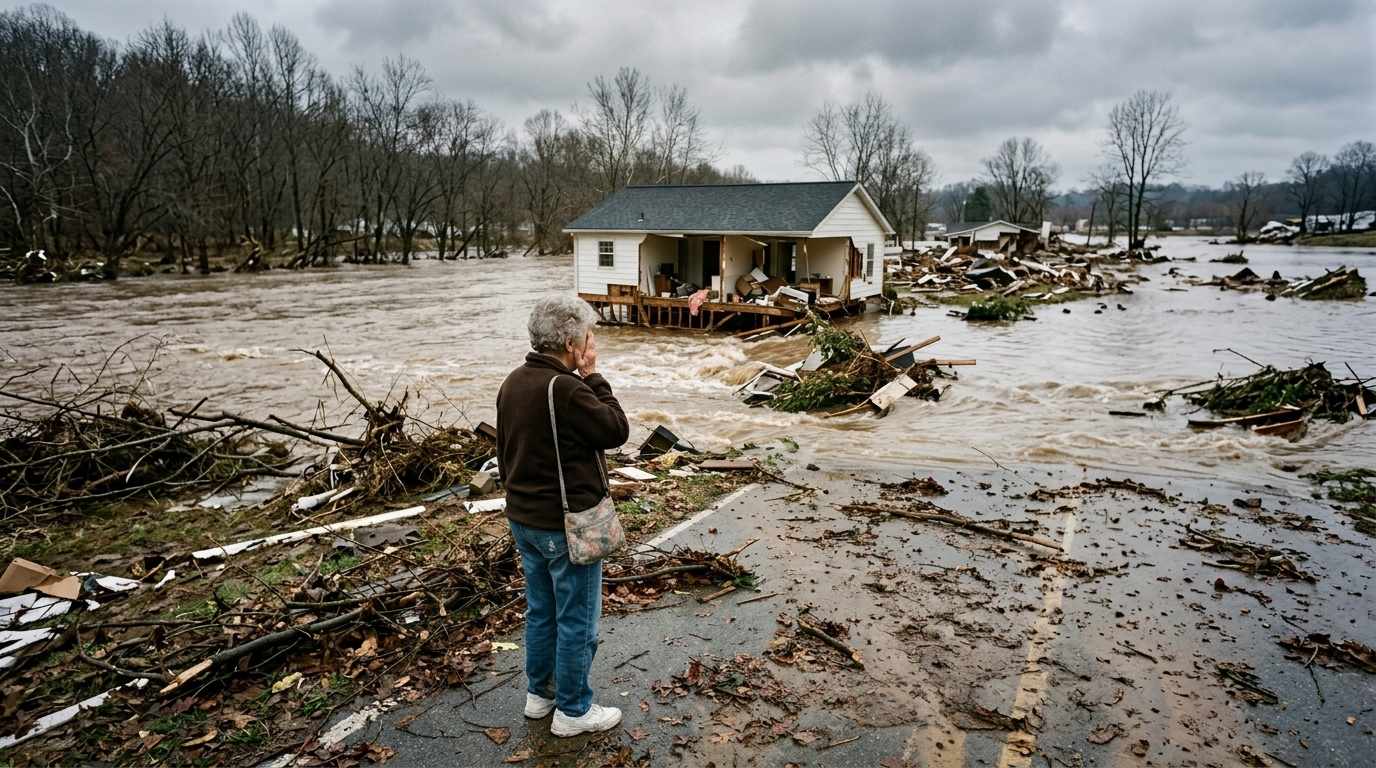
The family photographs floating across the floor.
I had cried for days after the adjuster declared the house a total loss.
I’d believed that losing the building meant losing the life Ron and I had created.
But now I understood something.
“I miss the memories,” I said.
Megan looked at me.
“But the house was only where we made them.”
She squeezed my hand.
“And now?”
I smiled.
“Now we make new ones.”
That evening, we returned to my apartment.
Josh brought dinner.
Lily carried a stack of library books.
Noah brought a board game with half the pieces missing.
We ate around my small dining table.
We laughed when Noah spilled lemonade.
We argued over the rules of the game.
And when Lily asked whether she could sleep over, Megan smiled.
“If Grandma says yes.”
I looked at my granddaughter.
“Of course.”
Lily cheered.
Later, after everyone had gone home except her, I sat beside the window.
The little blue bank book rested in my lap.
Its balance was lower now.
Helping Megan save the house had cost a substantial amount.
But I still had enough for my own needs, and I’d kept my retirement plans intact.
More importantly, I had learned that helping someone didn’t require surrendering my independence.
I opened the bank book.
Looked at the first page.
June 14, 2011.
The day Ron and I opened the account.
I remembered him sitting beside me at the bank.
He’d squeezed my hand and whispered, “Someday, this might make all the difference for our girl.”
I’d laughed.
“Let’s hope she never needs it.”
He’d smiled.
“That’s what saving is for, Ellie. You prepare for the storm and pray it never comes.”
I looked toward the window.
The evening sky was clear.
The maple trees moved gently in the breeze.
I thought about the flood that destroyed my house.
The basement that became my temporary shelter.
The rental agreement that broke my heart.
And the little blue bank book that helped save my daughter’s home.
Ron had been right.
The storm had come.
But it hadn’t arrived in the form we’d expected.
It wasn’t only the river.
It was unemployment.
Debt.
Fear.
Pride.
And the terrible things people sometimes say when they’re frightened of losing everything.
I closed the book.
Then I heard Lily calling from the bedroom.
“Grandma?”
I smiled.
“Yes, sweetheart?”
“Can you come read one more chapter?”
I stood.
“Coming.”
As I walked toward her, I thought about the words Megan had once thrown back at me.
Nothing in life is free, Mom.
She’d been right about some things.
A mortgage had to be paid.
Food cost money.
A house needed maintenance.
Bills didn’t disappear because someone was afraid to open them.
But there were things that should never come with a price tag.
A child’s love.
A grandmother’s place at the family table.
The dignity of someone who had lost her home.
And the simple comfort of knowing you belonged.
I sat beside Lily and opened her book.
She curled against me beneath the quilt I’d rescued from the flood.
“Grandma?”
“Yes?”
“Are you happy here?”
I looked around my little apartment.
At the bookshelves.
The photographs.
The warm lamp beside the couch.
The window overlooking the courtyard.
Then I looked at my granddaughter.
“Very happy.”
She smiled.
“Good. Because I like it here too.”
I kissed the top of her head.
Then began reading.
A year earlier, I had believed I needed my daughter’s permission to feel at home.
Now I understood that home wasn’t a basement someone allowed me to occupy.
It wasn’t a mansion.
It wasn’t even the little house Ron and I had spent forty years paying for.
Home was a place where I could live without apologizing for existing.
A place where my grandchildren could laugh without whispering.
A place where love was offered freely.
And where help, when given, didn’t become a weapon.
I had lost my house to the river.
But I had not lost my savings.
I had not lost my dignity.
And, in the end, I had not lost my daughter.
The flood had washed away the walls of my old life.
The truth had forced us to rebuild the rest.
My daughter once told me that nothing in life was free. Two years later, she learned that the most valuable things a family can give one another are love, honesty, respect, and a place to belong—and none of those should ever require a rental agreement.
THE END THANK YOU FOR READING !!!



