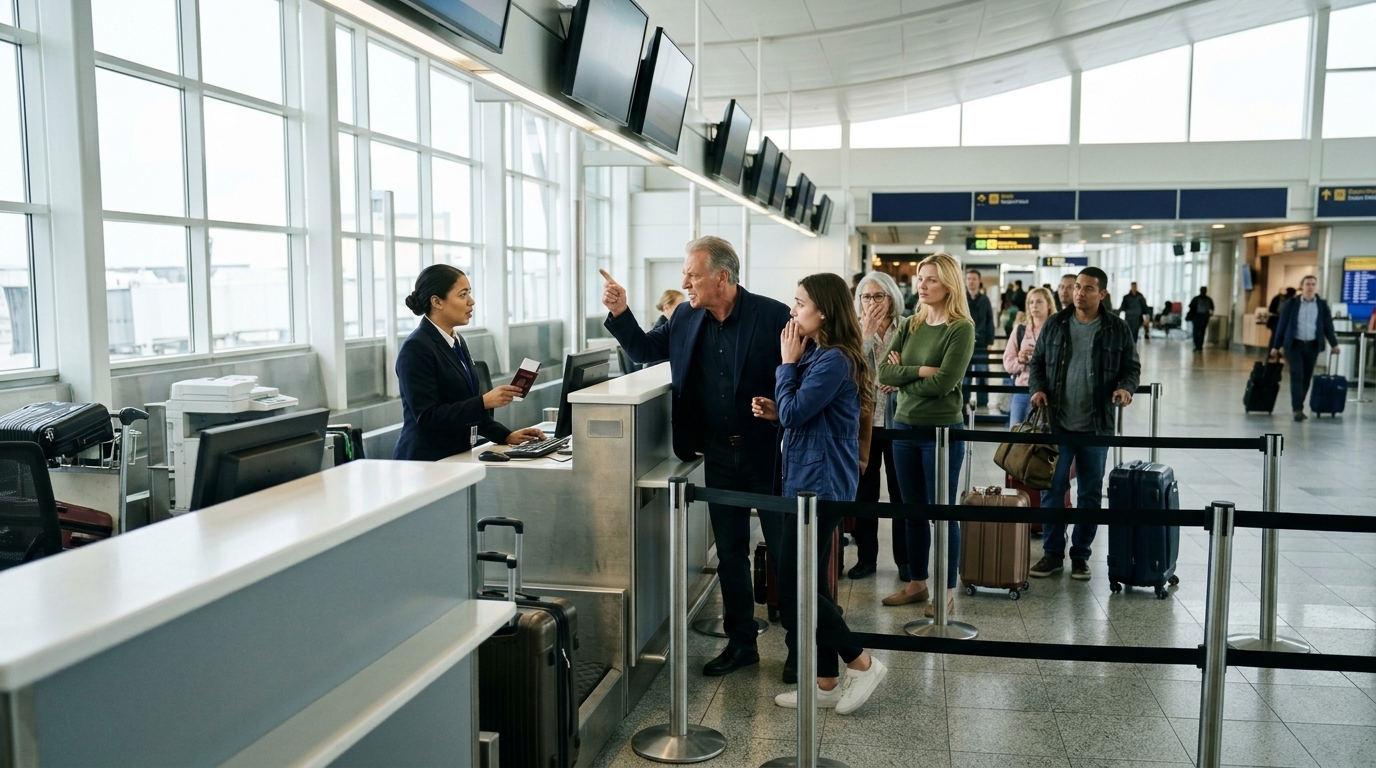
PART 3
My mother’s face changed the moment she realized I was actually calling the bank.
Not embarrassment.
Not anger.
Fear.
Real, unmistakable fear.
She reached toward my phone again, her cream cardigan slipping from one shoulder.
“Valerie, sweetheart, please. We can explain everything.”
I stepped backward.
“Then explain it.”
My father moved closer, his jaw clenched.
“You’re making a scene.”
I touched my burning cheek.
“You slapped me in front of an entire airport, Dad. I think we’re past worrying about scenes.”
Danielle rolled her eyes.
“Oh my God. Are you seriously going to ruin my graduation because of one little argument?”
I looked at her.
“One little argument?”
She shrugged.
“You always exaggerate.”
Before I could respond, a representative from my bank answered.
“Thank you for calling the fraud department. How can I assist you?”
I turned away from my family.
“My name is Valerie Castillo. I just received an alert about an eighteen-thousand-four-hundred-dollar charge from a company in Paris. I did not authorize it.”
My mother’s breathing became noticeably faster.
The representative asked me to verify my identity.
I answered the security questions while my father paced beside the airline counter.
Finally, the representative spoke.
“Ms. Castillo, I can confirm the transaction was submitted approximately forty minutes ago.”
“Forty minutes?”
“Yes, ma’am.”
I looked at my mother.
She avoided my eyes.
“Was my physical card used?”
“No. This was an online transaction using stored payment credentials.”
My stomach tightened.
“Can you tell me what the payment was for?”
“According to the merchant information, it appears to be a deposit associated with a private hospitality and event services company.”
I frowned.
“An event company?”
“Yes, ma’am. The merchant is registered as Maison Laurent Holdings.”
I stared at Danielle.
Her expression had changed.
The smug smile was gone.
“Please freeze that card immediately,” I said.
My father stopped pacing.
“Valerie!”
I ignored him.
The representative confirmed the card had been blocked and that a fraud investigation would begin.
Then she asked a question that made my blood run cold.
“Ms. Castillo, have you recently authorized any additional users on this account?”
“No.”
There was a pause.
“According to our records, a request to add an authorized user was submitted three weeks ago.”
I gripped my phone.
“Who?”
“The name listed is Margaret Castillo.”
My mother.
For several seconds, I couldn’t speak.
The representative continued.
“The request appears to have been submitted through your online account.”
I turned slowly.
“Mom.”
She looked at me.
“What?”
“Did you try to add yourself to my credit card?”
Her mouth opened.
Then closed.
My father stepped forward.
“That’s a private family matter.”
I stared at him.
“My credit card is not a family matter.”
The representative asked whether I wanted the unauthorized access investigated.
“Yes,” I answered immediately.
My mother began crying.
Not because my father had struck me.
Not because I was hurt.
Because I had stopped the payment.
“Valerie, please,” she whispered. “You don’t understand what you’ve done.”
I ended the call after securing my account and documenting the disputed transaction.
Then I faced my family.
“Tell me what that money was for.”
Danielle crossed her arms.
“It’s complicated.”
“Then simplify it.”
My father lowered his voice.
“You’re embarrassing us.”
I laughed bitterly.
“You’re worried about embarrassment? You stole my financial information.”
“We didn’t steal anything,” Mom insisted.
“Then how did someone use my card?”
Nobody answered.
Behind the airline counter, the employee who had witnessed my father slap me quietly approached.
“Ms. Castillo, airport security is on the way. Would you like to wait somewhere away from your family?”
My father immediately protested.
“This is a misunderstanding. I’m her father.”
The employee looked at my swollen cheek.
“Sir, I witnessed what happened.”
My father fell silent.
For the first time that morning, someone had challenged him without backing down.
I turned toward the employee.
“Yes. I’d appreciate that.”
Danielle grabbed my suitcase handle.
“Wait! What about our tickets?”
I gently removed her hand.
“That’s your concern right now?”
“Valerie, our flight leaves in an hour!”
“Then you should probably figure out what you’re going to do.”
Her eyes widened.
“You can’t abandon us!”
I looked at her.
“I paid for the tickets. I paid for the hotel. I paid for almost everything you’ve enjoyed for the past several years.”
She opened her mouth.
I continued.
“And when Dad hit me, you smiled.”
Her face reddened.
“You were being selfish!”
“No, Danielle. I was finally saying no.”
Airport security arrived moments later.
Two officers approached, accompanied by an airport supervisor.
The older officer introduced himself as Officer James Mitchell.
He asked what had happened.
My father immediately began talking.
“My daughter became hysterical over a seating arrangement.”
I stared at him.
He continued.
“She’s under tremendous work stress. We were trying to calm her down.”
Officer Mitchell looked toward the airline employee.
“Is that what you witnessed?”
The employee shook his head.
“No, sir. I saw this gentleman strike his daughter across the face.”
My father’s expression changed.
The officer turned toward me.
“Ma’am, would you like to make a statement?”
I looked at my family.
For thirty-two years, I’d been trained to protect them from consequences.
When Dad yelled, I apologized.
When Mom manipulated me, I surrendered.
When Danielle demanded money, I found a way to provide it.
I had spent my entire adult life making their problems disappear.
But this time, I was the person who needed protection.
“Yes,” I said.
“I would.”
My father stared at me.
“You wouldn’t dare.”
I met his eyes.
“Watch me.”
The officers separated us while they gathered statements and reviewed the incident.
I told them everything.
The demand for my seat.
The slap.
My mother’s response.
The suspicious charge.
The attempted unauthorized access to my account.
I also provided the fraud alert and transaction information.
Officer Mitchell listened carefully.
When I finished, he said, “Ms. Castillo, you have every right to report an assault. You don’t lose that right because the person responsible is related to you.”
Those words hit me harder than I expected.
Because somewhere along the way, I’d forgotten that.
I’d forgotten that being someone’s daughter didn’t mean accepting humiliation.
I’d forgotten that love wasn’t supposed to require surrendering my dignity.
And I’d forgotten that I was allowed to protect myself.
My father was taken aside for further questioning.
My mother began pleading with the officers.
Danielle stood near the counter, frantically texting someone.
Then her phone rang.
She glanced at the screen.
And something in her expression changed.
She stepped away, but I heard enough.
“No, Adrian, she found the charge.”
I turned.
Adrian?
Who was Adrian?
Danielle lowered her voice.
“I don’t know what we’re supposed to do now. Mom said everything would be ready before we arrived.”
She listened.
Then whispered something that made my stomach drop.
“No, she hasn’t seen the contract.”
The contract.
I looked toward my mother.
She was watching Danielle with an expression of pure panic.
And suddenly, I understood that the eighteen-thousand-dollar charge was only the beginning.
There was another document.
Another arrangement.
Something my family had planned without telling me.
I approached Danielle.
“Who’s Adrian?”
She froze.
“What?”
“Who is Adrian?”
“Nobody.”
“Then why are you discussing my credit card with him?”
Her eyes darted toward Mom.
I followed her gaze.
My mother shook her head almost imperceptibly.
That tiny movement told me everything.
They were coordinating their lies.
I held out my hand.
“Danielle, show me the contract.”
Her face went pale.
“What contract?”
“The one you just mentioned.”
She backed away.
“You’re crazy.”
I looked directly at her.
“Then prove it.”
For several seconds, neither of us moved.
Finally, she whispered, “You weren’t supposed to find out until Paris.”
I felt a chill run down my spine.
“Find out what?”
She swallowed.
Then my mother shouted from across the terminal.
“Danielle! Stop talking!”
Everyone turned.
And in that moment, I knew the truth was far worse than an unauthorized charge.
My family hadn’t simply planned to spend my money.
They had arranged something in Paris that required my presence.
Something involving a contract.
Something worth far more than eighteen thousand dollars.
And whatever it was, they were terrified I would discover it before boarding.
PART 4
I didn’t board the plane.
That decision was the first one I’d made in years without considering whether my parents would approve.
The airline helped me review my reservations and the available cancellation options.
Some expenses were nonrefundable.
Others could be credited or canceled.
I didn’t care about recovering every dollar.
I cared about making sure nobody could use my money again without permission.
I requested that my personal travel arrangements be separated from the rest of the group wherever possible.
I also contacted the hotel in Paris and explained that no additional charges or changes should be accepted under my name without direct verification.
My mother watched me from several yards away.
She looked furious.
But she didn’t approach.
Not with security standing nearby.
My father remained with the officers while they continued handling the assault report.
Danielle sat on her suitcase, crying into her phone.
For once, I didn’t rush to comfort her.
Instead, I called my closest friend.
Her name was Rebecca Shaw.
We’d met twelve years earlier while working at the same consulting firm.
Rebecca had watched me build my career from exhausting entry-level assignments to a senior executive position.
She also knew more about my family than anyone else.
When she answered, I heard traffic in the background.
“Valerie? Aren’t you supposed to be boarding?”
I closed my eyes.
“Rebecca, I need help.”
Her tone changed immediately.
“What happened?”
I told her.
Everything.
The first-class seat.
The slap.
The fraud alert.
The mysterious company.
The contract.
When I finished, she was silent for several seconds.
Then she asked, “Where are you?”
“Atlanta Airport.”
“Stay somewhere safe. I’m coming.”
“Rebecca, you don’t have to—”
“I’m coming.”
She ended the call.
I sat near a window overlooking the runway.
Airplanes rolled past beneath the morning sunlight.
Families hugged.
Children laughed.
Passengers hurried toward their gates.
The world continued moving as though mine hadn’t just collapsed.
I stared at my phone.
There were already seventeen missed calls from my mother.
Nine messages from Danielle.
Three from an unfamiliar international number.
Then another message appeared.
It came from my mother.
“Valerie, please don’t do anything else until we talk. Your father made a mistake, but you’re about to destroy something important for Danielle.”
I read it twice.
Something important for Danielle.
Of course.
Even now, after everything, my mother was worried about my sister.
Not my safety.
Not my stolen financial information.
Not the fact that my father had struck me.
Danielle.
I typed a response.
“What exactly am I destroying?”
Three dots appeared.
Disappeared.
Appeared again.
Then Mom replied.
“Her future.”
I stared at those two words.
Her future.
Apparently, mine was negotiable.
I didn’t respond.
Instead, I opened my email and searched for Maison Laurent Holdings.
Nothing.
I searched for Adrian.
Still nothing.
Then I remembered something.
Three weeks earlier, my mother had asked me to send her a copy of my passport.
She claimed the hotel needed identification for a special family reservation.
I’d been exhausted.
I sent it without thinking.
Two days later, she requested a recent bank statement.
That time, I’d refused.
She became irritated.
“It’s just for the hotel, Valerie. Why do you always make everything difficult?”
I’d told her hotels didn’t need my personal bank statements.
She dropped the subject.
Now I wondered whether she’d found another way to obtain them.
I called my bank again.
This time, I asked to speak with the fraud investigation team.
The representative reviewed the account activity and confirmed that the disputed charge was being investigated.
I also asked whether anyone had attempted to change my contact information.
After additional verification, the representative told me there had been a recent unsuccessful attempt to update the mailing address.
The proposed address was unfamiliar.
I wrote it down.
Then I searched it online.
It belonged to a commercial mail-receiving service in Atlanta.
My stomach tightened.
Someone had been trying to redirect financial correspondence.
Someone wanted access to information that belonged to me.
And the more I looked, the more carefully planned everything appeared.
Rebecca arrived ninety minutes later.
She found me sitting with my suitcase and a cold cup of coffee.
The moment she saw my face, she stopped.
“Valerie.”
I tried to smile.
She crouched beside me.
“Did your father do that?”
I nodded.
Her eyes filled with anger.
“Come on. We’re getting you checked out.”
She drove me to an urgent care clinic, where a doctor examined my cheek and documented the injury.
Afterward, we went to her apartment.
For the first time that day, I felt safe enough to cry.
Rebecca didn’t interrupt.
She didn’t tell me to calm down.
She didn’t suggest that my parents meant well.
She simply sat beside me.
Eventually, I whispered, “I don’t understand why they hate me.”
She turned toward me.
“Valerie, people can exploit someone without hating them. Sometimes they simply convince themselves they’re entitled to everything that person has.”
I wiped my eyes.
“But they’re my family.”
“I know.”
“I paid for Danielle’s education.”
“I know.”
“I helped Dad with his business.”
“I know.”
“I gave Mom money whenever she needed it.”
Rebecca took my hand.
“And when was the last time they asked whether you needed anything?”
I opened my mouth.
Then closed it.
Because I couldn’t remember.
That evening, Rebecca helped me organize the evidence.
We created a timeline of suspicious requests and transactions.
The passport copy.
The attempted authorized-user addition.
The attempted address change.
The eighteen-thousand-dollar charge.
The mysterious contract.
Then Rebecca noticed something in my messages.
“Valerie, who’s Adrian Moreau?”
I frowned.
“That’s the name Danielle mentioned.”
Rebecca turned her laptop toward me.
Three weeks earlier, my mother had forwarded me an email about our hotel reservation.
Buried in the forwarded message was a previous conversation.
One line included the name Adrian Moreau.
Another mentioned a company called Maison Laurent Holdings.
Rebecca scrolled down.
Then stopped.
“Valerie.”
I leaned closer.
The email discussed a private reception scheduled for the second evening of our Paris trip.
The event was described as a celebration of Danielle’s academic achievement.
But another sentence caught my attention.
“Principal guarantor must be present for final execution of the commercial financing agreement.”
I stared at the screen.
“Principal guarantor?”
Rebecca looked at me.
“Valerie, I think they’re trying to make you responsible for a loan.”
My mouth went dry.
“What loan?”
She continued reading.
A proposed financing arrangement.
A luxury retail business.
A French commercial lease.
An initial deposit.
And a total projected obligation exceeding six hundred thousand dollars.
I felt dizzy.
“Six hundred thousand?”
Rebecca nodded slowly.
“That’s what it says.”
I stared at the email.
Danielle’s failed clothing boutique suddenly made sense.
The graduation trip.
The mysterious event company.
The demand for my passport.
The attempted access to my bank account.
They weren’t simply celebrating her degree.
They were preparing to launch another business.
And they wanted me to finance it.
Without asking.
Rebecca pointed toward the screen.
“Look at this.”
A paragraph near the bottom described the proposed guarantor.
Valerie Castillo.
Senior corporate executive.
Established financial history.
Substantial annual income.
My professional information had been included in the application.
I felt physically sick.
“They used my career.”
Rebecca’s expression hardened.
“They used your identity.”
I stared at the screen.
Then I noticed the date.
The final signing was scheduled for the following evening.
Which meant my family expected me to arrive in Paris, attend a supposedly celebratory reception, and somehow become responsible for an enormous financial obligation.
I shook my head.
“But I would never sign that.”
Rebecca looked at me carefully.
“Maybe they planned to pressure you.”
I thought about my father striking me over an airplane seat.
My mother’s manipulation.
Danielle’s tantrums.
They’d spent years teaching me that refusing them was unacceptable.
Perhaps they believed that once I was thousands of miles from home, surrounded by strangers, and confronted with documents they’d already arranged, I would surrender.
Just as I always had.
Then another possibility occurred to me.
“What if they already forged my signature?”
Rebecca’s expression changed.
“We need an attorney.”
The next morning, we met with a financial crimes attorney named Caroline Hayes.
She reviewed the evidence carefully.
When she finished, she looked directly at me.
“Valerie, you need to understand something important. Being named in a financing proposal does not automatically make you legally responsible for the debt. A valid guarantee requires proper authorization and execution.”
I exhaled shakily.
“So they can’t just make me pay?”
“Not simply by putting your name on a document. But if someone has forged signatures or misrepresented your consent, we need to act quickly.”
She recommended documenting the identity theft concerns, notifying relevant institutions, and preserving every communication.
Then she contacted the company in Paris through its published business contact information.
We waited.
Two hours later, a representative returned the call.
His name was Adrian Moreau.
Caroline introduced herself and explained that she represented Valerie Castillo.
There was a pause.
Then Adrian said, “Ms. Castillo is expected in Paris tomorrow.”
Caroline replied, “My client has not authorized any commercial guarantee.”
Another silence.
Adrian sounded confused.
“That is not what we were told.”
“What were you told?”
“That Ms. Castillo was the principal financial sponsor of the project.”
My stomach dropped.
Caroline continued.
“Who provided that information?”
“Her family.”
“Has my client signed any documents?”
Adrian hesitated.
“We have received preliminary electronic documentation.”
Caroline’s expression sharpened.
“Please preserve those records. We dispute the authenticity of any signature or authorization attributed to my client.”
Adrian agreed to suspend the proposed transaction pending verification.
Then he said something unexpected.
“Counsel, there is another matter.”
Caroline leaned forward.
“Go ahead.”
“The eighteen-thousand-four-hundred-dollar payment was not merely an event deposit.”
I froze.
Adrian continued.
“It was designated as a nonrefundable reservation payment for the commercial premises.”
Caroline glanced at me.
“Who authorized it?”
“The payment credentials were supplied by Margaret Castillo.”
My mother.
I closed my eyes.
Adrian added, “She represented herself as authorized to act on her daughter’s behalf.”
For several seconds, nobody spoke.
Then Caroline asked him to preserve all correspondence and transaction records.
When the call ended, she turned toward me.
“Valerie, your family appears to have made significant representations about your consent that you say were false.”
I stared at the table.
“They were going to use me.”
Caroline nodded.
“That’s what the evidence suggests.”
I thought about the airport.
Danielle demanding my first-class seat.
Dad slapping me.
Mom blaming me.
And suddenly, the entire confrontation looked different.
They weren’t simply angry because I refused to surrender a luxury seat.
They were angry because I had refused to obey.
Because their plan depended on me continuing to behave like the daughter who never said no.
I looked at Caroline.
“What happens now?”
She closed the folder.
“Now we make sure nobody can pretend you agreed.”
That afternoon, my phone rang.
It was Danielle.
I almost ignored it.
Then I answered.
“Valerie!” she shouted. “What did you do?”
I remained silent.
“Adrian says the entire agreement is suspended!”
I closed my eyes.
“Good.”
“Good? Are you insane? Do you know how much money we’re going to lose?”
I took a slow breath.
“Danielle, did you tell those people I agreed to guarantee your business loan?”
She hesitated.
Then snapped, “You were going to help anyway!”
I felt something inside me finally settle.
“No.”
“What?”
“No, Danielle. I wasn’t.”
Her voice became shrill.
“You always help!”
“That’s exactly the problem.”
She began crying.
“You’ve ruined my future!”
I looked toward the window.
Outside, the afternoon sunlight fell across Rebecca’s small garden.
For the first time in years, I didn’t feel responsible for fixing my sister’s disappointment.
“Your future was never supposed to be built on stealing mine.”
Then I ended the call.
And for the first time, I didn’t call back.
PART 5
The first thing my mother did when she realized the Paris financing agreement had collapsed was accuse me of destroying our family.
Her message arrived at 6:14 the following morning.
“Your sister has worked her entire life for this opportunity. You have more money than you’ll ever need. I cannot believe you’d humiliate us over a little paperwork.”
I stared at the screen.
A little paperwork.
A potential six-hundred-thousand-dollar financial obligation.
An unauthorized charge.
An attempted change to my credit account.
A public assault.
To my mother, these were apparently minor inconveniences compared with Danielle’s disappointment.
I forwarded the message to Caroline.
Then I blocked my mother’s number.
Ten minutes later, my father called from an unfamiliar phone.
I didn’t answer.
He left a voicemail.
“Valerie, this has gone far enough. You need to stop behaving like a spoiled child and fix what you’ve done. Your mother is devastated, and Danielle’s entire future is at risk. Call me immediately.”
I saved the recording.
Then blocked that number too.
By lunchtime, Danielle had posted a long message on social media.
She didn’t mention the unauthorized credit card charge.
She didn’t mention the forged documents.
She didn’t mention my father’s slap.
Instead, she described herself as a hardworking graduate whose wealthy older sister had cruelly withdrawn financial support at the last minute.
She wrote that jealousy had destroyed what should have been the happiest week of her life.
Hundreds of people commented.
Some offered sympathy.
Others criticized the unnamed sister.
I read the post twice.
Then closed the application.
For years, I’d defended Danielle whenever she made mistakes.
When her boutique failed, I told people she’d been unlucky.
When she abandoned jobs, I said she was searching for her passion.
When she borrowed money and never repaid it, I told myself family wasn’t supposed to keep score.
But this time, I wasn’t going to finance another lie.
Rebecca called that evening.
“Have you seen Danielle’s post?”
“Yes.”
“Are you going to respond?”
I considered it.
Then shook my head, even though she couldn’t see me.
“No.”
“Why not?”
“Because I don’t need strangers to decide whether I’m allowed to protect myself.”
Rebecca was quiet.
Then she said, “That’s the healthiest thing I’ve heard you say in years.”
I smiled faintly.
But the situation was far from over.
Caroline continued working with the bank and the French company.
The disputed transaction remained under investigation.
The bank provided information about the attempted account changes.
Maison Laurent Holdings preserved its correspondence and suspended the commercial agreement.
Then an important discovery emerged.
The preliminary electronic guarantee documents contained a signature that resembled mine.
But it wasn’t mine.
Caroline arranged for a document examiner to review the available copies.
The signature appeared to have been reproduced from an older financial document.
I immediately remembered something.
Two years earlier, I’d helped Danielle apply for financing for her first boutique.
She’d needed evidence of family support.
I’d provided a limited financial contribution and signed paperwork relating only to that specific investment.
I had never agreed to guarantee future loans.
But Danielle had retained copies of those documents.
And apparently, someone had used them again.
When Caroline told me, I sat motionless.
“She copied my signature?”
“That’s one possibility supported by the documents. Investigators will need to establish who prepared and submitted them.”
I looked down at my hands.
I’d signed those original papers because I believed in my sister.
I’d wanted her to succeed.
I’d been proud that she was starting a business.
Now that act of generosity had become another opportunity to exploit me.
Caroline watched my expression.
“Valerie, we can continue pursuing this.”
I looked up.
“Please do.”
Over the following weeks, investigators reviewed the financial records and communications.
The evidence suggested that my mother had submitted the payment information and that Danielle had participated in preparing the financing proposal.
My father’s involvement in the financial scheme was less clear.
He had certainly pressured me.
He had assaulted me.
But the investigation needed to distinguish what he knew from what the others had done.
I was determined not to exaggerate anything.
The truth was damaging enough.
I provided every message, document, and recording requested.
Then I went back to work.
At first, it was difficult.
I couldn’t concentrate.
I kept replaying the moment my father’s hand struck my face.
Sometimes I heard my mother’s voice in my head.
“Ever since you were little, you’ve been nothing but a burden.”
Those words followed me into meetings.
Into grocery stores.
Into quiet evenings at home.
I’d spent my entire life trying to become someone my parents could be proud of.
I’d graduated with honors.
Built a successful career.
Bought my own home.
Paid my bills.
Helped my family.
And still, my mother had called me a burden.
One evening, I finally told Rebecca something I’d never admitted aloud.
“I think I kept giving them money because I thought eventually they’d love me properly.”
Rebecca sat beside me on the couch.
“What would loving you properly look like?”
I thought for a moment.
“Calling just to ask how I’m doing.”
She nodded.
“Anything else?”
“Remembering my birthday without asking for something.”
I laughed sadly.
“Being happy when something good happens to me.”
My eyes filled with tears.
“Not making me feel guilty for having a life.”
Rebecca squeezed my hand.
“Those aren’t unreasonable things to want.”
I wiped my face.
“I know that now.”
A month later, I began seeing a therapist.
Her name was Dr. Elena Morris.
During our first appointment, I explained the airport incident and the financial scheme.
Then I told her about my childhood.
How Danielle received elaborate birthday parties while mine were usually postponed.
How my parents praised her smallest accomplishments but treated my achievements as expectations.
How Dad would become furious whenever I questioned him.
How Mom taught me that keeping the peace was my responsibility.
Dr. Morris listened.
Then she asked, “When did you first learn that saying no was dangerous?”
I stared at her.
I hadn’t expected that question.
But suddenly, I remembered being twelve years old.
Danielle was seven.
She wanted the bicycle I’d received for my birthday.
I refused.
My father told me older sisters were supposed to sacrifice.
When I protested, he took the bicycle away.
Danielle rode it the next morning.
I remembered standing at the window watching her.
My mother had told me not to cry.
“Good girls share.”
I looked at Dr. Morris.
“I think I was twelve.”
She nodded.
“And what happened when you said no as an adult?”
I touched my cheek instinctively.
“He hit me.”
For a long moment, I couldn’t speak.
Then I began crying.
Not just for the woman standing in the airport.
But for the little girl who had spent twenty years believing love had to be earned through sacrifice.
Therapy didn’t change everything overnight.
But it helped me understand that boundaries weren’t cruelty.
They were protection.
And protecting myself didn’t mean I had stopped caring about my family.
It meant I had finally started caring about myself.
Three months after the airport incident, Caroline called with an update.
The bank had completed its review of the disputed transaction.
The charge was reversed, and the bank confirmed that I would not be responsible for it.
The attempted account changes had also been documented.
Maison Laurent Holdings had canceled the proposed financing arrangement after determining that the required authorization could not be verified.
The company had retained the relevant records for the investigation.
I sat at my desk listening.
For the first time in months, I felt my shoulders relax.
“So it’s over?”
“The financial agreement is no longer proceeding,” Caroline explained. “But the broader investigation is still active.”
I nodded.
“What about my family?”
“There may be legal consequences depending on the evidence and prosecutorial decisions.”
I looked out my office window.
Below me, Atlanta traffic moved through the afternoon sunshine.
“Thank you, Caroline.”
“You’re welcome.”
Then she added, “Valerie, I want you to remember something. You didn’t create this situation by refusing to cooperate.”
I swallowed.
“They created it by using my information without permission.”
“Exactly.”
After the call, I sat quietly for several minutes.
Then I opened my banking application.
For years, I’d maintained automatic transfers to my parents.
A monthly amount for household expenses.
Another for Danielle’s living costs.
Occasional payments toward debts they claimed were temporary.
I had already suspended those transfers while securing my accounts.
Now I reviewed the entire history.
The total shocked me.
Over seven years, I’d transferred more than two hundred and eighty thousand dollars to my family.
That didn’t include the boutique investment.
Or the tuition.
Or the Paris trip.
Or countless smaller purchases.
I stared at the number.
Two hundred and eighty thousand dollars.
I thought about the vacations I’d postponed.
The home renovations I’d delayed.
The weekends I’d spent working overtime because someone in my family needed another emergency payment.
I had been earning a good living.
But I hadn’t been living much of a life.
That evening, I opened a new savings account.
I named it something simple.
“My Future.”
Then I made my first transfer.
Not for Danielle.
Not for Mom.
Not for Dad.
For me.
It was a small act.
But it felt enormous.
Several weeks later, my father reached out through his attorney.
He wanted to apologize.
Caroline asked whether I wished to receive the message.
I hesitated.
Then agreed.
The letter was short.
Dad wrote that he regretted striking me.
He said he’d lost his temper.
He admitted the airport incident was unacceptable.
But halfway through, the apology changed.
He wrote that I had always been stubborn.
That Danielle had been under tremendous pressure.
That our family wouldn’t be suffering if I’d handled the situation privately.
I read the letter slowly.
Then placed it on the table.
It wasn’t an apology.
It was another attempt to make me responsible for everyone else’s choices.
I told Caroline I didn’t want to respond.
She respected my decision.
My mother never offered a genuine apology.
Instead, she sent messages through relatives.
She told my aunt that I’d abandoned the family.
She told my cousin that I’d become arrogant because of my career.
She told an old family friend that I’d ruined Danielle’s graduation over a misunderstanding.
Eventually, my aunt called.
Her name was Teresa.
She was my mother’s older sister.
We hadn’t spoken much in recent years.
When I answered, I expected another lecture.
Instead, she said, “Valerie, I heard what happened at the airport.”
I sighed.
“Aunt Teresa, I really don’t want to argue.”
“I’m not calling to argue.”
I waited.
She continued.
“Your mother told me you refused to help Danielle.”
“That’s not exactly what happened.”
“I know.”
I frowned.
“What do you mean?”
Teresa took a breath.
“Your mother showed me the messages she sent you. She expected me to convince you to forgive them.”
I closed my eyes.
“And?”
“And I told her she should be ashamed.”
I sat upright.
Teresa continued.
“Valerie, I’ve watched your parents take advantage of you for years. I should have said something sooner.”
My throat tightened.
She spoke gently.
“Your father had no right to hit you. Your mother had no right to use your financial information. And Danielle is old enough to take responsibility for her own life.”
I began crying.
Aunt Teresa waited.
Then she said something I would remember forever.
“You were never the difficult daughter, sweetheart. You were the dependable one. They just got so used to depending on you that they forgot you were a person.”
I covered my mouth.
Because those were words I’d needed to hear for most of my life.
We talked for nearly two hours.
For the first time, someone from my family acknowledged what had happened without demanding that I forgive it immediately.
That conversation changed something inside me.
I realized I hadn’t lost everyone.
I had simply stopped protecting people who hurt me.
As the months passed, the legal matters progressed.
My father accepted responsibility for the airport assault through the legal process.
The financial investigation resulted in formal action concerning the unauthorized transaction and documents.
My mother and Danielle ultimately entered agreements resolving charges connected to their roles, including restitution obligations and court-imposed conditions.
I did not attend every hearing.
I provided evidence when required.
Then I allowed the legal system to do its work.
I had spent enough of my life managing my family’s crises.
I wasn’t going to make their consequences another full-time job.
Danielle’s planned Paris boutique never opened.
Without my financial backing, the project couldn’t proceed under the terms she’d arranged.
She eventually found work with a retail company in Atlanta.
For the first time in years, she had to pay her own bills.
My parents sold their vacation property to address their financial problems.
I heard about these changes through Aunt Teresa.
I didn’t celebrate their difficulties.
But I didn’t rescue them either.
That distinction mattered.
I wasn’t trying to punish them.
I was simply refusing to sacrifice myself again.
Nearly a year after the airport incident, I received an unexpected email from Danielle.
The subject line read:
“Can we talk?”
I stared at it for a long time.
Then I opened it.
For once, she didn’t ask for money.
She didn’t accuse me of jealousy.
She didn’t complain about her ruined graduation.
Instead, she wrote:
“Valerie, I know you probably don’t want to hear from me. I’ve spent months being angry because everything fell apart. But I’ve started realizing how much you did for me. I treated your help like something I deserved. I was wrong.”
I read the words twice.
Then continued.
“I should have defended you when Dad hit you. I should never have participated in the financing paperwork. I know saying sorry doesn’t fix anything. I just wanted you to know I understand that now.”
I sat quietly.
Part of me wanted to respond immediately.
Another part remembered the airport.
Her smile.
Her shrug.
“You deserved it.”
I closed the email.
Then went for a walk.
I needed time to decide what forgiveness might look like.
Eventually, I wrote back.
I thanked her for acknowledging what happened.
I told her I hoped she would continue building an independent life.
But I also explained that rebuilding trust would require time, consistency, and respect for my boundaries.
I wasn’t ready to resume our old relationship.
And I would not provide financial support.
She replied the following day.
“I understand.”
For the first time, she didn’t argue.
That didn’t erase the past.
But it was a beginning.
A few months later, I made another decision.
I booked a trip to Paris.
Alone.
Not for Danielle’s graduation.
Not for my parents.
Not because someone needed me to pay for anything.
Because I’d wanted to visit Paris since I was sixteen.
I’d kept a photograph of the Eiffel Tower above my childhood desk.
Back then, I imagined walking along the Seine, eating pastries in little cafés, and spending afternoons exploring museums.
But whenever I saved money for travel, something happened.
Danielle needed tuition.
Dad needed help.
Mom had another emergency.
My dreams could always wait.
This time, they didn’t have to.
I booked a beautiful hotel near the river.
I purchased a business-class ticket using my own rewards.
And I planned an entire week around things I wanted to do.
When departure day arrived, I returned to Atlanta Airport.
The same airport.
The same terminal.
The same kind of polished floor where my coffee had spilled nearly a year earlier.
For a moment, I stopped walking.
I remembered the slap.
The silence.
My mother’s words.
Danielle’s smile.
The fraud alert.
The fear.
Then I looked around.
Nobody was shouting at me.
Nobody was demanding my boarding pass.
Nobody was telling me I was selfish.
I was simply a woman going on vacation.
At the airline counter, an employee scanned my passport.
“Good morning, Ms. Castillo. Your premium cabin seat is confirmed.”
I smiled.
“Thank you.”
She handed me my boarding pass.
I looked at the seat assignment.
Then laughed softly.
The same kind of seat I’d refused to surrender.
The seat that had somehow exposed years of manipulation.
The seat that had started the argument which changed my life.
I tucked the boarding pass into my purse.
And walked toward security.
When I landed in Paris, the morning sky was pale blue.
I checked into my hotel, opened the balcony doors, and stood looking toward the rooftops.
For the first time in years, I had nowhere I needed to be for anyone else.
No emergency payments.
No family arguments.
No guilt.
Just Paris.
That afternoon, I walked beside the Seine.
I bought a small bouquet of white flowers from a street vendor.
I sat outside a café and ordered coffee and a warm croissant.
Then I took a photograph.
Not for social media.
Not to make anyone jealous.
Just for myself.
I sent it to Rebecca.
She replied immediately.
“Look at you! Finally living your life!”
I laughed.
Then typed back.
“Finally.”
On my third evening, I visited the Eiffel Tower.
The city glowed beneath the sunset.
Couples held hands.
Tourists took photographs.
Children laughed as they chased each other across the plaza.
I stood quietly, watching the lights begin to sparkle.
And suddenly, I thought about the woman I’d been a year earlier.
The exhausted executive.
The dependable daughter.
The sister who paid for everything.
The woman who believed saying no made her selfish.
I wished I could go back to that airport and put my arms around her.
I wished I could tell her that she didn’t have to earn love by surrendering everything she had.
That success didn’t make her responsible for everyone else’s failures.
That family wasn’t a license to hurt someone.
And that walking away from mistreatment wasn’t abandonment.
It was self-respect.
My phone vibrated.
For a moment, I felt the old instinct to panic.
Another emergency?
Another demand?
Another problem I was expected to solve?
But it was only a message from Aunt Teresa.
“Hope you’re having a wonderful time, sweetheart. You deserve it.”
I smiled.
Then put my phone away.
The Eiffel Tower sparkled against the darkening sky.
And for the first time, I didn’t feel guilty about being happy.
A year earlier, my father had slapped me because I refused to give away a first-class seat.
My mother had called me selfish.
My sister had told me I deserved it.
They believed they could humiliate me, frighten me, and pressure me into surrendering whatever they wanted.
But they hadn’t realized something important.
The moment I stopped obeying them, their control began to disappear.
The fraud alert exposed their financial scheme.
The investigation protected my identity.
The legal process forced accountability.
And the boundaries I’d finally established gave me something money could never buy.
Peace.
I looked toward the illuminated tower and whispered a sentence I’d once been too afraid to say.
“I’m proud of you, Valerie.”
Then I smiled.
Because I meant it.
I had spent thirty-two years waiting for my parents to tell me those words.
Waiting for Danielle to appreciate me.
Waiting for someone in my family to recognize how much I’d sacrificed.
But standing beneath the Paris sky, I finally understood that I didn’t need their permission to be proud of the life I’d built.
I didn’t need to purchase affection.
I didn’t need to apologize for success.
And I didn’t need to give away my seat just because someone else believed they deserved it more.
That night, I returned to my hotel and opened the window.
Paris glittered beyond the rooftops.
I poured myself a glass of sparkling water and sat beside the balcony.
Then I opened my banking application.
My accounts were secure.
My savings were growing.
My future belonged to me.
I thought about the eighteen-thousand-four-hundred-dollar charge that had appeared on my phone at the airport.
At the time, it had felt like another disaster.
Another betrayal.
Another problem.
But looking back, that notification had been the warning that finally forced me to see the truth.
My family hadn’t merely been taking my money.
They had been taking my freedom to say no.
And the moment I reclaimed that freedom, everything changed.
I closed the application.
Turned off my phone.
And watched the city lights until midnight.
Tomorrow, I would visit the Louvre.
The following day, Versailles.
After that, perhaps I’d take a train somewhere beautiful simply because I could.
For once, I didn’t need a detailed plan.
I didn’t need anyone’s approval.
I didn’t need to explain why I deserved a little happiness.
I had already earned it.
And as I drifted to sleep that night, I thought about the lesson my family had unintentionally taught me.
The people who love you should never require you to become smaller so they can feel important.
My father had wanted me to surrender my seat.
My mother had wanted me to surrender my money.
My sister had wanted me to surrender my future.
Instead, I surrendered something else.
My fear of disappointing them.
And that was the decision that finally set me free.
THE END THANK YOU FOR READING !!!



