PART 3
I had spent twenty years building a business empire,
but nothing in my life had prepared me for the words of a dying woman I’d never met.
“Michael, Sophie isn’t the only child your father wanted you to find.”
I stood motionless on the Chicago sidewalk,
my phone pressed against my ear.
Around me, taxis honked. Pedestrians hurried past.
Somewhere behind me, a street musician played a violin.
But all I could hear was Emily Carter’s fragile breathing.
“What do you mean?” I whispered.
There was a long silence.
Then she said, Your father left instructions.
He wanted you to know about a little boy.
My stomach tightened.
“What little boy?”
“I can’t explain everything over the phone.”
Her voice weakened.
“Please come to the hospital.”
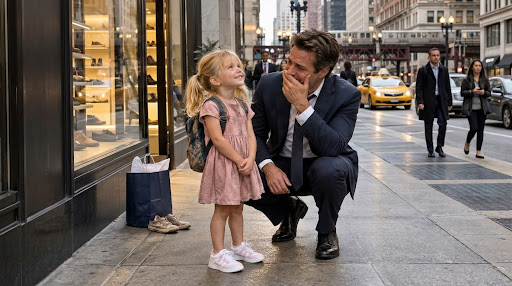
I looked toward the shoe store where Sophie had been laughing just minutes earlier.
The little girl with the worn-out shoes.
The child who had promised to repay me forty-five dollars.
Somehow, she’d led me to a woman who knew secrets about my father.
“I’ll be there,” I said.
Emily exhaled.
“Thank you.”
Then she whispered something that made my blood run cold.
“Please don’t tell anyone from Harrison Holdings where you’re going.”
The call ended.
For several seconds, I stared at my phone.
Harrison Holdings.
My company.
My father’s company before it became mine.
Why would a dying woman be afraid of someone finding out she was speaking to me?
I called my driver.
“Thomas, I need you to take me to Mercy Hospital.”
“Of course, sir.”
“And Thomas?”
“Yes?”
“Don’t mention this trip to anyone.”
There was a pause.
“Understood.”
Twenty-five minutes later, I stood outside Room 417.
The hallway smelled of disinfectant and freshly brewed coffee.
Nurses moved quietly between rooms.
Somewhere nearby, a medical monitor beeped steadily.
I had visited hospitals before.
Charity events.
Board meetings.
Photographs beside doctors who thanked me for generous donations.
But I’d never felt as helpless as I did standing outside that door.
I knocked.
A soft voice answered.
“Come in.”
I opened the door.
And saw Sophie.
She was sitting beside the hospital bed, swinging her legs.
Her new pink-and-white sneakers were resting proudly on the footrest of her chair.
When she saw me, her face lit up.
“Nice man!”
Before I could respond, she jumped down and ran toward me.
“You came!”
I knelt.
“Of course I came.”
She threw her arms around my neck.
Her hug was warm and trusting.
And for reasons I couldn’t explain, I felt something tighten painfully inside my chest.
Then I looked toward the bed.
Emily Carter was much younger than I’d expected.
Perhaps thirty-four.
Her face was pale.
Her dark hair was pulled loosely behind her head.
An oxygen tube rested beneath her nose.
She looked exhausted.
But her eyes were remarkably clear.
“Mr. Harrison,” she whispered.
I stood.
“Michael, please.”
She smiled faintly.
“Michael.”
Sophie hurried back to the bedside.
“Mommy, look! I told you he was nice!”
Emily brushed her daughter’s hair away from her face.
“Yes, sweetheart. You did.”
I pulled a chair closer.
“Emily, how did you get my phone number?”
She hesitated.
Then reached beneath her pillow.
She removed an old envelope.
Inside was a business card.
My father’s business card.
The corners were worn.
The paper had yellowed.
But I recognized the logo immediately.
Harrison Development Group.
The company my father had founded before it became Harrison Holdings.
On the back, written in blue ink, was a telephone number.
My private business line.
The same number I’d used for years.
I stared at it.
“Where did you get this?”
Emily’s eyes filled.
“Your father gave it to my mother.”
I looked up.
“Your mother?”
She nodded.
“Her name was Margaret Carter.”
The name meant nothing to me.
At least, not at first.
Then Emily continued.
“She worked for your father for almost eleven years.”
I frowned.
“In what capacity?”
“She was a bookkeeper.”
My heart gave a strange jolt.
My father had employed dozens of accountants.
Hundreds of employees.
But Emily’s next words stopped me.
“She wasn’t just his bookkeeper.”
I stared at her.
“She was the person who discovered what his business partner was doing.”
Emily began coughing.
I stood instinctively.
“Should I get a nurse?”
She shook her head.
“I’m okay.”
Sophie looked worried.
“Mommy?”
Emily smiled at her.
“Sweetheart, would you go ask Nurse Linda if she has any more of those apple crackers?”
Sophie brightened.
“The cinnamon ones?”
“Yes.”
She looked at me.
“Will you stay?”
I smiled.
“I’ll be right here.”
Sophie nodded seriously.
Then hurried into the hallway.
Emily waited until her footsteps disappeared.
Then she looked at me.
“Your father wasn’t always wealthy.”
I sat down.
“I know.”
“He built his first company with a partner named Charles Whitcomb.”
I nodded.
I remembered Charles.
A tall man with silver hair.
Expensive suits.
And a habit of calling me “young Harrison.”
He’d attended my father’s funeral.
He’d also served on the board of our company until retiring seven years earlier.
Emily watched my face.
“You remember him.”
“Yes.”
She swallowed.
“Charles was stealing from the company.”
I stared at her.
“What?”
“My mother found it.”
Emily’s voice trembled.
“She discovered payments to shell companies. False invoices. Money being moved into accounts nobody else knew existed.”
My mind began racing.
“Why wasn’t this reported?”
Emily looked away.
“It was.”
I frowned.
“To whom?”
“Your father.”
I leaned forward.
“And?”
“He confronted Charles.”
Emily closed her eyes.
“After that, everything changed.”
She explained that her mother had worked late one evening preparing records for an internal review.
The next morning, Margaret Carter was accused of stealing confidential company information.
Her employment was terminated.
She lost her health insurance.
And someone threatened to report her for financial misconduct if she spoke publicly.
I stared at Emily.
“Who threatened her?”
“Charles.”
I felt anger rise.
“Did my father know?”
Emily nodded slowly.
“Yes.”
I leaned back.
“Then why didn’t he stop it?”
Her eyes filled.
“He tried.”
I stared at her.
“He confronted Charles again. He demanded that the accusations be withdrawn.”
She paused.
“But Charles had documents that could damage the company.”
I frowned.
“What documents?”
“Records showing how much money had been moved. And evidence that your father’s signature appeared on some of the authorizations.”
My stomach tightened.
“Are you saying my father was involved?”
Emily shook her head.
“I don’t know what he knew at the beginning. My mother believed Charles had misused his authority and concealed transactions.”
She took a slow breath.
“But your father was terrified that exposing everything would destroy the business and cost hundreds of employees their jobs.”
I looked toward the window.
For my entire adult life, I’d viewed my father as a brilliant businessman.
Disciplined.
Honest.
Uncompromising.
Now I was hearing that he might have protected his company at the expense of an innocent employee.
Emily’s voice softened.
“He regretted what happened.”
I turned back.
“How do you know?”
“Because he spent years trying to make it right.”
Emily reached into a drawer beside the bed.
She removed a small wooden box.
It was scratched.
The brass clasp was tarnished.
But someone had carefully wrapped a blue ribbon around it.
“My mother kept this until she died.”
She placed it in my hands.
I opened it.
Inside were several photographs.
A folded letter.
A small silver key.
And a hospital bracelet.
I picked up the bracelet.
The name printed on it was faded.
BENNETT, DANIEL
Male.
Age: 6.
I frowned.
“Who is Daniel Bennett?”
Emily began crying.
“My brother.”
I looked at her.
“You have a brother?”
She nodded.
“He was six when he disappeared.”
My heart stopped.
“Disappeared?”
She wiped her cheeks.
“My mother had been raising him after his father died. Daniel had a serious medical condition when he was little.”
She looked toward the window.
“He needed treatment she couldn’t afford after losing her job.”
I stared at the bracelet.
“What happened?”
“Your father learned about him.”
Emily’s voice trembled.
“He paid for Daniel’s treatment.”
I felt relief.
Then she continued.
“But Charles discovered what he was doing.”
My stomach tightened again.
“And?”
“Charles threatened to use the payments as evidence that your father was secretly compensating my mother to keep quiet.”
I stared at her.
“That doesn’t make sense.”
“It didn’t to my mother either.”
Emily took a slow breath.
“But by then, she was frightened. She’d lost her job. People were accusing her of theft. She didn’t know whom to trust.”
I looked down at the bracelet.
“Where is Daniel now?”
Emily began crying harder.
“I don’t know.”
I stared at her.
“What do you mean?”
She covered her mouth.
“My mother arranged for him to stay with relatives while she tried to rebuild her life.”
Her voice broke.
“But those relatives moved away.”
I frowned.
“Without telling her?”
Emily nodded.
“There was a family dispute. The arrangements were informal. By the time she tried to find him, she couldn’t.”
I stared at her.
“How long ago?”
“Twenty-six years.”
The room seemed to tilt.
Twenty-six years.
A little boy.
A family torn apart.
And my father’s name connected to everything.
Then Emily whispered, “Before he died, your father promised my mother he would help find Daniel.”
I swallowed.
“Did he?”
“He tried.”
She looked directly at me.
“But he died before he could finish.”
I picked up the folded letter.
My father’s handwriting covered the envelope.
For Michael — when he is ready to understand.
My fingers trembled.
I hadn’t seen his handwriting in fifteen years.
I remembered the way he signed birthday cards.
The short notes he left on my desk.
The instructions he scribbled in the margins of financial reports.
I opened the envelope.
The letter began:
My son,
If this reaches you, then someone I failed has finally found the courage to tell you what I could not.
I stopped breathing.
I built a company because I believed success would give our family security.
Somewhere along the way, I began confusing the survival of the business with doing what was right.
My eyes blurred.
Charles Whitcomb exploited that weakness.
When Margaret Carter uncovered financial misconduct, I should have protected her immediately.
Instead, I hesitated.
And that hesitation destroyed more than one life.
I pressed my hand against my mouth.
The letter continued.
There is a boy named Daniel Bennett.
He is not your brother by blood.
But he is someone I promised to help.
His mother trusted me.
I failed her.
And when Daniel disappeared, I promised myself I would never stop searching.
I looked up.
Emily was crying silently.
I continued reading.
I have left documents and funds intended to support the search and help Daniel if he is found.
But more important than the money is the truth.
Michael, don’t make my mistake.
Never protect your reputation at the expense of someone else’s dignity.
I stared at the final sentence.
Then read it again.
And again.
For fifteen years, I’d believed my father’s greatest legacy was the company he’d left me.
Now I was holding a letter that suggested his greatest regret had been something he couldn’t repair.
Emily coughed again.
This time, the coughing didn’t stop quickly.
A nurse entered.
I stepped aside.
Sophie returned carrying a packet of crackers.
She froze when she saw the nurse.
“Mommy?”
Emily managed a weak smile.
“I’m okay, sweetheart.”
The nurse checked her oxygen and spoke gently to her.
I stood near the window, holding the letter.
For the first time in years, I felt completely powerless.
I could purchase companies.
Hire specialists.
Fund research.
But I couldn’t make Emily well simply because I wanted to.
When the nurse finished, Emily looked at me.
“Michael?”
I approached.
“Yes?”
She reached for my hand.
“Please find Daniel.”
Her voice was barely audible.
I swallowed.
“I’ll try.”
She shook her head.
“Promise me.”
I looked at Sophie.
She was sitting beside the bed, carefully examining her new sneakers.
Then I looked back at Emily.
“I promise.”
Her eyes filled.
“And Sophie?”
My throat tightened.
“What about her?”
Emily began crying.
“She doesn’t have anyone else.”
I felt something break inside me.
“She has no grandparents?”
Emily shook her head.
“No one who can take her.”
I stared at the little girl.
The child who’d stopped a stranger for shoes.
The child who’d promised to repay forty-five dollars.
And I realized that the real reason Emily had contacted me wasn’t simply to reveal my father’s secret.
She was terrified of leaving her daughter alone.
I took a slow breath.
“Emily, I can’t promise to fix everything.”
Her face fell.
“But I can promise Sophie won’t be ignored.”
Tears streamed down her cheeks.
“Thank you.”
Then she whispered something that stayed with me long after I left the hospital.
“That’s all I wanted.”
PART 4
I didn’t sleep that night.
I sat in my apartment overlooking Chicago, surrounded by documents from a past I barely understood.
My father’s letter lay open on the coffee table.
Beside it were photographs of Margaret Carter.
A woman who had lost her job.
A mother who had lost her son.
And a little girl who might soon lose hers.
I stared out at the city lights.
For years, I’d believed loneliness was simply the price of success.
I worked.
I traveled.
I attended meetings.
And I returned home to an apartment that looked beautiful in photographs but felt empty when the lights were off.
Now, somewhere across the city, Sophie was probably sleeping in a hospital chair beside her mother.
And I couldn’t stop thinking about her.
The next morning, I called my attorney, Rebecca Shaw.
Rebecca had worked with Harrison Holdings for more than a decade.
She was intelligent, cautious, and one of the few people who wasn’t impressed by my wealth.
“Michael,” she said, “what’s happened?”
I told her everything.
The little girl.
The shoes.
The hospital.
Emily.
My father’s letter.
Daniel Bennett.
And Charles Whitcomb.
Rebecca listened without interrupting.
When I finished, she was silent for several seconds.
Then she said, “We need to verify the documents.”
“I know.”
“And we need to be careful about making assumptions.”
“I understand.”
She paused.
“But Michael?”
“Yes?”
“If those records are authentic, your father may have left you an unresolved obligation.”
I looked at his letter.
“I think he did.”
Rebecca assembled a small team.
A forensic accountant.
A records researcher.
And an investigator experienced in locating missing family members.
We didn’t involve the broader company leadership.
Not yet.
I didn’t want rumors.
And I certainly didn’t want Charles Whitcomb learning what we were doing before we understood the evidence.
The first discovery came within four days.
Margaret Carter had indeed worked for Harrison Development Group.
She’d been dismissed twenty-six years earlier.
The termination records cited alleged mishandling of confidential financial information.
But there was no evidence she’d ever been convicted of a crime.
And the company’s internal records were incomplete.
Several files had disappeared.
Others contained unexplained discrepancies.
Rebecca studied the documents.
“This looks like someone tried to bury a problem.”
I stared at the screen.
“Charles?”
“We don’t know yet.”
I nodded.
But I remembered his smile.
His expensive suits.
The way he’d congratulated me after my father’s funeral.
And suddenly, those memories felt different.
The second discovery came a week later.
The investigator found an old medical assistance account.
It had been established through a private charitable arrangement connected to my father.
The account paid for Daniel Bennett’s treatment.
Then, after Daniel disappeared, the remaining funds were transferred into a restricted account.
The account had remained untouched.
I stared at the report.
“How much?”
Rebecca looked at me.
“After years of investment growth, approximately $680,000.”
I leaned back.
My father had left money for a missing child.
Money nobody had claimed.
Money that had been waiting for more than two decades.
Rebecca continued.
“The account documents identify Daniel as the intended beneficiary, subject to verification and the terms of the arrangement.”
I stared at her.
“Can we find him?”
“We’re trying.”
Meanwhile, I kept visiting Emily and Sophie.
At first, I told myself I was simply checking on them.
Making sure they had what they needed.
But soon, those visits became the most important part of my day.
Sophie began waiting for me.
Whenever I entered Room 417, she would jump up.
“Michael!”
Then she’d run toward me.
Sometimes she showed me drawings.
Sometimes she asked questions about my work.
Sometimes she simply wanted me to sit beside her while she colored.
One afternoon, she drew a picture of three people standing beneath a yellow sun.
A little girl.
A woman.
And a tall man.
I smiled.
“Who’s that?”
She pointed.
“Me.”
Then the woman.
“Mommy.”
Then the man.
I looked at her.
“Who’s he?”
She smiled shyly.
“You.”
My throat tightened.
I stared at the drawing.
Three stick figures.
A yellow sun.
And a little girl who had somehow included me in her world.
I swallowed.
“That’s beautiful, Sophie.”
She grinned.
“Can you put it on your refrigerator?”
I laughed softly.
“Absolutely.”
That evening, I took the drawing home.
I attached it to the refrigerator with a magnet.
Then stood there looking at it.
My apartment had expensive artwork.
Original paintings.
Sculptures.
Photographs purchased from famous galleries.
But nothing in the entire place meant as much as that piece of paper.
Emily’s condition continued worsening.
Her doctors explained that she had advanced heart failure complicated by a serious underlying illness.
She was receiving specialized care.
There were treatments that might help manage her symptoms.
But her prognosis remained uncertain and poor.
I asked whether transferring her to another hospital would make a difference.
The doctors were honest.
They could seek additional opinions.
But money couldn’t guarantee recovery.
I arranged for a consultation with specialists, with Emily’s consent.
I covered expenses that insurance didn’t.
And I made sure Sophie had access to appropriate support.
But I learned quickly that helping wasn’t the same as controlling.
Emily needed to make her own medical decisions.
And Sophie needed more than expensive gifts.
She needed stability.
One evening, I arrived to find Sophie asleep in a chair.
Her head rested against a small pillow.
Her new sneakers were lined up neatly beneath the bed.
Emily watched me enter.
“She’s been asking for you.”
I smiled.
“I brought her a book.”
Emily’s eyes filled.
“You’ve already done so much.”
I sat beside her.
“It’s okay.”
She shook her head.
“No, Michael.”
Her voice trembled.
“You don’t understand.”
I looked at her.
“What?”
“She hasn’t had many people stay.”
My throat tightened.
Emily continued.
“Her father left before she was born.”
I stared at her.
“He never came back?”
She shook her head.
“No.”
“And your family?”
“My mother died three years ago.”
She looked toward Sophie.
“After that, it was just us.”
I swallowed.
Emily began crying.
“I tried so hard.”
I leaned forward.
“Emily…”
“I worked whenever I could.”
Her voice broke.
“I made sure she ate before I did.”
She wiped her cheeks.
“And when I got sick, everything started falling apart.”
I felt tears gathering.
“She started worrying about money.”
Emily looked at me.
“Five years old, Michael.”
Her voice trembled.
“My little girl started worrying about money.”
I looked at Sophie.
She was sleeping peacefully.
One small hand rested beneath her cheek.
Emily whispered, “She asked for those shoes because the other children laughed at her.”
I nodded.
“She told me.”
Emily began crying harder.
“But she also wanted to look nice when she visited me.”
I stared at her.
“She thought if she looked happy, I’d feel better.”
My throat tightened painfully.
I looked away.
Because suddenly, I couldn’t trust my voice.
Two weeks later, Rebecca called with news.
“We found a possible match for Daniel Bennett.”
I stood so quickly my chair fell backward.
“Where?”
“Milwaukee.”
I stared at the wall.
“Is he alive?”
“Yes.”
My heart pounded.
“How old?”
“Thirty-two.”
I closed my eyes.
The little boy from the hospital bracelet.
Six years old when he disappeared.
Now a grown man.
“What does he do?”
Rebecca paused.
“He works as a mechanic.”
I smiled faintly.
“Does he know about his family?”
“We don’t know.”
“Can we contact him?”
“Carefully.”
She explained that the investigator had found records connecting Daniel to relatives who’d moved from Illinois to Wisconsin.
The relatives had raised him.
His surname had changed during childhood.
He was now Daniel Brooks.
The identity evidence was promising but needed confirmation.
I took a slow breath.
“Let’s do it properly.”
Three days later, I traveled to Milwaukee with Rebecca.
We met Daniel at a small diner.
He arrived wearing jeans and a dark work jacket.
He had short brown hair.
Strong hands.
And tired eyes.
He looked suspicious when he saw us.
“Are you the people who called about my childhood?”
Rebecca nodded.
“Yes.”
He sat down slowly.
I introduced myself.
“Michael Harrison.”
He frowned.
“Harrison?”
I nodded.
“Did you know my father?”
Daniel shook his head.
“I don’t think so.”
I placed the old photograph on the table.
The picture showed a little boy in a hospital bed.
Daniel stared at it.
His expression changed.
“Where did you get that?”
I swallowed.
“It belonged to a woman named Margaret Carter.”
His hands began shaking.
He looked up.
“My mother?”
I nodded.
His face went pale.
For several seconds, he couldn’t speak.
Then he whispered, “I thought she abandoned me.”
My heart broke.
Daniel explained that he’d been raised by relatives who told him his mother couldn’t care for him.
They moved several times.
He remembered being sick.
Remembered a hospital.
Remembered a woman singing to him.
But he didn’t remember much else.
When he was older, he tried asking questions.
His relatives discouraged him.
They told him his mother had made her choice.
Eventually, he stopped asking.
I stared at him.
“Daniel, your mother spent years trying to find you.”
His eyes filled.
“What?”
I nodded.
“She never stopped looking.”
He covered his mouth.
Then whispered, “Is she alive?”
My throat tightened.
“No.”
He closed his eyes.
A tear slipped down his cheek.
I continued gently.
“But your sister is.”
His eyes opened.
“My sister?”
I nodded.
“Emily.”
He stared at me.
“I have a sister?”
“Yes.”
His breathing became uneven.
“Where is she?”
I swallowed.
“Chicago.”
He leaned forward.
“Can I see her?”
I nodded.
“Yes.”
Then I hesitated.
“Daniel, she’s very ill.”
His face changed.
“What do you mean?”
I took a slow breath.
“She may not have much time.”
He stared at me.
Then whispered, “Please take me to her.”
We drove back to Chicago that afternoon.
Daniel barely spoke.
He held the photograph in his hands the entire way.
When we reached Mercy Hospital, I called Emily’s nurse.
She confirmed Emily was awake.
I entered Room 417 first.
Emily looked exhausted.
Sophie was coloring beside the bed.
“Michael?”
I smiled gently.
“Emily, there’s someone here.”
She frowned.
Then Daniel stepped into the room.
For a moment, neither moved.
Emily stared at him.
Her lips parted.
“Daniel?”
He began crying.
“Emily?”
She lifted a trembling hand.
He crossed the room.
Then knelt beside her bed.
And the two of them began sobbing.
I stood near the doorway.
Sophie looked confused.
“Mommy?”
Emily reached for her.
“Sweetheart, come here.”
Sophie climbed onto the bed carefully.
Emily smiled through tears.
“This is your Uncle Daniel.”
Sophie stared at him.
Then whispered, “I have an uncle?”
Daniel began crying harder.
Emily nodded.
“Yes, baby.”
Sophie smiled.
Then threw her arms around him.
And in that moment, I watched a family begin finding its way back together.
Daniel stayed at the hospital for hours.
He and Emily talked about their mother.
Their childhood.
The years they’d lost.
And the questions neither had been able to answer.
Emily showed him photographs.
Letters.
And the little wooden box.
Daniel held the hospital bracelet.
His hands trembled.
“I thought nobody wanted me.”
Emily shook her head.
“No.”
Her voice broke.
“Mom loved you.”
He began crying.
“She searched for you.”
I looked away.
Because I couldn’t stop thinking about my father.
He’d spent years trying to find Daniel.
He’d left money.
Documents.
And a letter.
But he’d died without knowing whether the boy was safe.
Now Daniel was sitting beside his sister.
And I wished my father could have seen it.
The next morning, Rebecca called again.
Her voice sounded different.
“Michael, we’ve uncovered something significant.”
I stepped into the hospital hallway.
“What?”
“Charles Whitcomb’s old financial records.”
My heart tightened.
“And?”
“There are documents suggesting he diverted company funds through several entities connected to the original misconduct.”
I closed my eyes.
“Can we prove it?”
“We have strong documentary leads. They need independent review.”
Then she paused.
“Michael, there’s more.”
I stared at the wall.
“What?”
“Your father appears to have created a separate restitution reserve before he died.”
I frowned.
“For Margaret?”
“For people harmed by the misconduct.”
I swallowed.
“How much?”
Rebecca took a breath.
“Approximately $4.6 million remains in the account and associated investments.”
I stared at the floor.
My father had been preparing to make things right.
But he’d never completed the process.
Then Rebecca said something that made my heart pound.
“Michael, the reserve wasn’t disclosed to you when you inherited control of the company.”
I frowned.
“Why not?”
“Because Charles remained involved in the administration of several legacy entities.”
My stomach tightened.
“Are you saying he concealed it?”
“I’m saying we need to determine why the information was withheld.”
I closed my eyes.
For the first time, I realized the secret wasn’t merely about a missing child.
It was about a financial injustice that had remained buried for decades.
And the man who helped bury it was still wealthy, respected, and living comfortably.
I looked through the hospital window.
Emily was laughing weakly as Daniel showed Sophie a photograph on his phone.
Then I made another decision.
I wasn’t going to let the truth disappear again.
PART 5
The investigation took six months.
Six exhausting months.
There were financial records.
Old contracts.
Corporate documents.
Witness interviews.
And meetings with attorneys who specialized in complex financial disputes.
I learned more about my father’s early business years than I’d ever known.
Some of it made me proud.
Some of it broke my heart.
And some of it forced me to question the story I’d spent my entire life believing.
My father had built a successful company.
But he’d also made mistakes.
Serious ones.
He’d trusted Charles Whitcomb too much.
He’d hesitated when Margaret Carter reported wrongdoing.
And he’d allowed fear of scandal to delay action that might have protected her.
He eventually tried to correct those mistakes.
But he died before he could finish.
I couldn’t change that.
What I could change was what happened next.
Our independent review found evidence supporting significant financial misconduct involving Charles and several associates.
The matter was referred to the appropriate authorities.
The company also pursued civil recovery where the evidence and law permitted.
Charles denied wrongdoing.
He claimed the transactions were legitimate.
He blamed missing records and poor historical accounting.
But the investigation identified patterns that couldn’t be explained away easily.
Eventually, civil proceedings resulted in a substantial settlement.
The company’s board adopted stronger oversight procedures.
And the restitution reserve was placed under independent administration so legitimate claims could be reviewed.
I didn’t announce that we’d solved every injustice.
We hadn’t.
Some records were missing.
Some people had died.
Some claims were too old or too difficult to establish.
But we could acknowledge the harm.
Preserve the truth.
And make meaningful restitution where appropriate.
Daniel’s identity was confirmed through records and additional verification.
The account my father had established for him was reviewed by independent counsel.
After the required legal steps, Daniel received the funds to which he was entitled.
He sat across from me when Rebecca explained the arrangements.
His hands trembled.
“I don’t understand.”
Rebecca smiled gently.
“The funds were set aside for you.”
Daniel looked at me.
“By your father?”
I nodded.
“Yes.”
He stared at the documents.
Then whispered, “Why?”
My throat tightened.
“Because he knew your family had been harmed.”
Daniel looked down.
“And because he wanted to help.”
For a long time, Daniel said nothing.
Then he began crying.
“I spent my whole life thinking I wasn’t worth finding.”
I leaned forward.
“Daniel, your mother searched for you.”
His eyes filled.
“Emily never stopped hoping.”
I swallowed.
“And my father tried too.”
Daniel covered his face.
I let him cry.
Because no amount of money could give him back the childhood he’d lost.
But maybe the truth could give him something he’d never had.
The certainty that he had been wanted.
Emily’s condition remained serious.
Some days were better than others.
She grew weaker.
Needed more help.
And spent longer periods resting.
But after Daniel returned, something changed in her.
She smiled more often.
She laughed when Sophie told stories.
And she no longer seemed terrified every time someone mentioned the future.
One afternoon, I arrived to find Daniel sitting beside her bed.
He was reading Sophie a picture book.
Sophie was laughing.
Emily watched them with tears in her eyes.
I stood quietly in the doorway.
Then Emily noticed me.
“Michael.”
I smiled.
“Hello.”
She reached for my hand.
“Look at them.”
I glanced toward Daniel and Sophie.
They were arguing playfully about whether a cartoon bear could really drive a car.
I laughed.
“They seem to be getting along.”
Emily smiled.
“He’s wonderful with her.”
I nodded.
“He is.”
Then she whispered, “She’s going to be okay.”
My throat tightened.
I looked at her.
She smiled sadly.
“I know I can’t control what happens to me.”
Her voice trembled.
“But now I know she won’t be alone.”
I sat beside her.
“Emily…”
She squeezed my hand.
“You gave me that peace.”
I shook my head.
“Daniel gave you that peace.”
She smiled.
“You found him.”
I looked toward Sophie.
The little girl with the new shoes.
The child who had started everything.
Then I whispered, “She found me first.”
Emily had been working with a hospital social worker and an attorney to make arrangements for Sophie’s care.
Daniel wanted to help raise his niece.
But he also understood that becoming responsible for a child required more than love.
He lived in Milwaukee.
Worked long hours.
And had only recently learned he had a sister.
We talked carefully.
With professionals.
With Emily.
And, in age-appropriate ways, with Sophie.
Nobody wanted to make promises we couldn’t keep.
Eventually, Emily designated Daniel as her preferred guardian if she died, subject to the necessary legal approval.
He began making practical preparations.
Finding a larger apartment.
Adjusting his work schedule.
Learning about Sophie’s school.
And spending as much time with her as possible.
I offered financial support.
Daniel initially resisted.
“I don’t want charity.”
I smiled.
“Neither did Sophie.”
He laughed softly.
Then looked at me.
“Michael, I can take care of her.”
“I believe you.”
I paused.
“But nobody should have to do everything alone.”
He stared at me.
Then nodded.
As the months passed, Sophie and I became close.
She started calling me Mr. Michael.
Then just Michael.
Then, one afternoon, she called me Uncle Michael.
I nearly dropped my coffee.
She looked up innocently.
“Is that okay?”
I swallowed.
“Of course.”
She grinned.
“Good.”
Then she returned to coloring.
As though she’d done nothing extraordinary.
But I sat there staring at her.
Because I had spent forty-two years believing family was something defined by blood.
By inheritance.
By surnames.
By the people whose photographs hung in expensive hallways.
And this little girl had just shown me something different.
Family could also be built through showing up.
Again.
And again.
And again.
One evening, Emily asked me to stay after Sophie went to sleep.
Daniel had stepped out to speak with a nurse.
The room was quiet.
Emily looked toward the window.
“Michael, can I ask you something?”
“Anything.”
She swallowed.
“Why did you help Sophie that day?”
I smiled faintly.
“She needed shoes.”
Emily shook her head.
“Lots of people saw her.”
I looked down.
“She asked me.”
Emily’s eyes filled.
“And you listened.”
I stared at her.
For a moment, I remembered the sidewalk.
The faded blue dress.
The broken shoes.
The tiny toes.
And the little voice saying, “Everyone laughs at me.”
I swallowed.
“I almost kept walking.”
Emily looked at me.
“Really?”
I nodded.
“I’d had a terrible day. I was tired. Distracted.”
I paused.
“And I nearly treated her like another interruption.”
Emily smiled sadly.
“But you didn’t.”
I looked toward Sophie’s sleeping face.
“No.”
Then I whispered, “And I’m grateful I didn’t.”
Emily died eleven months after the day I met Sophie.
She was thirty-five.
Her final days were peaceful.
Daniel stayed beside her.
So did I.
And Sophie was surrounded by people who loved her.
When Emily became too weak to speak, she squeezed our hands.
One evening, she looked at Daniel.
Then at me.
And whispered, “Thank you for finding each other.”
Tears streamed down Daniel’s face.
He kissed her forehead.
“I love you, Em.”
She smiled faintly.
“I love you too.”
Then she looked toward Sophie, who was sleeping in a nearby chair.
Her eyes filled.
“My baby…”
I took her hand.
“She’ll be loved, Emily.”
Her fingers tightened around mine.
I swallowed.
“I promise.”
She closed her eyes.
And several hours later, she was gone.
At Emily’s funeral, Sophie wore a pale pink dress.
And the same white sneakers with pink trim I’d bought her nearly a year earlier.
They were beginning to look worn.
The toes were scuffed.
The laces had been replaced.
But she refused to wear anything else.
“These are my special shoes,” she told Daniel.
He nodded.
“I know, sweetheart.”
I stood beside them as the service began.
Sophie held my hand.
Then she looked up.
“Uncle Michael?”
I knelt.
“Yes?”
“Is Mommy with Grandma now?”
My throat tightened.
I looked toward Daniel.
His eyes filled.
I turned back to Sophie.
“I don’t know exactly what happens after someone dies, sweetheart.”
She looked down.
I gently squeezed her hand.
“But I know your mommy loved you very much.”
She nodded.
“And the love she gave you doesn’t disappear.”
Sophie thought about that.
Then whispered, “Even when I can’t see her?”
I swallowed.
“Even then.”
She leaned against me.
And I held her close.
After the funeral, Daniel became Sophie’s legal guardian.
The process required court approval and careful planning, but Emily’s wishes were clear.
Daniel moved to Chicago.
He found a stable job at a respected automotive service company.
I helped him connect with financial advisers so he could manage his funds responsibly.
And Sophie began attending a school where she felt safe.
At first, she struggled.
She missed Emily.
She had nightmares.
Sometimes she cried because she couldn’t remember exactly how her mother’s voice sounded.
Daniel arranged grief counseling.
I attended family support sessions when appropriate.
And we learned that helping a grieving child wasn’t about making sadness disappear.
It was about making sure she never had to face it alone.
One afternoon, Sophie came to my apartment.
She ran straight toward the refrigerator.
Her old drawing was still there.
Three stick figures beneath a yellow sun.
She stared at it.
Then looked at me.
“You kept it.”
I smiled.
“Of course.”
She touched the paper.
“That’s Mommy.”
I nodded.
“Yes.”
She pointed toward the tall figure.
“And that’s you.”
I smiled.
“Yes.”
Then she looked up.
“Can we make another one?”
I laughed softly.
“Absolutely.”
We sat at the kitchen table.
Sophie took out her crayons.
She drew a bigger picture this time.
There was a little girl.
A woman with wings.
A man wearing work boots.
And another man in a suit.
I looked at it.
“Who’s everyone?”
She pointed.
“Me.”
Then the woman.
“Mommy.”
Then Daniel.
“Uncle Daniel.”
Then me.
“Uncle Michael.”
My throat tightened.
She added a bright yellow sun.
Then wrote four words beneath the picture.
MY FAMILY LOVES ME.
I stared at the words.
And began crying.
Two years later, I made a decision that surprised everyone at Harrison Holdings.
I stepped back from day-to-day executive leadership.
Not because the company was failing.
It was doing well.
But because I’d realized something about my life.
For twenty years, I’d treated work as the center of everything.
I measured success in acquisitions.
Revenue.
Market share.
And the number of zeros in my accounts.
I rarely took vacations.
Skipped family gatherings.
And convinced myself I was too busy for anything that didn’t involve the company.
Then a five-year-old girl asked me for shoes.
And somehow, she taught me that being needed was different from being useful.
That love couldn’t be purchased.
And that the moments worth remembering rarely appeared on financial statements.
I established a nonprofit organization called the Carter Promise Foundation.
Its purpose was simple.
Help children facing financial hardship obtain essential school supplies, footwear, and access to supportive services.
The foundation also partnered with established organizations assisting families dealing with serious illness.
I didn’t want to create another charity that existed mainly for photographs and fundraising dinners.
I wanted something practical.
Transparent.
And accountable.
Something that helped families before a small problem became a crisis.
We began with one school district.
Then three.
Then twelve.
Within several years, the foundation had helped thousands of children receive shoes and other necessities.
But I never forgot the first pair.
Forty-five dollars.
White sneakers.
Pink trim.
And a promise made by a little girl who thought kindness was a debt she had to repay.
Daniel became one of the foundation’s volunteer advisers.
He spoke about the importance of family support.
About growing up believing he’d been abandoned.
And about learning, as an adult, that his mother had searched for him.
His story helped shape the foundation’s work with families separated by hardship.
He never pretended money could repair every loss.
He simply wanted children to know that being poor didn’t make them less worthy of care.
And Sophie?
She became the foundation’s most enthusiastic volunteer.
Every year, she helped choose shoes for children.
She insisted that comfort mattered more than appearance.
“Because shoes aren’t supposed to hurt,” she would say.
And every time, I smiled.
One spring afternoon, when Sophie was nine, we visited the shoe store where we’d first met.
The owner remembered us.
He laughed when Sophie walked in.
“Well, look who’s grown!”
Sophie grinned.
“Hi!”
He looked at me.
“Mr. Harrison, I never imagined that little purchase would lead to everything I’ve read about your foundation.”
I smiled.
“Neither did I.”
Sophie walked toward the display.
She picked up a pair of white sneakers with pink trim.
They looked almost identical to her first pair.
She stared at them.
Then turned toward me.
“Uncle Michael?”
“Yes?”
She smiled.
“Do you remember what I promised?”
I laughed softly.
“That you’d pay me back?”
She nodded.
“Yep.”
I knelt beside her.
“Sophie, I told you then. You don’t owe me anything.”
She shook her head.
“But promises matter.”
My throat tightened.
She reached into her little backpack.
Then pulled out a small envelope.
I stared at it.
“What’s this?”
She smiled.
“Open it.”
Inside were forty-five dollars.
Three ten-dollar bills.
Two five-dollar bills.
And five one-dollar bills.
I stared at the money.
“Sophie…”
She grinned proudly.
“I saved it.”
My eyes filled.
“From birthdays. And helping Uncle Daniel. And my allowance.”
I swallowed.
She continued.
“I wanted to keep my promise.”
For a moment, I couldn’t speak.
Then I looked at her.
“Sophie, do you know what your mom would say?”
She thought about it.
“She’d say promises matter.”
I nodded.
“Yes.”
Then I smiled.
“But she’d also say kindness isn’t something you have to repay.”
Sophie looked down at the envelope.
I took her hand.
“Would you help me do something?”
She nodded.
“Sure.”
I handed the money back.
“Let’s buy shoes for another child.”
Her eyes widened.
“Really?”
I smiled.
“Really.”
She looked at the envelope.
Then at the shelves.
And slowly, her face lit up.
“Can I pick them?”
I laughed.
“Absolutely.”
That afternoon, Sophie selected a pair of comfortable sneakers for a child referred through one of our partner organizations.
She insisted on checking the soles.
The stitching.
And the fit.
She took the task very seriously.
When the purchase was complete, she looked at me.
“Uncle Michael?”
“Yes?”
“Did I pay you back?”
I smiled.
“More than you know.”
She frowned.
“But it was only forty-five dollars.”
I knelt beside her.
“Sophie, you gave me something much bigger than forty-five dollars.”
She looked confused.
“What?”
I swallowed.
“You reminded me how to care about people.”
She stared at me.
Then smiled.
“That’s easy.”
I laughed through tears.
“Is it?”
She nodded.
“You just have to notice when somebody needs help.”
I pulled her into my arms.
And held her tightly.
Because in one sentence, she’d explained something I’d spent forty-two years failing to understand.
Today, I’m forty-eight years old.
Harrison Holdings is still successful.
I still attend important meetings.
Still make investments.
Still have responsibilities.
But my life looks completely different.
I no longer return to an empty apartment every night.
Some evenings, Daniel and Sophie come over for dinner.
Sometimes we cook together.
Sometimes we order pizza.
Sometimes Sophie insists on showing me every drawing she’s made that week.
My refrigerator is covered with them.
There are photographs of Emily.
Daniel.
Sophie.
And even my father.
I no longer see his legacy as simply the company he built.
I see it as a complicated story.
A man who achieved extraordinary things.
Made serious mistakes.
And tried, too late, to repair some of the damage.
I can’t change his past.
But I can learn from it.
Every year on the anniversary of Emily’s death, Daniel, Sophie, and I visit her grave.
We bring flowers.
Sophie tells her mother about school.
About her friends.
About the foundation.
And about all the children who’ve received shoes.
Last year, Sophie knelt beside the headstone and whispered, “Mommy, I kept my promise.”
I felt tears gathering.
She continued.
“I paid Uncle Michael back.”
Daniel looked at me.
His eyes filled.
Then Sophie smiled.
“But he said I could pay it forward instead.”
She placed a small white flower beside the headstone.
“And now we help lots of kids.”
I looked toward the sky.
And wished Emily could see her.
Though in some ways, I felt certain she would have been proud.
Sometimes people ask me what inspired the Carter Promise Foundation.
They expect an elaborate answer.
A business strategy.
A major donation.
A personal tragedy.
But I always tell them the truth.
It began on a Thursday afternoon in Chicago.
With a little girl in a faded blue dress.
A worn backpack.
And shoes that hurt her feet.
She asked me for help.
I bought her a pair of sneakers.
Forty-five dollars.
That was all.
But that small act led me to a dying mother.
A missing brother.
A hidden letter from my father.
And a truth that changed everything I believed about success.
I used to think wealth meant freedom.
The ability to buy anything.
Go anywhere.
Control my future.
But I learned that money can build enormous houses without making them homes.
It can purchase expensive gifts without creating love.
And it can fill bank accounts while leaving a heart completely empty.
The greatest things in my life didn’t come from wealth.
They came from people.
From Emily’s courage.
Daniel’s resilience.
And Sophie’s stubborn little promise.
One evening, Sophie and I were sitting on my balcony overlooking the city.
She was ten now.
Her blonde pigtails had become a long ponytail.
Her feet had grown.
And she’d outgrown several pairs of sneakers since the day we met.
But she still had the same bright smile.
She looked toward the skyline.
“Uncle Michael?”
“Yes?”
“Are you happy?”
I smiled.
“What makes you ask?”
She shrugged.
“You used to look sad.”
I stared at her.
“When?”
“When we first met.”
My throat tightened.
“You noticed?”
She nodded.
“Yep.”
I looked toward the city.
Then back at her.
“I suppose I was.”
She leaned against my shoulder.
“Are you still sad?”
I thought about my life.
The company.
My father.
Emily.
Daniel.
The foundation.
And the little girl sitting beside me.
Then I smiled.
“Not the way I used to be.”
She grinned.
“Good.”
I laughed softly.
“Why?”
She looked at me as though the answer were obvious.
“Because nice people deserve to be happy too.”
I closed my eyes.
And for a moment, I couldn’t speak.
My name is Michael Harrison.
I spent most of my life believing success was measured by how much I could accumulate.
How many companies I could own.
How much money I could make.
How many people knew my name.
Then a little girl with broken shoes stopped me on a sidewalk.
And she changed everything.
She didn’t know I was wealthy.
She didn’t know my company.
She didn’t care about my reputation.
She simply needed someone to listen.
And when I did, she gave me something I couldn’t have purchased with every dollar I owned.
A reason to come home.
A family I never expected.
And a life that finally felt meaningful.
Sophie once promised to repay me forty-five dollars.
For years, I told her she didn’t have to.
But I understand now that she already did.
Not with money.
Not with gifts.
Not with anything that could fit inside an envelope.
She repaid me with trust.
With laughter.
With love.
And with the simple reminder that kindness matters.
I thought I was the one helping her that afternoon.
But I was wrong.
I bought a little girl a pair of shoes so she could walk without pain.
And somehow, she taught me how to walk toward a life worth living.
THE END THANK YOU FOR READING !!!!