PART 3
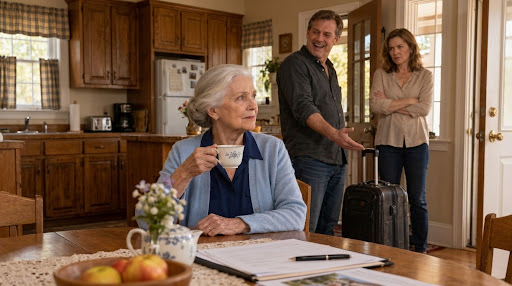
Luke stared at Richard Hayes as though
the man had just walked into our kitchen and
announced that the sun belonged to him.
For several seconds, nobody spoke.
Then Brenda stepped forward, her face tightening with irritation.
“Excuse me,” she said.
“Who exactly are you people, and why are you standing in our house?”
Richard didn’t raise his voice.
My name is Richard Hayes.
I purchased this property six months ago.
Luke laughed.
It was the same laugh he’d given me when
I told him to ask the owner before making demands.
Only now it sounded considerably less confident.
“That’s impossible,” he said. “My mother owns this house.”
Emily stepped inside and placed her leather briefcase on the kitchen table.
“Not anymore, Dad.”
Luke turned toward her.
His expression changed from confusion to anger.
“Emily?”
“Hello, Dad.”
“What are you doing here?”
“Helping Grandma.”
Brenda folded her arms.
“Oh, wonderful. The granddaughter who abandoned this family suddenly comes back when there’s property involved.”
Emily looked at her calmly.
“Interesting choice of words, Brenda. Especially considering Grandma’s property hasn’t belonged to her for six months.”
Luke pointed toward the front door.
“Everybody out. Right now.”
Richard remained where he was.
“Mr. Edwards, I understand this is unexpected, but I’m not leaving until we’ve clarified the situation.”
“Clarified what?”
“That you have no ownership interest in this property.”
Luke’s face reddened.
“My father built this house!”
“And your mother legally inherited it,” Emily replied. “She was the sole owner when she sold it.”
Luke looked at me.
“Mom?”
I sat in Patrick’s old kitchen chair, holding my teacup.
“Yes, Luke.”
“You sold Dad’s house?”
“I sold my house.”
His mouth opened.
Then closed.
“You had no right!”
I looked directly into his eyes.
“Luke, I had every right. Your father and I worked for nearly fifty years to pay for this property. After his death, the house belonged to me. You knew that when you moved in.”
Brenda grabbed the document lying on the table.
“This is ridiculous. We have paperwork ready for her to sign.”
Emily glanced at it.
“I noticed.”
She opened her briefcase.
Then she removed a folder containing several documents.
The first was a certified copy of the recorded deed transferring the property to Richard Hayes.
The second was the closing statement.
The third was my temporary occupancy agreement.
And the fourth was a letter Emily had been waiting six months to deliver.
But she didn’t show that one yet.
Instead, she turned the first document toward Luke.
“Here’s the recorded transfer. Here’s the closing date. Here’s the county recording information. Grandma sold the property through a legitimate transaction, with independent legal advice and confirmation that she understood what she was signing.”
Luke stared at the papers.
His eyes moved across the page.
Then he looked up.
“How much?”
I said nothing.
“How much did you sell it for, Mom?”
Richard answered.
“Four hundred and twenty-five thousand dollars.”
Brenda made a sharp sound.
Luke grabbed the edge of the table.
“Four hundred and twenty-five thousand?”
“Yes,” I said.
“Where’s the money?”
I looked at him.
“Somewhere safe.”
His face twisted.
“Safe from who?”
I set down my teacup.
“From you.”
The room went completely silent.
For the first time since Luke and Brenda moved into my home, I didn’t feel the need to soften my words.
I didn’t apologize.
I didn’t explain away his behavior.
I simply let the truth sit between us.
Luke stared at me as though I had slapped him.
“After everything we’ve done for you?”
I almost laughed.
“Everything you’ve done?”
His eyes narrowed.
“We gave up our privacy to take care of you.”
I looked around my kitchen.
At the cabinets Patrick had built.
At the table where we’d celebrated birthdays.
At the doorway leading to the little sewing room where I had been sleeping on a folding bed.
“You moved into my bedroom without asking,” I said quietly. “You took three hundred dollars from my pension every month. You packed away my belongings. You told me I was a burden.”
Brenda rolled her eyes.
“Oh, here we go.”
I turned toward her.
“And yesterday, you stood behind my son while he told me to sign away a house I no longer owned and disappear into a nursing home.”
Brenda’s expression hardened.
“We were trying to make arrangements for your care.”
Emily picked up the nursing home brochure.
“Then why did you circle a room at a facility that hasn’t received an application from Grandma?”
Brenda blinked.
“What?”
“I called the facility this morning, with Grandma’s permission. They confirmed there’s no admission agreement, no assessment, and no reservation in her name.”
Luke turned toward his wife.
“Brenda?”
She shrugged.
“I was going to call.”
Emily placed the brochure down.
“And the number written on the back isn’t the facility’s number. It’s the number of a real estate agent.”
Luke’s face changed.
I looked at the brochure.
I hadn’t noticed that.
Emily continued.
“Grandma told me you wanted her gone by Friday. So I checked the agent’s contact information.”
Brenda’s mouth tightened.
“That’s none of your business.”
“Actually,” Emily said, “when you’re pressuring an elderly woman to sign a property transfer based on false representations, it becomes a very serious matter.”
Luke pointed at Emily.
“Don’t you dare accuse my wife of anything.”
Emily didn’t flinch.
“Then explain why Brenda contacted a real estate agent about listing this house before Grandma had agreed to transfer it.”
I watched Luke turn slowly toward Brenda.
She looked away.
And suddenly I understood something.
My son had believed he was controlling the situation.
But Brenda had been making plans of her own.
Emily removed another sheet from her folder.
“This is an email the agent forwarded to Richard after realizing the property had already been sold. Brenda described herself and Luke as the incoming owners and asked about an immediate listing.”
Richard nodded.
“The agent checked the public records and discovered that I owned the property. She contacted my office because she was concerned about the conflicting information.”
Luke stared at his wife.
“You told me we were going to renovate.”
Brenda said nothing.
“You said we could refinance once Mom signed.”
Emily raised an eyebrow.
“Refinance?”
Luke looked suddenly uncomfortable.
I leaned forward.
“What refinance?”
Brenda shook her head.
“Don’t start.”
But Luke was looking at the kitchen floor.
“Brenda said we could borrow against the house to pay off some things.”
“What things?” I asked.
He didn’t answer.
Emily opened the next folder.
“Perhaps the sixty-eight thousand dollars in debt?”
Brenda’s head snapped up.
“Where did you get that number?”
Emily’s expression didn’t change.
“From the financial documents you voluntarily sent to the mortgage broker while trying to arrange financing on a property you don’t own.”
Luke sank into a chair.
For the first time, I saw fear in his eyes.
Not concern for me.
Not shame over how he’d treated me.
Fear that the money he’d expected was gone.
I remembered the night in March when I’d heard him laughing about selling the house after my death.
I remembered sitting on my folding bed, wondering whether the little boy I’d raised still existed somewhere inside that man.
Now I had my answer.
He had been thinking about the value of the house.
Brenda had been thinking about the money they could borrow.
And neither had been thinking about me.
Richard cleared his throat.
“There’s another matter we need to address.”
Luke looked up.
“What now?”
Richard glanced at Emily.
She nodded.
Then he said, “Under the terms of the sale, Mrs. Edwards has a temporary right to occupy the property. You and your wife do not have an ownership interest or an independent right to remain. Any question about ending your occupancy will be handled through the proper legal process.”
Brenda crossed her arms.
“You can’t just throw us out.”
“No,” Richard replied. “And I won’t attempt an illegal eviction. But the required notices will be served, and if necessary, the court will determine possession.”
Luke turned toward me.
“Mom, tell them to stop.”
I looked at him.
For nearly two years, I’d waited for those words.
Not because I wanted my son to suffer.
But because I wanted him to understand that I still had a voice.
“No, Luke.”
His eyes widened.
“What?”
“I said no.”
He stood so quickly his chair scraped against the floor.
“You’re choosing strangers over your own son?”
I felt the familiar pull of guilt.
The old instinct to comfort him.
To apologize.
To make things easier.
Then I remembered Owen—
No.
I remembered Luke as a child, standing in this very kitchen with a scraped knee, reaching for me because he trusted I would make everything better.
I had spent a lifetime doing exactly that.
But the man in front of me wasn’t asking for comfort.
He was demanding control.
“I’m choosing to protect myself,” I said.
Emily placed her hand over mine.
And then she opened the final folder.
“Dad,” she said, “there’s one more thing you need to see.”
She slid a document across the table.
Luke looked down.
His face drained of color.
Because it wasn’t a deed.
It wasn’t a bank statement.
It was a copy of a letter Patrick had written shortly before he died.
And the first line read:
“If Luke ever tries to take this house from his mother, I want him to know that I saw it coming.”
PART 4
I had not known about Patrick’s letter until Emily showed it to me three weeks earlier.
It had been hidden inside a wooden compartment beneath his old workbench in the garage.
Patrick had built that bench forty years ago.
It was made of oak, with deep drawers for tools and a narrow compartment beneath the top where he kept important measurements and handwritten plans.
After his death, I couldn’t bring myself to touch it.
The garage still smelled faintly of sawdust and machine oil.
His work gloves hung from a nail.
His measuring tape lay beside a box of screws.
Everything looked as though he might walk back in at any moment.
But when Emily came to help me organize my belongings, she noticed that the workbench had a false panel.
“Grandma,” she said, “did Grandpa ever show you this?”
I shook my head.
She carefully lifted the panel.
Inside was a sealed envelope.
On the front, written in Patrick’s familiar handwriting, were five words.
For Margaret, if she needs it.
My hands trembled when I opened it.
Patrick had written the letter several months before his death, when his health was declining.
He hadn’t told me.
Perhaps he hadn’t wanted to worry me.
Or perhaps he’d been waiting until he was certain.
The letter was three pages long.
And every sentence revealed how much my husband had understood about our son.
Luke picked up the copy now lying on the kitchen table.
His fingers shook.
Emily remained beside me while he read.
The letter began:
My dearest Margaret,
If you’re reading this, I may no longer be there to stand beside you. That thought hurts me more than anything else about leaving this world.
You and I built our life from almost nothing. We worked hard, raised our boy, and made a home where I hoped you would always feel safe.
But there is something I have been afraid to tell you.
Luke stopped reading.
He looked at me.
“Where did you get this?”
“Your father’s workbench.”
He shook his head.
“This isn’t real.”
I looked at him.
“You recognize his handwriting.”
Luke stared at the page.
He did.
Patrick’s handwriting had always been distinctive.
Strong block letters.
A slight slant to the right.
Numbers written with the careful precision of a carpenter measuring wood.
Emily nodded toward the paper.
“Keep reading.”
Luke swallowed.
Then his eyes moved down the page.
Patrick had written about a conversation he’d overheard during the last year of his life.
Luke had visited one afternoon while I was at the grocery store.
He believed his father was asleep in the bedroom.
But Patrick had been awake.
He heard Luke talking to Brenda on the phone.
They were discussing our property.
Specifically, how much money they could get if Patrick died and I eventually moved into assisted living.
Luke had apparently said that I would be easy to convince.
That I trusted him.
That I wouldn’t know how to manage property paperwork alone.
Patrick had confronted him.
Luke apologized.
He claimed it was only a foolish conversation.
Patrick wanted to believe him.
But he couldn’t forget what he’d heard.
So he met privately with an attorney.
He reviewed our estate documents.
And he made sure that when he died, I would hold clear ownership of our home.
Then he wrote the letter.
Luke’s hands were trembling now.
“Dad never said any of this.”
I looked at him.
“He said it in the letter.”
“He was sick.”
Emily leaned forward.
“Grandpa was ill, but he understood his property and legal affairs. The estate documents were properly prepared.”
Luke looked at her.
“You’ve always hated me.”
Emily’s expression changed.
Not to anger.
To sadness.
“No, Dad. I spent years trying to love you in a way that didn’t require me to pretend your behavior was acceptable.”
Brenda made an impatient sound.
“This is getting ridiculous. An old letter doesn’t change anything.”
“No,” Richard said. “The recorded deed establishes ownership. The letter is relevant to the family’s history, not a substitute for legal evidence.”
I appreciated his calmness.
Because the letter wasn’t important to me for legal reasons.
It was important because Patrick had seen what I refused to see.
My husband had tried to protect me even when he knew he might not be there to do it himself.
Luke continued reading.
Near the end, Patrick had written:
Margaret, if our son ever makes you feel unwelcome in the home we built, please remember this: you are not a guest in your own life.
You do not owe anyone your home simply because you gave them life.
I love Luke. I always will. But loving our son does not mean allowing him to take everything from you.
If the day comes when you must choose between keeping him happy and keeping yourself safe, please choose yourself.
You have spent your whole life taking care of everyone else.
Let someone take care of you now.
Forever yours, Patrick.
When Luke finished reading, the room was silent.
He placed the letter on the table.
For a moment, I thought he might cry.
I thought perhaps he would finally understand what he had done.
Instead, he looked at me and said, “So you turned Dad against me too?”
Something inside me became very still.
I had spent eighty-one years learning patience.
I had raised a child.
Buried my parents.
Cared for a dying husband.
Survived illnesses, financial struggles, and grief.
But nothing had prepared me for hearing my son blame me for the words his father had written before dying.
I stood.
Slowly.
My knees ached.
But my voice was steady.
“Luke, your father loved you.”
He looked away.
“He loved you when you failed your driving test. He loved you when you quit college. He loved you when you lost your first job. He loved you when you borrowed money and couldn’t repay it.”
I took a breath.
“But he was disappointed in the way you treated people.”
Luke’s face tightened.
“Mom—”
“No. You will listen to me now.”
He went silent.
“For two years, I let you convince me that I was lucky to have you here. I let you take my bedroom. I let you charge me rent in a house I owned. I let Brenda decide when I could use my own kitchen.”
Brenda opened her mouth.
I raised my hand.
“I’m not finished.”
She closed it.
“I spent fifty years making this house a home. I raised you here. I cooked your meals, washed your clothes, sat beside your bed when you were sick, and celebrated every accomplishment you ever had.”
My voice shook.
“But I did not raise you so you could stand in front of me at eighty-one years old and tell me to disappear.”
Luke stared at me.
I stepped closer.
“You asked me to sign over my home. You put my suitcase beside the door. You decided I belonged in a nursing home without asking what I wanted.”
Tears blurred my vision.
“And the worst part is that you never once asked whether I was happy.”
For the first time, Luke had no answer.
I looked at Brenda.
“You told me the sewing room was more appropriate for someone my age.”
She shifted uncomfortably.
“You told me my rocking chair was ugly. You packed away my husband’s photographs. You made me feel guilty for eating food bought with my own money.”
I took another breath.
“But I am done being ashamed of needing space in the world.”
Emily squeezed my hand.
Then Richard spoke.
“Mrs. Edwards, would you like to continue with the arrangements we discussed?”
I nodded.
“Yes.”
Luke looked between us.
“What arrangements?”
I sat back down.
“I’m moving.”
He frowned.
“Moving where?”
“To a place I’ve chosen.”
Brenda laughed nervously.
“So you are going into a nursing home?”
“No.”
I looked at Emily.
She smiled.
I turned back to my son.
“I bought a cottage near the lake.”
Luke blinked.
“A cottage?”
“Yes.”
“With what money?”
“My money.”
His expression darkened.
“How much did you spend?”
I almost smiled.
“Luke, you still haven’t learned.”
He stared at me.
I continued.
“My finances are no longer your concern.”
Emily explained that the proceeds from the house sale had been placed in accounts under my control, with appropriate planning for my living expenses and future care.
I had purchased a small two-bedroom cottage in a quiet lakeside community.
It had a covered porch.
A garden.
A sewing room with real windows.
And enough space for Patrick’s rocking chair.
I had already visited three times.
I knew the neighbors.
I had met a woman named Eleanor who invited me to join a quilting group.
And for the first time since Patrick died, I was looking forward to waking up in the morning.
Luke stared at me.
“You planned all this behind my back?”
I nodded.
“Yes.”
“Why didn’t you tell me?”
I looked at him.
“Because I heard you talking about selling this house after I died.”
His face went white.
Brenda stopped moving.
I continued.
“I heard you laughing about paying off your truck with the money.”
Luke opened his mouth.
Then closed it.
I watched him search for an explanation.
He couldn’t find one.
Finally, he whispered, “You weren’t supposed to hear that.”
The words hung in the room.
Emily slowly turned toward him.
“Dad,” she said quietly, “do you hear yourself?”
Luke looked down.
I felt something inside me settle.
Not happiness.
Not triumph.
Clarity.
For years, I had wondered whether I was being unfair to him.
Whether I was imagining things.
Whether grief had made me too sensitive.
But there it was.
He wasn’t sorry he’d said it.
He was sorry I’d heard.
Richard closed his folder.
“We’ll proceed with formal notice regarding the property. Any disputes about occupancy will be handled through the legal process.”
Luke stood abruptly.
“This is unbelievable.”
He looked at me.
“After everything, you’re throwing your own son onto the street.”
I shook my head.
“No, Luke. I’m refusing to let you throw me out of my own life.”
He stormed toward the hallway.
Brenda followed.
Before leaving the kitchen, she turned and pointed at Emily.
“You’ll regret this.”
Emily remained calm.
“No, Brenda. Grandma already spent two years regretting that she trusted you.”
Brenda disappeared.
A bedroom door slammed.
I flinched.
Emily noticed.
She put her arm around me.
“Grandma?”
I looked at her.
“I’m all right.”
“Are you sure?”
I glanced around the kitchen.
At the old cabinets.
At Patrick’s handmade shelves.
At the sunlight coming through the window.
Then I whispered, “I think I’m finally going to be.”
But I was wrong about one thing.
I thought the confrontation was over.
Three nights later, Luke entered my sewing room after midnight.
And what he was holding made me realize that losing the house had not ended his plans.
PART 5
It was 12:43 a.m. when I heard my sewing room door open.
I had been awake, reading a mystery novel beneath the small lamp beside my folding bed.
The house was quiet.
Brenda had gone to stay with her sister after an argument with Luke.
Luke had spent most of the evening in the garage.
I thought he was packing.
But when he stepped into my room, I knew something was wrong.
He was holding Patrick’s leather folder.
The one I’d kept beneath my dresser.
The one containing old property records, insurance documents, and copies of important family papers.
“Mom,” he said.
His voice was unusually calm.
I lowered my book.
“Luke?”
He closed the door behind him.
“We need to talk.”
I glanced toward my phone.
It was charging beside the bed.
“What about?”
He held up the folder.
“I found this.”
I sat straighter.
“That belongs to me.”
“I know.”
“Then please put it back.”
He ignored me.
Instead, he pulled out several sheets.
“I’ve been thinking.”
I waited.
“You made a mistake selling the house.”
I felt my stomach tighten.
“Luke, we’ve already discussed this.”
“No, you don’t understand.”
He stepped closer.
“You sold it for four hundred and twenty-five thousand. But it’s worth more now. A lot more.”
I said nothing.
“If we could get Richard to cancel the deal, we could sell it again. Maybe for five hundred thousand.”
I stared at him.
“The sale closed six months ago.”
“I know that.”
“Richard owns the property.”
Luke waved his hand.
“There must be a way around it.”
I looked at the folder.
“Did you come into my room in the middle of the night to ask me to undo a legal sale?”
His expression hardened.
“I’m trying to fix what you’ve done.”
I took a slow breath.
“Luke, I haven’t done anything wrong.”
He laughed bitterly.
“You’ve destroyed my marriage.”
I stared at him.
“Your marriage?”
“Brenda says if I can’t get the money, she’s leaving.”
For a moment, I saw something familiar in his face.
The frightened little boy who used to come to me when he had made a mistake.
The boy who wanted me to solve everything.
And for one dangerous second, I wanted to reach out.
To tell him I would help.
To make the problem disappear.
But then I remembered the suitcase beside the front door.
The nursing home brochure.
The folding bed.
The nights I’d eaten crackers because I felt unwelcome in my own kitchen.
I folded my hands.
“I’m sorry your marriage is struggling.”
He looked hopeful.
“But I won’t give you money to solve it.”
His expression changed instantly.
“Unbelievable.”
I remained quiet.
“You have hundreds of thousands of dollars, and you’re going to let your own son lose everything?”
“Luke, you’re fifty-four years old.”
“So?”
“You have a job. You have choices. You can seek financial counseling. You can make arrangements with your creditors.”
He shook his head.
“You sound just like Emily.”
“Maybe because she’s right.”
His face reddened.
“Emily turned you against me.”
“No.”
I looked directly at him.
“Your behavior did that.”
He stared at me.
Then he placed the folder on my dresser.
For a moment, I thought he was leaving.
Instead, he reached into his pocket.
He pulled out a folded sheet of paper.
“Just sign this.”
I didn’t move.
“What is it?”
“A statement saying you weren’t mentally competent when you sold the house.”
My blood ran cold.
He unfolded it.
“I spoke to someone. If you say you didn’t understand what you were signing, we might be able to challenge the sale.”
I stared at the paper.
“You want me to lie?”
“I’m trying to protect the family.”
“No.”
“Mom—”
“No, Luke.”
He stepped closer.
“Just listen.”
“I have listened to you for two years.”
My voice was shaking now.
“And every time, you ask me to surrender something else.”
He looked toward my phone.
Then back at me.
“Are you recording this?”
I wasn’t.
But the question frightened me.
“Luke, I want you to leave my room.”
He stood motionless.
“Please.”
His jaw tightened.
Then he grabbed the paper.
“You’re going to regret this.”
He walked out.
I heard his footsteps disappear down the hallway.
Then the front door slammed.
I sat on my folding bed for several minutes.
My hands were trembling.
I didn’t know whether Luke would return.
I didn’t know whether he would try again.
But I knew I couldn’t spend another night there.
I picked up my phone and called Emily.
She answered on the second ring.
“Grandma?”
“Emily, sweetheart.”
She heard something in my voice.
“What happened?”
I told her.
Every word.
When I finished, she was quiet for a moment.
Then she said, “I’m coming to get you.”
“It’s late.”
“I don’t care.”
“Emily—”
“Grandma, pack the things you need. I’ll be there as soon as I can.”
I looked around the sewing room.
At the boxes.
The fabric.
The folding bed.
Patrick’s photograph.
For almost two years, I’d been waiting for permission to leave that room.
Now I realized I didn’t need anyone’s permission.
I stood.
Opened my suitcase.
And began packing.
Emily arrived forty minutes later.
She brought her husband, Daniel, and called ahead to request a police escort while we collected my belongings because of the confrontation.
The officers explained that they could help keep the peace but would not decide ownership or possession disputes at the scene.
That was fine.
I wasn’t there to argue about the house.
I was leaving.
Daniel carried my suitcase.
Emily gathered my medication, documents, and jewelry.
I took Patrick’s photograph.
His wedding ring, which I’d kept in a little velvet box.
And the quilt I’d sewn during our first winter together.
When we reached the hallway, I stopped.
My old bedroom door was open.
Luke had apparently gone out.
Brenda’s clothes were scattered across the bed.
The same bed Patrick and I had shared for nearly fifty years.
I stood in the doorway.
For a moment, grief hit me so hard I could barely breathe.
I remembered Patrick waking before sunrise.
I remembered his warm hand reaching for mine beneath the blankets.
I remembered the nights we’d talked about our dreams.
The mornings he’d brought me coffee.
The day he’d told me he was sick.
And the final evening we’d spent together, when he whispered, “Promise me you’ll take care of yourself, Maggie.”
I had promised.
But I hadn’t known how.
Not until now.
Emily stood beside me.
“Grandma?”
I wiped my eyes.
“I’m ready.”
We walked toward the front door.
My suitcase rolled across the floor.
The same suitcase Luke had placed beside the door three days earlier.
But this time, nobody was forcing me out.
I was leaving because I had chosen a different life.
And that made all the difference.
The legal process concerning Luke and Brenda’s occupancy continued after I moved out.
Richard followed the required procedures.
There were notices, legal correspondence, and eventually a court hearing.
Luke tried to argue that he had been promised the property.
But he had no deed.
No written agreement transferring ownership.
And no evidence that I had ever intended to give him the house.
The court considered the documents and circumstances before issuing its decision regarding possession.
Luke and Brenda were ultimately required to leave.
I did not attend the final hearing.
Emily handled the communications that involved me.
By then, I was living at the lake.
And I had discovered something extraordinary.
Peace.
Not the kind that comes from pretending everything is fine.
The kind that comes from waking up without fear.
My cottage was small compared with the house Patrick built.
It had two bedrooms, a kitchen, a living room, and a porch overlooking a garden.
There was a narrow path leading toward the lake.
In the morning, birds gathered near the fence.
In the afternoon, sunlight filled my sewing room.
And every evening, I sat in Patrick’s rocking chair with a cup of tea.
The first morning I woke there, I didn’t know what to do with myself.
Nobody was complaining about the noise of the kettle.
Nobody was telling me where I could sit.
Nobody was asking for my pension money.
I walked into the kitchen.
Opened the refrigerator.
And laughed.
There was food inside.
Food I’d chosen.
Food I could eat whenever I wanted.
I made scrambled eggs.
Toast.
And a pot of coffee.
Then I carried my breakfast onto the porch.
The lake was silver beneath the morning sun.
I sat down.
And for the first time in nearly two years, I ate without feeling like an inconvenience.
I cried halfway through my toast.
Not because I was sad.
Because I was free.
Emily visited every Sunday.
Sometimes Daniel came.
Sometimes they brought their children, my great-grandchildren, Sophie and Benjamin.
Sophie was nine.
Benjamin was six.
They loved the lake.
They loved the garden.
And they especially loved the sewing room.
One afternoon, Sophie found a box of fabric scraps.
“Great-Grandma, can you teach me to make something?”
I smiled.
“What would you like to make?”
“A pillow.”
So we sat together at the sewing machine.
I showed her how to measure.
How to pin fabric.
How to keep her fingers away from the needle.
She listened carefully.
When she finished, the pillow was crooked.
One corner was higher than the other.
But Sophie held it against her chest as though she’d created something priceless.
“Look, Mommy!” she shouted.
Emily came into the room.
She smiled.
“That’s beautiful.”
Sophie looked at me.
“Great-Grandma taught me.”
I felt my heart swell.
For years, Brenda had treated my sewing room as a place to hide me.
Now it was filled with laughter.
With children.
With creativity.
With life.
And I thought Patrick would have loved that.
Three months after I moved, Luke called.
I almost didn’t answer.
His name appeared on my phone, and my stomach tightened automatically.
But I took a breath.
Then I accepted the call.
“Hello, Luke.”
There was a pause.
“Hi, Mom.”
He sounded tired.
Older.
“Are you okay?” I asked.
He hesitated.
“Not really.”
I waited.
“Brenda left.”
I closed my eyes.
“I’m sorry.”
“She moved in with her sister. Says she can’t live like this anymore.”
I didn’t respond.
“I’ve been staying in a small apartment.”
“That sounds difficult.”
He gave a bitter laugh.
“Yeah.”
Silence settled between us.
Then he said, “I guess you got what you wanted.”
I felt the familiar sting.
But I didn’t accept it.
“Luke, I never wanted your marriage to fail.”
“You wanted me out of the house.”
“I wanted to live somewhere I felt safe and respected.”
He sighed.
“Same difference.”
“No,” I said gently. “It isn’t.”
He was quiet.
Then he asked, “Do you ever think about Dad?”
“Every day.”
“Do you think he’d be disappointed in me?”
I looked toward Patrick’s photograph on the mantel.
I thought about the letter.
About the years we’d spent raising Luke.
About the man my husband had hoped our son would become.
“Yes,” I said.
Luke inhaled sharply.
I continued.
“I think he’d be disappointed in some of your choices. But I also think he’d hope you could make better ones.”
Luke didn’t speak.
I heard him breathing.
Then he whispered, “I messed everything up, didn’t I?”
I closed my eyes.
“You hurt me very deeply, Luke.”
“I know.”
It was the first time he’d said those words without immediately blaming someone else.
I waited.
He continued.
“I keep thinking about that night I put your suitcase by the door.”
My throat tightened.
“I do too.”
“I told myself I was helping you.”
I said nothing.
“But I wasn’t.”
Tears filled my eyes.
“No, sweetheart. You weren’t.”
He began crying.
I had heard my son cry many times.
As a baby.
As a child.
As a teenager.
But this was different.
He wasn’t demanding that I fix something.
He wasn’t asking for money.
He wasn’t threatening me.
He was finally facing what he’d done.
“I’m sorry, Mom.”
I held the phone against my ear.
For a moment, I couldn’t speak.
Then I said, “Thank you for saying that.”
“Can you forgive me?”
I looked out at the lake.
The water moved gently beneath the afternoon breeze.
“Luke, forgiveness is something I can work toward. Trust will take longer.”
He was quiet.
“I understand.”
“And I won’t give you money.”
He gave a small, sad laugh.
“I wasn’t calling for money.”
“I’m glad.”
We talked for another ten minutes.
Not about the house.
Not about Brenda.
Not about what he believed he had lost.
We talked about his job.
His health.
The counseling he’d recently started.
I didn’t know whether he would continue changing.
I didn’t know whether his apology would last.
But I knew I no longer had to surrender my independence to prove I loved him.
When we ended the call, I sat quietly for a long time.
Then I whispered toward Patrick’s photograph, “I hope we’re doing the right thing.”
The room was silent.
But I imagined what he would have said.
Keep your heart open, Maggie. Just don’t hand over the keys to your life again.
I smiled.
That sounded exactly like him.
A year after I sold the house, I received a letter from Luke.
It arrived on a Tuesday morning.
The envelope was plain.
My name was written in his familiar handwriting.
I carried it to the porch and opened it carefully.
Inside were two pages.
No demands.
No legal papers.
No requests for money.
Just a letter.
Dear Mom,
I’ve spent most of my life believing that being your son meant I was entitled to whatever you had.
I told myself that because Dad built the house, it should eventually belong to me.
I never stopped to think about what the house meant to you.
I forgot that you worked too.
That you paid bills.
That you made sacrifices.
That you were a person before you became my mother.
I stopped reading.
My eyes blurred.
Then I continued.
When Brenda and I moved in, I told myself we were helping you. But the truth is, I wanted the house.
I wanted the money.
And I was angry that you were still in control of something I thought should be mine.
I treated you like an obstacle.
I am ashamed of that.
I don’t expect you to forget what happened.
I don’t expect you to give me anything.
I only want you to know that I finally understand why you left.
You didn’t abandon me.
You protected yourself.
I should have been the son who protected you.
I’m sorry I wasn’t.
Love, Luke.
I sat there holding the letter.
The birds were singing.
The lake shimmered beyond the trees.
And I cried.
For the little boy Luke had been.
For the man he’d become.
For the years we’d lost.
And for the possibility that something better might still be ahead.
I didn’t call him immediately.
I wanted to think.
To feel everything without rushing to make it easier for him.
That evening, I placed the letter beside Patrick’s photograph.
Then I went into my sewing room.
I took out a piece of pale blue fabric.
And began making a quilt.
Not because anyone had asked me to.
Not because I needed to earn my place.
Simply because I wanted to.
On my eighty-third birthday, Emily organized a small celebration at the cottage.
There were flowers on the table.
A lemon cake.
And a vase filled with wildflowers Sophie and Benjamin had picked near the lake.
Eleanor from the quilting group came.
So did two neighbors.
Daniel grilled chicken in the backyard.
Emily hung a banner across the porch.
It read:
HAPPY BIRTHDAY, GRANDMA MARGARET!
I laughed when I saw it.
“Eighty-three,” I said. “Imagine that.”
Emily kissed my cheek.
“And still causing trouble.”
I smiled.
“The good kind, I hope.”
“The very best kind.”
Later that afternoon, a car pulled into the driveway.
I looked through the window.
Luke stepped out.
He was carrying a small wooden box.
He stood beside the car for a moment, looking nervous.
Emily came to stand beside me.
“Grandma, are you okay with him being here?”
I nodded.
We had spoken several times over the previous months.
He had continued counseling.
He had stopped asking me for financial help.
And although our relationship remained cautious, he had respected the boundaries I set.
I had invited him.
Not because I owed him access to my life.
But because I wanted to see whether we could build something healthier.
Luke walked onto the porch.
“Happy birthday, Mom.”
“Thank you, sweetheart.”
He held out the wooden box.
“I made you something.”
I stared at it.
“You made it?”
He nodded.
“I’ve been working with wood again.”
Patrick had taught him carpentry when he was young.
For years, Luke had abandoned it.
Now he was taking evening classes at a community workshop.
I opened the box.
Inside was a beautifully carved wooden picture frame.
The edges were decorated with tiny leaves.
The wood had been polished until it glowed.
And engraved along the bottom were the words:
For the woman who taught me what home means.
My hands trembled.
“Oh, Luke.”
He looked down.
“I know it doesn’t fix anything.”
I touched the frame.
“No. It doesn’t.”
He nodded.
“But it’s beautiful.”
His eyes filled.
“Dad would have made it better.”
I smiled through tears.
“Your father would have been proud that you tried.”
Luke looked at me.
Then he asked quietly, “Can I hug you?”
I stood.
“Yes.”
He wrapped his arms around me.
For the first time in years, I didn’t feel trapped in my son’s embrace.
I felt the cautious beginning of something new.
Not a return to the past.
Something different.
Something that would require honesty, patience, and boundaries.
And perhaps, one day, trust.
That evening, after everyone left, I sat alone on my porch.
The birthday flowers stood on the table.
Patrick’s rocking chair creaked gently beneath me.
The air smelled of fresh grass and lake water.
I thought about the house we’d built in 1974.
The long evenings Patrick spent measuring boards.
The sound of his hammer.
The first Christmas we celebrated there.
The birthdays.
The arguments.
The laughter.
The grief.
For a long time, I had believed that leaving that house meant abandoning the life we’d made.
But I understood now.
A home wasn’t simply walls and a roof.
It wasn’t a deed.
It wasn’t the amount of money someone might receive after your death.
It was the place where you were allowed to exist without apologizing.
Where your memories mattered.
Where your choices were respected.
Where love didn’t come with a demand for ownership.
I looked toward the lake.
The sunset had turned the water gold.
I imagined Patrick sitting beside me.
His work boots resting on the porch.
His hands wrapped around a cup of coffee.
His familiar smile.
“You did good, Maggie,” I imagined him saying.
I smiled.
“I finally listened to you.”
A soft breeze moved through the trees.
And for a moment, I felt as though he were there.
Not in the old house.
Not in the walls he’d built.
But in the peace he’d always wanted me to have.
I picked up my teacup.
Then I thought about the morning Luke placed my suitcase beside the front door.
He had believed he was sending me away.
He had believed my age made me powerless.
He had believed that because I was his mother, I would surrender everything rather than disappoint him.
But he had forgotten something important.
I was a woman long before I was his mother.
I had worked.
Loved.
Sacrificed.
Built a life.
And survived losses he could barely imagine.
At eighty-one, I had found the courage to begin again.
At eighty-three, I was finally living the life I’d chosen.
And the most valuable thing I owned wasn’t the money from the sale.
It wasn’t the cottage.
It wasn’t even the beautiful wooden frame Luke had given me.
It was the knowledge that I could love my family without giving them permission to hurt me.
I could forgive without forgetting.
I could be generous without surrendering my security.
And I could grow old without becoming invisible.
I set my teacup down.
The evening birds were settling into the trees.
Inside, the little sewing room waited for me.
There was a half-finished quilt on the table.
A photograph of Patrick beside the window.
And a new picture frame waiting to be filled.
I smiled.
Then I stood and walked inside my home.
My own home.
Where nobody charged me rent to sleep.
Nobody told me when I could eat.
Nobody hid my husband’s photographs.
And nobody ever again would place my suitcase beside the door and tell me I was no longer welcome.
Because my son thought he was taking my house away from me.
What he never understood was that by trying to take everything I had, he finally gave me the courage to take my life back.
And at eighty-three years old, I had never felt more at home.
THE END THANK YOU FOR READING !!!



