PART 3
Colonel Hayes picked up his telephone
without taking his eyes off the message on my screen.
“Get Major Bennett from the legal office,” he said.
“And ask Special Agent Rebecca Shaw to come to my office immediately.”
He listened for a moment.
“No. This isn’t a routine security matter.”
His gaze moved toward the mahogany box.
“Tell her it concerns Colonel Walter Palmer.”
The person on the other end apparently asked a question.
Hayes lowered his voice.
“Yes. His granddaughter is here.”
He hung up.
I stood beside his desk, still holding my phone.
My sister’s message glowed on the screen.
DAD SAYS YOU STOLE GRANDPA’S BOX. HE’S CALLING THE MILITARY POLICE.
I read it again.
Then I looked at Hayes.
“Sir, my father is going to make this a problem.”
The colonel leaned back in his chair.
Captain Palmer, your father can report a suspected theft.
That doesn’t mean his accusation is true.
He tapped the envelope.
“Do you have documentation showing how you received this?”
Yes, sir. Grandpa’s attorney gave me the box eight months after his death.
I have the signed receipt and a copy of the estate instructions.
“Good. Preserve them.”
He glanced toward the photograph on his computer.
“And don’t respond to your sister yet.”
I nodded.
But my attention had already returned to the screen.
My father stood beside a silver-haired man in an expensive charcoal suit. Behind them was a warehouse with a security fence.
I recognized the silver-haired man.
I’d seen his photograph on Savannah’s social media page.
His name was Richard Voss.
He was the father of her boyfriend, Julian.
And according to Savannah, Richard was a successful businessman who owned several transportation and manufacturing companies.
I looked at Colonel Hayes.
“Sir, why is my father standing beside Richard Voss?”
Hayes hesitated.
“That’s one of the questions investigators have been trying to answer.”
I felt my stomach tighten.
“Trying?”
He nodded.
“For some time.”
I stared at him.
“Are you telling me my grandfather knew my father was involved in something illegal?”
“I’m telling you your grandfather suspected serious misconduct involving a group of defense subcontractors. He collected records, raised concerns through authorized channels, and preserved information he believed investigators might need.”
I looked down at the mahogany box.
“Why didn’t he tell me?”
Hayes’s expression softened.
“Because he knew you were building your own career. And because he understood that family connections could create difficult conflicts.”
I thought about Grandpa.
His weathered hands.
His old wool cardigan.
The little American flag beside his porch.
The way he never raised his voice, even when my father shouted.
Then I remembered something.
Three years earlier, Grandpa had asked me a strange question.
Fiona, if someone you love is doing something wrong, does loving them mean protecting them from the consequences?
I’d been home on leave.
We were sitting on his back porch.
I remembered answering without hesitation.
“No, Grandpa. It means telling them to stop.”
He’d smiled.
Then he’d said, Good. I was hoping you’d say that.
At the time, I thought we were discussing some old argument with Dad.
Now I wasn’t so sure.
Colonel Hayes turned the box toward me.
“Captain, before we open anything further, we need to establish exactly what your grandfather intended and whether any materials require special handling.”
I nodded.
He pointed to the silver insignia.
It was small.
A shield surrounded by thirteen stars, with a single oak branch crossing a vertical sword.
I’d seen it before.
Not on a uniform.
On Grandpa’s old stationery.
He kept a silver letter opener with the same symbol.
“What does it mean?” I asked.
Hayes studied it.
“It was the emblem of a joint oversight working group your grandfather helped establish. The group no longer operates under that name.”
“Was he its commander?”
“No. He was one of the senior officers responsible for coordinating information between investigators, auditors, and contracting officials.”
I frowned.
“Then why did you say he left me control?”
Hayes looked uncomfortable.
“I should have chosen my words more carefully.”
He leaned forward.
“Your grandfather didn’t leave you command authority. He couldn’t. What he left was control over whether his privately held records would be disclosed, subject to the law and any restrictions that apply.”
I looked at the box.
“And he wanted me to decide?”
“He named you as the custodian of those records. He trusted your judgment.”
The words struck harder than I expected.
My parents had spent eleven years treating my military career like an embarrassing hobby.
Savannah had called me a government babysitter.
Dad had once introduced me at a family barbecue as his daughter who “couldn’t figure out what to do with her life.”
And Grandpa had trusted me with the one thing he believed mattered most.
The truth.
A knock sounded at the door.
Hayes stood.
“Come in.”
Major Bennett entered first.
He was a military attorney with closely cropped hair and a serious expression.
Behind him walked a woman in a dark civilian suit.
She introduced herself as Special Agent Rebecca Shaw, a federal investigator assigned to defense procurement fraud matters.
She looked at the box.
Then at me.
“Captain Palmer?”
“Yes, ma’am.”
“I’m sorry about your grandfather.”
“Thank you.”
She sat down.
“Colonel Hayes says you brought materials he left in your custody.”
I nodded.
She opened a notebook.
“Before anyone examines them, I want to make something clear. You’re not being asked to investigate your own family. In fact, because of your relationship to the people involved, you shouldn’t.”
I swallowed.
“Understood.”
“We’ll document what you brought, verify the provenance, and determine which authorities should review it.”
She paused.
“And you should preserve any communications from your family. Don’t delete messages, alter documents, or try to confront anyone for evidence.”
I looked at her.
“Is my father under investigation?”
She held my gaze.
“I can’t discuss every aspect of an ongoing matter. But I can tell you the company named in these records has attracted scrutiny.”
My heart sank.
Some part of me had still hoped the invoices were a mistake.
A misunderstanding.
Something Grandpa had misinterpreted.
But Special Agent Shaw’s expression told me this was serious.
We opened the box in the presence of the attorney and investigator.
Inside was a leather-bound notebook, three sealed envelopes, a small metal key, and a portable storage device.
The items were carefully arranged in a velvet-lined compartment.
On top lay a handwritten note.
FOR FIONA.
My throat tightened.
I unfolded it.
My dear girl,
If you are reading this, then I am gone, and the day I feared has probably arrived.
I wish I could spare you what comes next.
But I have watched you grow into a woman who understands that integrity is not something we practice only when it is convenient.
Your father made choices I could not approve.
I gave him opportunities to correct them.
He refused.
The materials in this box may help the proper authorities understand what happened.
You are not responsible for your father’s decisions.
You are responsible only for your own.
Whatever you decide, remember that I was proud of you long before anyone else understood what you had become.
Love, Grandpa.
I stared at the final line.
Then read it again.
I was proud of you.
My vision blurred.
For eleven years, I’d served through deployments, difficult assignments, and nights when I wondered whether I was strong enough to continue.
Grandpa had never demanded details.
He’d simply asked whether I was safe.
Whether I was eating enough.
Whether I remembered to rest.
And every time I received a promotion, he mailed me a card.
Usually with the same sentence.
Keep your feet on the ground and your head where it belongs.
I folded his letter carefully.
Then looked at the investigators.
“Whatever’s in there, I want it handled properly.”
Special Agent Shaw nodded.
“That’s what we’re here to do.”
The first envelope contained copies of correspondence between Grandpa and my father.
The earliest letter was dated almost four years earlier.
Dad had written:
Walter, I need you to introduce me to someone who can help Palmer Defense Logistics qualify for the new transport contract.
Grandpa’s reply was brief.
Arthur, I cannot use my former position to influence a contracting decision. Submit your proposal through the proper process.
The next letter was angrier.
You’re supposed to help your family. You spent thirty years serving strangers, and now you won’t even make one telephone call for your own son.
Grandpa had answered:
Helping you obtain an unfair advantage would not be helping you. It would be teaching you that the rules apply only to other people.
I stared at the page.
It sounded exactly like him.
Then came another letter.
This one from Dad.
Richard says there are ways around the paperwork. If you won’t help, at least stay out of it.
There was no written response.
Instead, Grandpa had made a note in the margin.
Voss involvement confirmed. Preserve correspondence.
I felt cold.
“Richard Voss,” I whispered.
Special Agent Shaw looked at the document.
“Yes.”
I thought about Savannah’s engagement.
The expensive ring she’d been showing everyone.
The Christmas dinner my mother had been planning for weeks.
The champagne.
The flowers.
The caterers.
And the way she’d laughed when Dad pushed my suitcase onto the porch.
Go back to your barracks, loser.
I wondered whether she knew anything about the business.
Or whether she’d simply been dazzled by Julian Voss’s money.
I wanted to believe it was the second.
Then we opened the next envelope.
And I wasn’t sure anymore.
The documents showed that Palmer Defense Logistics had submitted invoices for transportation services connected to a government-funded project.
Some appeared legitimate.
Others showed repeated charges for the same shipments.
Several listed equipment deliveries on dates when the corresponding facilities had recorded no such arrivals.
There were payments routed through intermediary companies.
One company was linked to Richard Voss.
Another was registered to a business address used by my father.
Special Agent Shaw studied the records without commenting on their meaning.
Major Bennett reminded me that suspicious paperwork was not the same as a legal finding of fraud.
I understood.
But then I saw a signature.
Savannah Palmer.
My sister.
Her name appeared on a document authorizing a consulting payment to a company called Sterling Advisory Group.
I stared at it.
“Why would Savannah sign this?”
Shaw looked up.
“Does your sister work for your father’s business?”
“No. She’s a luxury event planner.”
“Does she have any business interests you’re aware of?”
I hesitated.
“She runs a small company. Savannah Palmer Events.”
Shaw wrote something down.
“Have you heard of Sterling Advisory Group?”
“No.”
She nodded.
“Then we won’t speculate.”
But I couldn’t stop staring at my sister’s signature.
The same sister who mocked my military career.
The same sister who called Grandpa a boring old man.
The same sister who had laughed while I stood in the snow on Christmas morning.
And now her name was connected to payments my grandfather had considered suspicious.
My phone buzzed again.
This time, it was my mother.
FIONA, YOUR FATHER IS FURIOUS. BRING THAT BOX BACK BEFORE YOU MAKE THINGS WORSE.
A second message arrived.
SAVANNAH’S ENGAGEMENT IS TONIGHT. DO NOT RUIN THIS FOR HER.
I stared at the screen.
Then another message appeared.
From Dad.
YOU HAVE ONE HOUR TO RETURN MY PROPERTY.
I looked at Special Agent Shaw.
She held out her hand.
“May I see those?”
I gave her the phone.
She read the messages.
Then asked, “Would you be willing to preserve copies for the record?”
“Yes.”
She nodded.
“Good.”
I looked toward the window.
Snow was falling beyond the installation buildings.
It was Christmas Day.
Somewhere, families were gathering around tables.
Children were opening presents.
People were laughing.
And I was sitting in a military office discovering that my grandfather had spent years trying to protect the country from something my own family might have helped create.
I swallowed.
“Ma’am, what happens next?”
Special Agent Shaw closed her notebook.
“We verify the evidence and follow it wherever it leads.”
Then she looked directly at me.
“And Captain Palmer, there’s one more thing.”
My stomach tightened.
“What?”
She pointed to the final sealed envelope.
“Your grandfather marked this one for you alone.”
I looked down.
Across the front, in his handwriting, were six words.
WHEN THEY TRY TO DESTROY YOUR CAREER.
My blood ran cold.
Because my father had already threatened to do exactly that.
PART 4
I waited until Special Agent Shaw and Major Bennett had finished documenting the envelope before opening it.
Inside was another letter from Grandpa.
There was also a small folder.
I recognized the folder immediately.
It was the same dark green type Grandpa used to keep his military paperwork.
I opened the letter.
Fiona,
Your father has always believed that authority belongs to whoever speaks the loudest.
He has never understood the difference between influence and responsibility.
If he believes you stand between him and something he wants, he may try to damage your reputation.
I have included records of the occasions when he asked me to intervene in your career and the responses he received.
You have earned everything you have achieved.
Do not allow anyone to convince you otherwise.
And do not mistake a parent’s anger for proof that you have done something wrong.
Grandpa.
My hands began trembling.
I opened the folder.
Inside were copies of letters my father had written to military officials over the years.
The first was dated shortly after I completed officer training.
Dad had complained that the Army was “encouraging an unstable young woman to abandon her family obligations.”
I stared at the words.
Unstable.
That was what he’d called me.
The second letter had been sent after my first deployment.
Dad claimed I had a history of poor judgment and should not be placed in positions requiring trust.
The third was worse.
It alleged that I had exaggerated my qualifications and was using Grandpa’s military connections to receive preferential treatment.
I felt physically sick.
I looked at Colonel Hayes.
“Did these letters affect my career?”
He studied the copies.
“I can’t speak for every office that received them. But unsupported allegations don’t establish misconduct, and there are procedures for evaluating credible concerns.”
I swallowed.
“Grandpa knew?”
Hayes nodded.
“He learned about some of the correspondence and tried to make sure you weren’t blindsided.”
I looked at the papers.
For years, Dad had told relatives that I wasn’t succeeding.
That I was wasting my life.
That the Army only kept me because I was willing to follow orders.
And all that time, he’d been quietly trying to interfere with the career he claimed was worthless.
I thought about my first promotion.
The way he hadn’t called.
The way Mom said he was disappointed I hadn’t found a real job.
The way Savannah posted a photograph of her new designer handbag that same day with the caption:
Some of us actually know how to succeed.
I pressed a hand against my forehead.
“Why would he do this?”
Nobody answered.
Then Major Bennett spoke.
“Captain, sometimes people make accusations because they believe those accusations will give them leverage. What matters now is documenting the facts.”
I nodded.
But the pain was deeper than anything paperwork could fix.
My father hadn’t simply failed to support me.
He’d actively tried to undermine me.
And Grandpa had known.
By early afternoon, the investigators had completed an initial inventory of the box’s contents.
The storage device would be examined through authorized procedures.
The documents would be reviewed by the appropriate offices.
I signed a receipt documenting what I’d provided.
Special Agent Shaw explained that I might be contacted again.
She also advised me not to discuss the records publicly or attempt to gather evidence from my family.
I agreed.
Before leaving, Colonel Hayes asked me to remain for a moment.
He closed the office door.
Not dramatically this time.
Just quietly.
“Fiona.”
I stood at attention out of habit.
“At ease.”
I relaxed slightly.
He looked at me.
“Your grandfather was one of the finest officers I ever knew.”
My throat tightened.
“Thank you, sir.”
“He had a reputation for being difficult.”
Despite everything, I smiled.
“That sounds like him.”
Hayes smiled faintly.
“He was difficult when someone wanted him to ignore a problem.”
I looked down.
The colonel continued.
“He once told me that the most dangerous sentence in any organization was, ‘We’ve always done it this way.’”
I laughed softly.
“He used to say that at Thanksgiving.”
Hayes nodded.
Then his expression became serious.
“Your grandfather didn’t leave you a secret rank or authority over this installation. He left you something more personal.”
I looked up.
“His trust.”
My eyes filled.
Hayes continued.
“And from what I’ve seen today, you understand what that means.”
I swallowed.
“Sir, my family thinks I’m a failure.”
He studied me.
“Captain Palmer, you’ve served honorably for eleven years. Their opinion doesn’t erase your record.”
I looked away.
For a moment, I was thirty-three years old again.
Standing on a snow-covered porch.
Watching my father push my suitcase toward me.
Hearing Savannah laugh.
Feeling like the same little girl who’d spent her childhood trying to earn approval that never came.
Then I looked back at Hayes.
“Thank you, sir.”
He nodded.
“Now go get some rest.”
I drove to the small apartment I rented near Fort Blackwood.
It wasn’t fancy.
One bedroom.
A narrow kitchen.
A sofa I’d bought secondhand.
A bookshelf full of military history and mystery novels.
But it was mine.
I carried my suitcase inside.
Set it beside the door.
And sat on the floor.
For the first time that day, I allowed myself to cry.
Not because I’d been kicked out.
Not because Savannah had insulted me.
But because Grandpa had spent years protecting me from people who should have loved me without conditions.
I thought about all the Christmas mornings we’d shared.
The way he always saved me the largest cinnamon roll.
The way he slipped twenty-dollar bills into my birthday cards even after I became an officer.
The way he saluted me the first time I came home in uniform.
I remembered laughing.
“Grandpa, you outrank me by a mile.”
He’d smiled.
“Not today, Captain. Today I’m saluting my granddaughter.”
I covered my face.
“Oh, Grandpa.”
My phone rang.
Dad.
I let it go to voicemail.
Then Mom.
Then Savannah.
Then Dad again.
Finally, a voicemail appeared.
I listened.
My father’s voice filled the apartment.
“Fiona, I don’t know what game you’re playing, but you’ve gone too far. That box belongs to the family. You have no right to take it to the Army. If you don’t return it, I’ll make sure your commanding officer knows exactly what kind of person you are.”
The message ended.
I stared at the phone.
Then saved it.
I didn’t call back.
At 6:42 that evening, Savannah sent me a photograph.
She stood in my parents’ dining room beside Julian Voss.
She wore a white satin dress.
A diamond ring glittered on her finger.
Behind them, a banner read:
FOREVER BEGINS TONIGHT.
Her message said:
Some of us are building real futures. Hope your barracks Christmas was worth it.
I looked at the photograph.
Then noticed something.
Richard Voss stood in the background beside Dad.
They weren’t smiling.
They were talking intensely.
Dad’s face was pale.
Richard was holding a phone.
I enlarged the photograph.
Then stopped.
I wasn’t an investigator.
And I’d already been told not to try to become one.
I set the phone down.
Whatever was happening in that dining room was no longer mine to manage.
The next morning, my mother called from an unfamiliar number.
I answered before realizing it was her.
“Fiona?”
I closed my eyes.
“Mom.”
“Oh, thank goodness.”
Her voice sounded strained.
“Your father has been trying to reach you.”
“I know.”
“Why won’t you answer?”
“Because I don’t want to be threatened.”
She sighed.
“Your father was upset.”
“He pushed me out of the house on Christmas morning.”
“Fiona, please don’t exaggerate.”
I stared at the wall.
“He put my suitcase on the porch.”
“You were being difficult.”
I almost laughed.
“What did I do?”
Mom hesitated.
Then said, “You made Savannah uncomfortable.”
I closed my eyes.
“How?”
“You kept asking questions about Julian’s family.”
I frowned.
“I asked what his father did for work.”
“Exactly.”
I stared at the phone.
“That was one question, Mom.”
“You know how sensitive Savannah is.”
I took a breath.
“Mom, I didn’t insult anyone. I asked a normal question at breakfast.”
She lowered her voice.
“Your father says you’ve caused trouble with his business.”
My stomach tightened.
“What kind of trouble?”
“I don’t know. He won’t explain.”
I waited.
Then she whispered, “Men have been calling.”
I sat up.
“What men?”
“Attorneys. People asking questions about contracts.”
I said nothing.
Mom continued.
“Richard Voss left the engagement dinner early. Julian and Savannah had a terrible argument.”
I stared at the wall.
“I’m sorry to hear that.”
She sighed.
“Savannah says it’s your fault.”
I felt something inside me settle.
Of course she did.
For thirty-three years, anything that went wrong in our family somehow became my responsibility.
If Dad lost money, I hadn’t helped enough.
If Mom was upset, I was selfish.
If Savannah failed at something, I had made her feel insecure.
And now, even though I hadn’t been at the engagement dinner, I was apparently responsible for ruining it.
I spoke quietly.
“Mom, I didn’t do anything to Savannah’s engagement.”
“You took Grandpa’s box.”
“He left it to me.”
“Your father says it contains family property.”
“Grandpa’s attorney documented the transfer.”
She went silent.
Then asked, “What was inside?”
I looked toward the window.
“That’s not something I’m discussing.”
Her voice hardened.
“So you’re choosing the Army over your family?”
I took a breath.
“No, Mom.”
I paused.
“I’m choosing not to be threatened.”
Then I ended the call.
Three days later, my father arrived at Fort Blackwood.
I wasn’t expecting him.
I was in a training briefing when my phone received a message from the installation visitor center.
A man identifying himself as Arthur Palmer was asking to speak with me.
He claimed it was an urgent family matter.
I stepped outside and called the visitor center.
“Is he still there?”
“Yes, ma’am.”
“Has he been admitted?”
“No, ma’am. He’s waiting in the public visitor area.”
I closed my eyes.
Of course.
Dad had decided that if he couldn’t control me at home, he’d try to embarrass me at work.
I notified my supervisor.
Then I went to the visitor center.
Dad was standing beside a row of chairs.
He wore an expensive wool coat.
His face was red.
The moment he saw me, he marched forward.
“There you are.”
I stopped several feet away.
“Dad.”
“Where’s the box?”
I stared at him.
“That’s why you came?”
He lowered his voice.
“Don’t play games with me.”
I looked around.
Two soldiers were working at the counter.
A civilian couple sat nearby.
I kept my voice calm.
“You need to leave.”
Dad laughed.
“You think that uniform makes you important?”
I felt the old familiar sting.
Then he continued.
“You’re still my daughter.”
I nodded.
“Yes.”
“And you will do what I tell you.”
I looked directly at him.
“No.”
His expression changed.
“What did you say?”
“I said no.”
He stared at me.
I continued.
“Grandpa left the box to me. I’ve handled it appropriately. I’m not discussing its contents.”
Dad stepped closer.
“You have no idea what you’ve done.”
My stomach tightened.
“Then explain it.”
He froze.
I waited.
His eyes shifted toward the counter.
Then he whispered, “You could destroy everything.”
I stared at him.
“Everything?”
“My business. Savannah’s future. Our reputation.”
I felt cold.
“Dad, if your business is legitimate, then records being reviewed shouldn’t destroy it.”
His face darkened.
“You self-righteous little—”
“Sir.”
A calm voice interrupted.
We both turned.
Colonel Hayes stood several feet away.
He wasn’t alone.
A military police officer stood nearby, observing.
Hayes looked at my father.
“Mr. Palmer?”
Dad straightened.
“Yes.”
“I’m Colonel James Hayes, the installation commander.”
My father’s expression shifted.
For one brief moment, I saw him preparing to become charming.
He extended his hand.
“Colonel, thank you for coming. I’m Arthur Palmer. Fiona’s father.”
Hayes shook his hand.
Then said, “I’m aware.”
Dad smiled.
“Good. Then perhaps you can help me. My daughter has taken family property and caused considerable trouble.”
Hayes’s expression didn’t change.
“Mr. Palmer, disputes about private property belong with the appropriate civil authorities. This installation isn’t going to resolve an inheritance disagreement in its visitor center.”
Dad blinked.
“But the box—”
“Captain Palmer has provided documentation concerning the materials she received.”
My father’s smile disappeared.
Hayes continued.
“If you believe a crime occurred, you may make a report through the proper channels.”
Dad looked at me.
Then back at Hayes.
“She’s lying.”
The colonel remained calm.
“Do you have evidence supporting that accusation?”
Dad opened his mouth.
Then closed it.
Hayes waited.
Finally, Dad said, “She’s always been unstable.”
My heart stopped.
The word again.
Unstable.
The same word he’d used in those letters years earlier.
I stared at him.
Hayes’s expression hardened.
“Mr. Palmer, Captain Palmer’s military service record is not a subject for public argument here.”
Dad swallowed.
“I only meant—”
“I understand what you said.”
Silence.
Then Hayes gestured toward the exit.
“I believe your visit is finished.”
Dad stared at him.
For a moment, I thought he might argue.
Instead, he looked at me.
His face was twisted with anger.
“You’ll regret this, Fiona.”
I met his eyes.
“No, Dad.”
My voice was steady.
“I think I’m finally going to stop regretting the things I didn’t do to make you happy.”
He walked out without another word.
That evening, I received a message from Savannah.
For once, there was no insult.
No photograph.
No mocking comment.
Just six words.
Julian called off the engagement today.
I stared at the screen.
Then another message arrived.
His father says our families can’t be connected anymore.
I felt a strange sadness.
Not triumph.
Not satisfaction.
Just sadness.
Because Savannah had built her entire identity around becoming someone important through other people’s wealth.
And now the future she’d been celebrating had collapsed.
I typed a response.
I’m sorry you’re hurting.
Then I stopped.
I wanted to add that I hadn’t caused this.
That she had humiliated me.
That Dad had pushed me into the snow.
That none of them had cared whether I had somewhere to spend Christmas.
But I deleted those words.
I sent only the first sentence.
A minute later, Savannah replied.
Don’t pretend you care.
I set the phone down.
Some conversations didn’t need another answer.
Two weeks later, Special Agent Shaw called.
“Captain Palmer, I wanted to let you know that the materials your grandfather preserved have been incorporated into the appropriate review.”
I sat down.
“Is there anything else you need from me?”
“Not at this stage.”
I hesitated.
“Can you tell me what’s happening with my father?”
She paused.
“I can tell you that investigators are examining several companies and individuals connected to the contracts. I can’t discuss findings that haven’t been established.”
I nodded.
“Understood.”
Then she said something unexpected.
“Captain, your grandfather’s records helped identify documents that otherwise might have been difficult to locate.”
My throat tightened.
“He always kept everything.”
Shaw smiled faintly.
“So I’ve noticed.”
I looked at Grandpa’s photograph on my desk.
Then asked, “Did he know how serious this was?”
She hesitated.
“I think he knew enough to be concerned. And I think he hoped the people involved would correct their conduct before things reached this point.”
I closed my eyes.
That sounded like Grandpa.
He believed in accountability.
But he also believed people should have the opportunity to make better choices.
I thanked her.
Then ended the call.
I sat quietly for a long time.
Because I knew the next part of this story wasn’t going to be about a box.
Or an insignia.
Or even my military career.
It was going to be about what happened when my family could no longer hide behind the lies they’d told themselves.
PART 5
The investigation lasted nearly ten months.
During that time, I continued serving.
I went to work.
Completed my assignments.
Attended training.
Filed reports.
Helped younger soldiers prepare for their next responsibilities.
I didn’t become a celebrity.
I didn’t suddenly receive a secret promotion.
No general handed me command of an entire military installation.
The Army didn’t change its rules because my grandfather had been respected.
And that was exactly how Grandpa would have wanted it.
He’d spent his career insisting that no one should receive special treatment because of a name.
Not even his granddaughter.
Especially not his granddaughter.
The first public development came in late summer.
A federal announcement described charges involving a network of defense subcontractors accused of submitting false invoices and concealing related-party payments.
Richard Voss was among the individuals charged.
So was my father.
I read the announcement alone in my apartment.
I had known something was coming.
I’d prepared myself.
Or thought I had.
But seeing my father’s name in an official document made my stomach twist.
Arthur Palmer.
The man who’d taught me to ride a bicycle.
The man who’d carried me on his shoulders at county fairs.
The man who’d once promised that no matter what happened, he’d always protect me.
Now accused of participating in a scheme involving fraudulent contract payments.
I stared at the screen.
Then closed my laptop.
For a long time, I sat in silence.
I didn’t feel happy.
I didn’t feel vindicated.
I felt like a daughter watching the last pieces of a relationship fall apart.
Mom called that evening.
I answered.
“Fiona.”
Her voice was trembling.
“Mom.”
“Have you seen the news?”
“Yes.”
She began crying.
“Your father’s been charged.”
“I know.”
She sniffed.
“What are we going to do?”
I stared at the wall.
For thirty-three years, those words had meant one thing.
Fiona, fix this.
When Dad’s business struggled, I sent money.
When Mom’s medication became expensive, I paid the pharmacy.
When Savannah needed help covering rent, I quietly transferred funds.
And whenever I tried to establish boundaries, they accused me of being selfish.
I took a breath.
“Mom, Dad needs a qualified attorney.”
“He has one.”
“Then he should follow that attorney’s advice.”
She cried harder.
“Can you talk to someone?”
My chest tightened.
“Who?”
“Someone in the Army. Someone who can explain that your father isn’t a bad man.”
I closed my eyes.
“Mom, I can’t interfere with an investigation.”
“But you’re his daughter!”
“Yes.”
“Doesn’t that mean anything?”
I swallowed.
“It means I love him. It doesn’t mean I can make the consequences disappear.”
She went silent.
Then whispered, “Grandpa would be ashamed of you.”
The words struck like a slap.
I stared at the photograph on my desk.
Grandpa in uniform.
His silver hair neatly combed.
His familiar crooked smile.
I thought of his letter.
You are responsible only for your own decisions.
I took a breath.
“No, Mom.”
My voice trembled.
“Grandpa would be heartbroken about what’s happened. But he wouldn’t ask me to cover it up.”
She began crying again.
I waited.
Then said, “Mom, I’m willing to help you find support while you work through this. But I won’t pay legal bills, pressure officials, or lie for anyone.”
She didn’t answer.
Finally, she whispered, “You’ve changed.”
I looked out the window.
“Yes.”
Then I added, “I think I needed to.”
Savannah’s name appeared in the investigation too.
That frightened me more than I expected.
She had signed several consulting documents.
Investigators examined whether she understood the purpose of the payments.
For weeks, she avoided me.
Then one afternoon, she called.
I answered.
“Savannah?”
Her voice sounded small.
“Fiona.”
I waited.
She began crying.
“I need to ask you something.”
“What?”
“Do you think I’m going to prison?”
My chest tightened.
“I don’t know.”
She sobbed.
“I didn’t understand everything.”
I sat down.
“Then you need to tell your attorney exactly what you knew and what you didn’t.”
She sniffed.
“Dad said the paperwork was normal.”
I closed my eyes.
“And did you believe him?”
“Yes.”
“Then tell the truth.”
She hesitated.
“What if the truth makes him look worse?”
I stared at the wall.
“Savannah, the truth isn’t something you change depending on who it hurts.”
She went silent.
Then whispered, “You sound like Grandpa.”
My eyes filled.
“Good.”
Over the following months, the case developed.
My father eventually pleaded guilty to offenses involving false billing and financial misrepresentations.
The court considered the evidence, his conduct, and the applicable sentencing factors.
He was ordered to pay restitution and received a prison sentence.
Richard Voss faced his own proceedings.
Savannah’s involvement was reviewed separately.
She cooperated with investigators and was not charged in the final disposition of her portion of the matter.
That didn’t mean every decision she’d made was wise.
It meant the authorities evaluated the available evidence and reached their conclusions.
The investigation also affected Dad’s company.
Contracts were terminated.
The business eventually closed.
Employees who’d had nothing to do with the wrongdoing lost jobs.
That was one of the hardest parts for me to accept.
The consequences didn’t stop with the people who’d made the decisions.
They reached ordinary workers.
Families.
People who’d simply shown up every morning expecting an honest paycheck.
I thought about them often.
And I understood more clearly why Grandpa had refused to look away.
Fraud wasn’t just numbers on a spreadsheet.
It could destroy livelihoods.
Trust.
Institutions.
And families.
My father wrote to me from prison six months after sentencing.
The envelope sat unopened on my kitchen table for two days.
I knew his handwriting.
I’d seen it on birthday cards.
On school permission slips.
On the letters he’d sent trying to undermine my military career.
Finally, I opened it.
Fiona,
I don’t know whether you’ll read this.
I’ve had a lot of time to think.
I spent years believing your grandfather respected you more than me.
I hated it.
I hated that you joined the Army and became the person he talked about with pride.
I told myself you were doing it to make me look small.
I stopped reading.
My throat tightened.
I continued.
When I asked him to help with the contracts, he refused.
I thought he was choosing the Army over his own son.
Now I understand he was trying to keep me from making things worse.
I didn’t listen.
And when you brought that box to Fort Blackwood, I blamed you because I couldn’t face what I’d done.
My eyes filled.
I was cruel to you.
I tried to damage your career.
I let Savannah treat you like you were worthless.
And I watched your mother do the same.
I’m sorry.
I know that doesn’t fix anything.
Dad was proud of you.
I should have been too.
I folded the letter.
Then cried.
Because for most of my life, I’d wanted to hear those words.
Not from a colonel.
Not from a commanding officer.
Not from a stranger.
From my father.
And now that he’d finally written them, they couldn’t erase the years behind us.
I didn’t answer immediately.
I needed time.
I needed to decide what kind of relationship, if any, I could have with him.
And for once, I allowed myself to make that decision without feeling responsible for his emotions.
The following spring, Fort Blackwood held a memorial ceremony honoring former service members who had made significant contributions to the installation.
Grandpa was among them.
Colonel Hayes invited me.
I arrived wearing my dress uniform.
My medals were properly arranged.
My shoes polished.
My hair secured neatly.
I stood beside a row of officers as the ceremony began.
The installation band played.
A chaplain offered remarks.
Then Colonel Hayes stepped to the podium.
He spoke about service.
Duty.
Integrity.
The responsibility of leaders to protect the people entrusted to them.
Then he mentioned Grandpa.
“Colonel Walter Palmer believed that leadership was measured not by the authority a person possessed, but by what they chose to do when exercising that authority carried a personal cost.”
My eyes filled.
Hayes continued.
“He was a demanding officer, a dedicated mentor, and a man who understood that loyalty to the Constitution requires more than loyalty to individuals.”
I swallowed.
Then Hayes smiled faintly.
“He also had a habit of telling younger officers that if they wanted applause, they had chosen the wrong profession.”
A ripple of laughter moved through the audience.
I laughed through my tears.
That sounded exactly like Grandpa.
Hayes continued.
“Today, we honor his service and the example he left behind.”
He stepped away from the podium.
Then an officer approached me.
“Captain Palmer, please come forward.”
My heart began pounding.
I walked toward the stage.
Colonel Hayes stood beside a framed photograph of Grandpa.
He handed me a folded flag that had been prepared for the memorial presentation.
“On behalf of the installation,” he said, “please accept this in recognition of your grandfather’s service.”
I took it carefully.
“Thank you, sir.”
Hayes saluted.
I returned the salute.
And for a moment, I was no longer standing in front of a crowd.
I was back on Grandpa’s porch.
Wearing my uniform for the first time.
Watching him straighten his old back.
Seeing his hand rise toward his forehead.
Not today, Captain. Today I’m saluting my granddaughter.
I lowered my hand.
And cried.
After the ceremony, several officers approached to share memories of Grandpa.
One remembered how he’d stayed late helping a young lieutenant prepare for a difficult assignment.
Another remembered his insistence that soldiers receive credit for their work.
A retired general told me Grandpa had once challenged a decision that would have endangered personnel unnecessarily.
“He wasn’t interested in being popular,” the general said.
I smiled.
“No, sir. He wasn’t.”
The general looked at me.
“He was proud of you, Captain.”
My throat tightened.
“Thank you.”
He nodded.
“He talked about you often.”
I looked down.
For years, I’d thought Grandpa was the only person in my family who understood my life.
Now I was discovering that he’d carried his pride in me into rooms I’d never entered.
And somehow, that made his absence feel both sharper and easier to bear.
My mother attended the ceremony.
I hadn’t expected her.
I saw her standing near the back of the audience.
She wore a dark blue coat.
Her hair had gone grayer.
She looked smaller than I remembered.
Savannah stood beside her.
Neither approached during the formal presentation.
Afterward, Mom waited near a row of benches.
I walked toward her.
“Mom.”
Her eyes filled.
“Fiona.”
For a moment, neither of us spoke.
Then she looked at my uniform.
“You look beautiful.”
I swallowed.
“Thank you.”
She began crying.
“I didn’t know Grandpa had done so much.”
I looked at her.
“He didn’t talk about everything.”
She nodded.
Then whispered, “Neither did you.”
I stared at her.
She wiped her eyes.
“We treated your silence like proof you had nothing worth saying.”
My throat tightened.
Mom continued.
“I was wrong.”
I waited.
She looked down.
“I’m sorry we threw you out on Christmas.”
I felt tears burning behind my eyes.
She continued.
“I’m sorry I let your father speak to you that way. I’m sorry I made you feel like you had to earn a place at our table.”
For a moment, I wanted to hug her.
To tell her everything was fine.
To make the discomfort disappear.
That was what I’d always done.
But I remembered Grandpa’s advice.
If people confuse your silence with weakness, let them.
I took a breath.
“Mom, I appreciate your apology.”
She looked up hopefully.
“But I need more than words.”
Her expression changed.
“I know.”
“I won’t be insulted for my career anymore.”
She nodded.
“I won’t be expected to pay for things while being treated like I don’t belong.”
Another nod.
“And I won’t return to family gatherings where I’m humiliated.”
Mom began crying again.
“I understand.”
I looked at her.
“I hope you do.”
Savannah approached after Mom stepped away.
For once, she wasn’t wearing designer clothes.
Just a simple black coat.
Her hair was pulled back.
She looked nervous.
“Hey.”
I nodded.
“Savannah.”
She glanced toward the photograph of Grandpa.
“He really was important, wasn’t he?”
I smiled sadly.
“He was important before today.”
She looked down.
“I know.”
Silence settled between us.
Then she whispered, “I’m sorry.”
I waited.
She swallowed.
“For Christmas. For laughing. For calling you a loser.”
My chest tightened.
She continued.
“And for all the other times.”
I looked at her.
“Why did you do it?”
Her eyes filled.
“Because Dad always made everything a competition.”
I said nothing.
She wiped her cheeks.
“When you joined the Army, he said you were throwing your life away. When I got my first job, he said I was the successful daughter.”
She swallowed.
“I liked being the successful one.”
I looked away.
Savannah continued.
“And when you kept getting promoted, I was afraid he’d stop thinking I was special.”
My heart hurt.
For both of us.
Two daughters.
One father.
And a family that had taught us love was something to compete for.
I took a breath.
“Savannah, you didn’t have to make me small to be important.”
She began crying.
“I know that now.”
I looked at her.
“Do you?”
She nodded.
Then whispered, “I’m trying.”
I studied her face.
For the first time in years, I saw my little sister.
Not the woman who’d laughed while I stood in the snow.
Not the woman who’d flaunted her expensive engagement ring.
Just Savannah.
The girl who used to climb into my bed during thunderstorms.
The girl who once followed me around the backyard pretending we were explorers.
I felt tears filling my eyes.
“I hope you keep trying.”
She nodded.
“I will.”
We didn’t hug.
Not that day.
Some wounds needed more than one apology.
But we stood together beside Grandpa’s photograph.
And for a few minutes, we talked about him.
His terrible jokes.
His love of old western movies.
The way he burned toast every morning and insisted it tasted better that way.
For the first time in years, we shared a memory without turning it into a competition.
Over the following months, I made changes.
I stopped sending money automatically whenever someone in my family called.
I helped Mom find a financial counselor and review assistance options for her medication.
I encouraged Savannah to build her business independently.
And I kept my relationship with Dad limited to letters while I decided whether trust could ever be rebuilt.
Some relatives criticized me.
They said I was cold.
They said family should forgive everything.
They said I had become arrogant because officers respected me.
I listened.
Then I continued living my life.
Because I’d finally understood something Grandpa had been trying to teach me for years.
Forgiveness wasn’t the same as surrender.
Compassion wasn’t the same as allowing mistreatment.
And being a good daughter didn’t require me to become a convenient target.
One year after that terrible Christmas, I received a new assignment.
It involved mentoring younger officers and helping coordinate training programs.
It wasn’t glamorous.
It didn’t make headlines.
But I loved it.
I loved watching nervous young soldiers become confident leaders.
I loved seeing people discover abilities they hadn’t known they possessed.
And I loved knowing that the lessons Grandpa taught me could continue through the people I helped.
On my first day, a young lieutenant approached.
She looked anxious.
“Ma’am, can I ask you something?”
“Of course.”
She hesitated.
“Do you ever feel like you’re not good enough?”
I smiled gently.
“More often than you’d think.”
She looked surprised.
“But you’re a captain.”
I laughed softly.
“Rank doesn’t make doubt disappear.”
She looked down.
“My family thinks I made a mistake joining.”
My heart tightened.
I studied her.
Then asked, “Do you believe you made a mistake?”
She shook her head.
“No, ma’am.”
“Then keep learning. Keep doing your job well. Let your record speak for itself.”
She nodded.
I smiled.
“And find people who understand what you’re trying to build.”
She looked relieved.
“Thank you, ma’am.”
As she walked away, I thought of Grandpa.
And I knew he’d approve.
The next Christmas, I didn’t go back to my parents’ house.
Instead, I invited a few fellow soldiers who couldn’t travel home.
We cooked together.
Badly.
One lieutenant burned the rolls.
A sergeant accidentally put cinnamon in the mashed potatoes.
Someone forgot to thaw the dessert.
We laughed until our stomachs hurt.
At seven that evening, I stood beside the window holding a cup of hot chocolate.
Snow was falling outside.
Just like the previous Christmas.
I remembered Dad pushing my suitcase across the porch.
Savannah lifting her champagne glass.
Mom crossing her arms.
Go back to your barracks, loser.
I looked around my apartment.
There were people laughing at the table.
A Christmas tree glowing in the corner.
Food everywhere.
And a framed photograph of Grandpa beside the fireplace.
I smiled.
Because the barracks had never been the insult Savannah thought they were.
I’d spent years living and working beside people who understood sacrifice.
People who showed up when things became difficult.
People who didn’t care how expensive your clothes were or whether your parents approved of your career.
They cared whether you could be trusted.
Whether you did your share.
Whether you stood beside them when it mattered.
And those were the values Grandpa had taught me.
Later that night, I opened the small drawer beneath my desk.
Inside was Grandpa’s final letter.
The one he’d written just for me.
I unfolded it.
Read the familiar handwriting.
Then stopped at the last paragraph.
Fiona, there may come a day when you discover that the people who share your name do not share your values.
Do not let that discovery make you bitter.
Let it make you careful.
There are good people in this world.
Find them.
Stand beside them.
And never forget that your worth was never decided by the people who failed to recognize it.
I pressed the letter against my chest.
Then looked at his photograph.
“You were right, Grandpa.”
My voice trembled.
“About all of it.”
I’m thirty-five now.
I’ve served thirteen years in the United States Army.
I’ve learned that courage doesn’t always look like running toward danger.
Sometimes it looks like refusing to lie.
Sometimes it looks like saying no to someone you’ve spent your whole life trying to please.
Sometimes it looks like walking away from a table where everyone insists you should be grateful for a seat.
And sometimes it looks like opening a mahogany box, discovering something painful, and choosing to handle it with integrity rather than fear.
My father lost his business because of decisions he made.
Savannah lost her engagement because the family she’d hoped to marry into became entangled in serious wrongdoing.
My mother lost the comfortable illusion that silence could keep our family together.
And I lost something too.
The belief that if I worked hard enough, achieved enough, and sacrificed enough, my parents would finally be proud of me.
That loss hurt.
But it also freed me.
Because I no longer needed to spend my life chasing approval from people who refused to give it.
I still have the mahogany box.
After the records were properly handled, the box itself was returned to me.
I keep it on a shelf beside Grandpa’s photograph.
Sometimes I run my fingers over the little silver insignia carved into the lid.
The shield.
The stars.
The oak branch.
The sword.
For a long time, I thought those symbols represented power.
Now I understand they represented responsibility.
Grandpa hadn’t left me control over a secret military organization.
He hadn’t left me authority to punish my family.
He hadn’t left me a shortcut to success.
He’d left me a choice.
A choice between protecting people because I loved them and protecting the truth because it mattered.
He knew the decision would hurt.
He knew I might lose people.
But he trusted me to make it anyway.
And that trust meant more than any medal.
Sometimes I think back to the morning it all began.
Christmas Day.
The snow-covered porch.
Dad’s angry face.
Mom standing in the doorway.
Savannah raising her champagne glass.
And me carrying one suitcase and a mahogany box.
I remember how small I felt.
How foolish.
How unwanted.
I remember driving through the gates of Fort Blackwood, wondering whether Grandpa’s box contained something that might finally explain why he’d trusted me so much.
Then I remember Colonel Hayes.
The way his expression changed when he saw the insignia.
The way he closed the blinds.
Locked the door.
And told me to sit down.
I thought he was about to reveal that Grandpa had been someone important.
And he did.
But not in the way I’d expected.
Grandpa’s importance wasn’t measured by secret authority.
It was measured by the people he’d protected.
The standards he’d upheld.
The courage he’d shown when doing the right thing meant disappointing someone he loved.
And the example he’d left for me.
Last month, I visited Grandpa’s grave.
It was a clear autumn morning.
The cemetery was quiet.
I brought a small American flag and a bunch of yellow flowers.
His favorite.
I knelt beside the headstone.
“Hey, Grandpa.”
The wind moved through the trees.
“I finally understand the box.”
I smiled through my tears.
“You always did have a flair for dramatic instructions.”
I laughed softly.
Then grew quiet.
“Dad wrote again.”
I looked down.
“He says he’s trying to become a better man.”
I swallowed.
“I don’t know what our relationship will look like.”
The leaves rustled overhead.
“But I’m trying not to carry anger everywhere I go.”
I touched the headstone.
“Savannah’s doing better. She’s working. She’s learning how to stand on her own.”
My eyes filled.
“Mom’s trying too.”
I paused.
“And me?”
I smiled.
“I’m okay.”
For the first time in years, the words felt completely true.
I wasn’t pretending.
I wasn’t trying to impress anyone.
I wasn’t hiding pain behind a uniform.
I was simply okay.
I stood.
Straightened my coat.
Then raised my hand in a salute.
“Thank you, Grandpa.”
I held it for a moment.
Then lowered my hand.
As I turned to leave, I remembered the words he’d spoken when I received my first commission.
Keep your feet on the ground and your head where it belongs.
I smiled.
“I will.”
My parents kicked me out on Christmas morning because they believed I was the daughter who had accomplished nothing.
My sister laughed and told me to go back to my barracks.
They thought my military career was a failure.
They thought Grandpa’s old box was worthless.
They thought they could threaten me into surrendering whatever he’d left behind.
But one hour after they threw me out, I walked into Fort Blackwood carrying the one thing my grandfather had trusted me to protect.
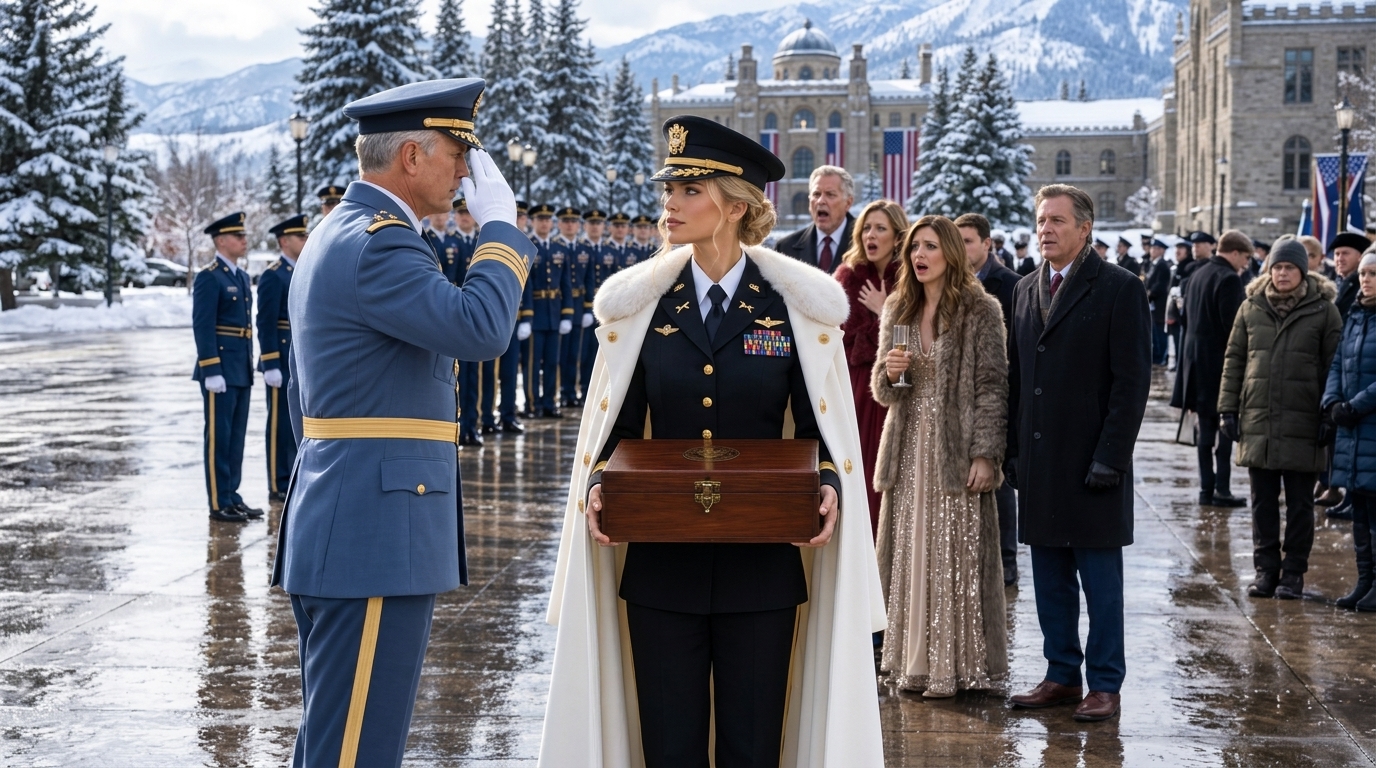
And when Colonel Hayes saw the insignia, he understood something my family had never bothered to learn.
The quietest person in the room isn’t always the weakest.
Sometimes she’s simply the one who understands that real strength doesn’t need to announce itself.
Grandpa had spent his life serving something larger than himself.
And in the end, he left me the opportunity to do the same.
Not by destroying my family.
Not by seeking revenge.
But by refusing to hide the truth.
I used to think the greatest gift my grandfather gave me was the courage to become a soldier.
Now I know it was something even more valuable.
He taught me how to remain honorable when the people I loved made honor difficult.
And that Christmas, when everyone else believed I’d lost my place in the family, I finally discovered where I belonged.
Not at a table where I had to beg for respect.
Not in a house where love depended on obedience.
But among people who understood that character matters more than appearances, integrity matters more than wealth, and loyalty means nothing if it requires you to abandon what is right.
My family called me a loser when I walked out carrying Grandpa’s mahogany box.
They never imagined that the greatest thing inside it wasn’t a secret, a fortune, or a weapon against them.
It was the truth.
And for the first time in my life, I was strong enough to carry it.
THE END THANK YOU FOR READING !!!



