PART 3
I stood beside my car, staring at the message glowing on my phone.
Nora, don’t leave yet.
Your father left one final instruction,
and your mother has no idea what happens at midnight.
The sender was Arthur Whitmore.
My father’s oldest friend.
His former business partner.
And the independent trustee my mother
had spent six months trying to convince everyone was too old
and confused to manage my father’s estate.
I looked back at the house.
Warm yellow light spilled through the living room windows.
Through the curtains,
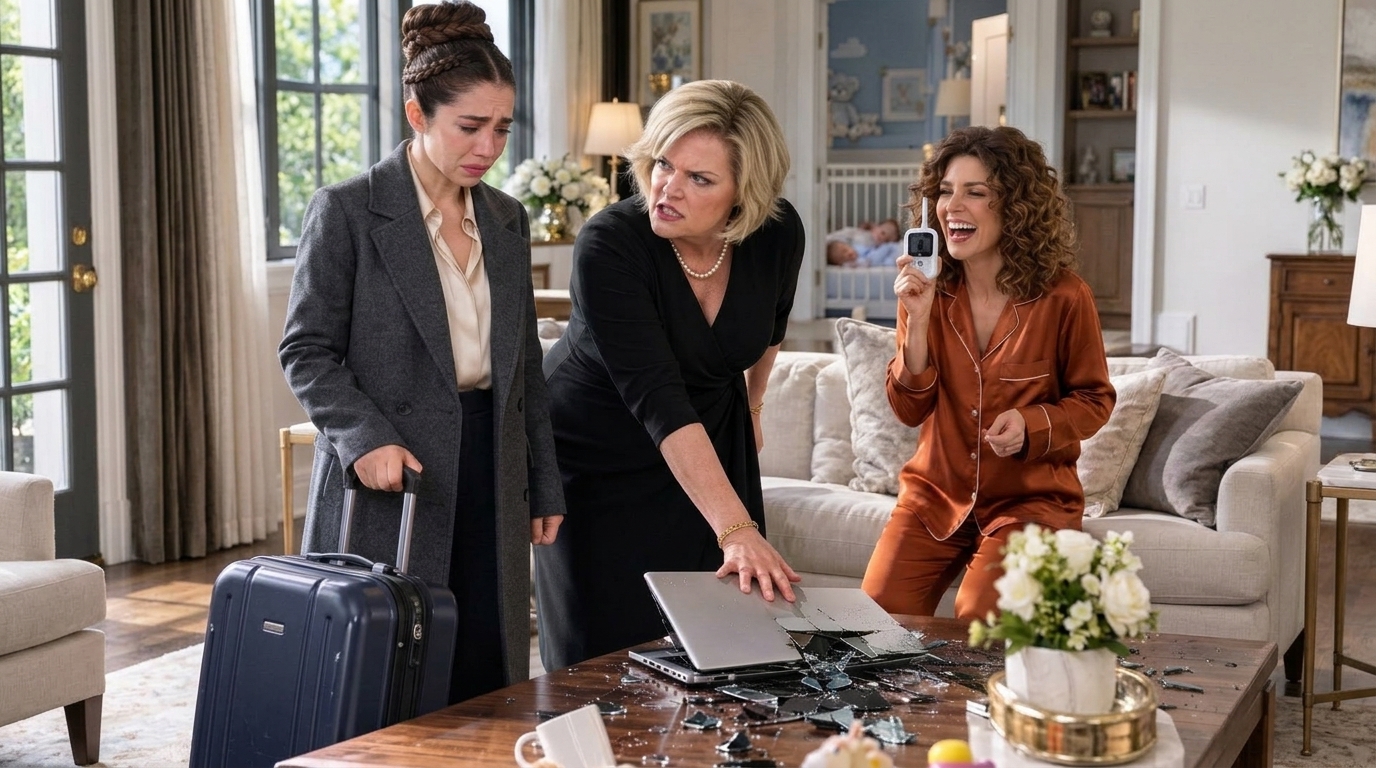
I could see Celeste standing beside the sofa,
laughing at something Mother had said.
They looked happy.
Relaxed.
Victorious.
My laptop lay broken on the coffee table.
My suitcase was beside my feet.
And the only home I had ever known had just been taken from me.
Or so they believed.
I typed a reply.
What instruction?
Arthur answered almost immediately.
Get somewhere safe. I’ll call you at midnight. Don’t go back inside.
I glanced at my watch.
11:44 p.m.
Sixteen minutes.
I opened my car door, placed my suitcase in the back seat, and climbed behind the wheel.
My hands were shaking.
Not from fear.
Not entirely.
I was remembering my father.
His name was Robert Hale.
He built a successful logistics company from a single delivery truck and a borrowed warehouse.
He wasn’t wealthy when I was little.
I remembered him coming home with grease on his shirt and exhaustion in his eyes.
I remembered Mother complaining that he worked too much.
And I remembered Celeste asking why we couldn’t live like the families in her private school.
But Dad never complained.
He just worked.
And slowly, the company grew.
One truck became five.
Five became twenty.
Then came warehouses, distribution contracts, and commercial properties.
By the time I was twenty-two, Hale Logistics had become a regional company worth several million dollars.
Dad still drove his old pickup.
He still wore work boots.
And he still believed that money was useful only when it protected the people you loved.
When he died three years earlier, I thought the hardest part of my life had already happened.
I was wrong.
At 11:51 p.m., I parked outside a twenty-four-hour diner.
The parking lot was almost empty.
I sat beneath a flickering streetlight, watching the clock on my dashboard.
My phone rang.
Celeste.
I declined.
A message appeared.
Don’t come crawling back when your little computer business fails.
Another followed.
Mom says your room is becoming the nursery playroom.
Then a third.
You should have signed the papers when we asked.
I stared at that final sentence.
There it was.
The real reason they’d wanted me gone.
Not because I was unemployed.
Not because I was supposedly irresponsible.
Because I had refused to sign documents transferring control of Dad’s remaining assets.
For months, Mother had insisted the estate needed restructuring.
She claimed Celeste’s childcare foundation would provide a wonderful legacy for Dad.
A foundation helping struggling families.
Supporting working mothers.
Providing early childhood education.
It sounded beautiful.
Until I began reviewing the numbers.
The foundation had no registered childcare facility.
No employees.
No verified charitable programs.
But it had received substantial transfers from accounts connected to Dad’s estate.
And Celeste had recently purchased a luxury SUV.
Mother had explained the vehicle as a business expense.
I had asked what childcare program required a seventy-eight-thousand-dollar SUV.
She told me to mind my own business.
That was the first time I realized something was terribly wrong.
At 11:57 p.m., I opened the encrypted backup application on my phone.
A green indicator appeared.
Scheduled release: 12:00 a.m.
I checked the recipient list.
Arthur Whitmore.
Attorney Margaret Ellis.
Forensic accountant Daniel Reeves.
Three people.
Three people Mother had spent months trying to keep away from the estate.
The evidence package contained copies of financial records I had lawfully obtained, messages sent to me, documents I had access to as an estate beneficiary, and notes documenting conversations in which I had participated.
I had also preserved recordings from a security device in my own work area, after getting legal advice about what could be recorded and used.
I hadn’t hacked anyone.
I hadn’t broken into private accounts.
I had simply kept copies of information that people assumed I was too foolish to understand.
At 11:59 p.m., my phone vibrated.
Arthur again.
One minute.
I stared at the clock.
Then it changed.
12:00.
The screen flashed.
Encrypted package released.
A second notification appeared.
Delivery confirmed.
I closed my eyes.
For the first time in six months, I allowed myself to breathe.
Then Arthur called.
“Nora?”
“I’m here.”
“Are you safe?”
“Yes.”
“Good.”
His voice was calm.
Almost too calm.
I swallowed.
“Arthur, what did you mean about Dad’s final instruction?”
There was a pause.
Then he said, “Your father anticipated that someone might try to pressure you into surrendering your inheritance.”
My stomach tightened.
“What?”
“He didn’t know exactly what would happen. But he understood the personalities involved.”
I stared through the windshield.
Arthur continued.
“Before he died, he signed a trust agreement containing specific protections for you.”
I felt my heart pounding.
“Protections?”
“Yes.”
“Why didn’t anyone tell me?”
“Some provisions were confidential until certain conditions were met. Your father wanted you to have time to build an independent life without everyone knowing what was being held for you.”
I swallowed.
“What conditions?”
Arthur took a breath.
“One of them was an attempt to improperly transfer trust assets without the required approvals.”
I stared at my phone.
“And?”
“And the documents you’ve sent may show that such an attempt occurred.”
My mouth went dry.
“Arthur, what are you saying?”
His voice softened.
“I’m saying your mother may have spent six months trying to take control of assets she never had the authority to touch.”
I closed my eyes.
Then he added something that made my entire body go cold.
“And Nora, the house you were just thrown out of isn’t owned by your mother.”
I sat completely still.
“What?”
“The house is held by the family trust.”
I stared into the darkness.
Arthur continued.
“And according to the trust documents, you have a protected right to occupy it.”
For several seconds, I couldn’t speak.
Then I whispered, “Mother said it was hers.”
“I know.”
“She said she could sell it.”
“She cannot sell trust property simply because she wants to.”
I looked back toward the road.
My hands were trembling again.
“Does she know?”
Arthur paused.
“She knows enough to understand she should not have threatened you.”
I swallowed.
“What happens now?”
“Tomorrow morning, we begin reviewing the evidence with counsel. We won’t make accusations we can’t support.”
I nodded.
“And tonight?”
“Tonight, you get some sleep.”
I gave a bitter laugh.
“Arthur, my mother just destroyed my laptop and threw me out of the house.”
“I know.”
His voice softened.
“And I’m sorry.”
I wiped my eyes.
Then he said, “Your father also left something else.”
I went still.
“What?”
“A letter.”
My throat tightened.
“A letter for me?”
“Yes.”
“When can I have it?”
“Tomorrow.”
I closed my eyes.
Arthur paused.
“Nora, there’s one more thing you need to understand before we meet.”
I waited.
“The trust wasn’t created merely to distribute money.”
“What do you mean?”
“It was designed to protect your father’s life’s work.”
I swallowed.
Arthur continued.
“And according to the latest financial records, someone has been trying to dismantle that protection.”
The following morning, I arrived at Arthur’s office at nine.
I hadn’t slept more than two hours.
My eyes were swollen.
My suitcase remained in my car.
But I was wearing the only professional clothes I had managed to pack.
Arthur met me in the lobby.
He was seventy-one, tall and silver-haired, with the same gentle expression I remembered from childhood.
When he saw me, his face changed.
“Oh, Nora.”
I tried to smile.
He opened his arms.
And suddenly I was twelve years old again, standing beside Dad at a company picnic.
I hugged him.
For a moment, I couldn’t stop crying.
Arthur held me quietly.
Then he said, “Your father would be proud of how carefully you’ve handled this.”
I pulled back.
“I don’t feel very strong.”
He smiled sadly.
“Strength rarely feels impressive while you’re using it.”
He led me into a conference room.
Two people were waiting.
Margaret Ellis, the estate attorney.
And Daniel Reeves, the forensic accountant.
On the table sat three thick folders.
Arthur gestured toward a chair.
“Sit down, Nora.”
I did.
Margaret opened the first folder.
“We’ve reviewed the initial evidence package.”
I held my breath.
She continued.
“There are significant discrepancies requiring investigation.”
Daniel slid a financial summary toward me.
I looked down.
Several transfers were highlighted.
Then I saw the total.
$684,000.
I stared at the number.
“What is that?”
Daniel looked directly at me.
“Transfers from estate-related accounts to entities associated with Celeste’s foundation and other accounts.”
My mouth went dry.
“Six hundred and eighty-four thousand dollars?”
He nodded.
“That’s the total we’ve identified for review so far. We haven’t yet determined which transactions were authorized.”
I stared at the page.
Mother had spent months calling me a financial burden.
Celeste had laughed about my supposed poverty.
And all that time, hundreds of thousands of dollars had been moving through accounts connected to Dad’s estate.
I looked at Arthur.
“Did they steal it?”
Margaret answered carefully.
“We’re not going to reach that conclusion without completing the review.”
I nodded.
She continued.
“But there are enough irregularities to justify immediate protective action.”
Then Arthur placed a sealed envelope in front of me.
My name was written across it.
In Dad’s handwriting.
I recognized every letter.
My throat closed.
Arthur spoke gently.
“Your father asked me to give you this when the time was right.”
I reached for the envelope.
My hands shook.
Inside was a letter.
And when I unfolded it, the first sentence made me start crying.
My little Nora, if you’re reading this, someone has mistaken your kindness for weakness.
PART 4
I read that sentence three times.
My little Nora.
Dad hadn’t called me that since I was a teenager.
He used to say it when I was upset.
When I failed a math test.
When someone hurt my feelings.
When I came home crying because Celeste had told her friends I was the weird sister who preferred computers to parties.
He would sit beside me at the kitchen table.
Push a cup of hot chocolate toward me.
And say, “What’s wrong, my little Nora?”
Now his handwriting was trembling slightly across the paper.
But the words were unmistakably his.
I continued reading.
I know you have always wanted to build something of your own. I know you worry that people will think every success you have comes from my money. That’s why I’ve tried to give you room to discover what you’re capable of.
Tears blurred the page.
But independence should never mean standing alone when someone is trying to hurt you.
I pressed my fingers against my mouth.
Arthur remained quiet.
I continued.
The family trust contains protections that may seem excessive. I created them because I have seen how money can change people. I hope those protections will never be needed.
My chest tightened.
If they are needed, remember this: You do not have to surrender what is rightfully yours simply to prove that you love your family.
I stopped.
That sentence hit harder than anything else.
Because for three years, Mother had used love as a weapon.
If I loved her, I would sign the papers.
If I loved Celeste, I would support the foundation.
If I loved my nephew, I would stop asking questions.
If I loved Dad’s memory, I would trust Mother’s judgment.
Every refusal became proof that I was selfish.
Every question became an accusation of disloyalty.
And every attempt to protect myself became another reason to punish me.
I looked down at the final paragraph.
Build your company, Nora. Make mistakes. Learn. Take risks. Be brave enough to fail. But never let anyone convince you that your dreams are worthless because they cannot control them.
I began crying again.
At the bottom, Dad had written:
I love you more than you know.
Dad.
I folded the letter carefully.
For several minutes, nobody spoke.
Then Arthur handed me a tissue.
I wiped my eyes.
“Did he know what Mother would do?”
Arthur shook his head.
“No. He couldn’t have known the future.”
I nodded.
“But he knew you.”
I looked at him.
“And he knew how determined you were to make something of your own.”
Margaret opened the second folder.
“Nora, we need to discuss the trust.”
I took a breath.
“Okay.”
She explained that Dad had placed several assets into a family trust before his death.
The commercial property.
Investment accounts.
A portion of his company ownership.
And the family home.
Mother was entitled to certain benefits during her lifetime.
But she didn’t own those assets outright.
The trust required independent approval for major distributions and transfers.
Arthur served as an independent trustee.
Margaret’s firm had been retained to provide legal oversight.
And I was a named beneficiary with specific rights under the agreement.
I stared at the documents.
“Then how did Mother move the money?”
Daniel leaned forward.
“That’s what we’re investigating.”
He pointed to several transactions.
“Some appear to have been presented as payments for charitable initiatives.”
I frowned.
“Celeste’s foundation?”
“Yes.”
“But the foundation doesn’t operate a childcare center.”
“We haven’t found evidence of one.”
I looked at the papers.
“Then what were the payments for?”
Daniel turned another page.
“Consulting services. Program development. Community outreach.”
I stared at him.
“Who provided those services?”
He paused.
“That’s unclear.”
I looked at the invoices.
They were beautifully formatted.
Professional logos.
Detailed descriptions.
Large amounts.
But several addresses matched properties associated with Celeste.
And one consulting company had been registered only weeks before receiving its first payment.
I felt sick.
“She made it look legitimate.”
Daniel nodded.
“That’s one possibility we’re examining.”
Margaret leaned forward.
“We’ve already begun the process of requesting complete records and seeking appropriate protections for the trust assets.”
I nodded.
“What about the signatures?”
She looked at Arthur.
He opened another folder.
Inside were copies of several documents.
My name appeared on one.
I stared at it.
It was a consent form.
According to the document, I had approved a transfer of certain beneficiary interests into a new charitable structure.
At the bottom was my signature.
Except it wasn’t my signature.
I knew immediately.
The letters were wrong.
The N was too rounded.
The final stroke curved upward in a way mine never did.
I looked at Margaret.
“I didn’t sign this.”
She nodded.
“We expected you might say that.”
I stared at her.
“Why?”
“Because the document is dated the same day you were attending a startup conference in Denver.”
I went still.
I remembered that conference.
I’d paid for the ticket myself.
Stayed in a cheap hotel.
Spent three days pitching my software to potential investors.
I even had photographs.
Registration records.
Travel receipts.
I looked at the document again.
“I wasn’t even in the state.”
Margaret nodded.
“That’s important evidence.”
I felt anger rising.
“Who signed it?”
“We don’t know yet.”
I looked at Arthur.
“Mother told me I had already agreed to the restructuring.”
He nodded.
“That’s one of the reasons we’re taking this seriously.”
That afternoon, I returned to my car and found twenty-seven missed calls.
Mother.
Celeste.
Mother again.
Aunt Diane.
Celeste.
Then another message.
NORA, YOU NEED TO COME HOME IMMEDIATELY.
I stared at it.
For the first time, the word home made me laugh bitterly.
Less than twenty-four hours earlier, Mother had thrown me out.
Now she wanted me back.
Another message appeared.
Arthur has been calling people and asking questions. What have you done?
I didn’t reply.
Then my phone rang.
Mother.
I answered.
“Nora!”
Her voice was sharp.
“Where are you?”
“Somewhere safe.”
“What does that mean?”
“It means I’m safe.”
She exhaled angrily.
“Stop playing games.”
I remained quiet.
She continued.
“Arthur contacted me this morning. He claims there are questions about the estate.”
I said nothing.
“Nora, did you send him documents?”
“Yes.”
There was silence.
Then she whispered, “What documents?”
I looked through the windshield.
“Records I was entitled to review.”
Her breathing changed.
“You had no right.”
I took a breath.
“Mother, did you sign my name on a trust consent form?”
Silence.
I waited.
Then she said, “You don’t understand how complicated estate management is.”
I closed my eyes.
“That wasn’t my question.”
She snapped, “Don’t take that tone with me.”
I remained calm.
“Did you sign my name?”
She didn’t answer.
Instead, she said, “Celeste has a baby. We’re trying to build something meaningful for this family.”
I stared at the dashboard.
“And that required transferring hundreds of thousands of dollars?”
Mother inhaled sharply.
“Who told you that number?”
I felt something settle inside me.
She hadn’t asked what money.
She hadn’t asked which transfers.
She had asked who told me the number.
I swallowed.
“Mother, I’m not discussing this without my attorney.”
Her voice changed instantly.
“Your attorney?”
“Yes.”
“Nora, don’t be ridiculous. We’re family.”
I closed my eyes.
“Family doesn’t make forged signatures acceptable.”
She gasped.
“How dare you accuse me!”
I took a breath.
“I’m asking for the truth.”
She began crying.
Loudly.
Dramatically.
The same way she cried whenever someone refused to give her what she wanted.
“After everything I’ve done for you…”
I waited.
“I gave you a home!”
I looked at my suitcase in the back seat.
“You threw me out last night.”
She went silent.
I continued.
“You destroyed my laptop.”
“That was an accident.”
I almost laughed.
“You slammed it shut.”
“You were being disrespectful!”
I swallowed.
“Mother, I’m ending this call.”
“Nora, if you hang up—”
I disconnected.
Then I sat quietly for several minutes.
My hands were shaking.
But I didn’t regret answering.
Because for the first time, I had spoken to my mother without begging her to understand me.
The next week was a blur.
I rented a small furnished apartment.
Bought a replacement laptop.
Restored my projects from cloud backups.
And continued working on my startup application.
The accelerator deadline was approaching.
For three years, I had developed software designed to help small logistics companies manage inventory and delivery routes.
It wasn’t glamorous.
It wasn’t fashionable.
But I understood the industry because I’d grown up watching Dad build his business.
I knew how much time small operators wasted on outdated spreadsheets and disconnected systems.
My platform brought those processes together.
I’d built the first version while freelancing at night.
Then tested it with several independent businesses.
The results were promising.
And I had finally been invited to submit a full application to a respected startup accelerator.
Mother called it my imaginary computer company.
Celeste called it a hobby.
But Dad would have understood.
He always said the best businesses solved problems people were tired of living with.
Three days after moving into my apartment, I received an email from the accelerator.
I opened it with trembling hands.
Dear Nora Hale,
Congratulations. Your company has been selected for the final interview round.
I stared at the screen.
Then I laughed.
Then I cried.
Then I called Arthur.
He answered immediately.
“Nora?”
“I got the interview.”
There was a pause.
Then he laughed.
A deep, delighted laugh.
“Your father would be dancing around the office.”
I wiped my eyes.
“He really would.”
Arthur’s voice softened.
“I’m proud of you.”
I closed my eyes.
For the first time in months, I felt something other than fear.
Hope.
Meanwhile, the estate investigation continued.
Daniel Reeves identified additional discrepancies.
Several invoices appeared to have been approved using credentials belonging to people who denied authorizing them.
A transfer request carried my disputed signature.
Another document contained a certification that Arthur had supposedly reviewed and approved a distribution.
He hadn’t.
The matter was referred for further legal review and, where appropriate, to investigators.
The trust’s counsel sought court intervention to protect the assets and determine responsibility for the questionable transactions.
Mother and Celeste retained their own attorneys.
They denied wrongdoing.
Then they began blaming each other.
Celeste claimed Mother handled the paperwork.
Mother claimed Celeste prepared the invoices.
Both insisted the foundation was legitimate.
But the records told a complicated story.
And the questions weren’t going away.
One evening, Celeste appeared outside my apartment.
She was holding my nephew.
Eight-month-old Oliver.
He wore a blue sweater and had one tiny sock missing.
For a moment, my heart softened.
I loved that little boy.
None of this was his fault.
Celeste looked exhausted.
Her hair was tied back.
Her eyes were red.
“Nora.”
I stood in the doorway.
“What are you doing here?”
She swallowed.
“I need to talk.”
I hesitated.
Then stepped into the hallway, leaving my apartment door open.
“What about?”
She looked down at Oliver.
“Mom says you’re trying to destroy us.”
I stared at her.
“I’m trying to understand what happened to Dad’s money.”
Celeste’s eyes filled.
“You don’t understand.”
I took a breath.
“Then explain it.”
She looked away.
For a long time, she said nothing.
Then she whispered, “The foundation was supposed to be real.”
I felt my stomach tighten.
“What?”
She swallowed.
“I wanted to open a childcare center.”
I stared at her.
She continued.
“Mom said we could use some of the estate money to get started.”
“Without approval?”
Celeste looked down.
“She said she would handle everything.”
I felt anger rising.
“And the invoices?”
She began crying.
“Some were real.”
I waited.
“Some weren’t.”
My chest tightened.
“Celeste…”
She looked at me.
“I didn’t think it would get this far.”
I stared at my sister.
Then I asked quietly, “Did you know someone signed my name?”
She froze.
Her silence answered me.
I felt the air leave my lungs.
“Celeste.”
Tears streamed down her face.
“Mom said it was just paperwork.”
I stepped backward.
“You knew?”
She sobbed.
“I didn’t do it myself.”
I stared at her.
“But you knew.”
She covered her face.
Oliver began fussing.
I looked at my nephew.
Then back at my sister.
“Celeste, you need to tell your attorney everything.”
She shook her head.
“Mom will never forgive me.”
I felt a bitter ache in my chest.
For years, we’d both been afraid of Mother’s anger.
But now that fear had helped create something much worse.
I took a breath.
“Then you need to decide whether protecting Mother matters more than telling the truth.”
Celeste stared at me.
Then she whispered, “There’s something else.”
My stomach tightened.
“What?”
She looked toward the stairwell.
Then back at me.
“Mom didn’t destroy your laptop because she was angry.”
I went completely still.
Celeste swallowed.
“She destroyed it because she thought it contained the only copy of the trust records.”
I stared at her.
“And how did she know what was on it?”
Celeste began crying harder.
“Because someone told her.”
I felt cold.
“Who?”
She looked directly at me.
Then whispered a name.
A name I hadn’t expected.
And suddenly, I realized the conspiracy surrounding Dad’s estate reached far beyond my mother and sister.
PART 5
“Graham,” Celeste whispered.
I stared at her.
“Graham who?”
She looked ashamed.
“Graham Mercer.”
My stomach tightened.
Graham Mercer had been my father’s longtime financial adviser.
He’d attended Dad’s funeral.
He’d hugged Mother while she cried.
He’d told me to focus on grieving while the professionals handled the estate.
And for three years, I’d believed he was one of the few people trying to keep our family together.
I stared at Celeste.
“What does Graham have to do with this?”
She shifted Oliver against her shoulder.
“Mom was worried you’d found something.”
I waited.
“She called Graham and asked whether you could challenge the transfers.”
My chest tightened.
“And?”
“He said you might have enough information to cause trouble.”
I felt sick.
Celeste continued.
“Then Mom told him you kept copies of everything on your laptop.”
I closed my eyes.
“And he told her to destroy it?”
Celeste shook her head.
“Not exactly.”
I looked at her.
“What did he say?”
She swallowed.
“He said if the records disappeared, it would be harder for anyone to prove what happened.”
For several seconds, I couldn’t speak.
Then I asked, “Did Graham prepare the documents with my signature?”
Celeste began crying.
“I don’t know.”
I studied her.
“Celeste, I need you to be completely honest.”
She nodded.
“I know.”
“Did you see him working on them?”
She hesitated.
Then whispered, “Yes.”
My stomach dropped.
The next morning, I met with Margaret Ellis.
I told her everything Celeste had said.
Margaret listened carefully.
Then she asked whether Celeste would provide a formal statement.
“I don’t know,” I admitted.
Margaret nodded.
“We’ll need to verify her account independently.”
I took a breath.
“Do you think Graham was involved?”
She folded her hands.
“We have reason to examine his role. But we need records, not assumptions.”
I nodded.
Then Arthur entered the room.
He looked troubled.
“Nora, there’s something I need to show you.”
He placed a folder on the table.
Inside were copies of emails between Graham and Mother.
Several discussed restructuring estate assets.
Others referenced the childcare foundation.
One contained a phrase that made my blood run cold.
We need to secure the necessary signatures before Nora begins asking more questions.
I stared at the page.
The email had been sent four months earlier.
Graham had written it.
Mother had replied.
I’ll handle Nora. Celeste can prepare the remaining documents.
I slowly lowered the paper.
For months, Mother had accused me of being unstable.
Lazy.
Unemployed.
Ungrateful.
All while she was apparently coordinating with people to move assets without my informed consent.
I looked at Arthur.
“Why didn’t you know?”
His face tightened.
“Because some documents were presented as routine administrative records and others were kept outside the normal trust reporting process.”
Margaret nodded.
“That’s part of what we’re investigating.”
I stared at the emails.
Then I remembered something Dad once told me.
The most dangerous person in a business isn’t always the one stealing. Sometimes it’s the one everyone trusts to explain the numbers.
I had thought he was speaking generally.
Now I wondered whether he’d been warning me about Graham.
The following months were exhausting.
There were meetings with attorneys.
Financial reviews.
Requests for records.
Formal interviews.
And court proceedings concerning the trust.
Graham denied knowingly participating in unauthorized transfers.
Mother insisted she had acted in the family’s best interests.
Celeste eventually retained separate counsel and provided information about the foundation’s finances.
The investigation uncovered additional transactions requiring explanation.
Some funds had gone toward genuine startup expenses for the proposed childcare center.
But other payments had been directed to personal purchases, consulting entities, and accounts that had no clear connection to the foundation’s stated purpose.
The disputed signatures became a central issue.
A forensic document examiner reviewed the available originals and comparison samples.
The findings raised serious concerns about authenticity.
The trust’s attorneys also identified approval procedures that appeared not to have been followed.
As the evidence developed, the court issued orders protecting the remaining assets while the parties worked through the legal process.
Mother could no longer treat trust funds as though they were her personal checking account.
Celeste’s foundation was required to account for its use of the money.
And Graham’s professional conduct came under scrutiny.
I wanted everything resolved immediately.
But Margaret reminded me that complicated financial cases rarely moved quickly.
“Your job,” she told me, “is to keep building your life while the legal process continues.”
I tried.
Some days, that was harder than anything else.
Meanwhile, my startup was moving forward.
I completed the accelerator interview from my tiny apartment.
My replacement laptop sat on a folding desk.
The internet connection dropped twice.
A neighbor’s dog barked through half my presentation.
And I was so nervous that I spilled coffee on my notes.
But I knew my product.
I knew the customers.
I knew the problems.
And when the interviewers asked why I had chosen logistics software, I told them about Dad.
I told them how he’d built his company.
How small operators struggled with inefficient systems.
How technology could help independent businesses compete without hiring entire administrative departments.
I didn’t mention Mother.
Or Celeste.
Or the broken laptop.
I didn’t need to.
The work spoke for itself.
Two weeks later, I received the email.
Congratulations, Nora. We’re delighted to offer your company a place in our upcoming accelerator cohort.
I stared at the screen.
Then I screamed.
A happy scream.
The kind I hadn’t made in years.
I called Arthur.
He answered immediately.
“Nora?”
“I got in!”
He laughed.
“I knew you would.”
I began crying.
“Arthur, I actually did it.”
His voice softened.
“Yes, you did.”
For a moment, neither of us spoke.
Then he said, “Your father always believed you would build something remarkable.”
I wiped my eyes.
“I wish he were here.”
Arthur was quiet.
Then he said, “In some ways, he still is.”
Six months after the night Mother destroyed my laptop, I received another letter from her attorney.
It proposed a meeting.
Mother wanted to discuss a family settlement.
Margaret reviewed the request.
Then asked whether I wanted to attend.
I hesitated.
Part of me never wanted to see Mother again.
But another part wanted answers.
Not excuses.
Not tears.
Answers.
So I agreed.
The meeting took place in a neutral conference room.
Mother arrived wearing a cream-colored suit.
Her hair was perfectly styled.
Her jewelry sparkled.
She looked exactly as she always had.
But when she saw me, her expression changed.
“Nora.”
I nodded.
“Mother.”
She glanced at my attorney.
Then at Arthur.
Her mouth tightened.
“I had hoped we could speak privately.”
Margaret answered.
“Nora prefers to have counsel present.”
Mother sighed.
“Of course she does.”
I remained quiet.
She sat across from me.
For several minutes, the attorneys discussed the proposed terms.
There were questions about repayment.
Accounting.
Future administration of the trust.
And the resolution of certain civil claims.
Then Mother looked directly at me.
“Nora, I never wanted any of this.”
I stared at her.
“Then why did it happen?”
She looked down.
“I was trying to protect the family.”
I took a breath.
“By signing my name without permission?”
She flinched.
Her attorney shifted.
Mother looked away.
“I made mistakes.”
I nodded.
“Yes.”
She began crying.
“I was under so much pressure after your father died.”
I felt something tighten inside my chest.
I had been grieving too.
But nobody had asked how much pressure I was under.
Nobody had worried about my sleepless nights.
Nobody had cared that I was trying to build a business while mourning the only parent who believed in me.
Mother continued.
“Celeste needed help. Oliver needed security. I thought if we built the foundation, everything would work out.”
I looked at her.
“And what about me?”
She blinked.
“What?”
“What about my future?”
She looked confused.
I continued.
“You told everyone I was unemployed.”
She opened her mouth.
“You called my business a fantasy.”
“Nora—”
“You threatened to leave me with nothing.”
Her eyes filled.
“And you destroyed my laptop because you thought it contained evidence.”
She stared at me.
For several seconds, nobody spoke.
Then I asked the question I’d been carrying for years.
“Mother, why was Celeste always worth protecting, but I was only worth controlling?”
Her face crumpled.
I waited.
She wiped her eyes.
Then whispered, “Because you were always stronger.”
I stared at her.
“What?”
She looked down.
“Celeste needed me.”
I felt cold.
“And I didn’t?”
Mother began crying harder.
“You were independent. You were like your father. You always had your own ideas.”
I swallowed.
“So you punished me for being capable?”
She shook her head.
“I didn’t see it that way.”
I looked at her.
“But that’s what you did.”
She had no answer.
And for the first time in my life, I didn’t need one.
The settlement discussions continued for several weeks.
Eventually, agreements were reached on certain civil issues.
Funds were returned or accounted for under the negotiated terms and court supervision.
The trust’s administration was strengthened.
Independent oversight was reinforced.
And restrictions were put in place to prevent similar unauthorized transactions.
Other matters involving disputed documents and professional conduct continued through the appropriate channels.
I didn’t get a dramatic moment where everyone confessed everything in a courtroom.
Real life was messier than that.
There were disagreements.
Partial admissions.
Complicated financial records.
And consequences that unfolded over time.
But the most important result was clear.
Dad’s trust was no longer being managed according to Mother’s demands.
And my rights as a beneficiary were protected.
One afternoon, Arthur called me.
“Nora, we need to discuss the house.”
I sat upright.
“What about it?”
“The trust administration has been clarified. Your right to occupy the property remains protected.”
I stared at the wall.
The house.
The one Mother had thrown me out of.
The one where Dad had taught me to ride a bicycle in the driveway.
The one where I’d spent countless nights working on my startup.
The one where my laptop had been destroyed.
Arthur continued.
“You have options.”
I swallowed.
“What options?”
“You can exercise your occupancy rights under the trust terms, or we can explore other arrangements through the proper process.”
I was quiet.
Then he asked, “Do you want to go back?”
I looked around my apartment.
It was small.
The furniture was mismatched.
My desk was covered with notes.
A whiteboard hung crookedly above the sofa.
But it was peaceful.
Nobody shouted at me.
Nobody demanded I surrender my work.
Nobody told me I was worthless.
I took a breath.
“No.”
Arthur was silent.
Then he said, “Are you sure?”
I smiled.
“Yes.”
I looked toward the window.
“I don’t want to live somewhere I have to keep remembering who threw me out.”
Arthur’s voice softened.
“Your father would understand.”
I wiped my eyes.
“I think he would.”
A year later, my startup hired its first full-time employees.
Three people.
Then five.
Then eight.
We signed contracts with several logistics companies.
Our software improved.
Our customer base grew.
And for the first time, I paid myself a proper salary.
Not much.
But enough.
I remember staring at that first paycheck.
Then laughing.
Mother had told me I had no career.
Celeste had told me I had no money.
They had both believed my future could be destroyed by breaking one laptop.
Yet here I was.
Building something real.
Something that belonged to me.
Celeste contacted me several months later.
She asked if we could meet for coffee.
I agreed.
We sat across from each other in a quiet café.
She looked different.
Tired.
Older.
Less certain of herself.
Oliver was now walking.
She showed me a photograph.
He was standing beside a couch, grinning.
I smiled.
“He’s getting big.”
She nodded.
“He is.”
For a while, we talked about ordinary things.
Then she put down her cup.
“Nora, I owe you an apology.”
I waited.
She took a breath.
“I was cruel to you.”
I nodded.
“Yes.”
“I laughed when Mom destroyed your laptop.”
I looked at her.
“I remember.”
Her eyes filled.
“I knew you were working hard. I knew you had something important on that computer.”
I swallowed.
“Then why did you laugh?”
She looked down.
“Because I was jealous.”
I stared at her.
She continued.
“You were building something without asking anyone for permission.”
I waited.
“And I hated that you didn’t need Mom’s approval the way I did.”
For several seconds, I said nothing.
Then I asked, “Did hurting me make you feel better?”
She began crying.
“No.”
I nodded.
“Good.”
She looked up.
I continued.
“Because it nearly destroyed our relationship.”
She wiped her eyes.
“I know.”
I took a breath.
“Celeste, I love Oliver. And I want him to grow up knowing his aunt.”
Her eyes filled.
“But I can’t pretend nothing happened.”
She nodded.
“I understand.”
I studied her.
“Trust has to be rebuilt.”
She whispered, “I’ll try.”
I nodded.
“Then start there.”
Two years after the night I was thrown out, I moved into a new office.
Not a rented bedroom.
Not a corner of someone’s house.
A real office.
With windows.
Conference rooms.
Employees.
And our company name on the front door.
HALE ROUTE SYSTEMS.
On opening day, Arthur arrived carrying a small wooden box.
He smiled.
“Your father would have wanted you to have this.”
I opened it.
Inside was Dad’s old brass desk nameplate.
ROBERT HALE — FOUNDER.
I stared at it.
My eyes filled.
Arthur continued.
“He kept it from the first office he rented.”
I ran my fingers across the engraved letters.
The brass was scratched.
The edges were worn.
But it was beautiful.
I placed it on the shelf behind my desk.
Then I put Dad’s letter beside it.
The one that began:
My little Nora, if you’re reading this, someone has mistaken your kindness for weakness.
I looked at Arthur.
“Thank you.”
He smiled.
“You earned this.”
I shook my head.
“Dad helped.”
Arthur nodded.
“Yes.”
Then he added, “But you’re the one who built it.”
That evening, after everyone had gone home, I sat alone in my new office.
The city lights glowed outside.
My laptop sat open on the desk.
A new laptop.
The third one I’d owned since that terrible night.
I looked at the screen.
There were project schedules.
Customer reports.
Financial projections.
Messages from employees.
Plans for the next version of our software.
Three years earlier, Mother had slammed my computer shut and told me my dreams meant nothing.
Celeste had laughed.
They had thrown me out with a suitcase and believed they had destroyed my future.
But they had misunderstood something fundamental.
The laptop was never the dream.
It was only a tool.
The dream lived in my mind.
In the skills I’d learned.
In the problems I wanted to solve.
In the determination Dad had encouraged since I was little.
And no one could destroy that by cracking a screen.
Sometimes I think about the final eighteen minutes before midnight.
The dark driveway.
The suitcase.
The broken laptop.
Mother smiling through the window.
Celeste laughing beside the baby monitor.
They believed they had won.
They believed they had taken everything.
But at midnight, the evidence reached people who could help protect the estate.
And in the months that followed, the truth began to emerge.
Not all at once.
Not dramatically.
But steadily.
Document by document.
Transaction by transaction.
Decision by decision.
I learned that justice doesn’t always arrive with shouting.
Sometimes it arrives as an audit.
A court order.
A corrected account.
A protected trust.
A signed agreement.
Or simply the moment you realize you no longer need permission to live your own life.
I also learned something about family.
Love doesn’t require surrendering your rights.
Forgiveness doesn’t require pretending harm never happened.
And sharing blood doesn’t give someone ownership of your future.
Mother once told me that without her house, I would have nothing.
She was wrong.
I had my education.
My work.
My determination.
My father’s guidance.
And eventually, I had something even more valuable.
Peace.
On the third anniversary of Dad’s death, I visited his grave.
I brought flowers.
Sat on the grass.
And told him everything.
About the startup.
The accelerator.
The employees.
The trust.
The house.
The painful conversations with Mother and Celeste.
And the life I was finally building.
I cried.
Then I laughed.
Then I placed a copy of our company’s first annual report beside the flowers.
“Look, Dad,” I whispered.
“I did it.”
The wind moved gently through the trees.
For a moment, I imagined him sitting beside me.
Wearing his old work boots.
Smiling that proud, quiet smile.
Then I remembered something he used to say.
People can take things from you, Nora. Money. Opportunities. Even a place to live. But don’t let them take the part of you that knows who you are.
I sat there for a long time.
Then I stood.
Brushed the grass from my clothes.
And walked back to my car.
I had a company to run.
A future to build.
And a life that no longer belonged to anyone else’s expectations.
My mother destroyed my laptop because she believed it contained my entire future. What she never understood was that the most important thing my father left me wasn’t money, property, or a trust. It was the courage to build a life nobody could take away from me.
THE END THANK YOU FOR READING !!!



