PART 3
The second document appeared
on the twenty-foot screen,
and my father stopped moving.
For the first time in my thirty-eight years,
I watched Richard Ashcroft lose control of a room.
His name appeared beneath the heading:
EXTERNAL INFLUENCE REVIEW —
REFERRED FOR INVESTIGATION
Below it was a summary of documented
concerns involving Ashcroft
Development Holdings,
Iron Summit Performance Group,
and communications attempting to
influence a candidate’s admissions review.
The ballroom fell silent.
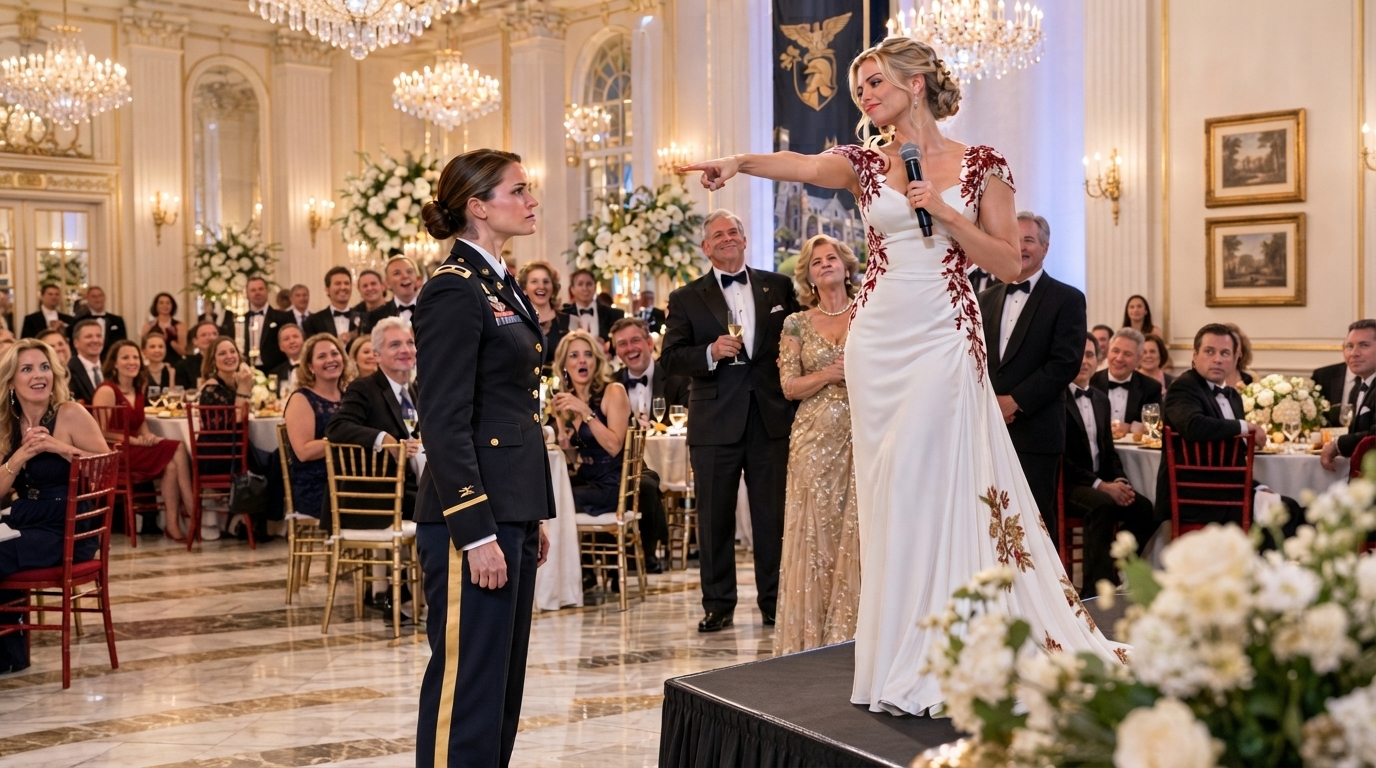
My sister, Priscilla, stood beside me in a white designer dress
that probably cost more than my first car.
Three minutes earlier,
she had been laughing about my supposedly insignificant military career.
Now her hands were shaking.
“What is that?” she whispered.
I kept my voice level.
“A summary of the determination concerning your application.”
She stared at me.
“You can’t do this.”
“I didn’t make the determination, Priscilla.”
My father stepped toward the stage.
“Tabitha, turn that screen off.”
I looked at him.
He was sixty-three, broad-shouldered, silver-haired, and accustomed to being obeyed.
He had spent thirty years building Ashcroft Development Holdings into one of the largest private construction companies in our region.
He owned office buildings, commercial developments, and enough expensive suits to dress a small army.
In our family, his word had always been treated as law.
But this wasn’t his boardroom.
And I wasn’t one of his employees.
“Dad,” I said quietly, “please return to your seat.”
His face darkened.
“Don’t you dare speak to me like that.”
Several guests shifted uncomfortably.
Priscilla grabbed my sleeve.
“You’re humiliating me.”
I looked at her.
“You invited two hundred people to celebrate an appointment that hadn’t been confirmed.”
Her eyes filled with tears.
“Because everyone said I was going!”
I nodded toward the screen.
“The official decision says otherwise.”
She shook her head.
“No. I have a congressional nomination.”
“A nomination is not an appointment.”
“But I passed everything!”
I took a breath.
“The independent review found material discrepancies in several parts of your application.”
She looked toward our father.
“Daddy, do something.”
He was already reaching for his phone.
I knew exactly what he intended.
Call someone.
Demand a favor.
Threaten a lawsuit.
Make the problem disappear.
It was how he had handled every inconvenient situation since I was a child.
But this time, the people involved weren’t his employees.
And the official decision had already been made through the appropriate process.
I turned toward the audience.
“Before anyone misunderstands what you’re seeing, I want to clarify something.”
The room remained silent.
“My sister’s application was reviewed through an independent process. Because of our family relationship, I disclosed the conflict and was recused from the final determination.”
A few people exchanged glances.
“I did not vote on her application. I did not decide whether she would be admitted.”
Priscilla looked confused.
“Then why are you doing this?”
I looked at her.
“Because you’ve spent the evening telling everyone that your appointment was guaranteed. It wasn’t.”
My mother stood abruptly.
“That’s enough!”
Victoria Ashcroft had always been a beautiful woman.
Even at sixty, she carried herself like someone who expected photographers to appear whenever she entered a room.
Her pearl necklace gleamed beneath the ballroom lights.
“Tabitha,” she said sharply, “you are destroying your sister’s celebration because you’re jealous.”
A familiar ache moved through my chest.
Jealous.
That had always been the explanation.
When I earned better grades than Priscilla, I was jealous.
When I received military awards, I was jealous.
When I declined to attend one of Mother’s charity luncheons because I was deployed, I was selfish and jealous.
And now, after fourteen years of military service, my family still believed my greatest ambition was to steal attention from my younger sister.
I looked at Mother.
“No. I’m correcting a false announcement.”
She pointed toward the screen.
“Those documents are private!”
I nodded.
“The official record remains with the appropriate authorities. The information being displayed here is a limited, cleared summary of the decision and the concerns already formally communicated to the parties involved.”
I paused.
“And I will not display anyone’s private application records beyond that.”
My father reached the foot of the stage.
“You’re finished,” he said.
His voice was low.
Dangerously low.
“You hear me? Your career is finished.”
I looked down at him.
For years, those words would have frightened me.
Not because he controlled my career.
He never had.
But because he controlled the thing I had spent my childhood trying to earn.
His approval.
I had spent decades hoping that one day he would look at me and say he was proud.
When I graduated from West Point, he said the ceremony had been too long.
When I earned my first promotion, he asked whether the Army had lowered its standards.
When I returned from a difficult overseas assignment, he told me not to wear my uniform to Thanksgiving because it made the family photographs look political.
And when I became a major, he sent a two-word text.
That’s nice.
But Priscilla received a congressional nomination, and he rented an entire ballroom.
I looked at him now.
“You don’t control my career, Dad.”
He gave a humorless laugh.
“We’ll see about that.”
Then he pointed toward the second document.
“Where did you get that?”
I didn’t answer the question directly.
“The concerns were documented and referred through official channels.”
His jaw tightened.
“What concerns?”
I looked at the screen.
“The employment relationship between the candidate’s fitness evaluator and your company. The disputed volunteer records. The inconsistent travel dates. And communications attempting to influence the verification process.”
A murmur passed through the room.
My father’s business partner, Charles Whitcomb, slowly lowered his champagne glass.
A woman near the front whispered something to her husband.
Priscilla looked at me.
“You checked my travel records?”
“The authorized reviewers examined information submitted and lawfully obtained during the verification process.”
She shook her head.
“This is insane.”
I turned toward her.
“Priscilla, did you supervise a military-family leadership retreat in Massachusetts from July eleventh through July sixteenth?”
Her mouth opened.
Then closed.
“Answer me.”
She glanced toward Father.
“Daddy said the hours counted.”
The ballroom went still.
I felt something inside me tighten.
“What hours?”
She swallowed.
“The leadership hours.”
I stared at her.
“Were you physically present at that retreat?”
She looked down.
“No.”
My mother made a small sound.
Priscilla began crying.
“But I helped organize it!”
“From Monte Carlo?”
She flinched.
“I sent emails!”
I took a breath.
“Your application stated that you personally supervised daily workshops.”
She shook her head.
“I didn’t write that part.”
I looked at her.
“Who did?”
Her eyes moved toward our father.
And suddenly, the room understood.
My father stepped forward.
“Enough.”
Priscilla’s face crumpled.
“Daddy, you told me everything was handled.”
He stared at her.
“Stop talking.”
The command came so sharply that even the guests near the back heard it.
For a moment, I was twelve years old again.
Standing in our dining room.
Watching Father silence anyone who threatened his version of the truth.
But this time, I wasn’t a frightened child.
I was Major Tabitha Ashcroft.
And I had spent fourteen years learning that leadership wasn’t about controlling people.
It was about accepting responsibility.
I handed Priscilla the microphone.
She stared at it.
“What?”
“You wanted to address your guests.”
Her eyes widened.
“Tabitha, please.”
I kept my voice quiet.
“Then tell them the truth.”
She looked at the audience.
Two hundred faces.
Family friends.
Business associates.
Former teachers.
Neighbors.
People who had been invited to celebrate a future that was no longer available.
Her hands trembled.
Then she whispered into the microphone.
“I didn’t know they would check everything.”
A stunned silence followed.
I felt a sharp pain in my chest.
Not because of the admission.
Because she still didn’t understand.
She wasn’t sorry she had submitted false information.
She was sorry someone had checked.
My father lunged toward the stage steps.
“Turn off that microphone!”
The event director stepped forward.
“Sir, please.”
My father pointed at him.
“Do you know who is paying for this event?”
The director hesitated.
I turned toward the technician.
“Please end the presentation.”
The screen went dark.
Then I faced the room.
“The celebration was organized on the assumption that an appointment had been secured. That assumption was incorrect. I regret that this evening has become painful.”
I paused.
“But I will not apologize for the requirement that candidates tell the truth.”
Nobody laughed.
Nobody applauded.
Nobody moved.
Then I stepped down from the stage.
My mother grabbed my arm.
“You’ve ruined everything.”
I looked at her hand.
“Let go.”
She released me.
Her eyes were blazing.
“Your grandmother will hear about this.”
I felt my stomach tighten.
Grandmother.
The one person in our family who had always defended me.
The woman whose memory-care expenses Father had threatened to stop paying.
I looked at him.
He was standing beside Mother, his face flushed with anger.
“You threatened her care,” I said quietly.
He smiled coldly.
“And I meant it.”
I stared at him.
Then said something he clearly hadn’t expected.
“I know.”
His smile faltered.
“That’s why I made arrangements before coming here.”
For the first time that evening, fear crossed his face.
“What arrangements?”
I picked up my handbag.
“You’ll find out tomorrow.”
And I walked out of the ballroom.
Behind me, Priscilla began screaming my name.
But I didn’t turn around.
Because the real confrontation wasn’t waiting in that ballroom.
It was waiting in the financial records of the family trust.
And my father had made one enormous mistake.
He had assumed that because I didn’t brag about my accomplishments, I didn’t know how to protect the people I loved.
PART 4
My grandmother’s name was Eleanor Ashcroft.
She was eighty-nine years old, sharp-witted on her good days, and stubborn enough to argue with a thunderstorm.
She had been a public-school teacher for thirty-seven years.
She loved crossword puzzles, lemon cake, and old black-and-white movies.
And she was the only person in my childhood who never treated my ambition as something embarrassing.
When I was eleven, I told her I wanted to attend West Point.
My mother laughed.
“Girls like you don’t belong in muddy boots.”
Grandmother looked at her.
“Girls like Tabitha belong wherever their abilities take them.”
I never forgot that.
When my parents refused to attend a military leadership program I completed in high school, Grandmother came.
When I received my West Point appointment, she cried.
When I graduated, she sat in the audience wearing a little American flag pin.
And when I received my commission, she gave me a silver watch.
On the back, she had engraved:
Lead with honor. Love, Grandma.
I wore that watch every day.
Even when the leather strap became worn.
Even when my family mocked it for being old-fashioned.
Because it reminded me that someone had believed in me before I had learned to believe in myself.
Three days before Priscilla’s celebration, Father had called and threatened to stop paying for Grandmother’s memory care.
He believed the threat would force me to interfere with an admissions review.
Instead, I called an attorney.
Her name was Rebecca Sloan.
She specialized in trusts and elder law.
I had met her years earlier when Grandmother asked me to help organize some estate documents.
At the time, I thought she was simply being careful.
Now I realized how important that meeting had been.
Rebecca answered my call immediately.
“Major Ashcroft?”
“Rebecca, I need your help.”
I explained Father’s threat.
The assisted-living expenses.
The family trust.
His claim that he could stop payment whenever he wanted.
Rebecca listened carefully.
Then asked, “Has your father actually suspended any payments?”
“Not yet, as far as I know.”
“Good. We need to review the trust documents and contact the facility before any interruption affects your grandmother.”
I took a breath.
“He says he controls everything.”
Rebecca was quiet.
Then said, “He controls the administration of certain assets. That is not the same as owning them.”
I sat upright.
“What do you mean?”
“Your grandmother’s trust contains specific provisions governing her care.”
I remembered signing some documents years earlier.
Grandmother had insisted I attend a meeting with Rebecca.
She said it was important that someone outside Father’s business understood her wishes.
At the time, I hadn’t thought much about it.
Now Rebecca explained.
The trust had been established by my grandfather before his death.
It held investments, a small commercial property, and proceeds from the sale of the family farm.
Father served as a trustee.
But he wasn’t the sole trustee.
And the trust required that Grandmother’s health and residential-care expenses receive priority.
I closed my eyes.
“So he can’t just stop paying?”
“Not lawfully simply to punish you. We need to examine the documents and the actual account activity, but a trustee has duties he cannot disregard.”
I felt tears gather.
For days, I had been terrified that Grandmother would suffer because I refused to help Priscilla.
Now I realized Father might have been threatening something he had no right to do.
Rebecca continued.
“There is also an independent co-trustee.”
“Who?”
She paused.
“Your grandmother appointed a professional fiduciary several years ago.”
I frowned.
“Why didn’t I know?”
“Your grandmother wanted the arrangement to remain separate from family disagreements.”
I looked down at my watch.
That sounded exactly like her.
Even when her memory began failing, she had anticipated the possibility that her son might confuse family loyalty with financial control.
Rebecca contacted the co-trustee.
The next morning, I joined a conference call.
We reviewed the trust provisions.
The assisted-living payment schedule.
The facility’s invoices.
And Father’s recent communications.
What we discovered was disturbing.
The facility had received a message from Father’s office asking whether Grandmother’s room could be placed on a temporary payment hold.
The administrator had refused to make changes without proper authorization.
The independent co-trustee had not approved any suspension.
Rebecca immediately sent a formal notice reminding Father of the trust’s obligations and requesting an accounting.
I also arranged, through proper channels, for the facility to contact Rebecca and the co-trustee directly if any payment problem arose.
Grandmother’s care continued without interruption.
That alone would have been enough.
But the accounting raised another question.
Several payments had been made from the trust to a company affiliated with Ashcroft Development Holdings.
The descriptions referred to property maintenance and consulting services.
Rebecca frowned when she reviewed them.
“Does your grandmother own property managed by your father’s company?”
“Not that I’m aware of.”
“We’ll need supporting contracts and invoices.”
I felt a familiar chill.
“What are you saying?”
“I’m saying the records require explanation.”
We didn’t jump to conclusions.
Rebecca requested documentation.
The co-trustee began an independent review.
And I returned to my military duties.
I had learned something important during my career.
Evidence mattered more than suspicion.
So I waited.
After the disastrous celebration, Father called me seventeen times.
I didn’t answer.
He left three voicemails.
The first was furious.
“You’ve embarrassed this family beyond repair.”
The second was threatening.
“Don’t think your uniform protects you from consequences.”
The third was different.
“Tabitha, call me. We need to discuss your grandmother.”
That was the one that frightened me.
I forwarded it to Rebecca.
She called within minutes.
“Don’t respond yet.”
“Is Grandma okay?”
“Yes. I’ve confirmed her care is continuing.”
I exhaled.
“Thank God.”
Rebecca paused.
“But the trust review has uncovered additional transactions.”
I sat down.
“What transactions?”
“Payments totaling approximately $186,000 over four years to entities associated with your father’s business.”
My chest tightened.
“Were they authorized?”
“We haven’t established that. Some may relate to legitimate services, but the documentation we’ve received is incomplete.”
I looked at the wall.
Father had threatened to withhold $8,940 a month from his own mother’s care.
Yet his companies had received substantial payments from the trust intended to support her.
I felt sick.
“What happens now?”
“The co-trustee is demanding a complete accounting. If the explanations are inadequate, we can seek court supervision and appropriate relief.”
I nodded.
“Do whatever is necessary to protect her.”
“We will.”
Then Rebecca asked something unexpected.
“Tabitha, when was the last time you visited your grandmother?”
“Two weeks ago.”
“How was she?”
I smiled sadly.
“She thought I was still a cadet.”
Rebecca was quiet.
“She asked whether I’d remembered to polish my shoes.”
We both laughed softly.
Then I added, “But she knew who I was.”
That afternoon, I visited Grandmother.
She was sitting beside a window in the memory-care lounge, working on a crossword puzzle.
Her silver hair was neatly brushed.
A knitted blue blanket covered her knees.
When she saw me, her face brightened.
“Tabby!”
I knelt beside her chair.
“Hi, Grandma.”
She touched my cheek.
“My beautiful girl.”
My throat tightened.
She looked at my uniform.
“Did you get promoted?”
I smiled.
“A while ago.”
She laughed.
“Well, they should promote you again.”
I sat beside her.
For nearly an hour, we talked.
Sometimes she remembered everything.
Sometimes she confused years.
Sometimes she asked about Grandfather as though he were still alive.
I answered gently.
Then she looked at my watch.
“You still wear it.”
I nodded.
“Every day.”
She smiled.
“Good.”
Her expression became serious.
“Your father is a difficult man.”
I froze.
“Grandma?”
She looked toward the window.
“He thinks money makes him important.”
I swallowed.
She turned back to me.
“But it doesn’t.”
I squeezed her hand.
“What makes someone important?”
She smiled.
“What they do when telling the truth costs them something.”
My eyes filled.
For a moment, she was completely herself.
The woman who had defended me when nobody else would.
The woman who had taught me that dignity wasn’t something other people could award or remove.
I leaned forward and kissed her forehead.
“I love you.”
She squeezed my hand.
“I know, sweetheart.”
Then she asked whether I had finished my homework.
I laughed through tears.
“Yes, Grandma.”
“Good. Don’t let your teachers push you around.”
I stayed until dinner.
When I left, I felt stronger than I had in months.
Two days later, Rebecca called with an update.
The independent review had found invoices submitted by an Ashcroft-affiliated company for services that appeared inconsistent with the actual work performed.
Some invoices listed maintenance at a property the trust no longer owned.
Others described consulting work without supporting records.
The co-trustee referred the findings for further examination.
Rebecca began preparing a petition seeking a formal accounting and, if justified, Father’s removal as trustee.
I listened quietly.
Then asked, “Does he know?”
“He’s received the notice.”
I looked at my phone.
There were eleven new messages from Father.
I opened the first.
You have no idea what you’re doing.
The second read:
That trust is family business.
The third:
Call off your lawyer.
I stared at the words.
Then typed one reply.
Grandmother’s care is not a bargaining chip. Please communicate with Rebecca regarding the trust.
I sent it.
Five minutes later, Father called.
I answered.
“Tabitha!”
His voice was thunderous.
“What have you done?”
I looked out the window.
“I protected Grandma.”
“You’ve turned my own family against me!”
“No.”
I paused.
“You did that when you threatened her care.”
He breathed heavily.
“You think you’re some kind of hero?”
“No.”
“You think wearing that uniform makes you better than me?”
I closed my eyes.
“No, Dad.”
“Then why are you doing this?”
I thought about the attic.
My hidden graduation photograph.
My commission tucked beneath broken vacuum hoses.
Fourteen years of accomplishments treated like embarrassments.
Priscilla’s celebration.
The laughter.
Grandmother’s watch.
Then I answered.
“Because someone has to stop pretending this family is built on the truth.”
He went silent.
For several seconds, I heard only his breathing.
Then he said quietly, “You’re no daughter of mine.”
The words should have shattered me.
Once, they would have.
But something had changed.
I looked at the silver watch on my wrist.
Then said, “I’m still your daughter, Dad.”
My voice remained steady.
“But I’m not your employee.”
I ended the call.
And for the first time in my life, I didn’t cry afterward.
I felt sad.
Deeply sad.
But I also felt free.
Then, just when I thought the worst had passed, Priscilla appeared outside my office.
She wasn’t wearing designer clothes.
No expensive jewelry.
No perfectly styled hair.
Just jeans, a gray sweatshirt, and sneakers.
She looked exhausted.
“Tabitha?”
I stopped walking.
“Priscilla.”
Her eyes filled.
“I need to tell you something.”
I waited.
She swallowed.
“Daddy didn’t just change my application.”
My stomach tightened.
“What do you mean?”
She looked around nervously.
Then whispered, “He made me sign a statement about you.”
I stared at her.
“What statement?”
Her voice broke.
“One saying you offered to help me get into West Point in exchange for money.”
For a moment, the hallway seemed to tilt.
My sister began crying.
“He said if everything went wrong, we needed someone else to blame.”
I looked at her.
“And you signed it?”
She nodded.
“Yes.”
I took a slow breath.
Then asked the only question that mattered.
“Has he submitted it?”
She wiped her face.
“Not yet.”
I closed my eyes.
Then looked directly at her.
“Priscilla, you need to tell the truth.”
She began sobbing.
“I know.”
I nodded.
“Then this time, start before someone catches you.”
PART 5
Priscilla stood outside my office, crying so hard that she could barely speak.
For most of our lives, she had been the golden child.
The beautiful daughter.
The charming daughter.
The daughter who knew exactly how to make our parents smile.
I had always assumed she enjoyed every minute of it.
But standing there in her gray sweatshirt, she looked less like the confident young woman who had mocked me at her celebration and more like a frightened girl who had never learned how to disappoint our father.
“Tabitha,” she whispered, “I’m scared.”
I looked at her.
“I know.”
“He said he’d cut me off.”
I nodded.
“He’s said the same thing to me.”
She wiped her eyes.
“But you don’t need him.”
I almost laughed.
“Priscilla, I spent half my life believing I needed him.”
She stared at me.
I continued.
“Not financially. Emotionally.”
My voice softened.
“I wanted him to be proud of me.”
She looked down.
“He is proud of you.”
I shook my head.
“He’s proud of what he can control.”
Priscilla began crying again.
I took a breath.
“Listen carefully. Because this concerns an allegation involving me and an official admissions process, I cannot handle your statement myself.”
She nodded.
“I understand.”
“You need independent legal advice. And you need to disclose what happened through the appropriate investigative channels.”
Her face tightened.
“Will I get in trouble?”
“I can’t promise you won’t.”
She looked terrified.
“But telling another lie will make everything worse.”
She covered her face.
“I don’t know how to fix this.”
I thought about Grandmother.
About the watch.
About the Honor Code.
Then I said, “You start by taking responsibility for the part you played.”
She lowered her hands.
“And then?”
“Then you keep telling the truth, even when it costs you something.”
For several seconds, she stared at me.
Then nodded.
“Okay.”
I didn’t hug her.
Not yet.
There were too many years between us.
Too many cruel jokes.
Too many family dinners where she had joined our parents in treating my career like an embarrassment.
But I gave her the contact information for the appropriate office and told her to obtain her own attorney.
She left quietly.
And for the first time, I wondered whether my sister might finally be ready to become someone other than the person our father had trained her to be.
The next few months were difficult.
Priscilla provided information about the false statement and her application materials.
Investigators reviewed the communications and supporting documents.
I was interviewed as a potential witness.
Because the allegations involved my family and my own conduct, I was kept away from any decision-making role in the matter.
My professional duties continued, but the relevant questions were handled by independent personnel.
That distinction mattered to me.
I had spent my career believing that rules existed for everyone.
Not just people without powerful parents.
Not just people without money.
Not just people without connections.
Everyone.
Including me.
Especially me.
My father, meanwhile, hired attorneys.
He publicly described the situation as a family misunderstanding.
He told business associates that Priscilla had been treated unfairly.
He claimed I had misinterpreted documents.
He insisted that his communications with admissions officials were merely expressions of parental concern.
But the independent reviews continued.
And outside the military process, Rebecca Sloan was still examining the family trust.
The financial accounting eventually identified approximately $186,000 in payments requiring explanation.
After additional document requests and legal proceedings, Father agreed to step down from his trustee role while the disputed transactions were addressed.
The court approved a replacement arrangement that kept Grandmother’s care funding under independent administration.
Some payments were supported by legitimate contracts.
Others were not adequately documented.
The resulting settlement required repayment of disputed amounts to the trust, without resolving every allegation about intent.
I didn’t celebrate.
Grandmother’s care had been protected.
That was what mattered.
She remained in her memory-care residence.
Her medications were uninterrupted.
Her room stayed the same.
Her favorite blue blanket remained folded beside her chair.
And nobody could threaten to take those things away simply because I refused to do something wrong.
When Rebecca called to tell me the arrangement had been approved, I cried.
Not because we’d defeated Father.
Because I had been carrying the fear of losing Grandmother for months.
Now I could finally put it down.
That evening, I visited her.
She was sitting in the garden courtyard.
A nurse had brought her outside because the weather was beautiful.
When she saw me, she smiled.
“Tabby!”
I knelt beside her.
“Hi, Grandma.”
She touched my face.
“You look tired.”
I laughed.
“I am.”
She studied me.
“Have you been working too hard?”
“Probably.”
She nodded wisely.
“Then stop.”
I laughed again.
“If only it were that easy.”
She squeezed my hand.
Then looked at my watch.
“Still wearing it.”
“Always.”
She smiled.
“Good girl.”
I sat beside her for a long time.
We watched birds gather near the fountain.
We talked about flowers.
She told me a story about Grandfather that I’d heard at least fifty times.
I listened as though it were the first.
Then she looked at me.
“Your mother still hiding your pictures?”
I froze.
It had been years since we’d discussed the attic.
“Grandma?”
She smiled faintly.
“She never liked seeing you in uniform.”
I swallowed.
“No.”
Grandmother looked toward the garden.
“Your mother wanted daughters who looked beautiful in photographs.”
She turned back to me.
“I wanted a granddaughter who could look herself in the mirror.”
My eyes filled.
She squeezed my hand.
“And you can.”
I bent forward and hugged her.
For several seconds, I couldn’t speak.
When I finally pulled away, she smiled.
“Now tell me, sweetheart. Did you finish your homework?”
I laughed through tears.
“Yes, Grandma.”
“Excellent.”
That night, I drove home feeling something I hadn’t felt in a long time.
Peace.
Not complete peace.
My family was still fractured.
My father still refused to speak to me except through attorneys.
My mother had sent a letter accusing me of destroying the Ashcroft name.
Priscilla was struggling to understand what her future would look like without the certainty of her parents’ money and influence.
But Grandmother was safe.
And I was no longer living according to my family’s expectations.
Several months later, Priscilla called.
I almost didn’t answer.
Then I remembered the frightened young woman outside my office.
“Hello?”
“Tabitha?”
“Hi.”
She hesitated.
“Can we talk?”
I looked at my calendar.
“About what?”
“My future.”
I paused.
“Okay.”
We met at a small coffee shop.
Priscilla arrived early.
That alone surprised me.
Growing up, she had always been late.
Someone else was expected to wait.
But when I walked inside, she was sitting at a corner table with two cups of coffee.
One was black.
Exactly how I liked it.
She stood.
“Hi.”
“Hello.”
We sat down.
For a moment, neither of us spoke.
Then she said, “I’m not applying to another service academy.”
I nodded.
“That’s your decision.”
She looked at me.
“I don’t think I ever wanted West Point.”
I studied her.
“Then why did you apply?”
She stared into her coffee.
“Because Daddy wanted it.”
I waited.
“He kept saying it would make me special.”
Her voice shook.
“That I’d be the first Ashcroft to do something important in the military.”
I felt a familiar pain.
The first.
As though my graduation had never happened.
As though my commission had never existed.
As though fourteen years of service had been erased.
Priscilla looked up.
“I know.”
I frowned.
“Know what?”
“What you’re thinking.”
She swallowed.
“He said those things in front of you. And I let him.”
I looked away.
She continued.
“I thought if I became what he wanted, he’d always love me.”
Her eyes filled.
“And when the appointment disappeared, he barely looked at me.”
I felt my chest tighten.
She wiped her cheeks.
“He stopped calling me his future cadet.”
I remained silent.
“He started calling me an embarrassment.”
For the first time, I understood something about my sister.
She hadn’t been free.
She had simply been rewarded for obeying.
I took a breath.
“Priscilla, what do you actually want to do?”
She stared at me.
Nobody had ever asked her that.
Not seriously.
Finally, she whispered, “I like teaching.”
I blinked.
“Teaching?”
She nodded.
“I volunteered at an after-school reading program last month.”
I raised an eyebrow.
“Actually volunteered?”
She gave a small, embarrassed smile.
“Yes.”
I couldn’t help laughing.
She laughed too.
Then her expression softened.
“I loved it.”
She looked down.
“There was a little boy who couldn’t read a whole page without getting frustrated. We worked together every Tuesday.”
She smiled.
“Last week, he finished an entire chapter by himself.”
I watched her face change as she spoke.
For the first time, she wasn’t describing something prestigious.
She was describing something meaningful.
“I think I want to study education,” she said.
I nodded.
“Then study education.”
She looked surprised.
“You don’t think it’s beneath me?”
I stared at her.
“Priscilla, our grandmother taught school for thirty-seven years.”
She smiled faintly.
“I know.”
“And she’s one of the finest people I’ve ever met.”
Tears filled her eyes.
“Me too.”
We sat quietly.
Then Priscilla reached into her handbag.
She removed a small cardboard box.
“I brought something.”
I frowned.
“What is it?”
She slid it across the table.
I opened it.
Inside was my original West Point graduation photograph.
The one Mother had hidden beneath the attic floorboard.
I stared.
My younger self stood proudly in uniform.
My shoulders were straight.
My smile was enormous.
My class ring caught the light.
For years, I’d assumed the photograph had been destroyed.
My hands trembled.
“Where did you find this?”
Priscilla swallowed.
“In the attic.”
I looked up.
She continued.
“I went looking after everything happened.”
Her eyes filled.
“I found a box labeled Vacuum Parts.”
I closed my eyes.
She nodded.
“Your commission. Your awards. Newspaper clippings. Letters.”
I stared at her.
She whispered, “They kept everything.”
I felt tears gather.
“Why?”
Priscilla shook her head.
“I don’t know.”
She hesitated.
“Maybe they couldn’t bear to throw it away. Maybe they wanted to pretend it didn’t exist.”
She wiped her eyes.
“But I thought you should have it.”
I looked down at the photograph.
Fourteen years.
Fourteen years of being told that my career was insignificant.
Fourteen years of listening to my family celebrate achievements that were smaller than the ones they’d hidden in an attic.
I traced the edge of the frame.
Then whispered, “Thank you.”
Priscilla began crying.
“Tabitha, I’m sorry.”
I looked at her.
“For what?”
She swallowed.
“For laughing.”
My chest tightened.
“For calling you a clerk.”
She wiped her eyes.
“For asking you to carry my bags.”
I remained silent.
She continued.
“For letting everyone think you weren’t important.”
Her voice broke.
“And for believing it myself.”
I stared at my sister.
Then said quietly, “I didn’t need you to think I was important.”
She looked confused.
“I just needed you to treat me like your sister.”
She began sobbing.
I reached across the table and took her hand.
It wasn’t forgiveness for everything.
Not yet.
But it was a beginning.
Over the following year, Priscilla enrolled in an education program.
She moved into a modest apartment.
Got a part-time job.
Learned to budget.
For the first time in her life, she had to make choices without Father’s credit card.
It wasn’t easy.
She complained sometimes.
She made mistakes.
She called me occasionally for advice.
But she stopped asking me to solve everything.
And slowly, we began building a relationship that had never existed before.
Not as the successful daughter and the disappointing daughter.
Not as the favorite and the forgotten.
Just two sisters.
My relationship with our parents remained distant.
Mother continued sending occasional messages about family appearances.
Father never apologized.
He maintained that he’d only been trying to secure Priscilla’s future.
The admissions-related investigation reached its conclusions through the appropriate channels, with findings and consequences determined by the responsible authorities.
I didn’t seek revenge.
I didn’t ask for special treatment.
I didn’t celebrate anyone’s punishment.
I simply continued serving.
Because my career had never been about proving my family wrong.
It was about honoring the commitment I’d made when I raised my right hand.
A commitment to something larger than myself.
Two years after that disastrous celebration, Grandmother turned ninety-one.
Her memory had declined.
Some days, she didn’t recognize me immediately.
Other days, she remembered stories from seventy years earlier with astonishing clarity.
Priscilla and I organized a small birthday gathering at her care residence.
No ballroom.
No champagne tower.
No speeches about prestige.
Just cake.
Flowers.
A few close friends.
And photographs from her life.
Priscilla brought a handmade scrapbook.
I brought her favorite lemon cake.
We sat beside Grandmother as she looked through pictures.
There she was as a young teacher.
Standing beside a classroom full of children.
There she was with Grandfather.
There she was holding me as a baby.
And there was a photograph of my West Point graduation.
Grandmother touched it.
Her eyes brightened.
“Tabby.”
I smiled.
“Yes, Grandma?”
She looked at my uniform in the picture.
“My girl.”
My throat tightened.
She looked up at me.
“Did you become a soldier?”
I laughed softly.
“Yes.”
She smiled.
“I knew you would.”
Priscilla began crying beside me.
Grandmother looked at her.
“And you?”
Priscilla wiped her eyes.
“I’m studying to become a teacher.”
Grandmother’s face lit up.
“A teacher?”
Priscilla nodded.
“Yes.”
Grandmother reached for her hand.
“Oh, sweetheart.”
She smiled.
“That’s wonderful.”
Priscilla began crying harder.
Because for the first time in her life, someone had celebrated what she actually wanted.
Not what Father wanted.
Not what looked impressive.
Not what would make the family name sound important.
Just her.
Later that afternoon, Grandmother fell asleep in her chair.
Priscilla and I sat beside her.
The room was quiet.
Sunlight filtered through the curtains.
My sister looked at me.
“Tabitha?”
“Yes?”
“Do you ever wish you’d done things differently?”
I thought about the ballroom.
The humiliation.
The screen.
The investigation.
The years of being ignored.
Then I answered.
“I wish our family had valued honesty before everything fell apart.”
She nodded.
“Me too.”
I looked at Grandmother.
“But I don’t regret refusing to compromise my duty.”
Priscilla smiled faintly.
“I know.”
She hesitated.
“Do you think Daddy will ever understand?”
I looked toward the window.
“I don’t know.”
She nodded slowly.
Then said, “I used to think he was the strongest person in our family.”
I looked at her.
“And now?”
She smiled sadly.
“Now I think Grandma is.”
I looked at the sleeping woman between us.
Her small hands rested on the blue blanket.
Her breathing was soft.
Her silver hair shone in the afternoon light.
I smiled.
“Yeah.”
I squeezed Grandmother’s hand.
“I think so too.”
That evening, I returned home and hung my West Point graduation photograph on the wall beside my commissioning certificate.
I placed my awards and service photographs in a cabinet.
Not because I needed visitors to admire them.
Not because I wanted to prove anything.
But because I was finished hiding my own life.
I stood in front of the photograph for a long time.
I remembered the young woman in it.
The one who had believed graduating from West Point would finally make her parents proud.
The one who had spent fourteen years waiting for approval that never came.
I wished I could speak to her.
Tell her that she would serve honorably.
That she would make mistakes and learn from them.
That she would lead people through difficult circumstances.
That she would find friends who became family.
That her grandmother would never stop believing in her.
And that one day, she would understand something important.
Her accomplishments were real even when her parents refused to acknowledge them.
Her service mattered even when her sister mocked it.
And her worth had never depended on being the favorite daughter.
I looked down at my silver watch.
The inscription had become worn over the years.
But the words were still visible.
Lead with honor. Love, Grandma.
I smiled.
Then I remembered Priscilla standing on that ballroom stage.
Her white dress.
Her expensive shoes.
Her arrogant smile.
The way she’d looked at me and said:
“Some of us are simply born to lead the nation.”
For years, my family had confused leadership with attention.
They believed leadership meant standing beneath bright lights while people applauded.
They believed it meant expensive celebrations, influential friends, and a prestigious name.
But I had learned something very different.
Leadership wasn’t about being the loudest person in the room.
It wasn’t about humiliating someone to make yourself appear important.
And it certainly wasn’t about using money or influence to avoid the rules everyone else had to follow.
Leadership was about integrity.
Responsibility.
Courage.
The willingness to do what was right even when it cost you something.
Especially when it cost you something.
My father had tried to purchase a future for Priscilla.
My mother had tried to erase mine.
My sister had tried to turn my career into a joke.
But none of them could change the truth.
I had earned my commission.
I had served my country.
I had protected my grandmother.
And I had refused to sacrifice my integrity for my family’s approval.
The greatest victory wasn’t the admissions decision.
It wasn’t the investigation.
It wasn’t watching my father’s smile disappear in front of two hundred guests.
The greatest victory was finally understanding that I no longer needed his approval.
And that my sister, despite everything, might still have a chance to build an honest life of her own.
That night, I turned off the lights in my apartment.
Before going to bed, I glanced once more at my graduation photograph.
The young woman in uniform seemed to be smiling directly at me.
I smiled back.
Then whispered the words my grandmother had taught me.
“Honor isn’t something people give you. It’s something you refuse to surrender.”
My sister had asked me to carry her bags on Reception Day.
But she never went.
Instead, she began carrying something much heavier.
Responsibility for her own choices.
And I?
I kept wearing my uniform.
Kept serving.
Kept doing my job.
Because I had never needed a ballroom full of strangers to tell me who I was.
I was Major Tabitha Ashcroft.
A soldier.
A granddaughter.
A sister.
And a woman who finally understood that the truth never needs permission to stand tall.
THE END THANK YOU FOR READING !!!



