PART 3
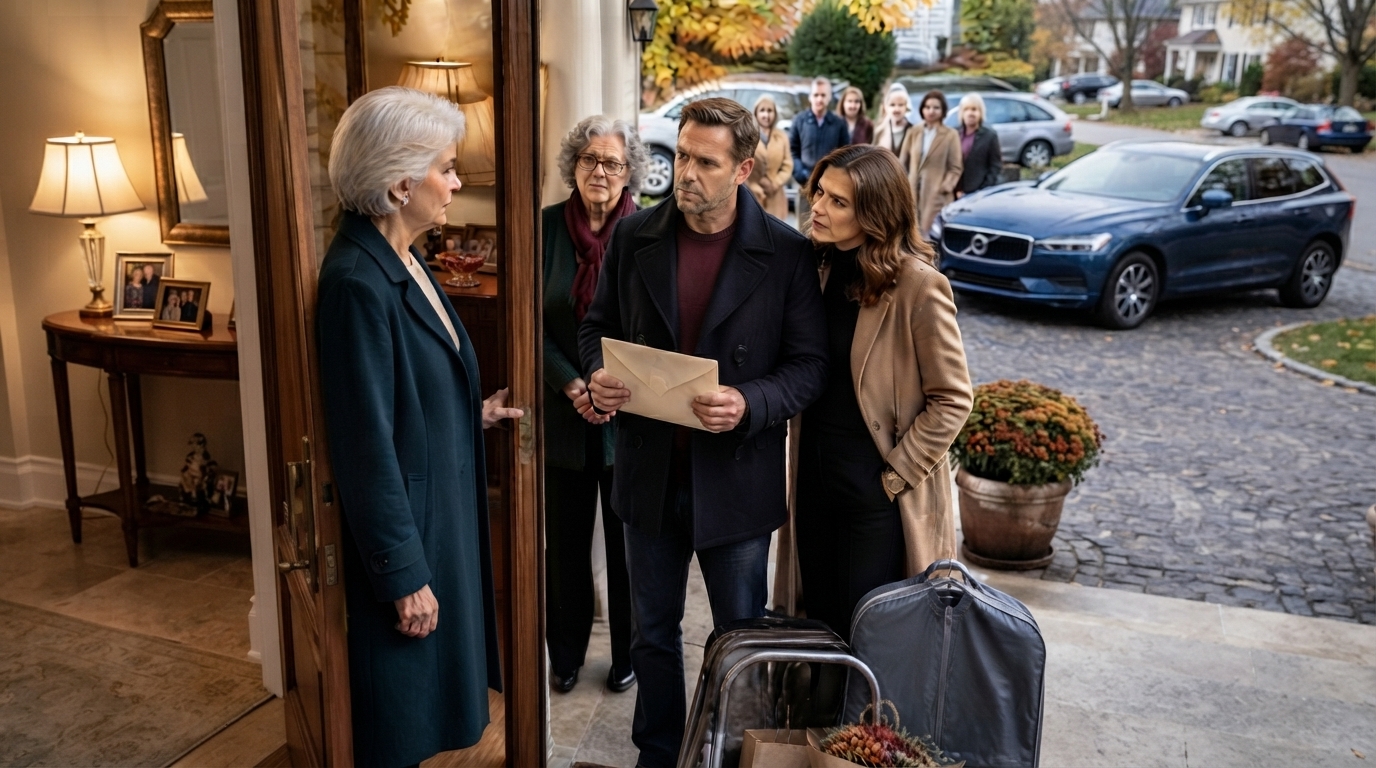
Daniel stood on my front porch with
twenty-eight relatives gathered behind him,
holding an envelope that had just turned his face the color of flour.
His wife Rebecca leaned over his shoulder.
“What does it say?”
He didn’t answer.
“Daniel, what does it say?”
Mrs. Carter, my seventy-eight-year-old neighbor,
stood beside them with her arms folded.
“I believe your mother has made her wishes quite clear,” she said.
Daniel pulled the papers completely out of the envelope.
Across the first page were the words:
NOTICE OF PROPERTY TRANSFER AND REVOCATION OF AUTHORITY.
Beneath that heading was my name.
Margaret Eleanor Whitmore.
And beside it was another name Daniel hadn’t expected.
Lily Whitmore.
His own daughter.
My nineteen-year-old granddaughter.
Rebecca snatched the second page.
“Why is Lily’s name on this?”
Daniel looked up at Mrs. Carter.
“Where is my mother?”
Mrs. Carter smiled politely.
“Enjoying Thanksgiving, I imagine.”
“Where?”
“That’s something you’ll have to ask her.”
Daniel pulled out his phone and called me.
I was sitting beside a cafe window in San Francisco,
watching people walk past with shopping bags and paper cups of coffee.
My phone vibrated.
Daniel.
I let it ring.
Then Rebecca.
Then Daniel again.
I took another sip of coffee.
For the first time in years, Thanksgiving morning belonged entirely to me.
No turkey to baste.
No potatoes to peel.
No relatives complaining about the seating arrangements.
No daughter-in-law criticizing my furniture.
Just coffee, sunshine, and the freedom to decide what I wanted to do next.
Across the country, however, my family was discovering that their plans had depended on a woman they hadn’t bothered to consult.
Daniel finally read the letter aloud.
“Dear Daniel and Rebecca. Since you have made arrangements concerning my home without my permission, I am formally notifying you that Thanksgiving will not be hosted at my residence.”
Aunt Helen gasped.
“What?”
Daniel continued, his voice growing tighter.
“My home is not available for gatherings, overnight accommodations, or property discussions. Any documents concerning my finances or residence must be directed to my attorney.”
Rebecca grabbed his arm.
“Keep reading.”
He swallowed.
“Furthermore, I have completed an estate-planning review. Any previous informal authority you believed you possessed has been revoked. My home has been transferred into a trust under arrangements established with independent legal counsel.”
Someone behind him muttered, “Good Lord.”
Daniel reached the next paragraph.
“My granddaughter Lily has been named successor trustee, subject to the terms of the trust, because she has consistently respected my independence and wishes.”
Rebecca’s mouth fell open.
“Lily?”
Daniel stared at the page.
“That can’t be right.”
Mrs. Carter adjusted her glasses.
“It certainly looks right to me.”
Rebecca turned toward the crowd.
“Everyone, please give us a minute.”
But twenty-eight people were already standing in my driveway, holding casserole dishes, pies, folding chairs, and enough groceries to feed a small army.
My cousin Patricia stepped forward.
“Daniel, are you telling me your mother isn’t home?”
He rubbed his forehead.
“There’s been a misunderstanding.”
Mrs. Carter spoke before he could continue.
“No misunderstanding. Maggie told them she wasn’t hosting.”
Aunt Helen looked at Rebecca.
“You said Maggie insisted on doing Thanksgiving.”
Rebecca’s face reddened.
“She always hosts!”
“That wasn’t the question,” Aunt Helen replied.
Then someone asked the question Daniel had been avoiding.
“Why were you planning to discuss her house after dinner?”
Silence spread across the driveway.
Daniel folded the papers.
“That’s private family business.”
Mrs. Carter looked directly at him.
“Then perhaps you shouldn’t have invited twenty-eight people to participate.”
I later heard every detail from Aunt Helen, who called me that afternoon.
But at the time, I was enjoying a breakfast pastry and looking through the travel guide Paul and I had bought years earlier.
I had circled three places I wanted to visit.
The Golden Gate Bridge.
The Japanese Tea Garden.
And a little restaurant near the waterfront where Paul had promised to take me for our anniversary.
We never made that trip.
Every time we saved enough money, something happened.
Daniel needed help with his business.
A car broke down.
Someone needed a loan.
Then Paul became ill.
And suddenly, our someday disappeared.
I looked at the empty chair across from me.
“I made it, sweetheart,” I whispered.
My eyes filled.
“I finally came.”
The waitress approached.
“Everything okay, ma’am?”
I smiled through my tears.
“Better than it has been in a very long time.”
Meanwhile, Daniel had apparently decided that my absence was an inconvenience he could solve by force.
He called a locksmith.
Mrs. Carter watched from her porch as the technician arrived.
Daniel explained that he was my son and needed access to the house.
The locksmith requested proof of authorization.
Daniel showed his driver’s license.
Unfortunately for him, sharing a last name didn’t establish ownership or permission.
When the locksmith called the contact number associated with my property instructions, my attorney answered.
The technician left without opening the door.
Rebecca was furious.
“This is ridiculous! We have twenty-eight people waiting!”
Aunt Helen crossed her arms.
“Then perhaps you should have asked your mother before inviting them.”
Rebecca snapped, “We didn’t think she’d behave like this!”
“Like what?” Aunt Helen asked. “A woman who owns her own house?”
Nobody answered.
Eventually, the relatives began leaving.
Some took their food home.
Others arranged to eat at a restaurant.
Several apologized to Mrs. Carter for the commotion.
Daniel and Rebecca remained until nearly two o’clock.
Before leaving, Daniel taped a handwritten note to my front door.
Mom, you’ve embarrassed us in front of everyone. Call me immediately.
Mrs. Carter removed it, photographed it, and sent me the picture.
I stared at the words.
Embarrassed us.
Not Are you safe?
Not Are you enjoying yourself?
Not even I’m sorry we didn’t ask.
Only embarrassment.
I put the phone away.
That evening, I ate dinner overlooking the water.
I ordered roasted chicken, vegetables, and a slice of pumpkin pie.
The waiter asked whether I was visiting family.
“No,” I said.
“Vacation?”
I thought about it.
“Something like that.”
He smiled.
“Well, I hope you’re having a wonderful time.”
I looked at the small cranberry-colored glass bowl sitting beside my handbag.
Paul’s bowl.
I’d wrapped it carefully before leaving Boston.
It was ridiculous, perhaps, to carry an old serving bowl across the country.
But that bowl had held cranberry sauce at every Thanksgiving dinner during our marriage.
It had survived moves, children, arguments, reconciliations, and nearly forty years of family celebrations.
Rebecca thought it looked old.
I thought it looked loved.
“Actually,” I told the waiter, “I am.”
But the biggest surprise came the following morning.
At 8:12, Lily called.
“Grandma?”
Her voice sounded frightened.
I sat up in my hotel bed.
“Sweetheart, what’s wrong?”
“Dad and Mom are furious.”
I sighed.
“I’m sorry they’ve involved you.”
“Grandma, did you really put my name on the house?”
I smiled gently.
“Not exactly. I placed the house into a trust. You are named as a future successor trustee if you’re willing and able to serve when needed. That doesn’t mean you own it today.”
She was quiet.
“Why me?”
I looked out at the city.
“Because you’ve always treated me like a person.”
“Grandma—”
“You visit when you don’t need money. You call to ask about my garden. You remember your grandfather’s birthday.”
Her voice broke.
“That doesn’t mean I deserve your house.”
“No,” I said softly. “And that’s exactly why I trust you.”
She started crying.
Then she told me something that made my stomach turn.
“Grandma, there’s something else.”
“What is it?”
“I saw the paperwork Dad wanted you to sign.”
I sat straighter.
“What paperwork?”
“It wasn’t just about helping you with bills.”
I closed my eyes.
“Tell me.”
Lily hesitated.
“Mom said they needed to get the house into their names before you changed your mind.”
My chest tightened.
“Changed my mind about what?”
“About moving.”
I stared at the wall.
“Moving where?”
Lily began crying harder.
“Grandma, they were looking at retirement communities.”
For several seconds, I couldn’t speak.
My son hadn’t merely planned Thanksgiving at my house.
He had planned to use the holiday gathering to pressure me into giving up control of the home where I had lived with Paul for forty years.
And he had apparently begun making plans for where I would go afterward.
I gripped the telephone.
“Did they tell you I agreed?”
“Yes.”
My heart sank.
“They said you were getting confused and that they needed to take care of things before something happened.”
I looked around my hotel room.
My suitcase was neatly unpacked.
My itinerary sat on the bedside table.
I’d booked my own flight, arranged legal advice, managed my finances, and traveled across the country alone.
But according to my son, I was too confused to decide where I wanted to live.
“Lily,” I said quietly, “I need you to listen carefully.”
“Okay.”
“You haven’t done anything wrong. And you don’t have to choose between your parents and me.”
She sniffled.
“But Dad says I betrayed him.”
“Your father is upset because his plans didn’t work.”
“What should I do?”
“Tell the truth. That’s all I ever want from you.”
She was quiet for a moment.
Then she whispered, “Grandma, I have pictures of the documents.”
I closed my eyes.
“Send them to my attorney, sweetheart. Not to the family chat.”
“Okay.”
“And Lily?”
“Yes?”
“Thank you for telling me.”
After we hung up, I called my attorney.
She listened without interrupting.
Then she said, “Maggie, I’m very glad you came to see me before leaving.”
“So am I.”
“We’ll review the documents Lily has and determine whether any further action is necessary. Don’t sign anything, and don’t discuss legal arrangements directly with Daniel until we’ve examined everything.”
I agreed.
Then I walked to the window.
Below me, the city was waking up.
People hurried toward buses.
A man walked a golden retriever.
Two children chased pigeons across the sidewalk.
Life continued.
And for the first time, I understood that my son’s plans didn’t have to become my future.
I wasn’t helpless.
I wasn’t confused.
And I certainly wasn’t finished living.
But when my attorney called again that afternoon, her voice was unusually serious.
“Maggie, I’ve reviewed the photographs.”
I gripped the phone.
“And?”
“The document Daniel brought to your house was more than a simple planning form.”
I felt cold.
“What was it?”
She paused.
“It included language authorizing a transfer of your property and broad financial decision-making powers.”
I sat down slowly.
Then she added something that made my blood run cold.
“And Maggie, there’s a signature page attached.”
I swallowed.
“Whose signature?”
“Yours.”
I stared at the phone.
Because I knew one thing with absolute certainty.
I had never signed that document.
PART 4
For several seconds, I couldn’t speak.
My attorney, Susan Bennett, waited patiently on the other end of the telephone.
Finally, I whispered, “Are you telling me someone forged my signature?”
“I’m telling you the document contains a signature purporting to be yours. We need to examine the original before drawing conclusions.”
I stared at my hands.
Seventy-two years old.
A little arthritis in my fingers.
A wedding ring I’d worn for nearly fifty years.
Those hands had raised children, cooked thousands of meals, held Paul’s hand through chemotherapy, and signed every mortgage payment that eventually made our house ours.
And now someone had apparently decided those same hands were no longer needed to make decisions about my own life.
“What do I do?” I asked.
“First, enjoy the remainder of your trip. The document doesn’t appear to have been recorded as a completed property transfer. I’ve already confirmed that your existing deed and trust arrangements remain in place.”
I released a breath.
“Thank goodness.”
“We’ll preserve the evidence and address the document properly when you return.”
I looked toward the window.
“Susan, I think my son believes I can’t stand up for myself anymore.”
Her answer came immediately.
“Then he’s about to discover otherwise.”
I almost laughed.
But after the call ended, I sat on the edge of the bed and cried.
Not because I was frightened of losing my house.
Susan had helped me protect it.
I cried because I remembered Daniel at eight years old, standing in our kitchen with a broken toy truck.
He’d held it out to Paul and said, “Daddy, can you fix it?”
Paul had smiled.
“Let’s see what we can do.”
We’d spent our entire marriage fixing things for Daniel.
Broken toys.
Bad grades.
Failed business ventures.
Overdue bills.
Even his marriage had survived a difficult period because Paul and I had helped pay for counseling and childcare.
And somewhere along the way, Daniel had learned that every problem in his life was something his parents should solve.
But I never imagined he’d begin treating me as the problem.
The next morning, I visited the Golden Gate Bridge.
The wind was colder than I expected.
I wrapped my scarf tightly around my neck and stood looking across the water.
Paul had wanted to come here.
He’d talked about it for years.
I could almost hear him saying, “Maggie, stop worrying about everybody else and look at that view.”
So I did.
I stood there for nearly an hour.
And when I finally turned away, I felt something loosen inside my chest.
For the first time since Paul’s death, I wasn’t simply surviving another day.
I was living one.
Three days later, I returned to Boston.
Mrs. Carter met me at the airport.
She insisted on carrying my suitcase, although I reminded her that she was older than I was.
“Nonsense,” she said. “I’ve been waiting all week to hear about your adventures.”
I laughed.
“Well, I’ve got stories.”
When we reached my house, everything was exactly as I’d left it.
The locks worked.
The photographs remained on the walls.
Paul’s favorite chair stood beside the fireplace.
And my home was wonderfully, beautifully quiet.
Mrs. Carter helped me carry my luggage inside.
Then she handed me a small stack of mail.
“Your son came by twice,” she said.
I sighed.
“Did he cause trouble?”
“Nothing I couldn’t handle.”
She smiled mischievously.
“He asked whether you’d finally come to your senses.”
I raised an eyebrow.
“What did you say?”
“I told him you’d gone to San Francisco, not lost your mind.”
I laughed so hard I nearly dropped my handbag.
But the laughter faded when I found a letter from Daniel.
It was handwritten.
Mom,
I don’t understand why you’ve turned this into a legal fight. Rebecca and I were only trying to make sure you’re taken care of.
You’ve become suspicious of everyone.
We wanted to help you make decisions before things became difficult.
Now you’ve embarrassed us, frightened Lily, and made the entire family uncomfortable.
Please call me so we can settle this privately.
Daniel.
I read it twice.
Not one apology.
Not one acknowledgment that he’d planned a dinner without asking me.
Not one word about the signature.
I folded the letter and placed it in Susan’s folder.
The following morning, I went to her office.
She had already reviewed the photographs Lily sent.
The disputed document was titled Durable Power of Attorney and Property Management Authorization.
Attached to it was a proposed deed transferring my home into a family-controlled entity.
The paperwork named Daniel as the primary person authorized to make certain financial and property decisions.
Rebecca was listed as an alternate.
And there, on the signature page, was something resembling my name.
It wasn’t my signature.
I knew that immediately.
The final letter curled in a way I had stopped writing years earlier.
And the middle initial was wrong.
Susan examined it carefully.
“We’ll need the original and information about how this was prepared,” she said.
“Can Daniel use it?”
“We’ve taken steps to notify the relevant parties that you dispute its authenticity and have not authorized him to act under it. Any attempted use would need to be addressed immediately.”
I nodded.
Then I asked the question that had been haunting me.
“Why would he do this?”
Susan looked at me gently.
“I can’t tell you his motives. But I can tell you that you have every right to make your own decisions.”
I looked down at the papers.
“Then I want to speak to him.”
She nodded.
“I recommend we arrange a meeting here.”
Two days later, Daniel and Rebecca arrived at Susan’s office.
Daniel looked tired.
Rebecca looked furious.
Neither greeted me.
Susan invited everyone to sit.
Daniel immediately began speaking.
“Mom, this whole thing is ridiculous. We were trying to help you.”
I looked at him.
“Then why didn’t you ask whether I wanted help?”
He frowned.
“Because you always say you’re fine.”
“Perhaps that’s because I am.”
Rebecca crossed her arms.
“Maggie, nobody stays independent forever.”
I turned toward her.
“That’s true. But needing help someday doesn’t mean I must surrender my home today.”
Daniel sighed dramatically.
“You’re making this emotional.”
I looked at Susan.
She slid the disputed document across the table.
“Daniel, can you explain where this signature came from?”
He stopped moving.
Rebecca leaned forward.
“What signature?”
Susan pointed to the page.
“The signature presented as your mother’s.”
Daniel stared at it.
For several seconds, he said nothing.
Then he looked at me.
“Mom, you signed that.”
I felt something break inside me.
“No, Daniel. I didn’t.”
He swallowed.
“You must have forgotten.”
I looked directly into his eyes.
“Do not do that.”
“Do what?”
“Do not tell me I forgot something that never happened.”
Rebecca reached for the paper.
“Daniel said you agreed to let him handle the property.”
I turned toward her.
“Did he?”
She looked confused.
“He told me you were ready to move somewhere smaller.”
I shook my head.
“I never said that.”
Rebecca stared at her husband.
“Daniel?”
He rubbed his forehead.
“Mom was talking about getting older.”
“Everybody gets older,” I said. “That doesn’t mean everybody is giving away their house.”
Susan spoke calmly.
“Daniel, we need to know who prepared this document and who witnessed or certified the signature.”
He looked at the floor.
Finally, he whispered, “I used an online template.”
Rebecca’s face changed.
“What?”
Daniel continued.
“I filled it out because I thought Mom would eventually agree.”
I felt sick.
“And the signature?”
He didn’t answer.
Susan waited.
Then Daniel said quietly, “I copied it from an old document.”
Rebecca pushed her chair back.
“Daniel!”
I stared at my son.
He looked like a frightened boy caught doing something he knew was wrong.
But he wasn’t a boy.
He was a forty-six-year-old man who had decided he could take control of his mother’s property without her consent.
“Why?” I whispered.
His eyes filled.
“Because we needed the house.”
I sat perfectly still.
“What do you mean?”
He covered his face.
“My business isn’t doing well.”
I closed my eyes.
Of course.
Another financial problem.
Another disaster I was expected to fix.
Daniel explained that he’d borrowed money to expand his contracting business.
Two major customers had delayed payments.
A commercial project had gone over budget.
And he’d been struggling to keep up with his obligations.
He’d convinced himself that if he could gain control of my property, he might be able to use it as security for financing.
Rebecca stared at him.
“You told me your business was fine.”
He shook his head.
“I didn’t want to worry you.”
She looked devastated.
“And you told me Maggie wanted to move!”
“I thought if Mom signed everything, we could make it work.”
I felt tears gathering.
“Daniel, you were going to risk my home to save your business?”
He looked at me.
“I wasn’t going to let anything happen to it.”
I shook my head.
“You couldn’t even protect your own business from trouble. How could you promise to protect my house?”
He began crying.
“Mom, I was desperate.”
I leaned forward.
“Then you should have told me the truth.”
He wiped his face.
“I thought you’d say no.”
I looked at him for a long moment.
“Yes, Daniel. I would have.”
His shoulders fell.
“And that was my right.”
Silence filled the room.
Susan explained that the disputed documents could not simply be treated as harmless drafts. Their preparation and any attempted use required proper review, and she would advise me on the available legal steps.
Daniel agreed to surrender the originals and provide information about where they had been circulated.
I told him I needed time before deciding how to proceed with the personal relationship.
Rebecca sat quietly.
Then she turned toward me.
“Maggie, I didn’t know about the signature.”
I believed her.
But I also remembered her seating chart.
Her instructions to hide Paul’s bowl.
Her willingness to treat my home as though it already belonged to her.
“You may not have known everything,” I said, “but you knew I hadn’t agreed to host Thanksgiving.”
She lowered her eyes.
“Yes.”
“And you knew Daniel planned to pressure me in front of everyone.”
Her face reddened.
“Yes.”
I nodded.
“Then you have something to think about too.”
For the first time since this began, Rebecca didn’t argue.
She simply whispered, “I’m sorry.”
I wanted to forgive them immediately.
That’s what mothers do, isn’t it?
We spend our lives trying to make pain disappear.
But I had learned that forgiveness given too quickly sometimes becomes permission for the same behavior to continue.
So I stood.
“I love you both,” I said. “But I need distance while these matters are resolved.”
Daniel looked up.
“Mom, please.”
I shook my head.
“I am not cutting you out of my life. But I am no longer allowing you to run it.”
Then I walked out.
The following weeks were difficult.
Susan handled the disputed paperwork and the appropriate notifications.
Daniel cooperated with the review and obtained separate legal advice.
The documents were not accepted as authorization to transfer my home, and my attorney helped ensure that my property arrangements remained protected.
I also updated my estate plan.
Lily remained the designated successor trustee, with professional safeguards and clear instructions.
I didn’t do that to punish Daniel.
I did it because Lily understood something her father had forgotten.
My life still belonged to me.
One afternoon, Lily came over with flowers.
She found me in the garden, pruning roses.
“Grandma?”
I looked up.
“Hello, sweetheart.”
She hugged me tightly.
“I’m sorry.”
I frowned.
“What are you apologizing for?”
“For my parents.”
I held her shoulders.
“Lily, their choices are not yours to carry.”
She wiped her eyes.
“Dad says everything is falling apart.”
I sighed.
“Sometimes things have to change before they can become healthier.”
She looked toward the house.
“Are you going to sell it?”
I smiled.
“Not anytime soon.”
“Good.”
“Why?”
She grinned.
“Because I love your kitchen.”
I laughed.
“That’s a very convincing reason.”
She helped me carry the gardening tools inside.
Then we made tea and sat at the old oak table.
Lily looked at the cranberry-colored bowl sitting in the center.
“You brought it back from San Francisco?”
“Of course.”
She ran her fingers along the rim.
“Grandpa loved this bowl.”
“He certainly did.”
She smiled.
“Remember how he’d always put too much cranberry sauce on his plate?”
I laughed.
“And then complain that he couldn’t taste the turkey.”
We spent the next hour telling stories about Paul.
No property discussions.
No legal documents.
No pressure.
Just memories.
And I realized that this was what I had wanted from my family all along.
Not gratitude for everything I’d given them.
Just the simple pleasure of being together.
By spring, Daniel had begun taking responsibility for his business problems.
He sold equipment he no longer needed.
He negotiated with creditors.
He reduced expenses.
And for the first time in years, he stopped treating me as his emergency financial solution.
Rebecca started working part-time again.
They moved into a smaller rental home after selling their own investment property.
Their lives weren’t as comfortable as before.
But they were managing.
One Sunday afternoon, Daniel called.
“Mom, could I come by?”
I hesitated.
“What for?”
“To talk.”
“About money?”
“No.”
“About the house?”
“No.”
I looked out at the garden.
“All right.”
He arrived carrying a small paper bag.
Inside were two cinnamon rolls from the bakery Paul used to love.
I smiled despite myself.
“You remembered.”
Daniel nodded.
“Dad used to bring these home on Sundays.”
We sat on the porch.
For a while, neither of us spoke.
Then he looked at me.
“Mom, I’ve been thinking about what I did.”
I waited.
“I told myself I was protecting you because I couldn’t admit I was trying to protect myself.”
My throat tightened.
He continued.
“I was scared of losing my business. Scared Rebecca would find out how badly things were going. Scared everyone would think I was a failure.”
He looked down.
“So I decided your house could solve everything.”
I said nothing.
“And when you refused to cooperate, I acted like you were the problem.”
Tears filled his eyes.
“I’m ashamed of myself.”
I reached for his hand.
“Daniel, being afraid doesn’t make you a failure.”
He nodded.
“But what I did was wrong.”
“Yes,” I said quietly. “It was.”
He wiped his face.
“I don’t expect you to trust me again right away.”
“Good,” I answered gently. “Because trust takes time.”
He gave a small, sad laugh.
Then he looked at me.
“Can I still come over sometimes?”
I smiled.
“Of course. You’re my son.”
His face softened.
“But next time, bring the cinnamon rolls without bringing paperwork.”
He laughed through his tears.
“Deal.”
That summer, I took another trip.
This time, I went to Maine.
I rented a little cottage overlooking the ocean and spent five days reading books, eating lobster rolls, and watching the waves.
Mrs. Carter joined me for two days.
We laughed like schoolgirls.
We talked about our husbands.
We complained about our knees.
And we promised each other that growing older would never mean becoming invisible.
When I returned home, I found a postcard from Lily.
She’d written:
Grandma, I’m proud of you for going places Grandpa wanted you to see. I think he’d be happy knowing you’re finally enjoying yourself.
I placed it beside Paul’s photograph.
Then I whispered, “You hear that, sweetheart? I’m finally doing it.”
The next Thanksgiving arrived sooner than I expected.
This time, I didn’t wait for the family group chat to tell me what I was supposed to do.
In early November, I sent everyone a message.
This year, Thanksgiving will be at my house, but only for a small gathering. I’ll provide the turkey and cranberry sauce. Everyone else can bring a dish. Please ask before inviting additional guests.
Daniel responded first.
Sounds wonderful, Mom. What can I bring?
Rebecca wrote:
I’ll make the mashed potatoes. And Maggie, please keep all your family photographs exactly where they are.
I stared at that message for a moment.
Then I smiled.
Lily sent a picture of a pumpkin pie.
I’m bringing dessert!
Mrs. Carter promised green beans.
And just like that, Thanksgiving became something I hadn’t experienced in years.
A celebration I actually wanted.
On Thanksgiving morning, I woke early.
I put on Paul’s favorite old jazz record.
I arranged flowers on the dining table.
And I placed the cranberry-colored bowl in the center, exactly where it had always belonged.
At noon, Daniel arrived.
He carried a casserole dish in one hand and a folding chair in the other.
“Where do you want this, Mom?”
I smiled.
“Ask Rebecca where she’d like the casserole.”
He laughed.
Then he stopped and looked at me.
“Mom?”
“Yes?”
“Thank you for inviting us.”
I felt something warm settle in my chest.
“You’re welcome, sweetheart.”
A little later, Rebecca came into the kitchen.
She looked at the bowl.
For a moment, neither of us spoke.
Then she said quietly, “I was wrong about that.”
I glanced at her.
“About what?”
She touched the rim of the bowl.
“Calling it old.”
I smiled.
“Well, it is old.”
She shook her head.
“No. It’s history.”
My eyes filled.
She continued.
“Paul loved it. You love it. And I should have respected that.”
I nodded.
“Thank you, Rebecca.”
She hugged me.
It wasn’t a perfect hug.
There was still history between us.
But it was a beginning.
That evening, we sat around the table.
Only nine of us.
No seating charts.
No strangers occupying my bedroom.
No one demanding I move my furniture.
No papers hidden beneath dinner plates.
Just family.
Before we ate, Daniel stood.
“I’d like to say something.”
My heart tightened.
He looked around the table.
“Last Thanksgiving, I made a terrible mistake.”
Everyone grew quiet.
“I treated Mom’s home like something I was entitled to. I made plans without asking her. And I forgot that she’s spent her whole life giving us more than we deserved.”
He looked directly at me.
“Mom, I’m sorry.”
Tears filled my eyes.
Then he added, “And I’m grateful you gave us another chance to sit at this table.”
For several seconds, nobody spoke.
Then Lily reached for my hand.
Mrs. Carter wiped her eyes.
And I smiled.
“Well,” I said, “if everyone is finished making me cry, the turkey is getting cold.”
The room erupted in laughter.
Later that night, after everyone had gone home, I stood alone in my dining room.
The dishes were washed.
The chairs were back in place.
The photographs remained on the walls.
And Paul’s cranberry-colored bowl sat in the center of the table.
I picked it up and held it carefully.
For nearly forty years, that bowl had reminded me of the life Paul and I built together.
But now it meant something else too.
It reminded me that memories deserve respect.
That independence doesn’t expire at seventy-two.
And that loving your children doesn’t mean giving them permission to take control of your life.
I looked toward Paul’s photograph.
“Well, darling,” I whispered, “I finally took that trip.”
Then I smiled.
“And I finally learned how to say no.”
For years, I’d believed being a good mother meant making everyone comfortable, even when it cost me my own happiness.
But I’d discovered something important.
A home is not simply a building that your children may inherit someday. It is the life you’ve built, the memories you’ve protected, and the place where you deserve to feel safe.
My son thought twenty-eight people around my Thanksgiving table would make me too embarrassed to refuse him.
He forgot that I had spent seventy-two years learning how to survive disappointment.
He forgot that I had buried the love of my life and still found the strength to wake up every morning.
And most importantly, he forgot that I was still capable of making plans of my own.
That Thanksgiving, I didn’t lose my family.
I lost the fear of disappointing them.
And once that fear was gone, I finally had room to live.
THE END THANK YOU FOR READING !!!



