PART 3
The young county inspector
stared at the folder as though someone
had handed him a document written in another language.
The delivery driver stood beside Dad’s old wooden fence,
waiting patiently.
Brent remained on his expensive back deck,
coffee mug suspended halfway to his mouth.
And my seventy-nine-year-old father?
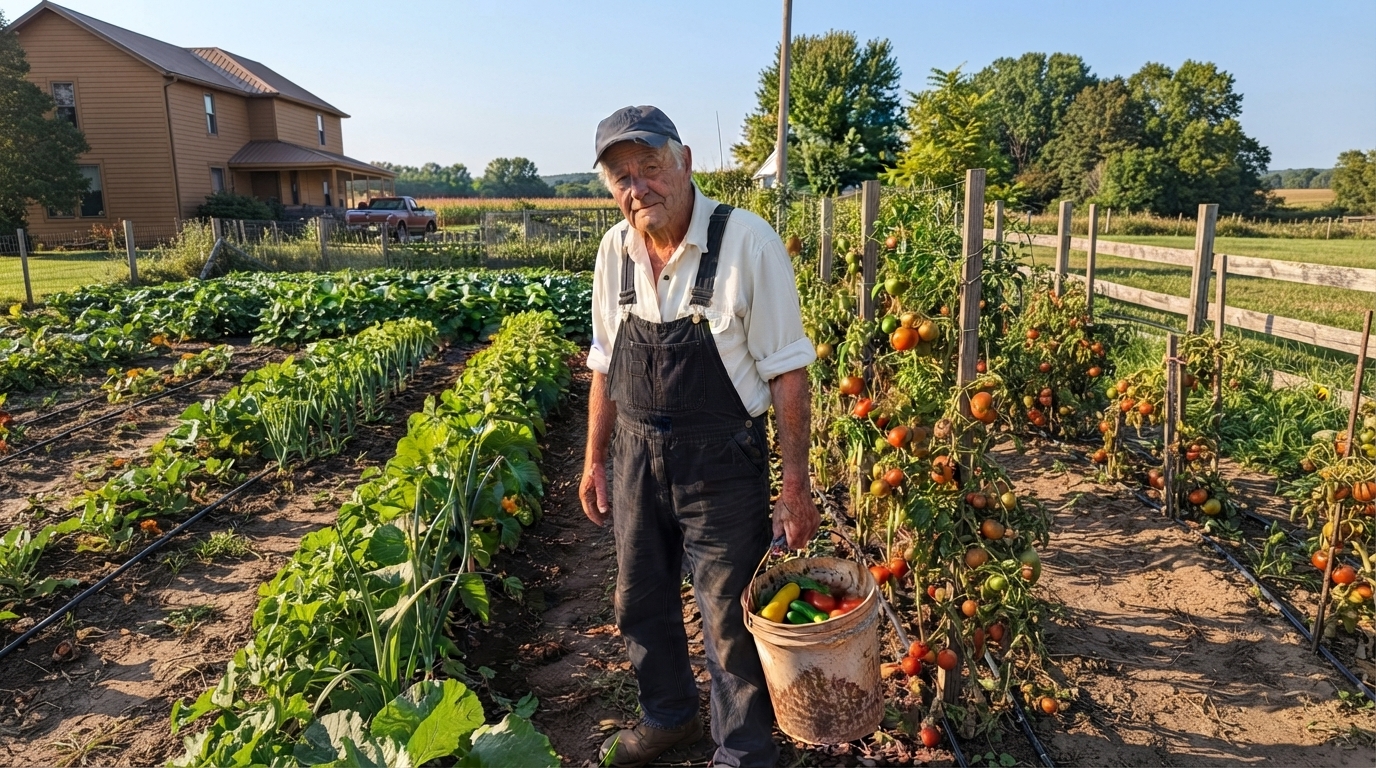
He was kneeling beside a row of green beans,
showing a little boy how to pick them without damaging the vines.
As though nothing unusual was happening.
“Sir,” the inspector finally said, “what exactly is this?”
The driver opened the folder.
County Community Food Program.
Registered volunteer distribution site number seventeen.
The inspector blinked.
“Distribution site?”
Yes. This property has supplied fresh produce to local families,
senior centers, and emergency food programs for nearly twelve years.
I felt my stomach tighten.
Twelve years?
Dad had been doing this for twelve years?
The driver continued.
“Mr. Lindqvist has been donating thousands of pounds of vegetables annually. We collect whatever isn’t distributed directly to families.”
The inspector looked toward the garden.
“Thousands?”
The driver nodded.
“Last season alone, this property supplied more than eight thousand pounds of fresh produce.”
I turned toward Dad.
He was still helping the little boy.
“Dad?”
He looked up.
“Yes, sweetheart?”
“Eight thousand pounds?”
He shrugged.
“Good growing season.”
I stared at him.
“Why didn’t you tell me?”
He smiled.
“You never asked how much.”
That was my father.
A man who could quietly change hundreds of lives and still act embarrassed if someone thanked him.
The inspector flipped through the paperwork.
His name was Daniel Mercer.
He couldn’t have been older than thirty.
He studied the registration certificate, the delivery records, and several letters from local organizations.
Then he frowned.
“This explains the food distribution. But the complaint concerns land use and property maintenance.”
The driver nodded.
“That’s why I brought the supporting records.”
He removed another document.
It was an old county acknowledgment of the garden’s charitable distribution activities.
Daniel examined it carefully.
“This is from eleven years ago.”
“Correct.”
“And the property has continued operating?”
“Every growing season.”
Daniel looked toward Dad.
“Mr. Lindqvist, why didn’t you mention any of this on Thursday?”
Dad stood slowly, brushed dirt from his knees, and walked toward us.
“Because you were doing your job.”
Daniel looked confused.
Dad continued.
“Somebody complained. You came to inspect. I didn’t figure arguing with you would help.”
“But you could have shown me these records.”
Dad smiled.
“I wanted you to see the people first.”
The inspector said nothing.
Dad looked toward the families moving between the vegetable rows.
“Paper tells you what something is called. People tell you what it means.”
I felt tears gathering in my eyes.
Across the fence, Brent finally spoke.
“This is ridiculous!”
Everyone turned.
He stood on his deck, his expensive robe hanging open over a pressed shirt.
“I don’t care if he’s feeding the entire county. It’s still an eyesore!”
The garden fell strangely quiet.
Dad looked up at him.
“Morning, Brent.”
Brent ignored the greeting.
“I paid a fortune for this property. I shouldn’t have to look at a farm every time I step onto my deck.”
The little boy beside Dad stopped picking beans.
His mother gently guided him away.
Daniel closed the folder.
“Sir, I understand you’re the complainant.”
Brent folded his arms.
“That’s right.”
“Then I need you to understand that we’re reviewing the actual conditions and applicable regulations.”
Brent laughed.
“What’s there to review? Look at it!”
He waved toward the garden.
“The stakes! The vines! The dirt! It’s completely inappropriate for this neighborhood.”
Dad glanced down at his boots.
Then toward the tomato plants.
“Well,” he said quietly, “vegetables do tend to grow in dirt.”
A few people laughed.
Brent’s face reddened.
“This isn’t funny!”
Dad nodded.
“Didn’t mean to upset you.”
But Brent wasn’t finished.
“Do you know what a garden like that does to property values?”
An elderly woman near the potatoes straightened.
“Do you know what an empty refrigerator does to a family?”
Brent looked offended.
She continued.
“My name is Evelyn Parker. I’m seventy-three years old. My husband died two years ago, and after I paid my medical bills, there were weeks when I had eighteen dollars left for groceries.”
She lifted a bag of tomatoes.
“This man told me I could take whatever I needed. He never once made me feel ashamed.”
Brent opened his mouth.
Evelyn raised her hand.
“I’m not finished.”
The garden went silent.
“He even brought vegetables to my house when I had surgery. He carried them up my steps and put them in my refrigerator because I couldn’t bend down.”
Her voice trembled.
“So forgive me if I don’t care what your expensive deck overlooks.”
I looked toward Dad.
He had lowered his head.
He hated attention.
Especially when people praised him.
But the stories kept coming.
A young father stepped forward.
“My wife was in the hospital for three months after our twins were born. Mr. Lindqvist brought food every Friday.”
A woman in a nursing uniform spoke next.
“I work at the senior center. His vegetables go into meals for people who can’t afford fresh produce.”
Then a teenage boy raised his hand.
“Mr. Lindqvist taught me how to grow tomatoes.”
Dad looked surprised.
The boy smiled.
“I used to come here after school when my mom worked late. He gave me something to do besides getting into trouble.”
I stared at the teenager.
Then at my father.
How many lives had he touched while I was busy worrying about whether he remembered to take his vitamins?
How many people knew a version of him I’d never seen?
The woman from the silver minivan approached us.
She was holding the little girl in the pink blanket.
“Mr. Lindqvist,” she said softly, “may I tell them?”
Dad’s expression changed.
For the first time that morning, he looked uncertain.
“You don’t have to, Anna.”
She smiled through tears.
“I know.”
Then she turned toward the inspector.
“My name is Anna Morales. Three years ago, my husband died in a construction accident.”
Her voice shook.
“I had three children and was pregnant with Rosie.”
She looked down at the little girl.
“I lost our apartment. We stayed with relatives, then in a shelter. I was working two jobs, but some weeks there still wasn’t enough money for groceries.”
The garden was silent.
“One Friday, I went to the food pantry. They gave me a box of vegetables.”
She looked toward Dad.
“There was a handwritten note inside.”
I felt my chest tighten.
Anna reached into her purse.
She removed a folded piece of paper, worn soft from being handled.
Then she read it aloud.
“If you need more, come by the garden. No questions asked. Bring the children. There’s always enough.”
Her voice broke.
“That was the first time in months somebody offered help without making me explain why I needed it.”
Dad wiped his eyes.
Anna continued.
“He didn’t just give us vegetables. He helped me find a mechanic who repaired my van at cost. He watched my children while I went to a job interview. And when Rosie was born, he showed up at the hospital with a basket of tomatoes and a little knitted blanket.”
I stared at Dad.
“A blanket?”
He cleared his throat.
“Your mother taught me a little knitting.”
I covered my mouth.
Anna began crying.
“Rosie’s middle name is Grace.”
She looked at Dad.
“After Mrs. Lindqvist.”
My knees nearly gave way.
Mom’s name.
Grace.
I hadn’t heard my mother’s name spoken with that much tenderness in years.
She died seven years earlier.
A quiet woman with flour on her apron and dirt beneath her fingernails.
She had always loved the garden.
Every spring, she planned the rows on graph paper.
Every summer, she canned tomatoes until the kitchen windows fogged.
And every autumn, she filled boxes with vegetables.
I remembered those boxes.
I remembered her saying they were for church friends or neighbors.
I never realized how many neighbors.
Or how much it mattered.
After she died, Dad expanded the garden.
I thought he was trying to keep busy.
Trying to fill the silence.
But standing there among the families, I suddenly understood.
He wasn’t merely keeping her garden alive.
He was keeping her kindness alive.
Daniel looked at the photograph Anna had given him.
Dad and Mom stood beside a long wooden table covered in vegetables.
Behind them were dozens of families.
On the back were Mom’s five handwritten words.
Nobody goes hungry while we’re here.
Daniel turned the photograph over several times.
Then he looked at Dad.
“My grandmother used to say something similar.”
Dad smiled.
“Smart woman.”
Daniel swallowed.
“She raised me after my parents died.”
For a moment, the clipboard seemed forgotten.
Then he straightened.
“Mr. Lindqvist, I need to be clear. I can’t simply ignore a zoning complaint because this garden does good work.”
Dad nodded.
“Wouldn’t ask you to.”
“But I can make sure the county reviews the correct facts.”
He lifted the folder.
“And these documents change what needs to be examined.”
Brent slammed his coffee mug onto the deck railing.
“Are you kidding me?”
Daniel turned.
“No, sir.”
“I expect that garden removed within thirty days!”
Daniel answered calmly.
“That deadline is part of an initial enforcement notice. Mr. Lindqvist has review and appeal options. The county must follow its procedures.”
Brent’s jaw tightened.
“I know people on the county board.”
Daniel nodded.
“Then they’ll understand why we need to apply the rules correctly.”
The delivery driver began loading boxes.
Families moved through the garden.
Children laughed.
A woman showed another woman how to tell when a squash was ready.
The sun rose higher, burning away the fog.
And Dad returned to his vegetables.
As though the entire morning had been perfectly ordinary.
I walked beside him.
“Dad.”
He looked at me.
“Yes?”
“Why didn’t you tell me what you were doing?”
He pulled a weed from the soil.
“Didn’t think it was much of a story.”
I stared at him.
“Dad, you’ve been feeding half the county!”
He chuckled.
“Not half.”
I laughed through tears.
He looked toward the rows.
“Your mother started it.”
I swallowed.
“Tell me.”
He was quiet for a moment.
Then he leaned against his old bucket.
“About thirteen years ago, Grace noticed a woman taking bruised tomatoes from the discount bin at the grocery store.”
I listened.
“She had two little children. Grace said they looked hungry.”
He smiled sadly.
“Your mother came home and filled three grocery bags with vegetables. Then she drove back and found that woman.”
My eyes filled.
“She never told me.”
Dad shook his head.
“Your mother didn’t like making people feel they owed her something.”
He looked toward the garden.
“That woman told another family. Then somebody else came. Pretty soon, we were growing more than we could eat.”
I wiped my cheeks.
“And after Mom died?”
Dad looked down.
“Well…”
His voice broke.
“I couldn’t bear the thought of the garden going empty.”
He swallowed.
“Every time I plant tomatoes, I can almost hear her telling me I’m putting them too close together.”
I laughed through my tears.
“She always said that.”
Dad smiled.
“Still does, in my head.”
Then he reached into his pocket.
He removed a small, faded envelope.
“There’s something I’ve been meaning to show you.”
I stared at it.
My name was written across the front.
In Mom’s handwriting.
“Dad…”
He nodded.
“She wrote it before she died.”
My hands trembled.
“Why didn’t you give it to me?”
He looked toward the garden.
“Because she asked me to wait until you understood why we planted so much.”
I opened the envelope.
And what I read made me realize that the garden was hiding one final secret.
PART 4
My mother’s handwriting was unmistakable.
Small.
Neat.
Slightly slanted to the right.
The same handwriting that had appeared on birthday cards, grocery lists, and little notes tucked into my school lunches.
I unfolded the letter.
My darling daughter,
If your father gives you this, I hope it means you’ve finally discovered what we’ve been doing with all those vegetables.
I laughed through tears.
Mom had known.
She’d known I would eventually ask.
I continued reading.
I know you worry about us. I know you think your father works too hard and I spend too much time in the garden.
But there’s something I want you to understand.
When I was a little girl, there were nights when my mother went without supper so my brothers and I could eat.
I didn’t know that until I was grown.
She used to tell us she wasn’t hungry.
Years later, I realized that was the kindest lie she ever told.
My throat tightened.
Mom had rarely spoken about her childhood.
I knew her family had been poor.
I hadn’t known how poor.
The letter continued.
I promised myself that if I ever had enough food to share, I would.
Your father made that promise with me.
We never became wealthy people. But we had land, seeds, and two pairs of working hands.
That turned out to be enough.
I pressed my hand over my mouth.
Someday, when we’re gone, I don’t expect you to spend your life growing beans.
I only hope you’ll remember that a small kindness can keep someone going when the world feels unbearable.
And if anyone ever tells you this garden is ugly, ask them to look at the people it feeds.
That’s where the beauty is.
Love always, Mom.
I couldn’t finish without crying.
Dad stood beside me, looking toward the rows.
For a long moment, neither of us spoke.
Then I hugged him.
He smelled like soil, coffee, and the peppermint soap he’d used my entire life.
“I’m sorry,” I whispered.
He looked confused.
“For what?”
“For not knowing.”
Dad patted my back.
“Nothing to be sorry about.”
I shook my head.
“I should have paid more attention.”
He smiled.
“You were raising your own family. Working. Living your life.”
His voice softened.
“Your mother and I were proud of you.”
That made me cry harder.
The following Monday, I took the day off work.
I called the attorney whose name I’d written on the envelope.
Her name was Rebecca Shaw.
She specialized in property and land-use matters.
I brought every document we had.
The complaint.
The inspection notice.
The community food program records.
Photographs of the garden.
And the letters from families who depended on it.
Rebecca listened carefully.
Then she said something that surprised me.
“Your father may have a stronger position than the original notice suggests.”
I leaned forward.
“How?”
She pointed to the paperwork.
“The county needs to determine which zoning provisions actually apply. The garden may qualify under provisions for personal gardening, established agricultural activity, or community food production.”
I nodded.
“But the inspector gave him thirty days.”
“An initial notice doesn’t necessarily settle every legal question.”
She turned another page.
“We’ll request the full complaint, review the zoning history, and file the appropriate appeal before the deadline.”
I exhaled.
“Can we stop them from destroying the garden?”
“We can pursue the available protections. I can’t promise the outcome, but your father has a right to a fair review.”
That was enough for me.
I didn’t need a miracle.
I needed someone to make sure the rules were applied fairly.
Three days later, something unexpected happened.
The county food program director called me.
Her name was Helen Carter.
“I understand your father received a zoning complaint,” she said.
“Yes.”
“I’d like to help.”
I thanked her.
Then she told me something that left me speechless.
“Your father’s garden supplies produce to six distribution partners. Several of them have asked what they can do.”
I sat down.
“Six?”
“Yes. And one of those partners provides meals for elderly residents who can’t easily leave their homes.”
I looked out my window.
Dad had never mentioned that either.
Helen continued.
“We’re gathering records of the produce received and the households served. We can provide that information for the review.”
I thanked her again.
Before hanging up, she added, “Your father is a remarkable man.”
I smiled.
“Yes. I’m beginning to realize that.”
The story spread through town.
Not because Dad wanted attention.
He certainly didn’t.
But one of the families posted a photograph of the garden online.
It showed Dad kneeling beside Rosie, helping her hold a tomato nearly as big as her head.
The caption read:
This man has helped feed our family for three years. Someone wants his garden removed because it’s an eyesore. I think it’s the most beautiful place in town.
Within two days, hundreds of people had shared it.
Former neighbors commented.
Teachers.
Nurses.
Retirees.
Parents.
People I hadn’t seen in decades.
One woman wrote that Dad had delivered vegetables after her husband died.
Another said he’d taught her son how to plant potatoes.
A local restaurant owner offered to donate compost.
A hardware store offered fencing materials.
And a group of high school students volunteered to help maintain the paths.
Dad was horrified.
“Why’s everybody making such a fuss?” he asked.
I smiled.
“Because you’ve been doing something wonderful for years.”
He frowned.
“Just growing vegetables.”
I laughed.
“Dad, you’re impossible.”
Brent wasn’t amused.
He posted a response online.
He claimed the garden attracted traffic.
He complained about the appearance.
And he insisted that charitable activity didn’t excuse zoning violations.
Some of his concerns about parking and access were reasonable enough to examine.
But the way he described my father made my blood boil.
He called him irresponsible.
Stubborn.
A nuisance.
Then he wrote:
People shouldn’t be allowed to turn residential neighborhoods into farms just because they want attention.
I showed Dad.
He read it slowly.
Then handed back my phone.
“He’s entitled to his opinion.”
I stared at him.
“Dad, he’s insulting you!”
Dad shrugged.
“Doesn’t make the beans grow any slower.”
I laughed despite myself.
But then he looked toward Brent’s house.
“Maybe he’s never been hungry.”
I frowned.
“What?”
Dad picked up his bucket.
“People who have always had enough sometimes forget what it feels like not to.”
The county scheduled a public hearing.
Rebecca prepared the documents.
Helen gathered the distribution records.
Families wrote letters.
And the inspector, Daniel, completed his review of the property.
He found several issues that could be addressed.
The garden’s temporary roadside parking arrangement needed improvement.
Some storage materials had to be moved farther from the property line.
And the county needed to clarify whether the food distribution activity required additional approval.
Dad didn’t argue about any of it.
He fixed what he could.
Volunteers helped create a safer parking area.
The hardware store donated materials for a small storage shed.
The high school students cleared the walkways.
And Dad put up a sign near the entrance.
GRACE’S GARDEN
TAKE WHAT YOU NEED. SHARE WHAT YOU CAN.
When I saw the sign, I cried.
Dad stood beside it.
“Your mother would’ve liked that.”
I nodded.
“She would have loved it.”
The hearing took place on a Wednesday evening.
The room was packed.
Dad wore his only good suit.
The same navy suit he’d worn to Mom’s funeral.
I tried to convince him to wear something more comfortable.
He shook his head.
“Important day.”
I held his arm as we entered.
Brent sat near the front.
He wore a tailored jacket and had a thick folder on his lap.
He looked confident.
Dad looked nervous.
For the first time, I saw how much the situation had frightened him.
He wasn’t worried about fines.
Or lawyers.
Or what the neighbors thought.
He was afraid of losing the last thing he and Mom had built together.
I squeezed his hand.
“We’re going to do everything we can.”
He nodded.
“That’s all anybody can ask.”
The hearing began with the county staff explaining the complaint.
The initial notice.
The garden’s size.
The food distribution activity.
The relevant zoning questions.
Then Brent was invited to speak.
He stood.
“I want to make something clear,” he began. “I have nothing against charity.”
A few people shifted in their seats.
“But I purchased my home in a residential neighborhood. I expected residential surroundings.”
He displayed photographs.
Rows of tomatoes.
Wooden stakes.
Vegetable crates.
Parked cars.
“Look at this,” he said. “Does this belong beside a modern home?”
Nobody answered.
He continued.
“I’m asking the county to enforce its rules. Nothing more.”
Then he sat down.
Rebecca rose.
She didn’t insult Brent.
She didn’t question his right to file a complaint.
She simply presented the evidence.
The history of the property.
The county’s prior acknowledgment.
The distribution records.
The improvements Dad had already made.
The proposed arrangements for parking and volunteer activity.
Then she asked the board to consider whether the original order to remove the garden was justified under the applicable rules.
Finally, she said, “The question isn’t whether this garden is popular. The question is whether it is lawful, and what reasonable conditions may be necessary for its continued operation.”
I was grateful for that.
Because I wanted Dad protected by something stronger than public sympathy.
Then the board invited public comments.
Anna Morales stood first.
She held Rosie’s hand.
“My children have eaten vegetables from Mr. Lindqvist’s garden since before my youngest daughter was born.”
Her voice trembled.
“He never asked whether I deserved help.”
She looked toward Dad.
“He just helped.”
Evelyn Parker spoke next.
Then the nurse from the senior center.
Then the teenage boy Dad had taught to garden.
One after another, people stood.
They didn’t shout.
They didn’t insult Brent.
They simply told the truth.
And every story made the room feel smaller.
More personal.
More human.
Finally, the board chair looked toward Dad.
“Mr. Lindqvist, would you like to say anything?”
Dad slowly stood.
He adjusted his glasses.
Cleared his throat.
Then looked at the microphone.
“I’m not much for speeches.”
A few people smiled.
He continued.
“My wife, Grace, started that garden with me a long time ago.”
His voice shook.
“She liked growing things. Said the ground always gave back more than you put into it if you treated it right.”
He paused.
“Then we started giving vegetables away.”
He looked down.
“After she passed, I kept planting.”
The room was silent.
“Some mornings, it’s hard getting out of bed. My knees hurt. My back hurts. I miss my wife.”
My eyes filled.
“But then I go outside, and there’s work to do.”
He smiled faintly.
“Beans don’t care how old you are.”
A quiet laugh moved through the room.
Dad continued.
“And every Friday, somebody needs tomatoes. Or potatoes. Or a bag of onions.”
He looked toward the board.
“I don’t want to cause trouble for my neighbors.”
Then he glanced at Brent.
“If there’s something I need to fix, I’ll fix it.”
His voice grew softer.
“But I’d sure appreciate being allowed to keep growing food.”
He stepped away from the microphone.
That was all.
No dramatic speech.
No accusations.
Just my father asking to keep doing what he’d done for years.
The board recessed to review the matter.
We waited in the hallway.
Dad sat on a wooden bench.
I brought him water.
He looked exhausted.
“How’d I do?” he asked.
I smiled through tears.
“Perfectly.”
He shook his head.
“Forgot half of what I meant to say.”
I squeezed his hand.
“You said enough.”
Across the hallway, Brent stood alone.
For the first time since moving into the neighborhood, he didn’t look angry.
He looked uncomfortable.
He glanced toward Dad several times.
Then he walked over.
“Mr. Lindqvist?”
Dad looked up.
“Evening, Brent.”
Brent hesitated.
“I didn’t know about the food program.”
Dad nodded.
“Didn’t figure you did.”
Brent looked down.
“I still think the parking needs to be managed.”
“You’re right,” Dad answered.
Brent blinked.
Dad continued.
“We’ve been working on that.”
For a moment, Brent seemed unsure what to say.
Then he looked toward the hearing room.
“I didn’t expect all those people.”
Dad smiled sadly.
“Neither did I.”
Brent hesitated.
“My grandmother used to grow tomatoes.”
Dad looked interested.
“That so?”
Brent nodded.
“She had a little garden behind her house.”
He swallowed.
“I haven’t thought about that in years.”
Dad leaned forward.
“Well, if you ever want a few plants, I’ve got extras.”
I stared at him.
The man had tried to shut down his garden.
And Dad was offering him tomatoes.
Brent looked embarrassed.
“Thank you.”
Then he walked away.
The board returned forty minutes later.
Everyone took their seats.
The chair reviewed the findings.
The county had not established sufficient grounds to require removal of the entire garden under the original notice.
The garden could continue, subject to specific conditions concerning parking, storage, and the distribution activity.
The county would work with Dad and the food program to complete any required approvals.
The original thirty-day removal order was withdrawn.
For a moment, nobody moved.
Then Anna began crying.
Evelyn covered her mouth.
Someone quietly whispered, “Thank God.”
I turned toward Dad.
He sat perfectly still.
“Dad?”
He looked at me.
“Does that mean I can plant next spring?”
I laughed through tears.
“Yes, Dad.”
He closed his eyes.
Then whispered, “Good.”
The following Saturday, I arrived at six in the morning.
Dad was already outside.
Of course he was.
He stood beside the tomato rows wearing his old work jacket.
The garden was filled with volunteers.
Some were harvesting.
Others were clearing paths.
The teenagers were building raised beds.
And Anna’s children were carrying little baskets between the rows.
I walked toward Dad.
“Need help?”
He looked surprised.
“Thought you liked sleeping in on Saturdays.”
I smiled.
“Not anymore.”
He handed me a bucket.
“Beans are ready.”
I took it.
Then I noticed someone working near the fence.
Brent.
He was wearing jeans and an old sweatshirt.
His expensive coffee mug was nowhere in sight.
He was helping install a neat wooden border along the garden path.
I stared.
Dad followed my gaze.
“Oh, Brent came over.”
“I can see that.”
“He knows a fellow who does landscaping. They’re helping with the parking area.”
I looked at Dad.
“After everything?”
Dad shrugged.
“Man offered to help.”
I shook my head.
“You’re unbelievable.”
He smiled.
“Better get those beans picked.”
Over the next few months, Grace’s Garden became something larger than any of us expected.
The county food program helped coordinate deliveries.
Local volunteers organized harvesting days.
A community foundation provided a small grant for tools and irrigation repairs.
And several nearby families began growing vegetables in their own yards.
Dad still supervised everything.
He insisted the tomatoes needed more space.
He complained when people watered too late in the evening.
And he refused to let anyone harvest potatoes before he decided they were ready.
But he also started sitting down more.
Letting others carry heavy buckets.
Allowing the teenagers to do the digging.
I think Mom would have been pleased.
One afternoon, I found Dad sitting on the bench beside the garden.
He was holding Mom’s photograph.
I sat beside him.
“Thinking about her?”
He nodded.
“Every day.”
I looked toward the rows.
“She’d be proud of you.”
He smiled faintly.
“She’d probably tell me the squash needs more water.”
I laughed.
Then he became quiet.
“You know, I worried what would happen to this place when I’m gone.”
My heart tightened.
“Dad…”
He raised a hand.
“I’m seventy-nine. I’m allowed to think about these things.”
I nodded.
He continued.
“I don’t want you feeling like you have to do all this alone.”
I looked toward the volunteers.
The families.
The children learning how to plant seeds.
The neighbors carrying boxes.
Then I smiled.
“I don’t think I’ll be alone.”
Dad followed my gaze.
His eyes filled.
“No,” he whispered. “Guess you won’t.”
That autumn, we held the first annual Grace’s Garden Harvest Dinner.
Long tables stood beneath strings of lights.
Families brought casseroles.
Fresh bread.
Pies.
Soup.
And dishes made from vegetables grown in Dad’s garden.
Nearly a hundred people came.
Dad sat at the head of one table wearing his old blue sweater.
Rosie climbed into his lap.
Brent helped serve food.
And Daniel, the county inspector, arrived with his grandmother.
Dad greeted her warmly.
She looked around at the tables.
Then took his hand.
“Mr. Lindqvist, this is a wonderful thing you’ve built.”
Dad smiled.
“My wife started it.”
The woman nodded.
“Then she must have been a wonderful person.”
Dad looked toward the sign beside the garden.
GRACE’S GARDEN
TAKE WHAT YOU NEED. SHARE WHAT YOU CAN.
His voice trembled.
“She was.”
Later that evening, after everyone had eaten, I stood beside Dad beneath the porch light.
The garden stretched into the darkness.
The tables were covered with empty plates.
Children were laughing.
Neighbors were talking.
And for the first time in years, Dad’s old farmhouse didn’t feel lonely.
I looked at him.
“Remember when I asked why you planted so many beans?”
He chuckled.
“Sure do.”
“You said they were for people.”
He nodded.
“That’s right.”
I looked toward the crowd.
“I finally understand.”
Dad slipped his arm around my shoulders.
“Good.”
Then he smiled.
“Because next spring, I was thinking we might plant another row.”
I laughed.
“Dad, you already have nine!”
He shrugged.
“Well, people keep eating.”
My father is eighty now.
He still wakes before sunrise.
Still wears the same faded gardening hat.
Still talks to his tomatoes when he thinks nobody is listening.
And every Friday, his pickup leaves the driveway before daylight.
Only now, I ride beside him.
We deliver vegetables to families.
To seniors.
To the food pantry.
To people whose names I never knew before.
Sometimes they thank us.
Sometimes they cry.
Sometimes they simply take the food and hurry away because accepting help is difficult.
Dad never makes anyone explain.
He just smiles.
And says, “Come back when you need more.”
A year ago, someone looked at my father’s garden and saw an eyesore.
Rows of vegetables.
Wooden stakes.
Muddy paths.
An old man with a bucket.
But that Saturday morning at six, I finally saw what my parents had been growing all those years.
It wasn’t just food.
It was dignity.
It was hope.
It was a reason for lonely people to feel remembered.
It was a place where a struggling mother could feed her children without shame.
Where an elderly widow could carry home fresh tomatoes.
Where a teenager could learn that he mattered.
And where a grieving husband could keep loving his wife long after she’d gone.
The county notice gave my father thirty days to remove his garden.
Instead, it brought an entire community together to protect it.
And the most remarkable part?
Dad never wanted recognition.
He never wanted applause.
He never wanted to prove Brent wrong.
He only wanted to plant another row of beans.
Because my father understood something that took me almost fifty years to learn.
A garden’s beauty isn’t measured by how it looks from someone’s expensive deck.
It’s measured by how many lives grow better because it exists.
And every Saturday morning, when the sun rises over those rows of vegetables, I can almost hear my mother’s voice.
“Nobody goes hungry while we’re here.”
THE END THANK YOU FOR READING !!!!