PART 3
Daniel’s smile disappeared so quickly that,
for one strange moment,
he looked like the little boy
who used to stand in our kitchen
after breaking something and
hope his father wouldn’t notice.
“What provision?” he demanded.
Nobody answered immediately.
Seven members of the board sat around the polished walnut table.
Our longtime accountant, Harold Benson,
stared at his folded hands.
Mary Caldwell stood beside me,
holding the envelope Robert and I had signed on February 8.
Daniel looked at me.
“Mom? What are you doing here?”
I almost laughed.
Forty minutes earlier, my son had abandoned
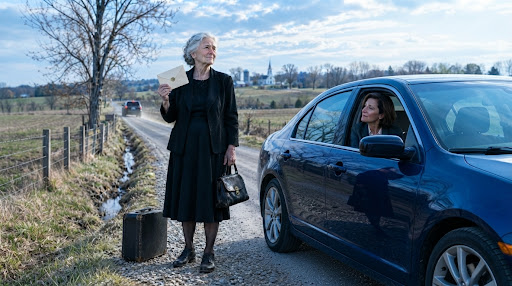
me beside a country road without a phone or money.
Now he seemed offended that I had found my way back.
“Good morning, Daniel.”
His eyes dropped to my dusty black shoes.
Then he looked at Mary.
“What’s going on?”
Mary pulled out a chair for me.
“Please sit down, Mrs. Harrison.”
I sat.
Daniel’s jaw tightened.
“Mrs. Harrison? Since when do you call my mother that?”
“Since I began representing her independently in matters concerning her property and business interests.”
Ashley stepped into the room behind him.
Her face went pale when she saw me.
“Mom?”
I looked at my daughter.
She had watched her brother leave me on that road.
She had said nothing.
And now she looked as though she had seen a ghost.
“Hello, Ashley.”
Daniel slammed his briefcase onto the table.
“Can somebody explain what this ridiculous meeting is about?”
The chairman, Thomas Whitaker, slowly stood.
“Daniel, your father established a succession plan before his death. The board is meeting to implement it.”
Daniel laughed.
“Dad already told me I’d be running the company.”
“Running the company,” Thomas replied, “is not the same as owning it.”
The room fell silent.
I watched my son process those words.
Then he turned toward me.
“Mom, tell them.”
“Tell them what?”
“That Dad wanted me to have the business.”
I folded my hands.
“Your father wanted you to earn the responsibility of running it.”
Daniel shook his head.
“That’s the same thing.”
“No, sweetheart. It isn’t.”
Six weeks before Robert died, he called me into his study.
By then, his illness had weakened him terribly.
He’d lost weight.
His hands trembled when he held his coffee.
Some mornings, he could barely walk from the bedroom to the kitchen without stopping.
But his mind remained sharp.
And he had begun noticing things.
Missing financial reports.
Unusual vendor payments.
Employees who suddenly stopped speaking whenever Daniel entered a room.
One evening, Robert asked me to close the study door.
“There’s something I need to show you, Ellen.”
That is my name.
Ellen Harrison.
For forty-two years, I had been Robert Harrison’s wife.
And for most of those years, I’d been the person who kept our family together while he built Harrison Industrial Supply from a rented warehouse into a regional distribution company.
Robert slid a folder across his desk.
Inside were copies of bank transfers.
I recognized the company accounts.
But not the recipients.
“What is this?”
“Payments Daniel approved.”
I studied the figures.
Eighteen thousand dollars.
Twenty-six thousand.
Forty-one thousand.
Several payments to a consulting company I’d never heard of.
“Who owns this company?”
Robert looked at me.
“That’s what Harold is investigating.”
My stomach tightened.
“Do you think Daniel is stealing?”
Robert closed his eyes.
“I think our son has convinced himself that everything I built already belongs to him.”
I sat down.
For several minutes, neither of us spoke.
Then Robert reached across the desk and took my hand.
“Ellen, promise me something.”
“What?”
“If I go before you, don’t let grief make you surrender everything.”
I began crying.
“Robert, please don’t talk like that.”
He squeezed my fingers.
“Listen to me. I know Daniel. I know how impatient he’s become. And I know Ashley has started treating our home like an asset waiting to be divided.”
I shook my head.
“They’re our children.”
“I know.”
His voice broke.
“That’s what makes this so difficult.”
The next morning, Mary Caldwell came to our house.
So did Harold Benson.
And Thomas Whitaker.
They spent nearly four hours in Robert’s study.
I learned that Robert had already begun restructuring the company’s ownership.
Years earlier, we had transferred our shares into a family trust for estate planning purposes.
But the trust documents had been written when our children were young.
Robert worried that Daniel would exploit the confusion surrounding his death to claim authority he didn’t possess.
So, with independent legal advice, we updated the trust and company governance documents.
Robert’s interests would remain under the trust’s control after his death.
I would serve as the controlling trustee during my lifetime.
Daniel would remain an employee, subject to the same standards as other executives.
He would not automatically become the owner.
And the board would retain authority over executive appointments.
There was another provision.
One that Robert insisted upon.
If Daniel attempted to coerce me into surrendering property, misrepresented his authority, or engaged in serious misconduct, the trustees could suspend his access to company systems and recommend his removal from management pending investigation.
The documents did not depend on a single sentence spoken beside a country road.
They depended on evidence, formal authority, and the procedures Robert had carefully established.
Mary had explained that to us.
Robert understood.
And so did I.
But we also made a separate arrangement.
If I ever felt threatened or abandoned by our children, I could contact Mary through a private number.
She would help me get somewhere safe.
She would not need Daniel’s permission.
Or Ashley’s.
Or anyone else’s.
The envelope in my purse contained copies of those instructions, my identification, and a signed statement confirming my wishes.
I had carried it since Robert’s funeral.
Not because I wanted to use it.
Because Robert had made me promise I would be prepared.
Back in the conference room, Mary finished explaining the succession documents.
Daniel stared at her.
“That’s impossible.”
She placed a certified copy of the trust amendment before him.
“You may have your attorney review it.”
He snatched it from the table.
Ashley leaned over his shoulder.
I watched their eyes move across the page.
Then Daniel looked up.
“Mom controls the trust?”
Thomas nodded.
“Yes.”
“And the board can remove me?”
“Subject to the company’s governing documents and applicable procedures, yes.”
Daniel laughed bitterly.
“Dad was sick when he signed this.”
Mary’s expression hardened.
“Your father had independent legal counsel and a physician’s assessment of his decision-making capacity. The execution was properly documented.”
Daniel looked at me.
“You did this.”
I felt the old instinct rise.
The instinct to soften my words.
To reassure him.
To make him feel better.
But I remembered the gravel beneath my shoes.
The door closing.
His SUV disappearing around the bend.
“No, Daniel. Your father and I did this together.”
His face twisted.
“You manipulated him.”
I stood.
“Don’t you dare.”
The words came out louder than I intended.
Everyone went still.
I looked directly at my son.
“Your father spent his last weeks worrying about whether you would destroy the business he spent his life building. He should have been resting. He should have been holding my hand and remembering our forty-two years together.”
My throat tightened.
“Instead, he was protecting me from our own children.”
Ashley began crying.
Daniel looked away.
Harold Benson opened another folder.
“There’s also the matter of the consulting payments.”
Daniel stiffened.
“What payments?”
Harold slid a spreadsheet across the table.
“Payments totaling two hundred and eighty-four thousand dollars over fourteen months.”
Daniel’s eyes narrowed.
“Those were legitimate business expenses.”
“Then you’ll have no difficulty providing the contracts, deliverables, and supporting records.”
“I already did.”
Harold shook his head.
“The documents provided so far don’t adequately explain the payments.”
Thomas leaned forward.
“Daniel, an independent review has been authorized.”
My son stood abruptly.
“This is a setup!”
Mary remained calm.
“You’ll have an opportunity to respond to the findings.”
He pointed at me.
“She’s doing this because she’s angry!”
I stared at him.
“Angry?”
He laughed.
“Because of this morning. You’re upset that I told you the truth about the house.”
I felt my stomach turn.
“The truth?”
“That you can’t stay there forever!”
I looked around the table.
Then back at him.
“Daniel, you told me the house and business were yours. You left me beside a road with no way to get home.”
He shrugged.
“You needed a reality check.”
For a moment, nobody moved.
Then Thomas spoke.
“Daniel, are you saying you deliberately left your mother on a remote road?”
Daniel hesitated.
Ashley stared at the floor.
“It wasn’t remote,” he muttered.
I looked at him.
“How far was the nearest house?”
He said nothing.
“How far, Daniel?”
“Maybe four miles.”
“And did you know I had no phone?”
Silence.
“Did you know I had no cash?”
He looked away.
I nodded slowly.
“Thank you. That’s all I needed to hear.”
The board recessed the meeting.
Mary accompanied me to a small office overlooking the parking lot.
I sat beside the window.
My hands had finally begun trembling.
Mary poured me water.
“You did well.”
I shook my head.
“I don’t feel like I did.”
She sat opposite me.
“How do you feel?”
I stared at the paper cup.
“Like I buried my husband twice.”
Mary said nothing.
“Once at the cemetery. And again this morning, when I realized our son had become someone Robert wouldn’t recognize.”
Tears slid down my face.
Mary reached across the desk.
“Ellen, Robert knew Daniel was struggling with entitlement and dishonesty. But he never stopped hoping he’d change.”
I wiped my cheeks.
“Neither did I.”
She nodded.
“Hope doesn’t require you to give him control.”
I looked at her.
That sentence settled somewhere deep inside me.
For years, I’d confused loving my children with protecting them from every consequence.
When Daniel failed a college course, I called the professor.
When he damaged his first car, Robert paid for the repairs.
When he made poor investments, we helped him recover.
Every time, we told ourselves we were giving him another chance.
But perhaps we’d been teaching him something else.
That mistakes were temporary.
That consequences were negotiable.
And that his parents would always absorb the damage.
When the meeting resumed, Thomas announced that Daniel would be placed on administrative leave while the financial review continued.
His company access would be suspended.
He would receive written notice of the process and an opportunity to respond.
Daniel stared at the chairman.
“You can’t do this.”
Thomas folded his hands.
“The board has voted.”
Ashley turned toward me.
“Mom, please.”
I looked at her.
“Please what?”
“Don’t let them destroy Daniel’s career.”
I stared at my daughter.
Then I asked the question I’d been holding since the roadside.
“Ashley, when your brother told me to get out of the car, why didn’t you say anything?”
She began crying.
“I didn’t know what to do.”
“You could have told him to stop.”
She looked down.
“You could have opened your door and come with me.”
Her shoulders shook.
“You could have called someone.”
“Mom—”
“But you sat there.”
She covered her face.
I felt tears rising again.
“That’s what I can’t understand.”
Daniel grabbed his briefcase.
“This family is finished.”
I looked at him.
“No, Daniel. This is what happens when you mistake a family for something you can own.”
He walked out.
Ashley followed.
And the conference room doors closed behind them.
For the first time in decades, I did not chase either of my children.
But I had no idea that the most painful discovery was still waiting for me.
Because when Harold opened the final folder, he revealed that Daniel hadn’t merely been planning to take over the company.
He had already tried to use my husband’s death to take our home.
PART 4
Harold placed a copy of a property document in front of me.
I recognized our address immediately.
Thirty-two years.
That was how long Robert and I had lived there.
Every Christmas morning.
Every birthday.
Every argument and reconciliation.
Every ordinary Tuesday when life felt so predictable that I never imagined I would one day be fighting to keep it.
I stared at the document.
“What is this?”
Mary leaned closer.
“It’s a proposed deed transferring the house into a company controlled by Daniel.”
My stomach dropped.
“Proposed?”
“Yes. It hasn’t been recorded as a completed transfer. But the supporting paperwork raises serious concerns.”
I looked at the signature line.
My name appeared there.
Ellen Harrison.
The letters were shaped almost correctly.
Almost.
But whoever had written them had made one mistake.
I always crossed the second letter of my surname with a slight upward stroke.
Robert used to tease me about it.
He said my signature looked like it was trying to climb a hill.
The signature on that page was smooth.
Perfect.
And completely wrong.
“I didn’t sign this.”
Mary nodded.
“We suspected that.”
I looked at the date.
February 11.
Three days after Robert and I signed our updated documents.
He had still been alive.
Still in our house.
Still struggling to breathe.
And Daniel had apparently been preparing to transfer our home.
I felt physically sick.
“Does this mean he tried to steal the house?”
Mary spoke carefully.
“It suggests an attempted unauthorized transfer. We need to establish who prepared the paperwork, how the signature appeared, and whether anyone submitted it.”
I stared at the page.
Then I whispered, “Robert knew.”
Mary looked at me.
“He suspected something.”
I shook my head.
“No. That’s why he kept asking me whether I’d checked the locks.”
She frowned.
“What do you mean?”
During Robert’s final month, he developed a strange habit.
Every evening, he asked whether the doors were locked.
Not because he feared burglars.
Because he feared our son would come into the house while we were sleeping.
At the time, I’d assumed illness had made him anxious.
Now I understood.
He’d been afraid someone would take advantage of us when we were most vulnerable.
Mary arranged for me to stay at a small furnished apartment while the situation was reviewed.
It was above a bookstore in the older part of town.
The apartment had two bedrooms, a narrow kitchen, and windows overlooking a courtyard filled with flowering trees.
It wasn’t luxurious.
But the first night, I slept without worrying that someone would enter my bedroom and demand I sign something.
The next morning, I woke to sunlight and birdsong.
For a moment, I reached toward Robert’s side of the bed.
Empty.
The grief hit me so hard I couldn’t breathe.
I sat on the edge of the mattress and cried.
Not the careful tears I’d shed at the funeral.
Not the quiet tears I’d swallowed in front of Daniel.
I cried until my chest hurt.
Then I washed my face.
Made coffee.
And called Mary.
“I want to go home.”
She paused.
“We can arrange that.”
“Not someday. As soon as it’s safe.”
“Understood.”
I looked around the apartment.
“And Mary?”
“Yes?”
“I want every document reviewed. Every account. Every transfer. Everything.”
Her voice softened.
“That’s exactly what we’re doing.”
Over the next several weeks, the investigation uncovered a pattern I could barely comprehend.
Daniel had been using his position at Harrison Industrial Supply to approve questionable payments to a consulting firm.
The firm was connected to an old business associate of his.
Investigators found records suggesting some of the money had been used to cover Daniel’s personal debts.
There were also communications discussing a plan to sell one of the company’s warehouses.
Daniel had described the proceeds as money that would become available once Robert was gone.
Once Robert was gone.
I stared at those words for a long time.
My husband had been dying.
Our son had been calculating.
And I had been sitting beside Robert’s hospital bed, holding his hand, believing our children would help me survive the worst loss of my life.
Instead, they were discussing property.
Ashley called me eleven days after the board meeting.
I almost didn’t answer.
But I did.
“Hello?”
“Mom?”
Her voice sounded small.
“Hello, Ashley.”
She began crying.
“I’ve been trying to reach you.”
“I know.”
“Can we talk?”
I looked out the window.
“About what?”
She hesitated.
“About that morning.”
I waited.
“Daniel told me we were taking you to an assisted-living facility.”
I closed my eyes.
“He told me you’d agreed to look at one.”
I said nothing.
“When he turned onto that road, I thought he was taking a shortcut.”
I remembered her fingers tightening around her phone.
“Then why didn’t you stop him when he told me to get out?”
She began sobbing.
“I was scared.”
“Of what?”
“Of losing everything.”
The answer stunned me.
“What everything?”
She hesitated.
Then whispered, “Daniel said if I didn’t support him, he’d make sure I got nothing from Dad’s estate.”
I sat very still.
“Ashley, did you know your father and I had already arranged our estate?”
“No.”
“Did you know Daniel had no authority to divide my property?”
She began crying harder.
“He told me he controlled the trust.”
I closed my eyes.
And there it was.
The truth.
Daniel had been manipulating his sister too.
But that didn’t erase her choice.
“Ashley,” I said, “you watched me standing beside that road.”
“I know.”
“You saw that I had no phone.”
“I know.”
“You saw him drive away.”
Her voice broke.
“I know, Mom.”
I swallowed.
“And you stayed in the car.”
Silence.
Finally, she whispered, “I’m sorry.”
I believed she was sorry.
But I also knew something important.
An apology is the beginning of accountability.
Not the end.
Two months later, I returned home.
Mary came with me.
So did a locksmith.
Not because Daniel owned the house.
He didn’t.
But because he had previously held keys and access codes, and I wanted to secure my home.
The property records had been checked.
The disputed deed had not transferred ownership.
The house remained protected under the arrangements Robert and I had established.
I stood on the porch for several minutes before unlocking the door.
The brass handle felt cold beneath my palm.
Inside, the house smelled stale.
Someone had moved the furniture.
Robert’s recliner was gone.
The photographs had been taken off the mantel.
And the dining table was covered with boxes.
I stared at the room.
“Where’s his chair?”
Mary looked around.
“We’ll find out.”
My hands began trembling.
“That was Robert’s chair.”
I walked toward the empty corner.
For twenty years, he’d sat there every Sunday afternoon.
He’d watched football.
Read newspapers.
Fallen asleep with his glasses slipping down his nose.
Sometimes I’d complain that he spent too much time in that chair.
Now I would have given anything to see him sitting there again.
I sank onto the sofa.
And cried.
The next day, Mary contacted Daniel’s attorney.
The chair was returned three days later.
So were several boxes of photographs, documents, and personal belongings.
Daniel claimed he’d moved them into storage while preparing the house for sale.
A sale I had never authorized.
When the delivery men carried Robert’s recliner into the living room, I touched the worn leather armrest.
Then I sat down.
For a moment, I could almost hear him.
The ground’s trying again, Ellen.
I closed my eyes.
“Yes, sweetheart,” I whispered. “I think it is.”
The financial review eventually resulted in Daniel’s dismissal from Harrison Industrial Supply.
The board concluded that his conduct had violated company policies and fiduciary obligations.
Civil proceedings were initiated to recover company funds.
The disputed property documents and financial records were also referred to the appropriate authorities.
I won’t pretend everything was resolved overnight.
There were lawyers.
Hearings.
Statements.
Months of uncertainty.
But I refused to withdraw legitimate claims simply because Daniel was my son.
For too long, I had believed that protecting him meant shielding him from consequences.
Now I understood that doing so had helped him become the man who abandoned his grieving mother beside a road.
I couldn’t change the past.
But I could stop repeating it.
Six months after Robert’s death, Daniel appeared at my front door.
I saw him through the window.
He looked thinner.
His expensive clothes were gone.
He wore an ordinary blue shirt and dark trousers.
I opened the door but didn’t invite him inside.
“Mom.”
“Daniel.”
He swallowed.
“Can we talk?”
I looked at him.
“Your attorney knows how to contact mine about the business matters.”
He shook his head.
“This isn’t about the company.”
I waited.
He looked down.
“I’ve been thinking about that day.”
I felt my chest tighten.
“Which day?”
“The road.”
I said nothing.
He swallowed.
“I keep seeing you standing there.”
I watched him carefully.
He continued.
“I told myself I was doing what needed to be done. That you were making everything difficult. That Dad wanted me to take charge.”
His eyes filled.
“But I knew you were grieving.”
I nodded slowly.
“And?”
He began crying.
“And I left you there anyway.”
For several seconds, neither of us spoke.
Then he whispered, “I don’t know how I became that person.”
I looked at my son.
The boy who once cried when he found an injured bird.
The teenager who used to bring me wildflowers.
The young man who’d hugged Robert after graduating from college.
Somewhere along the way, entitlement had crowded out gratitude.
And greed had replaced responsibility.
“I don’t know either, Daniel.”
He wiped his eyes.
“Can you forgive me?”
I looked toward the empty driveway.
I remembered standing in the dust.
The SUV disappearing.
The terrible silence.
Then I looked back at him.
“Forgiveness may come someday.”
His face crumpled.
“But trust will take longer.”
He nodded.
“I understand.”
I wasn’t sure he did.
Not yet.
But for once, he didn’t argue.
Ashley began visiting me on Sunday afternoons.
At first, our conversations were awkward.
She brought groceries.
Helped with the garden.
Sat beside me while I sorted Robert’s photographs.
Sometimes we talked about him.
Sometimes we said nothing.
One afternoon, she found a photograph of herself at eight years old, sitting on Robert’s shoulders.
She stared at it.
“Dad looks so happy.”
I smiled.
“He was.”
She began crying.
“I miss him.”
“So do I.”
She looked at me.
“Mom, I should have gotten out of the car.”
I folded the photograph into my lap.
“Yes, Ashley. You should have.”
She nodded through her tears.
“I know.”
I reached for her hand.
It was the first time since the funeral that I had done so.
I didn’t tell her everything was fine.
It wasn’t.
But I let her hold my hand.
And sometimes that is how healing begins.
The following spring, Harrison Industrial Supply celebrated its forty-fifth anniversary.
Thomas invited me to speak at the company gathering.
I almost declined.
The warehouse held too many memories.
Robert’s laughter.
His muddy boots.
His coffee cup balanced on a stack of invoices.
The way he’d walk through the loading dock greeting employees by name.
But then I thought about the people who’d worked beside him.
Some for decades.
People who had helped build the company.
People who had families depending on it.
So I went.
When I entered the warehouse, everyone stood.
I wasn’t expecting that.
For a moment, I stopped walking.
Then applause filled the room.
I covered my mouth.
Thomas approached and offered his arm.
“Welcome home, Ellen.”
I began crying.
He guided me toward the podium.
Behind him hung an enormous photograph of Robert.
My husband stood in front of the company’s first delivery truck, smiling beneath a faded baseball cap.
I stared at the photograph.
Then I began speaking.
“Forty-five years ago, my husband started this business with a borrowed truck, a rented warehouse, and more determination than common sense.”
The employees laughed.
I smiled.
“He believed that if you treated people fairly, paid your bills, and worked hard enough, you could build something worth keeping.”
My voice trembled.
“Robert wasn’t perfect. Neither was I. We made mistakes. We worried. We argued. We sometimes wondered whether we’d survive another year.”
I looked around the room.
“But he believed this company belonged to more than one family’s ambitions.”
Several employees nodded.
“He believed it carried responsibilities to everyone who depended on it.”
I paused.
“And that’s why I’m announcing something today.”
Thomas smiled.
I took a breath.
“We’re establishing the Robert Harrison Employee Education Fund.”
Applause began.
I continued.
“The fund will help employees and their children pursue vocational training, college education, and professional development.”
My eyes filled.
“Robert believed opportunity should be earned, but he also believed people deserved a fair chance to earn it.”
I looked at his photograph.
“And I think he would have liked this.”
The applause grew louder.
For the first time since his death, I felt something other than grief when I thought about the company.
I felt pride.
Later that afternoon, Thomas handed me a small wooden box.
“We found this in Robert’s old office.”
I opened it.
Inside was his first company badge.
A photograph of us on our wedding day.
And a folded piece of paper.
My hands trembled as I unfolded it.
It was written in Robert’s familiar handwriting.
Ellen,
If you’re reading this, I’m probably not around to tell you how stubborn you’ve always been.
I laughed through my tears.
You spent your life making sure everyone else had what they needed. The children. The employees. Me.
But I need you to promise something.
Don’t spend whatever years you have left asking permission to live them.
The house is your home.
The company is part of our story.
And your life still belongs to you.
If the children forget that, remind them.
If they refuse to listen, keep living anyway.
I loved you when we had nothing.
I loved you when we built something.
And I would love you just as much if tomorrow all we had left was a little house, two chairs, and coffee on the porch.
Forever yours,
Robert.
I pressed the letter against my chest.
And cried harder than I had at the funeral.
Because somehow, even after death, my husband had found a way to remind me that I was more than what I could give other people.
Two years have passed since Daniel left me beside that road.
I’m seventy-one now.
My hair is almost completely white.
My knees complain when I climb the stairs.
And sometimes I still reach for Robert in the middle of the night.
Grief doesn’t disappear.
It simply learns to live beside you.
Ashley and I have slowly rebuilt our relationship.
She visits regularly.
She listens more.
And she no longer assumes that being my daughter gives her authority over my decisions.
Daniel’s legal and financial matters have taken longer to resolve.
He has made restitution payments under an agreement reached through the appropriate proceedings.
He works now.
Not in a corner office.
Not with a company car.
He works for a smaller distribution business, where he is learning responsibilities he once believed were beneath him.
We speak occasionally.
Sometimes we meet for lunch.
I still love him.
But he has no access to my finances.
No authority over my home.
And no expectation of inheriting control of the company.
Those boundaries remain.
Last Sunday, Daniel came over to help repair the back porch steps.
He arrived carrying a toolbox.
No demands.
No paperwork.
No speeches about what he deserved.
He worked for nearly three hours.
When he finished, we sat on the porch with coffee.
For a while, neither of us spoke.
Then he looked across the yard.
“Dad used to sit here every morning.”
I smiled.
“Yes.”
Daniel stared at the fields.
“I remember him saying something about the ground after winter.”
My eyes filled.
“The ground’s trying again.”
He smiled faintly.
“That’s it.”
We sat quietly.
Then he looked at me.
“Mom?”
“Yes?”
“I know I can’t undo what I did.”
I nodded.
“No, you can’t.”
He swallowed.
“But I’m going to spend the rest of my life trying to be someone who would never do it again.”
I looked at him for a long moment.
Then I said, “That’s the first promise you’ve made that I truly hope you keep.”
He nodded.
And we watched the sun disappear behind the trees.
People sometimes ask why I didn’t simply forgive my children and put everything behind us.
I tell them forgiveness and access are not the same thing.
You can love someone without giving them the keys to your house.
You can wish someone well without giving them control of your money.
You can accept an apology without pretending the betrayal never happened.
And you can be a mother without surrendering your dignity.
For most of my life, I believed keeping my family together meant holding on tighter.
But that morning on the country road taught me something I wish I’d understood sooner.
Sometimes the people you love most are the ones you must stop rescuing.
Sometimes the door you need to close is the one you’ve spent years holding open.
And sometimes the moment someone believes they’ve abandoned you is the moment you finally discover how much strength you still have.
I still remember the sound of Daniel’s SUV disappearing around that bend.
The gravel beneath my shoes.
The dust against my stockings.
The unfamiliar suitcase.
The silence.
I remember thinking my son had taken everything.
My home.
My security.
My family.
My future.
But he hadn’t.
He had taken away one illusion.
The illusion that love guaranteed loyalty.
The illusion that sacrifice guaranteed gratitude.
The illusion that motherhood required me to accept whatever treatment my children chose to give me.
And in losing those illusions, I found something I hadn’t realized was missing.
Myself.
Robert knew I would need help finding my way back.
That’s why he insisted we update the trust.
That’s why he made sure Mary had a plan.
That’s why he left instructions that protected my choices rather than surrendering them to our children.
But even Robert couldn’t make the most important decision for me.
I had to make it myself.
I had to decide that I was worth protecting.
This morning, I stood on the back porch with my coffee.
The air smelled of wet earth.
A soft breeze moved through the fields.
And somewhere in the distance, birds were beginning to sing.
I looked at the repaired steps.
At the garden Ashley helped me plant.
At the warehouse roof visible beyond the trees.
And at the empty chair beside mine.
I smiled through my tears.
“The ground’s trying again, Robert.”
Then I lifted my coffee cup toward the morning sky.
“And so am I.”
Because the day my son abandoned me beside that road was not the day I lost everything.
It was the day I discovered that my husband had protected our legacy, that my children did not own my future, and that I still had the power to choose the life I wanted.
My son told me the house and business were his.
But the truth was simpler.
The house was still my home. The business was still our legacy. And my life had always belonged to me.
THE END THANK YOU FOR READING !!!



