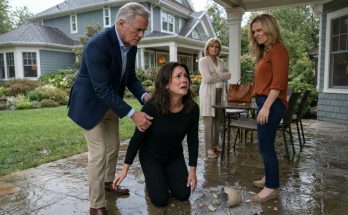
The first sound I heard inside my house was my mother screaming.
Not calling my name.
Not crying from confusion.
Screaming.
I had imagined coming home quietly, surprising my wife, Vanessa, after eight months in Saudi Arabia.
I had imagined dropping my suitcase by the foyer table, walking into the kitchen,
and seeing my mother in her wheelchair with tea in her hands while Vanessa pretended she had not missed me.
I had imagined normal things.
Instead, the house smelled like lemon polish, stale flowers, and fear.
My suitcase hit the marble floor.
The sound echoed once through the foyer.
Then my mother screamed again.
I ran toward the kitchen.
What I saw there ended my marriage before I understood it had ended.
Vanessa stood over my seventy-eight-year-old mother with a wooden spoon raised like a weapon.
My mother was on the floor beside her overturned wheelchair, gray hair loose, one slipper missing,
one bruised hand gripping the tile as if the floor were the only thing still willing to hold her.
Between them crouched Elena, our twenty-six-year-old housekeeper.
She had put her own body over my mother’s.
Blood ran from a cut above Elena’s eyebrow, down her cheek, and onto the pale blue collar of her uniform.
Her arm was spread across my mother’s shoulders.
She was shaking.
She did not move away.
“Stop!” I thundered.
Vanessa turned slowly.
For one second, I saw the real expression.
Terror.
Then the mask came down.
She smiled.
“Daniel, darling,” she said. “You’re home early.”
She lowered the spoon as if she had been caught stirring soup too loudly.
“Your mother had another tantrum. I was only teaching her a lesson.”
My mother gripped Elena’s sleeve.
Her hands shook so badly the fabric moved with them.
“She locks me in my room,” Mom whispered.
Vanessa laughed.
“She’s confused. You know how old people get.”
I had spent fifteen years designing industrial surveillance networks for refineries, shipping facilities, and private compounds.
I had seen people lie through access logs.
Through timestamps.
Through carefully edited camera feeds.
Still, nothing prepares you for watching your own wife stand above your injured mother and attempt to rename abuse as care.
I wanted to break something.
I wanted to put my fist through the cabinet.
I wanted to grab the spoon from Vanessa’s hand and make her understand the terror she had been spreading in my home.
Instead, I took out my phone and called emergency services.
That decision saved me later.
It kept the first official record clean.
Emergency call.
Time.
Injuries.
Scene.
Vanessa’s smile vanished.
“You’re embarrassing me.”
“No,” I said quietly. “You did that yourself.”
The kitchen became still.
The wheelchair’s wheel kept turning slowly beside my mother, ticking against the tile with every weak rotation.
A glass of water sat spilled under the table.
A medication bottle had rolled near the pantry.
Elena kept her body between Vanessa and my mother.
Even injured, she did not trust my wife to step closer.
That told me more than any explanation could have.
Paramedics arrived within minutes.
One knelt beside my mother.
Another examined Elena’s head.
Vanessa immediately changed tone.
She began speaking to them in that smooth, wounded voice she used at charity dinners and company functions.
“My mother-in-law has been declining,” she said. “She gets agitated. She fell, and the maid overreacted.”
The maid.
Not Elena.
Not the woman bleeding because she had protected my mother.
The maid.
Elena looked at me from the ambulance doorway while a paramedic pressed gauze to her eyebrow.
“Please check the blue sewing box in your mother’s closet,” she said.
Vanessa heard her.
She lunged forward.
A paramedic blocked her.
That was when I knew there was evidence.
And that was when I knew Vanessa knew it too.
Before I left for Saudi Arabia, my mother had moved in after a minor stroke.
It was not a devastating stroke.
It was small enough for doctors to speak hopefully, serious enough that she needed help with mobility, medication, bathing, and meals.
My mother had always been independent.
She hated the wheelchair at first.
She hated needing help even more.
But she loved me enough to accept it because I promised her she would not be a burden.
Vanessa performed support beautifully in those first weeks.
She arranged flowers in Mom’s room.
She bought soft blankets.
She told friends we were all adjusting as a family.
When people visited, she touched my mother’s shoulder and spoke gently.
After they left, her voice changed.
I noticed small things before I left.
I noticed Mom becoming quiet when Vanessa entered the room.
I noticed Elena watching doorways.
I noticed Vanessa’s irritation whenever I asked for updates.
So I hired Elena.
She was twenty-six, recommended by a colleague whose aunt had needed post-surgical care.
Elena was not a nurse, but she was patient, careful, and observant.
She cooked simple meals, helped with bathing, cleaned, and kept a notebook of medications.
Vanessa hated the notebook.
She said it made the house feel like a clinic.
I told her documentation helped me while I was overseas.
She said I trusted strangers more than my wife.
That sentence worked on me for a while.
Guilt often does.
I was leaving for eight months to supervise a refinery project in Saudi Arabia, and Vanessa made sure I felt the selfishness of that departure.
“You get to build your career,” she said. “I get trapped with your mother.”
I offered to arrange full-time care.
She refused.
I offered to move Mom temporarily to a reputable assisted living facility.
She cried and said I was abandoning family.
I offered to delay the project.
She told me not to sabotage our finances.
Every option became evidence against me.
So I did what I knew how to do.
I built a system.
Before I left, I upgraded the house security.
Visible cameras in common areas.
Door sensors.
A cloud archive.
Remote access.
Vanessa mocked me.
“This is not one of your oil facilities,” she said.
She did not know the visible cameras were not the real system.
The visible system was for deterrence.
The hidden system was for truth.
Small pinhole cameras in common areas.
Encrypted recordings.
Automatic upload to a private server under my control.
Tamper alerts routed through a separate application.
The system was legal because it covered common areas in my own home, not bathrooms or private changing spaces.
I told Vanessa the house was monitored.
I did not tell her every technical detail.
Three months after I left, she told me the cameras made my mother anxious.
She said Mom kept staring at them.
She said the wall monitor upset her.
She had the visible cameras removed.
I received the tamper notice.
I called Vanessa.
She was offended before I even asked.
“Your mother deserves dignity,” she said.
That word.
Dignity.
Cruel people love stealing the language of care.
I checked the hidden system that night.
It was still live.
I did not watch the footage then.
I should have.
That regret will never completely leave me.
In Saudi Arabia, the days were brutal and long.
Heat shimmered above metal.
Meetings began before sunrise and ended after dark.
I called home when I could.
Vanessa always answered near my mother’s door, never beside her.
Mom sounded tired.
Elena’s messages were brief.
Medication given.
Meal completed.
Physical therapy exercises attempted.
Mom slept poorly.
Mom asked for you.
Once, Elena wrote, “Your mother seems afraid of upsetting Mrs. Vanessa.”
I called immediately.
Vanessa answered.
She said Elena was dramatic.
She said young workers invented problems to feel important.
She said my mother had been crying because she missed me.
I wanted to believe that.
Not because it made sense.
Because believing it allowed me to stay where duty and money had put me.
Then the refinery project finished early.
I did not tell Vanessa.
I wanted to surprise her.
The surprise was mine.
At the hospital that night, the emergency doctor documented everything.
Bruising across my mother’s upper arms.
Dehydration.
Low blood pressure.
Poor nutrition.
An untreated wrist fracture already beginning to heal incorrectly.
Elena needed six stitches above her eyebrow.
The doctor asked questions.
My mother cried through some answers and whispered through others.
“She locked the door,” Mom said.
“When?”
“When Daniel called. When guests came. When I cried.”
Vanessa paced the hallway, making phone calls in a low, furious voice.
I did not speak to her.
Not yet.
I sat beside my mother until she slept.
Then I opened my laptop.
The hospital waiting room was bright, cold, and too quiet.
Elena sat across from me with a bandage over her eyebrow.
She looked exhausted.
I asked about the blue sewing box.
She told me my mother had hidden things there when Vanessa began searching drawers.
“Elena,” I said, “what is in it?”
“Receipts,” she whispered. “Notes. And a card.”
“What card?”
“A memory card. From my old phone. I copied what I could.”
I drove home with a police officer beside me because the hospital social worker had already made a report concerning elder abuse.
That was the first official door opening.
At the house, I went straight to my mother’s closet.
The blue sewing box sat behind folded blankets.
My mother had used it for years.
Inside were buttons, thread, old needles, and the evidence of a life no one was supposed to search.
Pharmacy receipts.
A torn bank withdrawal slip.
Two handwritten notes in my mother’s shaky hand.
Daniel, she takes my phone at night.
Daniel, please believe Elena.
And a tiny memory card wrapped in tissue.
My hands went cold.
Back at the hospital, I plugged the card into my laptop first.
The first video was shaky.
Elena must have recorded it from behind a half-open laundry room door.
Vanessa stood in the kitchen with Richard Hale, my accountant.
Richard had handled personal tax filings, investment reports, and household vendor payments for years.
I trusted him because he was boring.
That is how some thieves survive.
They cultivate dullness until suspicion slides off them.
In the video, Richard held my mother’s bank card.
Vanessa stood beside him with a glass of wine.
My mother sat in her wheelchair near the pantry door, silent.
Richard said, “If Daniel asks, these are care expenses.”
Vanessa laughed.
“Daniel asks from Saudi Arabia. He doesn’t see anything.”
Elena’s breathing shook behind the phone.
The video ended.
I opened the next one.
Richard was counting withdrawal slips.
Vanessa was telling my mother to sign a paper.
Mom refused.
Vanessa leaned down so close their faces nearly touched.
“If you make this difficult,” she said, “I’ll tell Daniel you’re getting violent again.”
Again.
I paused the video.
Elena looked down.
“She said your mother hit her,” she whispered. “She said she could have her placed somewhere.”
I opened the private server archive next.
One hundred and twelve days of footage.
The first clips were ordinary.
Meals.
Medication.
Elena helping Mom transfer from wheelchair to chair.
Vanessa walking through rooms with her phone in hand.
Then the pattern emerged.
Vanessa restricting food when Mom “complained.”
Vanessa taking Mom’s phone before my scheduled calls.
Vanessa telling Elena she would report her immigration status if she interfered.
Elena quietly bringing extra water.
Elena adjusting pillows.
Elena writing medication times in the notebook after Vanessa threw it away.
The footage became harder to watch.
I watched anyway.
At 9:13 p.m. on a Tuesday, Vanessa locked my mother’s bedroom door from the outside.
At 6:22 a.m. the next morning, Elena unlocked it with a small tool and brought water.
At 4:08 p.m. another day, Richard arrived with documents.
At 4:31 p.m., my mother signed something while crying.
At 4:36 p.m., Vanessa took the pen from her hand and said, “That was not so hard.”
Forensic proof has a brutality emotion does not.
You cannot bargain with timestamps.
You cannot tell a judge a locked door was a misunderstanding when the recording shows your hand turning the key.
By dawn, I had copied everything to three drives.
I sent one encrypted archive to my lawyer.
One to the police detective assigned after the hospital report.
One stayed with me.
Then I went into Vanessa’s office.
I found more.
Credit card statements.
Cash withdrawals labeled as medical expenses.
Invoices from care services never hired.
Emails from Richard.
Draft documents authorizing transfers from my mother’s savings account.
A folder named HOME CARE.
Inside it was not care.
It was theft wearing the right filename.
At 8:05 a.m., I called the bank.
I froze joint discretionary accounts.
I froze Vanessa’s authorized access to household funds.
I removed Richard’s access pending investigation.
Then I called my lawyer and told him to begin divorce proceedings immediately.
Vanessa arrived at the hospital at 9:12 a.m.
She wore sunglasses.
She had changed clothes.
She carried flowers.
That nearly made me laugh.
Flowers.
As if this were a misunderstanding wrapped in lilies.
Security stopped her before she reached my mother’s room.
She saw me in the hallway.
“Daniel,” she said, removing the sunglasses. “We need to talk privately.”
“No.”
Her face tightened.
“You’re making a mistake.”
“I watched the footage.”
That sentence stripped the performance off her.
Only for a second.
But long enough.
“What footage?”
“The hidden cameras.”
She went still.
Then she smiled again, but it was not the same smile.
It had effort in it.
“You recorded me in my own home?”
“My home,” I said. “Common areas. After informing you there was surveillance.”
“She manipulated you,” Vanessa said, pointing toward Elena through the glass.
Elena sat beside my mother’s bed, reading softly from a magazine because Mom had asked her not to leave.
Vanessa saw where I was looking.
Her voice sharpened.
“You believe the maid over your wife?”
“I believe the blood on her face,” I said. “I believe my mother’s fracture. I believe the videos. I believe the bank records.”
She slapped me then.
In the hospital hallway.
In front of security.
It was almost helpful.
Cruelty, when cornered, often stops being strategic.
A guard stepped forward.
Vanessa began shouting.
She said I was unstable from travel.
She said Elena had seduced me.
She said my mother was senile.
She said Richard had only helped manage expenses.
She said many things.
The police said fewer.
They asked her to come with them for questioning.
She refused.
Then she tried to walk past them toward my mother’s room.
That was when they stopped asking.
The case did not move quickly.
People imagine justice as a door kicked open.
Most of the time, it is paperwork.
Hospital records.
Photographs.
Doctor statements.
Bank documents.
Surveillance clips.
Witness interviews.
Metadata verification.
Chain of custody.
A forensic accountant.
Richard tried to cooperate early.
Men like him often do when they realize they have chosen the wrong partner in crime.
He claimed Vanessa pressured him.
He claimed he believed the expenses were legitimate.
Then investigators found his percentage.
Transfers routed through a consulting account.
Cash withdrawals split.
Email threads with phrases like “keep Daniel out of this until quarter close.”
Richard stopped looking boring after that.
Vanessa’s attorney tried to argue caregiver stress.
That argument died under the weight of the footage.
Caregiver stress does not forge invoices.
Caregiver stress does not lock an elderly woman in her room.
Caregiver stress does not threaten a housekeeper, hide medication, and steal bank funds with an accountant.

My mother’s testimony was difficult.
She shook through most of it.
Elena sat outside the room during questioning because the detective wanted Mom’s statement without influence.
Mom told the truth.
Slowly.
Painfully.
She explained how Vanessa had begun by insulting her.
Then limiting phone calls.
Then meals.
Then medication.
Then movement.
“She said Daniel would not believe me,” Mom whispered. “She said I was old.”
The detective asked why she trusted Elena.
Mom looked through the glass toward the hallway.
“Because Elena came back,” she said.
That sentence stayed with me.
Elena came back.
When Vanessa shouted, Elena returned.
When doors were locked, Elena found ways to check.
When food was withheld, Elena brought water.
When threats escalated, Elena recorded what she could.
When the spoon came down, Elena put her body between Vanessa and my mother.
Bravery is not always loud.
Sometimes it is a young woman with no power deciding that an old woman on the floor will not be alone.
During the divorce proceedings, Vanessa tried one final performance.
She cried in court.
She said our marriage had become lonely.
She said my work overseas had abandoned her.
She said my mother’s needs overwhelmed her.
She said Elena had poisoned the household.
Then my lawyer played the kitchen footage from the day I came home.
The courtroom watched Vanessa raise the spoon.
Watched Elena shield my mother.
Watched the smile appear when Vanessa realized I had entered.
Darling, you’re home early.
Your mother had another tantrum.
I was only teaching her a lesson.
There are sentences that become tombstones for lies.
That was one of them.
The divorce was granted.
The criminal case continued.
Richard accepted a plea and testified.
Vanessa was convicted on charges related to elder abuse, assault, unlawful restraint, and financial exploitation.
The sentence did not return my mother’s health.
It did not erase Elena’s scar.
It did not give me back the months I should have watched sooner.
But it established something Vanessa had spent eight months denying.
What happened in my house was not family conflict.
It was abuse.
After Vanessa went to prison, the house changed.
Not immediately.
At first, every room felt contaminated.
My mother flinched at kitchen sounds.
She cried if a door clicked too loudly.
She asked for Elena even when I was beside her.
I did not resent that.
Elena had been there when I had not.
That truth was painful, but pain is not an excuse to reject reality.
I hired a full-time nurse.
Elena stayed, at first, only because my mother begged her to.
I offered her paid leave.
I offered therapy.
I offered to help her find work somewhere safer.
She listened politely, then said, “Mrs. Hart asked me to stay until she is not afraid at night.”
My mother’s name was Margaret Hart.
Most people called her Mrs. Hart.
Elena said it with tenderness.
Weeks became months.
My mother improved.
Her wrist was treated again, though it never fully regained strength.
Her weight stabilized.
Her voice returned.
She began sitting in the garden in the mornings.
Elena would bring tea, then pretend not to notice when Mom cried quietly into the cup.
I began therapy too.
I needed it more than I wanted to admit.
It is a particular kind of shame to be a man trained to detect system failures and still miss the failure inside his own home.
My therapist did not let me turn guilt into self-punishment.
“Guilt should create repair,” she said. “Not performance.”
So I repaired what I could.
I reduced travel.
I restructured my work.
I rebuilt my mother’s finances.
I testified.
I apologized without asking my mother to comfort me.
And slowly, Elena and I became something neither of us named.
At first, we talked about Mom’s medication.
Then about books.
Then about the small town where Elena grew up.
Then about my life before Vanessa, which felt strange to speak of because Vanessa had made so much of my adult life feel staged.
Elena never asked for anything.
That was one reason I was careful.
She had been my employee.
She had been vulnerable in my house.
She had saved my mother.
Gratitude can disguise itself as love if a person is careless.
So I was not careless.
When my mother no longer needed Elena daily, Elena left the position.
I helped her secure references for a caregiving role with an agency, though she later chose nursing school instead.
We did not date immediately.
Months passed.
We met for coffee once because my mother insisted on giving her a birthday gift and then pretended she had forgotten to come downstairs.
Elena laughed for the first time in my hearing without looking over her shoulder.
That sound did something to me.
Still, I waited.
Not because I doubted her.
Because I respected what she had survived.
When I finally told her I had feelings for her, I said it plainly and gave her room to refuse.
She was quiet for a long time.
Then she said, “I was afraid you only saw me as the person who saved your mother.”
“I do see that,” I said. “But not only that.”
She looked at me then.
Really looked.
Our relationship grew slowly.
Dinner.
Walks.
Long conversations.
Silences that were not frightening.
My mother noticed before either of us admitted it aloud.
She began asking Elena to stay for lunch when she visited.
Then she began asking me why I was wearing nicer shirts on Saturdays.
Mothers recover many things before doctors measure them.
Suspicion is one of them.
A year after Vanessa’s conviction, Elena and I married in a small ceremony.
No spectacle.
No grand ballroom.
My mother sat in the front row with a cane beside her chair and tears on her face.
Elena wore a simple ivory dress.
A faint scar still crossed the skin above her eyebrow.
When she walked toward me, I thought of the kitchen floor.
The overturned wheelchair.
The blood.
The spoon.
Then I thought of everything after.
The hospital.
The statements.
The mornings in the garden.
The careful rebuilding of a home that had almost become a crime scene forever.
People sometimes ask if it was strange to marry the woman who had once worked in my home.
The honest answer is yes.
Life after violence is full of strange things.
But strange is not the same as wrong.
Wrong was Vanessa smiling over my injured mother.
Wrong was Richard counting withdrawal slips in my kitchen.
Wrong was my mother believing I might not believe her.
Elena was never the wrong part of the story.
She was the person who came back.
Today, my mother keeps the blue sewing box on her dresser.
Not hidden anymore.
Inside are buttons, thread, and one small envelope.
The envelope contains copies of the first hospital report, the date of Vanessa’s arrest, and a photograph from our wedding.
My mother says it reminds her that evidence matters, but so does what happens after the evidence is believed.
The scar above Elena’s eyebrow has faded.
Not disappeared.
Faded.
Some marks stay because the body refuses to lie about what it survived.
Vanessa remains in prison.
Richard lost his license and his freedom for a time.
The money stolen from my mother was partially recovered through restitution and civil action.
The rest became an expensive lesson in vigilance, trust, and the danger of outsourcing attention to people who benefit from your absence.
I still travel for work, but never the same way.
No project gets unlimited access to my life.
No professional emergency outranks my mother’s safety.
No smooth voice gets to reinterpret fear without being questioned.
The hidden cameras recorded everything.
But the truth is, the cameras only did what I should have done sooner.
They watched.
Now I do.
And every time I come home, I listen carefully to the first sound inside the house.
Most days, it is my mother humming in the garden.
Some days, it is Elena laughing in the kitchen.
Those sounds are ordinary.
That is why I treasure them.