PART 3
I read the message once.
Then again.
Then a third time because my mind couldn’t make the words fit the family story I had been hearing for years.
The screenshot was from Grandma Ruth.
The date was eighteen months before her death.
The message was addressed to June.
It said:
“Please promise me you won’t let Paige believe she is entitled to Megan’s house.
I know what she has been saying.
The house belongs to Megan, and I have never promised it to Paige.”
I stared at the screen.
My hands were shaking.
June had already left.
I nearly called her back immediately.
Instead, I sat at the kitchen island and kept reading.
There was another message beneath the first.
She thinks because I helped Megan years ago,
I gave her permission to claim whatever Megan has. That is not true.
Then:
“Please watch her after I’m gone. She is angry about the house,
and I am worried she will do something impulsive.”
I stopped breathing.
Paige had been telling me for months that Grandma wanted the house to stay in the family.
She had told me Grandma had said I was only “holding it.”
She had said our grandmother believed Paige should eventually have a home of her own.
And my parents had never once corrected her.
But Grandma had known.
She had seen what was happening.
She had warned someone.
I called June.
She answered on the second ring.
“Did you find it?”
“Yes.”
“The message?”
“Yes.”
She sighed.
“I was hoping you’d eventually see that.”
“You knew?”
“I knew some of it.”
“Why didn’t you tell me?”
“Because your grandmother made me promise.”
“A promise to what?”
“To wait until you needed to know.”
My voice cracked.
“When would that be?”
“After she was gone.”
I stared at the rain sliding down the kitchen window.
“Why?”
“Because she was afraid your family would pressure you.”
I closed my eyes.
“She was right.”
June was silent for a moment.
Then she said:
“Megan, there is something else.”
“What?”
“Your grandmother left more than a message.”
My heart started pounding.
“What did she leave?”
“A folder.”
“Where?”
“With me.”
I stood so quickly the chair scraped backward.
“I’m coming over.”
“No.”
I stopped.
“Why?”
“Because I want to bring it to you.”
“Why?”
“Because your grandmother told me never to let anyone else have it.”
That answer frightened me.
“June, what’s in the folder?”
“I don’t know everything.”
“You’ve had it for years.”
“I was told not to open it.”
I sat back down.
“Then why are you telling me now?”
“Because what happened tonight changed the promise.”
I swallowed.
“What promise?”
“Your grandmother said if anyone ever tried to take your home from you, I should tell you everything.”
I stared at my phone.
“I’m listening.”
June took a slow breath.
“Your grandfather didn’t leave the house to you because he thought you were his favorite.”
“I know.”
“He left it to you because he knew Paige would eventually fight over it.”
I closed my eyes.
That was the part I couldn’t understand.
“Why would he know that?”
June answered quietly.
“Because Paige had already asked him for money.”
“When?”
“Years ago.”
“How much?”
“More than once.”
I thought about every time Paige had described herself as the one who was always struggling.
Every failed business.
Every unpaid bill.
Every new plan.
Every request for “just a little help.”
Maybe the house had never been the beginning.
Maybe it was the end of a much longer pattern.
My mother and father had been protecting Paige from consequences for years.
Grandma had been trying to stop them.
And I had been the person everyone assumed would eventually give in.
June arrived an hour later.
She carried an old canvas folder.
It was faded blue.
My grandmother’s handwriting was on the front.
“FOR MEGAN. ONLY.”
I couldn’t touch it.
June placed it on the table.
“She loved you very much.”
I swallowed.
“What else did she say?”
June sat across from me.
“She said the family would probably tell you that she wanted everything divided fairly.”
I laughed bitterly.
“They did.”
“She said not to believe them.”
My hands went cold.
“Why?”
“Because fairness was never the problem.”
“What was?”
“Control.”
June opened the folder.
Inside were copies of financial records.
Bank transfers.
Property documents.
Letters.
A handwritten list.
And a legal memorandum.
I looked at the first transfer.
It was from Grandma to Paige.
$25,000.
Another.
$17,500.
Another.
$40,000.
There were dozens.
I turned to June.
“How much did she give her?”
“Your grandmother estimated over $300,000 across several years.”
I stared at the number.
“All of that?”
“Yes.”
“And Paige still said Grandma promised her my house?”
“Yes.”
“Why?”
June’s expression was sad.
“Because people who get rescued often forget the rescue was temporary.”
I kept turning pages.
There were notes from my grandmother.
“Paige says she will repay.”
Then:
“She hasn’t.”
Then:
“She is angry with Megan because Megan says no.”
Then:
“She believes Megan owes the family.”
I stopped.
There it was.
The sentence beneath all the others.
Megan owes us.
It had been there longer than I knew.
My mother had said it when I was a child.
My father had said it when I became successful.
Paige had said it when she needed money.
And I had always responded the same way.
By giving.
Grandma had recognized the pattern.
She had tried to interrupt it.
There was another document.
A letter addressed to me.
I opened it.
“Dear Megan,
If you are reading this, then I’m no longer around to tell you what I should have told you years ago.”
My throat tightened.
“You have spent too much of your life believing that generosity means surrender.”
I had to stop.
Then I continued.
“Your sister will tell you that she deserves what you have because she suffered more. Your mother will tell you that family should share. Your father will tell you that keeping the peace matters more than property.”
I stared at the page.
“They will all be wrong.”
I cried.
Not loudly.
Just tears falling onto the paper.
Grandma continued.
“You bought that house.”
“You paid for it.”
“You maintained it.”
“You protected it.”
“And your children should never be made to feel like guests there.”
I put the letter down.
She knew.
She had known about my children too.
She knew about the pressure.
Maybe she’d seen more than I had.
Then I read the final paragraph.
“If they ever try to take the house, do not fight with them. Don’t argue. Don’t plead. Go to the law. Let paper say what emotions cannot.”
I looked up.
June smiled sadly.
“She knew you would need that.”
I nodded.
“She really did.”
There was one final document in the folder.
A copy of an old family agreement.
At first it looked insignificant.
Then I noticed the names.
My father.
My mother.
Paige.
And a company I didn’t recognize.
I looked at June.
“What is this?”
“That’s the part I was waiting for.”
I read the document.
The company had been formed years earlier.
It owned several investment properties.
Paige was listed as an officer.
My mother had signing authority.
And my father had contributed money.
But the surprising part was that some of the initial funding had come from the sale of an asset Grandma had once owned.
I looked at June.
“What does this mean?”
She took a breath.
“Your grandmother believed they were using her money to establish Paige.”
“Did they?”
“Partly.”
“Then why did she keep giving them money?”
“Because she believed family could still be repaired.”
I looked at the document again.
“What happened?”
“Paige kept borrowing.”
“And your mother?”
“Covered it.”
“And my father?”
“Stayed quiet.”
It was the same story again.
Everyone had been trying to preserve peace.
Everyone except Grandma.
She had been trying to preserve truth.
Then I noticed another name.
A bank.
A loan number.
I recognized the bank immediately.
It was the same bank that had handled my mortgage.
I looked at June.
“Does this connect to my house?”
“Read the next page.”
I did.
The company had once attempted to obtain financing secured by property connected to the family.
The application had been denied.
Why?
The bank had determined that the collateral documentation was insufficient.
The property in question was my house.
I stared at the page.
My parents had already tried to use my house years before.
The application had failed.
Then they shifted tactics.
Paige began telling me Grandma wanted her to have it.
The family story became emotional instead of financial.
If I gave in voluntarily, no paperwork would be needed.
My stomach turned.
That was the real plan.
They didn’t need to steal the house.
They only needed me to surrender it.
I called my attorney.
Elaine answered immediately.
“I found something.”
“What?”
“Evidence that my family has been trying to obtain my property for years.”
“Send it to me.”
“I will.”
“Do not confront them.”
“I won’t.”
“Not yet.”
She paused.
“There’s something else.”
“What?”
“The title company found an old inquiry on your property.”
“What kind?”
“A request for preliminary transfer information.”
“To whom?”
She hesitated.
“Your mother’s attorney.”
I froze.
“When?”
“Four months ago.”
Four months ago.
That was before Paige’s demands had become aggressive.
Before the urn.
Before the ashes.
They were already preparing.
I looked at Grandma’s letter.
She had predicted it.
I felt a strange mixture of grief and anger.
Grief because I wished she’d told me sooner.
Anger because the rest of my family had lied.
That night, I didn’t sleep.
At 2:00 a.m., my phone buzzed.
Paige.
“I know you found Grandma’s letter.”
I stared at the screen.
How?
Then another message.
“Mom told me.”
I didn’t answer.
Another.
“You’re making this ugly.”
Another.
“The house was supposed to stay with the family.”
Then:
“Grandma wouldn’t want you to be selfish.”
I saved every message.
A final one came through.
“You know what happens when people choose property over family.”
I felt cold.
Was that a threat?
Maybe.
I didn’t assume.
I documented it.
The next morning, I drove to Elaine’s office.
She read the messages.
Then she looked at me.
“You’re doing exactly what you should be doing.”
“I feel like I’m betraying my family.”
“You aren’t.”
“I keep thinking maybe I’m being harsh.”
“No.”
She closed the file.
“You are responding to what they did.”
“What about Paige?”
“What about her?”
“She says Grandma wanted her to have the house.”
“We have documentary evidence that says otherwise.”
“What if she believes it?”
“That doesn’t change ownership.”
I nodded.
“What happens now?”
Elaine leaned back.
“We determine whether anyone has created legal claims against the property.”
“Can they?”
“They can try.”
“And if they do?”
“We respond.”
She paused.
“But there is another possibility.”
“What?”
“They may be in financial trouble.”
I looked at her.
“Why?”
“Because people don’t usually try to seize a house they have no claim to unless they need something.”
She turned her monitor toward me.
There were public records.
Loans.
Judgments.
Collections.
Several notices.
I recognized Paige’s name.
Then my mother’s.
Then my father’s.
I stared.
“How bad is it?”
“Bad.”
“How bad?”
She told me.
The family had accumulated substantial debt.
Some of it was connected to Paige’s failed businesses.
Some to personal loans.
Some to property investments.
And several obligations were past due.
The house wasn’t just valuable.
It was the last major asset they believed they could reach.
That explained the urgency.
That explained the ashes.
That explained why Paige had said:
“If I can’t have your $800,000 house, then you can live in pain.”
They weren’t thinking like grieving grandchildren.
They were thinking like debtors.
I looked at Elaine.
“Could they lose their homes?”
“Possibly.”
“Accounts?”
“Possibly.”
“Everything?”
“Depending on the creditors and the court.”
I sat back.
I didn’t feel joy.
I felt tired.
Because a year earlier, I would have helped them.
I would have sold investments.
Taken a loan.
Used my house as collateral.
Anything to keep my family afloat.
Now I knew that kind of help would simply move the crisis onto me.
And my children.
Elaine closed the laptop.
“There’s one more thing.”
“What?”
“Your mother has retained counsel regarding the trust.”
“Why?”
“She is claiming you haven’t properly accounted for certain family assets.”
“What family assets?”
Elaine looked at me.
“Your grandmother’s estate.”
I stared.
“She’s challenging my right to manage it?”
“Yes.”
“On what basis?”
“She’s alleging you influenced the estate.”
I laughed.
My grandmother had left me the documents.
Now they were accusing me of taking advantage of her.
Elaine shook her head.
“Don’t react.”
“I won’t.”
“Your grandmother’s records are very clear.”
She opened the file.
At the top was another sentence in Grandma’s handwriting.
“I leave this because Megan will use it responsibly.”
I looked at the words.
It wasn’t just an inheritance.
It was a statement of trust.
And I wasn’t going to betray it.
The next day, the court issued temporary orders restricting any transfer of the disputed property.
My house was protected.
The financial claims were moving separately.
And then, exactly forty-eight hours after Paige had thrown the ashes into my yard, the family came to my front door.
All three of them.
My mother.
My father.
Paige.
They were standing together.
No shouting.
No threats.
Just fear.
Paige was crying.
My mother looked exhausted.
My father looked older than I had ever seen him.
I opened the door but stayed behind the chain.
“What do you want?”
My mother whispered:
“We need your help.”
I stared at her.
“With what?”
My father answered.
“They froze our accounts.”
I felt my stomach tighten.
All three of them looked at me.
“Please,” Paige said.
“We didn’t know where else to go.”
I looked at my sister.
“You had a lot of places to go.”
She shook her head.
“Not now.”
My father said:
“Your grandmother’s estate had protections.”
I didn’t speak.
My mother stepped forward.
“Those assets can help us.”
I stared at her.
“You want Grandma’s money now?”
“Not for us.”
“For what?”
“For the family.”
I almost laughed.
“The family that threw her ashes into the yard?”
Paige cried harder.
“Please.”
I looked at them.
Then said the only thing I could.
“No.”
My mother stared.
“What?”
“No.”
Paige whispered:
“You’re really going to let us lose everything?”
I looked at her.
“You’ve been trying to take my home.”
“We were desperate.”
“So was I.”
She looked down.
I closed the door.
Then I heard my father say something through the wood.
“Your grandmother knew this would happen.”
I froze.
I opened the door again.
“What did you say?”
He looked at me.
“She knew.”
“About what?”
He swallowed.
“She knew your mother would come asking for the trust.”
I stared.
“Then why didn’t she tell me?”
He shook his head.
“She wanted you to choose for yourself.”
I stepped outside.
“What else did she know?”
He looked at my mother.
She closed her eyes.
Then she whispered:
“Everything.”
I felt cold.
“What does that mean?”
My father said:
“Your grandmother knew Paige had financial problems.”
“Yes.”
“She knew about the house.”
“Yes.”
“She knew your mother had been pressuring you.”
“Yes.”
He looked at me.
“And she knew I had helped them.”
I stopped.
“Helped them how?”
His voice broke.
“I signed the first loan.”
PART 4
I stared at my father.
“What loan?”
He looked exhausted.
“The company loan.”
“Paige’s company?”
“Yes.”
“How much?”
“Two hundred thousand.”
I closed my eyes.
“And the money?”
“Was gone within a year.”
“What did she spend it on?”
“Business expenses.”
“That isn’t an answer.”
He swallowed.
“Debts.”
I stared at him.
“Whose debts?”
He didn’t respond.
My mother did.
“Some were mine.”
I looked at her.
“Yours?”
She nodded.
“You used Paige’s company to hide them?”
“No.”
“Then what?”
She cried.
“We were trying to keep everything together.”
The phrase again.
Keep everything together.
It was the family excuse for every bad decision.
My father continued.
“Then we took another loan.”
“How many?”
He hesitated.
“Three.”
My chest tightened.
“How much?”
He told me.
I couldn’t believe it.
The total family debt was far larger than I had imagined.
And some of the collateral involved properties my grandmother had once controlled.
I asked:
“Why didn’t you tell me?”
My father looked down.
“Because we knew you wouldn’t approve.”
There it was.
The simplest truth.
They knew I would say no.
So they kept me uninformed.
I stepped backward.
“You all thought I was the problem because I wouldn’t keep giving.”
“No.”
My mother shook her head.
“We thought you were strong enough.”
I looked at her.
“That’s not strength.”
“What is it?”
“Being used.”
Silence.
Paige stood on the sidewalk crying.
I looked at her.
“Did Grandma really promise you my house?”
She shook her head.
“I thought she would.”
“That’s not what I asked.”
“No.”
She whispered:
“She never promised.”
“Then why did you say she did?”
“Because I wanted you to give it to me.”
I stared at her.
At least she was finally telling the truth.
“Why?”
“Because I was desperate.”
“Because you owed money.”
“Yes.”
“You thought selling my house would save you.”
She nodded.
“And when you refused?”
“I got angry.”
“Angry enough to throw Grandma’s ashes away?”
She began crying.
“I wasn’t thinking.”
I looked at the broken urn still sitting in my mind.
“You were.”
She didn’t answer.
My father asked:
“Will you help us?”
I looked at him.
“I can’t fix what you built.”
“We’re your parents.”
“Yes.”
“We need our daughter.”
I shook my head.
“You need a solution.”
My mother started crying.
“Please.”
I felt the old instinct rise inside me.
Give.
Fix.
Rescue.
Take the burden.
Make everyone okay.
Then I remembered my children on the porch.
Their fear.
Their tears.
The ashes in the rain.
I stepped back.
“I’ll help with one thing.”
They looked up.
“I will give your attorneys the documents they need to understand your options.”
My mother looked relieved.
“But I will not give you my house.”
Her face collapsed.
“I won’t give you Grandma’s trust money.”
Paige stared.
“But you’re our family.”
“I know.”
“Then how can you watch us lose everything?”
I answered quietly:
“Because watching you face consequences isn’t the same as wanting you to suffer.”
She looked away.
That was the end of the conversation.
They left.
I closed the door.
Then I stood there.
For the first time, I didn’t feel guilty.
The legal process moved quickly.
My attorney submitted the trust documents.
Grandma’s letter.
The title.
The financial records.
The bank statements.
Everything.
My mother’s challenge to the trust weakened immediately.
The original documents were clear.
My grandmother had deliberately structured the estate.
There was no evidence I had coerced her.
There was no evidence of improper transfer.
There was one repeated phrase in the records:
“Independent judgment.”
She had wanted me to have it.
Not because I was the favorite.
Because she believed I would use it responsibly.
That mattered.
The disputed claim against my home was dismissed.
The title remained unchanged.
The attempted financing was terminated.
And the family creditors continued pursuing the actual debtors.
Some accounts remained frozen.
Some assets were sold.
A few properties changed hands.
Paige’s company dissolved.
My parents moved into a smaller apartment.
It was painful to watch.
But it was also necessary.
For the first time, they had to live without assuming I would absorb the consequences.
Then something unexpected happened.
Paige called me.
She didn’t ask for money.
She didn’t ask for the house.
She said:
“I went through Grandma’s things.”
I waited.
“She wrote about me.”
I said nothing.
“She knew.”
“Yes.”
“She knew I was angry.”
“Yes.”
“She knew I was jealous.”
“Yes.”
“She still loved me.”
“Yes.”
Paige started crying.
“I don’t understand why.”
“Because love isn’t a reward.”
Silence.
Then:
“I don’t think I ever knew that.”
I took a breath.
“Neither did I.”
She laughed through tears.
“Are you okay?”
“Yes.”
“Really?”
“Yes.”
She was quiet.
Then asked:
“Do you hate me?”
“No.”
“Do you forgive me?”
I wasn’t ready to say yes.
“I don’t know.”
“That hurts.”
“It should.”
She accepted the answer.
Then she said:
“I want to make things right.”
“Then start small.”
“How?”
“Stop asking for things you haven’t earned.”
She nodded.
“I will.”
She did.
She got a job.
Moved into a modest apartment.
Started paying her debts.
She stopped calling me for money.
She started repaying small amounts from what she owed the family trust.
It wasn’t enough to erase everything.
But it was a start.
My parents followed a slower path.
My mother apologized.
My father admitted the truth.
Neither expected forgiveness.
That helped.
Months later, the family met again.
Not at my house.
At a neutral restaurant.
My mother looked at me.
“I wish I’d protected you.”
I nodded.
“So do I.”
She looked down.
“I thought you would always survive.”
“I did.”
“But I didn’t understand the cost.”
“No.”
My father said:
“I was afraid of choosing sides.”
I looked at him.
“There weren’t supposed to be sides.”
“I know.”
“There were supposed to be boundaries.”
He nodded.
That was the hardest thing for all of us to learn.
Family isn’t supposed to mean no boundaries.
It means boundaries are respected because the relationship matters.
My mother reached across the table.
I let her take my hand.
It was awkward.
But honest.
Paige sat across from us.
She looked at me.
“I want to say something.”
I nodded.
“I treated your house like it was something I could inherit just because I wanted it.”
“Yes.”
“I treated Grandma like she owed me because she helped me.”
“Yes.”
“I treated you like you owed me because you were my sister.”
“Yes.”
She started crying.
“I was wrong.”
I said:
“I know.”
Then she smiled through tears.
“Can we start over?”
I thought about it.
“Not from where we were.”
She looked confused.
“From where we are.”
She nodded.
“That sounds fair.”
The restaurant was quiet.
For the first time, I felt something change.
Not the past.
The future.
PART 5
A year passed.
The house was still mine.
The garden had been repaired.
I replaced the patio where the urn had broken.
I planted new flowers where the rain had carried the ashes.
The spot became a memorial garden for Grandma.
There was a bench.
A rose bush.
A small plaque.
Nothing extravagant.
Just her name.
And one sentence:
She believed love should never require surrender.
June helped me choose the wording.
She cried when she saw it.
So did I.
The first time my parents visited, they stood quietly by the bench.
My mother touched the plaque.
“She would have liked this.”
“Yes.”
My father sat down.
“I wish I had listened to her.”
I looked at him.
“Me too.”
He nodded.
“I understand now.”
I smiled faintly.
“I hope so.”
Paige visited too.
She brought flowers.
Not expensive ones.
A small bundle from the grocery store.
She placed them beneath Grandma’s name.
“I don’t have much right now,” she said.
“You don’t need much.”
She looked at me.
“I want you to know I’m trying.”
“I know.”
She smiled.
That was enough.
The family didn’t become perfect.
It became real.
There were still difficult conversations.
Still moments when old patterns returned.
But now we stopped them.
When someone asked for money, we discussed it openly.
When someone needed help, we defined the help.
When someone crossed a boundary, we said so.
No more silent resentment.
No more emotional contracts.
No more assumptions.
No more “family means you have to.”
One Thanksgiving, three years after the ashes were scattered, we gathered at my house.
The dining room was warm.
Candles were lit.
The children were laughing in the next room.
Paige brought dessert.
My mother brought a vegetable dish.
My father brought bread.
Nobody brought an argument.
That mattered.
Before dinner, I walked outside.
The rain had stopped.
The memorial garden was glowing under the porch lights.
I touched the plaque.
I thought about Grandma.
Then I thought about that terrible night.
The urn breaking.
Paige shouting.
Dad holding me back.
Mom shrugging.
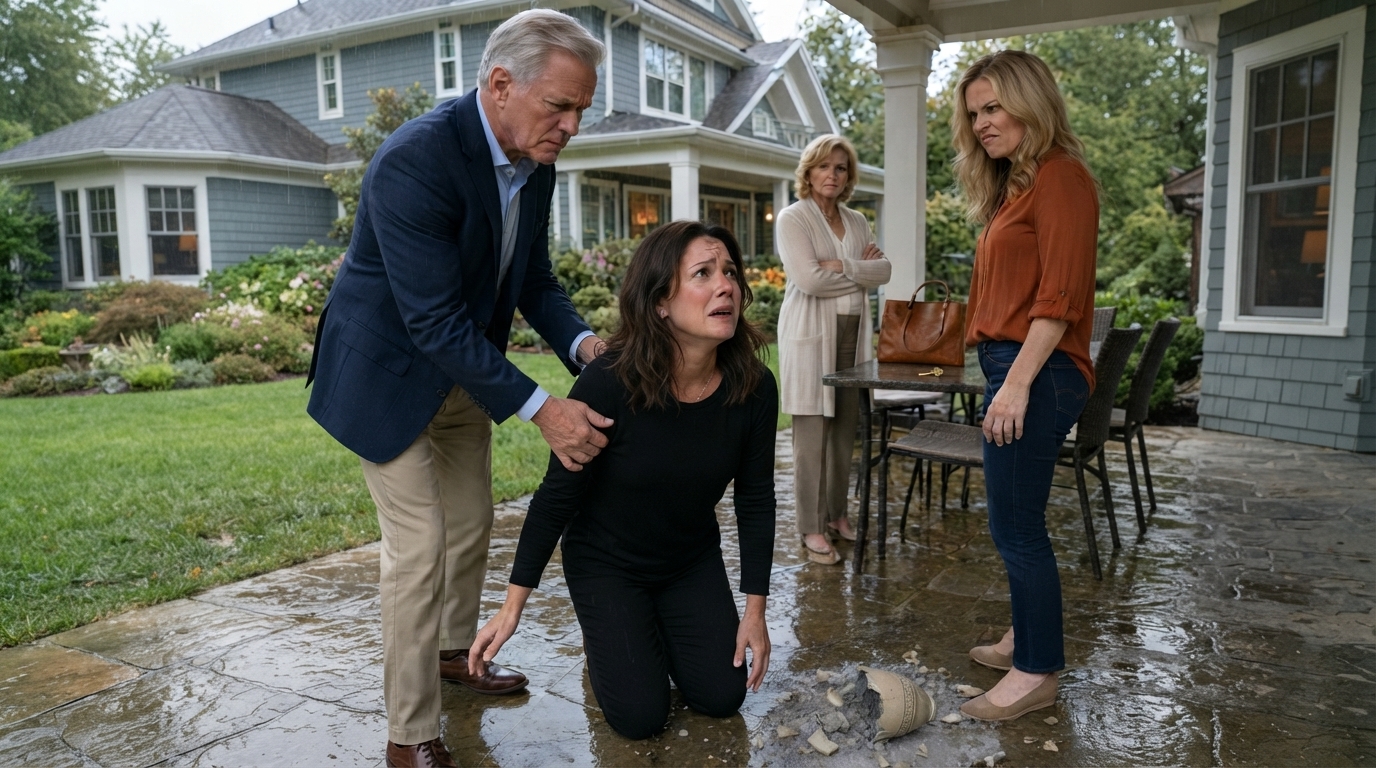
My family standing in my yard as if my grief were less important than their anger.
It had seemed like destruction.
Now, looking back, it was exposure.
The moment had exposed everything.
The entitlement.
The fear.
The debt.
The lies.
The pressure.
And underneath all of it, the truth.
My family didn’t know how to love without asking for something.
We had to learn.
I went back inside.
Paige was setting the table.
She looked at me.
“You okay?”
“Yes.”
She smiled.
“Grandma would have liked this.”
I nodded.
“She would.”
My mother looked toward the hallway.
“Everything is different.”
“Yes.”
“Do you miss how it was?”
I thought about it.
“No.”
She nodded.
“Neither do I.”
That surprised me.
But maybe she meant it.
After dinner, the children went outside.
Their laughter drifted through the open door.
My father sat in the recliner.
My mother was helping clean the dishes.
Paige was arguing with the kids about who cheated at a board game.
It was noisy.
Messy.
Ordinary.
And safe.
I looked around.
This was what family should feel like.
Not a transaction.
Not a competition.
Not a debt.
Not a threat.
A place where nobody had to prove they belonged.
Later that night, after everyone left, I stood alone in the kitchen.
My phone buzzed.
An old message thread from Grandma.
I opened it.
The last message said:
“Take care of your heart, Megan. And remember, a home is not valuable because it is worth money. It is valuable because you are safe there.”
I stared at it.
Then I smiled.
She had been right.
The $800,000 number had never been the important thing.
Neither was the property.
The important thing was that my children could sleep in their rooms without wondering whether someone would throw their belongings outside.
That their home was actually theirs.
That their mother would not trade their safety for family approval.
That lesson mattered more than any inheritance.
I put the phone down.
Then I walked to the memorial garden.
The roses were blooming.
I touched one carefully.
“Thank you, Grandma.”
The wind moved through the leaves.
For a moment, I imagined her voice.
Not giving advice.
Not warning me.
Just reminding me of something simple.
You can love people without giving them everything.
You can forgive without forgetting.
You can help without surrendering.
You can walk away without becoming cruel.
And sometimes, the most important inheritance isn’t what someone leaves you.
It’s what they teach you before they go.
Grandma had left me a house.
A trust.
A paper trail.
But more than that, she had left me permission.
Permission to stop.
Permission to say no.
Permission to protect my children.
Permission to love my family without being owned by them.
That was worth more than $800,000.
Years later, my children asked me about the memorial garden.
“Who is it for?”
“Your great-grandmother.”
“What was she like?”
I smiled.
“Smart.”
“Funny?”
“Sometimes.”
“Strict?”
“Very.”
“Did she love you?”
“More than I knew.”
They looked at the plaque.
“What does that sentence mean?”
I read it aloud.
“Love should never require surrender.”
My daughter thought about it.
“That sounds important.”
“It is.”
“Why?”
“Because someday, someone might tell you that being family means giving them whatever they want.”
She looked at me.
“And what do I say?”
I smiled.
“You say no.”
She laughed.
“That’s it?”
“Sometimes.”
She hugged me.
Then ran back toward the house.
I watched her go.
The house behind her was warm.
The lights were on.
The door was open.
Home.
Real home.
Not a property.
Not a financial asset.
Not a prize.
A place where she could be herself.
A place nobody could take by guilt.
A place protected by truth.
That was the ending I wanted.
Not my family destroyed.
Not my sister ruined.
Not my parents broken.
Just everyone finally living with what they had chosen.
And me no longer carrying what wasn’t mine.
The ashes were gone.
The debt was no longer my burden.
The house was secure.
The trust was intact.
The children were safe.
And I could finally grieve Grandma without also defending her.
That was the strangest part.
The night Paige threw the urn, I thought she had destroyed the last thing I had left of Grandma.
She hadn’t.
Grandma was everywhere.
In the garden.
In the house.
In the paperwork.
In the lessons.
In the boundaries.
In the way my daughter now knew she never had to make herself small to keep peace.
Paige thought she was throwing ashes into the rain.
Instead, she scattered the last illusion that our family could continue the way it had.
The broken urn ended one story.
The truth began another.
And that story had no throne.
No favorite.
No debt.
No one person controlling everyone else.
Just people learning, sometimes painfully, that love without respect isn’t enough.
The final time Paige asked me about the house, we were standing beside the garden.
“Do you think Grandma would have given it to me if she were still alive?”
I answered honestly.
“No.”
She nodded.
“I think I needed to hear that.”
“Why?”
“Because for years I thought she chose you over me.”
I looked at her.
“She chose neither.”
“What do you mean?”
“She chose what was right.”
Paige looked down.
“That hurts.”
“It should.”
She nodded.
“Maybe that’s what I needed.”
I smiled.
She placed another flower beneath Grandma’s plaque.
Then she said:
“Thank you for not giving me the house.”
I laughed softly.
“That may be the strangest thank-you I’ve ever received.”
She smiled.
“I mean it.”
I knew she did.
Because by then, she had finally learned what Grandma had understood years earlier.
A gift given under pressure isn’t love.
A house isn’t a family.
An inheritance isn’t a right.
And forgiveness isn’t a surrender.
I walked back toward the house.
My children were calling for me.
“Mama!”
I turned.
They were standing in the doorway.
“Coming,” I said.
And as I crossed the threshold, I thought about the night I had knelt in the rain trying to gather Grandma’s ashes.
I had believed I was trying to save what was left of her.
I was wrong.
What I was really saving was myself.
My family had spent years teaching me to give.
Grandma spent her final years teaching me when not to.
I finally listened.
And that’s why the house still stands.
That’s why the garden still blooms.
That’s why my children know they belong.
And that’s why, when the next person someday tells me that family means I owe them everything, I won’t argue.
I won’t explain.
I won’t feel guilty.
I’ll simply remember the broken urn in the rain.
Then I’ll say what I should have said years earlier.
I love you.
But no.
And this time, that will be enough.
THE END THANK YOU FOR READING !!!