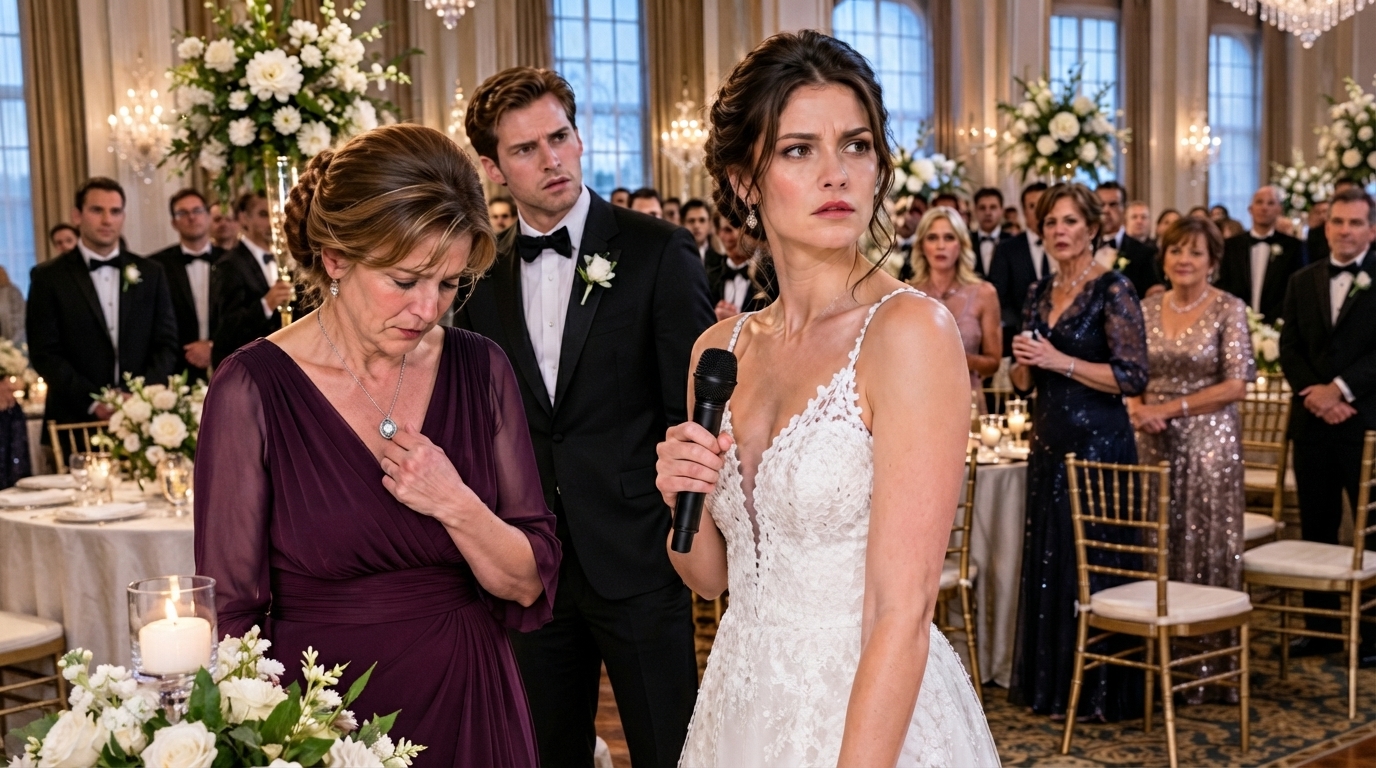
PART 3
I stared at the email on my laptop.
My mother sat beside me at her kitchen table,
clutching the silver locket around her neck.
Attorney David Miller remained on speakerphone.
For several seconds, nobody spoke.
Then I read the final paragraph aloud.
Once the wedding is complete,
Claire will be encouraged to persuade
Linda to sign the revised agreement.
If Linda continues resisting,
we can use the existing authorization documents and
the family’s financial circumstances to pressure her.
Claire doesn’t need to understand
the details until everything is finalized.
My voice broke.
I read the sentence again.
Claire doesn’t need to understand the details.
Daniel had written those words.
The man who had held my hand through my grandmother’s funeral.
The man who had kissed my forehead when I was sick.
The man who had proposed beneath a sky full of fireworks and promised we would build a beautiful life together.
He hadn’t simply hidden a business deal from me.
He had discussed using me to take something from my mother.
“David,” I whispered, “what exactly are these authorization documents?”
He took a breath.
“That’s what concerns me. There’s a purported limited power of attorney in the file.”
Mom looked up sharply.
“A what?”
“A document claiming you authorized certain people to act on your behalf regarding the property.”
Mom shook her head.
“I never signed anything like that.”
David continued.
“The signature needs to be examined, and we need to determine whether the document was ever used or recorded. But there is no reason to assume it’s valid simply because it’s in this file.”
I looked at my mother.
Her face was pale.
She was sixty-four years old.
For most of her life, she’d worked two jobs, raised me alone, and somehow kept our little house standing.
Now a wealthy family had apparently decided that because she was a widow, she would be easy to manipulate.
“Mom,” I said softly, “did Daniel ever ask you to sign anything?”
She hesitated.
My heart sank.
“Mom?”
She looked down.
“His father came here in October.”
I stared.
“Richard Carter?”
She nodded.
“He said he wanted to talk about the land.”
“Why didn’t you tell me?”
“Because I knew how excited you were about the wedding.”
My eyes filled.
She continued.
“He offered me three hundred thousand dollars. I told him the land wasn’t for sale.”
I nodded.
“I know that part.”
She swallowed.
“Then he said I should at least let his lawyer check the property records.”
I felt cold.
“What happened?”
“He brought some papers. Said they were just permission to review the title.”
I stared at her.
“Did you sign them?”
“No.”
She shook her head firmly.
“I told him I’d have my own lawyer look at anything before I signed.”
I breathed out.
“Then how did they get your signature?”
Mom looked toward the refrigerator.
There were family photographs held in place by faded magnets.
One showed me graduating from college.
Another showed my father holding me on his shoulders when I was five.
Mom stared at them.
“Daniel came back a week later.”
My stomach tightened.
“Alone?”
“Yes.”
“What did he want?”
“He said you were overwhelmed with wedding planning and asked whether he could borrow some family documents for the marriage records.”
I closed my eyes.
“Which documents?”
“A copy of my identification. Your father’s death certificate. Some old paperwork about the land.”
I stared at her.
“Mom.”
She began crying.
“I thought he was going to be my son-in-law.”
My heart broke.
She covered her face.
“I trusted him because you loved him.”
I reached for her.
“Mom, look at me.”
She shook her head.
“I’m so sorry.”
“No.”
I took her hands.
“You have nothing to apologize for.”
She looked at me.
“He was supposed to be family.”
“I know.”
And that was the cruelest part.
Daniel hadn’t broken into our house.
He hadn’t needed to.
We had opened the door.
We had invited him to dinner.
We had trusted him with our stories.
And he had apparently used that trust to gather information his family wanted.
David spoke gently.
“Claire, Linda, I need both of you to understand that we’re dealing with allegations at this point. We have suspicious documents and troubling communications, but we need to establish who prepared them, who signed them, and what actions were taken.”
I nodded.
“What do we do?”
“First, preserve everything. Don’t alter the files. Don’t delete messages. Don’t discuss the evidence with the Carters. I’ll arrange for certified property records and determine whether any deed or other instrument has been recorded.”
“And the land?”
“We’ll take steps to protect Linda’s interests while we investigate.”
Mom gripped my hand.
“Can they take it?”
David paused.
“Not simply because they possess a document bearing your name. A forged signature does not create genuine consent. But false documents can cause serious complications, so we need to act quickly.”
I swallowed.
“Then let’s act.”
That afternoon, David arranged for a title search.
He also contacted the law firm whose email had reached me.
Robert Walsh, the attorney who had first spoken to me, agreed to provide relevant information through appropriate channels.
By evening, we had learned something that made the entire situation even uglier.
Daniel’s family company, Carter Development Group, had been negotiating with a national distribution company interested in building a logistics center outside Columbus.
The proposed development required several adjoining parcels.
My mother’s twelve acres sat directly along the planned access road.
Without her land, the project would be significantly more difficult and expensive.
The Carters had already entered into a conditional agreement promising to deliver control of the property.
They had done that before my mother agreed to sell.
Before she signed anything.
Before she even knew the true value of the land.
I stared at the map David sent us.
Mom’s property was outlined in red.
A highway interchange sat to the east.
Commercial parcels surrounded it.
And a proposed access road ran straight through the middle.
“Four point eight million dollars,” I whispered.
Mom sat beside me.
“I never wanted millions.”
I looked at her.
She touched her locket.
“I just wanted to keep something your father loved.”
My eyes filled.
Dad had purchased the land when I was six.
Back then, it was mostly fields and trees.
He used to take me there on Sunday afternoons.
We’d walk along the creek and collect smooth stones.
He told me that one day, when he retired, he’d build a small cabin near the water.
He never got the chance.
Two years later, a heart attack took him from us.
Mom kept the land.
Even when money was tight.
Even when the roof leaked.
Even when people told her selling it would solve all her problems.
She kept it because it reminded her of him.
And Daniel’s family had looked at that same land and seen nothing but a payday.
The following morning, Daniel called.
I watched his name appear on my phone.
I didn’t answer.
He called again.
Then a third time.
Finally, he sent a message.
Claire, we need to talk. You’re misunderstanding everything.
I stared at it.
Then another arrived.
My family is furious. You embarrassed us in front of important people.
I almost laughed.
Important people.
Apparently, the two hundred guests mattered more than the woman he’d planned to marry.
Then came the message that erased the last trace of doubt from my heart.
If you hadn’t overreacted at the wedding, none of this would be happening.
I read it twice.
Not an apology.
Not an explanation.
Just blame.
I forwarded everything to David.
Then I blocked Daniel’s number.
For the first time since the wedding, I felt something other than heartbreak.
I felt clarity.
Two days later, David called with the title search results.
“Claire, I have good news and bad news.”
My stomach tightened.
“Tell me the good news first.”
“The recorded deed still shows Linda as the owner.”
I closed my eyes.
“Thank God.”
“The bad news is that a document purporting to grant authority over the property was submitted as part of the proposed transaction. We need to determine who prepared it and whether anyone attempted to rely on it.”
I looked at Mom.
She was sitting at the kitchen table, peeling potatoes for dinner.
The same table where she’d helped me with homework.
The same table where she’d paid bills after Dad died.
The same table where she’d cried when I told her Daniel had proposed.
“David,” I said, “can we stop the sale?”
“We can formally dispute the claimed authority and notify the relevant parties. The transaction cannot properly proceed on the assumption that Linda consented when she disputes doing so.”
I nodded.
“Do it.”
Then he said something unexpected.
“There’s another issue.”
I sat straighter.
“What?”
“The proposed buyer has asked for proof that Carter Development Group can deliver clear title.”
I frowned.
“And?”
“They can’t provide it without resolving Linda’s ownership and authorization.”
I stared at the phone.
David continued.
“That means the deal they were counting on may be in serious trouble.”
I looked at Mom.
She glanced up.
“What is it?”
I swallowed.
“Daniel’s family promised to sell land they don’t own.”
Mom set down the potato.
Her expression changed.
For years, she’d been polite to the Carters.
She’d smiled through their questions.
She’d tolerated their comments about her house, her clothes, and her accent.
She’d even tried to excuse their cruelty at the wedding.
But now something hardened in her eyes.
“Claire,” she said quietly, “your father worked too hard for that land.”
I nodded.
“He did.”
She straightened.
“Then nobody is taking it from us.”
I had never been prouder of her.
The next week, David arranged a meeting with representatives of the proposed buyer.
Mom attended.
So did I.
We sat across from three executives and their legal counsel.
One of them, a woman named Margaret Ellis, opened a folder.
“Mrs. Bennett, we were told your property was already under contract.”
Mom looked directly at her.
“It isn’t.”
Margaret paused.
“We were provided documentation suggesting otherwise.”
Mom folded her hands.
“I never agreed to sell my land to the Carters.”
Margaret glanced at her attorney.
David presented the relevant documents and explained that Mom disputed the purported signature and authorization.
He did not accuse anyone of a crime without evidence.
He simply laid out the facts.
The disputed signatures.
The communications.
The title records.
The absence of a valid agreement signed by Mom.
Margaret listened carefully.
Then she closed her folder.
“Mrs. Bennett, we take these concerns seriously.”
Mom nodded.
Margaret continued.
“We’ll suspend reliance on the Carter documentation while this is reviewed.”
I felt my shoulders relax.
For the first time, someone with power in the transaction was listening to my mother.
Not dismissing her.
Not talking over her.
Listening.
Then Margaret asked a question.
“Mrs. Bennett, would you ever consider discussing the property directly with us?”
Mom looked at me.
I squeezed her hand.
She turned back.
“Maybe someday.”
Margaret nodded.
“But not today,” Mom added.
A small smile appeared on Margaret’s face.
“Understood.”
We left the meeting together.
Outside, the winter sun shone through the bare branches.
Mom stopped on the sidewalk.
Then she began crying.
I hugged her.
“What’s wrong?”
She shook her head.
“Nothing.”
I held her tighter.
She laughed through her tears.
“It’s just that for the first time, somebody asked me what I wanted.”
I closed my eyes.
And I understood.
The Carters had spent months discussing my mother’s property.
Its value.
Its location.
Its potential.
Its paperwork.
But they’d never cared what the woman who owned it wanted.
Now that was finally changing.
And Daniel’s family was about to discover how expensive their arrogance could become.
PART 4
The first public sign that something was wrong at Carter Development Group appeared three weeks later.
A local business publication reported that the company’s proposed logistics development had been delayed.
The article didn’t mention my mother.
It didn’t mention the wedding.
It didn’t mention the forged signature allegations.
It simply said that several property acquisition issues remained unresolved.
But Daniel knew.
His father knew.
And apparently, the company’s lenders knew too.
Because that afternoon, Richard Carter called my attorney.
David told me about it later.
“He wants a meeting.”
I stared at him.
“With whom?”
“You and Linda.”
I shook my head.
“No.”
David nodded.
“That was my initial response.”
I looked at Mom.
She was sitting beside me, wearing her favorite cardigan.
“What do you think?”
She considered the question.
Then said, “I’ll meet him.”
I turned toward her.
“Mom, you don’t have to.”
“I know.”
She looked at me.
“But I’d like to hear what he has to say.”
David arranged the meeting at his office.
Richard arrived in a dark suit.
Daniel came with him.
So did a corporate attorney.
I hadn’t seen Daniel since the wedding.
The sight of him made my stomach twist.
He looked tired.
His hair was neatly combed.
His shoes were polished.
But the confidence he’d worn in the ballroom was gone.
He looked at me.
“Claire.”
I said nothing.
Richard took the chair across from Mom.
“Mrs. Bennett.”
Mom nodded.
“Mr. Carter.”
He cleared his throat.
“I understand there have been some misunderstandings.”
I felt anger rise.
David lifted a hand slightly, reminding me to let him speak.
Richard continued.
“Our company has been working on a major development. Your property is important to that project.”
Mom looked at him.
“I know.”
He blinked.
She continued.
“You offered me three hundred thousand dollars.”
Richard nodded.
“That was our initial valuation.”
Mom tilted her head.
“While you were arranging to sell it as part of a deal worth millions.”
Richard’s expression tightened.
“The overall transaction includes numerous parcels and development obligations.”
David spoke calmly.
“Mr. Carter, we’re not here to debate whether your company could earn a profit. We’re here because documents purporting to bear Mrs. Bennett’s signature were circulated without her authorization.”
Richard looked toward his attorney.
Then back at Mom.
“I’m sure there’s a reasonable explanation.”
Mom leaned forward.
“Then I’d like to hear it.”
Silence.
Daniel shifted.
His father looked at him.
For the first time, I noticed something strange.
Richard seemed genuinely uncertain.
As though he hadn’t expected to be asked that question so directly.
Finally, he said, “Daniel handled some of the preliminary documentation.”
My heart began pounding.
I turned toward Daniel.
He stared at the table.
“Daniel?” I whispered.
He looked up.
“Claire, I was trying to help everyone.”
I felt sick.
“Help?”
He nodded.
“The project would have made a lot of money. Your mother could have been taken care of for the rest of her life.”
Mom’s voice was quiet.
“I already take care of myself.”
Daniel looked toward her.
“I didn’t mean—”
“Yes,” she interrupted. “You did.”
The room went silent.
Mom folded her hands.
“You came into my home. You drank my coffee. You ate my cooking. You called me Mom.”
Daniel lowered his eyes.
“You told me you loved my daughter.”
He swallowed.
“And all that time, you were trying to get my land.”
He said nothing.
Mom continued.
“You could have asked me honestly.”
Daniel finally looked up.
“You wouldn’t have agreed.”
Mom nodded.
“That’s right.”
Then she said the words that ended the conversation.
“Because it was mine to refuse.”
Richard shifted in his chair.
His attorney leaned toward him and whispered something.
David opened his folder.
“We have a formal demand for preservation of all relevant records. We also intend to pursue appropriate remedies concerning the disputed documents.”
Richard looked uncomfortable.
“Are you threatening litigation?”
David remained calm.
“We’re explaining our clients’ legal position.”
I looked at Daniel.
He stared at me.
“Claire, please.”
I shook my head.
“Don’t.”
His eyes filled.
“I loved you.”
I felt something inside me ache.
For months, I’d wanted him to say those words.
I’d wanted him to tell me our relationship had been real.
That the laughter at the wedding had been a terrible mistake.
That he’d never intended to hurt my mother.
But now, hearing him say he loved me only made the betrayal worse.
“Daniel,” I whispered, “you don’t get to use love as an excuse for what you did.”
He looked down.
I continued.
“You let your family humiliate my mother in front of two hundred people.”
His eyes filled.
“You laughed.”
“I was nervous.”
I shook my head.
“You laughed because you thought I’d tolerate it.”
He said nothing.
“And you were right about one thing.”
He looked up.
“I did tolerate too much.”
My voice trembled.
“I ignored the questions about Mom’s property. I ignored the way your mother talked down to her. I ignored how uncomfortable she felt at family dinners.”
I swallowed.
“But I will never ignore someone trying to take what belongs to her.”
Daniel began crying.
I didn’t move.
The meeting ended without an agreement.
And for the first time, I walked away from Daniel without wondering whether I had made the wrong decision.
The months that followed were difficult.
There were attorneys.
Financial records.
Interviews.
Disputed signatures.
And a formal investigation into how the authorization documents had been created and circulated.
A document examiner compared the signature on the purported authorization with genuine examples of Mom’s handwriting.
The examiner’s report identified significant differences.
Other evidence showed that the document had been prepared and transmitted through channels connected to Carter Development Group.
Eventually, the company acknowledged that it could not establish valid authorization from Mom.
The proposed property transfer was abandoned.
The disputed document was formally withdrawn from the transaction.
Further legal proceedings addressed the alleged misconduct and the harm caused.
I won’t pretend every question was answered overnight.
Some facts took months to establish.
And the consequences were determined through the proper legal process, not by one dramatic confrontation.
But the business fallout began much sooner.
Without clear rights to Mom’s property, Carter Development Group couldn’t deliver the access corridor promised in its conditional agreement.
The proposed buyer suspended the project.
The company’s lenders demanded updated information about its exposure.
Investors began asking difficult questions.
And several other transactions were reviewed.
Then came the news that shocked nearly everyone in Columbus.
Richard Carter stepped down as chief executive while the company’s board conducted an internal investigation.
Daniel was removed from his development role.
The company later announced a restructuring and the sale of several commercial properties to reduce debt.
The wealthy family that had treated my mother like an embarrassment was suddenly fighting to preserve its own reputation.
And the irony wasn’t lost on me.
They had looked at a woman in a navy-blue dress and assumed she had nothing worth protecting.
Now the future of their biggest project depended on the very property she’d refused to surrender.
One evening, Daniel’s mother called.
I almost didn’t answer.
But curiosity got the better of me.
“Claire?”
Her voice sounded smaller than I remembered.
“Yes, Mrs. Carter?”
She hesitated.
“I think we should talk.”
I sat down.
“About what?”
“The wedding.”
I closed my eyes.
She continued.
“Things were said that evening.”
I waited.
“People were emotional.”
I stared at the wall.
“Your family called my mother a stupid country widow.”
Silence.
Then she said, “It was an unfortunate comment.”
I felt my jaw tighten.
“An unfortunate comment?”
She sighed.
“Claire, surely you understand that people sometimes say things they don’t mean.”
I took a breath.
“Mrs. Carter, your family didn’t accidentally insult my mother.”
She went quiet.
“You spent months treating her like she was beneath you.”
No answer.
“And when someone humiliated her publicly, Daniel laughed.”
She whispered, “I know.”
I swallowed.
“Then what exactly do you want to discuss?”
Her voice trembled.
“We’re losing a great deal.”
I stared at the phone.
There it was.
Not remorse.
Not concern for Mom.
Not even an apology.
Just fear of losing money.
I closed my eyes.
“Mrs. Carter, my mother nearly lost the only thing my father left her.”
She said nothing.
“You don’t get to ask us to protect your family’s finances after your family tried to take hers.”
I ended the call.
Then I sat quietly for a long time.
I didn’t feel victorious.
I felt tired.
Because I’d once imagined that woman becoming my mother-in-law.
I’d imagined holidays together.
Family photographs.
Children.
A future.
Now all I could see was the way she’d stood in the ballroom and accused me of humiliating her family.
As though protecting my mother had been the shameful act.
That summer, Mom and I drove out to the land.
It was a warm Saturday morning.
The grass had grown high.
Wildflowers lined the old fence.
The creek still ran along the western edge.
I hadn’t visited in years.
But the moment I stepped out of the car, memories rushed back.
Dad holding my hand.
Dad pointing out animal tracks.
Dad laughing when I slipped in the mud.
Mom walked slowly beside me.
She wore jeans, old boots, and a straw hat.
For a while, we didn’t speak.
Then she stopped near a large oak tree.
“Your father loved this spot.”
I nodded.
“He wanted to build a cabin here.”
She smiled.
“I know.”
We stood beneath the branches.
Then Mom reached into her purse.
She removed a small envelope.
“Claire, I want you to have this.”
I frowned.
“What is it?”
“Open it.”
Inside was a photograph.
Dad standing beside the creek.
I was six years old, sitting on his shoulders.
Mom stood beside us, smiling.
Behind us, the oak tree spread its branches across the sky.
My eyes filled.
“I remember that day.”
Mom nodded.
“You dropped your sandwich in the creek.”
I laughed through my tears.
“Dad said the fish were having lunch.”
She smiled.
Then her expression softened.
“Claire, I want you to know something.”
I looked at her.
“I was never ashamed of being a country widow.”
My throat tightened.
She continued.
“I was ashamed that I couldn’t give you more.”
I shook my head.
“Mom.”
She looked away.
“When your father died, I worried every day. About money. About your future. About whether you’d resent me for the life we had.”
Tears ran down my face.
“I never resented you.”
She smiled sadly.
“I know that now.”
I took her hands.
“Mom, you gave me everything that mattered.”
She began crying.
“You gave me a home. You taught me to work hard. You taught me to be kind. You taught me not to judge people by their clothes or their bank accounts.”
I swallowed.
“And you taught me that love means standing beside someone when it would be easier to walk away.”
She hugged me.
We stood beneath that oak tree for a long time.
Then she whispered, “Your father would have liked the woman you’ve become.”
I closed my eyes.
Those words meant more to me than any wedding gift Daniel’s family could have purchased.
Several months later, Margaret Ellis contacted David.
The distribution company had reconsidered its development plans.
They were no longer working with Carter Development Group.
Instead, they were exploring a smaller project with a different access route.
Margaret wanted to know whether Mom would consider selling a limited portion of her property.
David explained the proposal.
Mom listened.
Then she asked a question.
“Would I have to sell the creek?”
“No,” David replied.
“The oak tree?”
“No.”
“The place where my husband wanted to build his cabin?”
“No.”
Mom looked at me.
I smiled.
“It’s your decision.”
She thought about it for several days.
Then she agreed to discuss terms.
Not because anyone pressured her.
Not because she needed to prove something.
But because the new proposal allowed her to keep the land that mattered most while receiving a fair price for a smaller section.
An independent appraiser evaluated the property.
David negotiated the agreement.
Mom reviewed every document carefully.
And when she finally signed, it was her own signature.
Her own decision.
Her own future.
The proceeds allowed her to retire comfortably.
She repaired her house.
Replaced the aging roof.
Bought a reliable car.
And established savings that meant she’d never again have to worry about choosing between groceries and electricity.
But the first thing she did surprised me.
She hired a local builder.
And she built a small cabin near the creek.
Exactly where Dad had always wanted one.
The cabin had a green roof.
A stone fireplace.
A wooden porch overlooking the water.
Nothing extravagant.
Nothing designed to impress anyone.
Just a peaceful place where she could sit with her coffee and listen to the birds.
On the day it was finished, she invited me over.
I arrived carrying flowers.
Mom stood on the porch wearing her navy-blue dress.
The same dress she’d worn to my wedding.
I stopped at the bottom of the steps.
“Mom?”
She smiled.
“What?”
“Why are you wearing that?”
She looked down at the dress.
Then laughed.
“Because I like it.”
My eyes filled.
She touched the silver locket around her neck.
“And because I refuse to let those people turn a beautiful dress into a bad memory.”
I walked up the steps and hugged her.
She held me tightly.
Then she whispered, “You know, sweetheart, I thought that wedding was going to be one of the happiest days of your life.”
I swallowed.
“So did I.”
She pulled back.
“But maybe it saved you from a very unhappy marriage.”
I nodded.
“I think it did.”
We sat on the porch together.
The creek murmured nearby.
Sunlight filtered through the trees.
And for the first time in a long time, I felt completely at peace.
I never married Daniel.
Eventually, the engagement ring was returned through our attorneys.
The wedding photographs were packed away.
The invitations disappeared into a drawer.
And the beautiful future I’d imagined with him became a memory I no longer wanted to live inside.
But I didn’t lose everything.
I found something I’d nearly forgotten.
My own judgment.
My own courage.
And the certainty that the people I loved deserved to be treated with dignity.
A year after the wedding that never happened, Mom and I hosted a small gathering at the cabin.
There were no chandeliers.
No expensive champagne.
No two hundred guests.
Just a few friends, neighbors, and relatives who genuinely cared about us.
Mom made her famous chicken casserole.
I baked a cake.
We set folding chairs beneath the oak tree.
And as the sun began to set, Mom stood beside me holding a glass of lemonade.
She looked around at everyone laughing.
Then she leaned close.
“Claire?”
“Yes?”
“Are you happy?”
I looked at her.
At the woman who had worked herself half to death so I could have opportunities she never had.
At the woman who had worn secondhand coats so I could have new school shoes.
At the woman who had never stopped believing in me.
I smiled.
“Yes, Mom.”
My eyes filled.
“I really am.”
She squeezed my hand.
Then we sat together beneath the oak tree.
I thought about Daniel’s family.
Their expensive clothes.
Their polished manners.
Their enormous houses.
Their belief that money made them better than everyone else.
They had looked at my mother and seen a woman they could humiliate.
A woman they could manipulate.
A woman they could cheat.
They’d called her a stupid country widow.
But they’d never understood who she really was.
She was the woman who had survived losing her husband.
The woman who had raised a daughter alone.
The woman who had protected her husband’s memory through years of financial hardship.
The woman who refused to sign away her land simply because wealthy people told her it was a good idea.
And when the truth finally came out, she didn’t need to scream.
She didn’t need revenge.
She didn’t need to humiliate anyone.
She simply stood up for herself.
And let the truth do the rest.
That night, as we watched the sunset, Mom took the silver locket from around her neck.
She opened it.
Inside was a tiny photograph of Dad.
She smiled.
Then she whispered, “We kept our promise, didn’t we?”
I looked at her.
“What promise?”
She closed the locket gently.
“The promise to take care of each other.”
My throat tightened.
I wrapped my arm around her shoulders.
“Yes, Mom.”
“We did.”
And in that moment, I realized something.
The richest person in that ballroom had never been Daniel’s father.
It wasn’t his mother.
It wasn’t any of the wealthy guests who watched my mother being humiliated.
It was the woman standing beside me in a navy-blue dress, wearing a silver locket, who had given everything she had without ever asking for anything in return.
Daniel’s family thought they could buy anything.
They thought money gave them power over people.
They thought a widow with calloused hands and an old house would be too frightened to fight back.
But they were wrong.
Because some things aren’t for sale.
A mother’s dignity.
A father’s memory.
A daughter’s loyalty.
And the right to decide what happens to something you’ve spent your whole life protecting.
I walked away from a wedding that cost more than my mother had earned in years.
And I walked toward a woman whose love had always been worth more than every diamond in that ballroom.
That was the day I stopped confusing wealth with character.
And it was the day I finally understood that losing Daniel wasn’t the tragedy.
Marrying him would have been.
THE END THANK YOU FOR READING !!!