PART 3
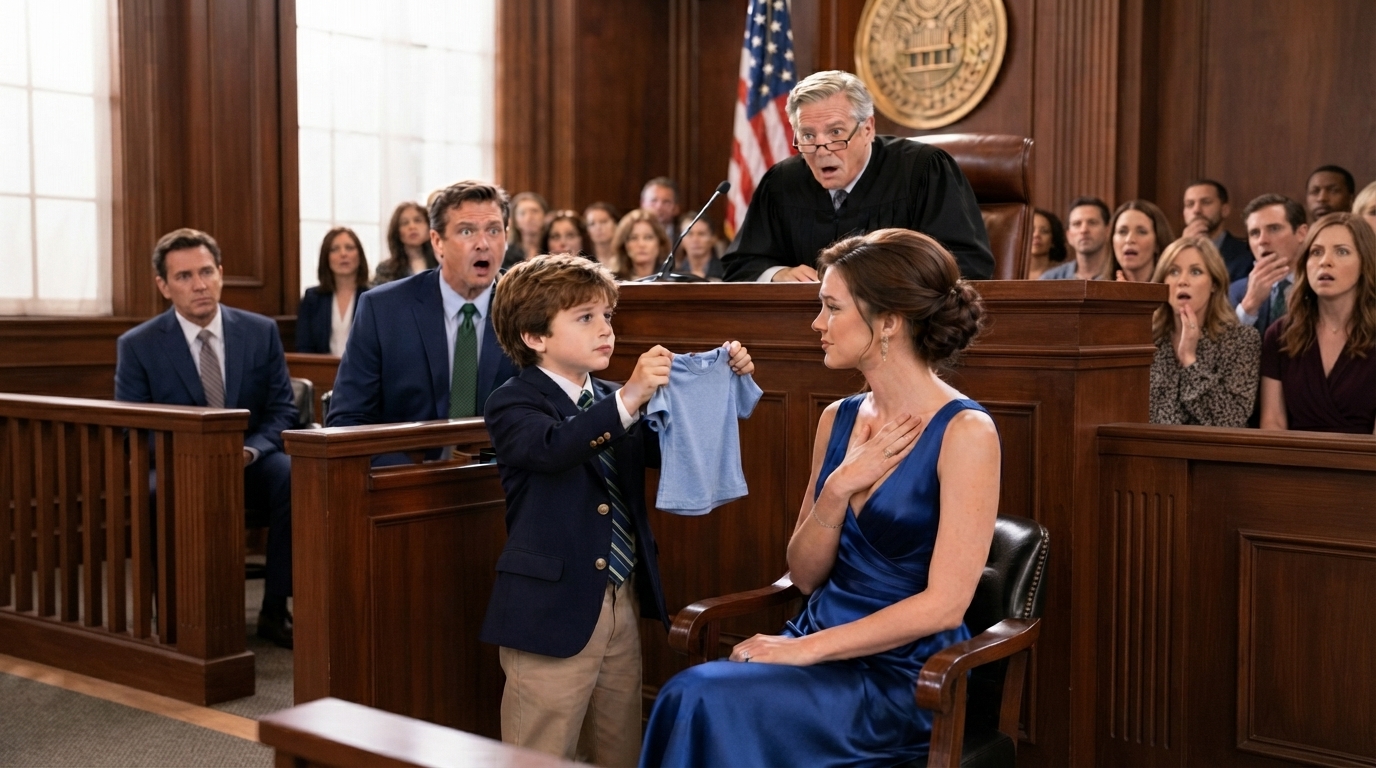
For several seconds, nobody in the courtroom moved.
My eight-year-old son stood beside me,
holding open the front of his faded navy shirt.
The words he’d written inside were crooked and uneven.
Some letters were larger than others.
A few had been traced over so many times
that the blue marker had soaked through the fabric.
But the final sentence was perfectly clear.
I know what Daddy keeps inside the locked room.
Across the courtroom, Russell Davenport went completely still.
His attorney, Benedict Welch, turned toward him.
“Russell,” he whispered, “what locked room?”
My ex-husband didn’t answer.
Judge Leonard leaned forward.
“Toby, sweetheart, I need you to listen carefully.”
Toby looked up.
You haven’t done anything wrong.
But I want to make sure you feel comfortable speaking.
Would you like to sit beside your mother?
Toby nodded.
I pulled out his chair.
He sat down and immediately reached for my hand.
His fingers were freezing.
I wrapped both my hands around his.
Judge Leonard turned toward the attorneys.
“We’re going to proceed carefully. Mr. Welch, return the clothing to the child. I also want to hear from the court’s family services representative before any further questioning.”
Welch slowly placed the shirt on the table.
He looked as though someone had pulled the ground out from beneath him.
“Your Honor,” he began, “my client has no knowledge of—”
“Mr. Welch,” the judge interrupted, “I haven’t asked for an explanation from your client.”
Russell shifted in his chair.
His expensive watch caught the overhead light.
The same watch he’d worn when he told me he couldn’t afford Toby’s school supplies.
I looked at him.
For the first time since our divorce, he wouldn’t meet my eyes.
A court officer approached the bench.
Judge Leonard spoke quietly with him, then announced a short recess so the appropriate arrangements could be made.
As people began standing, Russell suddenly pushed back his chair.
“This is ridiculous.”
His voice echoed through the courtroom.
Everyone stopped.
“He’s eight years old. He doesn’t understand what he’s saying.”
Toby flinched.
I felt his hand tighten around mine.
Russell pointed toward me.
“She put him up to this.”
I stood.
“No, Russell.”
He glared at me.
“You’ve been poisoning him against me for months.”
My voice trembled.
“I didn’t even know he’d written those words.”
“Liar.”
“Mr. Davenport,” Judge Leonard said sharply.
Russell turned.
“Your Honor, she’s manipulating our son.”
The judge’s expression hardened.
“You will stop addressing Mrs. Davenport and follow the court’s instructions.”
Russell opened his mouth.
“Now.”
He sat down.
I looked at Toby.
His eyes were wet.
“Mommy,” he whispered, “is Daddy mad?”
I knelt beside him.
“Sweetheart, you don’t have to worry about Daddy’s feelings right now.”
He swallowed.
“Did I do something bad?”
My heart broke.
“No.”
I brushed his hair away from his forehead.
“You told the truth about something that was frightening you.”
He looked down at his shirt.
“I didn’t know how else to tell you.”
I pulled him into my arms.
And there, in a courtroom full of strangers, I held my son while he cried.
I wanted to ask him a thousand questions.
What locked room?
What had Russell shown him?
Where had his father been taking him?
But I knew he was already overwhelmed.
So I didn’t ask.
I simply held him.
A few minutes later, a family services professional named Ms. Alvarez approached us.
She had kind eyes and a gentle voice.
She explained that the court wanted to speak with Toby in an age-appropriate setting, without either parent pressuring him.
I nodded immediately.
“Whatever helps him feel safe.”
Toby looked frightened.
“Do I have to go somewhere?”
Ms. Alvarez crouched beside him.
“Just to a quieter room, sweetheart. We’ll explain everything before we do anything.”
He looked at me.
I squeezed his hand.
“You’re not in trouble.”
He nodded.
Then he whispered something that nearly destroyed me.
“Mommy, if I tell them, will Daddy stop loving me?”
I felt tears rush into my eyes.
I wanted to tell him his father would always love him.
But after everything I’d heard, I couldn’t make promises on Russell’s behalf.
So I told him the one thing I knew was true.
“Nothing you say changes how much I love you.”
Toby nodded.
Then he followed Ms. Alvarez.
I watched him disappear through the side door.
The moment it closed, my knees felt weak.
I sat down.
And I began shaking.
Across the room, Russell was arguing with his lawyer.
I couldn’t hear every word.
But I heard enough.
“You said this would be simple,” Russell hissed.
Welch leaned closer.
“You didn’t tell me there was a locked room.”
Russell looked toward me.
Then he lowered his voice.
I turned away.
For two years, I’d believed Russell’s worst quality was selfishness.
He had left when Toby was six.
He’d moved into a beautiful townhouse.
He’d bought a new car.
He’d taken vacations.
And whenever I asked about child support, he’d told me money was tight.
I thought he was simply a man who wanted the appearance of being a successful father without the responsibility.
But now I wondered what else I hadn’t known.
And why my son had been so frightened that he’d hidden words inside his favorite shirt.
Twenty minutes later, Ms. Alvarez returned.
She spoke privately with the judge and the attorneys.
Then Judge Leonard resumed the hearing.
He looked directly at Russell.
“Mr. Davenport, your son has made statements raising serious concerns about the environment in which he spends his parenting time.”
Russell straightened.
“Your Honor, I have a perfectly safe home.”
The judge continued.
“These concerns require investigation. The court will not make factual findings about every allegation today.”
Russell nodded eagerly.
“Exactly.”
“But until we have more information, the child’s safety must come first.”
Russell’s expression changed.
Judge Leonard ordered temporary protective arrangements while the allegations were investigated, including supervised contact rather than the unsupervised visits Russell had been requesting.
My eyes filled.
Russell stood.
“You can’t do that!”
His attorney grabbed his sleeve.
“Russell, sit down.”
But Russell was staring at me.
“This is your fault!”
Toby wasn’t in the room.
I was grateful for that.
The judge’s voice became firm.
“Mr. Davenport, one more outburst and you will be removed.”
Russell slowly sat.
I stared at the wooden table.
My heart was pounding.
I had entered the courtroom terrified that Russell’s expensive attorney would convince the judge I was unfit because I couldn’t afford new clothes.
Now the court was examining whether Russell’s own home was safe.
And I still didn’t know what my son had seen.
After the hearing, Ms. Alvarez asked me to remain for a few minutes.
She sat beside me in a small conference room.
“Toby told us something important,” she said.
I felt my stomach tighten.
“What?”
She spoke carefully.
“He says his father has been taking him to a property outside Concord.”
I frowned.
“Russell lives in the city.”
“He apparently has access to another building.”
I stared.
“What kind of building?”
“A house or office property. Toby described it as a large building with a garage and a basement.”
I swallowed.
“And the locked room?”
Ms. Alvarez hesitated.
“Toby says his father keeps boxes of papers, computers, and several large metal cabinets inside.”
I blinked.
“Papers?”
She nodded.
“He also described hearing his father argue with another man about money.”
I felt a chill.
“What did they say?”
She looked at her notes.
“Toby remembers hearing his father say, ‘If Brenda finds the records, everything falls apart.’”
My breath caught.
I stared at her.
“Brenda?”
She nodded.
“Your name.”
For a moment, I couldn’t speak.
Why would Russell be discussing me in a locked room?
Ms. Alvarez continued.
“Toby also says his father told him that if he ever mentioned the building to you, you would get into trouble.”
I covered my mouth.
My little boy had been carrying that fear alone.
For months.
Perhaps longer.
“Is he safe?” I whispered.
“He’s with a staff member right now, and he appears calmer. We are making the appropriate referrals so the concerns can be investigated.”
I nodded.
Then I asked the question that had been burning inside me.
“Why did he write it on his shirt?”
Ms. Alvarez’s expression softened.
“He said it was the only thing he knew you would never throw away.”
I began crying.
She handed me a tissue.
“He told us you bought that shirt because he loved the moon.”
I nodded.
“He said you worked very hard to buy it.”
My chest tightened.
“And he said that whenever he was scared, he touched the little moon on the pocket because it reminded him of you.”
I covered my face.
For months, I’d felt ashamed that I couldn’t afford to replace that shirt.
I’d washed it carefully.
Mended the seams.
Scrubbed at the stain.
I’d worried that Russell would use it against me.
And he had.
But the shirt wasn’t evidence that I didn’t care.
It was the one place my son felt safe enough to leave me a message.
When Toby returned, I knelt in front of him.
He looked exhausted.
“Mommy?”
“Yes, sweetheart?”
“Can we go home?”
I pulled him close.
“Yes.”
He pressed his face against my shoulder.
“Can Grandma make pancakes?”
I laughed through my tears.
“Absolutely.”
He looked up.
“Even though it’s not breakfast?”
“Especially because it’s not breakfast.”
For the first time that day, he smiled.
We walked out of the courthouse together.
The January air struck my face like ice.
I held Toby’s hand tightly.
Behind us, Russell emerged with his attorney.
He saw us.
For a moment, he looked as though he might approach.
Then Welch caught his arm.
Russell stopped.
I kept walking.
I didn’t know what was inside that locked room.
But I knew one thing.
My son had been afraid to tell me.
And whatever Russell was hiding, he had made our child carry the weight of it.
That night, after Toby fell asleep, my mother sat beside me at the kitchen table.
Martha had made pancakes for dinner.
Toby had eaten four.
Then he’d curled up on the sofa beneath his favorite blanket and fallen asleep watching a documentary about Saturn.
Now the apartment was quiet.
My mother looked at me.
“Brenda, you need to tell me everything.”
So I did.
The shirt.
The hidden writing.
The locked room.
The judge’s temporary order.
The mention of records.
Mom listened without interrupting.
When I finished, she sat silently for a long time.
Then she said, “Your father used to say that when someone works that hard to make you look small, it’s usually because they’re afraid you’ll notice something bigger.”
I looked at her.
“What does that mean?”
She leaned forward.
“Russell wants everyone looking at your apartment, your clothes, and your paycheck.”
I nodded.
“Why?”
“Maybe because he doesn’t want anyone looking at his.”
I stared at her.
Then I remembered something.
Six months earlier, Russell had demanded copies of Toby’s birth certificate, Social Security card, and school enrollment records.
He’d said he needed them for insurance.
I had sent the birth certificate and school information through the appropriate channels but refused to give him Toby’s original Social Security card.
Russell had become furious.
At the time, I’d thought he was simply being controlling.
Now I wondered whether it was connected to something else.
I opened my folder of custody documents.
I found the messages.
Then another.
And another.
Russell had repeatedly asked for information he claimed was necessary for financial paperwork.
My hands began shaking.
I showed Mom.
She read the messages.
Then looked at me.
“Brenda, call someone.”
“Who?”
“Someone who knows how to find out whether your son’s information has been misused.”
I stared at the phone.
For the first time, I understood that the custody hearing might have been only one part of a much larger problem.
And that Russell’s biggest lie wasn’t about my son’s worn shirt.
It was about why he wanted custody in the first place.
PART 4
The next morning, I called the legal aid office.
I had tried to get representation before the hearing, but the waiting list was long.
This time, when I explained what had happened, the receptionist transferred me to an attorney named Caroline Hayes.
She listened carefully.
Then she said, “Mrs. Davenport, I’d like to review your documents.”
I almost cried from relief.
For two years, I’d felt as though I was fighting Russell with nothing but a folder and a prayer.
Now someone was finally willing to help me understand what was happening.
Caroline met with me that afternoon.
She was in her forties, with dark hair pulled into a neat bun and a calm, direct manner.
She reviewed the custody paperwork.
The child support history.
The messages.
The requests for Toby’s identifying information.
Then she looked up.
“Brenda, has Russell ever asked you to sign tax documents you didn’t understand?”
I froze.
“Yes.”
“When?”
“About a year after we separated.”
“What did he say?”
“That he needed my signature to correct a filing issue.”
“Did you sign?”
I shook my head.
“No. I told him to send it to me so I could have someone look at it.”
Caroline nodded.
“And?”
“He got angry.”
She wrote something down.
Then asked another question.
“Have you checked whether anyone has opened accounts using Toby’s information?”
I stared at her.
“No.”
She leaned forward.
“I don’t want to alarm you. We don’t know that anything improper has happened. But given the concerns you’ve described, we should investigate carefully.”
I nodded.
She explained the steps for checking for possible identity misuse and protecting Toby’s information.
We also discussed reporting the concerns through appropriate channels.
I left her office with a list of things to do.
And for the first time since Russell had walked out of our marriage, I didn’t feel completely alone.
Over the following days, Caroline helped me request records and pursue the appropriate legal procedures.
A separate investigation into the property Toby had described was also underway.
I didn’t tell Toby every detail.
He was eight.
He needed school.
Friends.
Pancakes.
And the freedom to think about planets instead of courtrooms.
So I kept his routines as normal as possible.
Every morning, Mom made breakfast.
Every afternoon, Toby came home and told us about school.
Every evening, I checked his homework.
And whenever he asked whether Daddy was angry, I reminded him that adults were responsible for their own choices.
Then, two weeks after the hearing, Caroline called.
“Brenda, can you come to my office?”
My stomach dropped.
“Is Toby okay?”
“As far as I know, yes. But we’ve received information relevant to the financial concerns.”
I left work early.
When I arrived, Caroline had several documents spread across her desk.
She looked serious.
“Brenda, the records suggest Russell has been involved in financial activity that may include the misuse of identifying information.”
I sat down.
“What kind of activity?”
She slid a document toward me.
It was a credit application.
I stared at the name.
Tobias Davenport.
My son’s full legal name.
My heart stopped.
“No.”
Caroline spoke gently.
“We’re still verifying the records, but this appears to be associated with an account opened using Toby’s identifying information.”
I stared at the page.
The listed address was unfamiliar.
The date was from eight months earlier.
I looked up.
“He’s eight years old.”
Caroline nodded.
“I know.”
My voice broke.
“Russell used our son’s identity?”
“That is one of the concerns being investigated. We need to establish exactly who submitted the application and how.”
I pressed my hands against my face.
I wanted to scream.
I wanted to drive straight to Russell’s townhouse.
I wanted to demand how a father could do something like that to his own child.
But Caroline gently stopped me.
“Brenda, don’t confront him. Let the investigation proceed.”
I nodded.
She continued.
“There is also evidence suggesting that some of the financial documents Russell submitted in the custody case may have been incomplete or misleading.”
I looked at her.
“What documents?”
“The records he provided about his income and expenses.”
My stomach tightened.
Russell had told the court he was struggling financially.
He claimed his business income was inconsistent.
He said he couldn’t afford higher child support.
Yet he’d hired an expensive attorney and arrived wearing a watch worth more than my car.
Caroline pointed toward another document.
“There are indications of additional business interests and assets that weren’t fully disclosed.”
I stared at the papers.
“So he lied about his money?”
“We have reason to challenge the accuracy of his disclosures. The court will determine the facts after reviewing the evidence.”
I leaned back.
Everything began to connect.
The expensive townhouse.
The missed child support.
The requests for Toby’s information.
The secret property.
The locked room.
And the sudden demand for custody.
Caroline looked at me.
“Brenda, I can’t tell you what Russell intended. But I can tell you that we need to protect Toby’s financial identity and ensure the custody court has accurate information.”
I nodded.
My eyes filled.
“Thank you.”
She smiled gently.
“That’s what we’re here for.”
Over the next several months, the investigations continued.
Records were obtained.
Financial accounts were reviewed.
The court considered the allegations involving Toby’s identifying information and Russell’s disclosures.
The process was slower than I wanted.
There were delays.
Requests for additional documents.
Meetings.
Hearings.
And nights when I lay awake wondering whether Russell would somehow convince everyone that I was the problem.
But something had changed.
I wasn’t fighting to prove I was wealthy enough to deserve my child.
I was fighting to make sure my child was safe.
And I had evidence.
I had support.
I had people who believed that being poor wasn’t the same as being neglectful.
During that time, Toby began seeing a child therapist.
Her name was Dr. Elena Morris.
She helped him understand that he wasn’t responsible for adult conflicts.
That he didn’t have to keep secrets that made him frightened.
And that telling the truth didn’t mean he had betrayed his father.
One evening, after a session, Toby climbed into my lap.
“Mommy?”
“Yes, sweetheart?”
“Dr. Morris says I’m not supposed to fix grown-up problems.”
I smiled sadly.
“She’s right.”
He looked thoughtful.
“But I helped fix one.”
I kissed his forehead.
“You helped us understand something important.”
He nodded.
Then whispered, “I was scared Daddy would be mad forever.”
My chest tightened.
I brushed his hair away from his eyes.
“Sweetheart, your father’s feelings are his responsibility.”
Toby looked at me.
“Even if he’s sad?”
“Even then.”
He thought about that.
Then he wrapped his arms around my neck.
“I’m glad I told you.”
I held him close.
“So am I.”
The next major custody hearing took place in late spring.
The snow had melted.
The trees outside the courthouse were beginning to bloom.
I wore the same cream blazer.
But this time, Caroline sat beside me.
And Toby wasn’t sitting at our table.
He was at school.
Exactly where an eight-year-old belonged.
Russell arrived with Benedict Welch.
He looked different.
His suit was still expensive.
His shoes were still polished.
But the confidence he’d carried into the January hearing was gone.
He avoided looking at me.
The court reviewed the updated evidence.
Caroline presented records showing my consistent involvement in Toby’s education and medical care.
His attendance was excellent.
His teachers described him as curious, kind, and well-supported.
His doctor confirmed that his health needs were being met.
My mother provided information about the childcare arrangements.
My employer supplied work records showing the schedule adjustments I’d made for Toby.
And the court considered the concerns about Russell’s conduct, including the ongoing financial investigations and the pressure Toby had described.
When Welch attempted to return to the subject of my income, Caroline stood.
“Your Honor, Mrs. Davenport has never claimed to be wealthy. She has demonstrated that Toby’s daily needs are being met. The evidence before the court concerns his stability, safety, and best interests, not whether his mother can purchase more expensive clothing.”
Judge Leonard nodded.
I stared at my hands.
For months, I’d been ashamed of how little money I had.
Now, for the first time, I understood that the sacrifices I’d made were not proof of failure.
They were evidence of how hard I’d worked to keep my son secure.
Russell’s attorney tried to challenge the allegations against his client.
The judge listened.
The court considered the evidence carefully.
And when the hearing concluded, Judge Leonard issued an order maintaining Toby’s primary residence with me, with Russell’s parenting time subject to protective conditions and professional oversight pending further review.
The judge emphasized that the decision was based on Toby’s best interests and the evidence presented.
Not on the price of his clothes.
Not on the size of our apartment.
Not on the fact that my mother helped with childcare.
I sat completely still.
Caroline touched my arm.
“Brenda,” she whispered, “you can breathe.”
I hadn’t realized I’d been holding my breath.
Then I began crying.
Quietly.
Into my hands.
I thought about every morning I’d left before sunrise.
Every evening I’d come home exhausted.
Every meal I’d stretched.
Every bill I’d worried over.
Every time I’d wondered whether I was failing my son because I couldn’t give him the life Russell could afford.
And I realized something.
Toby had never asked for a bigger house.
He’d never asked for designer clothes.
He’d never complained about Grandma making dinner.
He’d only ever asked me to come home.
To read with him.
To listen when he talked about the moon.
To be there.
And I had been.
Not perfectly.
Not without mistakes.
But consistently.
Lovingly.
Completely.
Outside the courthouse, Caroline hugged me.
“You did well.”
I shook my head.
“I don’t know what I would’ve done without you.”
She smiled.
“You were already doing the hardest part long before I met you.”
I looked at her.
“What’s that?”
“Raising your son.”
I began crying again.
She laughed softly and handed me a tissue.
“Now go home to him.”
So I did.
When I arrived at our apartment, Toby was sitting at the kitchen table with Grandma Martha.
They were building a model of the solar system from cardboard and colored paper.
Toby looked up.
“Mommy!”
He jumped from his chair and ran toward me.
I caught him in my arms.
He hugged me tightly.
“Did the judge say I can stay?”
I knelt.
I looked into his eyes.
“Yes, sweetheart.”
His face lit up.
“With you and Grandma?”
“Yes.”
He threw his arms around my neck.
“Good.”
I held him.
For a long time.
Then he pulled back.
“Can I still see Daddy?”
My heart tightened.
I took a breath.
“There are grown-ups working out how visits can happen safely. You don’t have to figure that out.”
He nodded.
“Okay.”
Then he smiled.
“Do you want to see Saturn?”
I laughed through my tears.
“More than anything.”
That evening, Mom made spaghetti.
Toby talked about his science project.
I helped him paint tiny stars onto a piece of cardboard.
And for the first time in months, our apartment felt peaceful.
The legal and financial matters involving Russell continued separately.
The investigation into the disputed accounts produced additional evidence.
Some financial records were corrected.
Steps were taken to protect Toby’s identity.
Russell faced legal consequences for conduct established through the appropriate proceedings.
I won’t pretend the process was simple.
It wasn’t.
There were setbacks.
There were difficult conversations.
There were days when I felt exhausted by paperwork and uncertainty.
But I learned something important.
Justice wasn’t always a dramatic moment when someone stood up and shouted the truth.
Sometimes it was a careful investigation.
A document obtained.
A professional who listened.
A judge who considered the evidence.
And a mother who refused to give up.
As for the navy shirt, I never threw it away.
Even after Toby outgrew it.
Even after the collar became too stretched to wear.
Even after the little silver moon began losing its shine.
I washed it one final time.
Carefully.
Then I folded it and placed it inside a memory box.
The writing remained visible.
The words my son had hidden when he didn’t know how to ask for help.
Sometimes I took it out.
Not because I wanted to remember the courtroom.
Not because I wanted to relive Russell’s lies.
But because that shirt reminded me of something I never wanted to forget.
Children notice more than we think.
They carry fears they don’t always know how to explain.
And sometimes the smallest things we give them become symbols of safety.
I had bought that shirt for twelve dollars.
I had worried that spending the money was irresponsible.
I had stood in the department store, staring at the clearance tag, wondering whether I should put it back.
But I bought it anyway.
Because Toby loved the moon.
Because I wanted him to have something new.
Because for one small moment, I wanted to see him smile without worrying about what we couldn’t afford.
I never imagined that shirt would become the place he hid his most frightening secret.
Or that the same shirt Russell tried to use against me would help bring the truth into the open.
A year later, Toby turned nine.
We couldn’t afford a big party.
So Mom baked a chocolate cake.
I invited three of his school friends.
We hung paper planets from the ceiling.
And I bought him a small telescope I’d saved for over several months.
When he opened it, his eyes widened.
“Mommy!”
He stared at the box.
“Is this really mine?”
I laughed.
“Every bit of it.”
He threw his arms around me.
“Thank you!”
That night, after everyone left, we carried the telescope to the little balcony outside our apartment.
The city lights made it difficult to see much.
But the moon was bright.
Toby carefully adjusted the lens.
Then he gasped.
“Mom!”
“What?”
“I can see the craters!”
I leaned down.
He moved aside so I could look.
There it was.
The moon.
Bright.
Beautiful.
Covered in marks left by things that had struck it long ago.
Toby stood beside me.
“Mommy?”
“Yes?”
“Do you think the moon is sad because it has so many craters?”
I smiled.
“What makes you ask that?”
He shrugged.
“It looks like it got hurt a lot.”
I looked through the telescope again.
Then I turned toward him.
“I don’t think the craters make it less beautiful.”
He considered that.
“Really?”
“Really.”
I brushed his hair away from his forehead.
“Sometimes the marks we carry are part of our story.”
He nodded slowly.
Then smiled.
“Like my old shirt?”
My throat tightened.
“Yes, sweetheart.”
“Like my old shirt.”
He leaned against me.
And together, we watched the moon.
I thought about the courtroom.
The lawyer holding up that worn navy fabric.
Russell sitting confidently in his expensive suit.
The judge looking down at the stain.
And my little boy standing up with trembling hands.
That’s not why I wear this shirt.
Those words had changed everything.
Not because Toby had magically solved every problem.
Not because one frightened child should ever have been responsible for saving his mother.
But because someone finally listened when he tried to tell the truth.
And that truth led adults to ask the questions that should have been asked long before.
My son had never needed a perfect mother.
He needed a mother who believed him.
Who protected him.
Who showed up.
And who loved him enough to keep going even when life became difficult.
I looked down at Toby.
His cheek rested against my arm.
He was smiling at the moon.
I kissed the top of his head.
“You know something, sweetheart?”
“What?”
“You’re the bravest person I know.”
He shook his head.
“No, Mommy.”
I smiled.
“No?”
He looked up at me.
“You are.”
My eyes filled.
Then he said something I’ll remember for the rest of my life.
“Because even when you don’t have much money, you always make sure I have everything I need.”
I pulled him close.
And I cried.
Not because I was ashamed.
Not because I was frightened.
But because my little boy had understood something his father never had.
A child’s security isn’t measured by the price of his clothes.
A mother’s love isn’t measured by the size of her paycheck.
And a worn shirt doesn’t prove neglect when the child wearing it knows exactly who makes him feel safe.
Russell’s lawyer had held up that shirt to prove I was an unfit mother.
But my son had opened it and revealed the words he’d been too frightened to say.
Those words didn’t make him responsible for winning our case.
They gave the adults a reason to listen.
And once they listened, the truth began to emerge.
The shirt cost twelve dollars.
The secret inside it was priceless.
And the greatest victory wasn’t what happened in the courtroom.
It was bringing my son home, where he could finally be a child again.
THE END THANK YOU FOR READING !!!