PART 3
Patrick’s face changed the moment
he saw Daniel Mercer standing in my doorway.
It was subtle at first.
A tightening around his mouth.
A quick glance toward Sarah.
Then his eyes dropped to the leather briefcase in Daniel’s hand.
“What’s going on?” Patrick demanded.
Daniel didn’t answer immediately.
He stood beside our family attorney, Rebecca Collins,
and two investigators who introduced themselves as
Mr. Harris and Ms. Bennett.
I stepped aside.
“Please come in.”
Sarah looked at me as though I’d lost my mind.
“Mom, who are these people?”
I closed the door gently.
“People your father trusted.”
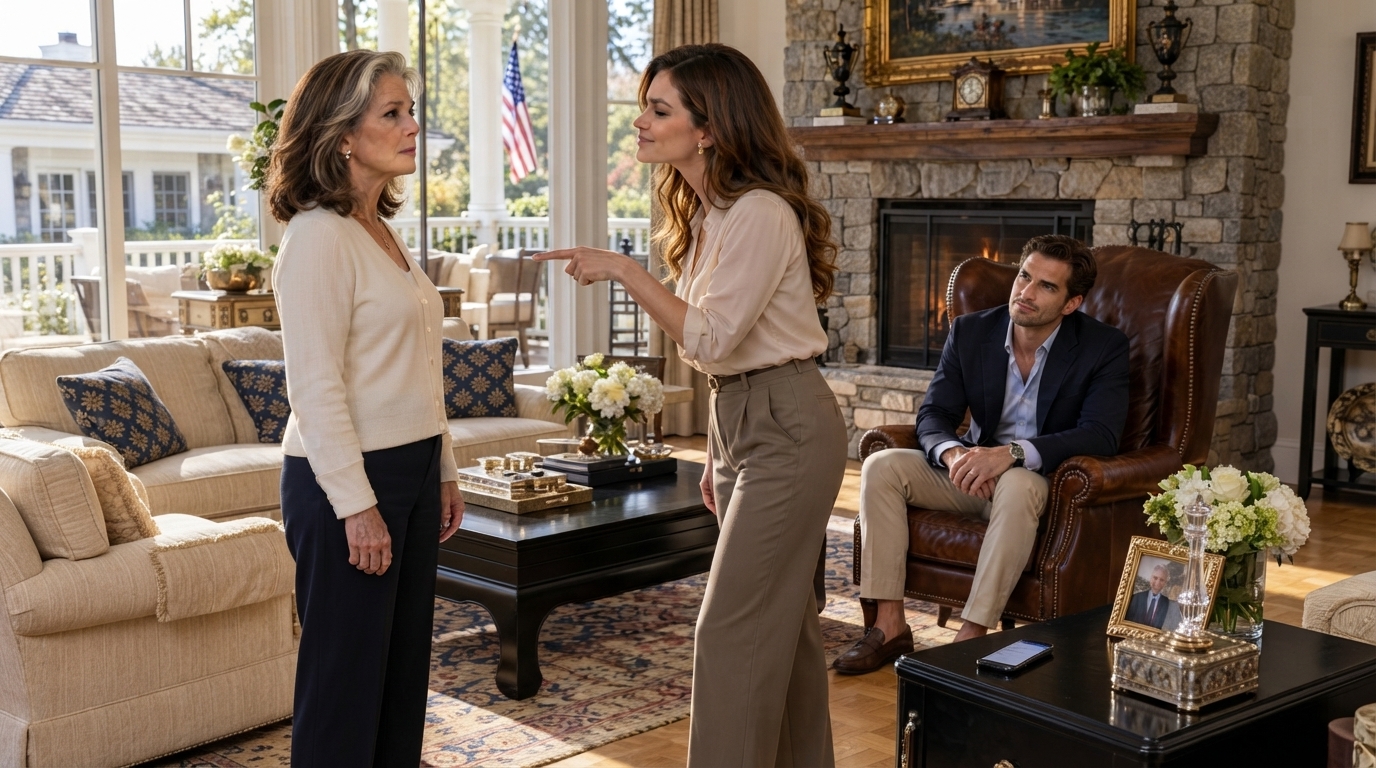
Patrick stood up from Arthur’s chair.
“I don’t appreciate strangers coming into a private family matter.”
Rebecca looked directly at him.
“Mr. Holloway, when substantial funds are transferred under a disputed power of attorney, it stops being a simple family disagreement.”
He laughed.
A short, unpleasant sound.
“Disputed? Margaret signed the documents herself.”
“Yes,” Rebecca replied. “And we have questions about how those signatures were obtained and how the authority was used.”
Sarah folded her arms.
“Mom knew exactly what she was signing.”
I looked at my daughter.
“Did I?”
She hesitated.
“Of course you did.”
“Then tell me, Sarah, why did you say those documents were simply to help organize the estate?”
Her expression hardened.
“Because that’s what they were.”
I turned toward Daniel.
“Would you like to explain?”
He nodded.
“Mrs. Vance, perhaps we should sit down.”
I looked toward Arthur’s chair.
Patrick was still standing beside it.
“Actually,” I said, “I’d like my husband’s chair back.”
Patrick stared.
“What?”
“You’ve been sitting in Arthur’s chair since you arrived. Please move.”
For a moment, nobody spoke.
Then Patrick stepped aside.
I lowered myself into the familiar wingback chair.
The leather was worn along the arms.
Arthur had spent thirty years sitting there, reading newspapers, reviewing business reports, and falling asleep during old detective movies.
For six weeks, I had avoided it.
It had seemed too painful to occupy the place where he should have been.
But that afternoon, I needed to feel close to him.
Daniel placed his briefcase on the coffee table.
“Mr. and Mrs. Holloway,” he began, “Meridian Private Bank has been reviewing a series of transactions involving accounts associated with the Vance estate.”
Patrick shrugged.
“There’s nothing to review. Margaret authorized me.”
“Your authorization is part of what we’re reviewing,” Daniel replied.
He opened a folder.
“The initial transfer of one hundred thousand dollars raised concerns because it moved funds from Mrs. Vance’s personal account into an account controlled by you.”
Patrick smiled.
“Which I was legally allowed to do.”
Daniel remained calm.
“A power of attorney does not automatically authorize an agent to use the principal’s money for the agent’s personal benefit.”
Patrick’s smile weakened.
Sarah stepped forward.
“We were protecting Mom’s money.”
I looked at her.
“By putting it in your husband’s name?”
She ignored me.
Daniel continued.
“After that transfer, additional instructions were submitted requesting the movement of substantially larger assets.”
He turned a page.
“Yesterday, Mr. Holloway initiated a series of transactions totaling approximately 2.8 million dollars.”
Sarah lifted her chin.
“That’s our family money.”
I felt a sharp pain in my chest.
Our family money.
Not my inheritance.
Not the savings Arthur and I had built together.
Not the financial security my husband had spent decades protecting.
Our family money.
I looked at her.
“Sarah, your father left those assets to me.”
She rolled her eyes.
“Mom, you’re sixty-three. What are you going to do with millions of dollars?”
The room went silent.
I stared at her.
She continued, apparently unable to stop herself.
“You already have the house. You have your pension. Patrick and I have a mortgage, two car payments, and plans for our future.”
I swallowed.
“So you decided you needed my money more than I did?”
She sighed.
“You’re making it sound ugly.”
“It is ugly.”
Patrick interrupted.
“Enough. We have the signed paperwork. Whatever Margaret thinks now doesn’t change that.”
Daniel looked at him.
“Actually, Mr. Holloway, the transactions did not proceed the way you believe.”
Patrick frowned.
“What does that mean?”
Daniel opened another folder.
“Mrs. Vance contacted Meridian after discovering the first transfer. She disputed the use of her authorization and instructed the bank to review any further activity.”
Sarah turned toward me.
“You called the bank?”
“Yes.”
“Behind our backs?”
I almost laughed.
“Sarah, you moved one hundred thousand dollars behind mine.”
She looked away.
Daniel continued.
“Once concerns were raised, the bank applied additional restrictions and began reviewing the account activity. Certain transfer instructions were held for investigation rather than completed.”
Patrick stared at him.
“That’s impossible.”
“No,” Daniel said. “It’s exactly what happened.”
Patrick pulled out his phone.
He tapped the screen several times.
Then his face drained of color.
“The money was there yesterday.”
Daniel nodded.
“You may have seen a pending transaction or provisional balance. That is not the same as cleared, unrestricted funds.”
Patrick began tapping faster.
Sarah leaned toward him.
“What?”
He didn’t answer.
“Patrick?”
“Shut up for a second.”
The words came out sharply.
My daughter flinched.
I noticed.
So did Rebecca.
Patrick finally looked up.
“You can’t just freeze my account.”
Daniel’s expression remained professional.
“I can’t discuss every aspect of the bank’s review in this room. But I can tell you that the transactions are being examined and that the relevant authorities have been notified where appropriate.”
Patrick looked toward the investigators.
For the first time, real fear appeared in his eyes.
Mr. Harris stepped forward.
“Mr. Holloway, we’d like to ask you some questions about the documentation submitted to the bank.”
Patrick straightened.
“I’m not answering anything without my lawyer.”
“That is your choice,” Harris replied.
Rebecca nodded.
“And it’s a sensible one.”
I looked at my daughter.
Sarah was staring at the floor.
Her earlier confidence had vanished.
“Mom,” she whispered, “you don’t understand.”
I felt tears gathering.
“Then explain it to me.”
She looked up.
“Patrick said the money wasn’t safe sitting in your accounts.”
“Why?”
“Because of taxes. Probate. People taking advantage of you.”
I shook my head.
“Your father had an estate plan. Rebecca explained it to us.”
Sarah’s eyes darted toward Patrick.
“He said there were problems with it.”
Rebecca spoke quietly.
“There were no such problems requiring these transfers.”
Patrick scoffed.
“That’s your opinion.”
“No,” Rebecca replied. “It’s based on the documents I prepared with Arthur and the records we’ve reviewed.”
I turned toward Daniel.
“Tell them about Arthur’s letter.”
Sarah looked at me.
“What letter?”
I reached into the drawer beside the chair and removed the envelope I’d found in my husband’s study.
The paper was slightly yellow.
Arthur’s handwriting stretched across the front.
Open when you’re ready, not before.
I had read the letter so many times that I knew almost every word.
Still, my hands trembled as I unfolded it.
“My darling Margaret,” I began.
Sarah looked uncomfortable.
I continued.
“If you’re reading this, I hope it’s because you’ve finally found the strength to look through my study. I know how much pain my leaving will cause you, and I wish more than anything that I could spare you that.”
My voice cracked.
I paused.
Then I kept reading.
“I have spent the last year making sure you will never have to depend on anyone’s generosity to live comfortably.”
Patrick shifted.
“Arthur was a paranoid old man.”
I looked up.
“Don’t speak about my husband that way.”
He fell silent.
I continued.
“There’s something I haven’t told you because I didn’t want to hurt you while we still had time together. Sarah and Patrick have asked me for money repeatedly. Some requests were reasonable. Others were not.”
Sarah’s eyes widened.
“Dad wrote that?”
I nodded.
“Your father documented everything.”
I read on.
“Patrick once asked me to guarantee a business loan using our home as collateral. When I refused, he told me I was selfish and that Sarah deserved her inheritance while I was still alive.”
Patrick’s face reddened.
“That conversation was private.”
Rebecca looked at him.
“Arthur recorded his account of it in his personal notes.”
I kept reading.
“Margaret, I hope Sarah never allows herself to be led into something dishonest. But if she does, please remember that loving our daughter does not mean surrendering your safety.”
Tears blurred the words.
Then I reached the final paragraph.
“I’ve asked Daniel Mercer to help you understand the safeguards we’ve put in place. No one should be able to move the principal assets without the required verification and authorization. If anyone pressures you to sign papers, take them to Rebecca. And if someone takes advantage of your grief, do not protect them from accountability simply because they share our blood.”
I lowered the letter.
For several moments, nobody spoke.
Then Sarah began crying.
“Dad thought I was going to steal from you?”
I looked at her.
“He was afraid someone would convince you that taking from me was acceptable.”
She shook her head.
“No. He didn’t trust me.”
I felt my heart ache.
“Sarah, you came into my home today and told me you’d taken everything your father left me.”
She wiped her cheeks.
“You don’t understand how hard things have been for us.”
“Then you could have told me.”
“You would have said no.”
I stared at her.
There it was.
The truth.
Not confusion.
Not misunderstanding.
She had known I might refuse.
So she had helped Patrick make the decision for me.
Daniel closed his folder.
“Mrs. Vance, there’s another matter.”
I looked at him.
He hesitated.
“During the review, the bank identified documentation associated with a separate credit application.”
Patrick suddenly stood.
“We’re done here.”
Rebecca looked at him.
“Sit down, Patrick.”
He glared at her.
“You don’t get to order me around.”
“No,” she replied. “But you should hear what is being discussed before deciding how to respond.”
Daniel continued.
“The application appears to have used financial information from Mrs. Vance’s accounts to support a request for business financing.”
I felt cold.
“What business financing?”
Patrick said nothing.
Sarah looked at him.
“Patrick?”
Daniel glanced at Rebecca.
She nodded for him to continue.
“The records suggest Mr. Holloway was seeking a loan of approximately six hundred thousand dollars.”
I stared.
“Using my money?”
“The application represented certain assets as available to support the borrowing,” Daniel explained. “Whether any security interest was properly created is under review.”
Sarah looked horrified.
“Patrick, you told me we were just moving the inheritance.”
He turned on her.
“Would you stop talking?”
She recoiled.
I watched my daughter stare at her husband.
And for the first time, I saw something other than smugness in her face.
Fear.
Not fear of losing money.
Fear of realizing the man she had defended might have been lying to her too.
Patrick looked toward the door.
“I want a lawyer.”
Mr. Harris nodded.
“You’re free to seek counsel. We won’t be conducting an interview without your cooperation.”
Patrick grabbed his jacket.
Then he looked at me.
“This isn’t over, Margaret.”
I stood slowly.
“No,” I said. “It isn’t.”
He walked out.
The front door slammed.
Sarah remained standing in the middle of my living room.
She looked at the empty doorway.
Then at the envelope in my hand.
“Mom,” she whispered, “what have we done?”
I looked at her.
And for the first time in my life, I didn’t rush to make my daughter’s pain disappear.
Because some truths are supposed to hurt.
And some consequences are the only things that finally make people listen.
PART 4
Sarah stayed in my living room long after Patrick left.
The investigators eventually departed after explaining the next steps in their review.
Daniel gathered his papers.
Rebecca remained beside me.
My daughter stood near the fireplace, twisting her wedding ring around her finger.
She looked younger somehow.
Not innocent.
Just frightened.
“Mom,” she whispered, “I didn’t know about the loan.”
I studied her.
“Did you know about the transfers?”
She lowered her eyes.
“Yes.”
“Did you know Patrick intended to put my money into an account under his control?”
She nodded.
“Yes.”
“Did you know I hadn’t agreed to give him that money?”
Her eyes filled.
“Mom—”
“Sarah.”
She began crying.
“Yes.”
The word hurt more than I expected.
Because there was no longer any room for excuses.
My daughter had known.
She had understood that the money belonged to me.
And she had helped take it anyway.
I sat back in Arthur’s chair.
“Why?”
Sarah wiped her face.
“We were drowning.”
I waited.
She sank onto the sofa.
“Patrick’s business has been losing money for almost two years.”
I stared at her.
“What business?”
“He invested in a commercial property development with two friends. They borrowed money, and the project fell apart.”
I remembered Patrick bragging about his investments at Christmas.
He had told Arthur that ordinary people never became wealthy because they were too afraid to take risks.
Arthur had listened politely.
Then, after they left, he’d said, “A man who talks that much about money usually wants someone else’s.”
At the time, I’d laughed.
Now the memory made my throat tighten.
“How much does he owe?” I asked.
Sarah looked down.
“Almost nine hundred thousand dollars.”
I closed my eyes.
Nine hundred thousand.
“Sarah, how could you hide that?”
She began crying harder.
“Because I was embarrassed.”
“Embarrassed?”
“He kept saying the next investment would fix everything. Then creditors started calling. He told me we’d lose the house.”
I felt sorrow rising beneath my anger.
But I kept my voice steady.
“And so you decided I should lose my security instead?”
She looked at me.
“I thought we could put the money back.”
I shook my head.
“With what?”
She didn’t answer.
“Sarah, you can’t repay nearly three million dollars with a promise.”
She covered her face.
“I know.”
I looked at Rebecca.
She gently touched my shoulder.
“Margaret, you don’t have to resolve this tonight.”
I nodded.
But there was something I needed to say.
I turned back to my daughter.
“When you came here today, you weren’t asking me for help.”
Sarah looked up.
“You were celebrating the fact that you believed you’d taken everything from me.”
Her face crumpled.
“Mom, please.”
“You smiled.”
She shook her head.
“You told me I should have been a better mother-in-law.”
Tears ran down her cheeks.
“And Patrick sat in your father’s chair while you waited for me to fall apart.”
She began sobbing.
“I was angry.”
“At what?”
She hesitated.
Then whispered, “At Dad.”
I stared.
“Why?”
“Because he left everything to you.”
I felt a sharp ache in my chest.
Sarah continued.
“He always said family came first. But when he died, I thought there would be something for me.”
I looked at her for a long time.
“Your father paid for your education.”
She nodded.
“He helped with your wedding.”
“I know.”
“He gave you and Patrick money for the down payment on your first house.”
“I know.”
“And when Henry was born, he started a college fund for him.”
Her shoulders shook.
“He loved you, Sarah.”
She looked up.
“Then why didn’t he leave me anything?”
I swallowed.
“Because he expected me to live for many more years.”
She stared.
I continued.
“I’m sixty-three. I may live another thirty years. Your father wanted me to be able to stay in our home, pay my bills, travel if I wanted, and never depend on anyone.”
Sarah looked away.
“He wasn’t punishing you by protecting me.”
For a long moment, she said nothing.
Then she whispered, “I never thought about it that way.”
I felt tears gather.
“That was the problem, sweetheart.”
Rebecca stood.
“I think Margaret needs some rest.”
Sarah looked frightened.
“Can I stay?”
I shook my head.
“Not tonight.”
“Mom—”
“Please go.”
She began crying again.
I wanted to hold her.
I wanted to tell her everything would be all right.
But I couldn’t.
Not yet.
Because love without boundaries had become the very thing Sarah expected to exploit.
Rebecca walked her to the door.
Before leaving, Sarah turned toward me.
“Do you hate me?”
I looked at my daughter.
The little girl who once slept with a stuffed elephant.
The teenager who cried when she failed her driving test.
The young woman Arthur had walked down the aisle.
And the adult who had tried to take away my financial security while I was grieving.
“No,” I said softly.
“I love you.”
She began to smile through her tears.
Then I added, “But I don’t trust you.”
Her smile disappeared.
“And love doesn’t erase what you’ve done.”
She lowered her head.
Then she left.
That night, I sat alone in Arthur’s study.
The house was silent.
I opened his letter again.
At the bottom, beneath his signature, was a sentence I hadn’t noticed the first time.
Margaret, you have spent your life taking care of everyone. Please let someone take care of you, even if that someone must finally be yourself.
I read it three times.
Then I cried.
Not the quiet tears I’d been shedding since his funeral.
I cried until my chest hurt.
I cried for Arthur.
For the years we would never have.
For the betrayal of our daughter.
For the woman I’d been before grief made me doubt my own judgment.
And when I finally stopped, I felt exhausted.
But I also felt something I hadn’t experienced in weeks.
Determination.
The following morning, I met Rebecca at her office.
Daniel joined us by video call.
We reviewed the estate plan carefully.
Arthur had structured the primary investments through a trust with clear rules about who could authorize distributions.
The power-of-attorney document Patrick had obtained did not give him authority over those trust assets.
The bank’s review had prevented the attempted large transfers from becoming completed withdrawals.
The initial one-hundred-thousand-dollar transfer was different.
That money had left my personal account.
Its recovery would require further investigation and possibly legal action.
I listened carefully.
For once, I asked every question.
Even the ones I thought might sound foolish.
Rebecca never rushed me.
Daniel explained the difference between account access, legal authority, and beneficial ownership.
And I began to understand what Arthur had done.
He hadn’t created a magical trap.
He had created safeguards.
Then, when I discovered the first unauthorized use of my money, those safeguards gave the bank a reason to stop and investigate before the damage became much greater.
Arthur had known that grief could make people vulnerable.
He had also known that a carefully prepared estate plan was only useful if I understood how to protect it.
By the end of the meeting, I had a list of steps to take.
Rebecca would handle the legal challenges to Patrick’s claimed authority.
The bank would continue its review.
I would change passwords, secure my documents, and establish new account procedures.
And I would no longer sign anything without independent advice.
When the meeting ended, Daniel looked at me through the screen.
“Mrs. Vance, your husband spoke about you often.”
My throat tightened.
“He did?”
Daniel smiled gently.
“He said you were the strongest person he knew.”
I laughed sadly.
“He must have been thinking of someone else.”
“No,” Daniel replied. “He said you just didn’t always know it.”
I looked away before he could see me cry.
The investigation continued over the following months.
Patrick hired an attorney.
His business creditors became involved.
The disputed transactions were examined.
Financial records were requested.
And the story he’d told Sarah began falling apart.
It turned out that the property investment wasn’t his only problem.
He had borrowed from relatives.
Used credit cards to cover business expenses.
And concealed several large debts from my daughter.
Sarah moved out of their house two months after the confrontation.
She took her son, Henry, and rented a small apartment near her workplace.
She filed for divorce shortly afterward.
I didn’t celebrate.
Their marriage ending wasn’t a victory.
There was a child involved.
There were years of memories.
And my daughter was learning painful lessons that would stay with her for a long time.
But I was relieved that she had begun making decisions for herself.
One afternoon, she called.
“Mom, could we meet for coffee?”
I hesitated.
Then I agreed.
We met at a small café near the library.
Sarah arrived early.
She looked tired.
There were dark circles beneath her eyes.
She wasn’t wearing her wedding ring.
When I sat down, she didn’t try to hug me.
I appreciated that.
For several minutes, we talked about Henry.
His school.
His new obsession with dinosaurs.
The way he had started asking complicated questions about everything.
Then Sarah placed a folded piece of paper on the table.
“What’s that?” I asked.
“A letter.”
I looked at her.
She swallowed.
“I wrote it because every time I try to apologize, I end up explaining myself instead.”
I unfolded the paper.
Her handwriting was uneven.
Mom, I betrayed you.
I stopped reading for a moment.
Then continued.
I knew you were grieving. I knew you trusted me. I used that trust to convince you to sign documents you didn’t understand.
My eyes filled.
Patrick pressured me, but I made my own choices. I could have said no. I could have warned you. Instead, I helped him.
I looked up.
Sarah was crying silently.
I kept reading.
I was jealous that Dad left everything to you. I told myself I deserved something because I was his daughter. I never stopped to think that you were his wife, that you had built that life together, or that the money was meant to protect you.
My throat tightened.
I don’t expect you to forgive me. I only want you to know that I understand why you can’t trust me.
At the bottom, she had written:
I’m sorry I made you feel alone when you had already lost Dad.
I lowered the letter.
For a long time, neither of us spoke.
Then Sarah whispered, “I started counseling.”
I nodded.
“That’s good.”
“I’ve been trying to understand why I let Patrick convince me that everything was somebody else’s fault.”
I looked at her.
“And?”
She wiped her eyes.
“I think I wanted the easy answer.”
I waited.
“If Mom has too much money, then taking some isn’t stealing.”
Her voice broke.
“If Dad was unfair, then we weren’t greedy.”
She shook her head.
“But those were lies.”
I felt tears slip down my cheeks.
“Yes,” I whispered.
Sarah reached toward my hand, then stopped.
“Can you ever forgive me?”
I looked at her.
“I don’t know how long that will take.”
She nodded.
“I understand.”
“But I want you to keep becoming someone who would never do this again.”
Her face crumpled.
“I will try.”
I took a breath.
“Then start there.”
We sat together for another hour.
I didn’t give her money.
I didn’t promise to fix her debts.
I didn’t invite her to manage my affairs again.
But when we left, I hugged her.
It was a cautious hug.
A painful hug.
Not the end of everything that had happened.
Just the beginning of something different.
Over the next several months, Sarah began rebuilding her life.
She worked full-time.
Made a budget.
Attended counseling.
And started paying back the small personal debts she had accumulated.
She also cooperated with the investigation into Patrick’s financial dealings.
I kept my distance from the legal details whenever possible.
Rebecca handled the paperwork.
The bank continued working through the disputed transactions.
Eventually, a portion of the initial one-hundred-thousand-dollar transfer was recovered through the legal process and related settlements.
The remaining loss was painful.
But the larger inheritance Arthur had protected remained intact.
I learned to accept that justice did not always mean getting every dollar back.
Sometimes it meant stopping the damage.
Sometimes it meant establishing the truth.
And sometimes it meant finally refusing to be the person everyone expected to sacrifice herself.
A year after Arthur’s death, I visited his grave.
It was a cool autumn morning.
The cemetery was quiet.
I brought yellow roses.
His favorite.
I knelt beside the headstone and brushed away a few fallen leaves.
“Hello, darling,” I whispered.
The words felt strange.
For thirty-four years, I’d said them when he came home from work.
Now I said them to a stone.
I placed the flowers beside his name.
“You were right about Patrick.”
The wind moved softly through the trees.
I smiled sadly.
“You were right about a lot of things.”
I sat on the grass.
Then I told him everything.
About the bank.
About Rebecca.
About Sarah’s apology.
About Henry starting school.
About the garden I’d finally planted behind the house.
And about the little trip I’d booked to the coast.
Arthur and I had always planned to spend a week by the ocean after he retired.
We never got the chance.
So I was going alone.
Not because I wanted to forget him.
But because I knew he would have wanted me to keep living.
I touched the headstone.
“I miss you every day.”
My voice broke.
“But I’m going to be all right.”
And for the first time since his death, I believed it.
That winter, Sarah came over for Christmas dinner.
She brought Henry.
Molly, my younger sister, joined us with her family.
The house was full of noise again.
Children laughing.
Dishes clattering.
Music playing softly from the living room.
For a moment, I stood in the doorway and watched everyone.
Arthur’s chair was empty.
It always would be.
But the room no longer felt entirely abandoned.
After dinner, Sarah helped me wash the dishes.
She dried a plate carefully.
Then glanced toward the living room.
“Mom?”
“Yes?”
“Can I ask you something?”
I nodded.
“Are you going to change your will?”
I turned off the faucet.
For one terrible second, the old fear returned.
Was this another conversation about money?
Another attempt to find out what she would receive?
Sarah saw my expression.
She immediately shook her head.
“No. I’m sorry. That came out wrong.”
I waited.
She swallowed.
“I just wanted to say you should.”
I stared at her.
“What?”
“You should make whatever arrangements make you feel safe.”
Her eyes filled.
“And if that means I don’t inherit anything, I’ll understand.”
I studied her face.
There was no smirk.
No entitlement.
No rehearsed argument.
Just sadness.
And something that looked like genuine acceptance.
I picked up a dish towel.
“Sarah, I have updated my estate plan.”
She nodded.
“I figured.”
“But I’m not going to discuss the details.”
She looked down.
“That’s fair.”
I touched her shoulder.
“I love you.”
She began crying.
“I love you too, Mom.”
I took a breath.
“And I hope that one day, money will never again be something that stands between us.”
She nodded.
“Me too.”
We finished the dishes together.
No promises about inheritance.
No bargaining.
No demands.
Just a mother and daughter standing side by side, learning how to exist in the same room without pretending the past hadn’t happened.
Later that night, after everyone left, I sat in Arthur’s chair with a cup of tea.
The Christmas tree glowed softly in the corner.
I looked around the living room.
The same fireplace.
The same bookshelves.
The same photographs.
The same house Sarah and Patrick had once believed they could take from me.
I remembered that afternoon so clearly.
Sarah standing across from me.
Patrick leaning forward in Arthur’s chair.
The smug announcement.
We transferred everything Dad left you into Patrick’s account.
And my answer.
How interesting.
People sometimes ask why I stayed so calm.
They imagine I had some brilliant plan.
That I knew exactly what would happen.
That I was enjoying watching them walk into a trap.
But the truth is simpler.
I was frightened.
I was grieving.
I was devastated that my own daughter could betray me.
I simply knew that shouting wouldn’t bring Arthur back.
Crying wouldn’t undo the transfers.
And begging wouldn’t make people respect me.
So I chose to listen.
To gather the facts.
To ask for help.
And to let the safeguards Arthur had put in place do their work.
My husband had left me more than money.
He had left me a house filled with memories.
A carefully prepared plan.
People I could trust.
And one final reminder that I deserved to be protected.
But the greatest thing he left me wasn’t written in the will.
It was the knowledge that I could survive without surrendering myself.
I looked at the photograph on the mantel.
Arthur was smiling.
His hair was silver.
His eyes were bright.
He was holding a fishing rod beside the lake where we’d spent our twentieth anniversary.
I smiled back.
“You clever old man,” I whispered.
Then I laughed.
A real laugh.
The first one I’d managed in that room without feeling guilty.
I lifted my tea toward his photograph.
“Thank you.”
Outside, snow began falling.
Inside, the house was warm.
And for the first time in more than a year, I wasn’t afraid of what would happen next.
Sarah had once believed my inheritance was money waiting to become hers.
Patrick had believed a grieving widow would be too weak to defend herself.
They had mistaken my silence for confusion.
My kindness for helplessness.
And my love for permission.
But they were wrong.
Because Arthur had spent his final months making sure I would never have to beg anyone for the right to live in peace.
And when my daughter announced she’d taken everything, she didn’t know the most important part of his plan.
The money was protected.
The truth was documented.
And the woman they expected to destroy was finally learning how strong she had always been.
I set my cup down.
Turned off the lamp.
And walked upstairs to the bedroom Arthur and I had shared for thirty-four years.
For so long, I’d been afraid to sleep there alone.
That night, I opened the curtains and watched the snow.
Then I climbed into bed.
I placed my hand on the empty pillow beside me.
“Goodnight, Arthur.”
And for the first time since losing him, I closed my eyes without wondering whether I would be able to face tomorrow.
I knew I would.
Because my husband hadn’t left me a fortune so other people could decide what to do with my life.
He had left it so I could decide for myself.
And that was the inheritance nobody could steal.
THE END THANK YOU FOR READING !!!