PART 3
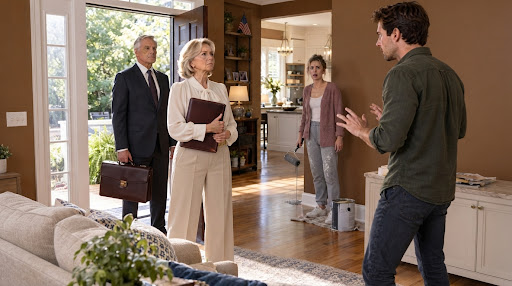
“Actually,” Arthur said, placing his briefcase on my dining room table,
“that’s exactly why we’re here.”
David’s face went completely white.
Sarah looked between us, her paint roller still dangling from one hand.
“What is this supposed to mean?” she demanded.
Arthur didn’t answer immediately.
Instead, he carefully removed a document from his briefcase and
placed it beside the original deed I had brought from my safe.
“Mrs. Bennett,” he said, looking at me, “would you like me to explain?”
I nodded.
“Please do.”
Arthur adjusted his glasses and turned toward my son.
David, approximately three weeks ago,
you submitted paperwork to a private lending company
claiming that you had legal authority to act on
your mother’s behalf regarding this property.
David swallowed.
“That’s not—”
Arthur raised one finger.
“Let me finish.”
Sarah stepped forward.
“David has power of attorney. His mother signed everything herself.”
I almost smiled.
There it was.
The lie I had been waiting to hear.
“Did I?” I asked quietly.
Sarah folded her arms.
“You know perfectly well you did. You signed the papers when we moved in.”
I looked at my son.
“David, is that what you told your wife?”
He stared at the floor.
My stomach tightened.
For forty-two years, I had loved that boy.
I had held him through fevers, taught him to ride a bicycle, stayed awake when he was late coming home, and helped him through every disappointment.
Now he couldn’t even look me in the eye.
Arthur opened the second document.
“This is the alleged power of attorney submitted to the lender,” he explained. “It appears to grant David authority over certain financial and property matters.”
Sarah nodded triumphantly.
“Exactly.”
Arthur continued.
“Unfortunately for your position, the signature attributed to Mrs. Bennett is disputed, and the document contains several serious irregularities.”
Sarah’s expression changed.
“What irregularities?”
“For one thing, the notarial acknowledgment identifies a location where Mrs. Bennett says she was not present.”
David’s eyes widened.
“And the date?” Arthur continued. “Mrs. Bennett was attending a charity luncheon with thirty-seven witnesses and a photographer.”
I placed a photograph on the table.
There I was, standing beside the mayor and three members of our local historical society.
The date was printed on the event program.
The same afternoon I had supposedly signed away authority over my home.
Sarah stared at the photograph.
Then she turned toward David.
“You told me she signed it at the kitchen table.”
Silence.
I looked at my son.
“Did you?”
David’s jaw tightened.
“Mom, we were only trying to help.”
I felt something inside me go cold.
“Help?”
He rubbed his forehead.
“You weren’t thinking clearly about the future.”
“David, I run three miles every morning. I manage my investments. I pay my taxes. I have never missed a mortgage payment because there isn’t a mortgage.”
Sarah suddenly interrupted.
“That’s exactly the problem! You’re sitting on a house worth almost a million dollars while your own son is struggling!”
The room went silent.
Arthur slowly closed his folder.
I stared at her.
“So that’s what this is about.”
Sarah’s cheeks flushed.
“Don’t twist my words.”
“You wanted my house.”
“We wanted stability for our children!”
“And you decided the best way to get it was to remove me?”
She opened her mouth.
Nothing came out.
I turned toward David.
“Tell me the truth. How much money were you trying to borrow?”
He looked away.
Arthur answered for him.
“Four hundred and twenty thousand dollars.”
For a moment, even I couldn’t breathe.
Four hundred and twenty thousand.
Against a house my husband and I had spent nearly forty years paying for.
A house we had purchased when David was just a baby.
A house filled with birthdays, Christmas mornings, and memories of the man I had loved.
And my son had tried to turn it into collateral without my informed consent.
“Why?” I whispered.
David finally looked at me.
His eyes were red.
“We’re in trouble, Mom.”
I waited.
“The business failed. I owe people money. Sarah’s credit cards are maxed out. We thought if we could borrow against the house, we’d have enough to start over.”
I stared at him.
“Then why didn’t you ask me?”
He gave a bitter laugh.
“Because you would have said no.”
I nodded slowly.
“Yes, David. I would have.”
Sarah threw the paint roller into the tray.
“You don’t understand what it’s like to have children and bills and no way out!”
I looked directly at her.
“Sarah, I raised three children on one income for almost two years after my husband was injured at work. I worked nights at a pharmacy and cleaned offices on weekends. Don’t lecture me about bills.”
She fell silent.
Arthur cleared his throat.
“There’s another issue we need to discuss.”
David closed his eyes.
I already knew what was coming.
During my week at Oak Hollow, Arthur had discovered that David and Sarah had contacted a real estate agent.
Not to ask about property values.
Not to explore possibilities.
They had requested an appointment to discuss listing my house.
The agent had been told that I was permanently moving into assisted living.
And that David was handling the sale.
Arthur placed a printed email on the table.
Sarah snatched it up.
Her face drained of color.
“You contacted the real estate agent?” I asked.
David said nothing.
“Were you going to sell my home while I was sitting in that nursing facility?”
“Mom, it wasn’t like that.”
“Then explain what it was like.”
He opened his mouth.
Closed it.
Then whispered, “We thought you’d be happier somewhere smaller.”
I looked around the living room.
At the gray paint covering the cream walls.
At the empty corner where my husband’s favorite armchair had stood.
At the family photographs removed from the mantel.
At the boxes stacked beside the staircase.
“You weren’t trying to make me happier,” I said. “You were trying to make me disappear.”
Sarah’s voice suddenly became sharp.
“Fine! You want us gone? Where are we supposed to take the children?”
There it was.
The weapon she always reached for when everything else failed.
My grandchildren.
Emily was twelve.
Jacob was nine.
Two beautiful children who had nothing to do with their parents’ deception.
I loved them fiercely.
And Sarah knew it.
She expected me to surrender the moment she mentioned them.
But I had prepared for that, too.
“The children will not be sleeping on the street,” I said.
Sarah blinked.
“What?”
“I’ve already spoken with your sister, Rebecca. She has agreed to let you stay temporarily while you find another place.”
David looked up.
“You called Rebecca?”
“Yes.”
“She hates me.”
“She doesn’t hate you, David. She’s tired of lending you money you never repay.”
Sarah’s face burned.
“You had no right to involve my family!”
I looked at her calmly.
“You involved my family when you tried to take my home.”
Arthur stepped forward.
“Mrs. Bennett has formally revoked any purported authority David claims to exercise on her behalf. The lender has been notified that the document is disputed, and no loan has been funded.”
David sank into a chair.
I could almost see the moment he realized his plan had collapsed.
But Arthur wasn’t finished.
“We have also prepared written notice terminating your permission to occupy the property. Mrs. Bennett is requesting that you leave voluntarily today. If you refuse, we will follow the applicable legal process.”
Sarah gave a humorless laugh.
“You can’t just throw us out!”
Arthur remained composed.
“That’s why we’re documenting the request and following the law. No one is proposing an unlawful lockout.”
I looked at my son.
“David, I want you to leave today. I don’t want this to become a courtroom battle.”
He rubbed both hands over his face.
“Mom, please.”
I waited.
“Can we talk privately?”
Sarah spun toward him.
“David!”
He ignored her.
“Please, Mom. Just five minutes.”
Arthur looked at me.
I nodded.
We stepped into my study.
The room smelled faintly of cedar and old books.
My husband’s framed military photograph still sat on the desk.
It was one of the few things Sarah hadn’t touched.
David closed the door.
Then he began crying.
Not quietly.
Not politely.
He collapsed into the leather chair across from me and covered his face.
“I’m sorry, Mom.”
I stood still.
“I didn’t mean for things to go this far.”
I looked at the man in front of me.
The little boy who once brought me dandelions from the backyard.
The teenager who cried when his father died.
The adult who had somehow convinced himself that my possessions belonged to him.
“David,” I said softly, “when did you stop seeing me as your mother and start seeing me as an obstacle?”
He looked up.
Tears ran down his cheeks.
“I don’t know.”
“Did you really believe I belonged in a nursing home?”
He shook his head.
“Then why did you put me there?”
“Sarah said you were getting older. She said we needed to think ahead.”
“And what did you think?”
He hesitated.
“I thought if we could get the house, maybe everything would be okay.”
I felt my heart break.
Not because of the money.
Because he had finally admitted it.
He had weighed my independence against his financial problems.
And decided my independence was expendable.
“You could have asked me for help,” I whispered.
“I knew you’d say no to that much money.”
“Yes.”
“Then what choice did I have?”
I stared at him.
“You had the choice to sell your cars. To find a smaller rental. To work another job. To declare bankruptcy if necessary. To tell the truth.”
He lowered his head.
“You had a hundred choices, David. You just didn’t want any of the difficult ones.”
For several moments, neither of us spoke.
Then he whispered, “Are you going to have me arrested?”
I looked toward my husband’s photograph.
“I have given Arthur permission to report the disputed documents. What happens next depends on the evidence and the authorities.”
David began shaking.
“Mom, please.”
“I will not lie to protect you.”
He stared at me as though I had struck him.
And I realized something painful.
He had grown so accustomed to my forgiveness that accountability felt like cruelty.
I opened the study door.
“Go pack your things, David.”
He followed me into the hallway.
Sarah was standing beside Arthur, speaking rapidly into her phone.
When she saw us, she demanded, “Well?”
David’s voice was barely audible.
“We’re leaving.”
She stared at him.
“What?”
“We’re leaving, Sarah.”
She looked at me with pure hatred.
“You’ve destroyed this family.”
I shook my head.
“No. I finally stopped allowing you to destroy me.”
And then, from the staircase, a small voice asked a question that broke my heart.
“Grandma?”
I turned.
My granddaughter Emily stood on the bottom step.
Her little brother Jacob was behind her.
Both were staring at the suitcases their parents had begun pulling from the closets.
Emily’s eyes filled with tears.
“Are you making us leave because you don’t love us anymore?”
For the first time that morning, my composure shattered.
Because whatever happened next, I knew two innocent children were about to pay an emotional price for the choices their parents had made.
And I refused to let them believe it was their fault.
PART 4
I crossed the hallway and knelt in front of Emily.
At seventy-two, my knees protested.
But I barely noticed.
I took her small hands in mine.
“Sweetheart, look at me.”
She wiped her cheeks.
“Are you mad at us?”
“No, darling. Not even a little.”
“Then why do we have to go?”
I glanced toward David and Sarah.
Neither spoke.
I chose my words carefully.
“Sometimes grown-ups make decisions that hurt other people. And when that happens, they have to take responsibility for those decisions.”
Emily frowned.
“Did Daddy do something bad?”
My throat tightened.
“Your daddy made some choices that weren’t right. But that has nothing to do with you or Jacob.”
Jacob stepped closer.
“Can we still come see you?”
I pulled him into my arms.
“Of course you can.”
“Even if Mommy says no?”
The question hit me harder than anything Sarah had said.
I looked at my grandson.
“We’ll work that out with your parents, sweetheart. But you must never think I stopped loving you.”
Emily wrapped her arms around my neck.
“I don’t want you to go away again, Grandma.”
I closed my eyes.
“Oh, my sweet girl. I never wanted to go away in the first place.”
Behind me, I heard Sarah make a small, angry sound.
But for once, I didn’t care.
My grandchildren needed reassurance.
Not another argument.
I stood slowly and faced David.
“Please take the children upstairs while you pack. They don’t need to watch us fight.”
David nodded.
He looked ashamed.
Good.
Shame wasn’t the same as change.
But perhaps it was a beginning.
Over the next four hours, my house became a place of frantic movement.
Sarah stomped through the rooms, stuffing clothes into suitcases and slamming drawers.
David carried boxes to his SUV.
Arthur remained downstairs, quietly documenting the condition of the property and confirming that the move was voluntary.
I sat at my kitchen table with a cup of tea.
I refused to argue.
Refused to apologize.
Refused to let Sarah turn my boundaries into a spectacle.
At one point, she marched into the kitchen carrying a cardboard box.
“You know,” she snapped, “most mothers would do anything to help their children.”
I looked up.
“Most mothers do help their children.”
“Apparently not you.”
I set down my cup.
“Sarah, I gave you a place to live when you had nowhere else to go. I paid the household expenses while you saved money. I offered you six months of stability.”
She crossed her arms.
“And now you’re throwing us out.”
“Because you tried to take the house.”
She opened her mouth.
I continued.
“You removed my furniture. You pushed me into a nursing facility. You attempted to gain control over property that wasn’t yours.”
“We were desperate!”
“Desperation doesn’t make dishonesty acceptable.”
Her expression hardened.
“You’ve always hated me.”
I shook my head.
“No, Sarah. I wanted to love you. I wanted you to feel welcome here. But you confused welcome with ownership.”
She stared at me.
Then she turned and walked away.
I didn’t follow.
By late afternoon, most of their belongings were loaded into two vehicles.
Rebecca arrived with her husband to help transport the children.
She greeted me quietly at the door.
“I’m sorry this happened.”
I nodded.
“Thank you for helping them.”
Rebecca sighed.
“They can stay with us for a little while. But I’ve made it clear that this isn’t permanent.”
“That’s wise.”
She glanced toward the stairs.
“Sarah told me you were losing your memory.”
I felt a chill.
“Did she?”
“She said you were becoming confused and couldn’t safely manage your finances.”
I stared at her.
“Rebecca, did you believe her?”
She shook her head.
“Not after I spoke to you on the phone. You sounded sharper than anyone else in the family.”
I almost laughed.
Then she said something that made my stomach tighten.
“There’s something else you should know.”
I waited.
“Sarah told me they were going to sell this house and buy a bigger place closer to her parents.”
I stared at her.
“Did she say when?”
“Within six months.”
My chest went cold.
So that had been the plan.
Not simply to borrow against my home.
Not merely to take over the master bedroom.
They intended to turn my entire life into a down payment on theirs.
Rebecca touched my arm.
“I’m sorry.”
I looked toward the living room, where the gray paint still covered half the wall.
“So am I.”
When David came downstairs carrying the final suitcase, he looked exhausted.
Sarah was already outside.
The children waited near the front door.
David stopped in front of me.
“Mom.”
I looked at him.
“I’m sorry.”
I nodded.
“I heard you the first time.”
He swallowed.
“Do you believe me?”
I thought about that.
Then I answered.
“I believe you’re sorry this happened. I don’t yet know whether you’re sorry for what you did.”
His face crumpled.
“That’s not fair.”
“Neither was putting me in a nursing home so you could take my house.”
He lowered his eyes.
I continued more gently.
“David, I love you. That hasn’t changed.”
He looked up.
“But love doesn’t mean I have to trust you with my home, my money, or my future.”
Tears slipped down his face.
“What happens now?”
“You find work. You take responsibility for your debts. You care for your children. And you stop expecting someone else to sacrifice their life to save yours.”
He nodded slowly.
Then he whispered, “Will you ever forgive me?”
I looked at my son for a long time.
“I hope so.”
His eyes filled again.
“But forgiveness and trust are different things. Trust has to be rebuilt.”
He stepped forward and hugged me.
For a moment, I let myself hold him.
I remembered his tiny hands gripping my fingers when he learned to walk.
I remembered carrying him through the house during thunderstorms.
I remembered the way he used to fall asleep against his father’s chest.
And I grieved the man he had become.
Then I stepped back.
“Go take care of your children.”
He nodded.
And walked out.
At 5:17 that evening, the final vehicle pulled away.
The house fell silent.
I stood in the doorway until the taillights disappeared.
Then I closed the door.
For the first time in weeks, I was alone in my own home.
I expected to feel victorious.
Instead, I felt exhausted.
I walked into the living room.
Half the walls were gray.
The other half remained cream.
A paint tray sat on a plastic sheet.
My husband’s armchair was missing.
The mantel was bare.
And a faint rectangle of dust marked the place where our wedding photograph had hung for thirty-nine years.
I sat on the floor.
And cried.
Not because I regretted making them leave.
I didn’t.
I cried because I had spent my entire life believing that if I loved my children enough, they would never deliberately hurt me.
I had been wrong.
The next morning, Arthur called.
“How are you holding up?”
“Better than yesterday.”
“Good. I have some updates.”
He explained that the lender had acknowledged receipt of the fraud report and had suspended processing of the proposed loan while the disputed authorization was reviewed.
He also confirmed that the property records still showed me as the sole owner.
No deed transferring my home to David had been recorded.
I closed my eyes in relief.
“Thank God.”
“But there’s more work to do,” Arthur cautioned. “We need to secure your accounts, update your estate documents, and ensure no one can use outdated paperwork to claim authority over your affairs.”
“Do it.”
We spent the following weeks putting safeguards in place.
I changed my passwords.
Reviewed my bank accounts.
Replaced the locks after confirming the house was fully vacated.
Updated my emergency contacts.
And worked with Arthur to prepare new estate-planning documents.
David would no longer be the person automatically entrusted with making decisions for me if I became incapacitated.
That responsibility went to my younger daughter, Claire.
Claire lived two states away.
She was a school principal with three children of her own.
When I told her what had happened, she cried.
“Mom, why didn’t you call me?”
I sighed.
“Because I didn’t want to put you in the middle.”
“Mom, you’re not a burden.”
Those words nearly broke me.
For weeks, David and Sarah had worked to convince me that I was becoming helpless.
And now my daughter was reminding me that needing support didn’t mean losing my dignity.
“I know, sweetheart.”
“No, Mom. I don’t think you do.”
I smiled through tears.
She continued.
“You spent your whole life taking care of everyone. But you don’t have to handle everything alone.”
I looked around my quiet kitchen.
“Maybe I’m finally learning that.”
Claire flew in the following weekend.
She arrived with her husband and two of their children.
When she saw the gray paint, she shook her head.
“Oh, Mom.”
I laughed.
“It’s certainly a bold decorating choice.”
She hugged me.
“We’re fixing this.”
And for the next three days, we did.
We repainted the walls their original warm cream.
We cleaned the floors.
We moved my furniture back into place.
My husband’s armchair had survived in the garage, though one leg was scratched.
Claire’s husband repaired it.
When he carried it into the living room, I cried again.
This time, the tears were different.
He placed the chair beside the window where it had always stood.
I ran my hand across the polished wood.
My husband, Robert, had loved that chair.
He sat there every Sunday morning with his newspaper and coffee.
After he died, I sometimes sat in it when I missed him.
Seeing it restored felt like recovering a small piece of my heart.
That evening, Claire and I sat together in the living room.
She handed me a glass of lemonade.
“Mom, can I ask you something?”
“Of course.”
“Why did you agree to go to Oak Hollow?”
I looked at her.
“Because I knew they were planning something.”
She frowned.
“You suspected the documents?”
“Not at first. But I knew they wanted me out of the house. And I wanted to understand how far they were willing to go.”
Claire shook her head.
“You could have been in danger.”
“I know.”
She took my hand.
“Promise me something.”
“What?”
“Next time, call me before you start investigating your own family.”
I laughed softly.
“Fair enough.”
But there was one more thing I needed to do.
Three weeks later, I returned to Oak Hollow.
Not as a resident.
As a visitor.
The director, Mrs. Whitmore, met me in her office.
She looked surprised.
“Mrs. Bennett. It’s lovely to see you.”
I sat down.
“I wanted to discuss my stay.”
Her smile faded.
“Was something wrong?”
I explained how David and Sarah had presented my visit as a step toward permanent placement, despite my intention to stay only one week.
I told her how they had described me as increasingly confused.
How they had spoken over me during the tour.
How they had tried to make decisions without asking what I wanted.
Mrs. Whitmore listened carefully.
Then she said something I appreciated.
“Mrs. Bennett, I remember you very well. You were clear that this was a voluntary trial stay. We should always be careful when relatives describe someone’s needs differently from the person themselves.”
I nodded.
“I don’t want another older person to be pressured into giving up their independence because their family wants their property.”
She promised to review the facility’s procedures for confirming residents’ wishes and consent.
I couldn’t know whether that conversation would change anything.
But at least I had spoken.
And that mattered.
Meanwhile, David’s situation continued to unravel.
The attempted loan never went through.
The lender’s investigation led to a formal referral concerning the disputed documents.
Months later, David entered into a legal agreement resolving his role in the false authorization, including financial penalties and conditions requiring him to avoid further misuse of my identity.
I didn’t celebrate.
I didn’t attend the proceedings.
I simply let the process take its course.
Sarah was furious.
She sent me a long message accusing me of destroying her children’s future.
I read it once.
Then I blocked her number.
I refused to spend another year defending my right to live in my own house.
David eventually found work managing inventory at a warehouse.
It wasn’t glamorous.
It wasn’t the business career he had imagined.
But it was honest work.
Rebecca told me he was slowly paying down his debts.
Sarah started working part-time at a dental office.
Their marriage was strained.
They moved from Rebecca’s house into a modest two-bedroom rental.
For the first time in years, they were living within their means.
I didn’t interfere.
I didn’t send checks.
I didn’t offer my spare bedrooms.
But I did keep my promise to my grandchildren.
With David’s agreement, Emily and Jacob began visiting me every other Saturday.
We baked cookies.
Played board games.
Worked in the garden.
And sometimes sat in Robert’s old armchair reading stories together.
One afternoon, Emily looked around the living room.
“Grandma, I like the walls this color.”
I smiled.
“Me too.”
She hesitated.
“Mommy said you were selfish because you wouldn’t let us keep living here.”
I set down my book.
“Emily, do you know what selfish means?”
She nodded uncertainly.
“Only caring about yourself?”
“That’s part of it.”
She looked at me.
“Were you selfish?”
I thought carefully.
“No, sweetheart. I cared about your family very much. But caring about someone doesn’t mean they get to take things that belong to you.”
She considered that.
Then she asked, “Like when Jacob takes my markers without asking?”
I laughed.
“Something like that.”
She nodded seriously.
“Then I understand.”
And just like that, a twelve-year-old understood something her parents had refused to accept.
Love and ownership are not the same thing.
Six months after that terrible Friday, David called.
I almost didn’t answer.
But something told me to pick up.
“Hello?”
“Mom.”
His voice sounded different.
Quieter.
Less defensive.
“Hi, David.”
He hesitated.
“I wanted to ask if we could talk.”
“About what?”
“Everything.”
I sat down.
“I’m listening.”
He took a long breath.
“I’ve been seeing a counselor.”
I blinked.
“Have you?”
“Yeah. Rebecca suggested it. I didn’t want to go at first.”
I waited.
“She asked me why I thought I deserved your house.”
My throat tightened.
“And what did you say?”
“I told her because I was your son.”
I closed my eyes.
He continued.
“She asked whether being your son meant I owned your life.”
There was a long silence.
Then he whispered, “I didn’t know how to answer.”
I stared at the sunlight falling across my kitchen table.
“David…”
“No, Mom. Please let me finish.”
I stayed quiet.
“I spent years believing that because Dad worked so hard for that house, it should eventually be mine. And when my business failed, I started thinking of the house as money that was being wasted because you were still living in it.”
Tears filled my eyes.
He continued.
“I didn’t think about what it meant to you. I didn’t think about your memories. I didn’t think about the fact that you had every right to live there for the rest of your life.”
His voice broke.
“I treated you like you were already gone.”
I covered my mouth.
“And when you agreed to go to Oak Hollow, I felt relieved.”
He began crying.
“Mom, I actually felt relieved.”
I let the silence stretch.
Then he whispered, “I hate that about myself.”
For the first time, I heard something I hadn’t heard in any of his previous apologies.
Understanding.
Not just regret over consequences.
Not just fear of losing money.
He was beginning to understand what he had done to me.
“David,” I said gently, “I don’t hate you.”
He sobbed.
“I know.”
“But I need time.”
“I understand.”
“And I need you to keep doing the work, whether I forgive you tomorrow or ten years from now.”
“I will.”
We spoke for another twenty minutes.
When the call ended, I sat quietly.
I didn’t rush to invite him back.
I didn’t offer money.
I didn’t pretend everything was healed.
But I allowed myself a little hope.
A year after the day I walked back through my front door with Arthur, I hosted a small family dinner.
Claire came with her husband.
Emily and Jacob helped set the table.
My youngest son, Michael, drove in from Ohio.
And David came alone.
Sarah had chosen not to attend.
That was fine.
Some relationships need distance before they can become healthy.
David arrived carrying flowers.
Not expensive ones.
A simple bunch of yellow tulips.
“They reminded me of Dad,” he said.
I smiled.
Robert used to plant yellow tulips along the front walkway every spring.
“Thank you.”
David looked around the living room.
The cream walls.
The polished floors.
The family photographs.
His father’s chair.
Everything was back where it belonged.
He swallowed.
“Mom, the house looks beautiful.”
I nodded.
“It feels like home again.”
His eyes filled.
“I’m glad.”
We ate dinner together.
There were awkward moments.
There were silences.
But there was also laughter.
Real laughter.
Not the forced kind people use to pretend nothing is wrong.
After dessert, David helped me carry dishes into the kitchen.
He stood beside the sink for a moment.
Then said, “Mom, I know I don’t deserve to ask, but could we start over?”
I looked at him.
“We can’t start over, David.”
His face fell.
“But we can start from here.”
He nodded slowly.
“I’d like that.”
“So would I.”
He reached for my hand.
And for the first time in a long time, I didn’t feel as though he was reaching for something else.
Just my hand.
Later that evening, after everyone had gone home, I sat in Robert’s chair with a cup of tea.
The house was quiet.
The kind of quiet I had once feared.
Now it felt peaceful.
I thought about the day David and Sarah moved in.
How grateful I had been to have family under my roof.
How quickly that gratitude turned into anxiety.
How I had begun walking carefully through my own rooms, afraid of upsetting people who were supposed to be my guests.
Then I remembered the day I returned.
Sarah holding the paint roller.
David standing in the kitchen.
Arthur beside me.
The original deed pressed against my chest.
I had thought the most important thing I was bringing home was proof of ownership.
But I was wrong.
The most important thing I brought home was my voice.
For too long, I had believed that being a good mother meant saying yes.
Yes to helping.
Yes to sacrificing.
Yes to forgiving.
Yes to making room.
But that year taught me something I wish I’d understood decades earlier.
A mother’s love can be unconditional without her home, money, and dignity being available for the taking.
I still loved David.
I still loved Sarah’s children.
I still hoped my family would heal.
But I no longer believed that keeping everyone happy was my responsibility.
The house belonged to me.
My decisions belonged to me.
And the years I had left belonged to me.
The following spring, I planted yellow tulips along the walkway.
Emily helped me dig the holes.
Jacob carried the watering can.
When we finished, Emily stood beside me and looked at the house.
“Grandma?”
“Yes, sweetheart?”
“Are you going to live here forever?”
I smiled.
“Well, not forever.”
She frowned.
“But for a long time?”
I looked at the windows glowing in the afternoon sunlight.
At the garden Robert had loved.
At the front door I had once been afraid of losing.
Then I wrapped my arm around her shoulders.
“As long as I choose to, darling.”
She grinned.
“Good.”
That evening, I stood on the porch watching the sunset.
A gentle breeze moved through the tulips.
Inside, the grandfather clock struck six.
I could almost hear Robert laughing.
Almost hear him saying what he used to tell me whenever life became difficult.
“Margaret, don’t let anybody make you a stranger in your own home.”
I smiled through my tears.
“I won’t, Robert.”
And I meant it.
Because one year earlier, my son had believed that putting me in a nursing home would give him everything I owned.
Instead, it taught me something far more valuable than the deed to a house.
I could love my family without surrendering my life to them.
And when I closed my front door that night, I didn’t lock it out of fear.
I locked it with the quiet confidence of a woman who finally knew that she had every right to be there.
In her own home.
On her own terms.
For as long as she pleased.
THE END THANK YOU FOR READING !!!