PART 3
“Marlo, I need you to sit down.”
Anise Halvorson’s voice sounded
different from the night I’d called
her from my hotel in Cambridge.
She was normally the kind of attorney who could deliver
terrible news with the same steady tone she used to discuss a parking ticket.
But now she sounded genuinely disturbed.
I set my coffee on the kitchen table.
“I’m sitting.”
Good. I’ve been reviewing the original estate
documents from your grandmother’s probate file.
There’s a document your parents never mentioned.
I stared at the morning sunlight spilling across my Seattle kitchen.
“What document?”
A letter of instructions attached to
your grandmother’s estate records.
It concerns the cabin,
certain financial accounts,
and a separate inheritance provision.
My heart began pounding.
“My grandmother left me the cabin. I know that.”
“Yes,” Anise replied. “But apparently, she left you more than that.”
I stopped breathing.
For sixteen years, I’d believed Grandma Eleanor’s greatest gift was the lake cabin.
She had been the only person in my family who made me feel important without expecting anything in return.
When I was little, she took me fishing before sunrise.
When Ranata received expensive birthday parties, Grandma Eleanor took me to the bookstore and let me choose anything I wanted.
When my mother forgot my high school awards ceremony, Grandma was sitting in the front row.
She never made excuses for my parents.
She simply showed up.
“What else did she leave me?” I whispered.
Anise paused.
“A financial gift that was supposed to be held for your benefit under specific conditions. The records suggest a trust was established, but we need to obtain the complete accounting.”
I stared at the wall.
“How much?”
“The original funding was one hundred and twenty thousand dollars.”
My hand flew to my mouth.
“One hundred and twenty thousand?”
“Yes.”
I couldn’t speak.
Anise continued carefully.
“Your grandmother named you as the beneficiary. Your father was initially appointed to administer the trust, subject to its terms.”
I closed my eyes.
My father.
The same man who had ignored my graduation.
Who hadn’t attended my wedding.
Who hadn’t called after Denver died.
The same man whose seventieth birthday party I’d flown across the country to attend, carrying a two-thousand-dollar gift he hadn’t bothered opening.
“What happened to the money?”
“That’s what we’re trying to determine.”
I felt cold.
“Anise.”
“Yes?”
“Please tell me my father didn’t take it.”
There was a long silence.
Then she said, “I can’t establish that yet. But the records I’ve seen don’t show the distributions to you that I would expect.”
I pressed my forehead against my hand.
And suddenly, the cabin wasn’t the most important thing anymore.
Neither were the bank accounts.
Because if my grandmother had left money for me, and my father had kept it from me, then the family I’d spent thirty-seven years trying to please had betrayed me in a way I hadn’t even imagined.
I hung up and walked into my living room.
Denver’s photograph sat on the bookshelf.
He was standing on a hiking trail in Washington, smiling beneath a faded baseball cap.
Three years.
It had been three years since pancreatic cancer took him.
Some mornings, I still reached toward his side of the bed before remembering he wasn’t there.
I picked up his photograph.
“You were right,” I whispered.
He used to tell me my family treated affection like a reward I had to earn.
Whenever I paid for something, helped with a crisis, or gave up my plans for theirs, they became temporarily kind.
Then the kindness disappeared.
Denver saw the pattern before I did.
He once asked me a question I never forgot.
“Marlo, if you stopped doing things for them tomorrow, would they still call you?”
I had laughed.
“Of course.”
He didn’t argue.
He just looked sad.
Now, standing in my living room with forty-nine missed calls on my phone, I finally understood.
They were calling because the money had stopped.
Not because they missed me.
At nine that morning, Ranata sent a message.
You’ve lost your mind.
Another arrived.
Dad’s golf membership payment bounced.
Then:
Mom says the landscaping company won’t come until the overdue balance is paid.
I stared at the screen.
There wasn’t a single question about how I was doing.
No mention of the birthday party.
No apology.
Just a list of inconveniences caused by my decision to stop funding their lives.
I typed one response.
Please direct financial questions to Anise Halvorson.
Then I muted the conversation.
Ten minutes later, my father called.
I let it go to voicemail.
“Marlo, this is your father. I don’t understand what’s happening. The cabin is gone, the accounts are frozen, and your mother is beside herself. Call me immediately.”
He paused.
Then added, “This is no way to treat family.”
I listened to that sentence twice.
This is no way to treat family.
I thought about my wedding.
The empty pew.
Denver squeezing my hand because he knew I was trying not to cry.
I thought about his funeral.
The single bouquet.
The card signed in Ranata’s handwriting.
Then I deleted the voicemail from my active inbox, knowing Anise already had a preserved copy of the communications.
The cabin sale had taken more planning than my family realized.
After the birthday party, Anise had contacted a buyer who had previously expressed serious interest through a local agent.
The property was valuable, beautifully maintained, and located on a desirable stretch of lakefront.
The buyers were a retired couple who wanted a summer home for their grandchildren.
We negotiated a sale for slightly above the recent appraisal.
The purchase agreement gave my family a limited, documented period to collect their belongings.
The closing attorney confirmed the title and required disclosures.
The proceeds went into an account solely in my name.
And the cabin that my parents had treated like a free vacation resort was no longer available to them.
I hadn’t sold it because I hated the memories.
I loved that cabin.
I loved the dock where Grandma Eleanor taught me to fish.
I loved the stone fireplace.
I loved the bedroom with the blue quilt she made herself.
But I couldn’t keep paying to preserve a place where everyone else felt entitled and I felt unwelcome.
The cabin had been mine.
The decision to sell it was mine too.
Three days later, Anise called with another discovery.
“Marlo, we obtained the account records you authorized us to request.”
I sat at my desk.
“What did you find?”
“The three accounts have a complicated history. Your name appears as the primary holder, and your parents had authorized access. The bank is reviewing the closures and outstanding obligations.”
I nodded.
“And the transfers to Ranata?”
“Seventy-nine thousand six hundred and forty dollars over approximately five years.”
I closed my eyes.
“Where did the money come from?”
“Mostly deposits associated with your income and funds transferred from an investment account you controlled.”
My stomach tightened.
I remembered those years.
I had worked long hours.
I had sent money home when my father complained about expenses.
I had transferred extra funds after my mother claimed the house needed repairs.
And I had never carefully reviewed how the money was being spent.
“Did Ranata receive it directly?”
“Yes. The records show recurring transfers to an account in her name.”
I stared at my hands.
“Why?”
“We don’t know yet. Some transfers were labeled household support. Others were labeled reimbursements.”
I shook my head.
“I never agreed to pay Ranata’s expenses.”
“Then we’ll request supporting documentation and examine who initiated each transfer.”
I swallowed.
“And the credit lines?”
“We’re addressing them separately. Closing an account doesn’t erase legitimate outstanding debt, and we’re making sure your credit is protected while any disputed transactions are reviewed.”
I nodded.
“Thank you.”
Anise hesitated.
“Marlo, I think you should prepare yourself.”
“For what?”
“The trust records may be worse.”
That evening, my mother finally sent a message that mentioned the birthday party.
Marlo, I think you’ve misunderstood what I said.
I stared at it.
Then another appeared.
I was only joking.
I almost laughed.
A joke.
Thirty-seven years of being treated as less important than Ranata.
A joke.
Being told I was invited out of pity.
A joke.
My mother continued.
Your sister was laughing because she knew I didn’t mean it.
I set down my phone.
Then it buzzed again.
You have always been so sensitive.
There it was.
The final piece of the familiar pattern.
First came the insult.
Then the denial.
Then the accusation that my reaction was the real problem.
I didn’t answer.
Instead, I opened the drawer beside my desk and took out Grandma Eleanor’s handwritten note.
Use this however you need to, my brave girl.
I traced the words with my finger.
For years, I thought she meant the cabin.
Now I wondered whether she had meant something bigger.
A week later, Anise asked me to join a video conference.
She had invited a trust-accounting specialist named Rebecca Shaw.
Rebecca was a woman in her fifties with silver-framed glasses and a calm, precise voice.
“Marlo,” she began, “we’ve located several years of trust statements.”
My heart raced.
“Okay.”
“The trust was funded shortly after your grandmother’s death. The documents required your father, as trustee, to manage the assets for your benefit and distribute them according to the trust’s terms.”
I swallowed.
“And?”
Rebecca looked toward Anise.
Then back at me.
“Large withdrawals were made over several years.”
My fingers tightened around the edge of my desk.
“How large?”
“Approximately ninety-three thousand dollars in principal withdrawals, excluding any investment changes or other adjustments.”
I couldn’t breathe.
“Where did it go?”
Rebecca glanced at her notes.
“Some payments appear to have gone toward expenses associated with your parents’ property. Others were transferred to accounts controlled by your father.”
I stared at the screen.
“My father used my grandmother’s money?”
“We have evidence of withdrawals,” Anise said carefully. “We still need to determine whether any were authorized under the trust terms. At present, the records raise serious questions.”
I covered my mouth.
Rebecca continued.
“There’s another issue. The trust appears to have required a final distribution or accounting when you reached a specified age. We haven’t found proof that happened.”
I whispered, “Nobody told me.”
Anise nodded.
“I know.”
I began crying.
Not because I needed the money.
Denver had left me financially secure.
I had savings.
Investments.
A comfortable home.
I wasn’t struggling.
But Grandma Eleanor had left something specifically for me.
And my father appeared to have treated it as another family resource he could control.
The betrayal was almost impossible to comprehend.
That night, I dreamed about my grandmother.
I was eight years old again.
We were sitting on the cabin dock, our fishing lines disappearing into the dark water.
She was wearing her old green cardigan.
I remembered asking why Ranata always received more attention.
Grandma had looked at me for a long moment.
Then said, “Sometimes people are so busy admiring the loudest person in the room that they forget to see the quiet one.”
I had asked whether that meant something was wrong with me.
She had squeezed my hand.
“No, sweetheart. It means you must never let their blindness become your mirror.”
I woke up crying.
And for the first time in years, I didn’t try to stop.
The next morning, Anise called again.
“Your father has retained an attorney.”
I sat straighter.
“Good.”
She sounded surprised.
“Good?”
“Yes. Maybe now he’ll take this seriously.”
Anise paused.
“His attorney has requested a meeting.”
“With me?”
“With us. Your parents want to discuss the cabin sale, the bank accounts, and the trust.”
I looked out at the Seattle rain.
“Will Ranata be there?”
“They’ve asked for her to attend.”
I thought about my sister laughing at the birthday party.
Then I remembered all the years she’d called me boring.
All the years she’d mocked my career.
All the years she’d treated me like an inconvenient relative who existed mainly to provide favors.
“Yes,” I said.
“Marlo, you don’t have to attend personally.”
“I know.”
“Are you certain?”
I took a slow breath.
“Yes.”
Because for thirty-seven years, my family had controlled every conversation by making me feel ashamed.
This time, there would be attorneys.
Documents.
Numbers.
And the truth.
The meeting took place two weeks later in a conference room in Boston.
I flew from Seattle the evening before.
I stayed at the same Cambridge hotel where I’d made the first call to Anise.
But this time, I didn’t sit on the bed crying.
I slept.
The next morning, I put on a navy suit, tied my hair back, and drove to the law office.
Anise met me outside.
“Ready?”
I nodded.
“Yes.”
We entered the conference room.
My parents were already seated.
Ranata sat beside them.
My mother looked furious.
My father looked older than he had at his birthday party.
Ranata was staring at her phone.
When she saw me, she scoffed.
“Well, look who finally decided to show up.”
I pulled out my chair.
Sat down.
And smiled politely.
“Hello, Ranata.”
My mother leaned forward.
“Marlo, this has gone far enough.”
I looked at her.
“Has it?”
“You sold our cabin.”
“My cabin.”
She waved a hand.
“You know what I mean.”
“No,” I replied. “I don’t think I do.”
The room went quiet.
My father cleared his throat.
“We’re here to resolve this.”
I nodded.
“Good.”
Anise opened her folder.
“Then let’s begin with the trust accounting.”
My father’s expression changed.
My mother stopped moving.
And Ranata finally put down her phone.
Anise placed the first document on the table.
“Mr. Whitcomb, can you explain why funds designated for Marlo were transferred into accounts associated with your personal expenses?”
My father stared at the paper.
Then whispered something I never expected to hear.
“Eleanor wasn’t supposed to leave her that money.”
The room went completely silent.
I looked at him.
“What did you just say?”
He raised his eyes.
And for the first time in my life, I saw fear in my father’s face.
PART 4
My father stared at the trust documents as though they were something dangerous.
My mother reached for his arm.
“Richard,” she whispered, “don’t.”
He pulled away.
I sat perfectly still.
“Dad,” I said, “what do you mean Grandma wasn’t supposed to leave me that money?”
He rubbed his forehead.
Nobody answered.
Anise spoke.
“Mr. Whitcomb, you’re not required to answer without consulting your attorney. But the trust records are central to this matter, and we need an accurate accounting.”
My father’s attorney leaned toward him.
They whispered for several seconds.
Then my father looked at me.
“Your grandmother made decisions without considering the rest of the family.”
I stared at him.
“What decisions?”
“She favored you.”
I almost laughed.
“Favored me?”
He nodded.
“She left you the cabin. She established that trust. She didn’t leave comparable gifts to Ranata.”
I felt my chest tighten.
“So you thought that was unfair?”
“Yes.”
I looked at my mother.
She avoided my eyes.
Then I looked at Ranata.
She stared at the table.
A terrible realization settled over me.
“You all knew?”
Nobody answered.
I leaned forward.
“Did you know Grandma left me money?”
Ranata finally looked up.
Her eyes were wet.
“Marlo—”
“Answer me.”
She swallowed.
“Yes.”
The word struck harder than I expected.
My sister had known.
My mother had known.
My father had known.
And for sixteen years, they’d allowed me to believe the cabin was the only inheritance Grandma Eleanor had left.
I looked at my father.
“Why didn’t you tell me?”
He shifted in his chair.
“We used the money for family needs.”
I stared at him.
“Whose needs?”
He sighed.
“Your mother’s medical bills. Repairs to the house. Expenses that came up.”
Anise glanced at the records.
“Some withdrawals may require additional explanation. The payments we’ve identified don’t all match those descriptions.”
My father stiffened.
I looked at him.
“Did you use my trust money to pay for your golf membership?”
He didn’t answer.
“Dad.”
His attorney raised a hand.
“We’re not going to characterize individual transactions without reviewing the full accounting.”
I nodded.
“Fine.”
Then I turned toward Ranata.
“Did you receive money from the trust?”
She began crying.
“I didn’t know where all of it came from.”
I stared at her.
“But you knew Grandma left me money.”
She nodded.
“And you never told me.”
She covered her face.
“I thought Dad was handling everything.”
I looked away.
For years, Ranata had treated me like the family disappointment.
The daughter who wasn’t glamorous enough.
The sister whose career wasn’t impressive enough.
The relative invited only when someone needed help.
And all that time, she had known I was being kept in the dark about an inheritance meant for me.
My mother suddenly spoke.
“Marlo, your grandmother always had a soft spot for you.”
I turned toward her.
“She loved me.”
“Of course she did.”
“No, Mom. She loved me enough to notice when nobody else did.”
My mother’s expression hardened.
“That’s unfair.”
I felt something inside me finally break.
“Unfair?”
My voice rose.
“You told me I was invited to Dad’s birthday party out of pity.”
She looked around the conference room.
“Must we discuss that here?”
“Yes.”
Anise sat quietly beside me.
I continued.
“You laughed when Ranata mocked me. You skipped my graduation. You didn’t come to my wedding.”
My throat tightened.
“You didn’t even come to Denver’s funeral.”
My mother looked down.
I felt tears rising.
“Do you know what it was like standing beside my husband’s coffin and realizing none of you had come?”
Nobody spoke.
I swallowed.
“I spent years believing I was asking too much.”
My voice shook.
“I wasn’t asking for money. I wasn’t asking for gifts. I was asking you to love me enough to show up.”
Ranata began crying harder.
My father stared at the table.
I wiped my eyes.
“And now I find out Grandma left me something, and you decided I didn’t deserve to know.”
The meeting continued for another hour.
Anise requested a complete trust accounting.
My father’s attorney agreed to provide the remaining records through the appropriate process.
We discussed the disputed transfers from the bank accounts.
We reviewed the cabin sale documents.
And we established that my parents would arrange to remove their remaining belongings from the property before the deadline agreed with the buyers.
My mother repeatedly tried to turn the conversation into an argument about loyalty.
Anise kept returning to the documents.
Every time.
When my mother said I’d abandoned the family, Anise asked about the trust records.
When my father said the cabin should have remained available to everyone, Anise referred to the deed.
When Ranata complained about the canceled summer vacations, Anise pointed out that she had no ownership interest in the property.
It was the first family meeting I’d ever attended where guilt couldn’t replace facts.
Near the end, my father looked at me.
“Marlo, what do you want?”
I stared at him.
The question was almost unbearable.
For thirty-seven years, I’d wanted him to ask me that.
Not about money.
Not about favors.
About me.
What did I want?
I thought about my grandmother.
About Denver.
About the empty pew at my wedding.
About the hospital room where I’d held my husband’s hand while he was dying.
And about the birthday party where my mother told me I was invited out of pity.
“I want the truth,” I said.
My father nodded slowly.
“And after that?”
I took a breath.
“I want the financial matters resolved properly.”
He looked down.
“And then?”
I stared at him.
“Then I want you to leave me alone until I decide whether I want a relationship with you.”
My mother gasped.
“Marlo!”
I looked at her.
“For once, Mom, you don’t get to decide what happens next.”
The legal and financial process took several months.
There was no magical moment when every dollar returned overnight.
The trust required a full accounting.
The bank had to review disputed transactions.
The credit lines had to be addressed according to their actual agreements.
And my father, as trustee, had to answer questions about withdrawals that appeared inconsistent with the trust’s purpose.
Anise handled most of the correspondence.
I continued working in Seattle.
I went hiking on weekends.
I visited friends.
And slowly, I stopped checking my phone every time it vibrated.
Eventually, my father agreed to a settlement addressing the trust-accounting dispute.
The agreement required repayment of an amount determined through the accounting and negotiations.
He had to sell investments and make other financial arrangements to satisfy the obligation.
I didn’t celebrate.
The money mattered.
But it couldn’t restore the years I’d lost believing my grandmother had forgotten to provide for me beyond the cabin.
It couldn’t bring Denver back.
And it couldn’t make my parents become the people I’d always needed.
The separate bank-account review revealed something else.
Not every transfer to Ranata had been unauthorized.
Some had been made through access I’d knowingly granted years earlier, even though I’d never understood how extensively that access was being used.
Other transactions lacked clear supporting instructions.
After reviewing the evidence, the bank corrected certain disputed charges and provided documentation for the rest.
Anise helped me resolve the remaining obligations and separate my finances completely.
The accounts were closed or restructured through the bank’s procedures.
Authorized users were removed.
Outstanding credit obligations were settled or refinanced as required.
And for the first time since I was twenty-one, my financial life no longer supported my parents’ household or Ranata’s spending.
It was an enormous relief.
Not because I needed the money.
But because I no longer wanted to participate in a system where my family treated my generosity as an obligation.
Ranata called me one evening in November.
I almost didn’t answer.
Then I saw she’d left a voicemail.
“Marlo, it’s me. I know you don’t want to talk. But I need to tell you something.”
Her voice broke.
“I’ve been thinking about Denver.”
I sat down.
She continued.
“I remember when he called us before he died.”
My heart stopped.
I stared at the phone.
Denver had called them?
She swallowed.
“He asked whether we would come visit you.”
My hands began shaking.
“He said you were exhausted. He said you were trying to be strong for him, and he was worried about what would happen to you afterward.”
I covered my mouth.
Ranata began crying.
“Mom said it would be too difficult to travel.”
I closed my eyes.
“And I agreed with her.”
Her voice broke.
“I’m sorry, Marlo.”
I couldn’t breathe.
Denver had been dying.
He’d known his time was running out.
And instead of worrying only about himself, he’d reached out to my family because he was afraid I’d be alone.
They hadn’t come.
Not even then.
I called Ranata back.
She answered immediately.
“Marlo?”
I could barely speak.
“Did Denver really call you?”
“Yes.”
“When?”
“About three weeks before he died.”
I pressed my hand against my chest.
“What did he say?”
She began crying.
“He said you needed your family.”
I closed my eyes.
“He said you were scared but pretending you weren’t.”
Tears streamed down my face.
“He asked us to come.”
I whispered, “And you didn’t.”
“No.”
I sat in silence.
Then Ranata said something that surprised me.
“I don’t have an excuse.”
I looked toward Denver’s photograph.
For once, my sister wasn’t blaming me.
She wasn’t calling me sensitive.
She wasn’t explaining why someone else’s needs were more important.
She was simply admitting what she’d done.
“I don’t know how to forgive you for that,” I whispered.
“I know.”
“I don’t know if I ever will.”
“I understand.”
We stayed on the phone for several minutes.
Then she said, “I don’t expect you to fix things for me anymore.”
I wiped my eyes.
“Good.”
She swallowed.
“But I wanted you to know he loved you enough to ask us to take care of you.”
I looked at Denver’s photograph.
And whispered, “I know he did.”
The next morning, I took a day off work.
I drove to the coast.
Denver and I used to spend weekends near the water, walking along beaches and collecting smooth stones.
I parked beside a quiet stretch of shoreline.
The sky was gray.
The wind was cold.
I walked until I reached a driftwood log and sat down.
For a long time, I listened to the waves.
Then I took out my phone.
I opened an old video.
Denver was standing in our kitchen, laughing because he’d accidentally burned pancakes.
“Don’t film this,” he said in the recording.
I laughed behind the camera.
“Why not?”
“Because someday you’ll use it as evidence that I was a terrible cook.”
I smiled through tears.
He turned toward me.
“Marlo, promise me something.”
In the video, I asked, “What?”
He smiled.
“Never stop laughing at me.”
The recording ended.
I watched it again.
Then again.
And finally, I cried until there were no tears left.
In December, Anise called with one final discovery.
“Marlo, we located a sealed envelope in the estate attorney’s archived files.”
My heart tightened.
“From Grandma?”
“Yes.”
“What does it say?”
“I haven’t opened it. It’s addressed to you, and the archive released it with the other records.”
I closed my eyes.
“Can you send it?”
“Of course.”
Three days later, a courier delivered a small package to my house.
Inside was a yellowed envelope.
Across the front, in familiar handwriting, were four words.
For my brave Marlo.
I sat at the kitchen table.
My hands trembled as I opened it.
Inside was a letter.
I recognized Grandma Eleanor’s handwriting immediately.
My darling Marlo,
If you are reading this, then I hope you have built a beautiful life.
I know you have spent many years trying to understand why your parents and sister treat you differently.
I wish I could give you an answer that would make the hurt disappear.
But sometimes people fail the ones who love them most, and there is no explanation that makes it acceptable.
I want you to remember something.
You were never less deserving of love.
You were never the disappointing one.
You were the child who noticed when someone was lonely.
You were the girl who helped me carry groceries without being asked.
You were the granddaughter who sat beside me when I was sick, even when everyone else had somewhere more exciting to be.
I left you the cabin because I knew it was the one place where you felt free.
I arranged the financial gift because I wanted you to have choices.
Not because I believed money could make you happy.
But because I wanted you to know you could walk away from anyone who made you feel small.
If the cabin brings you joy, keep it.
If it becomes a burden, sell it.
If the money helps you build a future, use it.
And if anyone tells you that loving your family means sacrificing your peace, remember that I never taught you that.
You are allowed to choose yourself, sweetheart.
You always were.
All my love,
Grandma Eleanor.
I pressed the letter against my chest.
And cried.
Not because I felt abandoned.
But because, after all those years, someone had finally put into words what I’d needed to hear.
I had never been the family disappointment.
I had simply been the daughter they didn’t know how to appreciate.
Christmas arrived quietly.
For the first time in my life, I didn’t fly to Massachusetts.
I didn’t send expensive gifts.
I didn’t wait for an invitation.
Instead, I invited six friends to my home.
We cooked together.
We exchanged small presents.
We played terrible board games.
And we laughed until midnight.
At one point, my friend Hannah looked around the room.
“Marlo, this is the best Christmas party you’ve ever hosted.”
I smiled.
“It’s the first one I’ve hosted without worrying whether everyone approves.”
She raised her glass.
“To that.”
We laughed.
And somewhere in the middle of the evening, I realized something.
Nobody had asked me to pay for their vacation.
Nobody had criticized my decorations.
Nobody had told me I was lucky to be included.
They were simply happy to be there.
With me.
My parents continued sending occasional messages.
My mother wrote that the family had suffered enough.
My father said he missed me.
Sometimes I believed him.
Sometimes I didn’t.
But I no longer felt responsible for solving their discomfort.
I had made my position clear.
Any future relationship would require honesty, respect, and an acknowledgment of what had happened.
Not vague apologies.
Not guilt.
Not another invitation designed to make me grateful for being included.
Real change.
And until I saw that, I was content to keep my distance.
Ranata and I spoke occasionally.
Our conversations were awkward.
Sometimes painful.
But she stopped asking for money.
She stopped mocking my life.
And once, when I mentioned Denver, she simply listened.
It wasn’t forgiveness.
Not yet.
But it was different.
I didn’t know whether we’d ever become close.
For the first time, I was comfortable not knowing.
The following summer, I received a photograph from the couple who had purchased the cabin.
They were standing on the dock with their grandchildren.
The youngest child was holding a fishing rod.
Behind them, the lake glittered beneath the afternoon sun.
The message read:
Thank you for allowing us to make memories in this beautiful place. We hope you know how much happiness it brings our family.
I stared at the photograph.
Then smiled.
Grandma Eleanor would have loved it.
The cabin was still full of laughter.
Just not the kind that came at someone else’s expense.
A year after my father’s birthday party, I returned to Massachusetts.
Not for a family gathering.
Not for a wedding.
Not for an apology.
I went to visit Grandma Eleanor’s grave.
I brought white roses.
Her favorites.
I knelt beside the headstone and placed the flowers carefully.
“Hi, Grandma,” I whispered.
The wind moved through the trees.
“I sold the cabin.”
My eyes filled.
“I hope that’s okay.”
I smiled through tears.
“Actually, I know it is. You told me so.”
I sat beside her grave for a long time.
Then I took out her letter.
The paper had become soft from being unfolded so often.
I read the final paragraph again.
You are allowed to choose yourself, sweetheart.
I closed my eyes.
And whispered, “I finally did.”
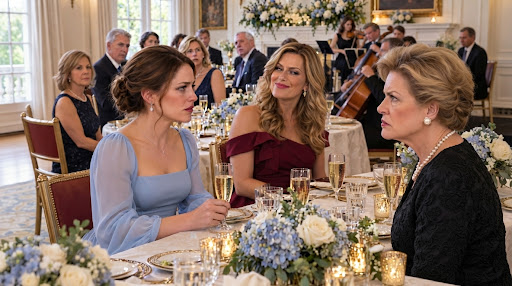
Sometimes I think about that birthday party.
The sixty guests.
The linen tablecloth.
The champagne.
The way Ranata laughed when my mother told me I was invited out of pity.
I remember sitting there, feeling the familiar urge to defend myself.
To explain.
To beg them to understand that I had feelings too.
But instead, I finished my drink.
Folded my napkin.
And left.
At the time, I thought I was simply walking away from another humiliating family gathering.
I didn’t realize I was walking away from thirty-seven years of trying to earn a place that should never have required payment.
I didn’t know the cabin would be sold.
I didn’t know the bank accounts would be examined.
I didn’t know Grandma had left me a trust.
And I certainly didn’t know that my family’s secrets would eventually come into the open.
But I knew one thing.
I was tired.
Tired of being useful but unwanted.
Tired of being generous but unappreciated.
Tired of being invited only when someone needed something.
And tired of mistaking obligation for love.
My family believed the cabin belonged to everyone because they’d used it for years.
They believed the accounts belonged to them because they’d spent money from them for years.
And they believed I would always remain available because I’d forgiven them for years.
They were wrong about all three.
The cabin belonged to me.
The financial decisions were mine to make within the agreements and laws governing them.
And my time, my energy, and my affection were not unlimited resources they could demand whenever it suited them.
I still have the first-edition naval history book I bought for my father’s seventieth birthday.
He never opened it.
After the party, I asked the hotel to retrieve the gift I’d left behind, and it was eventually returned to me.
For months, it sat on my bookshelf.
Then one afternoon, I donated it to a maritime history collection in Denver’s memory.
The librarian sent a lovely thank-you note.
She wrote that the book would be preserved and made available to researchers.
I smiled when I read it.
A gift that had been ignored in one place had finally found somewhere it was appreciated.
Perhaps that was fitting.
Today, my life is quieter.
I still live in Seattle.
I still work.
I still hike.
I still miss Denver.
And sometimes, when something wonderful happens, I reach for my phone before remembering I can’t call him.
But I am no longer alone in the way I used to be.
I have friends who show up.
People who remember my birthday.
People who ask how I’m doing and actually wait for the answer.
I have a home filled with photographs, books, laughter, and memories.
And I have Grandma Eleanor’s letter framed beside Denver’s picture.
Two people who loved me without requiring me to become someone else.
Two people who understood my worth long before I did.
My mother once told me I was invited to a family party out of pity.
A week later, she discovered the cabin was gone.
The financial accounts were being separated.
The money she’d taken for granted was no longer available.
And the daughter she’d treated as disposable had finally stopped answering every demand.
By 7:03 that morning, my phone showed forty-nine missed calls.
I remember staring at the screen and feeling something unexpected.
Not revenge.
Not satisfaction.
Relief.
Because for the first time, their emergency was not automatically my responsibility.
I used to believe being a good daughter meant enduring whatever my family said or did.
I believed forgiveness meant never setting limits.
I believed love meant showing up even when nobody showed up for me.
But Grandma Eleanor had been right.
Love should never require you to disappear.
Family should never be an excuse for taking advantage of someone.
And being generous does not mean giving other people ownership of your life.
My parents lost access to the cabin.
They lost the financial support they’d assumed would continue forever.
But I didn’t take away their ability to love me.
They had always had that choice.
They simply hadn’t made it.
And when I finally stopped paying for the privilege of belonging, I discovered something extraordinary.
There were people in my life who wanted me there even when I had nothing to give.
No money.
No vacation home.
No favors.
Just me.
Last Sunday, I sat on my porch with a cup of coffee.
The Seattle sky was gray.
Rain tapped softly against the railing.
I opened Grandma Eleanor’s letter one more time.
Then I looked at Denver’s photograph.
“I think I’m going to be okay,” I whispered.
And for the first time since losing him, I truly believed it.
Because the woman who had walked out of that birthday party wasn’t the same woman sitting on that porch.
That woman had been waiting thirty-seven years for her family to decide she mattered.
This woman already knew.
They invited me out of pity.
I left with my dignity.
And when the bills stopped being paid, they finally discovered how much I’d been worth to them.
But by then, I had learned something far more important.
My worth had never depended on what I could pay.
And my peace was no longer for sale.
THE END THANK YOU FOR READING !!!