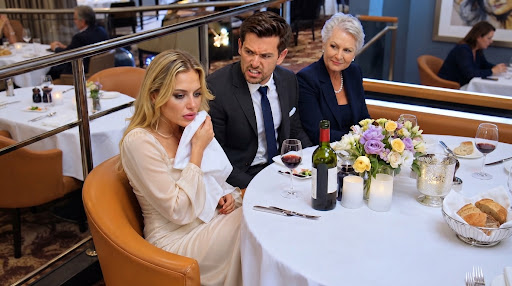
PART 3
For several seconds,
I couldn’t move.
The waiter stood beside
our table holding the receipt,
his face pale beneath the restaurant’s golden lighting.
Alejandro, the manager,
was staring at my husband with an
expression that had changed from
professional concern to unmistakable suspicion.
Javier leaned back in his chair.
“This is ridiculous,” he said.
“We’re not turning a simple dinner into a criminal investigation.”
I looked at him.
“A simple dinner?”
He avoided my eyes.
I touched the damp fabric of my dress.
Red wine had soaked through the neckline and down to my waist.
My hair was sticky,
my cheeks burned,
and every person in the restaurant
had witnessed my husband humiliate me.
But the worst part wasn’t the wine.
It was the realization that Javier and Mercedes had planned something long before we arrived.
Alejandro spoke calmly.
“Señor Rivas, I need to ask whether you arranged for additional purchases to be charged to this table.”
Javier laughed.
“Of course I arranged dinner. It’s my mother’s birthday celebration.”
Mercedes immediately nodded.
“Exactly. And my daughter-in-law agreed to pay.”
I turned toward her.
“When?”
She blinked.
“What?”
“When did I agree to pay?”
Mercedes pursed her lips.
“Clara, don’t be childish.”
I looked at Alejandro.
“I never agreed to pay for this dinner, and I certainly didn’t authorize purchases made before I arrived.”
The manager nodded.
“Understood.”
Javier suddenly stood.
“Enough. We’re leaving.”
One of the security guards stepped closer to the aisle, leaving space for him to pass but making it clear that the staff wanted the situation resolved.
Alejandro raised a hand.
“Sir, please remain available while we clarify the bill. The police have also been contacted.”
Javier’s face darkened.
“Do you have any idea who I am?”
Alejandro didn’t flinch.
“Yes, señor. You are a customer who has an outstanding restaurant bill.”
A few people nearby lowered their eyes to hide their reactions.
I almost smiled.
For years, Javier had relied on that question.
Do you know who I am?
He used it with waiters, receptionists, delivery drivers, and anyone he believed he could intimidate.
But Alejandro didn’t seem impressed.
Mercedes leaned forward.
“Clara, tell them this is a misunderstanding.”
I looked at her.
“You smiled when your son threw wine in my face.”
Her expression hardened.
“Because you were embarrassing him.”
I felt something settle inside my chest.
There was no confusion left.
No misunderstanding.
No hidden kindness waiting to reveal itself.
These people believed I deserved humiliation because I had refused to obey.
And I was finished pretending otherwise.
Alejandro asked whether I would accompany him to a quieter area while we waited for the police.
I agreed.
A female employee named Lucía brought me a clean towel and offered a private restroom where I could wash my face.
“I’m sorry this happened,” she whispered.
I looked at her.
“Thank you.”
She hesitated.
Then said, “You don’t have to go back to that table.”
Something about those words nearly broke me.
Because for years, I had believed I always had to go back.
Back to the dinner table after Javier insulted me.
Back to family gatherings after Mercedes humiliated me.
Back to our apartment after arguments where he made me feel small.
Back to apologizing for things I hadn’t done.
But Lucía was right.
I didn’t have to return to that table.
And suddenly, I understood that I didn’t have to return to the life waiting outside the restaurant either.
I dried my face.
Then followed Alejandro to his office.
The room was small, with two computer monitors and a desk covered in reservation schedules.
Alejandro sat down.
“I want to be clear,” he said. “The restaurant’s security footage may show what happened at your table. But we also have records of an unusual arrangement made yesterday.”
I folded my hands.
“What arrangement?”
He opened a reservation file.
“Your husband came here yesterday afternoon.”
I stared at him.
“Yesterday?”
“Yes.”
“He told me he’d been working until seven.”
Alejandro looked uncomfortable.
“He arrived shortly after four.”
He showed me the reservation details.
The booking had been made under Javier’s name.
Eight guests were originally expected.
Only three of us had attended.
But the account included several expensive purchases billed in advance.
Three bottles of vintage wine.
A premium champagne package.
A private tasting arrangement.
And a special service charge.
I stared at the total.
“Eleven thousand eight hundred euros?”
Alejandro nodded.
My stomach dropped.
The dinner we’d eaten couldn’t possibly have cost anything close to that.
“Why would he order all of this?”
The manager looked at me carefully.
“That’s what we need to clarify.”
He opened a written note attached to the reservation.
It stated:
Primary payer: Clara Morales. Payment to be collected at the conclusion of service.
Below it was another line.
Do not present the bill to Señor Rivas.
I stared at the screen.
Then whispered, “He arranged this yesterday?”
“Yes.”
“And nobody called me?”
Alejandro looked genuinely regretful.
“We should not have treated a customer’s statement about another person’s payment as authorization. I’m sorry.”
I nodded slowly.
Then he opened a video file.
“This is footage from the reception area. It includes sound recorded by our reception security system.”
On the screen, Javier appeared wearing the same navy jacket he’d worn the previous day.
Mercedes stood beside him.
I recognized her expensive handbag.
Her pearl earrings.
Her carefully styled hair.
She looked delighted.
Javier leaned toward the receptionist.
“My wife will be paying for everything tomorrow.”
The receptionist asked whether the arrangement had been confirmed.
Javier laughed.
“She always pays. Trust me.”
Mercedes added something that made my blood run cold.
“She needs reminding who makes decisions in this family.”
I covered my mouth.
The recording continued.
Javier pointed toward the reservation sheet.
“Make sure the bill goes to her. Don’t let her split it or send it to me.”
Mercedes laughed.
“And if she complains?”
Javier smiled.
“Then she can embarrass herself in front of everyone.”
The video ended.
I sat completely still.
Alejandro looked at me.
“Señora Morales?”
I couldn’t answer.
Because suddenly, every humiliating moment of the past four years rearranged itself in my mind.
The expensive birthday gifts Javier demanded I buy for his mother.
The vacations he booked without consulting me.
The credit card statements he told me not to question.
The way he called me selfish whenever I wanted to save money.
The way Mercedes reminded me that a good wife supported her husband’s family.
It hadn’t been occasional thoughtlessness.
It had been a pattern.
And I had spent years making excuses for it.
“Can you preserve that recording?” I whispered.
“Yes. We will preserve the relevant footage and transaction records for the authorities.”
I nodded.
“Thank you.”
Then my phone vibrated.
A message from Javier.
You have five minutes to fix this before I tell everyone what kind of wife you really are.
I stared at the screen.
Another message appeared.
You think the police will believe you over me?
Then a third.
Remember whose name is on the apartment.
My hands began shaking.
Alejandro noticed.
“Are you all right?”
I handed him the phone.
He read the messages.
His expression tightened.
“Please keep those.”
“I will.”
He hesitated.
“Do you have somewhere safe to stay tonight?”
I looked at him.
For a moment, I almost answered automatically.
Of course. My husband and I have an apartment.
But that wasn’t what he was asking.
I thought about Javier’s threats.
The anger in his eyes.
The way he’d thrown wine at me in front of strangers without hesitation.
If he could do that in public, I didn’t want to discover what he might do behind a closed door after the police left.
“My friend Elena,” I whispered. “I can call her.”
Alejandro nodded.
“That sounds sensible.”
The police arrived shortly afterward.
Two officers entered the restaurant and spoke with the manager.
I gave my account of what happened.
I described the argument.
The wine.
The threats.
The bill.
And the messages Javier had sent after I left the table.
The officers spoke separately with Javier and Mercedes.
They also interviewed staff and arranged for the relevant footage to be preserved.
I didn’t know what the investigation would ultimately establish.
But for the first time, I wasn’t being forced to rely on Javier’s version of events.
There were witnesses.
There were records.
And there was video.
One officer asked whether Javier had physically hurt or threatened me before.
I hesitated.
The honest answer was complicated.
He had never thrown wine in my face before.
But he had grabbed my wrist hard enough to leave marks.
He had blocked doorways during arguments.
He had shouted inches from my face.
He had taken my phone once because he said I was being disrespectful.
And he had spent years convincing me that his anger was something I caused.
I told the officer all of it.
My voice shook.
But I told the truth.
The officer listened carefully and explained that I could make a formal complaint, request information about protective measures, and seek legal support.
I nodded.
Then he asked whether I wanted medical attention.
“My face stings,” I admitted. “But I think I’m okay.”
He encouraged me to have any injury assessed and documented.
I agreed.
When I returned to the restaurant’s reception area, Javier was waiting.
Mercedes stood beside him.
Her perfect smile was gone.
Javier looked furious.
“Clara.”
I stopped several feet away.
He stepped toward me.
One officer moved closer.
“Señor, please give her space.”
Javier stopped.
Then looked at me.
“You’ve made your point.”
I stared at him.
“My point?”
He lowered his voice.
“Tell them you overreacted. We can go home.”
I felt something inside me turn cold.
“Javier, you threw wine in my face.”
He rolled his eyes.
“It was an accident.”
I looked at the officer.
Then back at him.
“You picked up your glass, looked directly at me, and threw it.”
His jaw tightened.
Mercedes interrupted.
“Clara, marriages survive worse things than a little spilled wine.”
I turned toward her.
“Then perhaps you should have taught your son how to behave before he got married.”
Her mouth fell open.
Javier stared at me.
I’d never spoken to his mother that way.
Not once.
And suddenly, I realized how much of my marriage had depended on my silence.
The restaurant bill was reviewed.
The charges for the additional bottles and arrangements were separated from the food and drinks actually served to our table.
Alejandro made clear that the restaurant would not treat me as the authorized payer simply because Javier had written my name on the reservation.
The remaining payment dispute was handled through the restaurant’s normal procedures and the information provided to the authorities.
I didn’t hand over my card.
I didn’t apologize.
And I didn’t pay eleven thousand eight hundred euros to make Javier stop shouting.
Instead, I signed the statement the officers asked me to review, collected my belongings, and called Elena.
She answered immediately.
“Clara?”
I took a breath.
“Can I stay with you tonight?”
Her voice changed.
“What’s happened?”
I looked at the wine stains on my dress.
Then whispered, “I’m leaving Javier.”
There was a brief silence.
Then Elena said the words I needed to hear.
“Come here. I’ll be waiting.”
Elena lived twenty minutes away.
When she opened her apartment door, she took one look at me and pulled me into her arms.
I hadn’t cried in the restaurant.
I hadn’t cried while speaking to the police.
I hadn’t cried when Javier threatened me.
But the moment Elena hugged me, everything broke.
I sobbed against her shoulder.
She held me without asking questions.
After a while, she led me inside.
She gave me clean clothes.
Made tea.
And sat beside me on the sofa.
When I finally told her what happened, her face changed.
“Clara,” she whispered, “you can’t go back there alone.”
I nodded.
“I know.”
She looked relieved.
Then she asked, “How long has he been treating you like this?”
I stared at my hands.
And for the first time, I stopped counting only the dramatic incidents.
I remembered the smaller ones.
The insults disguised as jokes.
The constant criticism.
The way Javier monitored my spending while using my salary to finance his own luxuries.
The way Mercedes treated me like an employee who had married into the family by mistake.
The way I apologized every time I tried to defend myself.
“Years,” I whispered.
Elena’s eyes filled.
“Why didn’t you tell me?”
I looked at her.
“Because I was embarrassed.”
She squeezed my hand.
“You have nothing to be embarrassed about.”
I began crying again.
And that night, lying awake in Elena’s guest room, I finally admitted something I’d been avoiding.
My marriage wasn’t going through a rough phase.
It was a place where I had slowly learned to disappear.
And I was done disappearing.
The following morning, I opened my laptop.
I was a financial analyst.
Numbers had always made sense to me.
They were clear.
They followed rules.
They couldn’t smile at you while secretly planning to humiliate you.
So I began reviewing our finances.
Our joint account.
My personal savings.
Credit card statements.
Household payments.
And the records from the small consulting company Javier had started two years earlier.
At first, everything looked familiar.
Then I noticed something strange.
Repeated transfers.
Not enormous amounts.
Nine hundred euros.
One thousand two hundred.
Seven hundred fifty.
All sent to an account I didn’t recognize.
I checked the dates.
There were eighteen transfers over the previous eight months.
The total was more than twenty-three thousand euros.
My heart began pounding.
The transfers had come from our joint account.
An account funded mostly by my salary.
I opened the transaction details.
The recipient name appeared.
M. Rivas Servicios.
Mercedes Rivas.
My mother-in-law.
I stared at the screen.
Then kept searching.
There were additional payments labeled consulting fees.
Payments to a company connected to Javier’s mother.
And several invoices from businesses I didn’t recognize.
My hands began shaking.
For years, Javier had told me his company was struggling.
He said we needed to reduce our household expenses.
He criticized me for buying new shoes.
He questioned every grocery receipt.
He made me feel guilty for spending money on my own birthday.
And all that time, thousands of euros had been moving out of our joint account.
I printed the statements.
Then I called Elena into the room.
She studied the documents.
“Clara, what is this?”
I swallowed.
“I think Javier and his mother have been taking money from our joint account.”
She looked at me.
“Did you know about these transfers?”
“No.”
“Then you need a lawyer.”
I nodded.
“I know.”
And that afternoon, I made an appointment with a family-law attorney named Isabel Ortega.
I thought the restaurant had shown me the worst of my marriage.
I was wrong.
Because when Isabel reviewed the statements, she noticed something I had missed.
A reference number.
An account designation.
And a payment linked to a loan application.
She looked up from her desk.
“Clara, did you know your husband applied for a business loan using information from your employment records?”
My blood ran cold.
“No.”
Isabel turned the document toward me.
“Then we need to investigate this immediately.”
I stared at the screen.
Beside my name was a digital signature.
A signature I had never authorized.
And beneath it were four words that made my stomach drop.
PERSONAL GUARANTEE — CLARA MORALES.
PART 4
I stared at the document until the letters blurred.
Personal guarantee.
My name.
My employment information.
A signature that looked like mine.
And a business loan I’d never agreed to support.
“Isabel,” I whispered, “what does this mean?”
She leaned forward.
“It means we need to determine whether the lender believes you’ve guaranteed repayment of your husband’s business debt.”
My mouth went dry.
“How much?”
She checked the paperwork.
“Seventy-five thousand euros.”
I felt the room tilt.
“Seventy-five thousand?”
She nodded.
“That’s the original loan amount shown here. We still need the current balance and the complete agreement.”
I shook my head.
“I never signed anything.”
“Then we’ll formally dispute the signature and request the electronic signing records.”
I stared at her.
“Can Javier really do this?”
“He can submit documents. Whether they’re valid or enforceable is another matter. We need evidence, and we need to notify the lender promptly.”
I swallowed.
Then asked the question that had been haunting me since the restaurant.
“Isabel, was any of this ever normal?”
She looked at me gently.
“What do you mean?”
“The way he treated me. The way his mother spoke to me. The way I was expected to pay for everything.”
My voice broke.
“I kept telling myself all marriages were difficult.”
Isabel was quiet for a moment.
Then she said, “Disagreements are normal. Humiliation, threats, and unauthorized financial dealings are not.”
I covered my face.
And cried.
Over the next several weeks, my life changed in ways I could never have imagined.
I filed for divorce.
I took steps to protect my personal accounts and update my passwords.
I asked the bank for records of the disputed transactions.
I notified the lender that I had not authorized the purported guarantee.
And I continued cooperating with the investigation into the restaurant incident.
I didn’t make public accusations.
I didn’t post dramatic videos.
I didn’t contact Javier’s coworkers or clients.
I let the documents speak.
Because after years of being told I was too emotional, too sensitive, and too difficult, I wanted the truth established through evidence.
Javier called constantly.
At first, he was furious.
“You’re destroying my reputation!”
Then he became pleading.
“Clara, please. We can fix this.”
Then he tried to bargain.
“If you come home, I’ll make sure my mother stays out of our marriage.”
I didn’t answer.
He sent flowers to Elena’s apartment.
Then expensive chocolates.
Then a handwritten letter.
In it, he wrote:
I know I lost my temper at the restaurant, but you know how much pressure I’ve been under.
I stared at that sentence.
Pressure.
It was always pressure.
Work pressure.
Family pressure.
Financial pressure.
The pressure of being misunderstood.
The pressure of having a wife who supposedly didn’t appreciate him.
But somehow, every form of pressure ended with me being expected to pay.
In money.
In apologies.
In silence.
I folded the letter.
Placed it in a folder.
And gave it to Isabel.
Mercedes was less subtle.
She called from unfamiliar numbers.
She left messages accusing me of ruining her son’s life.
She told relatives I’d abandoned Javier during a difficult time.
She claimed I had humiliated him in public.
Then, one evening, she sent me a message that made me stop breathing.
You should be grateful Javier married you. Women like you don’t get second chances.
I stared at the screen.
For four years, I’d tried to earn that woman’s approval.
I remembered bringing flowers to her birthday dinners.
Cooking her favorite dishes.
Helping her with appointments.
Buying her expensive gifts.
And listening politely while she criticized everything about me.
Now I understood.
There had never been a level of obedience that would satisfy her.
Because she didn’t want a daughter-in-law.
She wanted someone who would fund her son’s lifestyle and accept whatever treatment came with it.
I saved the message.
Then blocked her.
One month after the restaurant incident, the lender responded to my dispute.
The electronic signing records showed that the guarantee had been completed through an online process associated with an email account I didn’t recognize.
The verification details did not match my usual contact information.
Isabel arranged for the records to be examined further.
I also provided evidence showing that I had been at work during part of the supposed signing process.
The lender began a formal review.
It was not an instant victory.
There were forms.
Statements.
Requests for identification.
And weeks of waiting.
But eventually, the lender confirmed that it would not pursue me under the disputed guarantee based on the evidence available and the outcome of its review.
I sat in Isabel’s office holding the letter.
My hands trembled.
“Does this mean I’m free of that debt?”
“As far as the lender’s current determination is concerned, yes. We’ll retain the records and make sure there are no further claims.”
I began crying.
Not because seventy-five thousand euros had magically disappeared.
But because a debt I’d never agreed to was no longer being held over my head.
Isabel handed me a tissue.
“Clara, there’s something else.”
I looked up.
“What?”
“The lender has referred the suspicious documentation for further investigation.”
I nodded slowly.
“Will Javier be charged?”
“I can’t predict that. But the evidence will be reviewed by the appropriate authorities.”
I looked down at the letter.
For years, Javier had told me that my job was boring.
That my attention to detail was annoying.
That I worried too much about paperwork.
Now those same habits had helped me protect myself.
The disputed transfers from our joint account were more complicated.
Some had been made using Javier’s legitimate access to the account.
That meant the bank couldn’t automatically reverse every payment simply because I hadn’t approved the purpose.
But the records were important to our divorce proceedings.
They showed where money had gone.
They helped Isabel identify expenditures that needed to be accounted for.
And they revealed that Javier’s repeated claims about having no money were not the whole truth.
When the financial disclosures arrived, I learned that his consulting company had been paying Mercedes for vague administrative services.
There were invoices.
Contracts.
And bank records.
Whether those arrangements were legitimate business expenses was something his accountant and the relevant authorities would have to address.
But one fact was clear.
Javier had been telling me we couldn’t afford ordinary household expenses while transferring substantial sums to his mother.
And the restaurant dinner had been another attempt to make me pay for something they wanted.
Three months after I left, Javier asked to meet.
My attorney advised me not to meet privately, so we arranged a discussion through our lawyers.
We sat in a conference room.
Javier looked thinner.
His expensive watch was gone.
His hair, usually styled perfectly, looked untidy.
For a moment, I felt an old instinct rise.
I wanted to ask whether he’d eaten.
Whether he was sleeping.
Whether he needed help.
Then I remembered the wine running down my face.
And the way his mother smiled.
I sat quietly.
Javier looked at me.
“Clara.”
“Hello, Javier.”
He swallowed.
“I never thought we’d end up here.”
I looked at him.
“Neither did I.”
He stared at his hands.
“I was angry that night.”
“I know.”
“I shouldn’t have thrown the wine.”
“No. You shouldn’t have.”
He nodded.
Then whispered, “I’m sorry.”
I waited.
He looked up.
“Can we start again?”
I felt a familiar ache.
There had been a time when those words would have been enough.
When I would have rushed toward him, desperate to believe he finally understood.
But I was no longer that woman.
“Javier,” I said, “do you understand why I left?”
He nodded quickly.
“Because of the restaurant.”
I shook my head.
“No.”
He looked confused.
“The restaurant was the moment I stopped making excuses.”
I took a breath.
“I left because you spent years humiliating me, controlling me with money, and making me responsible for your mother’s demands.”
His face tightened.
“That’s not fair.”
I looked at him.
“You threatened to end our marriage unless I paid an eleven-thousand-euro restaurant bill.”
He looked away.
“You threw wine in my face.”
He said nothing.
“And someone submitted a business guarantee using my name without my authorization.”
His jaw tightened.
“Clara, that was a misunderstanding.”
I stared at him.
There it was again.
The same word.
Misunderstanding.
As though everything could be erased by making it sound smaller.
I leaned forward.
“Javier, I am not asking you to agree with me.”
He looked up.
“I am telling you why I am not coming back.”
For several seconds, nobody spoke.
Then he whispered, “So that’s it?”
I nodded.
“Yes.”
His eyes filled.
“You’re really ending our marriage?”
I looked at the man I’d once loved.
The man I’d imagined growing old beside.
The man who had stood in a luxury restaurant and demanded payment while wine dripped from my hair.
“Yes,” I said.
“I’m ending it.”
The divorce process took months.
There were financial disclosures.
Negotiations.
Disagreements over property.
Questions about the joint account.
And difficult conversations I wished I never had to experience.
The restaurant incident remained the subject of its own legal process.
The available footage and witness statements were reviewed.
Javier faced consequences through the applicable proceedings, although not every allegation resulted in the outcome I initially imagined.
I learned that justice rarely happens as quickly or dramatically as it does in movies.
Sometimes it arrives in letters.
In signed agreements.
In official decisions.
In financial records that finally become impossible to deny.
And sometimes the most important consequence is simply that a person no longer has access to you.
During those months, I began rebuilding my life.
I rented a small apartment in a quiet neighborhood.
It had pale walls, wooden floors, and a narrow balcony overlooking a courtyard.
There was no expensive furniture.
No enormous dining table.
No carefully arranged display of luxury.
Just a sofa.
A bookshelf.
A little kitchen.
And a bedroom where I could sleep without waiting for someone to become angry.
The first night I stayed there, I made pasta.
Nothing fancy.
Tomatoes.
Garlic.
Olive oil.
A little cheese.
I ate at the kitchen counter in my pajamas.
And halfway through dinner, I started crying.
Because nobody criticized what I’d cooked.
Nobody asked why I hadn’t bought better wine.
Nobody told me I was embarrassing the family.
Nobody demanded my bank card.
I was alone.
And for the first time in years, alone felt peaceful.
Elena visited often.
Sometimes we cooked together.
Sometimes we watched terrible television shows and laughed until midnight.
Sometimes I talked about Javier.
Sometimes I didn’t.
She never pressured me to recover faster.
She simply stayed.
One evening, she asked, “Do you miss him?”
I thought about it.
“Yes,” I admitted.
She nodded.
“I miss the person I believed he was.”
I looked toward the window.
“I miss the beginning. The way he used to bring me coffee. The way he’d call just to hear my voice.”
My throat tightened.
“But I don’t miss being afraid of disappointing him.”
Elena squeezed my hand.
“That makes sense.”
I smiled sadly.
“And I definitely don’t miss his mother.”
We both laughed.
For the first time in months, the laughter came easily.
Six months after the restaurant incident, I received an email from Alejandro.
He wanted to know whether I would be willing to meet for coffee.
At first, I hesitated.
But his message was professional and kind.
He explained that the restaurant had reviewed its procedures after what happened.
Staff would no longer accept instructions naming another person as the payer without appropriate confirmation.
Employees had also received additional training on responding to threatening behavior between guests.
I agreed to meet.
We sat at a café near Plaza de Santa Ana.
Alejandro ordered coffee.
I chose tea.
He looked at me.
“How have you been?”
I smiled.
“Better.”
He nodded.
“I’m glad.”
I hesitated.
“Can I ask you something?”
“Of course.”
“Why did you help me that night?”
He looked surprised.
“Because you needed help.”
I looked down.
“It sounds simple when you say it.”
He considered that.
“Sometimes people become so accustomed to being treated badly that basic respect feels unusual.”
My eyes filled.
I smiled.
“That’s exactly what happened.”
He nodded.
Then said, “You handled a very difficult situation with courage.”
I shook my head.
“I was terrified.”
He smiled gently.
“Courage doesn’t require the absence of fear.”
I looked at him.
And for the first time, I believed it.
One year after that dinner, I walked past the restaurant again.
I hadn’t planned to.
I was meeting a colleague nearby, and the shortest route took me along the same street.
The golden lights glowed through the windows.
The tables were covered in white linen.
A waiter carried a silver tray between guests.
Everything looked exactly as it had that night.
For a moment, my chest tightened.
I remembered the cold wine.
The silence.
Mercedes’s smile.
Javier’s threat.
Pay, or this ends tonight.
I stopped walking.
Then smiled.
Because he had been right about one thing.
It had ended that night.
Just not in the way he expected.
My divorce had been finalized by then.
I had protected my savings as far as the legal process allowed.
The disputed business guarantee had been addressed.
The joint financial matters had been resolved through the appropriate proceedings.
And I had moved forward with my life.
I was still working.
Still saving.
Still learning how to trust my own judgment again.
But something fundamental had changed.
I no longer apologized for asking questions.
I no longer felt guilty for refusing unreasonable demands.
And I no longer confused keeping the peace with accepting humiliation.
A few weeks later, Mercedes sent one final message through a relative.
She said Javier was lonely.
That he regretted what happened.
That his business had suffered.
That he needed someone who understood him.
Then came the familiar request.
Surely Clara can find it in her heart to help.
I stared at the message.
For a moment, I almost laughed.
Even after everything, Mercedes still believed my purpose was to rescue her son.
I typed a short reply.
I hope Javier gets the support he needs. It won’t be financial support from me.
Then I put down my phone.
I didn’t feel angry.
I didn’t feel guilty.
I simply felt finished.
On the anniversary of that dinner, Elena invited me out.
“Somewhere expensive?” she joked.
I laughed.
“Absolutely not.”
We chose a small family-run restaurant with wooden tables and handwritten menus.
There were no chandeliers.
No luxury wine packages.
No waiters hovering nervously.
Just good food and people enjoying themselves.
We ordered grilled vegetables, fresh bread, and two bowls of seafood rice.
When the bill arrived, Elena reached for it.
“My treat.”
I smiled.
“Are you sure?”
“Of course.”
I looked at her.
Then laughed.
“Actually, let’s split it.”
She grinned.
“Deal.”
We paid.
We thanked the waiter.
And walked outside into the cool Madrid evening.
It was such an ordinary moment.
Yet it felt extraordinary.
Because money was no longer being used to prove who had power.
It was simply a way to pay for dinner.
Sometimes people ask whether I regret calling 112 that night.
I don’t.
I called because I felt threatened and needed help.
I wanted the incident documented.
I wanted the restaurant to preserve what had happened.
And I wanted Javier to understand that humiliating me in public wasn’t something he could erase by ordering me to be quiet.
But I didn’t know then how much that call would change my life.
I didn’t know it would lead me to question years of financial arrangements.
I didn’t know it would reveal a disputed guarantee bearing my name.
I didn’t know it would force me to confront how deeply I’d accepted being mistreated.
And I certainly didn’t know that one year later, I would be living in a peaceful apartment, laughing with friends, and feeling like myself again.
I still remember the moment Javier threw the wine.
The shock of the cold liquid.
The sound of someone gasping.
The way Mercedes smiled.
And the terrible silence that followed.
For a few seconds, I felt small.
Ashamed.
Exposed.
As though everyone in that restaurant was looking at me and deciding I deserved what had happened.
But then I reached into my purse.
And instead of handing over my bank card, I took out my phone.
That was the moment everything changed.
Not because the police instantly solved my marriage.
Not because Javier suddenly became sorry.
And not because I stopped being afraid.
It changed because I finally refused to participate in my own humiliation.
I had spent years trying to be a good wife.
I paid bills.
Supported Javier’s ambitions.
Helped his mother.
Made excuses.
Forgave insults.
And convinced myself that if I just worked harder, gave more, and complained less, someday they would appreciate me.
But appreciation never came.
Only another demand.
Another expensive dinner.
Another criticism.
Another reason I supposedly wasn’t doing enough.
And when I finally said no, Javier threw wine in my face.
He thought it would shame me into obedience.
Instead, it showed me exactly who he was.
Last Sunday, I sat on my balcony with a cup of coffee.
The morning sun warmed the courtyard.
Somewhere below, a child was laughing.
A neighbor watered her plants.
And church bells rang in the distance.
My phone buzzed.
It was Elena.
Lunch today?
I smiled.
Absolutely.
Then she added:
My treat.
I laughed and replied:
We’ll decide when the bill arrives.
I put down my phone.
Looked around my little apartment.
And felt something I hadn’t felt in a very long time.
Safe.
Not because I had a perfect life.
Not because nothing difficult would ever happen again.
But because I knew I could protect myself.
I knew I could say no.
I knew I could walk away.
And I knew that love should never require someone to surrender their dignity.
Javier had given me an ultimatum that night.
“Pay, or this ends tonight.”
He expected me to panic.
To apologize.
To open my purse and surrender my money.
Instead, I looked him in the eyes and said, “Perfect.”
He thought I was bluffing.
His mother thought I would eventually beg for forgiveness.
They were both wrong.
Because the woman who walked into that restaurant was still trying to save her marriage.
But the woman who walked out had finally decided to save herself.
I didn’t pay the eleven-thousand-euro bill.
I didn’t return to the apartment to beg.
And I didn’t spend another year trying to convince people who humiliated me that I deserved respect.
I built a different life.
A quieter life.
A life where my money belonged to me, my decisions mattered, and nobody could threaten to withdraw their love whenever I refused to obey.
And whenever I remember that night, I no longer picture the wine running down my face.
I picture the moment I reached for my phone.
Because that was the moment I stopped asking for permission to be treated like a human being.
He said, “Pay, or this ends tonight.”
I said, “Perfect.”
And for the first time in our marriage, I meant every word.
THE END THANK YOU FOR READING !!!