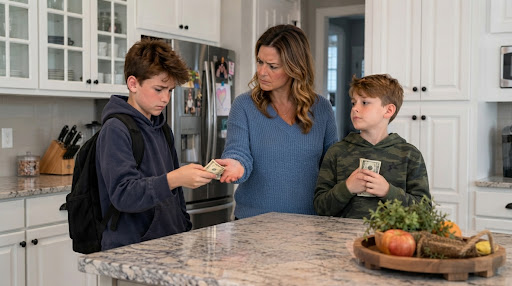
PART 3
I read Erin’s message three times,
hoping I had misunderstood it.
We need to discuss sending
Colin away before your next trip.
My next business trip was scheduled for Wednesday.
Four days away.
Four days until my wife apparently
intended to remove my twelve-year-old son
from the only home he’d ever known.
I looked at Colin sitting across the kitchen island,
his small hands wrapped around a glass of water.
He was watching me with the anxious expression of a
child waiting to learn whether he had done something wrong.
“Dad?” he whispered. “Am I going to Grandma Linda’s?”
I put my phone facedown.
“Not unless you want to visit her, buddy.”
His shoulders relaxed slightly.
“But Erin said you’d already agreed.”
I swallowed the anger rising in my throat.
“I haven’t agreed to anything. Nobody is sending you away.”
He looked at the forged contract.
“Then why did she make me sign that?”
I pulled the paper closer.
“That’s something Erin is going to explain.”
Colin hesitated.
“Please don’t tell her I showed you.”
My heart broke.
“Why?”
He stared at his knees.
“Because she said telling you about our agreement would mean I couldn’t be trusted.”
I leaned forward.
Colin, adults should never make you keep secrets about money,
threats, or where you’re allowed to live.
Especially from your father.
His eyes filled.
“She said it wasn’t a secret. She called it a responsibility lesson.”
I looked away before he could see my expression.
A responsibility lesson.
Sixteen weeks of taking money from a child.
Threatening his bedroom.
Confiscating birthday gifts.
Forging my signature.
And now discussing how to send him away.
This wasn’t a lesson.
It was a campaign to make my son feel unwanted.
I reached for his notebook again.
Sixteen entries.
Twenty-five dollars each.
Four hundred dollars in total.
Four hundred dollars might have been a small amount to an adult, but to Colin it represented months of mowing lawns, washing cars, and giving up the things he wanted.
I turned another page and noticed something I hadn’t seen before.
On the inside back cover, he’d written a list.
New cleats — $68.
Baseball registration — $45.
Birthday money remaining — $90.
Underneath, in smaller handwriting, he’d written:
If I can save $12 every week, maybe Dad won’t be disappointed.
I felt tears sting my eyes.
“Colin, how long have your cleats been too small?”
He looked embarrassed.
“A couple months.”
“Why didn’t you tell me?”
“I didn’t want you spending more money on me.”
I stared at him.
My son had been playing baseball in shoes that hurt his feet because my wife had convinced him that existing in our home was an expense he needed to repay.
I stood, walked around the island, and knelt beside his chair.
“Look at me.”
He lifted his eyes.
“You are not a bill, Colin. You’re my son. This is your home. You don’t have to earn your bedroom, your meals, or my love.”
His lower lip trembled.
“Even if I don’t make enough money?”
I wrapped my arms around him.
“Especially then.”
He began crying against my shoulder.
And I held him until the shaking stopped.
When Colin finally went upstairs to change for baseball practice, I called my mother-in-law.
Not Erin’s mother.
Linda.
My first wife’s mother.
Colin’s grandmother.
My first wife, Rachel, had died when Colin was four.
Cancer had taken her after eighteen months of treatment.
Linda had remained part of our lives ever since.
She was the woman who taught Colin how to bake chocolate-chip cookies and still called him every Sunday evening.
She answered on the second ring.
“Good morning, sweetheart.”
“Linda, I need to ask you something.”
My voice must have frightened her.
“What happened?”
“Has Erin contacted you about Colin living with you?”
Silence.
Then she said, “What?”
I closed my eyes.
“Please tell me.”
Linda took a shaky breath.
“She called me two weeks ago.”
My stomach dropped.
“What did she say?”
“She asked whether I could take Colin for a few months because you were struggling with his behavior.”
I gripped the counter.
“What behavior?”
“She said he was stealing money, refusing chores, and becoming disrespectful.”
I stared at the wall.
My son.
The child who apologized when he accidentally spilled juice.
The boy who spent his weekends mowing lawns so he could pay imaginary rent.
Erin had described him as a thief.
“Linda, none of that is true.”
“I didn’t think it sounded like Colin.”
“Then why didn’t you call me?”
Her voice broke.
“I tried. Erin told me you were overwhelmed and needed space. She said you were embarrassed and didn’t want to discuss it yet.”
I remembered three missed calls from Linda the previous week.
Erin had told me Linda was asking about holiday plans.
I’d meant to return them.
I never did.
Linda began crying.
“Is Colin okay?”
I looked toward the stairs.
“He will be.”
Then I told her everything.
The rent.
The notebook.
The birthday money.
The forged signature.
By the time I finished, Linda was sobbing.
“That poor baby.”
I swallowed.
“I need you to keep this conversation private for now. I’m going to speak with an attorney before making any decisions.”
“I understand.”
“And Linda?”
“Yes?”
“Colin might need you more than usual for a little while.”
Her voice steadied.
“Then I’ll be there.”
I called my attorney, Daniel Mercer, who had handled the purchase of my business several years earlier.
He listened without interrupting.
Then he asked me to photograph the notebook, the contract, and Erin’s text message.
“Don’t destroy anything,” he said. “And don’t make promises about legal outcomes before we review the facts.”
I agreed.
He advised me to protect Colin, document what had happened, and arrange a family-law consultation immediately.
Then he said something that stayed with me.
“Your son needs to know that the adults are handling this. Don’t make him responsible for proving what happened.”
I looked at the blue notebook.
Sixteen weeks of evidence.
Sixteen weeks during which Colin had believed he was responsible for keeping his place in my house.
“I understand.”
After the call, I photographed every page.
Then I checked our household accounts.
Erin and I maintained separate personal accounts and a joint account for shared expenses.
I paid the mortgage, utilities, insurance, and most groceries.
Erin contributed to certain household purchases and handled much of the shopping.
I had never questioned how she spent her personal money.
But now I looked through the transactions I could legitimately access.
Something caught my attention.
For months, Erin had been transferring small amounts from our joint account into her personal account under the description household reimbursements.
Those transfers weren’t proof of wrongdoing by themselves.
But they raised questions.
Especially when I noticed several expensive purchases for Tyler around the same dates Colin had been paying rent.
New gaming accessories.
Designer sneakers.
Sports equipment.
I stared at the screen.
I loved Tyler.
He had been part of my life for four years.
I had coached his soccer team, helped him with homework, and attended his school concerts.
None of this was his fault.
But the contrast between the boys was becoming impossible to ignore.
One child was being taught that everything came free.
The other was being taught that even his bedroom had a price.
Erin returned shortly after noon.
I heard Tyler laughing as they came through the front door.
“Mom, can we set it up now?”
“After lunch, honey.”
They entered the kitchen carrying shopping bags.
Tyler held a new gaming headset.
Erin smiled when she saw me.
“Hey! I thought you were taking Colin to practice.”
“Practice was canceled,” I said.
She set her handbag on the counter.
“That’s a shame.”
Then she noticed the blue notebook.
Her smile disappeared.
“What is that doing here?”
I watched her face.
“Colin showed it to me.”
She went completely still.
Then she laughed.
“Oh, that.”
I said nothing.
She waved her hand.
“It’s just a little responsibility exercise.”
I slid the notebook toward her.
“Sixteen weeks?”
Her eyes narrowed.
“What?”
“Four hundred dollars?”
She glanced toward the hallway.
“Where’s Colin?”
“Upstairs.”
She lowered her voice.
“He wasn’t supposed to bother you with this.”
My stomach twisted.
“Bother me?”
“You know what I mean.”
“No, Erin. I don’t.”
She crossed her arms.
“I was teaching him financial responsibility.”
“By charging him rent?”
“It’s not real rent.”
“Then why did you take real money?”
Her expression hardened.
“Because children don’t learn anything unless there’s a consequence.”
I pushed the forged contract across the counter.
“Did you sign my name?”
Her face changed.
Only for a second.
But I saw it.
“That’s ridiculous.”
“Did you?”
She snatched up the paper.
“I was trying to keep things organized.”
“That’s not what I asked.”
She looked away.
“I wrote your name because you weren’t home.”
I stared at her.
“You signed a document pretending I agreed to charge my twelve-year-old son rent.”
She sighed dramatically.
“Please stop making this sound criminal.”
“Then explain why the contract says Colin can be relocated if he doesn’t pay.”
Her eyes flashed.
“Because he needs boundaries!”
Tyler appeared in the doorway.
“Mom?”
Erin turned immediately.
“Go upstairs, sweetheart.”
He looked between us.
“Are you fighting?”
I softened my voice.
“We’re having an adult conversation, Tyler. You’re not in trouble.”
He nodded and left.
When his footsteps disappeared, I looked back at Erin.
“Why doesn’t Tyler pay rent?”
She stared at me.
“What?”
“Colin says you told him Tyler doesn’t pay because he’s your real son.”
Erin’s mouth opened.
Then closed.
I waited.
Finally, she said, “Tyler is younger.”
“One year younger.”
“It’s different.”
“How?”
She looked irritated.
“Colin has always been more independent.”
I felt something inside me settle.
Not anger.
Clarity.
“Did you tell Linda that Colin was stealing?”
Erin’s face drained.
“Why were you talking to Linda?”
“Answer me.”
She looked toward the stairs.
“Colin has been difficult lately.”
“Difficult how?”
“He questions everything. He doesn’t always listen.”
“Did he steal anything?”
She hesitated.
“No.”
“Then why did you tell his grandmother he was stealing?”
Her eyes filled suddenly.
“You don’t understand how hard it is when you’re away.”
I stared at her.
“Then help me understand.”
She sat down.
For a moment, she looked genuinely exhausted.
“I feel like everything in this house revolves around Colin.”
I couldn’t believe what I was hearing.
“Everything?”
“It’s his house. His memories. His mother’s pictures. His grandparents.”
Her voice rose.
“Tyler and I are always the people who came later.”
I stared at her.
“So you punished Colin?”
She shook her head.
“I wasn’t punishing him.”
“You took his birthday money.”
“I was holding it.”
“You threatened his bedroom.”
“I was trying to motivate him.”
“You told his grandmother he was a thief.”
“I was frustrated!”
Her voice echoed through the kitchen.
I stood.
“Erin, stop.”
She stared at me.
“You don’t get to call this frustration.”
Tears spilled down her cheeks.
“I just wanted Tyler to feel like this was his home too.”
I felt my chest tighten.
“Tyler does belong here. I’ve never treated him otherwise.”
She looked down.
“But you never adopted him.”
I blinked.
“We discussed that. His father is involved in his life, and adoption was never appropriate.”
She wiped her face.
“I know.”
I leaned forward.
“Colin didn’t take anything from Tyler.”
She said nothing.
“And making my son feel unwanted wasn’t going to make yours more loved.”
For the first time, Erin had no answer.
Then I showed her the text she’d sent.
We need to discuss sending Colin away before your next trip.
She stared at the screen.
I asked one final question.
“Were you planning to send my son to Linda without telling me the truth?”
Her silence was answer enough.
I told Erin we needed to live separately while I obtained legal advice and made sure both children were safe.
She began crying.
“You’re throwing away our marriage over twenty-five dollars?”
I looked at her.
“No.”
I pointed toward the stairs.
“I’m protecting my son from someone who made him believe he had to pay to be loved.”
She covered her face.
Then she said something I will never forget.
“I thought he’d eventually get used to it.”
I stared at her.
That was the moment I understood.
She hadn’t made one impulsive mistake.
She had watched my son struggle for sixteen weeks.
Watched him surrender his savings.
Watched him fear losing his room.
And instead of stopping, she had waited for him to accept it.
I stepped away from the counter.
“I’m calling Daniel back.”
Erin looked up.
“What are you going to do?”
I glanced toward the staircase.
“What I should have done the moment I promised Rachel I’d take care of our boy.”
Then I walked upstairs.
Because there was one person in that house who needed to hear what happened next.
And it wasn’t Erin.
PART 4
Colin was sitting on his bed when I knocked.
His baseball glove rested beside him.
He looked up immediately.
“Dad?”
I stepped inside.
“Can we talk?”
His expression tightened.
“Is Erin mad?”
I sat beside him.
“Erin and I had a serious conversation.”
He looked at his hands.
“I’m sorry.”
I felt my heart sink.
“Colin, what are you apologizing for?”
“For showing you the notebook.”
I shook my head.
“Buddy, showing me that notebook was exactly the right thing to do.”
He looked confused.
“But now you’re fighting.”
I took his hand.
“Adults are responsible for their own choices. You’re not responsible for what Erin did, and you’re not responsible for how I respond.”
He swallowed.
“Is she going to make me leave?”
“No.”
“Are you sure?”
I looked around his bedroom.
The baseball posters.
The bookshelf Rachel had painted blue when she was pregnant.
The wooden height chart attached to the closet door.
The photograph of Colin as a toddler sitting on my shoulders.
Then I looked back at him.
“This has been your home since you were born. Nobody gets to take that away because you can’t pay twenty-five dollars.”
His eyes filled.
“Really?”
“Really.”
He began crying.
Not loudly.
Just quiet tears slipping down his cheeks.
Then he whispered, “I thought you didn’t want me here anymore.”
I pulled him into my arms.
“Colin, there has never been a single day when I didn’t want you.”
He held on tightly.
For several minutes, we sat together without speaking.
Then he asked, “What happens to Erin?”
I took a breath.
“She’s going to stay somewhere else while we figure things out.”
He looked worried.
“Because of me?”
“No. Because of decisions she made.”
He stared at me.
“And Tyler?”
I felt my throat tighten.
“Tyler will be with his mom. But none of this is his fault either.”
Colin nodded slowly.
Then he whispered, “I don’t want Tyler to hate me.”
I held him closer.
“I know, buddy.”
That evening, Erin arranged to stay with her sister.
Tyler packed an overnight bag.
He stood in the hallway looking frightened.
I knelt in front of him.
“Hey, buddy.”
He looked at me.
“Are you and Mom getting divorced?”
I swallowed.
“I don’t know exactly what will happen yet.”
His eyes filled.
“Did I do something wrong?”
“No.”
I placed a hand on his shoulder.
“You didn’t do anything wrong.”
He glanced toward the stairs.
“Is Colin mad at me?”
I shook my head.
“Colin loves you.”
Tyler began crying.
“I didn’t know he was paying money.”
My chest tightened.
“I know.”
He wiped his face.
“Mom said Colin got extra allowance because he was older.”
I stared at him.
“What?”
Tyler looked embarrassed.
“She said he had lots of money from doing jobs, and that’s why I didn’t have to do as many chores.”
I closed my eyes briefly.
Erin had been telling each child a different story.
Colin believed he was paying rent because he wasn’t entitled to the same privileges as Tyler.
Tyler believed Colin had extra money and responsibilities because he was older.
Neither boy understood what was happening.
Neither deserved it.
I hugged Tyler.
“You don’t have to fix this.”
He wrapped his arms around my neck.
“Can I still talk to Colin?”
I swallowed.
“We’ll work out what’s appropriate with your mom. But I want you to know I care about you.”
He nodded.
Then Erin called him from the front door.
I watched them leave.
And for the first time in four years, the house felt painfully quiet.
The following Monday, I met with a family-law attorney Daniel had recommended.
I brought copies of everything.
The notebook.
The contract.
The text messages.
The household account records.
And the notes I’d made after speaking with Linda.
The attorney listened carefully.
Then she asked, “Has Colin been threatened with physical harm?”
“No.”
“Has he been denied food or shelter?”
“No. But he’s been told he might lose his room.”
She nodded.
“We need to evaluate the emotional and financial harm, as well as the forged signature. We’ll also need to determine the appropriate legal steps under your state’s laws.”
I appreciated that she didn’t make dramatic promises.
She didn’t tell me the case would be simple.
She didn’t pretend that every cruel act automatically resulted in a criminal charge.
Instead, she explained the importance of documentation, protecting Colin from further pressure, and making decisions that wouldn’t create additional harm.
We discussed my marriage.
Our finances.
The house, which I had purchased years before meeting Erin.
And the practical steps involved in a separation.
Then she asked something that stopped me.
“Has your son spoken with a counselor?”
I shook my head.
“Not yet.”
“I recommend arranging that.”
I looked down.
“He seems better now.”
She nodded.
“He may be. But children can carry shame and fear long after the immediate threat is gone.”
I thought about Colin asking whether he was in trouble.
About his fear of disappointing me.
About the way he had apologized for revealing the notebook.
“I’ll arrange it,” I said.
That afternoon, I drove Colin to a sporting-goods store.
He looked confused when we parked.
“Dad, why are we here?”
I smiled.
“Your cleats.”
He shook his head immediately.
“Dad, I don’t have enough money.”
I felt my chest tighten.
“You don’t need money.”
He looked uncomfortable.
“But they’re expensive.”
“Colin, baseball equipment is something I’m responsible for helping you with. You don’t need to earn the right to have shoes that fit.”
He looked at me for a long moment.
Then nodded.
Inside, he tried on three pairs.
The first was too narrow.
The second rubbed against his heel.
The third fit perfectly.
He stood and walked around the aisle.
Then smiled.
“Dad, these feel amazing.”
I laughed.
“Then those are the ones.”
He looked at the price tag.
His smile disappeared.
“Seventy-nine dollars.”
I shrugged.
“Okay.”
He stared at me.
“That’s more than three weeks of rent.”
The words hit me harder than I expected.
I crouched beside him.
“Buddy, we’re not measuring your life in rent payments anymore.”
His eyes filled.
Then he smiled again.
“Okay.”
We bought the cleats.
And a new baseball glove because his old one had started splitting along the seams.
On the drive home, Colin kept looking into the shopping bag.
Finally, he whispered, “Thanks, Dad.”
I smiled.
“You’re welcome.”
Then he said something that nearly made me pull over.
“I forgot what it felt like to get something without worrying what I’d have to give back.”
The next weekend, Linda came to visit.
She arrived carrying a homemade chocolate cake and a small envelope.
Colin ran into her arms.
“Grandma!”
She hugged him so tightly he laughed.
“Oh, my sweet boy.”
They sat together at the kitchen table.
Linda handed him the envelope.
He opened it.
Inside was a hundred-dollar bill.
He looked confused.
“Grandma, you already gave me birthday money.”
She nodded.
“I know.”
He stared at her.
“Then why?”
She took his hand.
“Because I wanted you to have another gift.”
Colin looked toward me.
“Dad?”
I smiled.
“You can accept it.”
He hesitated.
“Do I have to save it for rent?”
Linda’s face crumpled.
I sat beside him.
“No, buddy.”
His eyes filled.
“Can I spend some of it?”
“Of course.”
He looked at Linda.
“Really?”
She nodded through tears.
“It’s yours, sweetheart.”
He smiled.
Then he did something that made both of us cry.
He took twenty dollars from the envelope and placed it in front of her.
“Can we use this to buy ingredients for cookies?”
Linda covered her mouth.
“Of course we can.”
He grinned.
“Then let’s make Mom’s recipe.”
Rachel’s recipe.
The chocolate-chip cookies she used to bake every Sunday.
Linda reached across the table and held his face between her hands.
“She would be so proud of you.”
Colin smiled.
And for the first time in weeks, I saw my son relax without looking over his shoulder.
Erin contacted me several times during the separation.
At first, she was angry.
She accused me of overreacting.
She said I was allowing Colin to manipulate me.
She insisted the rent payments were supposed to teach him discipline.
But when I asked why she had forged my signature, she had no reasonable answer.
When I asked why she had threatened his bedroom, she changed the subject.
And when I asked why she had told Linda that Colin was stealing, she cried.
Eventually, she admitted that she had resented how much of my life still revolved around Rachel and Colin.
She said she felt like a guest in a house full of memories that weren’t hers.
I listened.
Then I told her something she didn’t want to hear.
“Erin, I would have worked with you to make this house feel like your home.”
She began crying.
“But you never gave me the chance.”
I paused.
“You decided the solution was to make Colin feel like it wasn’t his.”
She whispered, “I didn’t think about it that way.”
I shook my head.
“You had sixteen weeks to think about it.”
She said nothing.
Then she asked whether we could try marriage counseling.
I considered it.
But I couldn’t forget the contract.
I couldn’t forget the false accusations.
And I couldn’t forget the text about sending Colin away.
I told her I was willing to discuss practical matters respectfully, but I was proceeding with the separation and divorce process.
She cried.
I didn’t change my mind.
Three months later, our divorce proceedings were underway.
The financial issues were handled through attorneys.
The disputed money was documented and addressed as part of the broader resolution.
I didn’t demand public humiliation.
I didn’t post Erin’s behavior on social media.
I didn’t involve Tyler in the dispute.
My priority was Colin.
And slowly, I began seeing changes.
He stopped hiding his notebook.
He stopped asking permission to eat snacks from the pantry.
He stopped apologizing when he needed school supplies.
But some habits remained.
One afternoon, I found him standing in the laundry room holding a broken drinking glass.
His face was pale.
“Dad, I’m sorry.”
I looked at the glass.
“Did you get cut?”
He shook his head.
“No.”
“Okay. Step back so you don’t hurt your feet.”
I grabbed a broom.
Colin watched me.
“How much does it cost?”
I stopped.
“What?”
“The glass.”
I looked at him.
“Why?”
He swallowed.
“Do I have to pay for it?”
My heart sank.
I set the broom aside.
“Colin, accidents happen.”
He looked down.
“But it was my fault.”
“Being responsible means helping clean up safely and learning to be careful. It doesn’t mean you have to be afraid of me.”
He nodded.
Then whispered, “I’m still getting used to that.”
I pulled him into a hug.
“I know, buddy.”
Colin began seeing a counselor twice a month.
At first, he didn’t want to go.
He said counseling was for children who were in trouble.
I explained that counseling wasn’t punishment.
It was a place where he could talk about things that were difficult to understand.
After several sessions, he began opening up.
He talked about the rent.
The fear of losing his bedroom.
The embarrassment of asking classmates whether twelve-year-olds normally paid household bills.
And the shame he’d felt when Erin told him Tyler was different because he was her real son.
One evening after a session, Colin sat beside me on the porch.
“Dad?”
“Yeah?”
“Do you think Erin hated me?”
I took a breath.
“I don’t know everything Erin felt.”
He stared at the yard.
“But I do know she treated you unfairly.”
He nodded.
Then whispered, “I tried really hard to make her like me.”
I felt tears rising.
“I know.”
“I did chores without being asked. I cleaned my room. I gave her my money.”
His voice cracked.
“But it never seemed enough.”
I pulled him close.
“Colin, you should never have had to work that hard to feel welcome in your own home.”
He leaned against me.
For a while, we watched the sun disappear behind the trees.
Then he whispered, “I think I believe that now.”
Six months after that Saturday morning, something happened that told me Colin was finally beginning to heal.
It was another Saturday.
I was making coffee in the kitchen.
The same kitchen where he’d first asked whether he could pay half his rent.
Colin appeared wearing his baseball uniform.
“Dad?”
I turned.
“What’s up, buddy?”
He smiled.
“Can I ask you something?”
For a second, my chest tightened.
Then he said, “Can we invite Tyler to my birthday party?”
I stared at him.
“You want Tyler there?”
He nodded.
“Yeah. I miss him.”
I felt my throat tighten.
“I know you do.”
He looked down.
“I don’t want him thinking I stopped liking him because of what happened.”
I walked around the counter.
“That’s a kind thing to think about.”
He shrugged.
“It’s not his fault.”
I smiled.
“No, it isn’t.”
With appropriate arrangements made through the adults, Tyler came to the party.
He brought Colin a baseball signed by his favorite minor-league player.
Colin’s eyes widened.
“No way!”
Tyler grinned.
“My dad helped me get it.”
The boys hugged.
And for a moment, watching them laugh together, I felt something loosen inside my chest.
Erin’s choices had damaged our family.
But I wasn’t going to let them teach the boys to hate each other.
That evening, after everyone left, Colin sat at the kitchen island counting his birthday cards.
He had received gift cards, a little cash, and a handwritten letter from Linda.
I watched him arrange everything neatly.
Then he looked up.
“Dad?”
“Yeah?”
“I think I’m going to save most of this.”
I smiled.
“That’s a good idea.”
He nodded.
“Maybe I’ll buy a new bike next summer.”
“Sounds like a plan.”
He hesitated.
Then smiled.
“But I might spend twenty dollars on a video game.”
I laughed.
“That’s your decision.”
He looked genuinely surprised.
“Really?”
“Really.”
He grinned.
Then he reached into his backpack.
My stomach tightened when I saw the little blue notebook.
The same notebook that had started everything.
He placed it on the counter.
I looked at him.
“What’s that for?”
He smiled.
“I don’t need it anymore.”
I picked it up.
The cover was still bent.
The rubber band was still wrapped around the pages.
Sixteen weeks of payments.
Sixteen signatures.
Sixteen reminders of how badly I’d failed to notice what was happening in my own home.
I felt tears sting my eyes.
“Colin, can I keep this?”
He looked surprised.
“Why?”
I swallowed.
“Because I never want to forget how important it is to listen when you tell me something is wrong.”
He thought about that.
Then nodded.
“Okay.”
He started toward the stairs.
Then stopped.
“Dad?”
“Yeah, buddy?”
“I’m glad I told you.”
I smiled through tears.
“So am I.”
He walked back and hugged me.
“I love you.”
I held him tightly.
“I love you more than you’ll ever know.”
A year later, Colin was thirteen.
He had grown three inches.
His baseball team had reached the regional championship.
He was saving money for a bicycle.
And he had developed a habit of leaving his muddy cleats beside the back door, no matter how many times I reminded him to put them away.
One evening, I stood in the hallway staring at those cleats.
Then I laughed.
Because a year earlier, my son had been afraid he might lose his bedroom over ten dollars.
Now he was comfortable enough to annoy me with muddy shoes.
That might sound like a small thing.
But to me, it meant everything.
He felt safe.
He felt wanted.
He felt at home.
And I would never take that for granted again.
I still think about that Saturday morning.
The coffee.
The backpack.
The blue notebook.
And my twelve-year-old son standing beside the kitchen island, asking whether he could pay half his rent.
I remember laughing because I thought he was joking.
Then I remember the moment I realized he wasn’t.
I had spent years working hard to provide a home for my son.
I paid the bills.
Maintained the house.
Saved for his education.
Made sure he had food, clothes, and a warm bed.
But somewhere along the way, I’d assumed that providing those things automatically meant he felt secure.
I was wrong.
A child can live in a beautiful house and still be terrified of losing his place in it.
A child can have everything he needs materially and still believe love comes with conditions.
And sometimes the most important thing a parent can do isn’t earn more money or buy a bigger home.
It’s sit down, listen carefully, and believe their child when something doesn’t make sense.
I can’t erase the sixteen weeks Colin spent worrying about rent.
I can’t give him back every dollar he surrendered without fear.
And I can’t undo the moment he believed his own father might send him away.
But I can make sure the rest of his childhood tells a different story.
One where his bedroom is never a privilege he has to purchase.
One where mistakes don’t threaten his belonging.
One where asking for help doesn’t mean disappointing me.
And one where he knows, without a single doubt, that he is loved.
The little blue notebook still sits in the top drawer of my desk.
I don’t keep it as a reminder of Erin.
I keep it as a reminder of Colin.
A twelve-year-old boy who tried so hard to be responsible that he nearly forgot he was allowed to be a child.
And whenever I see it, I remember the question that changed everything.
Dad, can I pay half my rent this month?
If I could go back to that morning, I’d answer him even sooner.
“No, buddy. You don’t owe me rent. You don’t owe me money. You don’t owe me perfect behavior to deserve a home.”
“You’re my son.”
“And there will never be a price on your place in my life.”
THE END THANK YOU FOR READING !!!