PART 3
Vanessa Hale looked as though someone
had pulled the ground out from beneath her feet.
William Whitmore’s attorney,
Richard Collins,
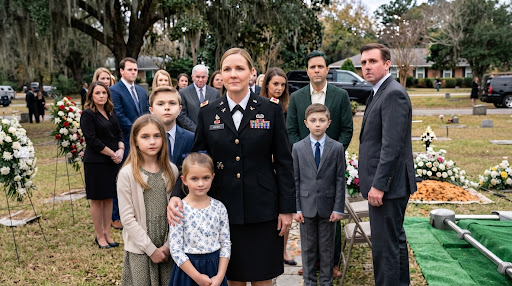
stood beside the open grave holding a sealed document.
The mourners who had been
whispering about my children were suddenly silent.
Grant stared at Vanessa.
“What did my father discover?”
Richard glanced toward the coffin.
Mr. Whitmore left specific instructions
that this information be delivered to you after his death.
Given what has just happened,
I believe you should hear it
before the family gathers for the reading of his will.
Vanessa stepped forward.
This is completely inappropriate.
We’re at a funeral.
Richard looked at her.
Then perhaps you should have considered
that before confronting Savannah and her children.
Her mouth snapped shut.
I felt Ethan’s hand tighten around mine.
He was the oldest of my five children by seven minutes, and he had appointed himself their protector long before I ever asked him to be.
“Mom,” he whispered, “we can leave.”
I looked down at him.
For ten years, I had taught my children that walking away from cruelty was not weakness.
But I had also taught them that they should never be ashamed of the truth.
“We’re going to say goodbye to your grandfather first,” I answered.
Richard approached Grant.
“Your father discovered that the allegations against Savannah were deliberately fabricated. He instructed me to preserve the supporting evidence and notify the appropriate authorities if necessary.”
Grant looked at Vanessa.
“Tell me he’s lying.”
Vanessa’s eyes filled.
“Grant, your father was confused near the end. He was taking medication. You know how sick he was.”
Richard’s expression hardened.
“Mr. Whitmore was examined by his physician before signing these instructions. His capacity was documented.”
Vanessa took another step backward.
Grant turned toward me.
“Savannah, what really happened at that hotel?”
I looked at the five children standing beside me.
They deserved the truth.
But they did not deserve to hear every painful detail while standing beside a grave.
“Not here,” I said.
Grant opened his mouth.
I raised my hand.
“You had ten minutes to hear my side ten years ago. Today, you can wait until your father’s funeral is finished.”
His face crumpled.
I turned toward the coffin.
William Whitmore had been a difficult man to understand.
He was wealthy, proud, and sometimes painfully traditional.
But when I married Grant, William had welcomed me into his home.
He taught me how to fish at the pond behind the estate.
He sent me books when I began officer training.
And when I was a young Army lieutenant struggling to balance military service and marriage, he told me something I never forgot.
“Savannah, don’t let this family convince you that your uniform makes you less of a wife. It means you know how to serve something bigger than yourself.”
After the divorce, I never saw him again.
But every Christmas, one handwritten card arrived.
Sometimes it contained only three sentences.
Sometimes it contained a Bible verse.
One year, he wrote:
I hope life has been kinder to you than we were.
I kept every card.
Now I placed a single white rose beside his coffin.
“Thank you for remembering me,” I whispered.
Then Rose stepped forward.
She was nine, like her brothers and sisters, and had Florence’s dark eyes.
She placed a folded drawing beside my rose.
It showed an old man standing beneath a large oak tree with five children around him.
At the top, she had written:
GOODBYE, GRANDPA. WE WISH WE HAD MET YOU.
Behind me, someone began crying.
I didn’t turn around.
I gathered my children and walked toward the waiting cars.
Grant called my name.
I kept walking.
For ten years, he had controlled the moment our marriage ended.
This time, I would decide when we spoke.
Two hours later, I sat inside Richard Collins’s office with a glass of water I hadn’t touched.
My children were at my sister’s house with their uncle Michael.
They had asked dozens of questions during the drive.
Was Grant really their father?
Why hadn’t he come to see them?
Had their grandfather known about them?
I answered carefully.
I told them Grant was their biological father.
I told them adults sometimes made terrible mistakes.
And I promised that none of those mistakes belonged to them.
But the hardest question came from Emma.
“Mommy, did Daddy not want us?”
I had nearly pulled the SUV off the road.
Because I remembered being twenty-six, sitting alone in a military clinic, staring at an ultrasound screen while a doctor told me there were five heartbeats.
Five.
I had been terrified.
My marriage had just ended.
My family lived hundreds of miles away.
And the man I loved had accused me of betraying him.
Yet when I heard those five heartbeats, I knew one thing.
Whatever happened next, my children would never have to earn my love.
I looked at Emma through the rearview mirror.
“Sweetheart, your father didn’t know you were coming. That doesn’t excuse everything, but it means he never had the chance to know you.”
She thought about that.
Then whispered, “Does he know now?”
“Yes.”
“Is he happy?”
I couldn’t answer.
Because I didn’t know.
Grant arrived at Richard’s office twenty minutes after I did.
He looked ten years older than he had at the cemetery.
His black suit was wrinkled.
His eyes were red.
And for the first time since I’d known him, he seemed completely uncertain of himself.
He stopped in the doorway.
“Savannah.”
I nodded.
“Grant.”
He sat across from me.
For several seconds, neither of us spoke.
Then he whispered, “Five children.”
I looked at him.
“Yes.”
“All mine?”
I slid the paternity report across the table.
“An accredited laboratory confirmed it after I obtained a sample you voluntarily provided during our divorce proceedings. My attorney had the testing arranged through the proper process years ago. The full records are here.”
Grant studied the report.
His hands began shaking.
“Ethan. Noah. Luke. Rose. Emma.”
I nodded.
He repeated their names as though trying to memorize them.
Then he covered his face.
“Oh, God.”
I watched him cry.
Ten years earlier, I would have reached across the table and comforted him.
But that woman no longer existed.
I had spent too many nights comforting myself.
Too many mornings getting five babies dressed before sunrise.
Too many birthdays explaining why there was no father in the photographs.
I wasn’t going to make his grief easier at the expense of my own.
Richard opened a folder.
“Before we discuss William’s instructions, I believe Savannah should explain what happened ten years ago.”
Grant looked up.
I took a breath.
“Do you remember the night Vanessa showed you those photographs?”
He nodded.
“You were entering a hotel room with another man.”
“My brother Michael.”
Grant swallowed.
“Vanessa told me your brother was dead.”
“Michael was serving overseas. He returned briefly on authorized leave because I needed help.”
“Help with what?”
I stared at him.
“Your family.”
Grant frowned.
I continued.
“Vanessa had been sending me anonymous messages for months. She said I was ruining your future. She said I wasn’t suitable for the Whitmore family. She threatened to expose private military information she claimed to possess.”
Grant looked stunned.
“Why didn’t you tell me?”
“I tried.”
He opened his mouth.
I stopped him.
“Three times, Grant. I tried three times. You told me Vanessa was practically family and that I was imagining things.”
He looked down.
“Michael came to Burlington because I was frightened. We met at his hotel to review the messages and decide whether I needed legal help.”
My voice tightened.
“Vanessa had someone photograph us entering the room.”
Grant whispered, “She said you spent the night.”
“I left after forty minutes.”
Richard slid a hotel folio across the desk.
“The original billing records and the manager’s sworn statement support Savannah’s account.”
Grant stared at the documents.
I continued.
“Vanessa also produced a handwritten confession supposedly signed by me.”
Grant nodded weakly.
“I remember.”
“Except I never wrote it.”
Richard placed another report beside the folio.
“A forensic document examiner identified significant inconsistencies between the signature and Savannah’s verified handwriting.”
Grant looked as though he might be sick.
I leaned forward.
“Do you remember what you said when I tried to explain?”
He closed his eyes.
I repeated his words.
“You have ten minutes to pack your things and get out of my house.”
A tear slid down his cheek.
“Savannah…”
“You told me you would never forgive me.”
He lowered his head.
“And when I begged you to listen, you told me that women like me always had an excuse.”
He began crying harder.
I waited.
Then I said the words I’d carried for ten years.
“You didn’t divorce me because I betrayed you, Grant. You divorced me because believing Vanessa was easier than trusting your wife.”
He couldn’t answer.
Richard opened William’s final statement.
“Your father began investigating the divorce several months ago after discovering correspondence between Vanessa and the former hotel manager.”
Grant looked up.
“How?”
“Vanessa had been involved in a dispute concerning payments made through an old family business account. Your father requested an audit.”
Richard turned a page.
“The audit uncovered payments to the hotel manager around the time of your divorce. Further investigation revealed communications suggesting that Vanessa arranged the photographs and altered the supporting records.”
Grant shook his head.
“Why would she do that?”
I laughed bitterly.
“You know why.”
He looked at me.
“Savannah…”
“Vanessa wanted to marry you.”
His face drained.
Three months after our divorce, Vanessa had begun appearing publicly beside Grant.
A year later, they became engaged.
Their wedding was postponed twice.
But according to what I’d heard, they had remained together ever since.
Grant stared at the table.
“She told me she was helping me survive what you’d done.”
I looked away.
Of course she had.
She’d created the wound.
Then offered herself as the cure.
Richard continued.
“William also discovered that several letters addressed to Grant had been intercepted.”
My heart stopped.
“What letters?”
Richard removed a packet tied with a blue ribbon.
I recognized the handwriting immediately.
Mine.
The first envelope was dated three weeks after my pregnancy was confirmed.
The second was dated two months later.
The third had been mailed shortly before my children were born.
I stared at them.
“I sent those.”
Grant looked up.
“What?”
“I wrote to you.”
His eyes widened.
“I never received them.”
I shook my head.
“I sent them to the estate. Your office. Your private mailing address.”
Richard nodded.
“William found these in a locked cabinet among Vanessa’s belongings after she moved some items into storage at the estate.”
Grant stared at the envelopes.
Then whispered, “She kept them?”
Richard handed him the first.
Grant opened it.
His eyes moved across the page.
Then he began shaking.
I knew exactly what it said.
Grant, I know you believe I betrayed you, but I am pregnant. The doctors have confirmed that I’m carrying five babies. I am not asking you to take me back. I am asking you to hear the truth before our children are born.
Grant pressed the letter against his mouth.
I watched his shoulders collapse.
For ten years, I had wondered whether he read that letter and chose to ignore it.
Now I knew.
He never saw it.
But that knowledge didn’t erase everything else.
It didn’t erase the ten minutes he’d given me.
It didn’t erase the insults.
It didn’t erase the fact that he had refused to hear me when I was still his wife.
Grant looked at me.
“Savannah, I didn’t know.”
My eyes filled.
“I believe you.”
He began sobbing.
“But I need you to understand something.”
He looked up.
“Vanessa hid the letters. She fabricated the evidence. She lied.”
I paused.
“But you were the one who threw me away.”
The room went silent.
Then Grant lowered his head.
And whispered, “You’re right.”
Richard reached for the final document.
“There is one more matter.”
Grant wiped his eyes.
“What?”
“Your father changed his estate plan after discovering what happened.”
Grant looked confused.
Richard continued.
“William established a trust intended to benefit his grandchildren, including any children whose parentage is legally established.”
My stomach tightened.
“I didn’t bring my children here for money.”
Richard nodded.
“William anticipated you would say that.”
He handed me a handwritten note.
I unfolded it.
Savannah,
If this reaches you, then I have failed to apologize while I was alive.
I believed my son when he accused you. I should have asked questions. I should have remembered the young woman who sat beside me at the pond and spoke about serving her country.
I cannot give you back the years.
But if you have children, please tell them their grandfather would have loved to know them.
And please understand that any provision I made for them is not a payment for your forgiveness.
It is simply my attempt to make sure they are never treated as strangers in their own family.
With regret, William.
I read the letter twice.
Then I covered my face.
For ten years, I had believed William simply forgot me.
But he hadn’t.
He’d carried regret.
And now the children he never met were standing at the center of the truth he had uncovered.
Grant looked toward Richard.
“Where’s Vanessa?”
Richard’s expression darkened.
“She left the cemetery shortly after you did.”
Grant reached for his phone.
I stopped him.
“Grant.”
He looked at me.
“Don’t make this another scene.”
His jaw tightened.
“She stole ten years from me.”
I shook my head.
“She helped steal them.”
He stared at me.
“And I need you to understand that if you want any place in our children’s lives, anger at Vanessa won’t be enough.”
He swallowed.
“What do you want me to do?”
I looked directly into his eyes.
“Become someone they can trust.”
PART 4
Grant did not meet the children that afternoon.
He wanted to.
He begged me.
But I refused.
Not because I wanted to punish him.
Because five nine-year-old children were not responsible for comforting a grown man who had just discovered the consequences of his mistakes.
“They need time,” I told him.
He nodded.
“I understand.”
“And they need to know that if you come into their lives, you won’t disappear when things become difficult.”
His eyes filled.
“I won’t.”
I held his gaze.
“You made promises to me once.”
He looked down.
“I know.”
“Don’t make promises to them unless you’re prepared to keep them.”
He nodded again.
For the first time in our history, he didn’t argue.
The next morning, I sat at my sister’s kitchen table while my children ate pancakes.
Michael stood beside the stove, flipping another batch.
He was forty now, broad-shouldered and graying at the temples.
The man Vanessa had once claimed was dead was very much alive.
And he had spent the last decade being the closest thing my children had to a father.
He taught Ethan how to ride a bicycle.
He helped Noah build model airplanes.
He took Luke fishing.
He attended Rose’s school performances.
And he let Emma paint his fingernails pink when she was five.
When I told him what had happened at the funeral, he sat down without speaking.
Then he shook his head.
“Ten years.”
I nodded.
“Ten years.”
He looked toward the children.
“What are you going to do?”
I watched Ethan helping Emma pour syrup.
“I don’t know yet.”
Michael took my hand.
“You don’t have to decide everything today.”
I squeezed his fingers.
“I know.”
Then Rose looked up.
“Mom?”
“Yes, sweetheart?”
“Is Daddy coming to see us?”
The kitchen went quiet.
I sat beside her.
“Would you like to meet him?”
She nodded.
“I think so.”
Ethan crossed his arms.
“I don’t.”
I looked at him.
“That’s okay.”
His face tightened.
“He made you cry.”
My heart broke.
I had tried so hard to hide my pain from them.
But children notice more than we think.
I reached for his hand.
“Ethan, what happened between your father and me wasn’t your fault.”
“I know.”
“And you don’t have to decide how you feel about him today.”
He looked away.
“What if he doesn’t like us?”
I felt tears rising.
“Then that would be his failure, not yours.”
Noah looked up from his pancakes.
“Does he know we all play baseball?”
I smiled.
“Not yet.”
Luke asked, “Does he know I want to be a pilot?”
“No.”
Emma whispered, “Does he know I have asthma?”
My throat tightened.
“No, sweetheart.”
She looked down.
“Then he doesn’t know anything.”
I wrapped my arms around her.
“Not yet.”
Three days later, Grant met the children at a quiet park.
I chose a public place.
Michael came with us.
Grant arrived early.
He stood beside a picnic table holding five small gift bags.
When the children approached, he looked terrified.
I had never seen him that way.
He had always been confident.
A Whitmore.
A man raised to believe his name could open any door.
But standing before five children, he seemed to understand that money and family influence meant nothing.
He couldn’t buy their trust.
He couldn’t demand their affection.
And he couldn’t erase ten years with an apology.
Ethan stood beside me.
Grant looked at him.
“Hello, Ethan.”
My son nodded.
“Hello.”
Grant turned toward Noah.
“And you’re Noah.”
“Yes, sir.”
Luke stepped forward.
“I’m Luke.”
Grant smiled shakily.
“I know.”
Then Rose waved.
“Hi.”
Grant’s eyes filled.
“Hi, Rose.”
Emma stayed behind my leg.
Grant crouched so he was closer to her height.
“And you must be Emma.”
She nodded.
He smiled.
“It’s nice to meet you.”
For a moment, nobody spoke.
Then Ethan asked the question I’d been dreading.
“Why weren’t you there?”
Grant’s face crumpled.
He looked toward me.
I said nothing.
This was his answer to give.
He swallowed.
“Because I made a terrible mistake.”
Ethan frowned.
“What kind?”
Grant took a shaky breath.
“I believed something untrue about your mother. I didn’t listen when she tried to explain.”
My son stared at him.
“Did you know about us?”
“No.”
“Why?”
Grant’s eyes filled.
“Because someone hid the letters your mother sent me.”
Ethan looked down.
Then back at him.
“But you still hurt Mom.”
Grant nodded.
“Yes.”
The word hung between them.
He continued.
“And I’m sorry. I can’t change what I did, but I want to take responsibility for it.”
Ethan studied him.
Then asked, “Are you going to leave again?”
Grant’s voice broke.
“I want to be part of your lives, if you’ll let me.”
My son crossed his arms.
“We don’t know you.”
Grant nodded.
“That’s true.”
Ethan looked at me.
Then back at Grant.
“You can start by coming to my baseball game.”
Grant began crying.
“I’d like that.”
Ethan shrugged.
“It’s Saturday.”
“I’ll be there.”
My heart tightened.
Because I knew Saturday would tell us more than a hundred apologies ever could.
Grant came to the baseball game.
He arrived twenty minutes early.
He sat three rows behind me.
He cheered when Ethan hit a double.
He stayed afterward to help collect equipment.
And when Ethan approached him, Grant didn’t try to hug him.
He simply smiled.
“You played really well.”
Ethan nodded.
“Thanks.”
Then he asked, “Are you coming next week?”
Grant looked at me.
I nodded slightly.
He smiled.
“If you want me there.”
Ethan considered that.
Then said, “Okay.”
It wasn’t forgiveness.
It wasn’t love.
But it was a beginning.
Meanwhile, Vanessa’s carefully constructed life began unraveling.
Grant ended their relationship.
His attorney obtained copies of the documents Richard had preserved.
The hotel manager’s statement and financial records were reviewed by investigators.
Rebecca, a former employee who had assisted Vanessa with the forged confession, also provided information through her attorney.
The allegations led to a formal investigation into possible fraud, forgery, and interference with correspondence.
Vanessa denied wrongdoing at first.
She claimed the payments were innocent.
She claimed the letters had been misplaced.
She claimed the handwriting report was unreliable.
But the evidence continued accumulating.
Eventually, her attorney began discussing a negotiated resolution with prosecutors.
I followed the developments from a distance.
I didn’t attend every hearing.
I didn’t stand outside the courthouse waiting to see her humiliated.
I had spent ten years building a life.
I wasn’t going to spend the next ten watching hers fall apart.
One afternoon, however, Vanessa called me.
I almost ignored the number.
Then I answered.
“Savannah.”
Her voice sounded smaller than I remembered.
“What do you want, Vanessa?”
She hesitated.
“I need to explain.”
I looked out the window.
“Then explain.”
She began crying.
“I loved Grant.”
I said nothing.
“I loved him before you married him. I thought he was supposed to be with me.”
I closed my eyes.
“So you destroyed our marriage?”
“I didn’t know about the babies.”
My throat tightened.
“You hid the letters.”
She began sobbing.
“I thought if he knew, he’d go back to you.”
I gripped the phone.
“Those letters weren’t about winning Grant back.”
She went silent.
“They were about five children who deserved to know their father.”
Her breathing became uneven.
“I know.”
“No, Vanessa. You don’t.”
My voice shook.
“You took away their birthdays with him. Their first steps. Their first words. Their first days of school.”
I paused.
“You took away William’s chance to know his grandchildren.”
She began crying harder.
“I never meant for it to go this far.”
I stared at the wall.
“That’s the problem with cruelty, Vanessa. You don’t get to decide how far the damage travels.”
She whispered, “Can you forgive me?”
I thought about my children.
About the nights I’d spent awake with sick babies.
About the times I’d signed school forms with only one parent’s name.
About the birthday parties where I smiled until everyone left, then cried alone in the kitchen.
“I don’t know,” I answered.
She began sobbing again.
“But I won’t let hating you become another thing you take from me.”
Then I ended the call.
Six months after William’s funeral, Grant asked to meet me alone.
We sat at a small café outside Savannah.
He looked nervous.
“I’ve been speaking with a family therapist,” he said.
I nodded.
“That’s good.”
“She told me something difficult.”
I waited.
Grant looked down.
“She said I keep talking about what Vanessa did because it’s easier than facing what I did.”
I studied him.
He continued.
“She’s right.”
For a moment, neither of us spoke.
Then he said, “I didn’t trust you.”
I felt my throat tighten.
“You didn’t.”
“I let someone else tell me who my wife was.”
He looked at me.
“And when you tried to defend yourself, I treated your explanation like an inconvenience.”
I looked away.
He continued.
“I’ve spent years telling myself Vanessa fooled me.”
His voice cracked.
“But she didn’t force me to humiliate you.”
I swallowed.
“No.”
“She didn’t force me to sign those divorce papers.”
“No.”
“And she didn’t force me to give you ten minutes to defend yourself.”
Tears filled his eyes.
“I did that.”
I looked at him for a long time.
Then nodded.
“Yes, Grant. You did.”
He wiped his face.
“I’m sorry.”
I believed he meant it.
But an apology couldn’t rebuild our marriage.
Not after ten years.
Not after everything I’d become without him.
“I accept that you’re sorry,” I said quietly.
He looked up.
“But we’re not going backward.”
His expression changed.
“I know.”
“We have five children together. That means we’ll need to communicate, cooperate, and put them first.”
He nodded.
“But it doesn’t mean we’re becoming husband and wife again.”
He closed his eyes.
“I understand.”
I watched him struggle with the words.
Then I added, “The children deserve a father who loves them without expecting their mother as part of the bargain.”
Grant looked at me.
And for the first time, he smiled without trying to change my mind.
“Then that’s the father I’ll work to become.”
The following year brought changes none of us could have predicted.
Grant began attending school events.
He learned which child hated tomatoes.
He discovered that Noah couldn’t sleep without a night-light.
He learned that Luke wanted to fly helicopters.
He learned Rose loved astronomy.
And he learned that Emma’s asthma required careful attention and a plan everyone responsible for her needed to understand.
He made mistakes.
Sometimes he forgot appointments.
Sometimes he tried too hard.
Sometimes Ethan became angry without knowing exactly why.
But Grant kept showing up.
And when he failed, he apologized without making excuses.
We worked with attorneys and a family counselor to establish appropriate parenting arrangements.
The children were given space to express their feelings.
Nobody forced affection.
Nobody demanded forgiveness.
And slowly, the distance between Grant and the children began to shrink.
One evening, Ethan came home from spending an afternoon with his father.
He sat beside me on the couch.
“Mom?”
“Yes?”
“Dad taught me how to change a tire.”
I smiled.
“That’s useful.”
He nodded.
Then looked at me.
“Is it okay if I like him?”
My heart broke in a completely different way.
I pulled him close.
“Ethan, you never have to choose between loving your father and loving me.”
He rested his head against my shoulder.
“Even after what he did?”
“Even then.”
He thought about that.
Then whispered, “I love you, Mom.”
I kissed his forehead.
“I love you too.”
William’s estate was settled according to the law and the terms of his final documents.
The children’s trust was administered independently, with safeguards intended to protect their interests until adulthood.
I insisted on transparency.
I wanted no confusion about why we’d returned to the Whitmore property.
My children weren’t there to collect a fortune.
They were there because their grandfather had been part of their history, whether anyone acknowledged it or not.
The trust might help pay for their education someday.
But it would never define their worth.
That was something I made sure they understood.
One Sunday afternoon, we visited William’s grave again.
This time, there were no whispers.
No accusations.
No woman standing in our way.
Grant came with us.
He carried five white roses.
The children walked ahead.
Ethan placed his rose beside the headstone.
“Hi, Grandpa.”
Noah added his.
“Dad says you liked fishing.”
Luke smiled.
“I’m going to learn.”
Rose knelt and placed a small drawing beside the flowers.
It showed William sitting under an oak tree with five children around him.
Emma looked at the headstone.
Then whispered, “I wish we’d met you.”
Grant began crying.
I stood a few feet away.
For a moment, I remembered the funeral.
The gray sky.
The whispers.
Vanessa’s cruel smile.
Grant staring at five faces that looked like his own.
And the envelope in my hand.
I’d arrived carrying ten years of silence.
But I hadn’t come to destroy anyone.
I’d come to honor the one person in that family who had remembered me.
And somehow, the truth had finally found its way into the open.
Later that evening, Grant walked me to my SUV.
The children were laughing inside, arguing about which movie to watch when we got home.
Grant looked toward them.
“They’re incredible.”
I smiled.
“They are.”
He hesitated.
“Savannah, I know I can’t get those years back.”
I nodded.
“No, you can’t.”
His eyes filled.
“But thank you for letting me know them now.”
I looked at him.
“You’re their father. What matters is what you do with that responsibility.”
He nodded.
Then he glanced at my uniform jacket folded across the passenger seat.
“You’ve built an amazing life.”
I smiled faintly.
“It wasn’t easy.”
“I know.”
I looked at him.
“No, Grant. You know parts of it now. But you weren’t there for the rest.”
He lowered his eyes.
“You’re right.”
I opened the driver’s door.
Then he said something I never expected.
“I’m proud of you, Savannah.”
For a moment, I couldn’t speak.
Ten years earlier, those words might have changed everything.
But now they were simply words I could appreciate without needing them.
“Thank you,” I answered.
Then I climbed into the SUV.
And drove away.
That night, after the children fell asleep, I sat alone on the porch.
Georgia crickets sang beneath the stars.
A warm breeze moved through the trees.
My phone rested beside me.
For the first time in years, I opened the folder containing the old divorce papers.
I looked at Grant’s signature.
I remembered how my hands shook when I signed my name beneath his.
I remembered leaving the Whitmore estate with two suitcases.
I remembered sitting in my car outside the gates, crying so hard I could barely see the road.
Back then, I believed my life was over.
I believed I’d lost everything.
My marriage.
My home.
My future.
Then I discovered five tiny heartbeats.
And somehow, the life I thought had ended became the beginning of something extraordinary.
I raised five children while serving my country.
I earned promotions.
I learned to ask for help.
I learned that strength didn’t mean never crying.
It meant getting up the next morning even when the night before had nearly broken you.
I learned that family wasn’t always the people who shared your last name.
Sometimes it was the brother who drove through the night when you needed him.
The neighbor who watched five babies so you could sleep for two hours.
The fellow soldier who brought groceries when you were too exhausted to shop.
And the five children who filled a house with so much noise and laughter that loneliness never stood a chance.
I closed the folder.
Then I placed it in a drawer.
Not because the past no longer mattered.
But because it no longer controlled me.
A few weeks later, Rose came into my bedroom holding a photograph.
It was the picture taken at William’s grave.
Grant stood beside the children.
I stood on the other side.
Everyone was smiling.
“Mommy?”
“Yes, baby?”
“Can I put this in my room?”
I looked at the photograph.
“Of course.”
She studied it.
“It’s nice.”
I smiled.
“It is.”
Then she looked up.
“Are we a family now?”
I knelt beside her.
“Rose, we’ve always been a family.”
She thought for a moment.
“Even when Daddy wasn’t here?”
“Yes.”
“And now that he is?”
“We’re still a family. Just learning a different way to be one.”
She smiled.
Then wrapped her arms around my neck.
“I like our family.”
I held her tightly.
“So do I, sweetheart.”
People sometimes ask whether I regret going to William Whitmore’s funeral.
I don’t.
I regret the years of silence.
I regret that William died without meeting his grandchildren.
I regret that my children grew up with questions I couldn’t answer.
And I regret that a woman driven by jealousy was able to cause so much pain.
But I don’t regret walking into that cemetery.
Because I didn’t arrive as a broken wife looking for revenge.
I arrived as a mother.
A soldier.
A woman who had rebuilt her life from the pieces someone else left behind.
And when Grant looked into the faces of Ethan, Noah, Luke, Rose, and Emma, he finally understood what had been taken from all of us.
Not a house.
Not an inheritance.
Not a family name.
Time.
Ten birthdays.
Ten Christmas mornings.
Ten years of bedtime stories.
Ten years of scraped knees, lost teeth, school performances, and whispered prayers.
Those moments could never be returned.
But the years ahead still belonged to the children.
And I refused to let the mistakes of the past steal those too.
Vanessa thought destroying my marriage would erase me from the Whitmore family.
Instead, ten years later, I walked back onto that property with five living reminders that the truth had never disappeared.
It had simply been growing up.
One child at a time.
I entered that funeral holding five little hands and ten years of silence.
I left knowing my children would never again have to wonder whether their existence was something to hide.
And as for me?
I no longer needed the Whitmore family to tell me what I was worth.
I had learned that long before I walked through their gates again.
THE END THANK YOU FOR READING !!!