PART 3
Norah lifted the business card between two fingers.
It was cream-colored, simple, expensive-looking without trying to be.
At the top was a logo I recognized immediately.
My stomach tightened.
I had seen that logo on architectural magazines.
On preservation reports.
On the brass plaque outside one of the most celebrated restoration firms in the state.
Whitfield Preservation & Design.
Underneath her name were three words:
Founder and Principal Architect.
Patricia stared at it.
Then she laughed.
“You’re an architect?”
Norah looked at her.
“Yes.”
Patricia glanced at me.
“Of course she is.”
Something in her tone made the old familiar embarrassment crawl up my spine.
The same tone she had used when I won my first award.
The same tone my mother used when she asked whether architecture was “really a career.”
The same tone that had followed me since childhood.
Norah didn’t react.
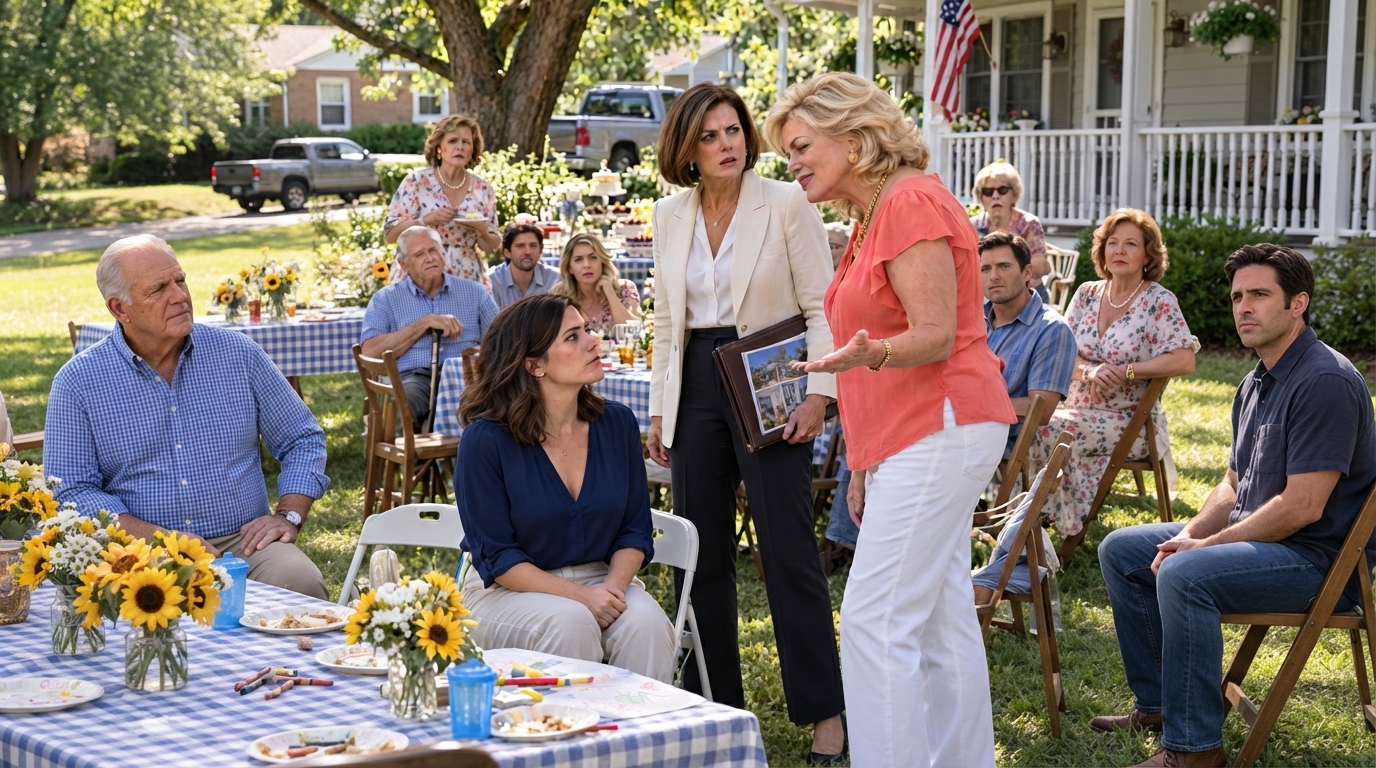
Instead, she opened the leather portfolio.
“I came because of Faith.”
My mother folded her arms.
“What exactly does that mean?”
Norah looked around the yard.
At the relatives.
At the folding tables.
At the children.
At my father beneath the oak tree.
Then she turned toward me.
“Faith, would you like to explain?”
I looked at everyone.
I could have.
I could have told them.
But for the first time in my life, I realized I didn’t need to introduce myself.
Norah could.
She held up a glossy photograph.
It showed a limestone courthouse restored to its original 1920s appearance.
At the bottom was a plaque.
Historic Preservation Award — Restoration Architect: Faith Mercer.
Patricia stared.
My mother blinked.
Jolene took the photograph from Norah.
“This is your work?”
“Yes.”
She flipped to another.
A church.
Another.
An old post office.
Another.
A Carnegie library.
Jolene looked at me.
“You did all these?”
“Yes.”
My brother Caleb finally spoke.
“You never told us.”
I smiled.
“You never asked.”
That silenced him.
Norah continued.
“Faith has spent more than a decade restoring historic buildings that other people had already decided were worthless.”
She pointed to the library photograph.
“This project was nearly demolished.”
My father watched from beneath the tree.
Norah looked at him.
“Her work preserved it.”
Patricia scoffed.
“That’s nice.”
Norah looked at her.
“It’s more than nice.”
She opened another section of the portfolio.
Inside were pages from the national preservation journal.
Articles.
Reviews.
Photographs.
The names of judges.
Awards.
Commendations.
My mother began flipping through them.
“What is all this?”
Norah answered:
“Evidence.”
“Evidence of what?”
“That your niece is one of the most respected young preservation architects in this region.”
I felt my face grow warm.
I wasn’t used to people describing me that way.
Especially not in front of my family.
Norah wasn’t finished.
She held up another page.
“This one is from a project in Savannah.”
Another.
“This one is the courthouse in Madison.”
Another.
“This one is the train depot Faith mentioned.”
Patricia leaned forward.
“Train depot?”
Norah nodded.
“The depot that was scheduled for demolition.”
My mother suddenly remembered.
“You said that was a small side project.”
“It started that way.”
Norah smiled.
“She convinced the town council to preserve it.”
My father smiled faintly.
I saw it.
That tiny smile.
The one I had seen only twice in my entire childhood.
Pride.
Norah continued.
“That depot is now on the state historical register.”
Someone at the table whispered:
“She did all that?”
Another cousin said:
“I had no idea.”
Patricia looked uncomfortable.
“Okay, she’s successful.”
Norah looked at her.
“No.”
Patricia frowned.
“You’re still here because of her.”
“Yes.”
“Then what else is there?”
Norah closed the portfolio.
“Faith’s name is being considered for the lead restoration architect on a project worth more than thirty million dollars.”
The yard went silent.
Jolene stared.
Caleb raised his eyebrows.
My mother looked confused.
“What project?”
Norah smiled.
“The Whitmore Civic Quarter.”
Patricia blinked.
“The downtown redevelopment?”
“Yes.”
“That project has been in the news for months.”
“Yes.”
“That’s your firm?”
“Yes.”
My father slowly sat forward.
“And Faith?”
Norah looked at me.
“Faith is the architect we’ve chosen to lead the historic restoration component.”
My mother stared at me as though she had never seen me before.
“You never told us.”
I shrugged.
“No one asked.”
She shook her head.
“You always kept everything secret.”
I almost laughed.
“I learned from you.”
That one landed.
My mother looked away.
Norah turned toward the relatives.
“There’s another reason I’m here.”
Everyone listened.
She reached into her portfolio and pulled out a formal invitation.
“This afternoon, I was supposed to meet with Faith privately.”
Patricia asked:
“For what?”
“To offer her the project.”
I felt my stomach flip.
“But you said you were here because of her.”
“I am.”
Norah handed the invitation to me.
I looked at it.
The top was embossed.
Whitfield Preservation & Design
and the State Heritage Commission
Request for Appointment
I looked at Norah.
“You didn’t have to bring this here.”
“I know.”
“Then why did you?”
She looked at my family.
“Because for thirty-four years, people in this yard have been telling a false story about you.”
No one spoke.
“I thought they should have the opportunity to hear the true one.”
My mother looked wounded.
“That’s unfair.”
Norah answered calmly.
“Unfair was introducing a successful architect as ‘the one we don’t talk about.’”
Patricia looked at the ground.
Norah continued.
“Faith doesn’t need a public defense.”
She looked at me.
“But she deserves one when people mock her to her face.”
My eyes filled.
I looked away.
My father stood.
“Norah.”
She turned.
“I’d like to apologize.”
Patricia looked shocked.
My mother looked at him.
“For what?”
He ignored her.
He spoke to me.
“For never telling you.”
My voice came out quietly.
“Telling me what?”
“How proud I was.”
I stared at him.
My father took a breath.
“I found your first award in the newspaper.”
I already knew.
“But there was more.”
He looked embarrassed.
“I kept every article.”
The yard went silent.
I looked at him.
“Why?”
“Because I knew your mother didn’t want to encourage you.”
My mother turned toward him.
“You never told me you were doing that.”
“I didn’t tell anyone.”
My father’s voice shook.
“When you passed your licensing exam, I bought six copies of the paper.”
My chest tightened.
“Dad…”
“I wanted to frame them.”
“Why didn’t you?”
He looked at my mother.
“I was afraid.”
I swallowed.
“Of her?”
He nodded.
“Of all of you.”
Something inside me broke open.
Not anger.
Something sadder.
Understanding.
My father had been watching me.
He had been proud.
But pride had stayed hidden because he had been too afraid to challenge the hierarchy.
I had interpreted his silence as indifference.
He had experienced it as cowardice.
Neither of us had said the truth.
Not once.
My father looked at me.
“I am sorry.”
I nodded.
“Thank you.”
Patricia scoffed.
“Now everyone wants to make Faith a hero.”
Norah turned toward her.
“No.”
Patricia blinked.
“I’m not?”
“I’m saying she doesn’t need to be a hero.”
Norah’s voice remained calm.
“She needs to be treated like a human being.”
That ended the laughter.
Jolene looked embarrassed.
Caleb stared at me.
Then my mother said:
“Your father had a stroke because of stress.”
I looked at her.
“That doesn’t have anything to do with this.”
“I think it does.”
She glanced around.
“The family has been under tremendous pressure.”
Norah’s eyebrows rose.
“Is that why you called her ugly?”
My mother flinched.
“That was a long time ago.”
“You’ve continued it.”
Patricia stepped in.
“It was teasing.”
Norah looked at her.
“Then why is Faith still quiet every time someone says it?”
That question landed harder than any accusation.
I hadn’t realized I did that.
But I did.
Every time someone complimented me, I discounted it.
Every time someone asked about my work, I minimized it.
Every time someone praised me, I assumed they were being polite.
I had spent decades learning to expect dismissal.
Norah closed the portfolio.
“I didn’t come here to embarrass anyone.”
She looked at the family.
“I came because Faith deserves to stop hiding.”
Then she looked at me.
“Come with me.”
I smiled.
“Where?”
“To the car.”
“Why?”
“Because your appointment starts in twenty minutes.”
I laughed.
“You planned this.”
“No.”
She smiled.
“I planned to get coffee with you.”
“And?”
“And then your aunt called you the one nobody talks about.”
I laughed through my tears.
“That sounds like Patricia.”
Patricia glared.
Norah extended her hand.
I took it.
As we walked toward the driveway, my mother called my name.
“Faith.”
I turned.
“What?”
She looked at me.
For the first time, she didn’t say ugly.
She didn’t say plain.
She didn’t say difficult.
She said my name.
“I didn’t know.”
I nodded.
“I know.”
Then I left.
PART 4
The Whitfield office overlooked downtown.
Glass walls.
Original brick.
Steel beams.
Modern furniture mixed with historic details.
It looked like the kind of place I had imagined working in when I was eighteen.
Norah led me into a conference room.
Three people were waiting.
A preservation specialist.
A structural engineer.
A representative from the state heritage commission.
I stopped in the doorway.
Norah smiled.
“They’re here for you.”
I looked at her.
“You really planned this.”
She laughed.
“I told you I was bringing you for coffee.”
“I knew you were lying.”
“I wasn’t lying.”
She nodded toward the coffee tray.
“There is coffee.”
I laughed.
Then the meeting started.
The Whitmore Civic Quarter was enormous.
An entire section of downtown was being redeveloped.
Modern offices.
Housing.
Retail.
Transportation.
But the historic buildings in the center were protected.
The project needed someone who could balance preservation with modern safety standards.
Someone who understood old materials.
Historic structures.
Adaptive reuse.
Community needs.
And political pressure.
Norah looked at me.
“We want you.”
I stared at her.
“Lead architect?”
“Yes.”
I swallowed.
“That is huge.”
“Yes.”
“You have senior architects.”
“I do.”
“People with more experience.”
“Yes.”
“Why me?”
Norah smiled.
“Because the buildings matter to you.”
I didn’t understand.
“You care about the story.”
She opened one of my old project files.
“You don’t just restore walls.”
She pointed toward the drawings.
“You restore memory.”
I looked down.
She continued.
“I’ve reviewed your work for years.”
“You have?”
“Yes.”
“Since when?”
“The library.”
I laughed.
“That was one of my first major projects.”
“It was one of the reasons I started following your work.”
I looked at her.
“You never told me.”
“You never asked.”
We both laughed.
That phrase had become a family joke.
Later that afternoon, the commission offered me the position officially.
I accepted.
My name would appear on the project.
Publicly.
Not hidden.
Not minimized.
Not described as a “little architecture job.”
Public.
Mine.
I went home that evening and called my father.
“I got it.”
He laughed.
“I know.”
“How?”
“Your mother saw it online.”
My stomach tightened.
I expected criticism.
Instead, he said:
“I printed it.”
I smiled.
“Dad.”
“I framed it.”
I started crying.
He went silent.
Then he said:
“I should have done that years ago.”
I wiped my eyes.
“You can start now.”
He laughed.
“Your mother is angry.”
“Why?”
“She says everyone will know she has an architect daughter.”
I laughed.
“I thought she already had one.”
He sighed.
“She’s embarrassed.”
“Of me?”
“No.”
“Of herself.”
That was the second time that phrase had been used.
Later that evening, my mother called.
“Faith.”
“Yes?”
“I saw the announcement.”
“Yes.”
“You’re leading the project.”
“Yes.”
“You’re really successful.”
I smiled.
“I guess.”
She hesitated.
“I didn’t know.”
“I know.”
“You’ve been doing this all these years.”
“Yes.”
“I thought you were doing little renovations.”
I laughed.
“No.”
She was silent.
Then:
“I owe you an apology.”
I didn’t answer.
“I know I told you architecture wasn’t for someone like you.”
“Yes.”
“I was wrong.”
“Yes.”
“I know that doesn’t fix it.”
“No.”
“But I’m sorry.”
I closed my eyes.
“Thank you.”
She started crying.
Then she asked:
“Are you still coming to family dinners?”
I smiled.
“Sometimes.”
“Why not always?”
“Because sometimes I have work.”
She laughed weakly.
“That’s fair.”
I hung up.
And for the first time, my mother hadn’t asked me to make her feel better.
She had apologized.
That mattered.
A few weeks later, the family reunion photographs circulated online.
One showed me with Norah.
Another showed the historic depot I had restored.
Another showed my father accepting the preservation award I had earned.
The comments were strange.
Relatives who had ignored my work for years suddenly wrote:
“So proud.”
“She’s always been talented.”
“Family accomplishment.”
I read them without anger.
But I noticed something.
Nobody called me ugly.
Nobody called me plain.
Nobody called me the one we don’t talk about.
Not because I had become more beautiful.
Not because I had become richer.
Because I had finally stepped outside the family story.
I no longer fit their assigned role.
One month before the Whitmore project began, Norah asked me to accompany her to a meeting.
There were investors.
City officials.
Architects.
Historians.
Developers.
At one point, an older gentleman asked:
“Who is leading preservation?”
Norah pointed toward me.
“Faith.”
He looked impressed.
“That’s young.”
I smiled.
“So was every architect once.”
He laughed.
“Fair.”
Another asked:
“Who trained you?”
I answered.
“My mother.”
Norah looked surprised.
“So your mother is an architect?”
“No.”
“She taught you architecture?”
“No.”
I smiled.
“She taught me perseverance.”
The room laughed.
But I meant it.
My mother had taught me exactly what not to become.
And somehow, that had shaped me too.
After the meeting, Norah and I walked outside.
She asked:
“Do you regret coming to the reunion?”
I thought.
“No.”
“Why?”
“Because I finally heard the story they tell about me.”
She nodded.
“And?”
“I realized I wasn’t living in it anymore.”
Norah smiled.
“That is why I came.”
“What do you mean?”
“I knew your family had no idea who you were.”
“How?”
“Because I had spent years working with people who admired your work.”
She paused.
“Whenever your name came up, I heard respect.”
“And at home?”
“Nothing.”
I laughed.
“That’s my family.”
She smiled.
Then she said:
“You’ve spent your whole life thinking you were less because they never described you accurately.”
I looked at her.
“How do you know?”
“Because I saw it in the way you looked down when I praised you.”
I stopped walking.
She was right.
I had been doing it again.
She put one hand on my shoulder.
“Don’t.”
“Don’t what?”
“Shrink.”
I laughed.
“I’m trying.”
“I know.”
A year after the reunion, the Whitmore Civic Quarter opened its first restored building.
The old courthouse stood behind a new glass tower.
Modern and historical.
New and old.
The city held a ceremony.
There were speeches.
Plaques.
Photographs.
My name appeared on the official project documents.
Lead Preservation Architect — Faith Mercer.
My father attended.
My mother attended.
Jolene attended.
Caleb attended.
Patricia came too.
I stood on the stage beside Norah.
Then the mayor handed me the microphone.
I looked at the crowd.
Then I looked at my family.
I thought about the girl with the stained dress.
The girl holding the disposable camera.
The girl who learned to photograph herself because nobody else would.
And I smiled.
“When I was young,” I said, “I thought being unseen meant being unimportant.”
The crowd listened.
“I was wrong.”
My mother lowered her eyes.
“Sometimes being unseen simply means the people around you are not looking carefully enough.”
The crowd applauded.
I continued.
“Buildings teach us something about that.”
I looked at the old courthouse.
“People see cracks and assume something is broken beyond repair.”
I smiled.
“But sometimes the structure is still strong.”
Norah looked at me.
“We just need to stop judging it from the surface.”
The applause grew louder.
I looked toward my father.
He was crying.
I looked toward my mother.
She was crying too.
Then I said:
“My work isn’t about making old buildings look new.”
I paused.
“It is about revealing what was worth saving.”
The crowd stood.
And in that moment, I understood something.
I had spent years trying to prove my family wrong.
That had been a mistake.
The goal was never to prove them wrong.
The goal was to become myself.
That was harder.
And better.
After the ceremony, Patricia approached me.
She looked uncomfortable.
“I owe you an apology.”
I nodded.
“Yes.”
“I didn’t know.”
“You didn’t ask.”
She laughed sadly.
“I know.”
She looked at the plaque.
“That’s your name.”
“Yes.”
“I heard them say you’re leading the entire project.”
“Yes.”
“That’s incredible.”
“Thank you.”
She looked at me.
“You know what I remember most?”
“What?”
“You at six years old.”
I smiled.
“What about me?”
“You were always drawing.”
I laughed.
“I was.”
“You used to draw houses on everything.”
“My mother threw some away.”
“I remember.”
I looked at her.
“You remember?”
“Yes.”
She looked ashamed.
“I laughed when she did.”
I nodded.
“I remember.”
“I shouldn’t have.”
“No.”
“I am sorry.”
I believed her.
Not because the apology erased anything.
Because it acknowledged something real.
I hugged her.
Not tightly.
But enough.
She cried.
Then she said:
“I’m proud of you.”
I smiled.
“Thank you.”
She walked away.
My mother approached.
She was holding something.
A frame.
She handed it to me.
Inside was one of my old photographs.
The Carnegie library.
The one I had restored at twenty-five.
At the bottom, my father had written:
She did this before any of us understood what she was becoming.
I looked at my mother.
“You kept this?”
“Yes.”
I smiled.
“You didn’t throw it away.”
“No.”
She started crying.
“I almost did.”
“Why?”
“Because I thought it made you look arrogant.”
I shook my head.
“No.”
“I know.”
She touched the frame.
“I was wrong.”
I hugged her.
This time, I held on.
Because I realized something.
Sometimes people change slowly.
Sometimes they don’t.
But I didn’t need my mother’s transformation to validate mine.
That was the final freedom.
I could accept her apology without handing her my identity.
I could love my family without returning to the old role.
And I could remember the insults without carrying them.
PART 5
A few months later, the family reunion came around again.
I almost didn’t go.
Then I remembered the oak tree.
The folding tables.
The disposable camera.
The girl nobody noticed.
So I went.
This time, my name was printed on the place card.
Faith Mercer — Lead Preservation Architect.
I laughed when I saw it.
Patricia came over.
“You approve?”
I smiled.
“I do.”
My mother hugged me.
My father shook my hand and then hugged me too.
Jolene brought a cake.
Caleb helped with the grill.
Nobody was perfect.
Nobody had magically forgotten the past.
But the family felt different.
Not because we had become close.
Because we had become honest.
At one point, a younger cousin asked:
“Why did everyone used to call you the ugly one?”
The yard went silent.
Children shouldn’t have to carry adult shame.
I looked at him.
“They didn’t know me very well.”
He frowned.
“But Aunt Patricia said—”
Patricia interrupted.
“I was wrong.”
The little boy looked confused.
“About what?”
“About her.”
He looked at me.
“What’s she like?”
I smiled.
“You should ask her.”
He did.
“What are you like?”
I laughed.
“Curious.”
He nodded.
“Are you smart?”
“I hope so.”
“Pretty?”
I looked at him.
“I think I’m okay.”
Everyone laughed.
Then the little boy said:
“You’re pretty to me.”
The yard went quiet.
I smiled.
“Thank you.”
My mother cried.
Not dramatically.
Quietly.
Later, my father asked me to walk with him.
We went beneath the oak tree.
He stopped.
“I have something for you.”
He handed me a box.
Inside were dozens of Kodak photographs.
My photographs.
The ones I had taken when no one else bothered.
He had found them in old storage.
“You kept these?”
“You said you didn’t need them anymore.”
I shook my head.
“I thought you didn’t care.”
“I cared.”
“Why didn’t you say anything?”
He looked at me.
“I was afraid your mother would make fun of me.”
I laughed sadly.
“You were both scared of each other.”
He smiled.
“I suppose so.”
I looked through the photographs.
My first apartment.
My first drafting table.
My first award.
The library.
The train depot.
My licensing day.
Me standing in a hard hat.
Me holding plans.
Me laughing with coworkers.
My younger face looked hopeful.
Determined.
Unaware of what was coming.
I looked at my father.
“You saw all this.”
“Yes.”
“Why didn’t you show me?”
“I thought you would dismiss it.”
“Why?”
“Because you were always looking for approval.”
That hurt.
Because it was true.
I had spent years wanting someone to say:
You’re beautiful.
You’re capable.
You’re successful.
You’re enough.
My father had wanted to say it.
My mother hadn’t known how.
And I had kept waiting.
Until I finally stopped.
My father touched my shoulder.
“You don’t need us to say it now.”
I smiled.
“No.”
He laughed.
“Good.”
I hugged him.
Then I walked back toward the yard.
Norah was there.
She had come to the reunion.
Patricia waved.
Jolene hugged her.
Caleb asked her about the Whitmore project.
And for a moment, it looked like a completely different family.
Norah leaned toward me.
“You okay?”
“Yes.”
“Really?”
I nodded.
“I think so.”
She smiled.
“Good.”
I looked around.
“My whole childhood, I thought I was ugly.”
Norah’s expression softened.
“And now?”
“Now I think they just didn’t know how to see me.”
She nodded.
“And do you care anymore?”
I smiled.
“Not much.”
“Good.”
We stood beneath the oak tree.
The same tree where Patricia had once introduced me as the one they didn’t talk about.
Now there was a different story.
Not because my family had rewritten the past.
Because I had stopped living under it.
That evening, the family gathered for dinner.
My mother stood up.
“I want to say something.”
Everyone groaned.
She laughed.
“Five minutes.”
She looked toward me.
“Faith was the child I didn’t know how to understand.”
The room became quiet.
“She was independent.”
“She was stubborn.”
“She asked questions.”
“She wanted more.”
“And I was afraid of all of that.”
My mother took a breath.
“I compared her.”
“I diminished her.”
“I let other people laugh.”
“And I taught her to hide.”
She looked at me.
“I am sorry.”
I stood.
I didn’t make a speech.
I simply said:
“Thank you.”
She sat down.
My father raised his glass.
“To Faith.”
Everyone lifted theirs.
I laughed.
“That’s too much.”
My brother Caleb shook his head.
“No.”
He smiled.
“You deserve it.”
Jolene nodded.
“Absolutely.”
Patricia lifted her glass.
“To the one we finally talk about.”
Everyone laughed.
Even me.
And maybe that was the best part.
The label had changed.
Not because they suddenly decided I was beautiful.
Because they finally knew who I was.
That night, after everyone left, I walked around the empty yard.
The folding chairs were stacked.
The tables were bare.
The oak tree was quiet.
I stood where Norah had first pulled out her business card.
I remembered Patricia’s words.
“This is the one we don’t talk about.”
Then Norah’s answer:
“Actually, I’m here because of her.”
At the time, I thought the revelation would be that I was successful.
That my family would finally be impressed.
That my awards would finally make me worthy.
But that wasn’t what happened.
The revelation was much simpler.
I had always been worthy.
They had just been looking in the wrong direction.
I didn’t need a stranger to make me beautiful.
I didn’t need an award to make me valuable.
I didn’t need a career to make me intelligent.
Those things only gave evidence to what had already been there.
The girl with the hand-me-down dress.
The teenager with the yellow camera.
The woman working until two in the morning.
The architect restoring buildings everyone else had abandoned.
She was the same person.
She had never been ugly.
She had simply been unseen.
And once I understood that, the old labels lost their power.
I went inside.
My father was packing up the chairs.
He looked at me.
“You leaving?”
“In a minute.”
He smiled.
“Good.”
I looked around the house.
For the first time, I didn’t feel like a guest.
I belonged there.
Not because anyone had given me permission.
Because I chose to.
Before I left, my father stopped me.
“Faith.”
“Yes?”
“You forgot something.”
“What?”
He handed me the framed article.
The one from my first major award.
I took it.
“You keep it.”
I shook my head.
“No.”
“What?”
“You keep it.”
He looked surprised.
“Why?”
“Because you were collecting evidence.”
He smiled.
“Of what?”
I looked at him.
“That I was worth talking about.”
He hugged me.
Then I walked outside.
The night air was cool.
The stars were bright.
My phone buzzed.
It was an email from Norah.
Whitmore Press Release — Lead Preservation Architect: Faith Mercer.
I smiled.
I hadn’t realized my name would be in the headline.
I opened it.
There it was.
My name.
Public.
Unhidden.
I thought about the disposable camera.
The girl who photographed herself because no one else would.
I opened my camera app.
I turned it toward myself.
For a second, I hesitated.
Then I smiled.
I didn’t need the picture.
But I took it anyway.
Not for proof.
For memory.
Because sometimes you should document the moment when you finally see yourself clearly.
The next morning, the newspaper ran the project announcement.
My mother clipped it.
My father framed it.
Jolene shared it.
Caleb texted:
You really did it.
Patricia sent a heart.
Norah sent one sentence:
Told you.
I laughed.
Years later, people would remember the reunion for the strange introduction.
The business card.
The portfolio.
The revelation.
But I would remember something else.
A six-year-old girl in a stained dress.
A yellow Kodak camera.
A father secretly saving newspaper clippings.
A grandmother who saw something in me.
A woman named Norah who walked into a family yard and refused to play along with the story.
And a sentence I had spent decades needing to hear:
You were never the one they said you were.
I had been the girl they overlooked.
The woman they underestimated.
The architect they didn’t bother to know.
But I was never the ugly one.
Never the plain one.
Never the one nobody talked about.
I was simply the one who learned to speak for herself.
And once I did, I discovered something even more important.
I didn’t need to become prettier.
I didn’t need to become smarter.
I didn’t need to become more successful.
I just needed to stop letting people who didn’t see me decide what I looked like.
That was the real transformation.
Not the awards.
Not the buildings.
Not the newspaper articles.
Not the applause.
Me.
The girl who once carried a disposable camera because nobody else thought her life was worth photographing eventually became the woman whose work was photographed around the world.
And the people who once whispered “the one we don’t talk about” eventually had to learn her name.
Faith.
Architect.
Daughter.
Mother.
Friend.
Builder.
And, finally, herself.
THE END THANK YOU FOR READING !!!