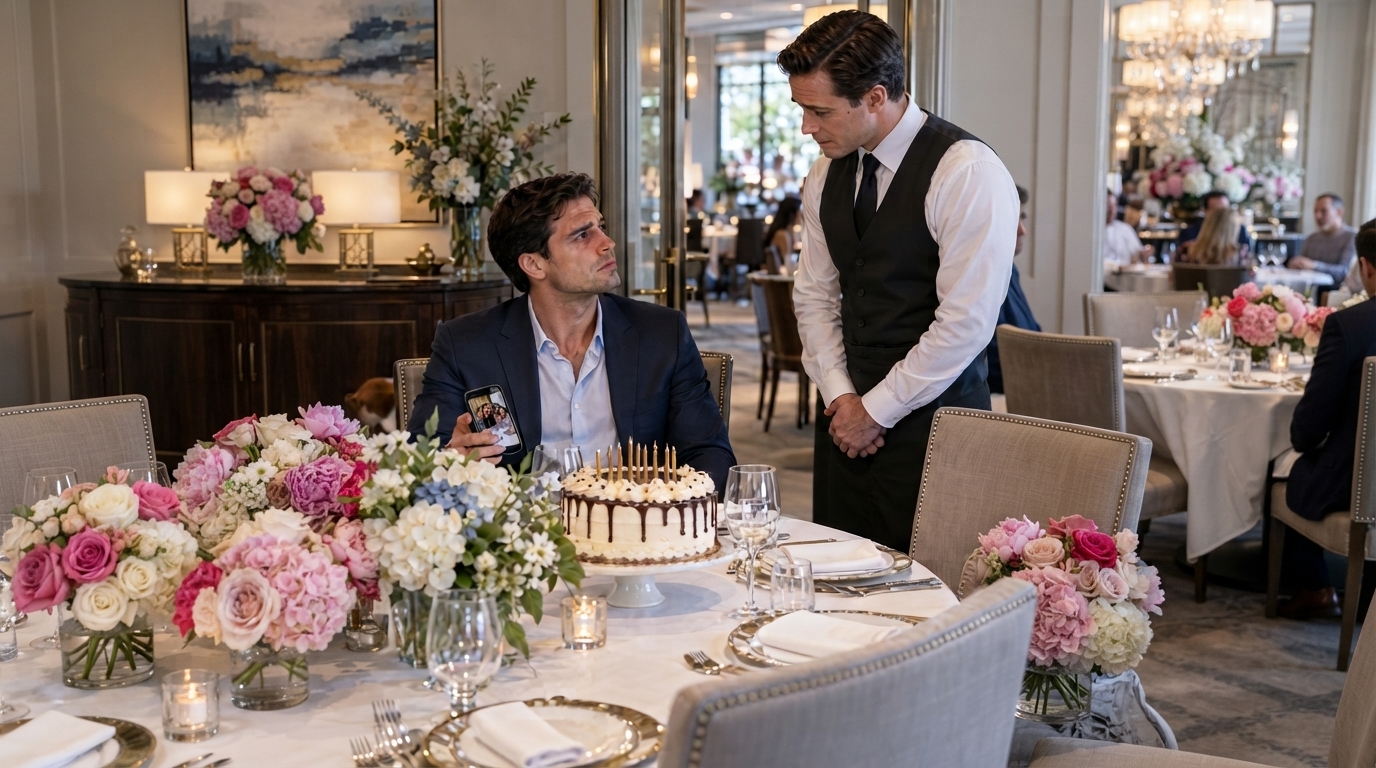
PART 3
By eight the next morning, I had seventeen missed calls.
Four from Mom.
Three from Dad.
Five from Kendra.
Two from Jordan.
One from Ray.
And two from numbers I didn’t recognize.
For a family that couldn’t find
the restaurant I’d reserved for my birthday,
they had suddenly become remarkably good at finding me.
I made coffee.
Turned my phone facedown.
And ate a slice of my own birthday cake for breakfast.
It tasted better than it had the night before.
Not because anything had changed.
Because I had.
At 8:17, Mom left a voicemail.
Marcus, honey, call me.
There’s something wrong with the rent transfer.
I checked my account and it isn’t showing as scheduled.
I don’t know if the bank made a mistake.
No mention of my birthday.
At 8:34, Dad texted.
Did you change cards? Insurance payment didn’t go through.
No happy birthday.
No apology.
At 8:51, Kendra sent:
Wow. Seriously?
Then:
You’re really doing this?
Then:
If you had a problem, you could’ve talked to us like an adult instead of putting family business online.
That one almost made me laugh.
She had posted a photograph of everyone skipping my birthday dinner.
Publicly.
She had told my aunt I had “my own plans.”
Publicly.
But apparently my response had crossed the sacred boundary of family privacy.
I didn’t answer.
By noon, Jordan finally texted.
Can we talk?
I stared at those three words.
Jordan and I had once been close.
He was four years younger than me.
When we were kids, I defended him constantly.
When he was sixteen and wrecked Dad’s truck, I helped him pay for repairs.
When he moved to Atlanta after college, I paid his security deposit because his first paycheck wouldn’t arrive for three weeks.
He promised to repay me.
I told him not to worry.
That had become the theme of my adult life.
Don’t worry.
I’ve got it.
I’ll cover it.
Pay me when you can.
Take care of yourself first.
Eventually everyone took me literally.
They stopped worrying.
Because Marcus would handle it.
I put my phone away and went to work.
At 2:06, the receptionist called my office.
“Your sister is here.”
Of course she was.
“Tell her I’m unavailable.”
There was a pause.
“She says it’s an emergency.”
I looked through the glass wall of my office.
Kendra stood in the lobby holding her phone.
She didn’t look frightened.
She looked irritated.
“Tell her I’m in a meeting.”
I wasn’t.
But for once, Kendra could wait.
She stayed twenty minutes.
Then left.
At 5:30, I walked to the parking garage and found a note tucked beneath my windshield wiper.
CALL MOM.
Not “I’m sorry.”
Not “Happy birthday.”
Call Mom.
I tore it in half.
The next three days were quiet only because I refused to participate.
Then Friday afternoon, someone started pounding on my front door.
I looked through the peephole.
Jordan.
I opened it.
He walked past me before I invited him inside.
“Okay,” he said. “What the hell is going on?”
I closed the door.
“You drove forty minutes to ask me that?”
“Mom’s freaking out.”
“I gathered.”
“She thinks she’s going to lose her apartment.”
“Her rent isn’t due for another week.”
“Exactly. So fix it.”
I stared at him.
He must have heard himself because his expression changed.
“That’s not what I meant.”
“Yes, it is.”
He dropped onto my couch.
“Marcus, come on.”
“No.”
“It’s five hundred bucks.”
“Then you pay it.”
He blinked.
“What?”
“You said it’s only five hundred dollars. Pay it.”
“I can’t just suddenly add five hundred dollars to my expenses.”
I nodded.
“Interesting.”
“What?”
“Neither could I.”
He rubbed his face.
“You make more money than I do.”
“There it is.”
“I’m just saying.”
“No, you’re explaining the family rule.”
“What family rule?”
“My money is family money. Yours is yours.”
He leaned back.
“That’s not fair.”
I laughed.
“Exactly.”
Jordan looked toward the kitchen.
For several seconds, neither of us spoke.
Then he said, “Nobody intentionally skipped your birthday.”
I felt something tighten in my chest.
“Really?”
“Kendra changed the restaurant.”
“What?”
“She wanted steak.”
“I reserved a private room.”
“I know.”
“I paid four hundred dollars.”
“I know.”
“I sent everyone calendar invitations.”
“I know.”
“Everyone accepted.”
He looked away.
That was the moment I realized he knew more than he’d planned to admit.
I sat across from him.
“When did Kendra change the restaurant?”
He didn’t answer.
“Jordan.”
“The afternoon before.”
My stomach dropped.
“The day before my birthday?”
“Yes.”
“And nobody told me?”
“Kendra said she would.”
I stared at him.
“But she didn’t.”
“No.”
“And when I texted from the restaurant asking where everyone was?”
He rubbed his hands together.
“I didn’t see it.”
“That’s a lie.”
His head came up.
I pulled out my phone.
The family group chat showed my message from 6:48.
I’m here. Private room is downstairs. Where is everyone?
Underneath it:
Read by Jordan.
Read by Kendra.
Read by Mom.
Read by Dad.
Read by Ray.
Five tiny confirmations.
Five people who had seen me asking where they were.
Nobody answered.
I held the screen toward him.
Jordan closed his eyes.
“Okay.”
“Okay?”
“I should’ve answered.”
“Why didn’t you?”
“Because it was awkward.”
I stared at him.
“It was awkward for you?”
“You know what I mean.”
“No. Explain it.”
“Kendra was already mad.”
“About what?”
His silence told me this wasn’t about steak.
“What was she mad about?”
Jordan stood.
“I don’t want to get involved.”
“You drove to my house.”
“Because Mom asked me.”
“Then you’re already involved.”
He walked toward the window.
“Kendra said you were making everything about yourself.”
“On my birthday?”
He almost smiled.
Then stopped himself.
“She said the dinner was too formal.”
“So she moved it.”
“Yeah.”
“And invited everyone except me.”
“She said you’d probably be happier doing your own thing.”
I felt the humiliation all over again.
Only this time it wasn’t an empty room.
It was deliberate.
“Did Mom object?”
Jordan didn’t answer.
“Dad?”
Nothing.
“Ray?”
He shook his head.
I nodded.
“Got it.”
“Marcus, nobody was trying to hurt you.”
“I texted all of you from an empty restaurant.”
“I know.”
“And you chose not to answer because responding would have made your steak dinner awkward.”
He looked ashamed.
Good.
For once, I didn’t rush to make him feel better.
He finally said, “We didn’t think you’d care this much.”
“Why?”
“You’re always so…”
He searched for the word.
“Independent.”
There it was.
The compliment people use when they want permission to neglect you.
Independent.
Responsible.
Strong.
Self-sufficient.
Every word meant the same thing.
Marcus won’t complain.
Marcus will figure it out.
Marcus doesn’t need anything.
I looked at my brother.
“You mean because I never ask you for anything.”
“I didn’t say that.”
“You didn’t have to.”
He picked up his keys.
“Are you really going to stop helping Mom?”
“Yes.”
“For how long?”
“I don’t know.”
“Dad too?”
“Yes.”
“Kendra says you’re punishing them.”
“No.”
“It looks that way.”
I walked to the door and opened it.
“Then you help them.”
He stared at me.
“What?”
“Mom needs five hundred dollars. Dad needs insurance. You, Kendra, and Ray were all available for family night. I’m sure you’ll figure it out.”
His face hardened.
“That’s petty.”
“No. Petty would be canceling their insurance because they didn’t buy me a birthday present. I’m stopping because I finally understand that I’ve been subsidizing people who don’t respect me.”
“They’re your parents.”
“And you’re their son.”
He had no answer.
After he left, I sat at my kitchen table and opened my laptop.
For the first time, I started counting.
Mom’s rent contribution.
Five hundred dollars a month.
Six thousand a year.
Dad’s insurance.
Kendra’s wedding photographer.
Her bridal shower deposit.
Jordan’s Atlanta apartment.
The money I’d sent when his transmission failed.
Ray’s dental surgery.
Mom’s refrigerator.
Dad’s tires.
Christmas flights.
Family dinners.
Emergency hotel rooms.
Prescription copays.
Little things.
Big things.
Things I’d forgotten five minutes after paying because I didn’t want money to poison family relationships.
Three years.
$42,318.
I stared at the number.
It wasn’t the amount that hurt.
I could earn more money.
I couldn’t earn back the years I’d spent believing generosity guaranteed belonging.
My phone buzzed.
Kendra.
I ignored it.
Then another message arrived.
You’re hurting Mom to make a point.
I typed a response.
Deleted it.
Typed another.
Deleted that too.
Finally I wrote:
Mom has three adult children.
I hit send.
Kendra replied almost instantly.
Unbelievable.
I put the phone down.
For the first time in ten years, somebody else’s emergency remained somebody else’s responsibility.
And the world didn’t end.
A week later, Kendra came to my house carrying cupcakes.
Six of them.
Store-bought.
Vanilla.
I hate vanilla.
She placed them on my counter.
“Peace offering.”
I looked at the plastic container.
“My birthday was last week.”
“I know.”
“Do you?”
She rolled her eyes.
“Can we not do this?”
“You came to my house.”
“Because Mom is terrified.”
There it was.
The cupcakes weren’t for me.
They were a delivery fee for the conversation she actually wanted.
“Her landlord emailed her.”
“About what?”
“The rent.”
“Her rent isn’t late.”
“She doesn’t know what she’s going to do next month.”
“She has income.”
“Not enough.”
“You have income.”
Kendra crossed her arms.
“I have a mortgage.”
“So do I.”
“I have two kids.”
“That’s true.”
“And expenses.”
“So do I.”
“You know I can’t just absorb Mom’s rent.”
I looked at her.
“But I could?”
“You’re single.”
The room went very quiet.
Kendra realized too late what she’d said.
She tried to recover.
“That’s not what I meant.”
“Yes, it is.”
“No. Marcus—”
“Because I don’t have a wife or children, my money belongs to everyone else.”
“I didn’t say that.”
“You didn’t have to.”
She sighed dramatically.
“This is exactly why people didn’t want to do your birthday dinner.”
I stared at her.
She froze.
There it was.
The truth slipping out because she was angry.
I spoke carefully.
“Why?”
“Because everything becomes this big emotional thing with you.”
“My birthday became emotional because nobody showed up.”
“You always act like you’re keeping score.”
I almost laughed.
“I didn’t even know the score until last week.”
She rolled her eyes.
“You know what I mean.”
“No. I don’t.”
“You help people, then apparently you expect everyone to worship you for it.”
That hurt.
Not because it was true.
Because I had worked so hard to make sure it wasn’t.
I had never asked Mom to announce who paid part of her rent.
Never asked Dad to thank me publicly.
Never reminded Jordan about his deposit.
Never mentioned Kendra’s wedding photographer after I paid the invoice.
I had done everything quietly.
And somehow even my silence had been rewritten as manipulation.
I walked to the counter.
Picked up the cupcakes.
Held them out.
“Take these.”
“Seriously?”
“Yes.”
She didn’t move.
I placed them beside her purse.
“Kendra, I’m not asking anyone to worship me.”
“Then what do you want?”
I thought about that empty dining room.
“Basic consideration.”
“Oh my God.”
She laughed.
“See? Drama.”
Something inside me finally went still.
“You need to leave.”
Her smile vanished.
“Marcus.”
“Leave.”
“You’re going to throw away your whole family over one dinner?”
“No.”
I opened the front door.
“I’m finding out whether there’s a family left when I stop paying for it.”
For the first time since she’d arrived, Kendra had nothing to say.
She grabbed her purse.
Then the cupcakes.
At the door, she turned.
“Dad’s insurance expires Monday.”
I nodded.
“I know.”
She waited.
I said nothing.
Then she left.
Monday came.
Dad’s insurance expired.
Mom paid her rent herself by pulling money from savings.
Nobody died.
Nobody became homeless.
But the family group chat became a war zone.
So that night, I finally sent one message.
Not angry.
Not dramatic.
Just true.
I told them about the private room.
The $400 reservation.
The invitations.
The empty chairs.
The photograph.
The lie that I “had my own plans.”
Then I listed the things I’d paid for over the years.
Not every dollar.
Just enough.
I ended with:
I don’t want repayment. I don’t want apologies made because you need something. I need distance. From now on, please make your financial arrangements without me.
Kendra replied first.
Of course.
A paragraph about humiliation.
A paragraph about how family matters should stay private.
A paragraph about how she’d never realized my help came “with strings.”
Mom wrote:
Marcus, please don’t do this.
Ray wrote:
Bro I honestly didn’t know you were at the other restaurant. Kendra said plans changed.
Jordan didn’t say anything.
Dad didn’t either.
Then two hours later, my phone buzzed.
Private message.
Dad.
Three words.
I messed up.
I stared at them.
Another message appeared.
Not asking about insurance.
I should have gone to your dinner.
Then:
Can I see you?
I didn’t answer immediately.
But the next morning, I did.
Saturday. 10 a.m.
His reply came seconds later.
I’ll bring coffee.
And for the first time since my birthday, I wondered whether somebody in my family was finally coming to see me instead of coming to collect something.
PART 4
Dad arrived at 9:52 Saturday morning.
Two coffees.
No insurance paperwork.
No bills.
No guilt-inducing messages from Mom printed out for me to read.
Just coffee.
He handed me mine.
“Black. One sugar.”
I looked at him.
He remembered.
That shouldn’t have surprised me.
But it did.
We sat on the porch.
For several minutes, neither of us spoke.
Dad looked older than he had in Kendra’s photograph.
Maybe because photographs only capture the second people are pretending everything is fine.
Finally he said, “I’m not asking you to restart the insurance.”
“Okay.”
“I got another policy.”
“Good.”
“Costs more.”
I shrugged.
He nodded.
“I deserved that.”
“I didn’t say anything.”
“You didn’t have to.”
He stared at his coffee.
Then he said, “Kendra told us you’d canceled your dinner.”
My fingers tightened around the cup.
“What?”
“The day before.”
I didn’t speak.
“She said you called her and said the private room thing felt too formal. She said you wanted to do something smaller another weekend.”
I stared at him.
“You believed her?”
“Yes.”
“Did you see my reminder text that afternoon?”
Dad closed his eyes.
“Yes.”
“What did you think?”
“I thought it was an old automated reminder.”
My stomach turned.
“And when I texted from the restaurant?”
His face changed.
“I saw that.”
“You read it.”
“Yes.”
“And?”
He looked away.
“Kendra said you were trying to make us feel guilty.”
I laughed.
Not because it was funny.
Because the alternative was shouting.
“I was sitting there.”
“I know.”
“Alone.”
“I know that now.”
“You knew I said I was there.”
“Yes.”
“But Kendra told you I wasn’t, so you chose the explanation that let you finish dinner.”
Dad nodded.
There was nothing he could say to make it better.
At least he didn’t try.
“Why?”
He took a long breath.
“Because it’s easier with you.”
I looked at him.
“What does that mean?”
“You’ve always been the one who handles things.”
“That’s not an answer.”
“No.”
He rubbed his thumb against the coffee lid.
“You were fifteen when I lost my first job.”
I remembered.
Dad had worked at the same manufacturing plant for eighteen years before it closed.
For almost a year, money was tight.
I got a weekend job at a grocery store.
I used part of my paycheck to buy my own school clothes.
Nobody asked me.
I thought I was helping.
“Kendra was eleven,” Dad continued. “Jordan was seven. They panicked about everything. You didn’t.”
“I panicked.”
He looked at me.
“I just didn’t tell you.”
His face fell.
“I know that now.”
The words sat between us.
Dad continued.
“When things got difficult, your mother and I started relying on you because you didn’t complain. Then you became an adult and we kept doing it.”
“You’re my parents.”
“I know.”
“You weren’t supposed to train me to be useful.”
He winced.
“I know.”
I looked toward the street.
A neighbor was washing his car.
Somewhere a lawn mower started.
It felt strange having a conversation that should have happened twenty years earlier while the rest of the world continued normally.
Dad said, “When you started helping with your mother’s rent, I told myself it was temporary.”
“So did I.”
“When you put my insurance on your card, same thing.”
“That was 2018.”
“I know.”
“Seven years.”
“I know.”
“Did you ever plan to take it back?”
He didn’t answer.
That was enough.
“I got comfortable,” he said.
“Yes.”
“Too comfortable.”
“Yes.”
“And I think…”
He stopped.
“What?”
“I think we all started measuring what you could handle instead of what was fair to ask.”
That sentence hit me harder than any apology could have.
Because it was true.
They had never asked whether I should carry something.
Only whether I could.
Dad looked at me.
“I came here because I finally understand what we lost.”
I waited.
“Not the insurance.”
His voice cracked.
“You.”
I looked down.
He continued.
“We made you into a function.”
I swallowed.
“The reliable one. The responsible one. The one who fixes things. And when your birthday came, we treated you like you’d be fine because Marcus is always fine.”
I couldn’t speak.
Dad’s eyes filled.
“You were sitting alone while I was eating a steak.”
I looked away.
“I saw your message.”
That was the part he couldn’t forgive himself for.
Maybe someday I would.
But not because he needed me to.
He continued.
“I should have gotten up.”
“Yes.”
“I should’ve said, ‘My son is waiting for us.’”
“Yes.”
“I didn’t.”
“No.”
He wiped his eyes.
“I’m sorry.”
There it was.
No excuse.
No request attached.
Just an apology.
I nodded.
“I appreciate you saying it.”
He looked at me.
“Does that mean we’re okay?”
“No.”
The answer hurt him.
I could see it.
But he nodded.
“Fair.”
That mattered.
The old Dad might have demanded forgiveness because he had apologized.
This Dad sat with the discomfort.
We finished our coffee.
Before he left, he took something from his pocket.
A folded piece of paper.
I looked at it.
“What is that?”
“My insurance information.”
I almost laughed.
He raised his hand.
“Not for you to pay.”
He unfolded it.
“I wanted you to see I handled it.”
The new policy was in his name.
His card.
His payment.
I handed it back.
“Good.”
He smiled faintly.
“I also canceled two subscriptions.”
“Look at you.”
“Don’t get carried away.”
I laughed.
A real laugh.
The first one we’d shared since my birthday.
Then his expression changed.
“There’s something else.”
Of course there was.
“What?”
“Kendra knew you were at the restaurant.”
“I know.”
“No.”
He shook his head.
“I mean before we ordered.”
I stared at him.
“She knew you were there waiting.”
“How?”
“You called her.”
“I called everyone.”
“She showed me the screen.”
My chest tightened.
“She saw my call?”
“Yes.”
“And?”
“She said, ‘Don’t answer. He’ll turn this into a whole thing.’”
I felt cold.
Dad looked ashamed.
“I let her.”
That hurt differently.
Until then, part of me had imagined Kendra making a selfish last-minute change and then panicking.
But she knew.
She knew I was sitting alone.
She made a conscious decision to keep everyone away.
“Why?”
Dad shook his head.
“I don’t know.”
I did.
Or at least I was beginning to.
This wasn’t about steak.
It wasn’t even about my birthday.
It was about control.
For years, Kendra had been the social center of the family.
She chose holidays.
Restaurants.
Vacation dates.
Who hosted.
Who brought what.
I funded plenty of it.
But Kendra directed it.
My birthday dinner was one event she hadn’t controlled.
I chose the restaurant.
I made the reservation.
I sent the invitations.
I was the reason everyone was gathering.
And apparently that was enough.
Dad stood.
“I thought you should know.”
“Thank you.”
He walked toward his car.
Then stopped.
“Marcus?”
“Yeah?”
“Don’t restart the payments.”
I stared at him.
“Even if your mother asks.”
I didn’t answer.
“Especially if she asks.”
Then he left.
That afternoon, Mom called.
For the first time, I answered.
“Hi, Mom.”
She immediately started crying.
“Marcus.”
I waited.
“Why are you doing this?”
There it was.
Not “I’m sorry.”
Not “How are you?”
Why are you doing this?
“I’ve explained why.”
“Kendra says your father went over there.”
“He did.”
“What did he tell you?”
I almost laughed.
“That sounds like you’re worried.”
“I’m worried about this family.”
“Were you worried when I was sitting alone on my birthday?”
Silence.
“Mom?”
“I didn’t know.”
“You read my message.”
“Kendra said—”
“I know what Kendra said.”
Silence again.
“Why didn’t you call me?”
“I thought you were upset.”
“I was.”
“You know how you get when you’re hurt.”
I frowned.
“How do I get?”
“Quiet.”
I waited.
That was almost funny.
Apparently even my silence had become a reason not to comfort me.
“You could’ve come,” I said.
“I didn’t want to cause a scene.”
“You chose not to cause a scene at Kendra’s dinner, so you left me alone at mine.”
“That’s not fair.”
“It is exactly what happened.”
She began crying again.
“Are you really going to let me struggle with rent?”
I closed my eyes.
There it was.
The conversation always returned to money.
“Mom, I love you.”
“Then why—”
“Love isn’t an automatic payment.”
She stopped.
“You have income. Dad has income. Kendra and Jordan have income. There are options.”
“You know my budget.”
“Yes.”
“Then you know I can’t live the same way without your help.”
That sentence changed something.
Not:
I can’t survive.
I can’t live the same way.
I thought about her apartment.
Two bedrooms.
A building with a pool.
Covered parking.
A neighborhood she’d chosen after Dad moved out because she “deserved somewhere nice.”
My five hundred dollars hadn’t been keeping Mom from homelessness.
It had been protecting her lifestyle.
“I think your budget needs to change.”
She gasped.
“Marcus.”
“I changed mine plenty of times to help everyone else.”
“You make good money.”
“So?”
“You don’t have children.”
There it was again.
The family equation.
Single meant surplus.
No children meant available.
Responsible meant obligated.
“I’m somebody’s child.”
Mom went quiet.
I continued.
“And on my birthday, my mother chose another restaurant.”
She started crying harder.
This time, I didn’t feel cruel.
I felt sad.
There is a difference.
“I love you,” I said again. “But I’m not paying your rent anymore.”
Then I hung up.
Two days later, I received an email from Kendra.
The subject line:
ENOUGH.
I almost deleted it.
Instead, I opened it.
She accused me of manipulating Mom.
Turning Dad against her.
Dragging Jordan into the middle.
Embarrassing Ray.
Destroying family traditions.
She ended with:
I hope your $42,000 was worth losing your family over.
I stared at that sentence.
Then I replied with six words.
It was never about the money.
I sent it.
Five minutes later, another email arrived.
Then another.
I didn’t open them.
Because I finally understood something.
Kendra wanted a fight.
A fight would let her make us equals in the conflict.
Two siblings saying cruel things.
Two people behaving badly.
Two sides.
But I wasn’t interested in fighting.
I wanted boundaries.
And boundaries are infuriating to people who benefit from your lack of them.
So I blocked her email for thirty days.
Not forever.
Just long enough to hear myself think.
Then something unexpected happened.
My life became quiet.
And in that quiet, I started noticing how much of it had never really belonged to me.
PART 5
The first Saturday after blocking Kendra, I woke at seven because my body expected an emergency.
There wasn’t one.
No call from Mom about a bill.
No message from Jordan asking for a loan.
No family group chat debating who would pay for dinner.
I made coffee.
Then I stood in my kitchen and realized I had absolutely nowhere I was required to be.
At thirty-two, that should have felt normal.
It felt revolutionary.
I went for a walk.
I bought breakfast at a café I’d passed a hundred times but never entered.
Then I did something ridiculous.
I booked a weekend trip.
Just me.
Two nights.
A hotel near the coast.
Nothing extravagant.
But when I clicked “confirm,” I stared at the screen like I’d committed a crime.
That feeling told me how badly I needed to go.
Over the next two months, the family adjusted.
Not gracefully.
Mom moved into a smaller apartment.
She complained constantly during the process.
Then, eventually, she admitted the new place was fine.
Dad kept paying his own insurance.
Jordan started sending Mom a hundred dollars a month.
Kendra contributed too.
Interesting how impossible helping Mom had seemed until I stopped doing it.
Ray called and apologized.
He told me Kendra had said the birthday venue changed and that I knew.
When he saw my message from the restaurant, he assumed there had been some misunderstanding.
“I should’ve called,” he said.
“Yes.”
“I was a coward.”
I appreciated that more than an excuse.
Jordan took longer.
One evening, he invited me to dinner.
Just the two of us.
When the check arrived, I reached for it automatically.
Jordan slapped his hand over the bill.
“No.”
I laughed.
“What?”
“I’m paying.”
“Why?”
“Because apparently I’ve been an ass for ten years.”
“Only ten?”
He smiled.
Then he became serious.
“I’ve been thinking about what you said.”
“What part?”
“That your money became family money and mine stayed mine.”
I waited.
“You were right.”
That surprised me.
“I don’t think I consciously believed it,” he continued. “But every time something happened, I thought, Marcus can handle it.”
“Everyone did.”
“I know.”
He looked ashamed.
“I never asked whether you should have to.”
I nodded.
“Dad said something similar.”
Jordan smiled faintly.
“He’s becoming philosophical now that he has to pay his own insurance.”
I laughed.
Then Jordan reached into his jacket.
He placed an envelope on the table.
I stared at it.
“No.”
“You don’t know what it is.”
“If it’s money, no.”
“Open it.”
Inside was a check for $2,000.
I pushed it back.
“Jordan.”
“It’s not everything.”
“I don’t want repayment.”
“I know.”
“Then why?”
“Because that security deposit in Atlanta was supposed to be a loan.”
“That was years ago.”
“I remember.”
“So do I.”
“You told me not to worry about paying you back.”
“I meant it.”
“I know.”
He pushed the check toward me again.
“But I want to be the kind of brother who pays you back anyway.”
That shut me up.
I looked at him.
He looked nervous.
Not because of the money.
Because he wanted me to accept the gesture.
So I did.
“Thank you.”
His shoulders relaxed.
“Don’t get emotional.”
“Shut up.”
We laughed.
Things with Mom were slower.
For months, every conversation carried an invisible invoice.
She would mention how expensive groceries were.
Pause.
Mention the rent.
Pause.
Tell me about a medical copay.
Pause.
The old Marcus would have filled those silences with an offer.
The new Marcus let silence remain silence.
Eventually she stopped.
Then one Sunday she called and asked something unexpected.
“How was your trip?”
I almost didn’t understand.
“What?”
“The coast. Your father said you went.”
“It was good.”
“What did you do?”
Nobody in my family had asked me a question like that in years.
A question with no request hidden inside it.
So I told her.
About the hotel.
The seafood place.
Walking along the beach at sunrise.
The little bookstore where I spent too much money.
She listened.
Then she said, “That sounds nice.”
“It was.”
Another pause.
Then:
“I’m sorry about your birthday.”
I sat down.
Mom continued before I could answer.
“I’ve been trying to find a way to explain what I did that doesn’t make me sound terrible.”
I waited.
“I don’t think there is one.”
That was a start.
“I knew you were at the restaurant,” she said.
“I know.”
“I saw your message.”
“I know.”
“Kendra told us you’d calm down.”
My throat tightened.
“And you believed her.”
“No.”
That surprised me.
“What?”
“I didn’t believe her.”
Mom’s voice shook.
“I wanted to.”
I closed my eyes.
“Because if I believed her, I didn’t have to get up and leave.”
There it was.
The truth.
Ugly.
Simple.
Human.
“I was having a good time,” she whispered.
I didn’t answer.
“And I told myself I’d call you tomorrow.”
“Okay.”
“Then I saw your post.”
“The cake.”
“Yes.”
She started crying.
“I realized what we’d done.”
“Why didn’t you apologize then?”
“Because I saw the part about the rent.”
Of course.
“And I panicked.”
I nodded even though she couldn’t see me.
“I thought if I admitted what we’d done, you’d stop helping.”
“So you didn’t admit it.”
“No.”
“And I stopped anyway.”
“Yes.”
There was something almost absurd about it.
Fear had made her choose the exact behavior that guaranteed the outcome she feared.
“I am sorry,” she said.
“I believe you.”
“Can you forgive me?”
I thought carefully.
“I think I can.”
She exhaled.
“But forgiveness doesn’t mean I’m restarting the rent.”
“I know.”
That mattered.
Six months after my birthday, something arrived in the mail.
A plain envelope.
No return address.
Inside was a birthday card.
The front said:
FOR SOMEONE WHO DESERVES A DO-OVER.
Inside, Dad had written:
Saturday. 7 p.m. Wear something nice. No money required.
Underneath were signatures.
Dad.
Mom.
Jordan.
Ray.
And, surprisingly, Kendra.
I stared at her name.
I hadn’t spoken to her in almost three months.
I texted Dad.
What is this?
His response:
Trust me once.
I nearly said no.
Then I thought about the coffee on my porch.
Jordan’s check.
Mom’s apology.
People could change.
Not instantly.
Not completely.
But sometimes enough to deserve an opportunity to show it.
So Saturday evening, I drove to the address Dad sent me.
When I pulled into the parking lot, I stopped.
It was the same restaurant.
The restaurant where I had spent my thirty-second birthday alone.
For a moment, I couldn’t move.
Then I walked inside.
The hostess smiled.
“Marcus?”
“Yes.”
“Your party is waiting.”
Those words almost broke me.
Waiting.
For me.
She led me downstairs.
The private dining room doors were closed.
Then they opened.
Everyone was there.
Mom.
Dad.
Jordan.
Ray.
My aunt.
Two cousins.
Several friends.
And Kendra.
On the table sat a chocolate cake.
Thirty-two candles.
Dad stood.
“Technically you’re still thirty-two.”
I laughed.
Everyone did.
Then Dad walked toward me.
“This doesn’t erase anything.”
I looked around the room.
“No.”
“We know.”
Mom hugged me.
Jordan handed me a drink.
Ray pulled out a chair.
For me.
Nobody asked me to pay.
Nobody handed me a bill.
Nobody mentioned rent.
I looked at Kendra.
She remained near the far end of the table.
For once, she wasn’t standing in the center.
After dinner, she approached me.
“Can we talk?”
I nodded.
We stepped into the hallway.
She crossed her arms.
Then uncrossed them.
“I was jealous.”
Of all the explanations I’d imagined, that wasn’t one of them.
“Of what?”
“You.”
I almost laughed.
“Why?”
“Because everybody needs you.”
I stared at her.
“That isn’t as wonderful as you think.”
“I know that now.”
She looked toward the dining room.
“You were always the responsible one. Dad trusted you. Mom called you. Jordan asked you for advice. Whenever something went wrong, everybody said, ‘Call Marcus.’”
“That was exhausting.”
“I thought it meant you were the favorite.”
I shook my head.
“It meant I was available.”
“I know.”
She looked down.
“Your birthday was supposed to be this big dinner where you organized everything again. And I thought…”
She stopped.
“What?”
“I thought if everyone came to my idea instead, maybe for once I would be the person bringing everyone together.”
I stared at her.
“So you sabotaged my birthday.”
“Yes.”
No excuse.
No “but.”
Just yes.
“You knew I was sitting there.”
Her eyes filled.
“Yes.”
“You told Dad not to answer me.”
“Yes.”
“You posted that picture knowing I’d see it.”
She wiped her cheek.
“Yes.”
“That was cruel.”
“I know.”
I didn’t rush to comfort her.
She continued.
“I can’t undo it.”
“No.”
“I don’t expect you to trust me.”
“Good.”
She almost smiled.
“I deserved that.”
“Yes.”
She nodded.
Then she reached into her purse.
Not cupcakes.
An envelope.
I sighed.
“What is it with this family and envelopes?”
She laughed through her tears.
“Open it later.”
I did.
The next morning.
Inside was a check.
$4,800.
A note said:
Wedding photographer. I should have paid you back years ago. This isn’t an apology. The apology has to stand on its own.
I deposited the check.
Not because I needed it.
Because Kendra needed to understand that repayment wasn’t punishment.
It was responsibility.
Our relationship didn’t magically repair itself.
There were awkward holidays.
Careful conversations.
Mom sometimes slipped into old habits.
Dad occasionally complained about insurance premiums.
Jordan still tried to borrow my tools and forgot to return them.
Kendra and I remained cautious around each other.
But something fundamental had changed.
They stopped assuming.
If Mom needed help, she asked.
Sometimes I said yes.
Sometimes I said no.
And when I said no, the world continued turning.
Dad never let me pay for his insurance again.
Jordan eventually repaid the rest of his old loan.
Kendra and I started having coffee once a month.
Not because we became best friends.
Because rebuilding something requires showing up before it feels natural.
A year after the birthday disaster, my thirty-third birthday arrived.
I didn’t reserve a private room.
I didn’t send twelve invitations.
I didn’t pay in advance.
I booked a table for four at a small Italian restaurant.
Dad.
Jordan.
My best friend, Chris.
And me.
Mom was visiting her sister that weekend.
Kendra had plans with her children.
And strangely, that didn’t hurt.
Because this time nobody lied.
Nobody pretended.
Nobody promised to come and disappeared.
At 6:55, I arrived.
Dad was already there.
At 6:57, Jordan walked in.
At 6:59, Chris arrived.
Three people.
Three chairs filled.
That was enough.
Halfway through dinner, the waiter approached.
“Someone sent dessert.”
I frowned.
“Who?”
He placed a chocolate cake on the table.
Not huge.
No candles.
Written across the top in icing were four words:
FOR THE REAL ONE.
I laughed.
There was a card beside it.
From Kendra.
Inside she had written:
That caption last year was cruel. This one is true. Happy birthday, Marcus.
I stared at it for a moment.
Then put it in my pocket.
Dad raised his glass.
“To Marcus.”
Jordan lifted his.
“To the guy who’s not paying.”
I laughed.
“Damn right.”
We toasted.
And for the first time in years, my birthday didn’t feel like a test of whether people loved me.
It was simply dinner.
That was enough.
Looking back, people assume canceling those automatic payments was revenge.
It wasn’t.
Revenge would have meant I wanted my family to suffer.
I didn’t.
I wanted them to become responsible for themselves.
More importantly, I wanted to become responsible for myself.
I had spent years confusing being needed with being valued.
They are not the same thing.
When someone needs your money, your labor, your patience, or your ability to solve problems, they may keep you close.
But being valued looks different.
It looks like remembering your birthday.
Showing up when you said you would.
Answering when someone tells you they’re sitting alone.
Apologizing without attaching an invoice.
Accepting “no” without treating it as betrayal.
And making room for a person even when they have nothing to give you.
The night my family skipped my birthday, I thought I had discovered how little I mattered.
I was wrong.
What I discovered was how little I had required from people in exchange for access to my life.
That was something I could change.
The $400 private room taught me more than any birthday celebration ever had.
Twelve empty chairs showed me exactly where I stood.
So I stopped paying for my place at the table.
Some people got angry.
Some walked away.
Some looked at themselves and changed.
And I learned that a smaller table filled with people who genuinely want you there is worth more than a banquet room full of people who only remember your name when a payment doesn’t go through.
I still help my family sometimes.
That’s the part people don’t expect.
I helped Mom with a medical bill last winter.
I loaned Jordan money when his furnace broke.
I bought Dad new tires for Christmas.
But now there is one difference.
They don’t expect it.
And I don’t need to do it to prove I belong.
Last month, Dad called me.
“Insurance renewal came.”
I laughed.
“Sounds expensive.”
“It is.”
“You calling for money?”
“Nope.”
“Good.”
“I just wanted to complain.”
“That’s allowed.”
We talked for twenty minutes.
About football.
His neighbor.
My job.
Nothing important.
Everything important.
Before hanging up, Dad said, “Love you, son.”
“Love you too.”
No request followed.
No bill.
No emergency.
Just my father calling his son.
Afterward, I sat there smiling.
Because that was what I’d wanted all along.
Not gratitude for paying.
Not praise for being dependable.
Not repayment.
I wanted to matter when I wasn’t useful.
It took an empty birthday table for me to finally demand that.
And it took my family losing access to the version of me who never said no for some of them to learn how to love the version who finally did.
The photograph Kendra posted that night is still online.
“Family night. Grateful for the real ones.”
I could ask her to delete it.
I never have.
Sometimes I look at it.
Mom smiling.
Dad holding his drink.
Jordan leaning toward the camera.
Ray laughing.
Kendra in the middle.
And one person missing.
Me.
I don’t look at that photograph anymore and see rejection.
I see a receipt.
Proof of the exact moment I stopped financing my own exclusion.
That night, I walked out of a $400 private room alone.
But I wasn’t abandoned.
Not anymore.
Because for the first time in my adult life, I chose not to abandon myself.
And that turned out to be the birthday gift I should have given myself years ago.
THE END THANK YOU FOR READING !!!