PART 3
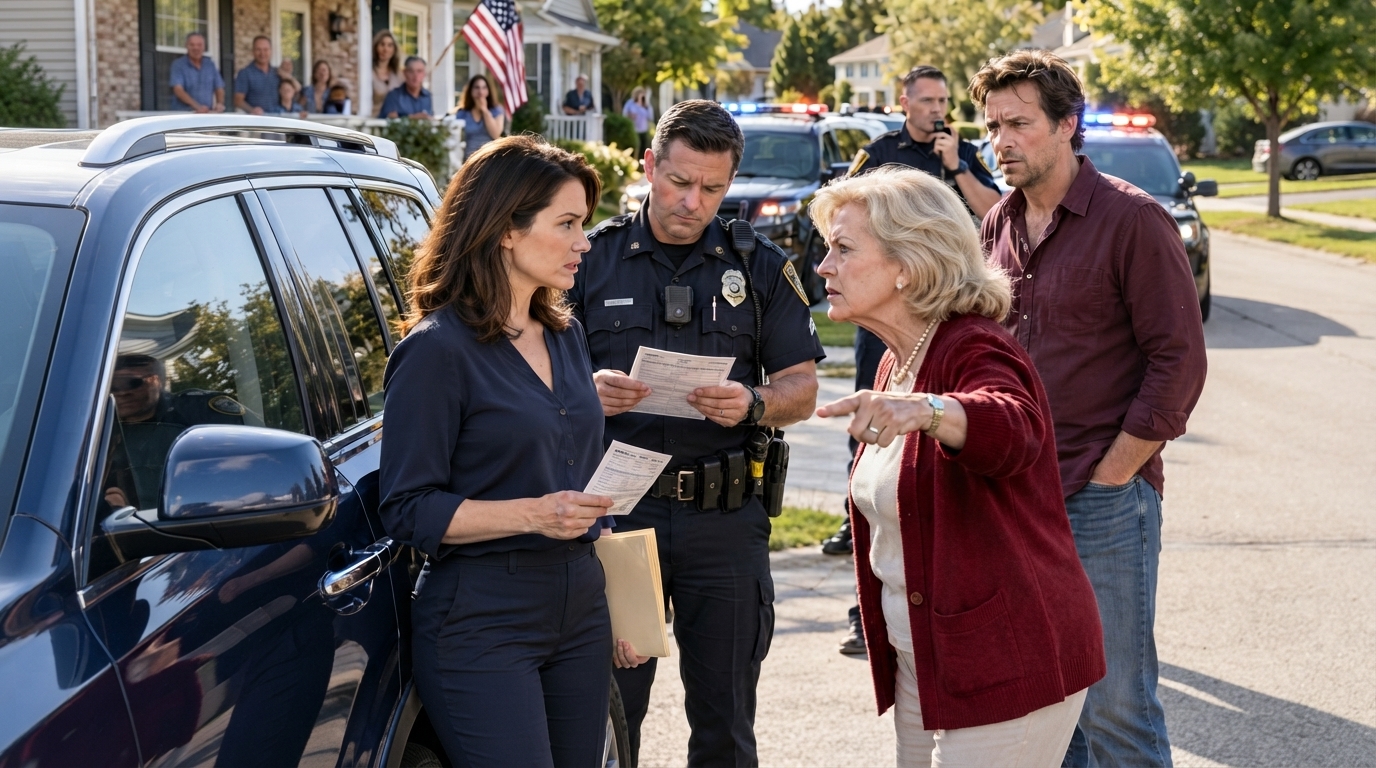
The second officer reached for Wade’s wrist.
My mother stepped between them.
“Wait.”
Her voice had changed.
It wasn’t the sharp, commanding voice she had used on me at dinner.
It was frightened.
“What did he do?”
The officer looked at her.
“Ma’am, step aside.”
“This is my son.”
“I understand.”
“You can’t just arrest him.”
The officer’s expression stayed professional.
“Mrs. Mercer, the records we received indicate Mr. Wade Mercer has an active warrant.”
My mother turned toward Wade.
“What warrant?”
Wade looked away.
I didn’t say anything.
I didn’t need to.
The officer continued.
“It appears to be connected to a failure to appear in a financial-fraud investigation.”
My mother’s face went white.
“That’s impossible.”
The officer looked at Wade.
“Is your full name Wade Thomas Mercer?”
“Yes.”
“Date of birth?”
Wade gave it.
The officer checked his screen.
Then nodded.
“Yes.”
My mother looked at me.
“You did this.”
I shook my head.
“No.”
“You called them.”
“I called nobody about the warrant.”
“You knew.”
“I suspected.”
Wade turned on me.
“You set me up.”
I stared at him.
“How?”
“You knew they were going to run my name.”
“Every officer runs a person’s name during a call.”
“You planned all of this.”
“No.”
I stepped closer.
“You planned to use my identity.”
The officer looked between us.
“What does she mean?”
My mother answered immediately.
“She is exaggerating.”
I looked at her.
“No.”
Then I pulled the manila folder from the SUV.
I handed the officer the first document.
Wade’s signed acknowledgment.
I, Wade Mercer, acknowledge that I used the credit account opened in Lorraine Mercer’s name without her authorization. I agree to repay $12,400 within thirty days.
The officer read it.
Then looked at Wade.
“You signed this?”
Wade said nothing.
My mother grabbed my arm.
“Why would you do this to your brother?”
I pulled my arm free.
“Why would he do it to me?”
“He was desperate.”
“So was I.”
“You have a career.”
“I also have a Social Security number.”
She looked at me.
“What is that supposed to mean?”
“It means desperation doesn’t give someone permission to steal.”
Wade stepped forward.
“I didn’t steal anything.”
The officer looked at the signed agreement.
“You just admitted it in writing.”
“I was going to pay her back.”
“You had thirty days.”
“I needed more time.”
“You asked for no extension.”
“I didn’t think she’d actually go this far.”
I looked at him.
“That is the problem.”
The officer asked me to explain the account.
I did.
I told him when I first learned about it.
I showed him the statements.
The charges.
The deployment records.
The dates.
The truck tires.
The fuel purchases.
The restaurant charges.
The hardware store.
Everything.
Then I showed him the credit bureau report confirming the account had been opened while I was overseas.
The second officer took photographs.
He asked Wade whether he had the card.
Wade said no.
The officer asked where it was.
Wade didn’t answer.
My mother stepped in.
“Maybe he threw it away.”
The officer looked at her.
“Ma’am, please let him answer.”
Wade finally said:
“It’s in my truck.”
“Where?”
“Glove compartment.”
One of the officers walked to Wade’s truck.
He returned with the card.
My name was printed across it.
My photo wasn’t.
But it didn’t need to be.
The officer held it up.
“Mr. Mercer.”
Wade said nothing.
“This is issued in your sister’s name.”
“Yes.”
“Why do you possess it?”
“I was authorized.”
“By whom?”
Wade looked at my mother.
She didn’t answer.
He looked at the ground.
The officer nodded.
“That’s what I thought.”
My mother suddenly started crying.
“I didn’t know he used her identity.”
I looked at her.
“You knew about the debt.”
“I knew he’d borrowed money.”
“You knew it was in my name?”
She hesitated.
“Yes.”
The word came quietly.
I felt something inside me go still.
“You knew?”
“I didn’t realize it was criminal.”
“You knew he used my name.”
“He said he would pay you.”
“You knew the account wasn’t his.”
She didn’t answer.
I waited.
Finally:
“Yes.”
The officer wrote something down.
My mother looked at me.
“Please.”
I stared at her.
“Please what?”
“Don’t make this worse.”
“Worse?”
She glanced at the handcuffs.
“He’s my son.”
“And I’m your daughter.”
Her lips trembled.
“I know.”
“Do you?”
I looked around the yard.
Neighbors had gathered.
Curtains were moving in nearby windows.
My mother’s carefully maintained world had suddenly become visible from the street.
She whispered:
“You’re being cruel.”
I shook my head.
“No.”
I held up the signed agreement.
“I’m being finished.”
The officer put Wade in handcuffs.
My mother cried.
“Wade!”
He looked at her.
“Mom.”
She rushed toward him.
The officer blocked her.
“Please give us space.”
Wade stared at me.
“You’re going to regret this.”
I looked at him.
“Maybe.”
He seemed surprised.
I continued.
“But I already regretted trusting you.”
He was placed in the patrol car.
My mother stood frozen on the porch.
Then she turned to me.
“You’ve destroyed this family.”
I looked at the house.
“No.”
I shook my head.
“I stopped funding the part that was already broken.”
She walked toward me.
“You took the car.”
“I took my car.”
“You took the money away.”
“I stopped paying.”
“You let your brother get arrested.”
“He opened a credit account in my name.”
“You could have handled it privately.”
“I did.”
I pointed toward the folder.
“I gave him thirty days.”
“He needed more time.”
“He had seventeen years.”
She stared at me.
“What does that mean?”
I answered honestly.
“It means I started paying for this family when I was twenty-three.”
My mother looked confused.
“I don’t understand.”
“You will.”
She looked toward the house.
“Where are you going?”
“Home.”
“This is your home.”
I looked at the house.
It had my name attached to the deed.
But for the first time, I understood why that didn’t matter as much as I thought it did.
“No,” I said quietly.
“It isn’t.”
Then I got into my SUV and drove away.
My phone began ringing before I reached the highway.
My father.
My aunt.
My mother’s friend.
Unknown numbers.
I ignored all of them.
At a gas station outside town, I finally listened to the voicemail from my father.
His voice sounded shaken.
“Lorraine, your mother says Wade has been arrested. What happened?”
I stared at the dashboard.
He didn’t know.
Of course he didn’t know.
That was another part of our family pattern.
My mother managed the stories.
My father managed the silence.
I called him back.
“Dad.”
“What happened?”
“Wade used my identity.”
“What?”
“I found a credit card in my name with $12,400 in charges.”
“He wouldn’t do that.”
“He signed an agreement admitting it.”
Silence.
Then:
“Let me talk to him.”
“He’s in custody.”
“He’s your brother.”
“He knows.”
My father’s voice hardened.
“You don’t put your brother in jail.”
“I didn’t.”
“Then why did you call the police?”
“I didn’t call them about Wade.”
He stopped.
“What?”
“Mom called the police because of the car.”
Silence again.
“She told them I stole it.”
My father’s voice dropped.
“She did what?”
“She said it was hers.”
He exhaled.
“Is the vehicle yours?”
“Yes.”
“Is the house yours?”
“Yes.”
“Are the payments yours?”
“Yes.”
He was quiet for several seconds.
Then he asked:
“How much have you paid?”
I almost didn’t answer.
“Over seventeen years?”
“Yes.”
I looked at the road.
“More than I should have.”
“How much?”
“Mortgage. Roof. Furnace. Medical bills. Utilities. Repairs.”
“I know about the roof.”
“No, Dad.”
“What?”
“You don’t know all of it.”
He was silent.
“I paid the $14,300 roof.”
“I thought your mother did.”
“She told you that?”
He didn’t answer.
“Dad?”
“Yes.”
I knew.
My mother had told him it had been covered by a home-equity loan.
It hadn’t.
I had paid it.
The phone went quiet.
Finally, my father said:
“I need to talk to your mother.”
“You should.”
“Lorraine.”
“Yes?”
“I didn’t know.”
“I believe you.”
That made him even quieter.
“Why didn’t you tell me?”
“Because every time I tried, Mom said it would embarrass you.”
He swallowed.
“She said you were helping.”
“I was.”
“Then what changed?”
I thought about the dinner table.
The sentence.
I wish you’d never been my daughter.
“Mother’s Day.”
He sighed.
“I heard.”
“She told me she wished I’d never been born.”
He was silent.
Then:
“She didn’t mean it.”
I looked out the windshield.
“She said it.”
“Sometimes people say things when they’re angry.”
“She meant it enough to say it.”
He had no response.
We ended the call.
I drove home.
My apartment was quiet.
For seventeen years, I had measured my value by how much I could provide.
That night, I opened my bank account.
I looked at the automatic payments.
Mortgage support.
Utility transfers.
Insurance assistance.
Medical reserve.
Recurring grocery transfer.
Family phone plan.
Storage unit.
I canceled them one by one.
Not dramatically.
Not with anger.
Just deliberately.
By the time I finished, I had removed thirty-two recurring charges.
My phone buzzed.
My mother.
Then again.
Then my father.
Then an unknown number.
I didn’t answer.
At midnight, I received one message from my mother.
You have become heartless.
I stared at it.
Then another.
Family is supposed to help each other.
I typed:
Help is something you give. It isn’t something you are entitled to.
I didn’t send it.
Instead, I wrote:
I understand.
Then I put the phone down.
The next morning, my bank called.
They had identified another account associated with my Social Security number.
A utility account.
Opened seven years earlier.
I stared at the representative.
“Who opened it?”
“We can’t disclose personal information over the phone without verification.”
“I am the account holder.”
“Yes.”
“Then I didn’t open it.”
There was silence.
“We’re going to flag this for investigation.”
“How many accounts are there?”
“We currently see three potential accounts that require verification.”
My stomach dropped.
Three.
I thought about the family bills.
The payments.
The years.
And suddenly the $12,400 credit card wasn’t one betrayal.
It might have been the visible edge of something much larger.
I called my attorney.
She told me to freeze my credit immediately.
Then she asked:
“Do you have access to your old financial records?”
“Yes.”
“Preserve everything.”
I did.
That afternoon, I drove to the bank.
I changed every password.
Replaced every security question.
Added fraud alerts.
Requested full account histories.
I created a new safe deposit box.
And I started building a timeline.
Every year.
Every payment.
Every account.
Every document.
Every conversation I could remember.
It took three days.
At the end, the number on my spreadsheet was so large that I thought I had made a mistake.
I checked it again.
Then a third time.
The total direct financial support I had provided to my mother and brother over seventeen years was $286,940.63.
That didn’t include the house itself.
That didn’t include my mother’s medical expenses I had paid directly.
That didn’t include the roof.
That didn’t include the months when I sent grocery money.
I sat in my office staring at the number.
Then I laughed.
Not because it was funny.
Because I finally understood why I was exhausted.
I wasn’t helping occasionally.
I had become infrastructure.
And infrastructure doesn’t get thanked.
It just gets used.
That evening, my father called.
“I need to tell you something.”
“What?”
“Your mother told me you were always angry because you wanted more money.”
I closed my eyes.
“I never asked for more money.”
“I know that now.”
“What changed?”
“I opened the cabinet.”
“What cabinet?”
“The one with the family bills.”
My chest tightened.
“What did you find?”
“Your receipts.”
I said nothing.
“She kept them.”
“Why?”
“I don’t know.”
Then my father said:
“She kept copies of everything you paid.”
That was strange.
“Where?”
“In a folder.”
My stomach tightened.
“What folder?”
He answered:
“Your name is on it.”
I went silent.
Then he said:
“There is something else.”
“What?”
“I found a second folder.”
“For who?”
“For Wade.”
My heart started beating faster.
“What’s inside?”
“I don’t know yet.”
“Dad.”
“Yes?”
“Don’t open anything alone.”
“Why?”
“Because if Mom knew those records existed, she may have been hiding more than I thought.”
He agreed to meet me.
The next morning, I drove back to Ohio.
When I arrived, my mother wasn’t home.
My father was waiting.
He looked older than he had the day before.
He led me into the study.
Two folders sat on the desk.
One had my name.
The other had Wade’s.
My father’s hands trembled.
“I think,” he said, “we need to find out what your mother has been keeping from both of us.”
I opened my folder.
The first page was a copy of a deed.
The second was a loan agreement.
The third was a payment history.
Then I reached the fourth page.
And my blood ran cold.
It was dated seventeen years earlier.
The title read:
PROPERTY TRANSFER AGREEMENT.
My name was listed as the purchaser.
My mother’s name was listed as the beneficiary.
But underneath the beneficiary section was a handwritten note.
She doesn’t know yet.
I looked at my father.
“Dad.”
He leaned closer.
“What?”
I pointed to the note.
He stared at it.
Then slowly sat down.
“I’ve never seen that.”
I turned the page.
There was another signature.
Not mine.
My mother’s.
And beneath it was a second name.
Wade.
That was when I realized my family hadn’t simply accepted my money.
They had been planning around it.
For years.
PART 4
My father stared at the document for several seconds.
Then he whispered:
“I need to tell you something.”
“What?”
“Your mother said the house was hers.”
“It isn’t.”
“I know.”
“Then why did she think she could call the police over the car?”
He rubbed his face.
“Because she believes anything you provide becomes family property.”
I looked at the deed.
“Did she believe the same about the house?”
“Yes.”
“But she knew my name was on it.”
“Yes.”
“How?”
“She saw the original.”
“Then why did she tell everyone it belonged to her?”
He looked embarrassed.
“Because I agreed.”
I stared.
“What?”
“I let her tell the story.”
“Why?”
“Because I didn’t want people asking questions.”
I laughed softly.
“That family again.”
He looked at me.
“What family?”
“The imaginary one where nobody has to take responsibility.”
He flinched.
I opened the folder again.
Inside were copies of mortgage documents.
A home-equity agreement.
A contractor invoice.
A property insurance policy.
My name appeared on all of them.
My mother had the right to live there.
I had ownership.
It had never been ambiguous.
My father looked at the documents.
“She told me the deed was only in your name because the lender required it.”
“It wasn’t.”
“I know.”
“Did you ever read it?”
“No.”
I looked at him.
“You signed a document without reading it.”
“Yes.”
“So did Wade.”
He nodded.
I opened the second folder.
Wade’s.
The first page was an old vehicle loan.
The second was a business credit line.
The third was a personal guarantee.
Then I reached the fourth page.
I recognized the company name.
It was Wade’s failed landscaping business.
The same business my family had spent years calling his “little startup.”
There were loan payments.
Late notices.
Default letters.
And then something that made me sit back.
A transfer from one of my accounts.
My father looked at it.
“What is that?”
“Money I sent Mom.”
He shook his head.
“No.”
I pointed.
“Look at the destination.”
The money had gone into Wade’s business account.
I had never known.
My mother had told me it was for her mortgage.
I looked through more pages.
Four transfers.
Then seven.
Then twelve.
Over a period of several years.
My mother had been taking money I sent for household expenses and redirecting some of it to Wade.
I looked at my father.
“How much?”
He counted the pages.
“About seventy thousand.”
I closed my eyes.
The number was not what hurt.
The deception was.
My father whispered:
“She said he needed a chance.”
I looked at him.
“And I didn’t?”
He didn’t answer.
A text arrived from my mother.
Why are you in the house?
I showed my father.
He looked at me.
“She knows.”
“How?”
“She has security alerts.”
I stared.
“What does that mean?”
“The house security system sends her notifications.”
I laughed.
“She doesn’t own it.”
“I know.”
I opened the security account.
My mother’s phone number was listed as the primary contact.
She had changed the settings.
I changed them back.
Then I removed her access.
My father watched silently.
“You’re really doing this.”
“Yes.”
“What are you going to do?”
“I’m not sure yet.”
He nodded.
“That is probably wise.”
My mother called.
I answered.
“What are you doing there?”
“Looking at the records.”
“What records?”
“The ones you kept.”
She became silent.
Then:
“You went through my things.”
“They concern me.”
“No.”
I looked around.
“Some of them have my name on them.”
She started crying.
“Your father is helping you attack me.”
“No.”
“Then why are you doing this?”
“Because you lied.”
“I was trying to keep the family together.”
“You used my money to keep Wade afloat.”
“He needed help.”
“You could have asked me.”
“You would have said no.”
“That isn’t true.”
“You already said no.”
“When?”
“When you stopped.”
I stared at the phone.
“You’re angry because I stopped paying.”
“Yes.”
“Not because I hurt you.”
She was silent.
That was answer enough.
I ended the call.
My father looked at me.
“She is going to fight you.”
“I know.”
“She’s going to tell everyone you’re cruel.”
“I know.”
“She’ll say you abandoned her.”
I looked at him.
“I never did.”
He nodded.
“You’re right.”
Then he handed me another envelope.
“This was in the drawer.”
I opened it.
It was an old handwritten letter from my mother.
The date was seventeen years earlier.
The first line read:
Lorraine thinks this money is temporary.
I kept reading.
Once the house is stabilized, we need to make sure she remains responsible for the payments.
My hands started shaking.
Then:
Wade can handle the rest once his business gets moving.
I stopped.
“What?”
My father took the page.
He read it.
His face changed.
“She planned it.”
I looked at him.
“From the beginning.”
The letter continued.
She is too loyal to refuse family.
I folded it.
That sentence hurt more than anything else.
They had studied my loyalty.
They had depended on it.
They had weaponized it.
And when I finally stopped, they called me heartless.
I sat there for several minutes.
Then my father said:
“I think I owe you an apology.”
I looked at him.
“For what?”
“For letting this happen.”
I said nothing.
“For letting your mother make you responsible for everyone.”
I looked down.
“You should have protected me.”
“I should have.”
“You knew she was taking money from me.”
“I knew some of it.”
“Enough.”
He closed his eyes.
“Yes.”
We sat in silence.
Then he said:
“I thought you were strong enough.”
I answered:
“I was.”
He looked at me.
“But strength shouldn’t mean nobody has to protect you.”
He nodded.
“You’re right.”
That afternoon, I met with my attorney.
She reviewed everything.
The forged credit account.
The vehicle title.
The property deed.
The redirected payments.
The letters.
The altered security account.
The family trust documents.
She told me not to make threats.
Not to post anything publicly.
Not to confront my mother or Wade alone.
Document.
Preserve.
Report.
That became our approach.
The financial institutions were notified.
The fraudulent accounts were disputed.
The credit card was frozen.
The police continued reviewing the identity-theft evidence.
Wade’s attorney began negotiating his release conditions.
I never asked for punishment beyond what the law required.
I simply stopped interfering with the consequences.
Two weeks later, Wade was released pending further proceedings.
He came to see me.
My attorney insisted the meeting happen in an office.
No family home.
No private confrontation.
Wade sat across from me.
He looked exhausted.
“You ruined everything.”
I looked at him.
“No.”
“You had to call the police.”
“I didn’t call them because of the car.”
“You knew they’d arrest me.”
“I didn’t.”
“You knew about the warrant.”
“No.”
He stared at me.
“I didn’t.”
He leaned back.
“Mom said you’d never do it.”
“What?”
“Cut us off.”
I looked at him.
“She was wrong.”
He laughed bitterly.
“You were always the tough one.”
“No.”
I shook my head.
“I was the dependable one.”
He looked away.
“That isn’t the same thing.”
He stared at the floor.
“Why didn’t you just help me?”
“I did.”
“I needed more.”
“You needed accountability.”
He looked at me.
“You think you’re better than me.”
“No.”
“I think you hate me.”
“I don’t.”
“What do you feel?”
I answered honestly.
“Sad.”
That surprised him.
“Why?”
“Because I loved you enough to keep paying your bills.”
He didn’t respond.
“And you loved me enough to use my name.”
His face fell.
“I didn’t think of it like that.”
“That was your problem.”
I stood.
“We’re done.”
He looked up.
“Are you seriously never helping me again?”
“Yes.”
He swallowed.
“Even if I lose everything?”
I paused.
“You already lost something.”
“What?”
“My trust.”
He looked at me.
“Can I get it back?”
“Not because you ask.”
He nodded.
“I understand.”
For the first time, I believed him.
Not because he had changed.
Because he finally understood there would be consequences.
That night, I drove home.
My mother sent one final message.
We need to talk. Just you and me.
I didn’t answer.
Then a second message.
Please.
I stared at it.
Finally, I replied:
Not alone.
She didn’t respond.
The next morning, my father called.
“She wants to meet.”
“With you there?”
“Yes.”
“Then I’ll come.”
We met at the house.
My mother sat at the kitchen table.
The same table where she had told me she wished I had never been her daughter.
She looked older.
Tired.
I sat across from her.
She began crying.
“I was wrong.”
I said nothing.
“I thought you would always come back.”
“I did.”
“I know.”
She wiped her face.
“I thought you couldn’t leave us.”
“I couldn’t leave you.”
She looked at me.
“But you left anyway.”
“No.”
I answered softly.
“I stopped carrying you.”
Her face crumpled.
“That feels like abandonment.”
“It isn’t.”
“What is it?”
“Boundaries.”
She looked down.
“I don’t know how to live without your help.”
I stared at her.
“That is not my responsibility anymore.”
She nodded.
“You’re really serious.”
“Yes.”
“What about the house?”
“It stays mine.”
“What about me?”
“You can live there as long as the legal arrangements allow, but the financial arrangement changes.”
She looked shocked.
“You’re charging me rent?”
“No.”
“Then what?”
“Utilities. Maintenance. Insurance.”
She stared.
“You want me to pay for my own life.”
“Yes.”
She cried.
I felt sad.
But I didn’t rescue her.
That was new.
She eventually agreed.
Not happily.
But she agreed.
The house remained in my name.
My mother could live there under a written occupancy agreement.
My father moved his finances into separate accounts.
Wade was responsible for his own debts.
The family credit lines were closed.
The premium cards were canceled.
Every recurring obligation ended.
For the first time in seventeen years, I wasn’t waiting for another phone call asking for money.
I slept better.
I ate better.
I stopped checking my bank account every morning.
And something strange happened.
I started having money left over.
Not because I had received a raise.
Because I wasn’t funding three adults anymore.
I started saving.
Then investing.
Then planning.
I took a vacation.
A real one.
No family emergencies.
No repair calls.
No sudden bills.
Just me.
On the beach, I sat with a coffee and watched the ocean.
I realized I had never learned what it felt like to spend money on myself without guilt.
That was another lesson.
Family can teach you to feel selfish for having boundaries.
You have to teach yourself otherwise.
Months later, the legal proceedings involving the fraudulent account were resolved according to the applicable court process.
Wade took responsibility for what he had done.
He repaid part of the debt under a formal arrangement.
The remaining issues were handled through the legal system.
He didn’t go to my house anymore.
My mother stopped demanding money.
My father became the first person in the family to say:
“You don’t owe us anything.”
I didn’t realize how much I needed to hear that.
But the biggest change came one Mother’s Day later.
I drove to Ohio.
Not because my mother demanded it.
Because I chose to.
I brought flowers.
She opened the door.
For a second, neither of us spoke.
Then she said:
“You came.”
“Yes.”
“Why?”
I smiled.
“Because I wanted to.”
She started crying.
“I thought you’d never come back.”
“I came back when I could.”
She nodded.
I handed her the flowers.
She took them.
“Thank you.”
We sat at the table.
Not the old table.
A new one.
The old one had been sold when the house was refinanced.
That seemed appropriate.
My mother looked at me.
“I wish I hadn’t said those words.”
“Which ones?”
She looked down.
“I wish you’d never been my daughter.”
I was quiet.
“I meant them for one second.”
“I know.”
“And regretted them immediately.”
“I know.”
“I was angry.”
“I know.”
She reached for my hand.
“I don’t deserve your forgiveness.”
I looked at her.
“No.”
She nodded.
“But I hope you’ll eventually give it.”
I thought about it.
“I can forgive you.”
She looked relieved.
“But things won’t go back to how they were.”
Her eyes filled with tears.
“Why?”
“Because how they were hurt me.”
She nodded.
“That makes sense.”
We sat quietly.
Then she asked:
“Do you still have the SUV?”
I laughed.
“Yes.”
“Good.”
“Why?”
“It’s a nice car.”
I smiled.
“You still can’t borrow it.”
She laughed.
“I know.”
That laugh was the first normal sound we’d shared in a long time.
My mother didn’t become perfect.
Neither did I.
But she learned that love wasn’t an automatic charge against my bank account.
And I learned that saying no didn’t make me cruel.
It made me honest.
PART 5
People sometimes ask me why I let things go on for so long.
The answer isn’t simple.
Because the truth is, I wasn’t stupid.
I wasn’t weak.
I wasn’t blind.
I was loyal.
And there is a dangerous difference.
When you’re loyal, you can convince yourself that sacrifice is temporary.
One bill.
One repair.
One emergency.
One loan.
One favor.
Then another.
Then another.
Eventually, the emergency becomes the arrangement.
That’s what happened to me.
I became the person everyone called when something went wrong.
And because I always fixed it, nobody had to learn how to prevent it.
My mother’s mortgage was behind.
I paid it.
The roof leaked.
I paid for it.
The furnace failed.
I paid for it.
Wade lost money.
I helped.
Wade started a business.
I helped.
Wade opened a credit card.
I didn’t know.
But when I found out, I still gave him thirty days.
I gave him a chance.
He chose not to use it.
My mother said family should help each other.
She was right.
Family should help each other.
But helping is not the same as enabling.
And love should never require you to pretend something isn’t wrong.
The Mother’s Day when everything exploded wasn’t the day my family fell apart.
It was the day I stopped pretending we were together.
Three police cars on the street looked dramatic.
Neighbors watching from windows looked embarrassing.
My brother in handcuffs looked terrible.
But none of those things caused the damage.
They revealed it.
The real damage had been happening quietly for seventeen years.
It happened every time I paid a bill that wasn’t mine.
Every time someone lied about where my money went.
Every time I was told I was selfish for asking questions.
Every time I was called difficult because I wanted receipts.
Every time I was told:
“That’s what family is for.”
I used to hear that sentence as love.
Now I hear it differently.
It can mean love.
But sometimes it can mean:
“You’ve done this before, so do it again.”
I didn’t become heartless.
I simply stopped allowing guilt to make my financial decisions.
My mother eventually sold some things.
Moved into a smaller home.
Learned how to manage her monthly expenses.
My father became more independent.
Wade rebuilt his career slowly.
He had to.
No one would save him on demand anymore.
And something surprising happened.
They all became more capable.
My mother learned how to negotiate with utility companies.
My father learned how to track the household budget.
Wade got a legitimate job and paid down his debt.
They did not need me as much as they had convinced me they did.
That was perhaps the saddest revelation of all.
I had spent years believing they couldn’t survive without me.
They could.
They simply preferred not to.
Once the financial safety net disappeared, everyone discovered abilities they had never needed to use.
I also changed.
I started taking care of myself with the same seriousness I had always given them.
I built an emergency fund.
I updated my estate plan.
I protected my identity.
I froze my credit.
I stopped leaving important documents where anyone could access them.
I created separate accounts.
Not because I no longer loved my family.
Because love and financial security are not the same thing.
I learned that from experience.
The SUV stayed with me.
The title stayed with me.
The house stayed legally mine until I eventually decided to sell it.
The proceeds went into my own financial plan.
I did not use them to punish anyone.
I did not give them away to prove a point.
I simply made a decision about my property as the person who owned it.
The funny thing is that my mother had spent years telling me family shouldn’t divide things with paperwork.
But paperwork was exactly what finally protected me.
The title.
The deed.
The bank records.
The signed agreement.
The insurance documents.
The timestamps.
The credit report.
Everything she had dismissed as unnecessary turned out to be the thing that made the truth undeniable.
One year after the Mother’s Day incident, I visited the same house.
The porch light had been replaced.
The siding had been repaired.
The yard looked different.
My mother answered the door.
She smiled.
“Your father made coffee.”
I laughed.
“Is it any good?”
“No.”
She laughed.
We went inside.
There was a new table in the kitchen.
No crystal glasses.
No family performance.
Just coffee.
We talked for an hour.
About ordinary things.
The weather.
My work.
My father’s new hobby.
Wade’s latest job.
Nothing dramatic.
Nothing hidden.
Before I left, my mother called my name.
I turned.
She held out a small envelope.
“What is this?”
“Open it later.”
I took it.
When I got into the SUV, I opened it.
Inside was a handwritten letter.
Lorraine,
I spent too much of your life confusing your generosity with your obligation.
I kept reading.
You were never supposed to become the person responsible for keeping all of us comfortable. You were my daughter. I should have protected you, not depended on you.
Then:
I’m sorry for the day I told you I wished you were never my daughter. I didn’t deserve to say it, and you didn’t deserve to hear it.
The final line was simple.
I’m proud that you learned to say no.
I folded the letter.
I cried.
Not because everything was fixed.
It wasn’t.
But because the truth had finally replaced the old story.
I drove home.
The road was long.
The sun was setting.
And for the first time, Mother’s Day didn’t feel like the anniversary of a family disaster.
It felt like the day my life changed direction.
A mother had said she wished she had never had a daughter.
A daughter had answered:
“Then pretend you never had one.”
A car became a police call.
A police call revealed a warrant.
The warrant opened a financial investigation.
The investigation uncovered identity theft.
The documents revealed seventeen years of manipulation.
And the silence finally ended.
People might look at those events and call them a tragedy.
I don’t.
I call them a correction.
For seventeen years, my family had been living beyond its means emotionally and financially.
They treated me like the reserve account.
The emergency fund.
The person who would always say yes.
Then one Mother’s Day, I said no.
Not loudly.
Not cruelly.
Just finally.
And that single word changed everything.
I still love my mother.
I still love my father.
I still care what happens to Wade.
But I no longer confuse love with unlimited access.
I no longer feel guilty when I protect my own finances.
And when someone says:
“That’s what family is for.”
I remember that family is supposed to be a place where people help each other stand.
Not a place where one person is forced to carry everyone else.
My mother once believed I would always come back with money.
Now, when I come back, I bring flowers.
That is enough.
My brother once believed my credit was his safety net.
Now his credit is his responsibility.
That is enough.
My father once believed staying quiet preserved peace.
Now he knows that sometimes speaking up is the only way to preserve a relationship.
That is enough.
And me?
I finally understand something I should have learned years ago.
Being a daughter does not mean being a bank.
Being a sister does not mean being collateral.
Being a soldier does not mean being invulnerable.
And being strong does not mean nobody gets to protect you.
The day I drove away from my mother’s house, I thought I was leaving my family behind.
I wasn’t.
I was leaving behind the version of myself that believed I had to earn love by paying for it.
That woman stayed on Cardinal Court.
She never came home.
And I was finally free.
THE END THANK YOU FOR READING !!!