PART 3
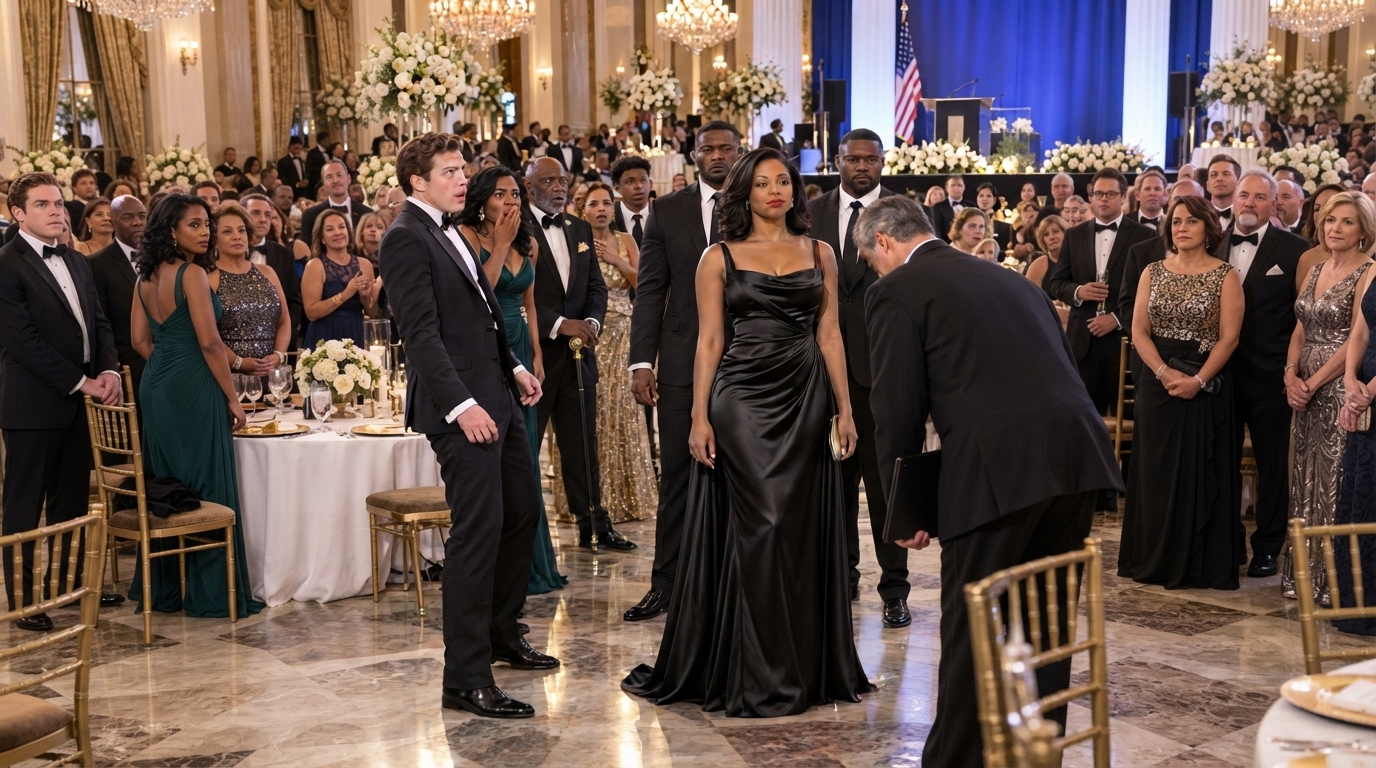
The event manager opened his mouth.
Ladies and gentlemen,” he said, before tonight’s keynote begins
we need to recognize the principal owner of Zenith Holdings.
He turned toward me.
“Ms. Maya Carter.”
For one second, nobody reacted.
The ballroom was so quiet I could hear the soft
clink of a glass being set down somewhere behind me.
Then Spencer laughed.
It was an uncomfortable little laugh.
A nervous laugh.
The kind people use when reality has become so
absurd that they assume everyone must be joking.
“No,” he said.
He looked at the event manager.
Then he looked at me.
“No. That’s not possible.”
The manager held out his hand.
“Ms. Carter, the board is ready for you.”
I placed my clutch on the table.
My mother stood so suddenly that her chair scraped against the marble floor.
“What is this?” she demanded.
The manager turned toward her.
“Ma’am, I’m sorry, but this is a private event.”
“This is my gala.”
He gave her a confused look.
“No, ma’am. This is a Zenith Holdings event hosted at the Ritz-Carlton.”
My mother opened her mouth.
Nothing came out.
Spencer stepped in.
“There’s been a mistake.”
The manager looked at him.
“I don’t believe so.”
Spencer pointed toward me.
“She doesn’t belong here.”
The room began to stir.
People were turning in their seats.
Whispers moved from table to table.
I recognized some of the names.
Bank executives.
Developers.
Attorneys.
Investors.
People Spencer had spent years trying to impress.
People who suddenly realized that the woman he had
just threatened was standing in the center of the room under a spotlight.
The manager continued.
“Ms. Carter is the controlling owner of Zenith Holdings and chair of its investment committee.”
Spencer’s face lost all color.
He looked at my mother.
Then my father.
Then Nia.
Finally, he looked at Malik.
His mouth moved.
“That’s impossible.”
I took the microphone.
“Yes, Spencer.”
My voice carried across the ballroom.
“It is.”
Someone near the front laughed quietly.
I didn’t.
I looked directly at him.
“You were right about one thing.”
He stared at me.
“Power belongs to the people who control the capital.”
I paused.
“And tonight, that person is me.”
My father lowered himself into his chair.
My mother looked like she wanted to disappear.
Nia had stopped breathing.
Malik looked from me to Spencer, then back to me.
“What did you do?” he asked.
I looked at him.
“I stopped explaining myself.”
The event manager stepped aside.
I walked toward the stage.
The applause began slowly.
One person.
Then another.
Then an entire section stood.
It wasn’t because they knew me personally.
It wasn’t because they loved me.
It was because they finally understood what everyone at that table had refused to understand.
I was not the woman Spencer thought he could intimidate.
I was not the daughter my parents could order around.
And I was not the struggling stranger they had
convinced themselves belonged somewhere beneath them.
I was the person whose signature could approve or
kill the very deal Spencer had been bragging about all week.
I reached the stage.
The chairman of Zenith Holdings handed me the presentation folder.
“Ms. Carter,” he said, “the board is honored.”
I nodded.
Then I looked down at the audience.
“At the beginning of this evening,” I said, “I was told I did not belong in this room.”
A few people glanced toward Spencer.
“I was told I was an embarrassment.”
My mother closed her eyes.
“I was told my apartment could be taken from me because my family believed someone else needed it more.”
I let that settle.
“And this week, a man representing himself as a powerful real estate executive attempted to use his position to threaten me with a fraudulent eviction notice.”
The ballroom went silent again.
Spencer’s attorney, who had been seated two tables away, suddenly stood.
“That’s a serious allegation.”
“It is.”
“And you have evidence?”
I smiled.
“I do.”
I reached into my clutch.
The red envelope.
The one I had carried all evening.
I placed it on the podium.
“This is evidence from a forensic review conducted over the last forty-eight hours.”
Spencer stared at it.
“What is that?”
“You’ll find out.”
He rushed toward the stage.
Security stepped between us.
“Mr. Spencer,” one guard said firmly, “please remain in your area.”
“You don’t understand,” Spencer snapped.
“We understand enough.”
The chairman stepped forward.
“Mr. Spencer, please return to your seat.”
Spencer hesitated.
Then slowly sat down.
I opened the envelope.
Inside were copies of the forged eviction notice.
The security logs.
The master access request.
The rooftop incident report.
The videos.
And a certified statement from the property management office confirming that Spencer had no authority whatsoever to evict me.
But there was more.
Far more.
The forensic audit had uncovered a pattern of behavior stretching back years.
Spencer had manipulated vendor approvals.
He had redirected referral fees.
He had quietly steered clients toward companies owned by relatives.
He had used confidential information obtained through his brokerage to pressure property owners into unfavorable deals.
And then came the part even I hadn’t expected.
The audit showed that some of the suspicious transactions had involved Malik.
My brother had been receiving “consulting payments” from one of the shell companies.
Malik stared at the screen.
“That isn’t true.”
The investigator seated near the back spoke.
“It is documented.”
Nia turned toward him.
“Malik?”
Malik looked terrified.
“I didn’t know.”
Spencer snapped.
“Shut up.”
Malik flinched.
That one word told me almost everything.
He hadn’t been working alone.
He had been useful.
Small payments.
Free access.
Introductions.
A favor here.
A favor there.
Spencer had used him.
My parents had used me.
And everyone at that table had spent years teaching each other that manipulating family was acceptable because family would eventually forgive.
I looked at my mother.
“Do you remember telling me I should be grateful Malik was willing to live in my apartment?”
She didn’t answer.
“You said it wasn’t really mine in the first place.”
Her voice trembled.
“I was wrong.”
“No.”
I shook my head.
“You weren’t confused.”
She looked down.
“You were certain.”
My father stood.
“Maya, let’s take this somewhere private.”
I looked around the ballroom.
“Private?”
He nodded.
“This is family.”
I almost smiled.
“That’s exactly why we’re having this conversation here.”
A ripple of discomfort went through the audience.
My father lowered his voice.
“You’re embarrassing your mother.”
I stared at him.
“You once threw me out with fifty dollars.”
He looked away.
“You told me I would never amount to anything.”
“I was angry.”
“You told me the world didn’t owe me a place.”
His jaw tightened.
“You were difficult.”
“And now you want a place in the company I built.”
He said nothing.
I turned toward the microphone.
“My parents threw me out of their home when I was eighteen because they said I wasn’t the right kind of daughter.”
My mother started crying.
“I slept in a room above a diner.”
I kept speaking.
“I worked double shifts. I learned how to write contracts. I learned how to negotiate. I learned how to build relationships with people who cared more about results than appearances.”
I looked toward the executive tables.
“And I built something.”
The room applauded.
I continued.
“Not because anyone believed in me.”
The applause quieted.
“Because I stopped waiting for people to.”
Then I said the thing that changed everything.
“Zenith Holdings is not a shell company.”
The chairman nodded.
“It is an investment group I founded privately eight years ago. We hold interests in commercial property, construction, logistics, technology, and development.”
Spencer’s hands were trembling.
“You’re Zenith?”
I looked at him.
“Yes.”
He stood again.
“You never told anyone.”
“I never needed to.”
“You lied.”
“No.”
I shook my head.
“You assumed.”
He looked furious.
“You’ve been pretending to be broke.”
“I was never pretending.”
I smiled faintly.
“You simply only saw what you wanted to see.”
He looked at my father.
My father looked at the floor.
Then Spencer’s anger disappeared.
Something colder replaced it.
Fear.
“What are you going to do?”
I answered honestly.
“That depends on what the evidence shows.”
A member of the Zenith legal team rose.
“Ms. Carter, perhaps we should proceed.”
I nodded.
The chairman announced that the board had suspended the proposed merger involving Spencer’s brokerage pending an internal compliance investigation.
Spencer stared at me.
“This was a trap.”
“No.”
I gathered the documents.
“You made your own trap.”
My mother came toward me after the presentation.
Her voice shook.
“Maya, please.”
I stopped.
“What?”
“I didn’t know.”
I stared at her.
“You told me to disappear.”
“I was afraid.”
“You threatened me.”
“I thought you would come back.”
“I did come back.”
She looked at me.
“You didn’t recognize me.”
She began crying.
My mother reached for my hand.
I stepped back.
“Not tonight.”
She stopped.
My father was standing behind her.
Nia followed.
Even Malik.
All of them.
My entire family standing there because the daughter they had discarded had become impossible to dismiss.
Then Nia said something unexpected.
“She really owns it.”
My father glared at her.
Nia ignored him.
“You knew, didn’t you?” she asked me.
“About what?”
“That company.”
I looked at her.
“I knew enough.”
She laughed bitterly.
“All these years…”
“What?”
She looked down.
“I thought you were losing.”
I didn’t answer.
She wiped her eyes.
“I was wrong.”
There was something almost heartbreaking about hearing that from her.
Not because I needed her approval.
But because I finally understood that I had spent so much energy trying to make them see me that I had forgotten I had nothing left to prove.
The gala continued without them.
The board proceeded with its presentation.
The merger was suspended.
Spencer was removed from several responsibilities pending investigation.
And by midnight, three major news organizations had already begun reporting that Zenith Holdings’ anonymous founder had appeared publicly for the first time.
I went upstairs to a private suite.
Maria, my closest friend and chief operating officer, was waiting for me.
She held out a glass of water.
“You did it.”
I shook my head.
“No.”
I sat down.
“I survived it.”
She smiled.
“That’s sometimes the harder part.”
I looked through the window at Atlanta.
The city lights stretched forever.
Ten years earlier, I had slept above a diner.
Tonight, the same woman who had been told she would never belong anywhere had just walked onto the largest stage of her life.
But there was still one thing bothering me.
Spencer had been reckless.
He had been arrogant.
He had threatened me.
But he wasn’t stupid.
Not completely.
Someone had given him information.
Someone had helped him get the master access card.
Someone had known enough about my apartment ownership to forge a believable notice.
And someone had known I would attend the gala.
I turned toward Maria.
“Who told Spencer about the apartment?”
She opened a folder.
“We don’t know yet.”
“And the master card?”
“His credentials were used.”
“By him?”
“We’re tracing it.”
I stared at the documents.
“Then we’re not done.”
Maria nodded.
“No.”
She slid another envelope across the table.
“This came in while you were onstage.”
It wasn’t red.
It was white.
There was no return address.
I opened it.
Inside was a single photograph.
Me.
Standing outside my building.
Taken three days earlier.
On the back, six words had been written.
You are not the only one watching.
I looked up.
For the first time that night, the victory disappeared.
PART 4
The next morning, I canceled every meeting.
Not because I was frightened.
Because I had learned something important.
The attacks had never been random.
Someone had been studying me.
I called the security director.
“Pull every camera angle from the last thirty days.”
“All of them?”
“All.”
“Building security included?”
“Yes.”
“Private elevator footage?”
“Yes.”
“Garage?”
“Yes.”
“Service corridors?”
“Everything.”
He nodded.
“And freeze the access logs.”
“They’re already preserved.”
“Good.”
Then I called our forensic team.
Within hours, we had hundreds of pages of records.
Most were routine.
Deliveries.
Maintenance.
Visitors.
Employees.
Then we found something.
A temporary access card had been issued six times over a four-month period.
The name attached to it was not Spencer.
It belonged to a contractor.
A man named Daniel Reed.
Daniel had worked on the tower’s electrical systems.
He also had a second employer.
A small consulting company.
One whose registered owner was…
My mother.
I stared at the screen.
Maria said nothing.
Neither did the investigator.
I finally whispered, “Run everything.”
They did.
The company had very little legitimate activity.
But it had received payments from a property development group.
That development group was tied to the brokerage Spencer worked for.
The trail went deeper.
My mother had not created the company recently.
She had created it three years ago.
Around the same time my father had begun complaining about “Maya becoming distant.”
Around the same time Nia had started asking questions about my apartment.
Around the same time Spencer began appearing at family events.
The investigator looked at me.
“Do you want me to keep going?”
“Yes.”
By afternoon, we had a map.
Money moved from the brokerage.
To the development company.
To my mother’s consulting company.
Then to Daniel.
And Daniel had access to my building.
The chain wasn’t enough by itself to prove motive.
But it was enough to tell me this wasn’t simply a family misunderstanding.
I called my mother.
“Did you hire Daniel Reed?”
Silence.
Then:
“Yes.”
“Why?”
“I needed someone to help me.”
“With what?”
She started crying.
“I was trying to find out what you owned.”
My chest tightened.
“Why?”
“Because your father said you were keeping secrets.”
I closed my eyes.
“So you investigated me.”
“I thought you were hiding money from us.”
“You threw me out.”
“We were angry.”
“You’ve spent ten years investigating your daughter because I wouldn’t tell you how much I made.”
She whispered:
“Yes.”
I sat down.
“Did you give Spencer information?”
“I didn’t know what he would do.”
“Did you know he was trying to remove me from my apartment?”
“No.”
“Did you know he had a master access card?”
“No.”
“Then what did you know?”
She broke down.
“I told him about your building.”
That was enough.
I ended the call.
My mother had not planned the entire scheme.
But she had opened the door.
Spencer had walked through it.
Then Malik had followed.
Then Nia.
A chain of decisions.
A family convinced that my success belonged to everyone except me.
That afternoon, Spencer’s attorneys sent us a letter.
They threatened to sue.
They claimed the public statements at the gala had damaged his reputation.
They demanded an enormous settlement.
We responded with evidence.
The surveillance footage.
The forged documents.
The access records.
The shell company.
The payment trail.
The audio from the rooftop incident.
The police report.
We gave them enough to understand that a lawsuit would expose him further.
They withdrew the demand within twenty-four hours.
But Spencer didn’t disappear.
He called me.
I didn’t answer.
He called again.
And again.
Finally, he left a voicemail.
“You think you’ve won.”
I listened.
“You have no idea what you’re dealing with.”
Then his voice changed.
“This isn’t about your family.”
I replayed the message.
“This isn’t about your family.”
Those words stuck with me.
Because they meant there was another layer.
I asked the forensic team to analyze every communication associated with Spencer during the last year.
They found a recurring number.
Not his broker.
Not his lawyer.
Not a family member.
A private number registered through a corporate service.
We traced it to a business address.
A company called Meridian Capital Strategies.
Its founder had been a business partner of Spencer’s for nearly a decade.
His name was Ethan Cole.
Ethan had spent years advising property developers.
And one of his largest clients was the company Spencer’s brokerage had been trying to merge with.
Suddenly, the pieces connected.
Spencer wasn’t only trying to control my apartment.
He wanted access to Zenith’s investment network.
The merger wasn’t simply a business opportunity.
It was a gateway.
If he could force me out.
If he could create a paper trail making me look financially unstable.
If he could damage my reputation.
He could later approach Zenith’s board with a narrative that the mysterious owner was inexperienced, unreliable, and under financial pressure.
He wasn’t trying to steal my apartment.
He was testing whether I could be manipulated.
The forged notice had been a test.
The rooftop incident had escalated it.
The interference with my construction shipment had been pressure.
The gala was supposed to be the final humiliation.
Instead, it became his exposure.
I met with federal and local investigators to determine what evidence belonged to which jurisdiction.
I did not make accusations beyond what the records supported.
That was important.
I had learned from my own family how easily a story could be distorted.
Facts mattered.
Documents mattered.
Dates mattered.
Records mattered.
So we built the case carefully.
Then something happened I hadn’t expected.
Malik called.
His voice was shaking.
“Maya?”
“What?”
“I need to tell you something.”
“Go ahead.”
“I knew about Spencer’s access card.”
Silence.
“I didn’t know he was going to hurt you.”
“What did you know?”
“He asked me where you kept your packages.”
My stomach turned.
“Why?”
“He said he wanted to know when you were home.”
“Why?”
“I don’t know.”
I waited.
Then he said:
“He told me you were going to lose everything.”
I sat back.
“Did you believe him?”
“Yes.”
That answer hurt more than I expected.
“Why?”
“Because Mom and Dad always said you were unstable.”
I closed my eyes.
They had built that story so thoroughly that my own brother had accepted it.
I asked him one more question.
“What did you give him?”
“Nothing important.”
“Malik.”
He sighed.
“Your building schedule.”
I felt a chill.
“What schedule?”
“The maintenance schedule.”
That explained the access card.
He had not needed to know my personal routine.
He only needed to know when maintenance crews were entering.
Enough to blend in.
Enough to get closer.
The evidence was getting stronger.
But I still needed to know why they had chosen me.
The answer came from an old file.
Aunt Ruby had given me a letter years earlier.
I had never opened it.
I found it while reviewing her estate records.
The outside read:
For Maya, when she finally understands the value of being underestimated.
Inside she had written:
“Maya, your family will always measure you by the version of you they remember. Don’t let that become your measurement of yourself.”
I sat there for a long time.
Then I read the final paragraph.
“If someone ever tries to force you out of something you built, don’t fight them emotionally. Let them put their intentions in writing.”
I smiled.
Ruby had known.
Maybe not the exact people.
Maybe not the exact circumstances.
But she knew.
That night, I called my attorney.
“I want every document preserved.”
“Already done.”
“Every communication.”
“Yes.”
“Every version of the lease.”
“Yes.”
“Every property record.”
“Yes.”
“Good.”
Then I asked one last question.
“Can we quietly acquire the brokerage’s outstanding debt?”
She looked at me.
“You’re considering buying their position?”
“I’m considering protecting mine.”
She smiled.
“Understood.”
Over the next two weeks, Zenith began purchasing distressed positions associated with the brokerage.
Not to destroy anyone.
Not to take revenge.
To prevent anyone from using those assets against us.
Spencer noticed.
By the third week, his confidence was gone.
He asked for a meeting.
I agreed.
We sat across from each other in a conference room.
No family.
No cameras.
Just documents.
He looked older.
“I underestimated you.”
“Yes.”
“I thought you were just some woman with inherited money.”
“I didn’t inherit Zenith.”
He nodded.
“I know.”
“You thought I was easy.”
“Yes.”
“Why?”
“Because nobody in your family spoke about you like you were powerful.”
I leaned back.
“That was their mistake.”
He stared at me.
“Can we settle this?”
“No.”
“I’ll resign.”
“That doesn’t erase what happened.”
“I’ll repay everything.”
“That isn’t the issue.”
“What is?”
I looked directly into his eyes.
“Accountability.”
He stared at me for a long time.
Then he asked:
“What do you want?”
I answered:
“The truth.”
He laughed bitterly.
“You already have it.”
“No.”
I slid a document across the table.
“This one is from your internal server.”
His face changed.
It was an email.
From Ethan Cole.
Sent to Spencer.
Make her believe the apartment is vulnerable. Once she panics, she’ll sell.
Spencer looked down.
“That isn’t—”
“There’s another.”
I placed the second page on top.
Her family will help. Her father already hates confrontation. The brother is easy to manipulate.
He looked up.
“That was Ethan.”
“Did you know?”
He said nothing.
“Did you know my family was involved?”
“I knew your father had been talking to Ethan.”
That was the final piece.
My father had met with Ethan months before the eviction notice.
Not about my apartment.
About Zenith.
My own father had been trying to get close to the company I had built.
He had discovered Spencer could serve as the bridge.
The apartment was never the true target.
I was.
Because if they could reduce me to a frightened daughter again, they could make me surrender control.
I stood.
“We’re done.”
Spencer rose too.
“You’ll regret this.”
“No.”
I gathered my papers.
“I regretted believing people who told me I was less than them.”
I walked out.
A week later, Ethan Cole was formally investigated over the business conduct uncovered through the records.
Spencer resigned.
The brokerage terminated several employees.
Malik gave a statement.
My mother cooperated.
My father did too.
Nia moved out of the city.
And the family that had once called me difficult suddenly had a very different description for me.
Independent.
Successful.
Dangerous.
I didn’t care.
The old names had stopped mattering.
But one final conversation remained.
With my parents.
PART 5
They came to my penthouse on a Sunday morning.
The same apartment they had demanded I surrender to Malik.
The same apartment they had promised I would lose.
The same apartment they had claimed I didn’t deserve.
My mother stood at the door holding a small cardboard box.
My father stood beside her.
Neither spoke.
I opened the door wider.
“Come in.”
They entered slowly.
My father looked around.
He had never been here before.
Not really.
He had visited once during a holiday gathering but had spent the entire time criticizing the furniture.
Now he looked at the skyline.
“This is beautiful.”
“Yes.”
He nodded.
“You built this.”
“Yes.”
He sat down.
My mother placed the box on the table.
“What is that?”
“Your things.”
I frowned.
“My things?”
“Things we kept after you left.”
She opened it.
Inside were old photographs.
School programs.
A college acceptance letter.
A faded diner name badge.
My childhood bracelet.
The cheap watch I wore the night they threw me out.
I picked it up.
I hadn’t seen it in ten years.
My mother began to cry.
“We should have given these to you.”
“Yes.”
My father stared at his hands.
“We were wrong.”
I waited.
He took a breath.
“I told myself you needed to learn independence.”
I laughed softly.
“You did teach me.”
He looked up.
“Just not the way you intended.”
He nodded.
“You were eighteen.”
“I know.”
“We thought you’d come back.”
“I did.”
My mother wiped her eyes.
“We know.”
I sat across from them.
“Why did you want Malik to have my apartment?”
My father answered.
“He was starting college.”
“So?”
“We thought it would help him.”
“Then help him.”
He looked at me.
“We thought you had more than enough.”
I looked around.
“I did.”
He nodded.
“And Malik didn’t.”
“No.”
My mother whispered:
“We thought family should share.”
I smiled sadly.
“Family shares when sharing is freely offered.”
She looked down.
“You weren’t free to say no?”
“No.”
“You threatened me.”
“Yes.”
My father swallowed.
“You’re right.”
That word sounded strange coming from him.
Right.
I had spent years trying to hear it.
Now that I had it, it felt smaller than I expected.
He continued.
“We were afraid.”
“Of what?”
“That you had become someone we couldn’t control.”
I said nothing.
My mother looked at me.
“You were always stubborn.”
“I prefer determined.”
She smiled faintly.
“Determined.”
Then she reached into the box and pulled out my old college letter.
“You were accepted.”
“Yes.”
“We told everyone you dropped out because you couldn’t handle it.”
I looked at her.
“I left because it wasn’t what I wanted.”
“We made it sound like failure.”
“You did.”
She cried.
“I don’t know why we did that.”
“Yes, you do.”
She looked at me.
“Because your success made us uncomfortable.”
Silence.
My father finally spoke.
“Yes.”
There was no argument.
No excuse.
Just truth.
That moment mattered.
Not because it erased anything.
Because for once, my parents had stopped rewriting history.
They had finally said what happened.
I looked at my mother.
“Do you remember what you said when you kicked me out?”
She nodded.
“I said you would come crawling back.”
“Yes.”
“You never did.”
“No.”
“Why?”
I smiled.
“Because I learned how to stand.”
She began crying again.
My father looked toward the window.
“You don’t need us anymore.”
I answered carefully.
“I needed parents.”
He closed his eyes.
“And we weren’t them.”
“No.”
That was perhaps the hardest sentence I had ever spoken.
But it was also the most honest.
After they left, I stood at the door for several minutes.
I watched them walk toward the elevator.
My mother turned around.
I expected her to wave.
Instead, she simply placed one hand over her heart.
I did the same.
Then the elevator doors closed.
I didn’t know whether I would ever let them fully back into my life.
Maybe one day.
Maybe not.
That decision belonged to me.
And for the first time, I wasn’t making it from fear.
I wasn’t making it because I owed them.
I wasn’t making it because I wanted approval.
I was making it because my life was finally mine.
A month later, Zenith held another event.
This one wasn’t a gala.
It was a scholarship ceremony.
We announced funding for students who had been forced to leave home young and build their lives without support.
When I walked onto the stage, I thought about the eighteen-year-old girl sleeping above the diner.
The girl with fifty dollars.
The girl carrying her clothes in a garbage bag.
The girl everyone had decided was a failure.
I wished I could go back and tell her something.
Not that she would become rich.
Not that she would own a company.
Not that one day her family would regret their choices.
None of that was the point.
I would tell her:
You don’t need them to know your value.
You need to know it yourself.
I stepped to the microphone.
“The easiest person to underestimate is the person who stops asking to be understood.”
The audience listened.
“Sometimes people see your quietness and mistake it for weakness.”
I paused.
“Sometimes they see your kindness and mistake it for permission.”
I looked across the room.
“But there comes a day when you realize you don’t owe anyone access to what you worked for.”
The applause began.
I smiled.
“Your boundaries are not cruelty.”
More applause.
“Your success is not a debt.”
Louder.
“And walking away from people who only love you when you’re useful is not failure.”
The room stood.
I looked toward the back.
My mother was there.
She had come quietly.
My father stood beside her.
They weren’t sitting at the head table.
They weren’t demanding attention.
They were just watching.
For the first time, I let them.
After the ceremony, my mother came backstage.
“You were wonderful.”
“Thank you.”
She looked nervous.
“Can I ask you something?”
“Yes.”
“Would you ever consider letting us be part of your life again?”
I thought about it.
“I already did.”
She looked surprised.
“You’re here.”
She smiled through tears.
“That’s not what I meant.”
“I know.”
I hugged her.
It wasn’t forgiveness.
Not completely.
It was something more honest.
A beginning.
My father waited behind her.
I hugged him too.
Then we separated.
No promises.
No speeches.
No pretending.
Just a possibility.
Later that night, I returned to my penthouse.
I walked to the window.
Atlanta was glowing below me.
I thought about that Sunday ten years earlier when my parents had shown up and demanded my apartment.
“Give it to Malik.”
As though my life were something they could redistribute.
As though everything I had built belonged to whoever they thought deserved it most.
I remembered my answer.
“Or you could kick him out like you did me and let him figure it out himself.”
At the time, I had said it because I was angry.
Now I understood it differently.
Independence isn’t something parents can teach by abandoning a child.
Independence is something people learn by discovering that they can survive without permission.
My parents had meant to punish me.
They accidentally taught me not to depend on approval.
Spencer had meant to scare me.
He accidentally taught me to document everything.
My family had meant to make me feel small.
They accidentally gave me the freedom to become someone they could no longer control.
And the apartment?
I never gave it to Malik.
But I did something else.
I paid the remaining balance on a small condo and put it in his name.
No strings.
No conditions.
Not because he deserved a reward.
Because he had finally taken responsibility, apologized, and made the difficult choice to tell the truth when lying would have been easier.
I told him only one thing.
“This is yours.”
He looked at me.
“Why?”
“Because I know what it feels like to be twenty and scared.”
He started crying.
I hugged him.
“You’re still responsible for your own life.”
He nodded.
“I know.”
“Good.”
The penthouse remained mine.
The company remained mine.
The decisions remained mine.
But the most valuable thing I had gained wasn’t property.
It wasn’t capital.
It wasn’t the title of CEO.
It was the ability to walk into any room without wondering whether I belonged there.
Because I finally understood:
Belonging isn’t something other people grant you.
It is something you refuse to surrender.
Ten years ago, my parents stood at my door and said my brother needed my home more than I did.
Ten years ago, I had fifty dollars and nowhere to sleep.
Today, I had built a life they couldn’t take from me.
And the greatest irony was that the moment they finally saw my worth wasn’t when they heard about my company.
It wasn’t when they learned how much money I controlled.
It wasn’t when the ballroom applauded me.
It was when they realized they could no longer make decisions for me.
That was the real power.
Not the money.
Not the penthouse.
Not the company.
The freedom to say no.
The freedom to leave.
The freedom to protect what belongs to you.
And the freedom to stop begging people to love the person you already know you are.
I closed the curtains.
Placed the old red envelope in the top drawer of my desk.
And under it, I put the photograph from the storage box.
The one of the eighteen-year-old girl standing beside her garbage bag.
I kept it there as a reminder.
Not of where I came from.
Of what I survived.
Because sometimes the people who tell you that you are nothing are simply terrified of the day you discover they were wrong.
My parents wanted my brother to “get used to” my apartment.
Instead, I got used to something far more important.
Living without their permission.
And once I did, there was no door they could ever close on me again.
THE END THANK YOU FOR READING !!!