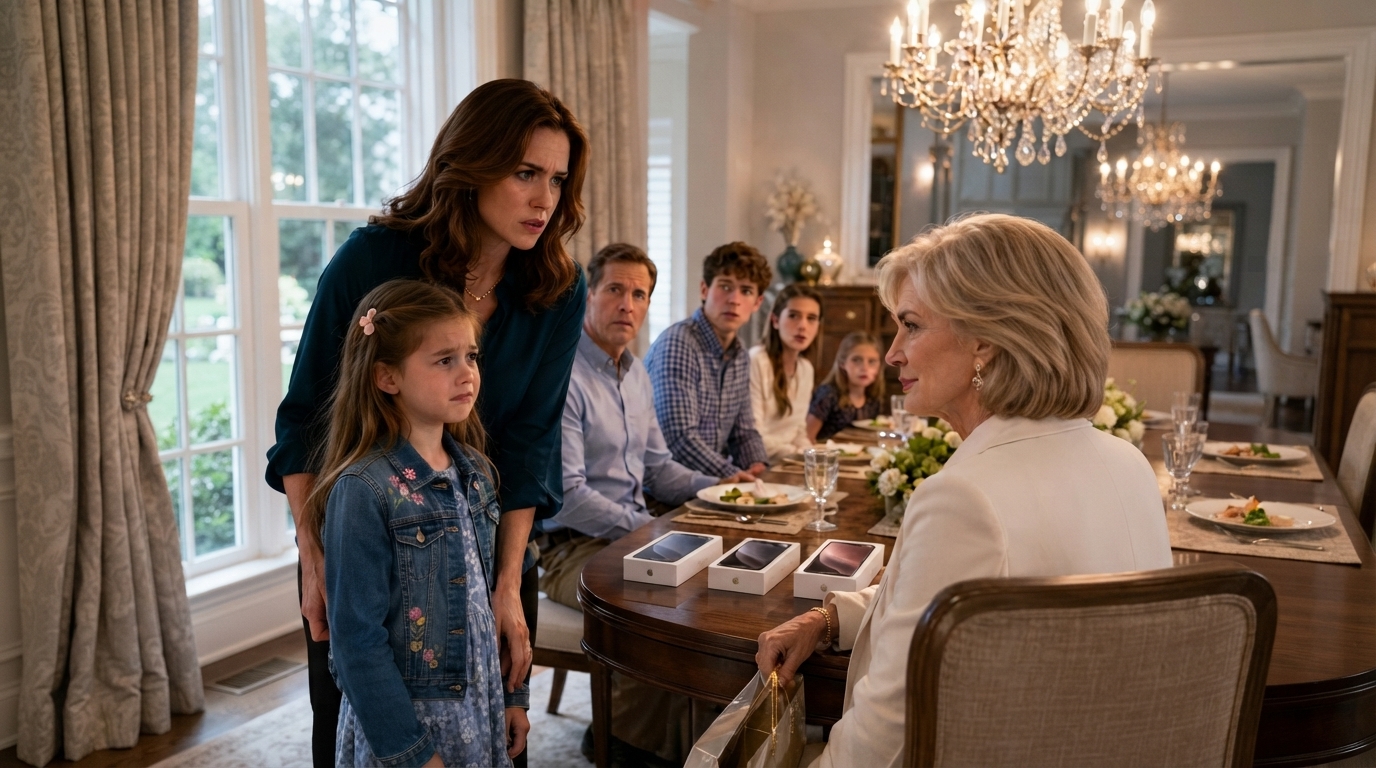
PART 3
I placed the deed on the table.
For a few seconds, nobody touched it.
Glenda looked at the first page.
Then at Tanner.
Then at me.
“What is this?”
Tanner answered quietly.
“The deed.”
“To what?”
“The building on Mercer Avenue.”
Her face changed.
Everyone in the room knew the property.
It wasn’t a mansion or some glamorous vacation home.
It was a three-story commercial building in an old downtown block,
with storefronts on the first floor and offices upstairs.
Glenda had talked about it for years.
Her father had owned part of it.
Then ownership had passed through several family arrangements after his death.
For years, she had spoken about that building as if it were
proof that the family had built something important.
She liked to say it would “stay in the family forever.”
She had told relatives that someday her children would benefit from it.
She had even told my daughter, once, that “our family businesses are for our own blood.”
I remembered every word.
She looked at the deed again.
“You didn’t buy that.”
Tanner said:
“We did.”
“With whose permission?”
He stared at her.
“Ours.”
She laughed.
That brittle little laugh again.
“This is some kind of stunt.”
I shook my head.
“No.”
“When did this happen?”
“Fourteen months ago.”
Her eyes narrowed.
“Why wasn’t I told?”
“Because we didn’t want you interfering.”
The room went silent.
That was the first time anyone had ever said that to Glenda.
Her expression hardened.
“You think I interfere?”
Tanner looked at me.
Then back at her.
“Yes.”
She stared at her son.
“After everything I’ve done for you?”
He didn’t answer.
I did.
“That’s exactly the problem.”
Glenda turned toward me.
“You have some nerve.”
I took a breath.
“I’ve been patient for seven years.”
“With what?”
“With watching you tell my daughter, over and over, that she isn’t as real as the other children.”
She scoffed.
“I never said that.”
“You said it tonight.”
“I said those phones were for my grandchildren.”
“You called them your real grandchildren.”
“I didn’t mean it that way.”
Emory was standing beside Tanner.
She was holding his hand.
Glenda looked toward her.
“Oh, sweetheart, you’re making this much bigger than it is.”
Emory shrank closer to her father.
I saw Tanner’s jaw tighten.
“No,” he said.
Glenda looked at him.
“No what?”
“You don’t get to tell her how much it hurt.”
His voice was still calm.
“But you do get to hear it.”
Glenda blinked.
She had expected him to stay silent.
The old Tanner would have.
The old Tanner would have told me later that his mother “didn’t mean it.”
The old Tanner would have changed the subject.
The old Tanner would have asked everyone to forgive her.
That man wasn’t standing at the table anymore.
He reached across and pulled the deed closer.
Then he turned the first page toward Glenda.
“Read the owner’s name.”
She looked down.
Her lips moved silently.
Then she whispered:
“Tanner Merritt.”
“And?”
She read the second name.
“Shelby Merritt.”
“Correct.”
She looked at the bottom.
“Why are you showing me this?”
“Because you said tonight that family assets were only for your blood relatives.”
She frowned.
“So?”
“So you made it clear what you think family means.”
I looked at Emory.
“She is our daughter.”
Then at Glenda.
“She is not a category you get to rank.”
Glenda slammed her hand on the table.
“You are manipulating my son.”
Tanner shook his head.
“I made this decision.”
“You’ve always been manipulated by her.”
“No.”
He looked at her.
“I was manipulated by you.”
The room went completely still.
My mother-in-law stared at her son as if he had slapped her.
She turned toward her husband.
“Caleb?”
Her husband lowered his eyes.
He had barely spoken all evening.
Now he sighed.
“Glenda.”
“What?”
“You went too far.”
Her mouth fell open.
“You too?”
He looked at Emory.
Then at the empty iPhone bag.
“Yes.”
Glenda pushed her chair back.
“This is outrageous.”
I sat perfectly still.
“What are you angry about?”
“You’re taking away family property.”
“We purchased it.”
“With what money?”
“Our money.”
“Where did you get it?”
Tanner looked at her.
“From our business.”
She stared.
“That little consulting company?”
“Yes.”
“The one I helped you start?”
“You gave me twenty thousand dollars nine years ago.”
She looked offended.
“I gave you my support.”
“You gave me twenty thousand.”
“And?”
“I paid you back.”
That silenced her.
Tanner reached for another document.
“Full repayment.”
A copy of a bank transfer.
Dated years earlier.
Glenda stared.
“I don’t remember that.”
“You didn’t want to.”
I looked at her.
She pushed the paper away.
“You’ve become ungrateful.”
Tanner smiled sadly.
“No, Mom.”
“I’ve become an adult.”
That sentence seemed to hit harder than any accusation.
Glenda sat down.
Her eyes moved around the table.
Some relatives suddenly found their plates fascinating.
Dana, the aunt who had been staring into her water all night, finally spoke.
“Glenda, maybe we should stop.”
Glenda snapped:
“You stay out of this.”
Dana looked at Emory.
Then at me.
“I’ve stayed out of it for years.”
Silence.
“That was the mistake.”
Glenda’s face turned red.
“You all want to gang up on me.”
“No,” I said.
“We want you to hear what you’ve been saying.”
I stood.
“We’re not staying for dinner.”
Emory looked relieved.
Tanner nodded.
We started gathering our things.
Glenda called after us.
“You think a deed makes you better than us?”
I turned.
“No.”
I looked at the three phones lined up on the side table.
“I think treating a child with dignity does.”
We walked out.
In the car, Emory sat between us.
She didn’t speak for several minutes.
Then:
“Mom?”
“Yes?”
“Did Grandma really mean it?”
I looked at Tanner.
Then back at her.
“She said something wrong.”
“That wasn’t my question.”
Her voice was tiny.
“Did she mean it?”
I pulled the car into a quiet side street before answering.
“I think Grandma said something she had no right to say.”
Emory looked down.
“Am I real?”
That sentence nearly broke me.
Tanner reached back and took her hand.
“You are our daughter.”
“Forever?”
“Forever.”
She nodded.
Then she leaned against the seat.
I stared ahead.
Tanner said quietly:
“I should have stopped her years ago.”
I didn’t answer.
He continued.
“I kept thinking there would be a better time.”
“There never was.”
“I know.”
He swallowed.
“I let you take all the fights.”
I looked at him.
“I’m not asking you to fight your mother for me.”
“I know.”
“I’m asking you to protect your daughter.”
“I will.”
At home, Emory went to bed early.
Tanner and I stayed in the kitchen.
The deed was spread across the table.
He looked at it.
“Fourteen months.”
“Yes.”
“You really kept this quiet that long?”
“Yes.”
“Why?”
“Because I wanted to see whether she would change without us forcing the issue.”
He sighed.
“I knew she wouldn’t.”
“You hoped she would.”
He nodded.
We sat quietly.
Then he asked:
“How did you know?”
“Know what?”
“That she was going to go this far.”
I looked at him.
“I didn’t.”
I touched the deed.
“I only knew I wouldn’t let Emory grow up thinking she had to earn belonging.”
Tanner nodded.
That night, neither of us slept much.
The next morning, Glenda called eleven times.
I didn’t answer.
Then my phone buzzed with a message.
“We need to talk before this gets out of hand.”
I showed Tanner.
He replied:
“It already has.”
Then he blocked her.
That was the first time he had ever blocked his mother.
And once he did, something changed.
Not just between them.
Inside him.
He seemed lighter.
Like a person finally setting down a weight he’d been carrying for decades.
The building on Mercer Avenue had been our quiet investment.
We bought it because the owner was elderly and wanted to sell to someone who would preserve the property.
The first floor had two storefronts.
The second floor held small offices.
The third floor was mostly unused.
For fourteen months, we had renovated it slowly.
We never told Glenda.
She would have demanded involvement.
She would have called it a “family asset.”
She would have wanted control.
Instead, we created something else.
A business center.
The first floor would house a bookstore and a small café.
The second floor would become affordable office space for local entrepreneurs.
And the third floor?
Tanner had an idea.
A community learning center.
We hadn’t finished it yet.
But we planned to.
The day after the Thanksgiving dinner, we went there.
Emory came with us.
She walked through the unfinished third floor.
“What is this?”
“A surprise.”
“For who?”
“For you.”
She looked confused.
I knelt.
“This is going to be a place for kids to learn things.”
“Like school?”
“Sort of.”
“What kind of things?”
“Art.”
“Can I do art?”
“Absolutely.”
She smiled.
For the first time since the dinner, I saw her shoulders relax.
Tanner came up beside us.
“We’re calling it the Emory Center.”
Her eyes widened.
“My name?”
“Yes.”
She looked at me.
“Why?”
“Because you taught us something.”
“What?”
“That family isn’t about who you’re related to.”
Tanner added:
“It’s about who you choose to protect.”
She smiled.
“Can my friends come?”
“All of them.”
“Even if they’re adopted?”
I swallowed.
“Yes.”
“Even if they don’t have grandparents?”
“Yes.”
She smiled.
“Good.”
That afternoon, we signed the final renovation contracts.
The irony wasn’t lost on me.
A building my mother-in-law had treated like a symbol of bloodline would become a place specifically designed to make children feel included.
Not because they were related to us.
Because they were children.
Meanwhile, Glenda was not finished.
The following week, we received a legal letter.
She claimed the building had been purchased with funds that should have been considered “family money.”
We gave the letter to our attorney.
He reviewed the bank records.
Then smiled.
“The money came from your company.”
“Yes.”
“Was your husband a shareholder?”
“Yes.”
“Was his mother?”
“No.”
“Then she has no ownership interest.”
“What about her claim that she contributed to the original business?”
“We have repayment records.”
He held up the old bank transfer.
“That’s done.”
I exhaled.
“What now?”
“Respond formally.”
“We will.”
Then something unexpected happened.
Glenda’s attorney requested records of our household finances.
Not because of the building.
Because she wanted to establish that I had “isolated” Tanner financially from his family.
That phrase was laughable.
But it frightened me because I knew how these situations could become emotionally expensive.
We gave our lawyer everything.
Bank accounts.
Business records.
Tax returns.
Trust documents.
All clean.
Then the attorney asked:
“Have you retained any messages from the night of Thanksgiving?”
“Yes.”
“Save everything.”
We had.
Glenda had been careless.
She had sent a message afterward to a family group chat.
It said:
“I don’t understand why Shelby is so offended. Blood should matter to people.”
Then:
“Some children don’t appreciate what they’re given.”
Then:
“The family has every right to decide who belongs.”
I printed them.
Our attorney smiled.
“These are useful.”
I asked:
“Why?”
“Because they’re contemporaneous.”
He tapped the paper.
“She wrote them herself.”
The next message came from Dana.
“Glenda, Emory is family.”
Glenda answered:
“Not by blood.”
That was it.
There was no arguing with that.
We saved it.
A few days later, my husband received an email from his father’s business lawyer.
The building ownership was confirmed.
Our renovation plan was legitimate.
Glenda had no legal claim.
But then came another issue.
A trust.
The Elder Family Trust.
I had heard the name before.
Glenda had always spoken about it vaguely.
Now our lawyer wanted the documents.
We discovered that there were several old family assets held in trust.
Some were connected to commercial properties.
One of those properties was the building we had purchased.
That was impossible.
Unless the property had been transferred incorrectly years earlier.
We checked the title history.
And there it was.
A recorded transfer from Glenda’s father to an entity controlled by Caleb’s family.
Then another transfer.
Then another.
Eventually, the ownership history became complicated.
But one thing was clear.
When we purchased the building, we had bought it from the legal owner listed in the current record.
The transaction was valid.
Glenda’s old family expectations did not override current ownership.
She had confused history with title.
Then our attorney found something else.
A prior agreement.
Glenda’s father had placed certain properties into trust with explicit instructions that they could not be transferred to family members simply because someone claimed sentimental ownership.
The language was straightforward.
The properties belonged to whoever lawfully held them.
That ended Glenda’s claim.
But the trust raised another issue.
If she had misunderstood the property, what else had she misunderstood?
We asked for the complete family financial records.
And that’s when we found the bigger problem.
PART 4
The first suspicious entry was small.
$7,500.
Then $12,000.
Then $18,500.
Then $42,000.
All transferred over several years from family accounts.
All connected to businesses.
Several payments were labeled as “temporary loans.”
None had proper repayment documentation.
Our attorney traced the recipients.
The names led back to businesses associated with people close to Glenda.
One belonged to a cousin.
Another belonged to an old family friend.
A third was connected to a business in which Glenda had an undisclosed financial interest.
I looked at Tanner.
“Did your mother know?”
“She had to.”
Our attorney corrected him.
“We need evidence.”
So we kept digging.
The numbers grew.
Eventually, the total exceeded several hundred thousand dollars.
But then we found something much more serious.
Some family assets had been pledged as collateral for personal debts.
And one of those debts had apparently been secured using information connected to Tanner.
He didn’t know.
I didn’t know.
The documents were old.
Years old.
But the signature looked suspiciously familiar.
It wasn’t Tanner’s.
The property address was one we recognized.
A smaller rental house that his grandfather had owned.
Tanner stared at the page.
“My mother managed that property.”
“Was she authorized?”
He shook his head.
“I don’t know.”
We sent it to the attorney.
The lawyer brought in a forensic document examiner.
The result was preliminary but concerning.
The signature likely had been reproduced rather than written naturally.
That changed everything.
We were no longer dealing with family prejudice.
We were dealing with potentially unauthorized financial conduct.
And then another name appeared.
Glenda.
The examiner found three documents with similar irregularities.
Each connected to a different transaction.
Tanner looked sick.
“Mom?”
I reached for his hand.
“Let’s not assume.”
He nodded.
But the evidence kept pointing back.
We learned that Glenda had repeatedly borrowed against assets she did not fully own.
Some were family properties.
Some were business interests.
And some had been represented as hers because she had been managing them for years.
Her sense of ownership had apparently become detached from legal ownership.
That explained her behavior.
She wasn’t simply entitled.
She believed authority came with proximity.
If she managed something, she thought it was hers.
If she raised someone, she thought she owned them.
If she gave someone money, she believed they owed her obedience.
It was the same philosophy she had applied to Emory.
And to Tanner.
And, apparently, to family assets.
The court process expanded.
Glenda’s attorneys began asking increasingly aggressive questions.
We answered with records.
She demanded proof that the building belonged to us.
We provided the deed.
She demanded evidence that the purchase money was ours.
We provided bank statements.
She claimed I had isolated Tanner.
We provided his independent ownership records and his own written decisions.
She claimed Emory had turned him against her.
We provided nothing.
Because we refused to make our daughter’s feelings into a legal argument.
One morning, Tanner came into the kitchen holding his phone.
“Mom wants to see Emory.”
“What did you say?”
“No.”
“Good.”
“She says she’s changed.”
I looked at him.
“Has she?”
“I don’t know.”
“Then the answer stays no until we do.”
He nodded.
A few days later, we received an invitation from the court-appointed mediator.
Family settlement.
Glenda wanted everything resolved privately.
Our attorney recommended going.
We agreed.
The mediation room was small.
No chandeliers.
No family photographs.
No audience.
Just lawyers, family members, and documents.
Glenda arrived with two attorneys.
She looked exhausted.
She sat across from us.
“I don’t want to fight with my son.”
Tanner answered:
“Then stop fighting with my wife and daughter.”
She looked at me.
“You’ve changed him.”
“No.”
I said it calmly.
“He changed himself.”
She sighed.
“I miss you.”
Tanner’s face softened.
For a second, I wondered whether he would fold.
Then he said:
“I miss who we were.”
Glenda began crying.
“That can be repaired.”
“Maybe.”
“What do you want?”
He answered:
“Respect.”
She nodded.
“And my granddaughter?”
“Respect.”
She looked down.
“I can do that.”
Our lawyer interrupted gently.
“Then let’s discuss boundaries.”
The agreement was simple.
No financial involvement in our businesses.
No claim to the Mercer Avenue property.
No unsupervised access to Emory.
No comments concerning adoption or biological family.
No communication with Emory about adult disputes.
And no disparaging remarks about me in the child’s presence.
Glenda signed.
We signed.
For the first time in months, it seemed possible that the situation might finally settle.
It didn’t.
Two weeks later, a letter arrived from a creditor.
Glenda had defaulted on a personal obligation connected to one of the family entities.
The creditor was attempting to identify assets.
One of the properties mentioned?
The Mercer Avenue building.
I called our attorney.
“How can they do this?”
“They can’t, if the title is clear.”
“It is.”
“Yes.”
“Then why is our building listed?”
“Because someone represented that they had an interest.”
“Who?”
He sent me a copy.
My mother-in-law.
She had apparently provided the lender with old family documents suggesting she had a beneficial interest.
They weren’t current.
They weren’t accurate.
But the lender had relied on them.
Now our property was caught in a dispute.
Our attorney moved quickly.
We filed documentation showing current title.
The lender withdrew the claim.
But by then, I was furious.
Not because of the paperwork.
Because she had done it after signing the mediation agreement.
I called her.
“I want to know why.”
She began crying.
“I was trying to save the family.”
“You were using our property.”
“I thought it belonged to all of us.”
“It doesn’t.”
“But it came from your grandfather-in-law.”
“That doesn’t make it yours.”
She went quiet.
Then:
“I don’t know where I belong anymore.”
I understood that sentence differently than I once would have.
But understanding is not permission.
“You don’t have to own something to belong somewhere.”
She cried.
“I don’t know how to do that.”
“Then learn.”
She hung up.
The next day, Tanner sat across from me.
“She needs help.”
“Yes.”
“Not money.”
“No.”
“Counseling.”
“Probably.”
He nodded.
He seemed relieved that I hadn’t said otherwise.
A month later, Glenda entered a supervised family counseling program.
Not because a court ordered it.
Because she finally admitted that she didn’t understand where boundaries ended and family began.
The counselor’s first recommendation was simple.
“Stop treating access as ownership.”
It took Glenda weeks to accept it.
Then something happened.
She sent Emory a letter.
Not a gift.
Not a demand.
A letter.
It said:
“I’m sorry for making you feel like you had to prove you belonged.”
Emory read it.
Then looked at me.
“Do I have to answer?”
“No.”
She folded the letter.
“Maybe later.”
That was enough.
A few months passed.
The Mercer Avenue building reopened.
The café opened first.
Then the bookstore.
Then the offices.
And finally, the third floor.
The Emory Center.
The opening ceremony was small.
Children painted murals.
Families came.
There were bookshelves.
Art supplies.
Computers.
A reading corner.
And a wall with one sentence painted across it:
EVERY CHILD DESERVES A PLACE WHERE THEY BELONG.
Emory stood beside me holding a pair of scissors.
She cut the ribbon.
Everyone applauded.
Tanner looked at her.
Then at me.
We both cried.
Glenda was not at the opening.
We weren’t ready.
But she saw photographs.
The next day, she sent one message.
“I’m proud of her.”
I didn’t respond.
Not because it wasn’t kind.
Because sometimes people need to prove change through consistency rather than words.
Over time, she did.
She stopped asking for money.
Stopped making demands.
Stopped talking about “real grandchildren.”
Stopped comparing children.
At holidays, she brought gifts that were equal.
At first, Emory was suspicious.
Then one year, Glenda handed her a wrapped box.
Emory looked at her.
“Is this really mine?”
Glenda smiled.
“Yes.”
“No tricks?”
“No tricks.”
Emory opened it.
A set of watercolor paints.
She smiled.
“Thank you.”
Glenda cried.
But she didn’t ask for a hug.
She knew better.
Emory eventually hugged her anyway.
Not because she was pressured.
Because she chose to.
That distinction mattered.
A few months later, the legal dispute over the old family assets finally settled.
The court recognized the current ownership of the Mercer Avenue building.
The unrelated family claims were resolved separately.
Certain financial records were reviewed.
Some disputed transactions were reimbursed.
Others were resolved through settlement.
No one received a magical reset.
There was no moment when everyone hugged and forgot what happened.
But the truth was clear.
The building was ours.
The business was ours.
The future was ours.
And Emory was our daughter.
No document was needed to make that true.
Years later, when Emory was older, she asked me about the iPhones.
We were sitting in the Emory Center.
“What happened?”
“What do you mean?”
“That night.”
I smiled faintly.
“I remember.”
“Did Grandma really say I wasn’t real?”
I took a breath.
“She said something hurtful.”
“Why?”
“I think she believed family was about blood.”
“Isn’t family blood?”
“Sometimes.”
She looked at me.
“Then what is it?”
I pointed around the room.
“Look.”
Children were reading.
A volunteer was helping a teenager with homework.
Two little girls were painting.
A father was waiting with his son.
“This is family too.”
She smiled.
“Because we choose it?”
“Yes.”
She thought about that.
Then she said:
“I think that’s better.”
I kissed her forehead.
“So do I.”
A week later, Glenda came to the center.
She stood near the entrance.
She looked around.
“What do you think?”
She smiled.
“You made something beautiful.”
“We did.”
She looked at the wall.
Then at Emory.
“She belongs here.”
I corrected her gently.
“She doesn’t have to belong here.”
Glenda looked at me.
“She already does.”
Then she smiled.
“Yes.”
That was the closest thing to closure we ever received.
Not the court.
Not the deed.
Not the money.
That sentence.
She already does.
PART 5
Five years after the iPhone incident, Emory was twelve.
She was taller.
Confident.
Still artistic.
Still carried a sketchbook everywhere.
The Emory Center had expanded.
There were tutoring programs.
Weekend workshops.
A scholarship fund.
A summer art camp.
The building had become more than a business.
It had become a community.
And every time I walked through the doors, I remembered the little girl who once stood beside an empty gift bag and asked:
“Did Grandma forget mine?”
She had not been forgotten.
She had been excluded.
There is a difference.
And I was never going to let her confuse the two.
Glenda changed too.
Not perfectly.
But genuinely.
She learned to ask before assuming.
She learned that being a grandmother didn’t make her the parent.
She learned that love could survive a boundary.
She even began volunteering at the center.
At first, she only organized books.
Then she helped with art supplies.
Eventually, she started reading stories to younger children.
One afternoon, I watched her kneel beside a little girl who was crying because she couldn’t finish a drawing.
Glenda said:
“You don’t have to be the best. Just keep going.”
I smiled.
The irony wasn’t lost on me.
She had spent years trying to teach children that value came from categories.
Now she was learning to teach them that value came from being themselves.
Life can change people.
But usually not because someone forces them.
Because reality eventually becomes impossible to deny.
The night of the iPhone incident had been that moment for all of us.
It had forced us to choose.
And once we chose, we couldn’t go back.
Tanner and I were still married.
Stronger than before.
Not because we never disagreed.
We did.
But we had learned something important.
Marriage is not about avoiding difficult conversations.
It’s about having them before resentment becomes another person at the table.
He had once believed peace meant keeping his mother happy.
Now he understood that peace meant keeping his family safe.
One evening, he asked me:
“Do you ever wonder what would have happened if I hadn’t spoken up?”
“Yes.”
“What do you think?”
I looked at him.
“I think Emory would still remember that night.”
“She does.”
“Yes.”
“But maybe differently.”
“How?”
“She would remember that her father chose her immediately.”
I smiled.
“That matters.”
“It does.”
We sat quietly.
Then he said:
“I wish I’d done it sooner.”
I looked at him.
“You did it when you were ready.”
He nodded.
“I hate that it took so long.”
“So do I.”
Neither of us pretended otherwise.
One Christmas, all three of us sat together at the dining table.
Glenda brought the gifts.
There were equal-sized boxes.
No labels that said “real grandchild.”
No comparisons.
No ranking.
She handed Emory her package first.
Emory opened it.
A pair of art supplies she had wanted for months.
She looked at Glenda.
“You remembered.”
Glenda smiled.
“Of course.”
Emory hugged her.
Glenda closed her eyes.
Tanner looked at me.
I smiled.
Then Glenda handed him a package.
“What’s this?”
“Something for you.”
He opened it.
Inside was an old photograph.
His father.
His mother.
Him.
And the Mercer Avenue building in the background.
There was a note on the back.
“Build something that outlives me.”
Tanner stared at it.
He looked up.
“Mom.”
She nodded.
“I meant it.”
He smiled.
Not everyone gets a perfect second chance.
But sometimes they get a real one.
And sometimes real means different.
Not the old relationship.
Not the old expectations.
Something new.
A few months later, Emory won an art competition.
She brought home a blue ribbon.
She was beaming.
Glenda stood up before anyone else.
She applauded.
Then she said:
“That girl is going to build something beautiful.”
I smiled.
Because once upon a time, that woman had looked at my daughter and decided she wasn’t real.
Now she was looking at her and seeing exactly who she was.
A child with talent.
A child with kindness.
A child with a future.
A child who never needed permission to belong.
Years after that first dinner, the Emory Center had become known throughout the neighborhood.
People donated.
Businesses partnered with it.
Children returned every summer.
Some were adopted.
Some were biological.
Some lived with grandparents.
Some lived with foster families.
Some had no stable family at all.
Nobody asked.
Nobody ranked them.
They just came inside.
That was the whole point.
One evening, after everyone had left, Emory and I were walking through the building.
She pointed at the wall.
“Mom?”
“Yes?”
“Do you remember why you named this after me?”
I smiled.
“Because of one very bad dinner.”
She laughed.
“The phones?”
“The phones.”
She looked at the wall.
“I think that was a good thing.”
I frowned.
“A good thing?”
“Yes.”
“Why?”
“Because otherwise this place might not exist.”
I stopped.
She smiled.
“Maybe Grandma accidentally helped.”
I laughed.
“Don’t tell her that.”
“Why?”
“She’ll take credit.”
We both laughed.
Then she hugged me.
I held her tightly.
I realized something that evening.
The best response to rejection is not always revenge.
Sometimes it’s building something the rejection can never touch.
That’s what we had done.
Glenda tried to define family.
We built a place that refused the definition.
She tried to divide children.
We created a space where every child had a chair.
She tried to make blood the measure of worth.
We made belonging the measure.
And somehow, the insult that was supposed to shrink my daughter became the reason hundreds of children found a place to grow.
I never bought another expensive phone for Emory because I wanted to prove a point.
I bought her things she loved when we could afford them.
Books.
Paints.
Concert tickets.
Little things.
Because gifts were never the issue.
The issue was what Glenda thought the gift communicated.
This one counts.
This one doesn’t.
This child matters.
This child doesn’t.
We rejected the entire system.
One day, Emory asked:
“Mom, do you think Grandma regrets what she said?”
“Yes.”
“Do you think she regrets giving the other kids phones?”
“Probably.”
She smiled.
“I don’t.”
I looked at her.
“Why?”
“Because I got something better.”
“What?”
She pointed around the center.
“This.”
I hugged her.
That was the answer.
Not the phone.
Not the deed.
Not the lawsuit.
Not the money.
This.
A place.
A purpose.
A future.
And a family that no longer needed anyone else’s approval.
Glenda eventually asked me a question.
We were sitting outside the center one spring afternoon.
“Do you still think I’m a bad person?”
I looked at her.
“I think you made some cruel choices.”
She nodded.
“And?”
“I think you’re making different choices now.”
She smiled.
“Is that enough?”
“For today.”
She laughed softly.
“I’ll take it.”
I looked at the building.
“Change doesn’t erase the past.”
“I know.”
“But it can change the future.”
She nodded.
“I hope so.”
She was quiet for a moment.
Then asked:
“Do you think your father would have liked this?”
I looked at the Mercer Avenue sign.
“Yes.”
“Why?”
“Because he believed family meant making room.”
She smiled.
“I wish I’d learned that sooner.”
“So do I.”
No anger.
No bitterness.
Just truth.
That was enough.
Years later, when Emory was eighteen, she stood on the steps of the center and gave a speech to a crowd of families.
She talked about inclusion.
About adoption.
About belonging.
About the danger of teaching children that they are less because adults have complicated beliefs.
Then she said something that made me cry.
“Someone once told me I wasn’t a real grandchild.”
The crowd became silent.
“I was seven.”
She smiled.
“I believed her for about thirty seconds.”
Then she looked toward me.
“My parents didn’t.”
Everyone applauded.
Emory continued.
“They taught me that family isn’t a competition.”
That sentence stayed with me.
Because it was the truth.
Family isn’t a competition.
There is no winner.
No “real” child.
No less important child.
No better grandchild.
No more deserving daughter.
No bloodline scoreboard.
There are only people.
People who deserve to be treated like people.
And children who deserve to know they belong.
After the ceremony, Emory hugged me.
“You okay?”
“Yes.”
“You’re crying.”
“I know.”
She laughed.
“You always cry.”
“Occupational hazard.”
She smiled.
Then she looked toward the center.
“What are you going to do with the building when I’m older?”
I laughed.
“Whatever you want.”
“Really?”
“Yes.”
She thought about it.
“I’d keep it.”
“Why?”
“Because somebody has to keep the door open.”
I hugged her.
“Then keep it open.”
She nodded.
And that is where the story truly ends.
Not with Glenda losing the building.
Because she never owned it.
Not with the phones.
Because they were just objects.
Not with the arguments.
Because arguments fade.
The real ending happened when a seven-year-old girl who had once stood beside an empty gift bag stopped asking whether she was real.
She knew.
She was real.
She was loved.
She was chosen.
She belonged.
And no grandmother, no tradition, no family rule, no bloodline, and no expensive gift could ever change that again.
The deed had proven the building belonged to us.
The years proved the family could change.
But my daughter proved something even more important.
You don’t need someone to hand you a place at the table.
Sometimes you build the table.
You decide who gets a chair.
You make sure there is room.
And you leave the door open for everyone who was once told they didn’t belong.
That’s what we did.
One quiet decision at a time.
The woman who once smiled as she handed phones to “real grandchildren” eventually learned that real love doesn’t need a blood test.
It needs patience.
Respect.
Accountability.
And the willingness to make room.
I still remember Emory standing in that dining room.
Her hands clasped.
Her eyes full of hope.
The gift bag empty.
The room silent.
And I remember the choice I made.
I could have fought over a phone.
Instead, I fought for the meaning behind it.
I could have screamed at Glenda.
Instead, I changed the structure around her.
I could have demanded that everyone apologize.
Instead, I protected my daughter.
And I could have let that night become the story of her childhood.
Instead, we built a different story.
One where she walked into a building carrying her own name.
One where hundreds of children had a seat.
One where no one asked whether they were “real.”
They were simply there.
And that was enough.
Glenda once believed she could decide who counted.
She can’t anymore.
Not because I defeated her.
Because nobody gets to decide that for us.
Not anymore.
The table is bigger now.
The door is open.
The chairs are full.
And every child who walks through that door hears the same thing:
“You belong here.”
That is what Emory deserved all along.
And that is what she will carry with her for the rest of her life.
Not the memory of the missing phone.
The memory of the woman she became after someone tried to make her feel small.
A woman who knows her worth.
A woman who makes room.
A woman who never asks another child whether they are real.
Because she knows the answer.
They are.
And so is she.
THE END THANK YOU FOR READING !!!