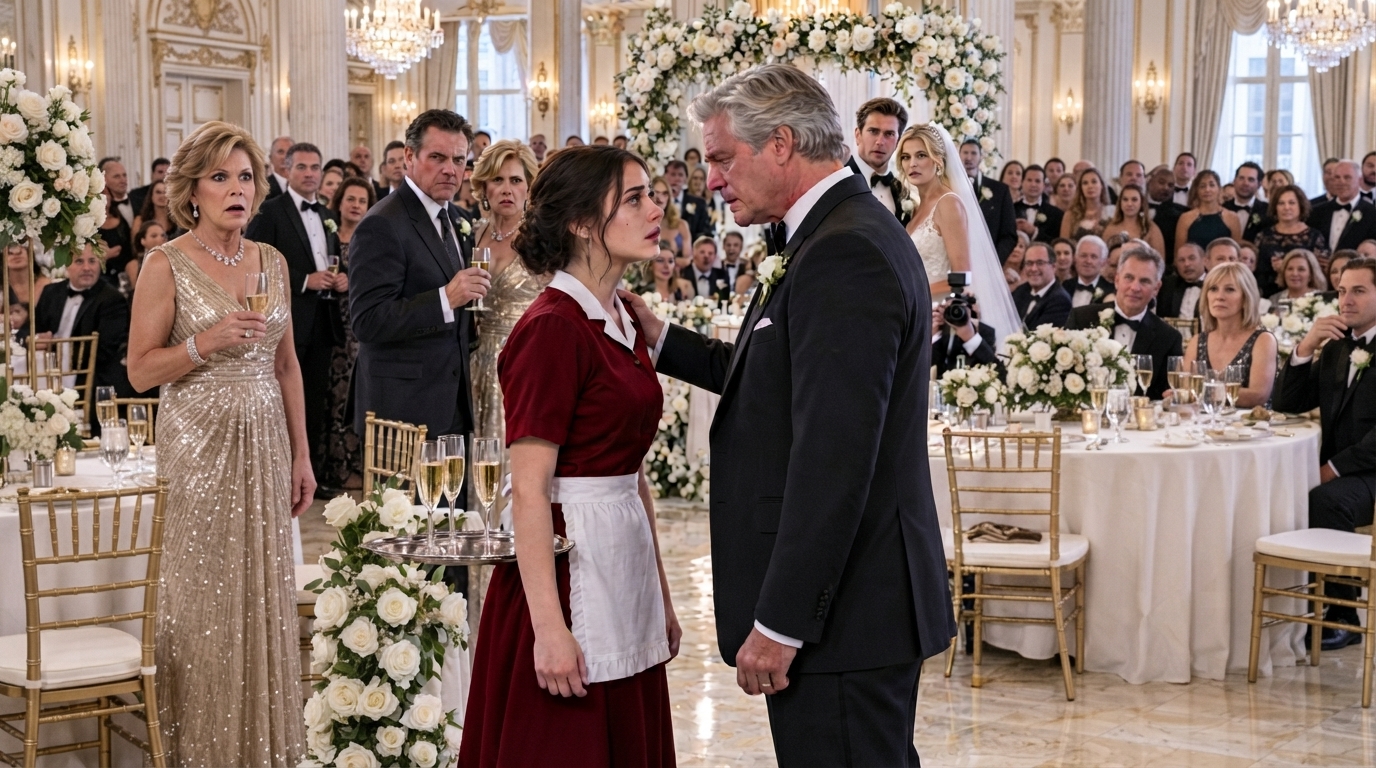
I was standing ten feet away in a black service dress,
still holding a tray of champagne.
My brother Brandon had one arm around his new wife.
Donna stared at the floor.
Gerald’s jaw tightened.
No one answered.
Then Richard Whitmore—the bride’s father,
the man paying for the entire $200,000
wedding—looked straight at me and said,
“Yes. She’s family. Briana, come stand beside me.”
For the first time in my life, Gerald Patterson looked afraid.
I was twenty-three years old, and until that moment,
I had spent nearly every day believing I was exactly what the Pattersons told me I was:
Someone born to serve.
My bedroom was their basement in Fairfield County, Connecticut.
Concrete floor.
No windows.
A thin mattress beside the furnace.
Every morning at five, I went upstairs to scrub granite counters,
make breakfast, wash clothes, iron Gerald’s shirts, clean Brandon’s bathroom,
prepare Donna’s coffee, and make sure the house looked perfect before anyone else woke up.
Brandon slept upstairs in a bedroom with bay windows, a walk-in closet,
and a television mounted on the wall.
He went to private school.
He had tutors.
He played tennis.
He went skiing with friends.
At eighteen, Gerald bought him a BMW.
At twenty-one, Brandon received a condo as a graduation present.
I received a used vacuum cleaner.
“It still works,” Donna had said.
I had smiled because I didn’t know what else to do.
I had no driver’s license.
No birth certificate.
No Social Security card.
No passport.
No school records.
No photographs of myself as a baby.
No medical records.
Nothing.
Whenever I asked about my documents, Donna gave me the same answer.
“They were lost.”
Sometimes she said they had been destroyed in a house fire.
Sometimes she said the hospital had made an administrative mistake.
Sometimes she said the state had misplaced them.
The explanation changed.
The conclusion never did.
I belonged to them.
And because I had no papers proving otherwise, I believed them.
When I was twelve and asked why I couldn’t enroll in school, Donna told me it was too late.
“You’ve fallen behind,” she said. “Public school would be embarrassing for you.”
She hired someone to teach me basic reading and arithmetic twice a week.
After three months, the lessons stopped.
When I asked why, Gerald told me education wasn’t necessary for someone who would eventually work in the family home.
I was thirteen when I learned how to cook an entire Thanksgiving dinner.
I was fourteen when I learned how to remove wine stains from silk.
I was fifteen when Donna began leaving handwritten lists on the basement door.
Laundry.
Bathrooms.
Kitchen.
Guest rooms.
Grocery inventory.
Brandon’s clothes.
Brandon’s meals.
Brandon’s shoes.
Brandon’s schedule.
At sixteen, I finally asked the question that had been burning inside me for years.
“Why does Brandon get to live upstairs?”
Donna was sitting at the kitchen island, reading a magazine.
She didn’t even look up.
“Because he’s your brother.”
“I know.”
“Then why are you asking?”
“I mean… why does he get everything and I don’t?”
She lowered the magazine.
Her expression wasn’t angry.
It was almost amused.
“Briana, honey, some children are born to be loved.”
I waited.
“And some are born to help others.”
She smiled.
“You’re the second kind.”
I stared at her.
She turned another page.
“That’s your purpose.”
I didn’t sleep that night.
I lay on the thin mattress beside the furnace and stared at the ceiling.
Some children are born to be loved.
Some are born to help others.
I repeated those words until they became something I couldn’t separate from myself.
Maybe she was right.
Maybe something had been wrong with me from birth.
Maybe Brandon had been born special.
Maybe I had been born useful.
So I became useful.
I learned how to disappear.
When guests arrived, I stayed in the kitchen.
When family photographs were taken, I stood behind the camera.
When Brandon graduated, I watched from the hallway because Donna said the ceremony was “family only.”
When he got his first serious girlfriend, I was instructed to clean the guest room before she arrived.
When he proposed to Victoria Whitmore, I was given a list of fifty-seven things to do before the engagement party.
I never complained.
Not because I wasn’t hurt.
Because I had learned that complaining only made people remind me of my place.
Then came the wedding.
Brandon was marrying Victoria Whitmore, the daughter of Richard Whitmore.
The Whitmores were wealthy in a way even the Pattersons respected.
Their name appeared on buildings, hospital wings, scholarship programs, and museum plaques.
Richard Whitmore was known throughout Connecticut as a businessman and philanthropist.
His daughter was beautiful, educated, and confident.
She had graduated from Georgetown.
She had spent summers in Europe.
She spoke French.
She played piano.
And somehow, despite everything, she had fallen in love with Brandon.
Donna treated the wedding like a military operation.
She ordered me around from sunrise to midnight.
“Check the seating chart.”
“Call the florist.”
“Steam Victoria’s dress.”
“Pick up the rings.”
“Make sure Brandon’s tuxedo is ready.”
“Don’t embarrass us.”
“Don’t talk to the Whitmores unless spoken to.”
That last instruction was repeated three times.
I didn’t question it.
Then, three weeks before the wedding, Donna told me something that surprised even me.
“You won’t be in the family photographs.”
I looked up from the invitation boxes I was sorting.
“Why?”
“Because you’re working.”
“I’ve worked at every family event.”
“Exactly.”
She said it like that settled everything.
“You’ll help the catering staff.”
I nodded.
“Of course.”
She smiled.
“Good girl.”
I hated those two words.
Good girl.
They made me feel eight years old.
The wedding day arrived.
It was held in a grand hotel ballroom decorated with white roses, crystal chandeliers, gold candleholders, and towering arrangements of orchids.
Two hundred guests attended.
The bride wore a dress that looked like something from a magazine.
Brandon looked proud.
Gerald looked important.
Donna looked triumphant.
And I wore a simple black service dress.
At one point, Brandon walked past me while I was carrying champagne.
“Briana.”
“Yes?”
“There’s no champagne at my table.”
“I’ll bring some.”
“And make sure they don’t give me the cheap stuff.”
“I’ll check.”
He walked away without saying thank you.
One of his friends stopped him.
“Who’s that?”
Brandon glanced back.
“Oh. Her?”
He laughed.
“Housekeeper. She’s worked for us forever.”
I heard every word.
Something inside me cracked.
Not loudly.
Not dramatically.
Just enough to make me realize I couldn’t keep pretending.
I had spent twenty-three years hoping that if I was good enough, helpful enough, quiet enough, they would eventually treat me like family.
But Brandon didn’t even know how to introduce me.
He called me the housekeeper.
And somehow, that hurt more than everything else.
I went into the service hallway and stood there alone.
I looked at myself in the mirror.
Black dress.
Hair pinned back.
Tired eyes.
A tiny scar near my left eyebrow.
I wondered who I would have been if someone had loved me.
Then I heard a voice behind me.
“Excuse me.”
I turned.
Richard Whitmore was standing there.
He looked at me for several seconds.
“You’re Briana, aren’t you?”
“Yes, sir.”
His expression changed.
“Who told you to call me sir?”
I blinked.
“No one.”
“Then why did you?”
“Because you’re Mr. Whitmore.”
He stared at me.
“You’ve met me before?”
“No.”
“Are you sure?”
“Yes.”
He studied my face.
Then his eyes moved toward my left eyebrow.
The tiny scar.
His breathing changed.
“Where did you get that?”
I touched it.
“This?”
“Yes.”
“I don’t remember.”
“Who raised you?”
I froze.
“The Pattersons.”
“Gerald and Donna?”
“Yes.”
“How long?”
“All my life.”
His face went pale.
Before he could ask another question, Donna appeared.
“Richard!”
He turned.
Donna smiled too quickly.
“There you are. Everyone’s looking for you.”
Richard didn’t move.
His eyes remained on me.
Donna’s smile disappeared.
“Briana, get back to work.”
I nodded.
Richard looked at Donna.
“Why does she call you Mrs. Patterson?”
Donna stiffened.
“Because that’s what she calls me.”
“And what does she call Gerald?”
“Mr. Patterson.”
Richard looked confused.
“She’s twenty-three years old.”
Donna forced a laugh.
“She’s always been respectful.”
Richard didn’t answer.
He simply watched me walk away.
I didn’t know it then, but that was the moment everything began falling apart.
During the reception, Richard kept looking at me.
I noticed.
Donna noticed too.
Gerald definitely noticed.
At one point, I was carrying a tray past the family table when Richard stopped me.
“Briana.”
“Yes?”
“Come here.”
Donna immediately stood.
“She’s working.”
Richard looked at her.
“I wasn’t asking you.”
The room seemed to grow quiet.
I approached.
Richard stared at my face.
“Do you know who your birth mother is?”
My heart stopped.
I laughed nervously.
“I don’t think I understand.”
“Your birth mother.”
“I was told she died.”
Donna’s glass slipped slightly in her hand.
Richard noticed.
“Who told you?”
“Donna.”
He looked at Donna.
“What was her name?”
I swallowed.
“I don’t know.”
“Do you have a birth certificate?”
“No.”
“Hospital records?”
“No.”
“Any photographs?”
“No.”
His expression changed.
Not surprise.
Recognition.
Almost grief.
He took out his phone.
“I need to make a call.”
He walked away.
Gerald grabbed my arm.
“What did you tell him?”
“Nothing.”
“Don’t lie to me.”
“I didn’t.”
His fingers tightened.
“If you say anything about this family, I’ll put you on the street.”
I stared at him.
“No money. No clothes. Nothing.”
His voice dropped.
“Without papers, you don’t exist.”
That sentence had controlled me for years.
But this time, I wasn’t afraid.
Because someone else was finally asking questions.
Someone important enough that Gerald couldn’t silence him.
Richard returned fifteen minutes later.
He had tears in his eyes.
“Briana,” he said softly.
“Yes?”
“I need you to trust me.”
I almost laughed.
Trust.
That word had been used against me my entire life.
But there was something in his voice.
Something honest.
“I’ll try.”
He reached into his jacket and pulled out an old photograph.
“I’ve been looking for someone for twenty-three years.”
He turned it around.
I looked.
A young woman stood beside a lake.
She had dark chestnut hair.
Green eyes.
A small scar near her left eyebrow.
My scar.
My eyes.
My face.
I couldn’t breathe.
“Who is she?”
Richard’s voice broke.
“My daughter.”
I looked at him.
“Her name was Eleanor.”
The room seemed to tilt.
“She disappeared in 2003.”
I stared at the photograph.
“How old was she?”
“Twenty-two.”
My fingers began shaking.
“How did she disappear?”
“She was pregnant.”
The champagne tray slipped from my hand.
It crashed onto the floor.
Everyone turned.
Richard caught my arm before I fell.
“She was supposed to have a baby,” he whispered.
I looked at the photograph again.
The young woman was smiling.
She looked happy.
Alive.
Loved.
“Did she have the baby?”
Richard nodded.
“A little girl.”
My heart began pounding.
“What happened to her?”
“She disappeared.”
“And the baby?”
He closed his eyes.
“We were told the baby died.”
I stared at him.
“Who told you?”
“Gerald Patterson.”
I looked across the ballroom.
Gerald was standing beside Donna.
Both of them were pale.
Richard whispered, “That’s why I called a private investigator.”
He took a small envelope from his pocket.
“We need a DNA test.”
I looked at him.
“Why?”
“Because if you’re who I think you are…”
He couldn’t finish.
The next morning, I was sitting in a private medical office in Stamford with a cotton swab in my mouth.
Richard sat across from me.
His attorney was beside him.
His private investigator stood near the window.
Nobody spoke.
When the nurse left, I looked at Richard.
“What if I’m not her?”
He smiled sadly.
“Then I’ll apologize for reopening a wound.”
“And if I am?”
His eyes filled with tears.
“Then you’ve been missing from my life for twenty-three years.”
The results came back forty-eight hours later.
Richard asked me to meet him at his office.
I arrived wearing the only decent clothes I owned.
He was standing by the window.
A folder sat on his desk.
He didn’t speak when I entered.
He simply pushed the folder toward me.
I opened it.
I didn’t understand all the scientific terminology.
But I understood one sentence.
Probability of biological relationship: 99.9998%.
I looked up.
Richard was crying.
“So you’re…”
“My granddaughter.”
The room went silent.
I stared at him.
“I have a grandfather?”
“Yes.”
I swallowed.
“My mother…”
“Eleanor.”
“She’s dead?”
Richard nodded slowly.
“I’m afraid so.”
“How?”
His expression hardened.
“She died eleven years ago.”
I couldn’t understand.
“If she died eleven years ago, why did no one tell me?”
Richard looked at the investigator.
Then back at me.
“Because we didn’t know where you were.”
I felt something collapse inside my chest.
“All these years…”
“Yes.”
“They told you I died?”
“They told us you died at birth.”
I covered my mouth.
“Why?”
Richard didn’t answer immediately.
Instead, he opened another folder.
Inside were copies of old hospital records.
Photographs.
Letters.
Police reports.
Missing-person documents.
And one newspaper clipping.
Eleanor Whitmore had disappeared three weeks before her scheduled wedding.
She was pregnant.
Her car had been found abandoned.
No body was ever recovered.
Richard had spent years searching.
He had hired investigators.
He had contacted hospitals.
He had checked adoption records.
Nothing.
Then eleven years ago, someone finally reported that Eleanor had been found.
But she was already dead.
She had been living under another name.
She had left behind a letter.
Richard handed it to me.
“Read it.”
The handwriting was elegant.
My hands shook as I unfolded the paper.
The letter began:
Dad,
If you’re reading this, I’m sorry.
I’m sorry I disappeared.
I’m sorry I couldn’t come home.
But most of all, I’m sorry about my baby.
I know you believe she died.
She didn’t.
My eyes blurred.
I kept reading.
Someone took her.
I don’t know where she is.
But I know she’s alive.
Gerald Patterson knows where she is.
I stared at the page.
Richard whispered, “That letter was found after Eleanor died.”
I looked up.
“Why didn’t you find me?”
“We tried.”
“Why didn’t you find Gerald?”
“We did.”
My stomach twisted.
“What happened?”
Richard’s investigator answered.
“Gerald claimed Eleanor had given the baby to him voluntarily.”
I stared at him.
“He said your mother didn’t want you.”
Richard’s voice trembled.
“I believed him.”
I looked down.
For twenty-three years, I had believed I was unwanted.
My mother didn’t want me.
My family didn’t want me.
I had been born to serve.
But none of it had been true.
It had been a story.
A carefully constructed story.
A lie.
I suddenly remembered something.
“Wait.”
Richard looked at me.
“When I was little, I had a necklace.”
“What kind?”
“A silver locket.”
Richard’s face changed.
“What did it look like?”
“Small. Oval. There was a tiny flower engraved on the front.”
He stood so quickly his chair moved backward.
“That was Eleanor’s.”
My breath caught.
“She gave it to me.”
“When?”
“I don’t remember.”
Richard looked at the investigator.
“Find out if she still has it.”
I reached into my purse.
“I do.”
I had kept it for years.
I didn’t know why.
It was the only thing I owned that Donna never took from me.
I pulled it out.
Richard stared.
Then he began crying.
He touched the locket with trembling fingers.
“Eleanor gave this to you.”
“How do you know?”
“Because I gave it to her.”
He opened the tiny clasp.
Inside was a photograph.
A young Richard.
A young Eleanor.
And another woman.
I looked closer.
“Who is she?”
Richard went completely still.
“That…”
He stopped.
“What?”
His face became pale.
“That is Donna.”
I stared at him.
“Donna?”
“Yes.”
“But why would my mother have a picture of her?”
Richard looked at the investigator.
“Because Donna worked for us.”
Everything became clear.
Donna hadn’t randomly taken me.
She had known my mother.
She had known Richard.
She had known exactly who I was.
The question was why.
Three days later, Richard confronted Gerald and Donna.
I was there.
So was Richard’s attorney.
So was the investigator.
And so was Brandon.
For the first time in my life, my entire family sat in one room while I sat at the table.
Gerald refused to look at me.
Donna stared at the floor.
Richard placed the DNA report on the table.
“She’s my granddaughter.”
Gerald said nothing.
Richard continued.
“You told me Eleanor’s baby died.”
Still nothing.
“You told me you never knew what happened to Eleanor.”
Silence.
“You lied.”
Gerald finally spoke.
“You don’t understand.”
Richard’s voice became cold.
“Then explain.”
Gerald looked at me.
For the first time, I saw fear in his eyes.
“You weren’t supposed to find out.”
Brandon looked at him.
“Dad?”
Gerald closed his eyes.
Donna started crying.
And then she confessed.
It came out slowly.
Twenty-three years earlier, Donna had been working for the Whitmore family.
She had been responsible for household management.
She knew Eleanor was pregnant.
She also knew Richard and Eleanor were fighting over Eleanor’s relationship with a man Richard didn’t approve of.
That man was Gerald.
Gerald had been Donna’s brother.
He had debts.
A gambling problem.
And a desperate need for money.
Eleanor had decided to leave home.
She planned to take her baby and disappear.
Gerald convinced her he could help.
Instead, he took the baby.
Donna helped him.
They told Richard the baby had died.
But Eleanor refused to give up.
She searched.
She threatened to expose them.
She tried to find me.
Then one night, Gerald confronted her.
There was an accident.
Eleanor was seriously injured.
Gerald panicked.
Donna helped him cover it up.
Eleanor survived.
But she disappeared afterward.
She lived under another name.
She spent years trying to locate me.
When she finally found evidence that I was alive, she wrote the letter.
But she died before she could reach me.
I was sitting completely still.
Brandon stared at his parents as if they were strangers.
“You stole a baby?”
Donna covered her face.
Gerald whispered, “It wasn’t supposed to be like this.”
Brandon stood.
“You raised her as a servant.”
Gerald said nothing.
“You made her clean my room.”
Still nothing.
“You told her she was worthless.”
Donna began sobbing.
Brandon looked at me.
His face had changed.
For the first time, he looked ashamed.
“I didn’t know.”
I looked at him.
“You didn’t ask.”
He flinched.
That sentence stayed in the room.
Because it was true.
He hadn’t known the truth.
But he had known I was treated differently.
He had known I had no room upstairs.
He had known I didn’t attend school.
He had known I wasn’t allowed at the family table.
And he had never asked why.
Richard’s attorney eventually uncovered something even worse.
Gerald and Donna had been receiving money from an account Eleanor had inherited.
For years.
They had used money belonging to me.
My grandfather had unknowingly funded the life of the people who had imprisoned his granddaughter.
The amount was staggering.
By the time everything was calculated, the trust was worth more than $18 million.
I stared at the figure.
It didn’t feel real.
I had spent twenty-three years thinking a new pair of shoes was a luxury.
Now someone was telling me I had inherited millions.
But the money wasn’t what broke me.
It was something else.
Richard had found my mother’s final letter.
There was one paragraph he had not shown me before.
He handed it over.
I read it alone.
Briana,
If you ever read this, I need you to know something.
You were never unwanted.
You were never a burden.
You were never born to serve.
You were the reason I kept going.
If someone has convinced you otherwise, believe me instead.
You were loved before you were born.
You were loved every day I was alive.
And if I am not there when you find this, please know that I spent every moment I had left trying to find you.
My daughter.
My little girl.
You were never forgotten.
I couldn’t breathe.
I pressed the letter against my chest.
For twenty-three years, I had been waiting for someone to tell me I mattered.
My mother had.
She just hadn’t been there to say it.
Richard sat beside me.
He didn’t touch me until I nodded.
Then he wrapped his arms around me.
I cried against his shoulder.
Not because I was sad.
Not entirely.
I cried because for the first time, someone was holding me like I belonged somewhere.
The legal proceedings lasted months.
Gerald and Donna faced criminal charges related to fraud, kidnapping, identity concealment, and financial crimes.
I won’t pretend I felt triumphant.
Watching them leave in handcuffs didn’t erase my childhood.
It didn’t give me back school.
It didn’t give me back birthdays.
It didn’t give me back the teenage years I spent cleaning Brandon’s bathroom.
It didn’t bring my mother back.
But it stopped the lie.
And sometimes, stopping the lie is the first step toward healing.
Richard helped me obtain legal identification.
My first driver’s license arrived three weeks later.
I held it in my hands for almost an hour.
My photograph looked strange.
Not because I looked different.
Because my name was finally mine.
Briana Eleanor Whitmore.
Not Patterson.
Whitmore.
My mother’s name.
My name.
I also enrolled in college.
At twenty-three.
I sat in a classroom beside eighteen-year-olds who complained about homework and cafeteria food.
Sometimes I felt ridiculous.
Sometimes I felt ancient.
But I kept going.
I studied history first.
Then business.
Then eventually social work.
I wanted to understand children who disappeared inside families.
Children who learned to become invisible.
Children who were told that love had to be earned through obedience.
Richard supported every decision.
He never told me what to do with the money.
He never told me what career to choose.
He never treated me like property.
He simply said, “It’s yours. Your life is yours too.”
That sentence became my favorite.
Your life is yours.
Six months after the wedding, Victoria asked me to meet her for coffee.
I almost refused.
She had married Brandon.
She was part of that family.
But when I arrived, she stood immediately.
“I owe you an apology.”
“You didn’t know.”
“I knew something was wrong.”
I looked at her.
She lowered her eyes.
“I saw the way they treated you.”
“So did everyone.”
She swallowed.
“I should have asked.”
I nodded.
“Yes.”
She didn’t make excuses.
That mattered.
Then she said something unexpected.
“I’ve decided to leave Brandon.”
I wasn’t surprised.
“Why?”
“Because I realized I married a man who thought cruelty was normal.”
I didn’t answer.
Victoria continued.
“I don’t blame you.”
“I didn’t ask you to leave him.”
“I know.”
She smiled sadly.
“I just need you to know that.”
We hugged before leaving.
Brandon eventually contacted me.
It took him almost a year.
He sent a letter.
Not an excuse.
Not a request for forgiveness.
Just an apology.
He wrote that he had spent his life believing privilege was normal.
He had assumed the house existed for him.
He had assumed I existed to maintain it.
He admitted that he had been selfish.
I didn’t forgive him immediately.
I didn’t owe him that.
But I eventually agreed to meet him.
We sat across from each other at a coffee shop.
He looked different.
Less confident.
Older.
“I don’t know what to call you,” he said.
“Briana is fine.”
He nodded.
“I used to think you were just… there.”
“I know.”
“I didn’t realize.”
“You didn’t want to realize.”
He looked down.
“That too.”
We sat in silence.
Finally, he said, “Do you hate me?”
I thought about it.
“No.”
He looked surprised.
“I don’t hate you.”
“Why?”
“Because I don’t want to spend another part of my life belonging to what you did to me.”
He nodded slowly.
That was the last time we spoke for a long time.
And that was okay.
I didn’t need everyone to become good people.
I just needed to stop letting bad people define me.
A year after the wedding, Richard took me back to the lake shown in the old photograph.
It was autumn.
The leaves were gold and red.
The water was almost perfectly still.
He handed me another photograph.
My mother.
Pregnant.
Smiling.
Alive.
I stared at her.
“She knew you would find me?”
Richard shook his head.
“No.”
“Then why did she smile like that?”
He smiled.
“Because she loved you.”
I sat beside him.
For a long time, neither of us spoke.
Then I took out the old silver locket.
I opened it.
Inside was the photograph.
My mother.
My grandfather.
A life I should have known.
I closed it.
“I used to think my life started when someone finally found me.”
Richard looked at me.
“But it didn’t.”
He waited.
“My life started when I decided I wasn’t what they called me.”
He smiled.
“That sounds like Eleanor.”
I laughed.
“Was she stubborn?”
“Terribly.”
“Good.”
We sat there until sunset.
Years later, I opened a small foundation in my mother’s name.
It helped young adults obtain identification, legal documents, education, and housing when family members had deliberately kept them isolated.
I never used my story to tell people what they should feel.
I simply told them what I wished someone had told me.
You are not what someone calls you.
You are not the role someone assigns you.
You are not a burden because someone treated you like one.
And you are never born to serve another person’s ego.
The strangest part was what happened on the anniversary of Brandon’s wedding.
I received an invitation.
Not from Brandon.
From Richard.
He was hosting a family gathering.
The first real one.
No servants.
No separate tables.
No hidden rooms.
Everyone sat together.
Richard placed a chair beside him.
“This seat is yours,” he said.
I smiled.
“I know.”
Then I looked around the table.
For most of my life, I had dreamed about sitting there.
But once I finally did, I realized something.
The chair wasn’t what mattered.
It was the fact that I no longer needed permission to sit in it.
Later that evening, Richard showed everyone the wedding photograph.
The photograph from the night everything changed.
Brandon stood beside Victoria.
Donna and Gerald were in the background.
And I was standing beside Richard.
Still wearing the black service dress.
Still holding myself like I was afraid to take up space.
Richard pointed at me.
“This was the night we found her.”
I looked at the picture.
Then I smiled.
“No,” I said.
Everyone looked at me.
“This was the night I found myself.”
Richard’s eyes filled with tears.
He raised his glass.
“To Briana.”
Everyone followed.
I looked down at the silver locket around my neck.
For twenty-three years, I had believed I was born to serve.
For twenty-three years, I had believed I was less important than my brother.
For twenty-three years, I had believed my mother had abandoned me.
But the DNA results hadn’t just changed my last name.
They had destroyed the lie at the center of my life.
I wasn’t the servant.
I wasn’t the unwanted child.
I wasn’t the mistake.
I wasn’t the girl who had been born to clean someone else’s room.
I was Eleanor Whitmore’s daughter.
Richard Whitmore’s granddaughter.
And, finally, I was Briana.
Just Briana.
A woman who had survived a childhood that should never have happened.
A woman who had lost twenty-three years.
But who refused to lose another one.
And whenever someone asks me what changed the day Richard saw my face at that wedding, I tell them the truth.
It wasn’t the DNA.
The DNA only proved what I was.
The real change happened when someone looked at me and didn’t see a servant.
They saw a person.
They saw family.
And for the first time in my life, I saw myself too.
THE END THANK YOU FOR READING !!!