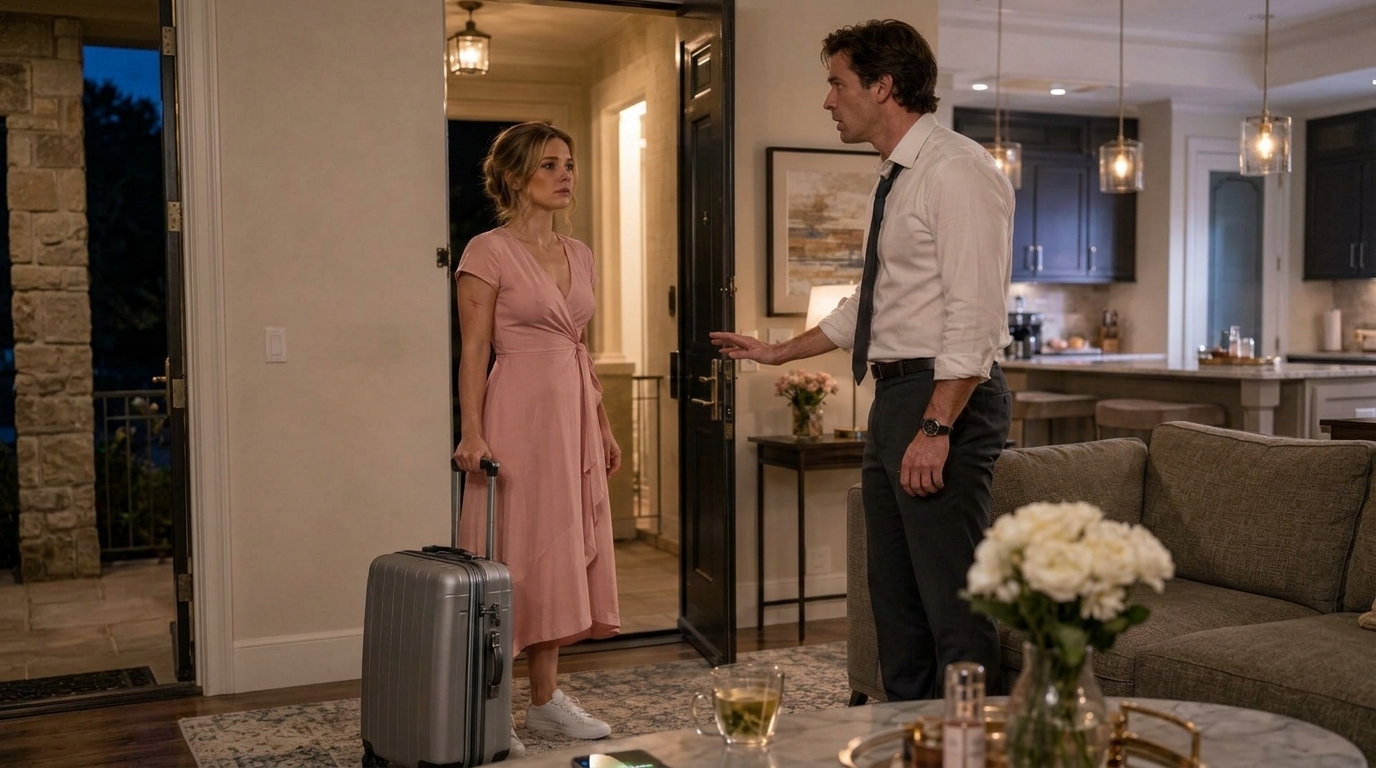
My husband came home late at night,
trailing the scent of perfume and a lipstick smudge on his collar.
I gave him a calm look and said,
It seems she’s better at keeping you by her side.
He stopped in the doorway.
For several seconds, Jasper Croft did not move.
He didn’t ask who I meant.
He didn’t laugh.
He didn’t pretend I was imagining things.
He simply stared at me.
And that was how I knew.
Skyler Jennings wasn’t a suspicion anymore.
She was a fact.
Three months later, we were sitting across from each other inside County Family Court.
His lawyer stood first.
Calm.
Polished.
Confident.
“The defendant does not agree to a divorce,” he said.
“Mr. Croft believes this marriage can still be repaired.”
Jasper finally looked at me.
For eleven years, I had known every version of that face.
The college boy who chased me across campus because he’d forgotten to return my economics notes.
The husband who burned our first anniversary dinner and laughed until he cried.
The man who held my hand during the birth of our daughter.
The founder who came home exhausted and put his head in my lap while telling me we were building something together.
And then there was the man sitting across from me now.
A stranger wearing my husband’s face.
Judge Evans glanced over her glasses.
“Mrs. Croft?”
My attorney, Amelia Reed, touched my arm.
I stood.
“I don’t agree with the statement that this marriage can still be repaired.”
Jasper’s jaw tightened.
I looked directly at him.
“Because I stopped trying to repair something he had already decided to replace.”
His attorney objected.
Judge Evans raised one hand.
“Let her finish.”
So I did.
“I spent three months waiting for my husband to come back on his own. I never confronted him. I never followed him. I never created a scene. I gave him an opportunity to tell me the truth.”
My voice remained steady.
“He didn’t.”
Jasper looked down.
I continued.
“So I stopped waiting.”
That sentence changed the expression on his face.
But it was nothing compared to what happened next.
Because the story of my marriage hadn’t started in that courtroom.
It had started ninety-one days earlier.
At 2:17 in the morning.
I had been sitting on our living room sofa for almost two hours.
The house was dark except for the lamp beside me.
A cup of herbal tea sat untouched on the coffee table.
I’d made it at midnight.
At 12:30, I told myself Jasper was working.
At 1:00, I told myself the same thing.
At 1:30, I stopped making excuses.
At 2:00, I heard a car pull into the driveway.
At 2:17, the front door opened.
Jasper stepped inside.
He looked exhausted.
Or at least he wanted me to think he did.
His tie was loose.
His hair was slightly messy.
He smelled like expensive cologne.
And something else.
Something floral.
Something distinctly feminine.
I didn’t say anything.
He saw me sitting there and sighed.
“Avaline, why are you still awake?”
I looked at the clock.
“It’s 2:17.”
He glanced at it.
“I told you not to wait.”
“I know.”
He took off his shoes.
I watched him hang his jacket.
That’s when I saw it.
A faint red lipstick mark near the collar of his white shirt.
Not enough to be obvious.
But enough.
There are moments when the truth doesn’t arrive like thunder.
Sometimes it arrives quietly.
Sometimes it is the tiny stain on a shirt.
The unfamiliar perfume.
The second phone.
The changed password.
The way someone suddenly turns their screen away when you walk into the room.
I’d noticed all of those things.
For months.
I’d simply refused to put them together.
Until that night.
Jasper walked toward the kitchen.
I said, “It seems she’s better at keeping you by her side.”
He stopped.
His shoulders stiffened.
I didn’t raise my voice.
I didn’t cry.
I didn’t throw anything.
I simply watched him.
“Who?” he asked.
I almost smiled.
“Skyler Jennings.”
His face changed.
It happened so quickly that someone who didn’t know him might have missed it.
But I had known him for eleven years.
I saw the panic.
Then calculation.
Then denial.
“Ava—”
“Don’t.”
He stopped.
“I can explain.”
“I know.”
“No, you don’t understand.”
“I understand enough.”
He rubbed his forehead.
“She works on the Westbridge account.”
“So?”
“We’ve been under enormous pressure.”
“That’s not an answer.”
“She stayed late.”
“You stayed with her.”
“Nothing happened.”
I looked at the lipstick on his collar.
He followed my eyes.
For the first time that night, he looked frightened.
Then he made the mistake that changed everything.
He reached for my suitcase.
It was already packed.
I had packed it that afternoon.
He stared at it.
“You’re leaving?”
“No.”
I looked at him.
“You are.”
He didn’t understand.
“Where am I supposed to go?”
“Wherever you go when you don’t want to come home.”
He stared at me.
I walked upstairs.
That night, I slept in the guest room.
But I didn’t sleep.
I sat on the edge of the bed until sunrise.
At 6:12 in the morning, I opened my laptop.
I created a new folder.
I named it:
PERSONAL.
Inside it, I created another folder.
DOCUMENTS.
And then another.
EVIDENCE.
I didn’t know exactly what I was preparing for.
I only knew that whatever happened next, I didn’t want to depend on Jasper’s memory of events.
Or his version.
Or his promises.
The next morning, he apologized.
He told me Skyler was just a colleague.
He said the lipstick must have come from someone at the restaurant.
He said the perfume belonged to the woman sitting beside him at dinner.
I listened.
Then I went to work.
I was not interested in catching him anymore.
I was interested in understanding my own life.
That distinction mattered.
Because over the next three months, I learned things I wished I had never known.
I learned that Skyler wasn’t just a junior employee.
She had become a regular presence in Jasper’s schedule.
I learned that several late-night meetings had taken place at hotels rather than the office.
I learned that Jasper had been paying certain expenses from company accounts.
And I learned that money had been moving in ways I couldn’t explain.
At first, I didn’t assume criminality.
I didn’t assume fraud.
I didn’t even assume adultery was the whole story.
I simply documented what existed.
Amelia Reed became my attorney.
She was recommended by a friend who had gone through a difficult business-related divorce.
At our first meeting, I handed her a notebook.
She read it quietly.
Then she asked me a question.
“Do you want revenge?”
“No.”
“What do you want?”
I thought about it.
“Certainty.”
She nodded.
“Good.”
She closed the notebook.
“Certainty is much more useful.”
Over the following weeks, Amelia helped me separate what belonged to our marriage from what belonged to Jasper’s company.
That was important.
Because I didn’t want to become the woman who believed divorce gave her ownership of everything her husband touched.
It didn’t.
Some assets were marital.
Some were separate.
Some belonged to the company.
Some belonged to investors.
Some belonged to third parties.
Some transactions needed explanation.
Some simply looked suspicious because I didn’t understand the underlying business.
So Amelia brought in a forensic accountant.
His name was Daniel Mercer.
Daniel spent weeks examining financial records that were lawfully available through the divorce process.
He didn’t dramatize anything.
He didn’t tell me Jasper was a criminal.
He simply highlighted inconsistencies.
One afternoon, he placed a spreadsheet in front of me.
“These are recurring payments,” he said.
I looked at the numbers.
“What’s the recipient?”
“An outside consulting entity.”
I looked closer.
“Jennings Advisory?”
“Yes.”
My stomach tightened.
“Skyler?”
“Not directly.”
He tapped the document.
“The entity is registered to a relative of hers.”
I stared at the page.
“How much?”
“About five thousand dollars a month over the period we’ve reviewed.”
I felt cold.
“Why?”
“We don’t know yet.”
That was the phrase Daniel used repeatedly.
We don’t know yet.
It kept me from jumping to conclusions.
It also kept me awake.
The payments weren’t enough by themselves to prove anything.
But there were hotel charges.
Transportation expenses.
Gift purchases.
Apartment-related payments.
And several expenses that had been categorized as business development.
Amelia advised me not to confront Jasper.
“Let the records speak first,” she said.
So I stayed quiet.
Jasper noticed the change.
He began trying harder.
Flowers appeared.
Then dinners.
Then apologies.
He told me he loved me.
He told me he had made a terrible mistake.
He told me Skyler meant nothing.
I asked him once whether he was still seeing her.
“No.”
He looked directly into my eyes.
“No.”
That was the first time I realized something.
Jasper wasn’t sorry because he’d hurt me.
He was sorry because I knew.
There is a difference.
I didn’t tell him what I knew.
I didn’t tell him about the consulting payments.
I didn’t tell him about the hotel records.
I didn’t tell him that Amelia had already begun preparing for the financial side of the divorce.
And I definitely didn’t tell him about the company issue.
Because that was when things became more complicated.
Jasper was the founder and chief executive of Croft Systems.
The company had started in our apartment eleven years earlier.
Back then, he had one laptop, two clients, and an idea.
I had worked beside him.
I reviewed contracts.
I proofread proposals.
I sat through investor meetings.
I helped build budgets.
When the company eventually grew, my name disappeared from most of the visible history.
That didn’t bother me.
At least, not then.
I never wanted credit.
I wanted partnership.
But now I began wondering how much of our financial life had been built on assumptions I had never questioned.
Jasper’s company was preparing for a major financing round.
Several investors were involved.
The company had grown quickly.
And when Daniel Mercer examined the records, he found a handful of transactions that didn’t immediately make sense.
One involved a consulting firm.
Another involved a property.
A third involved payments routed through a company with no obvious connection to Croft Systems.
Amelia told me not to assume the worst.
So I didn’t.
But I asked questions through the proper legal channels.
And eventually, the picture became clearer.
Some payments were legitimate.
Some were poorly documented.
Some appeared connected to personal expenses.
And one category involved Skyler.
That was enough for me to know I wasn’t imagining things.
Then came the night Jasper discovered I had filed.
He came home furious.
Not heartbroken.
Furious.
“You filed without telling me?”
I looked at him.
“You knew this was coming.”
“You could have talked to me.”
“I did.”
“No, you didn’t.”
“I asked you if there was someone else.”
He said nothing.
“I gave you the opportunity to tell me.”
He looked away.
“You’re destroying everything.”
“No.”
I shook my head.
“You destroyed the marriage.”
“You’re destroying my company.”
“Your company is separate from our marriage.”
“You know exactly what you’re doing.”
“Yes.”
That surprised him.
I think he’d expected tears.
Instead, he saw certainty.
He stepped closer.
“You’re going to regret this.”
I looked at him.
“Maybe.”
Then I said something I had been waiting weeks to say.
“But regret isn’t the same thing as wanting you back.”
His face hardened.
The next morning, the financial restrictions associated with the divorce proceedings took effect.
Jasper called me from an unknown number.
“Avaline.”
I didn’t answer immediately.
He continued.
“Please.”
His voice had changed.
“Can we talk?”
“We’re talking.”
“I mean face-to-face.”
“No.”
“I’m serious.”
“So am I.”
He took a breath.
“I ended it with Skyler.”
I said nothing.
“I swear.”
Still nothing.
“I made a mistake.”
I finally spoke.
“Which one?”
Silence.
“The affair?”
He didn’t answer.
“The lies?”
Nothing.
“The money?”
His breathing changed.
That was enough.
Then he snapped.
“Avaline Vance, are you insane?”
I closed my eyes.
“No.”
“You’re trying to ruin me.”
“I’m not ruining you, Jasper.”
I paused.
“You ruined yourself.”
I hung up.
That was the moment I stopped confusing guilt with responsibility.
His panic was not mine to calm.
His company was not mine to rescue.
His affair was not mine to forgive.
His reputation was not mine to protect.
And his decision to lie was not something I needed to carry for him.
Three weeks later, his attorney requested that the divorce petition be withdrawn.
Amelia refused.
Then they requested mediation.
We attended.
Jasper arrived with a stack of papers and a tired expression.
“I want to save my marriage.”
I looked at him.
“You’ve had three months to do that.”
“I was confused.”
“You weren’t confused.”
“I made mistakes.”
“You made choices.”
He stared at me.
“Is there anything I can do?”
“No.”
He leaned back.
“You don’t love me anymore?”
I thought about that question.
“I loved you enough to give you the truth.”
His eyes filled with tears.
“I still love you.”
“That may be true.”
He looked surprised.
“But love doesn’t erase consequences.”
The mediation ended without reconciliation.
Then his attorney did something unexpected.
He filed a response stating that Jasper did not consent to the divorce.
That was why, three months later, we were sitting inside Judge Evans’s courtroom.
His lawyer stood.
“The defendant does not agree to a divorce,” he said. “Mr. Croft believes this marriage can still be repaired.”
I looked at Jasper.
He was wearing the navy suit I had bought him for our tenth anniversary.
For one strange second, I remembered why I had loved him.
Then I remembered the lipstick.
The perfume.
The hotel records.
The lies.
And the moment he had reached for my suitcase.
Judge Evans looked at me.
“Mrs. Croft, do you wish to respond?”
I stood.
“I spent three months waiting for him to come back on his own. I never confronted him. I never fought with him. I gave him an opportunity to tell me the truth.”
I looked at Jasper.
“He didn’t come back.”
Jasper lowered his head.
My attorney stood.
“Your Honor, we have documentation relevant to the financial and factual circumstances surrounding this marriage.”
She lifted the manila folder.
Jasper’s attorney frowned.
“What documentation?”
Amelia didn’t answer him.
She handed it to the bailiff.
The folder moved across the courtroom.
Jasper watched it approach.
His attorney opened it.
The first page contained a timeline.
The second contained financial records.
The third contained documentation relating to the consulting payments.
Then hotel records.
Then photographs.
Then communications.
The attorney’s confidence began to disappear.
Jasper leaned toward him.
“What is that?”
His attorney whispered something.
Jasper shook his head.
“No.”
Judge Evans turned a page.
Her expression remained neutral.
That was worse than anger.
She read quietly.
Then she asked Amelia:
“Are these records authenticated?”
“Yes, Your Honor.”
“Were they obtained through lawful discovery?”
“Yes.”
Judge Evans turned another page.
Jasper’s lawyer stood.
“Your Honor, we would request additional time to review—”
“You may request whatever is appropriate,” Judge Evans said. “But I’m asking a preliminary question.”
She looked at Jasper.
“Mr. Croft, are you denying these payments?”
Jasper stood.
“I don’t know what she’s trying to suggest.”
Judge Evans didn’t blink.
“That’s not what I asked.”
His attorney touched his arm.
Jasper sat.
Amelia spoke.
“The records show recurring payments to an entity connected to Ms. Jennings and additional personal expenditures that appear to have been characterized as business-related.”
Jasper’s lawyer objected.
“Appears?”
Amelia nodded.
“We are not asking the court to make a criminal finding today.”
That mattered.
“We are asking the court to consider whether the defendant’s stated position regarding reconciliation is consistent with the factual circumstances.”
Judge Evans looked at the documents.
Then at Jasper.
Then at me.
And asked the question that changed the room.
“Mr. Croft, if you believe this marriage can be repaired, why did you transfer money to a business connected to the woman your wife alleges you were having an affair with?”
Nobody moved.
Jasper looked at his lawyer.
His lawyer looked at the floor.
Finally, Jasper spoke.
“It was business.”
Judge Evans raised an eyebrow.
“Then explain the business relationship.”
Jasper opened his mouth.
Nothing came out.
Amelia reached for another document.
“There is more.”
Jasper’s attorney immediately objected.
“Your Honor—”
Judge Evans held up her hand.
“Let counsel proceed.”
Amelia placed a second file on the table.
“This concerns the company.”
Jasper looked at me.
For the first time that morning, I saw genuine fear.
Not fear of losing me.
Fear of what else I knew.
Amelia continued.
“Several transactions made by Croft Systems are currently being reviewed by independent professionals. We are not asking this court to decide corporate liability. But some of these records are directly relevant to marital assets.”
Jasper’s attorney looked through the pages.
His face went pale.
He whispered something to Jasper.
Jasper’s eyes widened.
I couldn’t hear what he said.
But I knew.
There was something in that file Jasper had not expected me to know about.
Judge Evans looked over the documents.
Then she asked:
“Mr. Croft, did you authorize these transfers?”
Jasper swallowed.
“I don’t remember.”
Judge Evans looked at him for several seconds.
Then she said:
“That’s a remarkably convenient answer.”
His attorney objected.
Judge Evans ignored the tone and continued.
“I am not making a finding of fraud today. But I am ordering that these records be preserved and that any disputed marital assets be clearly identified before further proceedings.”
She looked at both attorneys.
“I also want a complete accounting.”
Jasper’s shoulders dropped.
The hearing continued for another hour.
By the end, his request to delay the divorce had accomplished almost nothing.
Judge Evans set deadlines for discovery.
She ordered financial disclosures.
She refused to treat reconciliation as a reason to indefinitely delay proceedings.
And when Jasper’s lawyer asked whether the court would consider counseling before finalizing the divorce, Judge Evans said:
“Counseling is available if both parties wish to participate. It is not a condition of one spouse’s consent to the other’s decision to end the marriage.”
Jasper looked at me.
I looked away.
Outside the courthouse, reporters were waiting.
Croft Systems was too large for the divorce to remain completely private.
But I didn’t speak to them.
Neither did Amelia.
We walked to the car.
Then she stopped.
“Avaline.”
I turned.
“There is something you should know.”
“What?”
“The corporate records are worse than we expected.”
My stomach tightened.
“What does that mean?”
She lowered her voice.
“It means your husband’s personal misconduct may not be the only issue.”
That evening, I learned why.
Daniel Mercer called.
He had found a pattern.
Several payments from Croft Systems had gone to entities that appeared unrelated.
But those entities shared addresses, directors, or banking relationships.
One company had been created only weeks before receiving a large payment.
Another had been dissolved shortly afterward.
None of this automatically proved wrongdoing.
But together, it warranted investigation.
Jasper had always told me his company was complicated.
I believed him.
Now I wondered whether he had been using complexity as camouflage.
Amelia arranged a meeting with independent corporate counsel.
I attended.
They explained that the divorce court could address marital property, but corporate wrongdoing would involve different processes.
That distinction protected me.
I didn’t want to control his company.
I wanted my own financial interests separated from his.
But if company assets had been improperly transferred, that was a matter for the company, its board, investors, auditors, and potentially regulators.
I understood that.
So I stepped back.
Then came the letter.
It arrived at my office three days later.
No return address.
Inside was a single sheet of paper.
The handwriting was unfamiliar.
It said:
“Mrs. Croft,
I don’t know if you will ever read this.
But if you do, please understand that I tried to warn someone.
There are transactions inside Croft Systems that don’t make sense.
Your husband isn’t the only person involved.
Look at the people who benefited after the money moved.
Don’t trust anyone who tells you everything is fine.”
There was no signature.
Only initials.
D.R.
I showed it to Amelia.
She immediately told me not to contact the writer.
Because we didn’t know who had sent it.
The initials meant nothing by themselves.
But when Daniel Mercer searched the records again, he found an employee named Daniel Rowe.
Former internal systems analyst.
Left the company six months earlier.
His departure had been recorded as voluntary.
Except the exit documentation was incomplete.
Amelia requested additional records through the proper legal process.
And then we found something strange.
Daniel Rowe had submitted an internal complaint before leaving.
The complaint concerned access to company systems.
Someone had used senior executive credentials to access confidential financial files.
One of the credentials belonged to Jasper.
Jasper claimed he had not been the person using it.
That was possible.
Large companies have security teams.
Credentials can be compromised.
Accounts can be shared.
But there was another detail.
The access occurred at 11:43 p.m.
On a night Jasper claimed he had been with Skyler.
I sat silently in Amelia’s office.
She looked at me.
“This is no longer simply about an affair.”
“I know.”
“What do you want to do?”
“Find out what happened.”
She nodded.
The investigation moved slowly.
And legally.
That mattered.
No one broke into accounts.
No one hacked anything.
We relied on records obtained through the divorce process, company disclosures, and information voluntarily provided by former employees.
One former employee agreed to speak.
Her name was Nina Patel.
She had worked in compliance.
She told Amelia that Daniel Rowe had repeatedly complained about unusual payments.
“Did he accuse Jasper?”
“No.”
“What did he say?”
Nina hesitated.
“He said he thought someone inside the company was moving money.”
“Did he name anyone?”
“No.”
“Did he mention Jasper?”
“He said Jasper’s credentials were involved.”
I leaned forward.
“Did he believe Jasper was doing it?”
Nina shook her head.
“He wasn’t sure.”
That answer mattered.
Because uncertainty was still uncertainty.
We couldn’t turn suspicion into fact.
Then Nina gave us something else.
A copy of a message Daniel had sent before leaving.
It said:
“I think someone is using executive credentials to authorize transfers. If I confront the wrong person, I could lose my job.”
The message ended with:
“If anything happens to me, check the access logs.”
My skin prickled.
I looked at Amelia.
She looked back.
“Anything happened to him?”
Nina hesitated.
“He died.”
The room went still.
“How?”
“Car accident.”
“When?”
“Two months after he left.”
I felt something cold settle in my chest.
“What kind of accident?”
Nina didn’t know.
We later learned the accident had been investigated.
There had been no immediate evidence of foul play.
But Daniel’s records were relevant because they suggested he had been investigating something before his death.
We gave everything to the appropriate authorities.
I did not accuse Jasper of killing anyone.
I didn’t even know whether Jasper had known Daniel.
But I knew enough to understand that this was beyond the scope of our marriage.
The next weeks became a blur.
Jasper’s company announced an internal review.
Investors demanded information.
His board appointed outside counsel.
His attorney became increasingly cautious.
And Jasper stopped calling me.
For almost three weeks, there was silence.
Then he sent a message.
“I need to see you.”
I didn’t respond.
He sent another.
“Please.”
I still didn’t respond.
Then:
“I never wanted this to happen.”
That one I answered.
“What didn’t you want?”
His reply came immediately.
“To lose you.”
I stared at the screen.
Then typed:
“You should have thought about that before you gave someone else the hours that belonged to our marriage.”
He didn’t answer.
Two days later, I received another message.
“You don’t understand what happened.”
I replied:
“Then tell the truth.”
Nothing.
That was the last message he ever sent me personally.
After that, everything went through attorneys.
The corporate investigation eventually revealed that several employees had created a network of unauthorized transactions.
Some involved legitimate vendors.
Others did not.
Money had moved through intermediaries.
Certain executives had benefited.
But the investigation also showed something more complicated.
Jasper had known there were irregularities.
He had failed to report some of them promptly.
He had authorized payments without adequate documentation.
He had concealed certain internal complaints because he feared the company’s valuation would collapse.
That did not automatically make him responsible for every transaction.
But it placed him in serious trouble.
The affair became almost secondary.
The woman I had thought was the center of my husband’s betrayal turned out to be only one part of a much larger story.
Skyler eventually contacted Amelia.
She wanted protection.
She admitted she had received gifts.
She admitted Jasper had paid certain expenses.
She admitted they had been involved.
But she also insisted she knew nothing about the corporate transfers.
Her brother had operated one of the consulting companies.
That complicated matters.
She provided records.
Those records helped investigators trace payments.
And they revealed that Skyler had been lied to as well.
Jasper had told her the money was legitimate compensation.
She believed him.
Or at least she claimed she did.
I never decided whether I believed her.
That wasn’t my job.
My job was to protect myself.
Months passed.
The divorce progressed.
There were disputes over property.
There were negotiations over accounts.
There were arguments about valuation.
And there were lawyers who made sure every asset was handled according to ownership, marital-property rules, contracts, and applicable law.
I didn’t receive Jasper’s company simply because I was his wife.
I didn’t seize his accounts.
I didn’t magically become the owner of his business.
What I did receive was what the law and our agreements entitled me to.
And that was enough.
Because I wasn’t trying to win his life.
I was trying to get mine back.
One afternoon, Amelia called.
“The settlement is almost finished.”
I sat back.
“Really?”
“Yes.”
“How does he feel?”
She paused.
“He asked whether you might reconsider.”
I closed my eyes.
“No.”
“I told him.”
“Thank you.”
There was another pause.
Then Amelia said:
“There is one more thing.”
“What?”
“Jasper’s company has reached an agreement with its investors regarding the leadership transition.”
I wasn’t surprised.
“Is he still CEO?”
“No.”
I felt something unexpected.
Not happiness.
Not satisfaction.
Just relief.
For years, I had believed Jasper was the center of everything.
His company.
His ambition.
His reputation.
His success.
His failures.
I had built my identity around supporting him.
Now I realized how dangerous that had been.
A marriage should not require one person to disappear so the other can shine.
The final hearing took place six months after I filed.
Jasper arrived alone.
No flowers.
No grand speeches.
No promises.
He looked older.
Not because of anything dramatic.
Just because consequences age people.
Judge Evans reviewed the settlement.
Then she looked at us.
“Mrs. Croft, do you understand the terms?”
“Yes.”
“Mr. Croft?”
“Yes.”
She looked at Jasper.
“Do you still object to the divorce?”
He was silent for several seconds.
Then he said:
“No.”
I looked at him.
For the first time in months, I saw something I recognized.
Not the husband I had married.
But the man he had been before he convinced himself that he could have everything.
Judge Evans signed the final order.
It was over.
Eleven years ended with a signature.
Outside, Jasper caught up with me.
“Avaline.”
I stopped.
He stood several feet away.
“Can we talk?”
I considered it.
Then nodded.
We stood beneath the courthouse steps.
He looked at me.
“I did love you.”
“I know.”
“I still do.”
“I know.”
“Then why couldn’t you forgive me?”
I took a slow breath.
“Because forgiveness isn’t the same as reconciliation.”
He looked down.
“I thought if I could just get you to stay long enough, we’d fix it.”
I shook my head.
“You didn’t want to fix it.”
He looked at me.
“You wanted to avoid losing it.”
He didn’t answer.
“You were afraid of consequences.”
“I was afraid of losing everything.”
I nodded.
“That was your mistake.”
“What?”
“You thought losing me meant losing everything.”
I looked at him.
“You had already lost me when you decided I was something you could betray and still keep.”
His eyes filled with tears.
I didn’t hate him.
That surprised me.
For months, I thought the end of anger would be forgiveness.
It wasn’t.
It was indifference.
I walked away.
Three months later, I moved into a smaller house across town.
It wasn’t impressive.
There was no huge driveway.
No marble foyer.
No elaborate guest rooms.
But the first morning I woke there, sunlight came through the kitchen window.
I made coffee.
I sat alone.
And for the first time in years, the silence felt peaceful instead of lonely.
I reopened my legal consulting work.
I started helping women who had stepped away from their careers while supporting family businesses.
I taught them how to understand contracts.
How to keep financial records.
How to know what was jointly owned and what wasn’t.
How to ask questions before signing documents.
I never told them to leave their husbands.
I never told them to stay.
I told them something else.
Know what you’re signing.
Know what you own.
Know what you don’t.
And never confuse love with financial blindness.
Months later, I received an email from Daniel Rowe’s family.
They thanked me for preserving the records.
I didn’t know what to say.
I hadn’t done anything extraordinary.
I had simply refused to ignore something that didn’t make sense.
The corporate investigation eventually concluded that Daniel’s concerns had been legitimate.
Several people had manipulated company payments.
The evidence did not establish that Jasper had orchestrated Daniel’s death.
That distinction mattered.
Jasper was not charged with murder.
But he faced consequences for financial misconduct and obstruction-related conduct connected to the corporate investigation.
The company survived under new leadership.
Skyler disappeared from my life.
The consulting companies were dissolved or reorganized as investigators traced their involvement.
And my marriage became something I rarely discussed.
Not because it was shameful.
Because it was finished.
A year after the divorce, I returned to the courthouse.
Not for Jasper.
For a professional seminar.
When I walked through the same hallway, I remembered that morning.
His lawyer standing confidently.
Jasper believing he could stop the divorce.
The manila folder.
The documents.
The question.
“Why did you transfer money to a business connected to the woman your wife alleges you were having an affair with?”
I remembered how small Jasper had looked in that chair.
And I understood something.
The folder had never been about destroying him.
It had been about proving that my reality existed.
For months, he had made me question my own judgment.
Maybe I was paranoid.
Maybe I was overreacting.
Maybe he was just busy.
Maybe the perfume had an innocent explanation.
Maybe the lipstick had come from someone else.
Maybe I was the problem.
That is what betrayal does when it lasts long enough.
It makes the person being lied to investigate herself instead of the liar.
But eventually, I stopped investigating myself.
I investigated the facts.
And the facts spoke.
Not loudly.
Not dramatically.
Just clearly.
Years later, someone asked me whether I regretted not confronting Jasper sooner.
I thought about the question.
Then I said:
“I regret how long I confused loyalty with silence.”
She asked what I meant.
I told her:
“Silence can be loving.”
I paused.
“But sometimes silence is just fear wearing a respectable name.”
She asked how I knew when it was time to leave.
I smiled.
“I didn’t leave because I stopped loving him.”
She waited.
“I left because I finally started loving myself enough to believe what I already knew.”
That night, I went home.
I opened the old box containing photographs from our marriage.
There was one of Jasper and me at twenty-two.
We were sitting on the floor of our tiny apartment.
His arm was around my shoulders.
He was laughing.
I looked at that photograph for a long time.
Then I put it back.
I didn’t tear it.
I didn’t burn it.
I didn’t need to.
That photograph belonged to a part of my life that had been real.
The fact that the ending was painful didn’t make the beginning a lie.
But it also didn’t obligate me to stay inside the ending.
I closed the box.
Outside, the city lights shimmered through the window.
My phone rang.
It was Amelia.
“Everything okay?” I asked.
She laughed.
“Actually, I was about to ask you that.”
“I’m fine.”
“You sound different.”
“I am.”
“How?”
I looked around my quiet house.
At the books on the shelf.
The coffee cup beside me.
The legal files stacked neatly on my desk.
The life I had built without asking anyone’s permission.
“I stopped waiting for someone else to tell me I was allowed to move on.”
There was silence.
Then Amelia said:
“Good.”
I smiled.
“Very good.”
We ended the call.
I walked to the window.
For years, I had believed the hardest part of leaving was losing someone.
It wasn’t.
The hardest part was discovering how much of yourself you had abandoned while trying to keep someone else.
I had spent eleven years believing Jasper and I were building one life.
We weren’t.
He was building his.
And I was quietly building mine around his.
When he betrayed me, I thought he had destroyed everything.
He hadn’t.
He had only destroyed the version of my future that depended on him.
The rest was still mine.
My name.
My work.
My voice.
My choices.
My peace.
And most importantly, my ability to walk away.
I never slapped Jasper.
I never screamed at Skyler.
I never destroyed his company.
I never needed to.
The truth had done what anger couldn’t.
It had separated what was real from what was convenient.
And that was enough.
Because on the night Jasper came home smelling like another woman, he thought he was bringing an affair through the front door.
He didn’t realize he was bringing the end of our marriage with him.
He thought my calmness meant I didn’t know.
Then he thought my silence meant I would stay.
Then he thought my filing was an emotional reaction.
Then he thought his lawyer could delay the inevitable.
But by the time we entered that courtroom, I wasn’t reacting anymore.
I was prepared.
And when Judge Evans turned the final page and asked the question that changed the room, I understood something I would never forget.
Sometimes the strongest response to betrayal isn’t screaming.
It isn’t revenge.
It isn’t destroying the person who hurt you.
Sometimes it is simply becoming impossible to manipulate.
Jasper had spent three months believing he could control the story.
He had forgotten one thing.
He wasn’t the only person who knew how to keep records.
He wasn’t the only person who understood numbers.
He wasn’t the only person who could prepare.
And he certainly wasn’t the only person in our marriage capable of walking away.
The woman sitting beside him in that courtroom was not the wife who had waited until 2:17 in the morning.
She was the woman who had finally understood why she had been awake.
Not because she was waiting for her husband.
Because somewhere inside herself, she had already known he was gone.
She just needed the courage to stop waiting for him to come back.
And when I walked out of that courthouse, I didn’t feel like I had won.
I felt free.
There is a difference.
Winning keeps you connected to the person you defeated.
Freedom doesn’t.
I never looked back.
Not because the past didn’t matter.
But because, finally, the future mattered more.
THE END THANK YOU FOR READING !!!