My husband’s secretary turned pale the moment
she saw me in the office and whispered,
Quick, get into the closet!
I didn’t even have time to ask why.
I obeyed.
And when my husband walked into the room a minute later,
I heard him laugh about the woman he had been married to for twenty-five years.
That woman was me.
He didn’t know I was listening.
He didn’t know I was recording.
And he certainly didn’t know that, by the time he discovered what I had learned,
the life he had spent years building behind my back would already be unraveling.
It started on a rainy Tuesday morning.
I had the day off from the county hospital,
which was rare enough that I decided to surprise Richard at his office.
For twenty-five years, I had been the kind of wife who remembered everyone’s birthdays,
kept track of insurance renewals, paid bills before they were due,
and knew exactly how Richard liked his coffee.
That morning, I bought two cinnamon cappuccinos from the little café beneath his office building.
His favorite.
I remember smiling as I stepped into the elevator.
I remember thinking I might tease him for working through another rainy morning.
I remember looking at my reflection in the elevator doors and
wondering when I had started looking so tired.
At fifty-one, I didn’t feel old.
But I looked older than I had five years earlier.
Maybe it was the double shifts.
Maybe it was the debt.
Maybe it was simply twenty-five years of putting everyone else first.
Richard always told me it was temporary.
“One more year,” he would say.
“One more contract.”
“One more expansion.”
“One more loan.”
Then we’d finally breathe.
So I worked.
I covered morning shifts at the county hospital and picked up evening hours at an urgent-care clinic three days a week.
When the mortgage payment increased, I stopped buying new clothes.
When Richard said his business needed more cash, I canceled my dental appointment.
When the transmission in my car started slipping, I kept driving it.
When he announced another business trip, I smiled.
I thought we were sacrificing together.
I didn’t realize I was sacrificing for a life that Richard had already divided into two separate worlds.
The elevator doors opened on the seventh floor.
I stepped out carrying the drinks.
“Surprise,” I said.
Olivia looked up.
And everything changed.
My husband’s secretary had worked for Richard for nearly eight years.
She knew me.
She knew my name.
She had sent flowers when my mother died.
She had called me once when Richard forgot our anniversary.
Normally, Olivia would have smiled.
Instead, she froze.
The color drained from her face.
“Mrs. Hale?”
I laughed lightly.
“Don’t look so frightened. I brought coffee.”
She stared past me toward Richard’s closed office door.
Then she looked back at me.
Her lips parted.
“Quick,” she whispered.
I frowned.
“What?”
She came around the desk so quickly that her chair rolled backward.
“Get into the closet.”
I thought I had misheard her.
“What?”
“Please.”
She grabbed my arm.
“Get inside. Now.”
There was something in her eyes that frightened me more than her words.
Not embarrassment.
Not surprise.
Fear.
She pulled open the door of the large coat closet beside the executive conference room.
I stared at the darkness inside.
“Olivia, what is going on?”
“I can’t explain.”
“Is Richard—”
Footsteps sounded down the hallway.
Olivia’s fingers tightened around my wrist.
“Please.”
I stepped inside.
She closed the door.
The darkness swallowed me.
I stood between expensive wool coats and cedar hangers, holding two cinnamon cappuccinos against my chest.
My heart was pounding.
I could hear Olivia return to her desk.
Then the elevator chimed.
Footsteps approached.
A man’s voice drifted down the hall.
Richard.
“Did you get the documents?”
“Yes,” Olivia answered.
His footsteps stopped.
A moment later, the office door opened.
Richard entered.
I heard him drop something onto the conference table.
Then he laughed.
It was the familiar laugh I had heard thousands of times.
The laugh I used to love.
The laugh of the man who had once carried me across the threshold of our first apartment because I had jokingly told him I was too tired to walk.
Now that same laugh sounded foreign.
Richard began talking to someone.
I assumed it was a client.
Then I heard him say:
“Jessica should have the rest by Friday.”
My entire body went cold.
Jessica.
I had never heard that name in connection with Richard.
“She’s getting impatient,” a man’s voice replied through the speakerphone.
Richard chuckled.
“She can be patient.”
“You promised her.”
“I promised her what she wanted to hear.”
Silence.
Then the other man asked:
“And your wife?”
Richard laughed again.
“She trusts me blindly.”
My fingers tightened around the coffee cups.
One lid popped loose.
A drop of coffee spilled across my hand.
I didn’t feel the heat.
Richard continued.
“She thinks I’m working late because the company is struggling.”
The man on the phone laughed.
“She still believes that?”
“She believes everything.”
Richard’s voice became almost amused.
“She thinks the loans are for expansion.”
My stomach twisted.
The loans.
For two years, Richard had told me the company was under pressure.
He had told me we needed to tighten our household budget.
He had told me that once his next contract closed, everything would improve.
I had believed him.
Now I stood inside a closet listening to my husband explain that the financial crisis I had been working two jobs to survive might never have been real.
“Did you move the money?” the other man asked.
“Most of it.”
“Into the second account?”
“Yes.”
“Jessica’s place?”
Richard paused.
Then said:
“Some of it.”
My breathing stopped.
Jessica.
A house.
Money.
Another life.
Then Richard said something that made my knees nearly buckle.
“The suburban house is the important part.”
The man on the phone asked why.
“Because she thinks it’s protected.”
“Isn’t it in both names?”
“Technically.”
Richard laughed.
“But she signed the refinance documents.”
I closed my eyes.
I remembered those documents.
Richard had brought them home eighteen months earlier.
He had been standing in the kitchen with a stack of papers.
“Just refinancing,” he’d said.
“We’ll lower the interest rate.”
I had been exhausted after a fourteen-hour shift.
He had pointed to the signature lines.
“Initial here. Sign there.”
I had trusted him.
Now he was laughing about it.
“She won’t understand what she signed,” he said.
The man on the phone chuckled.
“And if she refuses the divorce?”
“She won’t.”
“How do you know?”
“Because she has nothing without me.”
I almost stepped out of the closet.
Almost.
But then Richard said:
“I’ll make sure she thinks leaving is her idea.”
There was a pause.
Then:
“If she fights me, I’ll use the medical records.”
My blood ran cold.
“What records?” the other man asked.
Richard sighed.
“She picked up extra shifts. She’ll look unstable if we need to paint a picture.”
I couldn’t breathe.
He was planning to use my exhaustion against me.
My work.
The very thing I had done to keep our family afloat.
He was going to turn it into evidence that I couldn’t manage my own life.
Then he said something even worse.
“If necessary, I’ll make it look like she cheated.”
The room seemed to disappear.
I heard the recording app open on my phone.
My hands were shaking so badly that I almost dropped it.
I pressed the button.
Red.
Recording.
For the first time in twenty-five years, I stopped being Richard’s trusting wife.
I became a witness.
Richard continued talking.
He discussed bank transfers.
An LLC I had never heard of.
A property in another county.
A second account.
Jessica.
Tyler.
His son.
His other family.
I stood in that closet and realized my husband had not merely been having an affair.
He had built an entire financial structure around a second life.
And I had been financing it.
When Richard finally left for lunch, Olivia opened the closet.
I stepped out.
Neither of us spoke.
She looked at the coffee cups still in my hands.
“I’m sorry,” she whispered.
I looked at her.
“How long?”
She swallowed.
“I don’t know everything.”
“How long?”
“About two years.”
I stared at her.
Two years.
Two years of double shifts.
Two years of canceled appointments.
Two years of believing our marriage was struggling because Richard was trying to save his company.
Two years of him telling another woman that I was useful.
I set the coffees down.
“Why did you warn me?”
Olivia looked toward Richard’s office.
“Because I found something.”
She walked inside.
I followed.
She opened the bottom drawer of her desk and removed a thin envelope.
“Three months ago, Richard asked me to prepare paperwork for a new company.”
She handed it to me.
“Laurent Consulting LLC.”
I frowned.
“Who’s Laurent?”
“No one.”
“What?”
She shook her head.
“That’s the point. The company exists on paper, but I couldn’t find an actual office. I started noticing invoices going there.”
She lowered her voice.
“Large ones.”
I looked at the envelope.
“Why didn’t you tell me?”
“Because Richard noticed I was asking questions.”
Her eyes filled with tears.
“He threatened to fire me.”
“That’s not all, is it?”
She looked away.
“No.”
I waited.
Finally she said:
“I was afraid he’d destroy my career.”
I understood.
Fear makes people quiet.
I’d spent twenty-five years confusing silence with peace.
That afternoon, I didn’t go home immediately.
I drove to a law office across town.
I didn’t know a divorce attorney personally, but one of the physicians at the hospital had recommended a woman named Evelyn Mercer.
I walked into her office carrying my phone, the photographs I had taken, and the envelope Olivia had given me.
Evelyn listened for nearly two hours.
She interrupted only to ask questions.
“Are these documents originals?”
“No.”
“Where are the originals?”
“Richard’s office.”
“Did you remove anything?”
“No.”
“Good.”
She listened to the recording.
Her expression changed.
Not dramatically.
Just enough for me to notice.
When it ended, she removed her glasses.
“Do you know what you’re looking at?”
“No.”
“You’re looking at evidence of a potential financial fraud problem.”
I swallowed.
“Can he take the house?”
“That depends.”
“On what?”
“Ownership. The deed. How it was acquired. How it was financed. What money went into it. Whether there are liens. Whether either of you transferred an interest.”
She opened the copy of the deed.
“Who owned this property before you married?”
“My father.”
Her eyes lifted.
“Your father?”
“Yes.”
“When did he transfer it to you?”
“Seven years into our marriage.”
She studied the document.
“Was it a gift?”
“Yes.”
“To you personally?”
“Yes.”
“Not to both of you?”
“No.”
Evelyn leaned back.
“That matters.”
I stared at her.
“For the first time all day, I felt something other than fear.”
Not victory.
Not relief.
Just possibility.
Evelyn explained that property characterization depended on the exact facts and state law, and that the house couldn’t simply be declared mine because my father had once owned it.
But the deed gave us something important.
A starting point.
Then she asked about the mortgage.
I told her Richard had refinanced it.
She asked whether I had signed.
“Yes.”
“Do you know what you signed?”
“No.”
She nodded.
“That is something we’ll need to investigate.”
Over the next week, my life became a maze of documents.
Bank statements.
Tax returns.
Corporate filings.
Loan agreements.
Credit-card statements.
Investment records.
Property searches.
Every document told part of the story.
And the story was uglier than I had imagined.
Richard had not been secretly stealing every dollar we owned.
That would have been easier.
Instead, he had built layers.
Money moved from one account to another.
Business expenses were mixed with personal expenses.
Some payments were legitimate.
Some were not.
Some loans had actually been used for the company.
Others had financed properties and expenses connected to Jessica.
And because I had trusted Richard to handle most of the business paperwork, I had signed things without understanding their full implications.
But there was one thing Richard had never realized.
I was not financially illiterate.
I had simply trusted him.
For twenty-five years, I had handled the household finances.
I knew how to read a statement.
I knew when a number didn’t make sense.
And once I stopped assuming Richard was telling the truth, the inconsistencies became obvious.
Evelyn hired a forensic accountant named Marcus Bell.
Marcus spent six weeks tracing the transactions.
One evening he spread documents across a conference table.
“Look here.”
He pointed to a series of payments.
“Money leaves the company.”
Then another column.
“It moves through this consulting entity.”
Another.
“Then it lands here.”
“Jessica?”
Marcus nodded.
“Not directly. Through an LLC.”
“Whose LLC?”
“That’s what we’re still establishing.”
He tapped another document.
“But this is interesting.”
I leaned forward.
“What?”
“The property.”
He showed me a purchase record.
A house.
A much larger house than ours.
A gated property in a neighboring county.
Purchased eighteen months earlier.
The owner was an LLC.
The manager was Richard.
I stared at the page.
“That’s where she lives?”
“Likely.”
My hands went cold.
“And Tyler?”
“School records show a child with that name at the address.”
I closed my eyes.
Twenty-five years.
Two households.
One husband.
Then Marcus showed me something else.
A transfer from our joint account.
I recognized the amount.
$38,400.
I remembered it.
Richard had told me it was a tax payment.
It wasn’t.
It had gone toward the down payment on the other property.
I felt sick.
But Evelyn didn’t let me spiral.
“Listen to me.”
I looked up.
“Don’t confront him.”
“Why?”
“Because right now, Richard believes you know nothing.”
She folded her hands.
“That is your advantage.”
I almost laughed.
“Advantage?”
“You’ve been thinking like a wife.”
She looked at the documents.
“Now you need to think like someone protecting herself.”
So I did.
For the first time in my life, I separated emotion from action.
Evelyn filed the divorce petition.
She requested appropriate temporary financial protections through the court.
She sought orders designed to prevent either party from improperly disposing of marital assets while the case proceeded.
And because the house’s ownership was disputed, she documented every claim rather than simply declaring it mine.
The legal process moved slowly.
Richard reacted quickly.
He hired one of the most expensive divorce attorneys in the city.
Then he called me.
“You’re making a mistake.”
I was sitting at my kitchen table.
“No.”
“You’re angry.”
“No.”
“You don’t understand what you’re doing.”
“I understand enough.”
He laughed.
“You think you can destroy my company?”
“I haven’t destroyed anything.”
“You’ve always been dramatic.”
That sentence hurt more than I expected.
Not because it was true.
Because it was familiar.
He had used it for years.
Whenever I cried.
Whenever I questioned him.
Whenever I said I was tired.
Whenever I asked why we never had enough money despite his increasing salary.
I had been dramatic.
He had been reasonable.
Until now.
“Richard,” I said quietly, “who is Jessica?”
Silence.
For several seconds, he said nothing.
Then:
“I don’t know what you’re talking about.”
I ended the call.
That night, Olivia sent me a message.
She had found another document.
A draft agreement.
Richard had prepared it three months before I filed.
It proposed that I receive a modest cash settlement, keep an older vehicle, and leave the house.
In exchange, I would sign a confidentiality agreement.
The document referred to “marital misconduct allegations.”
I had never been accused of anything.
Yet he was already preparing the language.
Evelyn read it.
“This is important.”
“Why?”
“Because it shows preparation.”
“For what?”
“To control the narrative.”
That phrase stayed with me.
Control the narrative.
Richard had spent twenty-five years controlling the narrative of our marriage.
He was the successful husband.
I was the exhausted wife.
He was the provider.
I was the dependent.
He was the businessman.
I was the nurse.
He was the one building our future.
I was the one who supposedly didn’t understand money.
But now the narrative was changing.
Not because I wanted revenge.
Because documents were finally speaking louder than Richard.
Months passed.
Richard became increasingly confident.
He assumed the divorce would collapse.
He assumed I’d run out of money.
He assumed I’d become emotional.
Then he made his biggest mistake.
He sent me a settlement offer.
The number was insulting.
The house was excluded.
The investment accounts were excluded.
The business interests were minimized.
And there was one clause requiring me to acknowledge that I had no knowledge of Richard’s business dealings.
Evelyn read it and smiled faintly.
“Don’t sign.”
“I wasn’t going to.”
“I know.”
She closed the folder.
“But we’re going to respond.”
Two weeks later, we filed our response with supporting financial records.
That was when Richard stopped treating the case like a divorce.
It became a financial dispute.
Then came the discovery requests.
Richard was required to produce documents.
Bank statements.
Corporate records.
Loan agreements.
Property records.
Tax filings.
Messages.
Emails.
At first, his attorney produced thousands of pages.
Marcus reviewed them.
Then he found something.
A wire transfer.
A large one.
From the company to an account controlled by the LLC that owned Jessica’s house.
Richard’s attorney claimed it was a legitimate consulting payment.
Marcus traced the LLC.
Its only substantial income came from Richard’s company.
Its only major expense was the property.
Its only regular beneficiary appeared to be Jessica’s household.
That changed everything.
Richard’s attorney requested another settlement conference.
Evelyn refused to negotiate blindly.
Instead, she asked the court for appropriate relief based on the financial evidence and requested further examination of disputed transfers.
Richard panicked.
Then he called me again.
This time he was angry.
“You’ve gone too far.”
I was sitting in the hospital parking lot after a twelve-hour shift.
“You should stop calling me.”
“You think your lawyer can save you?”
“No.”
“Then who can?”
I looked through the windshield.
“Documents.”
He hung up.
Three days later, Richard disappeared for a business trip.
He told his attorney he needed time away.
He told his employees he was traveling.
But Olivia knew where he was going.
France.
Jessica was with him.
And Richard had planned something.
A wedding.
When Olivia told me, I felt something inside me go strangely quiet.
I wasn’t surprised.
Not anymore.
He had already married her emotionally.
The ceremony was simply paperwork.
Still, the thought hurt.
Twenty-five years of marriage.
And he was preparing to stand beside another woman in France while our divorce case was still unresolved.
Evelyn told me not to react publicly.
“Let him go.”
“Why?”
“Because the court isn’t deciding whether his French wedding is romantic.”
She looked at me.
“We’re dealing with the financial and legal consequences of your marriage ending. Stay focused.”
So I did.
Richard flew to France.
Photographs appeared online.
Jessica wore a white dress.
Richard wore a dark suit.
Someone posted pictures from a vineyard.
His smile looked enormous.
For the first time, I didn’t feel replaced.
I felt relieved.
Because I finally understood something.
The man in those photographs was not the man I had thought I married.
Maybe he had never been.
The divorce proceedings continued.
The court reviewed the disputed property.
The evidence showed that the house had originated as a transfer from my father to me individually.
Richard had later contributed marital funds toward certain expenses and had signed financing documents.
That did not automatically make every dollar or every interest exclusively mine.
So the court examined the records.
The refinance.
The payments.
The principal reduction.
The improvements.
The separate-property documentation.
The marital contributions.
The evidence mattered.
Eventually, the court determined the house’s ownership interests and the financial obligations attached to it according to the applicable law and evidence.
Richard did not get the simple outcome he had expected.
Neither did I.
That was the point.
Real life wasn’t a movie.
No judge waved a magic wand and declared everything belonged to me.
Instead, the court separated what could be established as separate property from what had become subject to marital claims.
Certain assets were awarded to me.
Certain assets remained Richard’s.
Certain obligations had to be divided.
Some disputed transfers were addressed separately.
And the money Richard had moved through his company became a much bigger problem.
Because those transfers were no longer just marital accusations.
They were corporate records.
And corporate records could be examined.
Richard returned from France expecting to resume control.
Instead, he found his attorneys waiting.
The next hearing was scheduled for a Friday morning.
I arrived early.
My hands were steady.
Richard arrived twenty minutes later.
He looked confident.
Until he saw the financial accountant.
Then Olivia.
Then the evidence box.
His attorney whispered something.
Richard’s face tightened.
He walked toward me.
“You’ve made your point.”
I looked at him.
“No.”
“What do you want?”
“I want the truth documented.”
He scoffed.
“You always needed attention.”
I almost smiled.
“No, Richard.”
I looked at the courtroom doors.
“I needed honesty.”
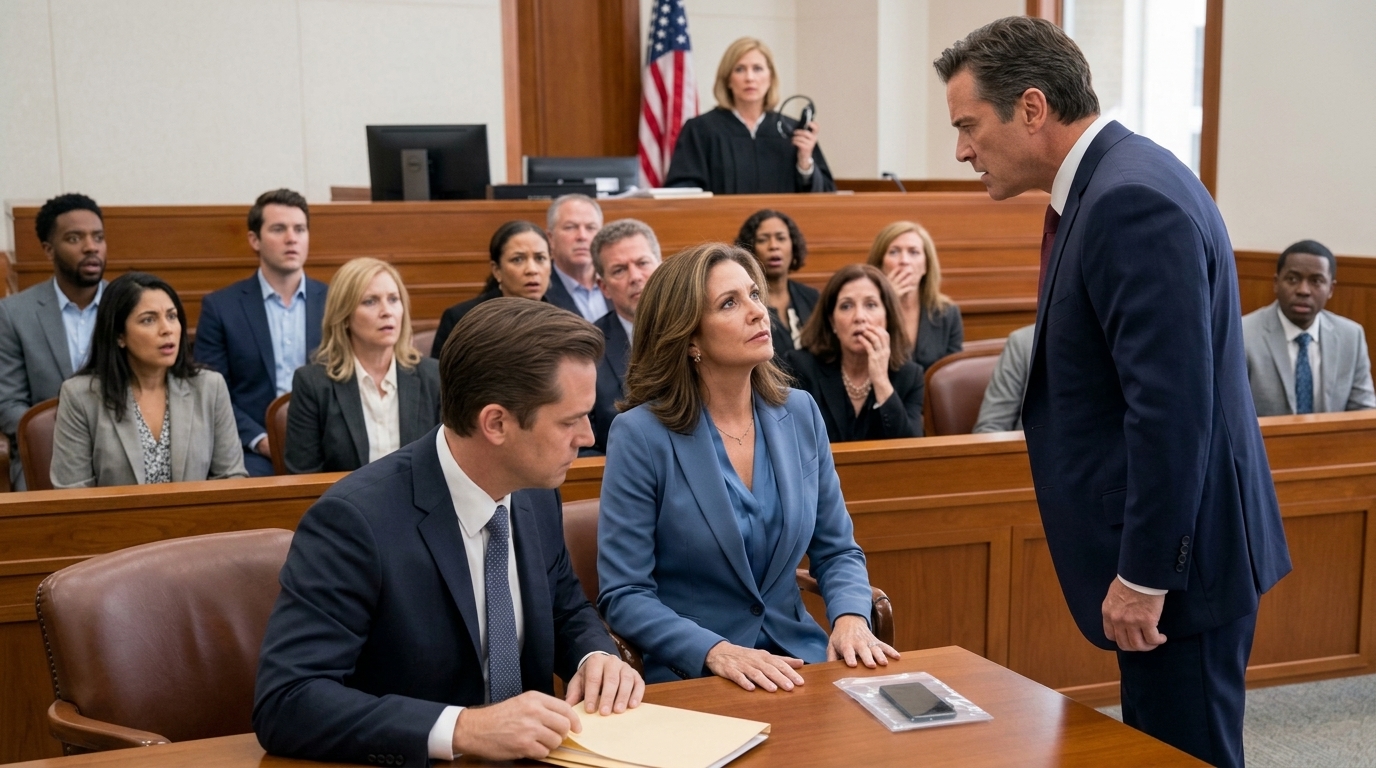
The judge entered.
Everyone stood.
The proceedings began.
Richard’s attorney argued that the recording should be excluded.
My attorney responded that it had been obtained lawfully and was relevant to the financial issues before the court.
The judge reviewed the legal objections.
Then she ruled that the recording could be considered subject to the applicable evidentiary standards.
Richard looked at me.
I didn’t look away.
The clerk placed the headphones on the judge’s desk.
The courtroom became silent.
My attorney stood.
“Your Honor, the recording is not being offered as proof of every allegation discussed in it. It is offered as evidence relevant to the respondent’s statements concerning financial transfers, property, and his stated intentions toward the petitioner.”
The judge nodded.
“Play it.”
The clerk pressed the button.
Static.
Then Richard’s voice.
“She trusts me blindly.”
Richard shifted in his chair.
The recording continued.
“She thinks the loans are for expansion.”
His attorney lowered his eyes.
Then:
“The suburban house is the important part.”
Silence.
Richard stared at the table.
The recording played his conversation about the refinancing documents.
Then the LLC.
Then Jessica.
Then the money.
Then his plan to make me appear unstable.
Then the statement that made Richard’s face turn gray.
“If she fights me, I’ll make it look like she cheated.”
The recording stopped.
Nobody moved.
The judge looked toward Richard.
“Is that your voice?”
His attorney objected.
The judge overruled.
Richard swallowed.
“I don’t remember.”
My attorney stood.
“We have forensic verification.”
The forensic specialist explained the recording’s metadata, chain of custody, and authentication procedures.
Olivia testified about what she witnessed before the recording.
Marcus testified about the financial trail.
Bank records supported the transactions.
Property records supported the ownership structure.
Corporate records showed the LLC.
The evidence didn’t depend on one recording.
That was the part Richard hadn’t anticipated.
He had spent months believing he could explain away individual facts.
But hundreds of small facts had become one large story.
At the end of the hearing, the judge did not give a dramatic speech.
She didn’t need to.
The evidence had already spoken.
The court entered orders addressing the disputed property and financial matters.
The divorce itself was finalized shortly afterward.
Twenty-five years ended not with screaming.
Not with a slammed door.
But with signatures.
Richard walked out of the courthouse alone.
I watched him go.
I expected to feel victorious.
I didn’t.
I felt tired.
The kind of tired that comes after surviving something rather than winning it.
Outside, Evelyn stood beside me.
“You okay?”
I looked at the courthouse steps.
“I think so.”
“What are you going to do now?”
I smiled faintly.
“Sleep.”
She laughed.
“That’s a good start.”
But the story didn’t end at the courthouse.
The company still had problems.
Because when the financial review expanded, several questionable transactions came to light.
Some were legitimate.
Some were poorly documented.
Some involved related parties.
And some raised questions that Richard could not answer.
The company’s lenders became nervous.
Investors asked questions.
The board commissioned an independent review.
Richard’s position changed.
He was no longer the untouchable executive who had everything under control.
He became a man answering questions.
And Jessica?
She disappeared from his social media.
The French photographs vanished.
The wedding posts were deleted.
A month later, I heard through Olivia that Jessica had moved out of the house.
Apparently, the money had never been the whole story.
Jessica had believed Richard was wealthy.
Richard had believed the company would always cover his choices.
Both had believed something that wasn’t true.
As for me, I did something unexpected.
I stayed in healthcare.
I didn’t quit.
I didn’t run away to some beach and reinvent myself overnight.
Real healing wasn’t that cinematic.
I simply stopped living for someone else’s approval.
I moved into a smaller home.
I bought new shoes.
It sounds ridiculous.
But I cried the first time I walked into a store and bought myself a pair without checking my bank balance three times.
I replaced the cracked dishes.
I repaired my car.
I took the vacation I had postponed for eight years.
And I started sleeping through the night.
Olivia eventually left Richard’s company.
I helped her find a position with another executive.
We became friends.
One afternoon, she came to visit me.
She looked around my new house.
“It’s quiet.”
“Yes.”
“Do you miss the old one?”
I thought about it.
“No.”
She smiled.
“Why?”
“Because I thought the house was my home.”
I looked out the window.
“Turns out home was the part of me I kept giving away.”
She didn’t answer.
Neither of us needed to.
Months later, Richard contacted me.
Not through his attorney.
Through a handwritten letter.
I almost threw it away.
Instead, I opened it.
It wasn’t an apology.
Not really.
It was a list of explanations.
He blamed pressure.
The company.
His father.
His childhood.
His fear of failure.
His desire to feel successful.
He said Jessica had made him feel admired.
He said he had convinced himself I didn’t care anymore.
He said he never intended to hurt me.
I read the letter twice.
Then I folded it.
There was one sentence that stayed with me.
“I never thought you would find out.”
I sat at my kitchen table for a long time.
Then I understood.
That was the real problem.
He hadn’t been afraid of hurting me.
He had been afraid of being caught.
I never responded.
Years passed.
My life became ordinary.
And I learned to appreciate ordinary.
I worked fewer shifts.
I started exercising again.
I visited friends.
I called my sister more often.
I laughed without checking whether someone was listening.
One evening, I was leaving the hospital when Olivia called.
“Have you heard?”
“Heard what?”
“Richard’s company.”
I stopped walking.
“What happened?”
“The independent review is finished.”
“And?”
She hesitated.
“It’s bad.”
I leaned against my car.
“What does that mean?”
“It means they found transactions that Richard couldn’t explain.”
I closed my eyes.
“Is he going to prison?”
“I don’t know.”
I was silent.
Then Olivia said:
“I thought you’d want to know.”
I smiled sadly.
“I don’t.”
There was a pause.
Then she asked:
“Really?”
“No.”
I looked at the sunset beyond the hospital roof.
“I wanted to know who he was.”
“And now?”
“Now I know.”
I hung up.
That was the last time I discussed Richard’s company.
Because eventually I understood something more important than whether he lost his position, his money, or his reputation.
None of those things could give me back the twenty-five years I had spent believing I was loved.
But I could decide what happened to the years ahead.
One Sunday morning, I opened a box in my closet.
Inside were old photographs.
Richard and me at twenty-six.
Our wedding.
Our first apartment.
Our first Christmas.
A picture of us standing beside the house.
I looked at that young woman.
She had no idea what was coming.
I didn’t hate her.
I felt protective of her.
She had trusted someone.
That wasn’t a crime.
I put the photographs back.
Then I found the old phone I had used the day everything changed.
The recording was still there.
I didn’t play it.
I didn’t need to.
I remembered.
The dark closet.
The smell of cedar.
Two cinnamon cappuccinos cooling in my hands.
Richard’s laughter.
And Olivia’s frightened whisper.
“Quick, get into the closet.”
That closet had saved me.
Not because it hid me from my husband.
Because it gave me time to hear the truth before I reacted.
That was the lesson I carried forward.
Sometimes the most powerful thing you can do when someone expects you to explode is become still.
Listen.
Document.
Think.
And then act.
Richard had believed my silence meant weakness.
He had mistaken patience for ignorance.
He had mistaken kindness for dependence.
And he had mistaken twenty-five years of loyalty for twenty-five years of blindness.
He was wrong.
The final piece of the story arrived nearly a year after the divorce.
A letter came from an attorney representing the company.
I almost ignored it.
Instead, I opened it.
It explained that the company’s independent review had identified several transactions involving related parties and that certain records had been referred to appropriate authorities for review.
The letter did not accuse Richard of crimes.
It didn’t need to.
Facts had their own weight.
I folded the letter and put it away.
Then I walked outside.
The sun was bright.
For the first time in years, I wasn’t rushing anywhere.
No shift.
No appointment.
No husband waiting.
No bills hidden inside someone else’s explanation.
Just me.
I sat on the porch with a cup of coffee.
Not a cinnamon cappuccino.
Just plain coffee.
I smiled at that.
For twenty-five years, I had remembered exactly how Richard wanted his coffee.
Now I was learning what I liked.
And strangely enough, that felt like freedom.
A week later, I received a message from an unknown number.
It was Richard.
Just three words.
“I was wrong.”
I stared at the screen.
Then I deleted it.
Not because I hated him.
Because I no longer needed him to understand what he had done.
That was the final thing he had taken from me without realizing it.
The need for his approval.
And that was the one thing I finally refused to give back.
I never became rich overnight.
I never became famous.
I didn’t get revenge.
I simply rebuilt.
Quietly.
Piece by piece.
And sometimes, late at night, I thought about that rainy Tuesday morning.
About how I had entered his office carrying two coffees because I wanted to surprise my husband.
About how I had stepped into a closet because his secretary told me to hide.
About how, one minute later, the man I loved walked through the door and began describing how easily he could destroy my life.
He thought the closet had hidden me.
It didn’t.
It revealed him.
And when the courtroom recording finally played months later, Richard heard his own laughter echo through the room.
I watched his face change.
Not because I wanted to hurt him.
Because for the first time, he had no control over the story.
The truth was no longer something he could negotiate.
No longer something he could explain away.
No longer something he could bury beneath expensive attorneys, polished suits, business trips, or promises.
It belonged to the evidence.
And the evidence belonged to the record.
As for me?
I walked out of that courtroom without the man I had married.
But I walked out with something I hadn’t had in years.
My own life.
And this time, I intended to keep it.
THE END THANK YOU FOR READING !!!