My six-year-old daughter, Ava, grabbed the back of my faded shirt and buried her face against my side. Jessica stood inches from me, breathing hard, her perfectly manicured hand still raised. “Do not ever call me your sister,” she hissed. You and that child are the greatest embarrassments this family has ever had.
I tasted blood where my teeth had cut the inside of my cheek.
But I didn’t move.
I didn’t cry.
I simply looked at her.
That calmness made her even angrier.
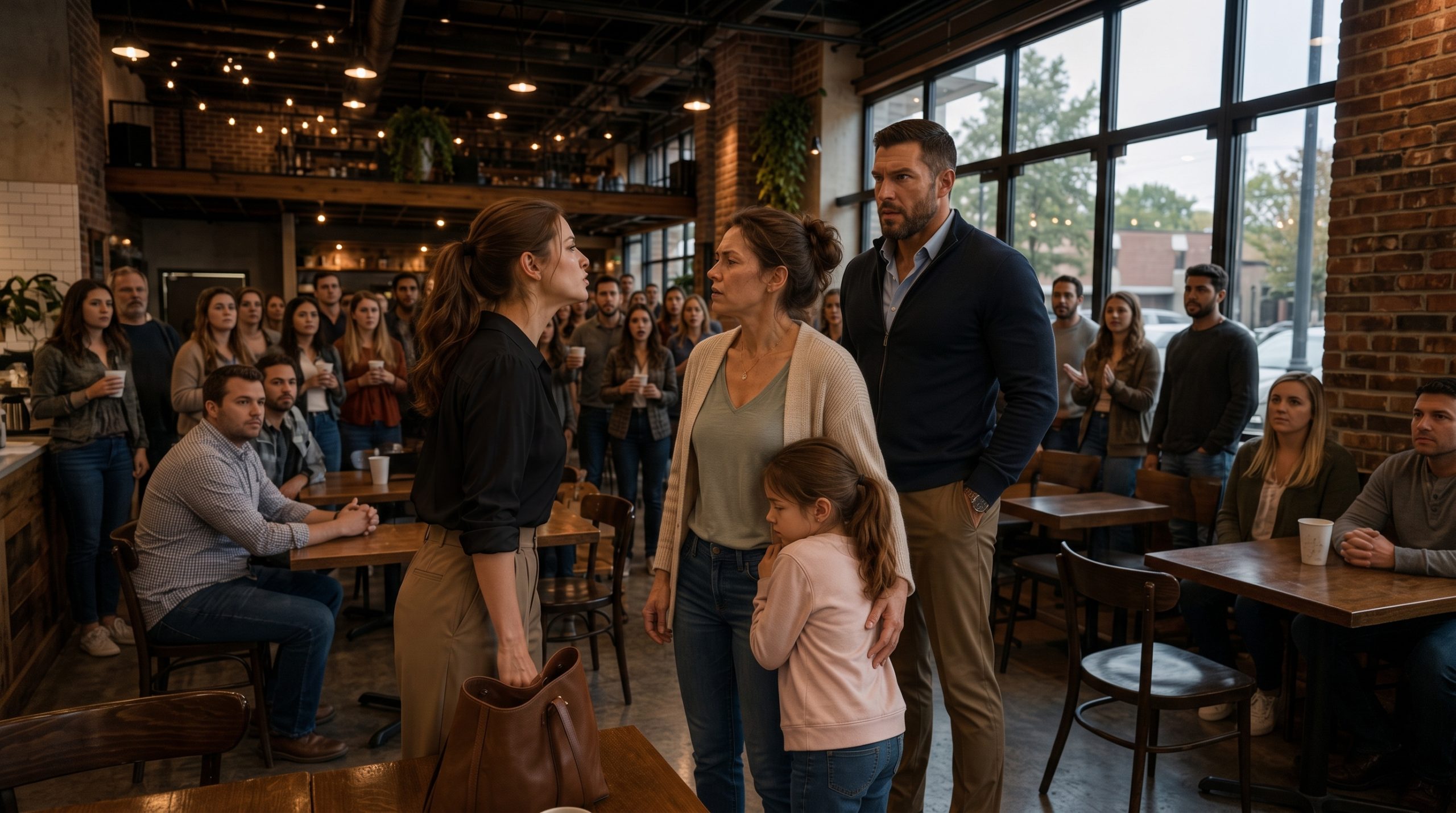
Jessica spun toward the enormous man beside her.
John, are you really going to stand there while she disrespects your wife?
she snapped. “Handle her.”
John stepped forward.
He stood nearly six and a half feet tall,
with shoulders that stretched his expensive jacket and hands
large enough to make several customers instinctively back away.
His fists tightened.
For one terrible second, I calculated the distance between him, me, and Ava.
Old instincts returned instantly.
Protect the civilian.
Control the threat.
Do not escalate unless necessary.
Then John looked directly at my face.
At the scar.
He froze.
His fists slowly opened.
Every trace of color drained from his skin.
He took one step backward.
Then another.
Then a third.
His chest began rising and falling as though the air had suddenly disappeared from the room.
He stared at me like he had just seen a dead woman walk through the door.
“That can’t be possible,” he whispered.
Jessica grabbed his arm.
“What is wrong with you?”
John didn’t even look at her.
His eyes remained locked on me.
“Is that… Captain Watson?”
The name hit harder than Jessica’s slap.
Suddenly, the café vanished.
I was ten years younger again.
Back beneath the blinding white lights of a military trauma unit.
Back to the smell of antiseptic, burned fabric, fuel, and blood.
Back to the moment I opened my eyes and discovered thick bandages covering the entire left side of my face.
I had been a Marine captain stationed outside Fallujah when our Humvee struck an improvised explosive device.
The explosion tore through the road beneath us.
One second, we were moving.
The next, the world became fire and metal.
Fragments ripped through my side of the vehicle.
My body absorbed most of the blast.
Doctors later explained that where I had been sitting—and the way my body had taken the impact—shielded the Marines behind me.
Every man inside that Humvee survived.
I received a Purple Heart while lying in a hospital bed, barely able to open one eye.
A general called me a hero.
Nurses told me the scar was proof that courage sometimes left permanent marks.
I believed my family would see it that way too.
I was wrong.
When military transport finally brought me home, I entered our family estate carrying a duffel bag and leaning on a cane.
My parents waited in the marble foyer.
Neither embraced me.
My mother looked away.
My father stared at the floor.
Then Jessica descended the staircase in a designer dress, surrounded by expensive perfume.
Her eyes landed on my scar.
She physically recoiled.
“Keep her in the guesthouse during the charity gala,” she told the butler.
“I don’t want our guests staring at that.”
That was my welcome home.
The next morning, I forced myself downstairs for breakfast.
Jessica sat at the head of the table scrolling through her phone.
When I pulled out a chair, she slammed her coffee cup against its saucer.
“You’re terrifying my friends,” she said.
I stared at her.
“I’m sorry?”
“You heard me.”
She gestured toward my face.
“And you’re damaging the family image.”
My father lowered his newspaper.
My mother continued buttering toast.
Jessica leaned toward me.
“You need to understand something. People don’t want to look at tragedy while they’re enjoying themselves.”
I touched the edge of the scar.
“It’s part of my face.”
“Exactly.”
She pushed a folder across the table.
Inside was a brochure for a private cosmetic surgeon.
“I’ll pay for reconstructive surgery.”
I looked up.
“There is one condition.”
Her voice became colder.
“You remain out of sight until it’s done.”
I laughed once.
Not because anything was funny.
Because I couldn’t believe this was real.
“You want me to hide?”
“Until you’re presentable.”
I looked at my parents.
My father finally spoke.
“Jessica is only thinking about the family.”
I stared at him.
“I spent seven years serving this country.”
“I know.”
“I nearly died.”
“I know.”
“And this is what you’re worried about?”
Silence.
That was the moment something inside me finally broke.
Not my pride.
Not my courage.
My attachment.
I went upstairs.
I packed three changes of clothes, my military medals, and one photograph of my unit into an old duffel bag.
Then I walked out.
Nobody followed me.
Civilian life without my family’s money became another kind of battlefield.
I worked nights in a warehouse, dragging wooden crates across concrete until blisters split across my palms.
I rented a cramped apartment that smelled like mildew and cheap paint.
Most nights, dinner was rice and canned beans.
Corporate employers interviewed me enthusiastically until they saw my scar.
Then suddenly the position had been filled.
Coworkers invented stories about me.
Car accident.
Domestic violence.
Gang attack.
I stopped correcting anyone.
I had already spent enough of my life explaining myself to people determined to misunderstand me.
Marine discipline kept me moving.
Every morning, I woke at 5:30 without an alarm.
I made my bed with sharp corners.
Polished my work boots.
Recorded every dollar in a spiral notebook.
Within six months, I became supervisor of the warehouse night shift.
Eventually, my military logistics experience helped me secure a stable job as a supply-chain coordinator.
I learned spreadsheets.
Negotiations.
Procurement.
Inventory systems.
Transportation contracts.
The things nobody thought a woman with a scar could understand.
I understood them very well.
Within a few years, I became operations manager.
Then regional logistics director.
I bought a small house.
I paid off every debt.
I built savings.
And little by little, I built something my family had never given me.
Peace.
Then Ava came into my life.
Her father, another veteran, died in a motorcycle accident before learning I was pregnant.
From the moment Ava was born, she became my most important mission.
She never feared my scar.
When she was four, she once asked me why I had a different face than the women on television.
I told her the truth.
“Because something happened to Mommy a long time ago.”
“Did it hurt?”
“Yes.”
“Did you cry?”
“Not then.”
“Why?”
“Because I had people to protect.”
She thought about that.
Then she kissed the scar.
“You’re brave.”
That nearly destroyed me.
But the moment that stayed with me happened one Sunday morning.
Ava was small enough to fit completely in my lap.
She traced the damaged skin with one tiny finger.
“Mommy,” she whispered, “is this a magical map?”
I smiled.
“A map?”
She nodded seriously.
“Does it show where treasure is hidden?”
I had survived an explosion without crying.
That question nearly broke me.
To Ava, my face wasn’t ugly.
My scar wasn’t shameful.
It was simply part of her mother.
For six years, we lived quietly.
I worked.
I saved.
I kept our world small.
Meanwhile, Jessica became one of the city’s most influential media executives.
Her flawless face appeared on magazine covers beneath headlines celebrating her as a defender of women and traditional family values.
She gave speeches about kindness.
She donated to charities.
She posted photographs with military families.
She even launched a foundation supporting veterans.
The irony never escaped me.
She publicly praised people like me.
Privately, she had once asked me to hide.
I stayed completely outside her glittering world.
Until that Saturday morning.
Ava and I were sitting at our usual corner table at Groundwork Café.
She was excitedly describing a picture she had drawn at school.
“It has a castle,” she explained.
“And this is the dragon.”
She pointed to a green scribble.
“And this is you.”
I laughed.
“Why am I holding a sword?”
“Because you’re Mommy.”
Before I could answer, her elbow accidentally bumped her mug.
Hot chocolate spilled across the table.
Some splashed onto a brightly colored designer handbag carried by a woman walking beside us.
I immediately stood.
“I’m so sorry.”
Then I saw her face.
Jessica.
She recognized me instantly.
Her eyes moved from my scar to Ava.
And what should have been a simple accident became an opportunity.
“You worthless parasite!”
People turned.
Ava froze.
Jessica pointed at my daughter.
“Your mother is garbage, and you are no better than she is.”
I immediately moved between them.
“Do not speak to my daughter like that.”
Jessica laughed.
“You haven’t changed.”
“Neither have you.”
Her expression hardened.
“I can’t believe you still show that face in public.”
A few people nearby stared.
I took out my wallet.
“I’ll pay to replace the handbag.”
Jessica looked at the money.
Then at me.
“With what?”
I put the wallet away.
“You don’t get to insult my daughter.”
She folded her arms.
“You’re embarrassing yourself.”
“No.”
I looked directly at her.
“You are.”
Jessica pulled out her phone.
“You have no idea who you’re dealing with.”
“I know exactly who I’m dealing with.”
“My attorneys can make your life very difficult.”
I said nothing.
“I can have you investigated.”
Still nothing.
“I can have someone examine your mental stability.”
My jaw tightened.
Then she said the words that crossed a line.
“And if you’re unstable, maybe Ava shouldn’t be living with you.”
Ava grabbed my shirt.
“Mommy…”
I knelt beside her.
“It’s okay.”
Jessica smiled.
She thought she’d won.
That was her mistake.
I stood.
“You will apologize to my daughter.”
Jessica laughed.
Then she slapped me.
Directly across the scar.
My head turned slightly with the impact.
Ava screamed.
“Mommy!”
The café erupted in whispers.
I slowly turned my head back.
Jessica stared at me.
For one second, she looked satisfied.
Then she called out.
“John!”
Her husband stepped forward.
Six feet five.
Broad shoulders.
Former Marine.
His expensive jacket could barely hide the physical strength underneath it.
“Handle her,” Jessica ordered.
John’s fists tightened.
I shifted slightly, placing my body between him and Ava.
Old training took over.
Distance.
Hands.
Exit.
Threat assessment.
Then John saw my face.
He stopped.
His expression changed.
His eyes widened.
He stared at my scar.
Then at me.
His fists slowly opened.
“Wait.”
Jessica frowned.
“What?”
John stepped closer.
“No.”
He looked terrified.
“That’s impossible.”
I said nothing.
His eyes never left my face.
“Are you…”
His voice broke.
“Are you Captain Elena Watson?”
The café went completely silent.
Jessica blinked.
“What are you talking about?”
John whispered again.
“Captain Watson?”
I stared at him.
“Who are you?”
He looked like he’d been punched.
“John Miller.”
Nothing.
Then he said:
“Convoy Seven.”
My heart stopped.
“Humvee Three.”
The room disappeared.
I remembered smoke.
Fire.
A young Marine screaming.
A hand trapped beneath twisted metal.
I remembered pulling him free.
John’s eyes filled with tears.
“You saved my life.”
Jessica stared between us.
“No.”
John turned toward her.
“Yes.”
He pulled out his wallet.
His hands were shaking.
Inside was a faded photograph.
Six Marines stood beside a damaged Humvee.
And there I was.
Ten years younger.
Uniform dusty.
Face unscarred.
John pointed.
“That’s her.”
I looked at the photograph.
I remembered that day.
“Your leg was trapped.”
John nodded.
“You went back three times.”
“I had to.”
“No.”
He shook his head.
“You didn’t have to go back the third time.”
I looked away.
John continued.
“The vehicle was burning. Everyone was screaming at you to get out.”
He wiped his eyes.
“You went back anyway.”
Jessica’s face had gone completely white.
John looked at me.
“You pulled me through the passenger window.”
I remembered.
“You were unconscious.”
“I woke up in the ambulance.”
He swallowed.
“The medic told me I shouldn’t have survived.”
Then he looked at the scar.
“You took most of the blast.”
Nobody spoke.
John turned toward the café.
“She saved six Marines.”
Then he looked at Jessica.
“And you slapped her.”
Jessica’s lips trembled.
“I didn’t know.”
John’s voice hardened.
“You didn’t know because you never cared enough to ask.”
That sentence hit her harder than anything I could have said.
She stared at me.
For the first time in years, she wasn’t looking at my scar.
She was looking at me.
Really looking.
And suddenly she saw the woman behind it.
Not the embarrassment.
Not the damaged sister.
Not the family problem.
The person.
John turned back to me.
“I’ve spent ten years trying to find you.”
I smiled faintly.
“Why?”
“To thank you.”
“You don’t owe me anything.”
“Yes, I do.”
“No.”
I glanced toward Ava.
“Just raise your daughter to help people when she can.”
John nodded.
“I will.”
Jessica stepped forward.
“Elena…”
I looked at her.
She hesitated.
For years, Jessica had always known exactly what to say.
Now she couldn’t find the words.
“I…”
Her voice cracked.
“I was wrong.”
The café remained silent.
I waited.
She looked at Ava.
Then at me.
“I shouldn’t have said those things.”
“No.”
She swallowed.
“I shouldn’t have threatened you.”
“No.”
Her eyes dropped.
“And I shouldn’t have hit you.”
I looked at her.
“No.”
She began crying.
“I’m sorry.”
I believed she was sorry.
But not because she’d suddenly become a different person.
She was sorry because the truth had finally become impossible to ignore.
I picked up Ava’s backpack.
Then took my daughter’s hand.
We started walking toward the door.
“Elena!”
I stopped.
Jessica stood behind me.
“I want to make it right.”
I turned.
“Then start by never making Ava feel ashamed of where she comes from.”
Jessica nodded through tears.
“And?”
I looked at my sister.
“Stop pretending you’re kind.”
Her face fell.
“Become kind.”
Then I walked out.
Outside, the afternoon sunlight felt warmer than usual.
Ava held my hand.
“Mommy?”
“Yes?”
“Was that man really saved by you?”
“Yes.”
“Are you a superhero?”
I smiled.
“No, sweetheart.”
She thought about it.
“Then why did he cry?”
I looked through the café window.
John was still standing there, holding the old photograph.
“Because sometimes people remember the person who saved them.”
Ava nodded.
Then she squeezed my hand.
We walked home.
Three days later, a letter arrived.
It was from the Marine Corps.
I opened it at the kitchen table.
Ava climbed into the chair beside me.
“What is it?”
I read it twice.
Then once more.
The Marine Corps was organizing a formal recognition ceremony for members of my old unit.
My name was on the list.
So was John’s.
Ava’s eyes widened.
“Are you famous?”
I laughed.
“No.”
“Then why are they having a party?”
“Because sometimes people like to remember.”
She smiled.
“Can I come?”
I hugged her.
“Absolutely.”
The ceremony took place two weeks later.
I wore my old dress uniform.
For the first time in years, I pinned my medals onto my chest.
Ava stood beside me wearing a tiny navy-blue dress.
When we entered the hall, dozens of Marines turned toward us.
Then someone began clapping.
Another person joined.
Then another.
Within seconds, the entire room was standing.
I froze.
Ava squeezed my hand.
“Mommy.”
I looked down.
“Why are they clapping?”
I smiled through tears.
“Because they remember.”
John stood at the front of the room.
He saluted me.
I returned the salute.
Then he walked toward me.
Neither of us spoke.
We simply embraced.
Later, John found me outside.
“Jessica didn’t come,” he said.
I nodded.
“That’s probably for the best.”
He looked at me.
“She finally started therapy.”
I smiled slightly.
“Good.”
“She also resigned from the foundation.”
I looked surprised.
“Why?”
“She said she couldn’t publicly talk about supporting veterans while privately being ashamed of you.”
I looked away.
“That wasn’t my decision.”
“I know.”
He paused.
“She wants to apologize properly someday.”
“Maybe someday.”
He nodded.
Then he looked at Ava.
She was sitting nearby, coloring a picture.
“What is she drawing?”
I smiled.
“Apparently, she’s drawing superheroes.”
John laughed.
Ava looked up.
“Mommy says she’s not a superhero.”
John looked at me.
“She is.”
I shook my head.
“No.”
He smiled.
“Maybe not.”
He looked at Ava.
“But she is brave.”
Ava grinned.
“I know.”
That evening, when we returned home, Ava helped me remove my medals.
She carefully placed them on the table.
Then she touched my scar.
“Mommy?”
“Yes?”
“Do you wish you didn’t have this?”
I thought about Jessica.
The mansion.
The guesthouse.
The humiliation.
The warehouse.
The nights I cried alone.
The little apartment.
The first time Ava kissed my scar.
John’s photograph.
The Marines standing to honor me.
I shook my head.
“No.”
“Why?”
I kissed her forehead.
“Because this scar reminds me that I survived.”
Ava smiled.
“It’s still a magic map.”
I laughed.
“Still?”
She nodded.
“It shows where Mommy became strong.”
I pulled her into my arms.
And for the first time, I understood something I should have understood years earlier.
My scar had never been the ugly part of my story.
The ugly part was believing someone else’s shame could become mine.
Jessica had spent years trying to make me hide.
But I didn’t need to hide anymore.
I had survived the explosion.
I had survived my family’s rejection.
I had survived poverty.
I had survived loneliness.
And most importantly, I had built a life in which my daughter would never learn to measure a person’s worth by appearance.
A month later, I received another letter.
This one wasn’t from the military.
It was from Jessica.
There were only four sentences.
I spent years being afraid people would see your scar.
Now I realize I was afraid they would see what it meant.
You were brave when I was cruel.
I’m sorry.
I folded the letter.
I didn’t throw it away.
But I didn’t frame it either.
I placed it in a drawer.
Because forgiveness didn’t mean forgetting.
And moving forward didn’t require pretending the past never happened.
It simply meant the past no longer controlled me.
That night, Ava fell asleep beside me while watching an old movie.
I carried her upstairs.
Before leaving her room, I kissed her forehead.
She opened one sleepy eye.
“Mommy?”
“Yes?”
“Are you still a superhero?”
I smiled.
“No.”
She closed her eyes.
“You are to me.”
I stood there for a moment.
Then I quietly closed the door.
Downstairs, my medals sat beneath the warm kitchen light.
Beside them was the photograph of six young Marines.
And in that photograph was a younger version of me.
A woman who hadn’t known how much pain she would carry.
A woman who hadn’t known how strong she would become.
A woman who had believed saving others meant sacrificing herself.
Now I understood something different.
Courage wasn’t just running toward danger.
Sometimes courage was walking away from people who taught you to hate yourself.
Sometimes courage was raising a child differently from the way you were raised.
Sometimes courage was looking at the scar someone used to humiliate you and saying:
This is not my shame.
It is my history.
My survival.
My proof.
My story.
And nobody gets to take that away from me.
Not even family.
Especially not family.
I touched the scar once.
Then smiled.
The magic map was still there.
And this time, I knew exactly where it led.
Home.
THE END THANK YOU FOR READING !!