PART 3
“Thomas wasn’t the only person who knew.”
Those seven words changed everything.
I stood in my living room,
still wearing the black dress I’d worn to my husband’s funeral,
staring at the attorney as though he had suddenly begun speaking another language.
My name is Margaret Collins. I was seventy-three years old,
a widow after just thirty-one days of marriage,
and until that moment,
I had believed the greatest tragedy of my life was losing Thomas twice.
Once when we were seventeen.
And again when cancer took him from me.
But now a stranger was standing in my home telling me that
the daughter I’d buried in my heart fifty-five years earlier might still be alive.
“Who else knew?” I whispered.
The attorney, Mr. Samuel Bennett, lowered his eyes.
“Your older sister, Evelyn.”
I felt something inside me go completely still.
“Evelyn?”
He nodded.
My sister was seventy-eight years old.
She lived forty minutes away in a beautiful retirement community.
We spoke every Sunday.
She sent me birthday cards.
She had attended my wedding to Thomas, holding my hands afterward and telling me how wonderful it was that fate had brought us together again.
She had stood beside me at his funeral.
And she had watched me cry.
“That’s impossible,” I said.
Samuel opened his briefcase.
“I understand how difficult this is.”
“No, you don’t.”
My voice came out sharper than I intended.
“You cannot possibly understand what you’re telling me.”
He remained silent.
I pressed my hand against my chest.
I had a baby when I was eighteen.
My mother told me she died.
I never saw her face.
I never held her.
I spent fifty-five years believing my daughter was buried somewhere without even a name on her grave.”
Samuel’s expression softened.
“Margaret, I’m very sorry.”
I shook my head.
“Don’t be sorry. Tell me where she is.”
He hesitated.
Then he placed a second envelope on my coffee table.
“Thomas wanted you to read this before making any decisions.”
I stared at it.
“Why?”
“Because the truth involves more people than you realize.”
I looked toward the wooden box.
The photograph of Thomas and me at seventeen lay beside the old gold ring.
We had been smiling in that picture.
Two foolish teenagers who thought love would protect them from everything.
I picked up the envelope.
My hands were shaking so badly I could barely open it.
Inside were three documents.
The first was a copy of a birth certificate.
The second was a letter written in my mother’s handwriting.
The third was a photograph of a woman who looked about fifty-five.
She had dark brown hair, warm eyes, and a small dimple in her left cheek.
My dimple.
I had spent my whole life looking at that dimple in the mirror.
Now I was looking at it on someone else’s face.
I sat down so suddenly that Samuel reached toward me.
“Margaret?”
I couldn’t answer.
I touched the photograph.
“Is this her?”
Samuel nodded.
“Her name is Caroline.”
I began crying.
Not quietly.
Not gracefully.
I cried the way I had cried when the hospital nurse told me my baby hadn’t survived.
Except this time, the tears came with something I hadn’t felt in fifty-five years.
Hope.
Samuel waited until I could breathe again.
Then he began explaining.
My mother had never approved of Thomas.
She believed his family was beneath ours, despite the fact that his father owned a successful local business.
She wanted me to attend college, marry someone wealthy, and build what she called a respectable life.
Thomas wanted to stay in our hometown.
I wanted to study nursing.
We argued about it.
I left.
But what neither Thomas nor I knew at the time was that my mother had already begun interfering.
She had visited Thomas privately.
She told him that I had decided to end our relationship permanently.
Then she showed him a letter supposedly written by me.
It said I no longer loved him.
That I wanted a different future.
That he should never contact me again.
“I never wrote that,” I whispered.
Samuel nodded.
“Thomas eventually discovered that.”
I looked down.
For decades, I’d believed Thomas had simply stopped loving me after I left.
He never called.
Never wrote.
Never came looking for me.
I had interpreted his silence as proof that our young love hadn’t been strong enough.
But now I was learning that silence had been carefully manufactured.
“Why didn’t he come after me?” I asked.
Samuel looked uncomfortable.
“Your mother also threatened to interfere with his father’s business. Thomas believed contacting you would create trouble for your family.”
I shook my head.
“That still doesn’t explain fifty-five years.”
“No,” Samuel admitted. “It doesn’t.”
He looked at me carefully.
“Thomas knew he made mistakes. He wrote about them.”
I stared at the letter in my lap.
Then Samuel continued.
“Several months after you left, your mother learned you were pregnant.”
My stomach tightened.
I remembered that terrible autumn.
The nausea.
The exhaustion.
The fear.
I’d been eighteen, alone in a college dormitory, terrified that my future was disappearing before it had begun.
My mother came to collect me.
She told the school I had a medical problem.
Then she took me to a private maternity facility several hours away.
I was ashamed.
Frightened.
And desperate for someone to tell me everything would be all right.
My mother promised she would handle everything.
I believed her.
God help me, I believed her.
I remembered the birth in fragments.
A bright light.
A nurse telling me to breathe.
My mother’s voice somewhere near the door.
Then pain.
Exhaustion.
And darkness.
When I woke, my mother sat beside the bed.
She was wearing a pale blue dress.
I remembered that dress more clearly than anything else.
She took my hand.
“Margaret,” she said, “there were complications.”
I asked for my baby.
She began crying.
Then she told me my daughter had died.
I screamed.
I begged to see her.
My mother said it would only make things worse.
She told me the hospital had already made arrangements.
I was young.
Weak.
Medicated.
And surrounded by adults who insisted they knew what was best.
Eventually, I stopped asking.
But I never stopped grieving.
Every year, on the anniversary of her birth, I lit a candle.
I imagined what she might have looked like.
I wondered whether she would have loved music.
Whether she’d have been tall like Thomas.
Whether she’d have inherited my mother’s stubbornness.
I had mourned a child I never held.
And now Samuel was telling me that child had grown into a woman.
A woman with a name.
A life.
Perhaps children of her own.
“Where did she go?” I whispered.
Samuel opened the second document.
“Your mother arranged a private adoption.”
I stared at him.
“She gave my daughter away?”
He nodded.
I covered my mouth.
The room began spinning.
Samuel moved toward me.
“Margaret, take your time.”
I shook my head.
“No. Keep talking.”
He hesitated.
“Your mother signed documents representing that you had consented.”
I looked at him.
“But I didn’t.”
“I understand.”
“Then how could they take her?”
“The records contain serious irregularities. Thomas spent years trying to understand exactly what happened.”
I looked at the birth certificate.
My daughter’s original name had been written as Baby Girl Collins.
No first name.
No father’s name.
Just a child reduced to a line on a document.
“What happened to her?” I asked.
Samuel took a breath.
“She was adopted by a couple named Robert and Helen Parker.”
I closed my eyes.
“They lived in Ohio. They named her Caroline.”
I repeated the name.
“Caroline.”
It felt strange on my tongue.
Beautiful.
Painful.
Real.
“Was she loved?”
Samuel smiled sadly.
“From everything Thomas learned, yes.”
I began crying again.
Because after fifty-five years of imagining my daughter alone somewhere in the dark, the thought that someone had held her, fed her, comforted her, and called her their own was almost too much to bear.
Then Samuel told me how Thomas had discovered the truth.
Twenty years earlier, after his father’s death, Thomas had been sorting old business records.
Among them were letters from my mother.
At first, he thought they concerned a financial disagreement.
But one letter mentioned the maternity facility where I’d given birth.
Another referred to an adoption arrangement.
Thomas became suspicious.
He hired a private investigator.
It took years to piece together the records.
Eventually, he found Caroline.
I stared at Samuel.
“Twenty years?”
He nodded.
“Thomas knew for twenty years?”
“Yes.”
My grief turned suddenly into anger.
“Then why didn’t he tell me?”
Samuel looked down.
“Because Caroline asked him not to contact you.”
I froze.
“What?”
“He approached her first.”
My heart began pounding.
“He told her?”
“He explained what he had discovered.”
I stared at him.
“And she didn’t want me?”
Samuel shook his head.
“It wasn’t that simple.”
I laughed bitterly.
“It sounds simple.”
“Margaret, Caroline had been told a very different story about her birth.”
“What story?”
Samuel hesitated.
Then he said, “She believed you had willingly given her up because you didn’t want a child.”
I felt as though someone had struck me.
“No.”
Samuel nodded sadly.
“Her adoptive parents had been given paperwork indicating you had consented to the adoption.”
I pressed my hands over my face.
For fifty-five years, I had believed my daughter was dead.
And for fifty-five years, she had believed I had abandoned her.
Two women grieving opposite sides of the same lie.
Samuel reached into his briefcase again.
He removed a small recording device.
“Thomas left something else.”
I stared at it.
“What?”
“A message.”
He placed it on the table.
“He recorded it shortly before your wedding.”
I looked at the device.
My chest tightened.
“Can I hear it?”
Samuel nodded.
He pressed play.
For a moment, there was only a faint rustling sound.
Then I heard Thomas’s voice.
Weak.
Breathless.
But unmistakably his.
“Margaret, my darling girl.”
I began crying immediately.
“I know that when you hear this, I will probably be gone.”
He paused to catch his breath.
“I have carried a secret for twenty years, and I have hated myself for every day I kept it.”
I gripped the edge of the sofa.
“Your daughter is alive, sweetheart.”
His voice broke.
“She is alive.”
I covered my mouth.
“I found her years ago. I thought I could bring you both together, but I was afraid of hurting her. Then I was afraid of hurting you. And after enough years passed, I convinced myself silence was kindness.”
He coughed.
“I was wrong.”
I closed my eyes.
“I should have told you the moment I knew.”
His breathing became uneven.
“I asked you to marry me because I loved you. That part was never a trick.”
He paused.
“But I also knew my time was ending, and I wanted to leave you the means to discover the truth.”
Another pause.
Then he whispered:
“Margaret, the trap Samuel mentioned is not a punishment.”
I opened my eyes.
“It is a promise I made to myself.”
His voice grew softer.
“I promised that if life ever brought you back to me, I would not let you leave this world believing your daughter died.”
The recording crackled.
Then Thomas said the words that broke my heart all over again.
“She has your eyes, Margaret.”
I sobbed.
“She has your beautiful eyes.”
The recording ended.
For a long time, Samuel and I sat in silence.
Then I looked at him.
“Where is Caroline now?”
He hesitated.
“She lives in Columbus.”
I stood.
“Then I’m going to Columbus.”
Samuel raised a hand.
“Margaret, there’s something you need to know first.”
I stared at him.
“What now?”
He looked at the photograph.
“Caroline knows Thomas died.”
I felt my heart tighten.
“And?”
Samuel swallowed.
“She called my office yesterday.”
I gripped the back of the chair.
“What did she say?”
He looked directly at me.
“She asked whether you were still alive.”
PART 4
I didn’t sleep that night.
I sat at my kitchen table with Caroline’s photograph in front of me.
Every few minutes, I picked it up.
Then put it down.
Then picked it up again.
She had my eyes.
Thomas had been right.
She also had his straight nose and the same thoughtful expression he wore when he was trying to solve a difficult problem.
I traced her face with one trembling finger.
“My baby,” I whispered.
The words felt both natural and impossible.
She was fifty-five years old.
Old enough to have children.
Old enough to have grandchildren.
Old enough to have lived an entire life without me.
And yet somewhere inside my heart, she was still the newborn I’d begged to hold.
The following morning, I called Samuel.
“Have you spoken to her again?”
“Yes.”
My heart jumped.
“What did she say?”
“She wants to meet you.”
I pressed my hand against my chest.
“Really?”
“Yes.”
I began crying.
Samuel waited.
Then he added, “Margaret, she is nervous.”
“So am I.”
“She has questions.”
“I have answers.”
He hesitated.
“Some of those answers may be painful.”
I looked at the photograph.
“Samuel, I have spent fifty-five years believing my daughter was dead. There is nothing she can ask me that will hurt more than that.”
He was quiet.
Then he said, “She’ll meet you Saturday.”
I closed my eyes.
Saturday.
Three days away.
For fifty-five years, I’d waited for something I didn’t know was possible.
Now I had three days to prepare.
I spent those days doing foolish things.
I cleaned the house twice.
I bought flowers.
I baked lemon cake because Thomas had loved it when we were teenagers.
Then I realized I didn’t know whether Caroline liked lemon cake.
I bought tea.
Coffee.
Biscuits.
Fruit.
I changed the tablecloth.
Then changed it back.
I stood in front of my closet for twenty minutes trying to decide what to wear.
At seventy-three, I had faced emergencies in hospital wards.
I’d held dying patients’ hands.
I’d worked double shifts.
I’d lived through grief, illness, and disappointment.
But the thought of meeting my daughter made me feel like a frightened eighteen-year-old again.
On Friday evening, my sister Evelyn called.
“Margaret, sweetheart, how are you holding up?”
I stared at the phone.
Her voice was warm.
Familiar.
The same voice that had comforted me after Thomas died.
The same voice that had comforted me after my baby supposedly died.
I felt sick.
“Evelyn,” I said quietly, “I know.”
Silence.
Then she whispered, “Know what?”
I closed my eyes.
“Caroline.”
I heard her inhale sharply.
For several seconds, neither of us spoke.
Then Evelyn began crying.
“Oh, Margaret.”
I gripped the phone.
“You knew.”
She didn’t answer.
“You knew my daughter was alive.”
Her voice shook.
“I wanted to tell you.”
I laughed bitterly.
“For fifty-five years?”
“Margaret, please.”
“Fifty-five years, Evelyn.”
She began sobbing.
“Mother made me promise.”
I stared at the wall.
“Our mother has been dead for eighteen years.”
Silence.
“You could have told me after she died.”
“I know.”
“You could have told me when I came back to town.”
“I know.”
“You could have told me when Thomas proposed.”
Her crying grew louder.
“I was afraid.”
I felt anger rise through my grief.
“Of what?”
“Of losing you.”
I shook my head.
“You were afraid of losing me, so you let me believe my daughter was dead?”
Evelyn whispered, “I’m sorry.”
I looked toward Caroline’s photograph.
“Do you know what I did every year on her birthday?”
Evelyn said nothing.
“I lit a candle.”
My voice broke.
“Every single year.”
She began crying harder.
“I know.”
I froze.
“What?”
“I knew you did.”
I stared at the phone.
For a moment, I couldn’t breathe.
“You watched me mourn a living child.”
Evelyn whispered my name.
I ended the call.
Saturday arrived with rain.
I woke before sunrise.
I showered.
Dressed.
Made tea I couldn’t drink.
Then sat beside the window watching cars pass.
At ten minutes before eleven, a silver sedan stopped outside my house.
My heart began pounding.
A woman stepped out.
She wore a dark blue coat and carried a small handbag.
Her hair was streaked with silver.
She paused beside the car.
Then looked toward my front door.
I knew immediately.
I didn’t need a photograph.
Didn’t need an introduction.
Something in the way she stood made my chest ache.
She was my daughter.
I opened the door before she reached the steps.
She stopped.
For a moment, we simply stared at each other.
Then she whispered, “Margaret?”
I nodded.
“Caroline?”
Her eyes filled.
“Yes.”
I gripped the doorframe.
She looked at me for a long time.
Then she said, “You look like me.”
I laughed through my tears.
“No, sweetheart.”
My voice broke.
“You look like me.”
She began crying.
I took one step forward.
Then stopped.
I didn’t know whether I had the right to hug her.
I didn’t know whether she wanted me to.
So I asked.
“May I?”
Caroline looked at my outstretched arms.
Then she stepped forward.
And after fifty-five years, I held my daughter.
I cannot describe that embrace properly.
There are moments in life that language simply cannot carry.
I felt her arms wrap around me.
I felt her shoulders shake.
I felt her face press against my neck.
And suddenly I was eighteen again, reaching for a baby someone had taken away.
Except this time, nobody stopped me.
Nobody told me to rest.
Nobody said it was too late.
I held her.
And she held me.
We cried on the front porch until the rain began blowing against our shoes.
Then I led her inside.
We sat at the kitchen table.
Caroline looked around the room.
“It’s lovely.”
I smiled nervously.
“Thank you.”
She noticed the cake.
“Is that lemon?”
I nodded.
“I wasn’t sure what you liked.”
She smiled.
“It’s my favorite.”
I began crying again.
Caroline reached across the table and took my hand.
“Margaret, please don’t feel like you have to cry every time we discover something in common.”
I laughed.
“I’ll try.”
She smiled.
Then her expression grew serious.
“I have so many questions.”
I nodded.
“Ask me anything.”
She looked down.
“Did you really think I died?”
I felt my chest tighten.
“Yes.”
Her eyes filled.
“For fifty-five years?”
“Yes.”
She covered her mouth.
I reached into my handbag and removed a small folded paper.
It was worn and yellowed.
I placed it on the table.
“What is that?” she whispered.
“A letter.”
“To whom?”
“To you.”
She stared at it.
“I wrote it on your first birthday.”
Her hands began trembling.
“I didn’t know where you were. I thought you were in heaven.”
I swallowed.
“But I wrote anyway.”
She unfolded the paper carefully.
My handwriting was young and uneven.
My darling little girl,
Today you would have been one year old.
I wonder whether you would have liked flowers.
I wonder whether you would have laughed when I kissed your cheeks.
I wish I could have held you.
I wish you knew how much I love you.
Wherever you are, I hope you are warm and safe.
Love, Mommy.
Caroline pressed the letter against her chest.
Then she began sobbing.
I moved beside her.
She looked up at me.
“All my life, I thought you didn’t want me.”
I shook my head.
“No.”
“They told me you were young and wanted to finish school.”
“I did want to finish school.”
My voice broke.
“But I wanted you too.”
She cried harder.
“I would have found a way.”
I took her hands.
“I would have worked nights. I would have left college. I would have done anything.”
She looked at me.
“I believe you.”
Those three words nearly brought me to my knees.
We talked for six hours.
Caroline told me about her childhood.
Her adoptive parents had been kind people.
Her father taught history.
Her mother worked in a library.
They had loved her deeply.
She showed me photographs.
A little girl riding a bicycle.
A teenager wearing a graduation gown.
A young woman on her wedding day.
I stared at every picture.
There she was.
My daughter.
Growing up.
Laughing.
Learning.
Living.
Without me.
It hurt.
But I was grateful she’d been loved.
Caroline told me her adoptive father had died twelve years earlier.
Her mother had passed away three years ago.
She had married a man named Michael.
They had two children.
A son named Andrew.
And a daughter named Grace.
I smiled.
“Grace.”
Caroline nodded.
“She’s twenty-eight.”
I looked at her.
“I’m a grandmother.”
She laughed through her tears.
“You are.”
Then she hesitated.
“And a great-grandmother.”
I froze.
“What?”
Caroline smiled.
“Andrew has a little boy. His name is Noah.”
I covered my mouth.
“A great-grandmother?”
She nodded.
I began laughing and crying at the same time.
Caroline joined me.
For a few minutes, we couldn’t stop.
Then the conversation turned to Thomas.
Caroline looked toward his photograph on the mantel.
“He came to see me twenty years ago.”
I nodded.
“Samuel told me.”
She looked down.
“I was angry.”
“Of course.”
“He told me he’d loved you when you were young. He said he’d discovered I existed and believed you didn’t know.”
I listened.
“But I thought he was trying to excuse you.”
She wiped her eyes.
“My adoptive parents had always told me my birth mother had willingly placed me for adoption. I couldn’t understand why Thomas was telling me something different.”
I nodded.
“He showed me documents, but I didn’t know what to believe.”
She paused.
“Eventually, I asked him not to contact me again.”
My heart tightened.
“Did he?”
“Not directly.”
She smiled sadly.
“But he sent me a birthday card every year.”
I stared at her.
“What?”
“He never signed them as my father. Just Thomas.”
Caroline opened her handbag.
She removed a bundle of cards tied with ribbon.
“I kept them.”
I touched the ribbon.
“Why?”
She looked at me.
“Because even when I didn’t believe his story, I knew he cared.”
I began crying.
Caroline took my hand.
“When I learned he was dying, I called him.”
I looked up.
“He didn’t tell me.”
“He said he didn’t want to pressure you.”
She nodded.
“He told me he’d found you again.”
My heart began pounding.
“He said you were still the most beautiful woman he’d ever known.”
I laughed through my tears.
Caroline smiled.
“He asked me to give you a chance if you ever wanted to meet.”
I looked toward Thomas’s photograph.
“And you said yes?”
She nodded.
“Not immediately.”
She paused.
“But after he died, I couldn’t stop thinking about it.”
Then she looked at me.
“I realized I’d spent fifty-five years believing one story without ever hearing yours.”
I squeezed her hand.
“I’m so glad you came.”
She smiled.
“So am I.”
That evening, Caroline stood to leave.
My heart sank.
I knew she had to go home.
I knew she had a husband and a life.
But after finally finding her, the thought of watching her walk away felt unbearable.
She seemed to understand.
“Margaret?”
“Yes?”
She smiled.
“Would you like to come to Columbus next weekend?”
I stared at her.
“What?”
“Michael wants to meet you.”
My eyes filled.
“And Grace. And Andrew.”
She laughed.
“And Noah, although he’s only three and mostly interested in dinosaurs.”
I covered my mouth.
“You want me to meet your family?”
Caroline took my hands.
“Margaret, you are my family.”
I began crying again.
She hugged me.
Then she whispered something I will remember for the rest of my life.
“I don’t know what to call you yet.”
I nodded.
“That’s all right.”
She held me tighter.
“But I think someday I’d like to call you Mom.”
I closed my eyes.
And for the first time in fifty-five years, the emptiness inside me began to heal.
PART 5
I went to Columbus the following Saturday.
Caroline met me at the train station.
She hugged me before I could even put down my suitcase.
“You made it!”
I laughed.
“I did.”
She took my arm.
“Come on. Everyone’s waiting.”
My heart began racing.
I was seventy-three years old.
I’d delivered babies.
Worked emergency shifts.
Comforted families after terrible losses.
But I had never been so nervous in my life.
Caroline drove us through a quiet neighborhood lined with maple trees.
Then she pulled into the driveway of a yellow house with white shutters.
A little boy was standing at the front window.
He pressed both hands against the glass.
Caroline laughed.
“That’s Noah.”
I stared at him.
My great-grandson.
A little boy with curly brown hair and a bright red shirt.
He began waving.
I waved back.
And suddenly, I understood how much life had happened while I was grieving a child who was never dead.
The front door opened before we reached it.
A tall man with kind eyes stepped onto the porch.
“Margaret?”
I nodded.
He smiled.
“I’m Michael.”
Caroline’s husband.
He shook my hand.
Then surprised me by pulling me into a gentle hug.
“We’re glad you’re here.”
I felt tears gather.
“Thank you.”
Inside, a young woman hurried toward me.
She had Caroline’s smile.
“Hi! I’m Grace.”
I stared at her.
My granddaughter.
She hugged me.
Then a young man appeared carrying Noah.
“I’m Andrew.”
I smiled.
“And this must be Noah.”
The little boy looked at me seriously.
“Do you like dinosaurs?”
Everyone laughed.
I nodded.
“Very much.”
He held out a plastic dinosaur.
“This is Mr. Chomp.”
I accepted it solemnly.
“It’s a pleasure to meet you, Mr. Chomp.”
Noah giggled.
And just like that, the nervousness began to disappear.
We spent the afternoon looking at photographs.
Caroline brought out albums from her childhood.
Grace showed me pictures of her wedding.
Andrew told me about his work.
Michael asked about my nursing career.
And Noah insisted that I help build a dinosaur hospital out of wooden blocks.
I sat on the living room floor with him.
He handed me a toy stethoscope.
“Doctor Grandma,” he announced.
The room went quiet.
I looked up.
Caroline was standing in the doorway.
Her eyes were shining.
Noah tugged my sleeve.
“Doctor Grandma, Mr. Chomp is sick.”
I swallowed hard.
Then I smiled.
“Well, we’d better examine him.”
Everyone laughed.
But Caroline wiped her cheeks.
And I knew she had heard what I had.
Grandma.
A word I never expected to hear directed at me.
That evening, after dinner, Caroline and I sat alone on the back porch.
The sky was turning pink.
A breeze moved through the trees.
She handed me a cup of tea.
“Are you overwhelmed?”
I laughed softly.
“A little.”
She smiled.
“I was afraid it might be too much.”
I shook my head.
“No. It’s wonderful.”
We sat quietly.
Then Caroline said, “There’s something I’ve been thinking about.”
I looked at her.
“What?”
“Thomas.”
My chest tightened.
She looked toward the garden.
“He spent twenty years trying to bring us together.”
I nodded.
“He did.”
“And he never got to see it happen.”
I felt tears gather.
“No.”
She was quiet.
Then she said, “Do you think he knew we’d meet?”
I thought about his final letter.
The wooden box.
The recording.
The photograph.
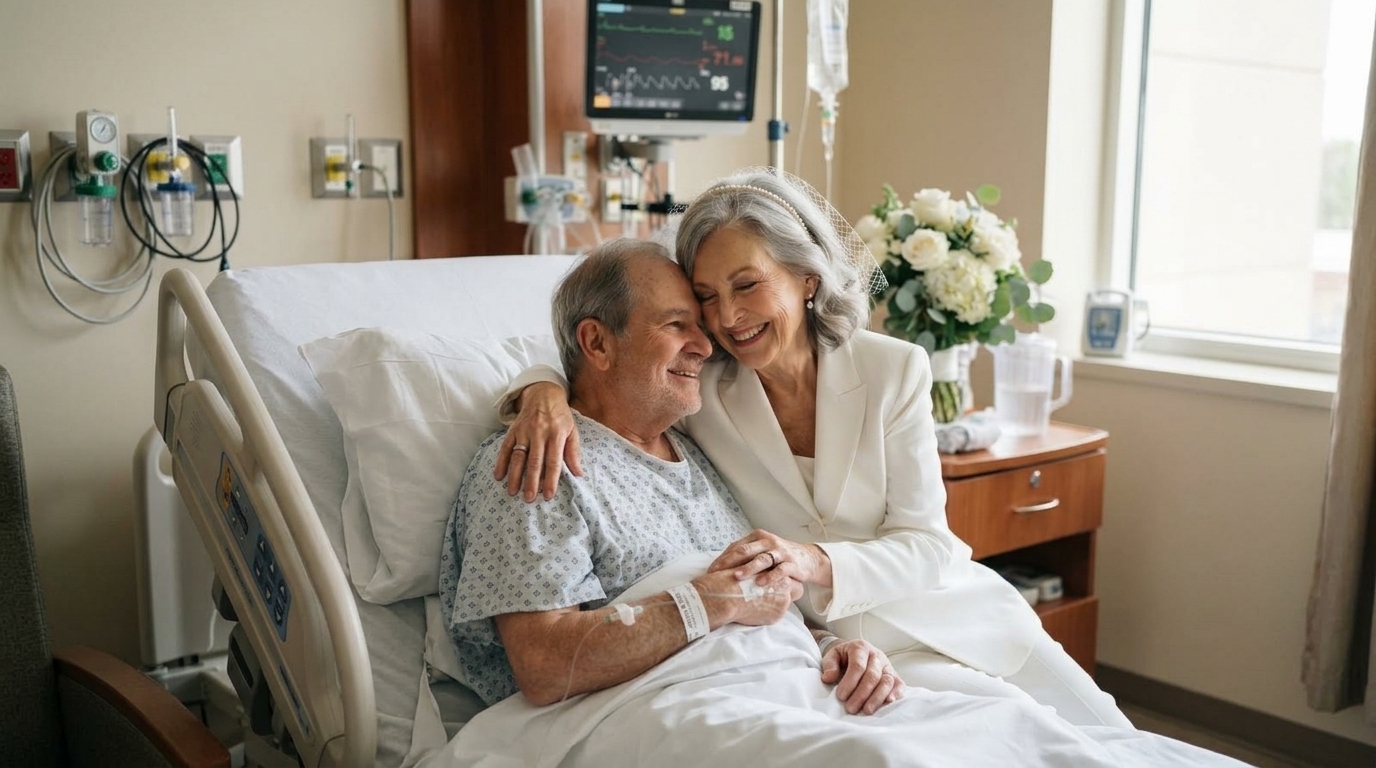
And the way he’d looked at me in his hospital bed when he asked me to marry him.
“I think he hoped.”
Caroline nodded.
Then she reached into her pocket.
“I have something for you.”
She handed me a small envelope.
Inside was a photograph.
Thomas and Caroline.
They were standing outside a coffee shop.
He looked about sixty.
She looked about thirty-five.
Both were smiling awkwardly.
I stared at it.
“I didn’t know you had a picture together.”
Caroline nodded.
“It was taken the day we met.”
I touched Thomas’s face.
“He looks happy.”
She smiled sadly.
“He was.”
I looked at her.
“Did he tell you much about me?”
She laughed.
“Enough that I felt I already knew you.”
My eyes filled.
“What did he say?”
Caroline looked at me.
“He said you were stubborn.”
I laughed.
“He was right.”
“He said you always stood up for people who couldn’t stand up for themselves.”
I smiled.
“He remembered that?”
She nodded.
“And he said that when you were seventeen, you once stayed up all night helping an injured stray dog.”
I covered my mouth.
I’d forgotten that.
Thomas hadn’t.
Caroline continued.
“He said you were the kindest person he’d ever known.”
I began crying.
She took my hand.
“And he said he hoped I’d inherited that from you.”
I looked at her.
“You did.”
She smiled.
Then she leaned her head against my shoulder.
For a long time, we watched the evening sky.
When I returned home, Samuel called.
“Margaret, how was Columbus?”
I laughed.
“Wonderful.”
He sounded relieved.
“I’m glad.”
I hesitated.
“Samuel, can I ask you something?”
“Of course.”
“Why did you call it a trap?”
He was quiet for a moment.
Then he laughed softly.
“Because Thomas insisted on that word.”
I smiled sadly.
“Why?”
“He said you were the most stubborn woman he’d ever met.”
I laughed.
“He wasn’t wrong.”
Samuel continued.
“He told me that if he simply left you money, you’d refuse it. If he asked you to investigate his past, you’d tell him he should have handled it himself.”
I smiled through my tears.
“That sounds like me.”
“So he arranged something you couldn’t ignore.”
I looked toward the wooden box.
“Caroline.”
“Yes.”
I was quiet.
Then Samuel said, “Thomas called it his final act of matchmaking.”
I began laughing.
Then crying.
Samuel waited.
“He told me that when you discovered the truth, you’d be furious with him.”
“I was.”
“And then you’d find your daughter.”
“I did.”
“And eventually, you’d understand why he couldn’t leave this world without trying.”
I looked toward his photograph.
“Yes.”
Samuel’s voice softened.
“Margaret, Thomas loved you very much.”
I closed my eyes.
“I know.”
But there was still one person I needed to confront.
Evelyn.
My sister.
The woman who had known the truth for decades.
I hadn’t spoken to her since that terrible telephone call.
She had left messages.
Sent letters.
Asked Samuel to tell me she was sorry.
But I wasn’t ready.
Then, one afternoon, I found an old photograph while sorting through family albums.
It showed Evelyn and me as children.
She was twelve.
I was seven.
We were standing in our mother’s garden, holding hands.
I stared at it for a long time.
Then I picked up the phone.
“Evelyn?”
She answered immediately.
“Margaret?”
Her voice broke.
“Oh, Margaret.”
I closed my eyes.
“I want to talk.”
She began crying.
“Thank God.”
I took a breath.
“But I need you to tell me the truth.”
She was quiet.
“All of it.”
Evelyn came the next morning.
She looked older than I remembered.
Her hands shook as she sat at my kitchen table.
For several minutes, neither of us spoke.
Then she whispered, “I’m sorry.”
I looked at her.
“Why did Mother do it?”
Evelyn began crying.
“She was afraid.”
“Of what?”
“That you’d ruin your future.”
I stared at her.
“She thought having a baby would stop you from becoming a nurse.”
I shook my head.
“So she took my daughter?”
Evelyn nodded.
“Mother believed she was saving you.”
I felt anger rise.
“She didn’t save me.”
“I know.”
“She destroyed fifty-five years of my life.”
Evelyn lowered her head.
“I know.”
I leaned forward.
“Did Father know?”
She shook her head.
“Not at first.”
My heart tightened.
“When did he find out?”
“Years later.”
I stared at her.
“And?”
“He was furious.”
I felt tears gather.
“He wanted to tell you. Mother begged him not to.”
I closed my eyes.
My father had been a quiet man.
Gentle.
Reserved.
He rarely argued with my mother.
I had always believed he didn’t know about the baby.
Now I was learning that even he had carried part of the secret.
“Why didn’t he tell me?”
Evelyn wiped her cheeks.
“He was afraid you’d never forgive him for allowing it to happen.”
I shook my head.
“Everyone was so afraid of losing me that they let me lose my daughter.”
Evelyn began sobbing.
I looked away.
Then she whispered, “I was nineteen when Mother told me.”
I turned back.
“She said the baby had been adopted. She made me promise never to tell you.”
I stared at her.
“You were nineteen.”
She nodded.
“I was afraid of Mother.”
I swallowed.
“But you weren’t nineteen forever.”
Evelyn covered her face.
“No.”
“You had fifty-five years.”
“I know.”
“You watched me light candles.”
“I know.”
“You watched me cry every birthday.”
She nodded.
“And you said nothing.”
Evelyn looked up.
“I was a coward.”
For the first time, she didn’t make excuses.
Didn’t blame Mother.
Didn’t say she’d been trying to protect me.
She simply admitted the truth.
“I was a coward, Margaret. And I am so sorry.”
I stared at her.
Then I said quietly, “I don’t know whether I can forgive you.”
She nodded.
“I understand.”
“But I don’t want to spend whatever years I have left hating you.”
Her eyes filled.
“Does that mean—”
“It means we can try to talk again.”
She began crying.
I reached across the table.
She took my hand.
And for the first time in months, we sat together without pretending the past had been something other than it was.
The following year changed my life.
Caroline visited often.
Sometimes she came alone.
Sometimes she brought Michael.
Sometimes the entire family arrived, filling my little house with laughter and noise.
Grace called me every Sunday.
Andrew sent photographs of Noah.
And Noah began calling me Grandma Margaret.
The first time he said it over the telephone, I cried so hard that Caroline had to take the phone away from him.
He asked whether I was sad.
She laughed.
“No, sweetheart. Grandma’s happy.”
I also made a decision about my nursing job.
I had returned to work because my pension wasn’t enough to cover my expenses.
But Thomas had left me a modest inheritance.
Not an enormous fortune.
Enough to pay off my debts, improve my living situation, and give me some breathing room.
I didn’t want to stop working entirely.
I loved nursing.
I loved helping people.
But I no longer wanted to spend every available hour working when I’d just discovered a family I wanted to know.
So I reduced my shifts.
I began volunteering at a community health clinic.
And every few months, I traveled to Columbus.
For the first time in decades, I felt as though my life belonged to me.
On the first anniversary of Thomas’s death, Caroline came with me to the cemetery.
We brought flowers.
White roses for me.
Yellow tulips for her.
We stood beside his grave in the morning sunlight.
I looked down at the headstone.
THOMAS EDWARD HARRISON
Beloved Husband
A Love That Waited Fifty-Five Years
I knelt carefully.
“Hello, sweetheart.”
Caroline stood beside me.
I placed the roses on the grave.
“I found her.”
My voice broke.
“I found our daughter.”
Caroline began crying.
I looked toward the sky.
“She has your eyes when she smiles.”
Caroline laughed through her tears.
“And your stubbornness,” she whispered.
I smiled.
“Yes.”
Then I took her hand.
“Thomas, I wish you could see us.”
The wind moved through the trees.
For a moment, the world was very quiet.
Then Caroline knelt beside me.
She touched the headstone.
“Thank you,” she whispered.
I looked at her.
She continued.
“For finding me.”
Her voice broke.
“For not giving up.”
I wrapped my arm around her shoulders.
And together, we cried for the man who had loved us both.
A few months later, Caroline surprised me with a gift.
It was a framed photograph.
Not of her childhood.
Not of Thomas.
But of the two of us standing together on my front porch the day we met.
Our faces were wet with tears.
Our arms were wrapped around each other.
And we were smiling.
Beneath the photograph, she’d written:
Fifty-five years late, but right on time.
I stared at it.
Then I hugged her.
“Where did you get this?”
She smiled.
“Samuel took it.”
I laughed.
“That sneaky man.”
Caroline laughed too.
“He said Thomas would have wanted proof.”
I looked at the photograph again.
Then I began crying.
Because Thomas had been right.
I had walked straight into his trap.
But it wasn’t a trap made of lies.
It wasn’t a trap meant to hurt me.
It was a carefully prepared path toward a truth I had been denied for more than half a century.
He had known I would resist.
He had known I would be angry.
He had known the truth would break my heart before it began to heal it.
And still, he had left the box.
The letters.
The photographs.
The recording.
Everything I needed to find my daughter.
On my seventy-fifth birthday, Caroline organized a celebration.
She invited the whole family.
Grace.
Andrew.
Michael.
Noah.
Evelyn came too, after Caroline and I agreed we were ready.
We gathered in Caroline’s backyard beneath strings of warm lights.
There was cake.
Music.
Flowers.
And more laughter than I could remember hearing in years.
At one point, Noah climbed onto my lap.
“Grandma Margaret?”
“Yes, sweetheart?”
“Were you always old?”
Everyone laughed.
I smiled.
“No, darling. Once I was very young.”
He looked surprised.
“Really?”
“Really.”
He thought about that.
Then asked, “Did you know dinosaurs?”
The entire table erupted in laughter.
I kissed his forehead.
“Not personally.”
He giggled.
Then Caroline stood.
She raised her glass.
“I want to say something.”
Everyone grew quiet.
She looked at me.
“For most of my life, I believed my birth mother had chosen not to keep me.”
My eyes filled.
“I thought meeting her would reopen an old wound.”
She paused.
“But instead, I discovered something extraordinary.”
She looked around the table.
“I discovered that love can survive even when people are separated by lies, distance, and time.”
Her voice trembled.
“And I discovered that the woman who gave birth to me had loved me every single day of my life.”
I covered my mouth.
Caroline walked toward me.
She took my hand.
“Mom.”
I froze.
She smiled through her tears.
“Happy birthday.”
I began sobbing.
She hugged me.
And everyone applauded.
But I barely heard them.
Because after fifty-five years, my daughter had finally called me Mom.
That night, when the party ended, I sat alone for a few minutes beneath the backyard lights.
I thought about Thomas.
About the seventeen-year-old boy who had held my hand beneath the bleachers after a football game.
About the young man who had begged me not to leave.
About the elderly patient who had smiled when I walked into his hospital room.
About the husband I’d married at seventy-three.
And about the man who had died believing there was still one final thing he could do for me.
I looked toward the house.
Through the window, I could see Caroline laughing with Grace.
Michael was washing dishes.
Andrew was helping Noah put away his toys.
My family.
A family I had believed impossible.
I touched the wedding ring Thomas had given me.
For a moment, I imagined him sitting beside me.
Smiling.
Teasing me for crying again.
Then I whispered, “You did it, sweetheart.”
A breeze moved through the trees.
I smiled through my tears.
“You brought her home.”
I had spent fifty-five years believing my daughter was dead.
I had spent fifty-five years wondering what kind of woman she might have become.
And I had spent fifty-five years carrying a grief that nobody around me seemed to understand.
But now I knew.
She had become Caroline.
A loving wife.
A devoted mother.
A grandmother.
A woman who liked lemon cake.
A woman who laughed with her whole face.
A woman who had inherited my stubbornness and Thomas’s gentle eyes.
I could never recover the years we’d lost.
I could never hold her as a newborn.
Never walk her to her first day of school.
Never watch her graduate.
Never help her choose a wedding dress.
Those moments were gone.
And no amount of love could bring them back.
But I could hold her now.
I could listen to her stories.
I could celebrate her birthdays.
I could know her children.
And I could love her for whatever time remained.
People sometimes ask whether I regret marrying Thomas so late in life.
Whether thirty-one days of marriage were worth the heartbreak of losing him.
I always give the same answer.
Yes.
A thousand times yes.
Because those thirty-one days gave me something I never expected to have again.
Love.
Hope.
And the truth.
Thomas didn’t give me back the past.
He couldn’t.
But he gave me a future I hadn’t known was waiting.
And the wooden box he left behind became the most precious gift of my life.
Not because it contained money.
Not because it held jewelry.
But because it contained the truth about a daughter I thought I’d lost forever.
I had walked straight into his trap.
And on the other side, I found my family.
My daughter.
My grandchildren.
My great-grandson.
And a love that had somehow survived fifty-five years of silence.
THE END THANK YOU FOR READING !!!!