PART 3
Margaret, we discovered something
else about Daniel’s finances.
Patricia Holloway’s voice came through my phone
with the careful calm of a woman who had learned
that terrible news was best delivered without decoration.
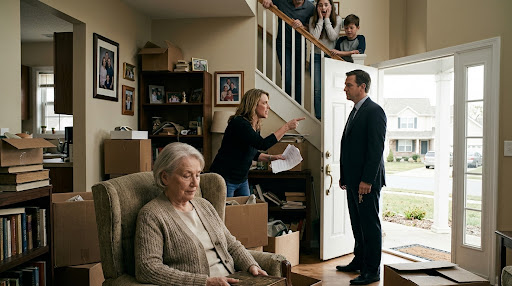
I stood beside the staircase, holding my phone against my ear.
Across the foyer, my son Daniel was staring at
the real estate representative as though
the man had announced that the sun had stopped rising.
Renee stood beside him, one hand pressed against her throat.
“The Whitcomb Family Trust?” she repeated. “What does that even mean?”
I looked at her.
“It means I bought the house.”
Daniel turned so quickly that his bare heel slipped against the polished floor.
“You what?”
“I bought the house you and Renee wanted.”
His eyes widened.
“With what money?”
I didn’t answer immediately.
Instead, I turned slightly away.
“Patricia, can I call you back in five minutes?”
“Of course,” she said. “But Margaret, don’t sign anything Daniel gives you. And don’t discuss your financial arrangements with him until we’ve spoken.”
A cold sensation moved through my stomach.
“Understood.”
I ended the call.
The real estate representative, whose name was Andrew Collins, shifted uncomfortably near the doorway.
“Mrs. Whitcomb, I apologize for the unexpected visit. I was instructed to deliver these documents to Mrs. Briggs.”
He looked toward Renee.
“These relate to the previous purchase inquiry your household submitted.”
Renee snatched the folder.
“Previous purchase inquiry?”
Andrew nodded.
“The seller’s agent requested confirmation that your earlier offer is no longer under consideration. There are also some outstanding questions about the financial documentation submitted with it.”
Daniel’s expression changed.
Not confusion.
Fear.
I recognized the difference immediately.
For two years, I had watched my son navigate everything from school schedules to expensive car repairs with the confidence of a man who believed every problem could be solved by speaking loudly enough.
But now he looked as though the floor beneath him had begun to move.
“What financial documentation?” I asked.
Andrew glanced at Daniel.
“I’m afraid that would be better discussed with your attorney.”
Daniel stepped forward.
“There’s nothing to discuss. Thank you for coming.”
He tried to close the door.
I raised my hand.
“Daniel.”
He stopped.
“Don’t be rude to the man.”
His face reddened.
“Mom, this doesn’t concern you.”
I looked at the folder in Renee’s hands.
“Apparently, it might.”
Renee’s fingers tightened around the papers.
Andrew gave me a polite nod and left.
The door clicked shut.
For several seconds, nobody spoke.
Then Daniel turned toward me.
“How much did you pay for that house?”
“Enough.”
“Mom.”
“Daniel.”
He stared.
“Where did you get the money?”
I folded my hands.
“From my own finances.”
Renee gave a short, disbelieving laugh.
“Your finances? Margaret, you haven’t worked in years.”
I looked at her.
“Neither have I asked you to explain every dollar in your checking account.”
Her mouth opened.
Then closed.
Daniel rubbed his forehead.
“Mom, please. We’re trying to understand.”
I nodded.
“Then perhaps you should start by explaining why you told me to move out.”
He sighed.
“Not this again.”
“Yes,” I said quietly. “This again.”
Renee crossed her arms.
“We needed our space.”
“Then you should have said so before I sold my home.”
Daniel looked away.
I continued.
“You asked me to come here after Harold died. You said you didn’t want me living alone.”
“That was two years ago.”
“Yes.”
My voice remained steady.
“Two years during which I cooked your dinners, watched your children, drove them to school, cleaned your kitchen, and made sure your household ran smoothly.”
Renee’s cheeks flushed.
“We never forced you to do those things.”
“No,” I replied. “You simply became very comfortable expecting them.”
Daniel exhaled sharply.
“Mom, can we please focus on the house?”
I looked at him.
“Why?”
“Because Renee and I have been trying to buy that property for months!”
“I know.”
He stared.
“You knew?”
“Of course. You’ve shown me the photographs at least a dozen times.”
Renee stepped closer.
“Then why would you buy it out from under us?”
I studied her.
“Because I liked it.”
Her face twisted.
“That’s cruel.”
I almost laughed.
Not because anything was funny.
Because the word sounded so strange coming from her.
“Cruel?”
“Yes! You knew how much that house meant to us.”
I looked around their enormous Scottsdale home.
Three garages.
A pool.
Five bedrooms.
A kitchen larger than the entire first apartment Harold and I had shared.
“Renee, you already have a beautiful house.”
“That’s not the point!”
“Then what is?”
She looked at Daniel.
He looked at the floor.
And suddenly, I understood that the dream house had never been merely a dream.
Something else was happening.
Something they hadn’t told me.
I stepped toward the staircase.
“I’m going to make a phone call.”
Daniel followed.
“Mom, wait.”
I stopped.
He lowered his voice.
“Are you really moving out?”
“Yes.”
“When?”
“As soon as my arrangements are ready.”
His expression softened.
Or perhaps he simply rearranged it.
“Mom, you don’t have to rush.”
I stared at him.
“Last night you wanted to know when I was finally leaving.”
“I was frustrated.”
“With what?”
He hesitated.
“Everything.”
I nodded.
“Then I’ll make one thing easier.”
I climbed the stairs.
Behind me, Renee whispered something sharp.
Daniel answered in an equally angry voice.
I didn’t turn around.
For the first time since Harold died, I was walking toward something that belonged entirely to me.
Not a guest room.
Not a borrowed chair.
Not a place where I had to apologize for using the kitchen.
A home.
I closed my bedroom door and called Patricia.
She answered immediately.
“Margaret.”
“I’m alone.”
“Good. I need to explain something.”
I sat on the edge of the bed.
“What did you find?”
“Your son and daughter-in-law are in considerably more financial difficulty than they’ve admitted.”
I looked toward the window.
Outside, sunlight glittered across the swimming pool.
“How bad?”
“Bad enough that the house they wanted appears to have been part of a plan to refinance their obligations.”
I frowned.
“Explain.”
Patricia paused.
“During the purchase process, their lender requested additional documentation. Our real estate counsel received a notice concerning an unresolved prior offer. It appears Daniel represented that he expected a substantial family contribution toward the down payment.”
My stomach tightened.
“What contribution?”
“Three hundred and fifty thousand dollars.”
I went still.
“From whom?”
“That’s what we’re investigating.”
I looked at the Bible on my nightstand.
The same Bible that had held the lottery ticket.
“Patricia, I never promised Daniel three hundred and fifty thousand dollars.”
“I know.”
“Did he tell someone I did?”
“According to the documents we’ve seen, he described it as an anticipated gift from a family member.”
I closed my eyes.
“Me.”
“Possibly.”
There was a pause.
Then Patricia said, “Margaret, I need to ask you something. Have you ever signed a gift letter for Daniel’s mortgage application?”
“No.”
“Have you ever authorized him to access your accounts?”
“No.”
“Does he know about the lottery winnings?”
“Not unless he discovered them somehow.”
“Good.”
I looked toward the bedroom door.
“Patricia, there’s something I haven’t told you.”
“I’m listening.”
“Daniel and Renee started being unusually nice after I began meeting with you.”
“How so?”
“Breakfast brought to my room. Offers to drive me places. Questions about my paperwork.”
Patricia was silent.
Then she asked, “Have they had access to your personal documents?”
I thought about the filing cabinet I’d kept in the guest room.
My old bank statements.
Harold’s death certificate.
My Social Security paperwork.
The documents from selling my Tucson house.
My throat tightened.
“Some of them.”
“Then we need to review your credit reports and confirm that no applications were made using your information.”
I stared at the wall.
“Do you think my son would do that?”
Patricia’s answer was gentle.
“I don’t know, Margaret. And we shouldn’t assume it without evidence.”
I appreciated that.
I had spent seventy-one years learning that fear could make ordinary shadows look dangerous.
But I also knew something else.
Daniel had been behaving strangely long before the lottery ticket.
And the moment he’d heard I bought the house, his first question hadn’t been whether I was happy.
It had been where I’d found the money.
Patricia continued.
“There’s another issue.”
I closed my eyes.
“Of course there is.”
“The house you’re purchasing is still going through its final closing procedures. The offer has been accepted, but ownership hasn’t transferred yet.”
I nodded.
“I understand.”
“We’ll make sure the closing is completed properly. In the meantime, please don’t tell Daniel anything more.”
“All right.”
“And Margaret?”
“Yes?”
“You are not obligated to explain your financial independence to anyone simply because they’re related to you.”
I looked down at my wedding ring.
Harold had given it to me forty-eight years earlier.
The gold had grown thin along the underside.
I still wore it every day.
“Thank you, Patricia.”
After we hung up, I sat quietly for a long time.
Then I opened the drawer beside my bed.
Inside was a photograph of Harold standing beside our old yellow kitchen.
He was holding a mug of tea.
His hair was white.
His smile was crooked.
I ran my thumb across the glass.
“You always told me to keep something for myself,” I whispered.
I could almost hear his answer.
About time you listened, Maggie.
That afternoon, I began packing.
Not everything.
Just the things that mattered.
My wedding photographs.
Harold’s watch.
The recipe cards written in my mother’s handwriting.
A small blue ceramic bird Emma, my granddaughter, had made in art class.
And the quilt my grandmother had sewn before I was born.
I placed them carefully inside two boxes.
Then I heard a knock.
“Grandma?”
It was my granddaughter, Lily.
She was thirteen, with Daniel’s brown eyes and a habit of twisting her hair whenever she was nervous.
“Come in, sweetheart.”
She stepped inside.
Her gaze moved toward the boxes.
“Are you really leaving?”
I smiled sadly.
“Yes.”
Her face fell.
“Because of what Dad said?”
I hesitated.
“Partly.”
She looked down.
“I heard them talking.”
My stomach tightened.
“Who?”
“Mom and Dad.”
I waited.
She swallowed.
“They said you were being difficult because you wanted attention.”
I sat beside her.
“Oh, Lily.”
She looked at me.
“Is that true?”
“No, sweetheart.”
“Then why are they saying it?”
I thought carefully.
“Sometimes people tell themselves stories that make their own behavior easier to live with.”
She stared at her hands.
“Mom said you were getting old and confused.”
I felt something break inside me.
Not loudly.
Not dramatically.
Just a quiet fracture.
“Do I seem confused to you?”
Lily shook her head.
“No.”
“Then trust what you’ve seen.”
She nodded.
Then whispered, “I don’t want you to go.”
I pulled her close.
“I know.”
She wrapped both arms around me.
“Who will make pancakes on Saturdays?”
I laughed softly.
“Your father knows how.”
“He burns them.”
“Then he’ll have to practice.”
She smiled through her tears.
I held her for a long time.
Then she asked a question that made my chest ache.
“Grandma, if you have your own house, can I still visit?”
I kissed the top of her head.
“Always.”
That evening, Daniel knocked on my door.
He was holding a folder.
I looked at it.
Then at him.
“What’s that?”
He smiled.
“Just some paperwork.”
My pulse slowed into something deliberate.
“What kind?”
He stepped inside.
“Mom, Renee and I have been talking.”
I waited.
“We think maybe we handled things badly.”
I said nothing.
He sat on the edge of the bed.
“We don’t want you to feel unwanted.”
I looked at the packed boxes.
“That’s a little late.”
He sighed.
“Mom, please.”
I folded my hands.
“Go on.”
He opened the folder.
Inside was a document titled:
FAMILY FINANCIAL SUPPORT AGREEMENT
I stared at the words.
Daniel cleared his throat.
“We thought maybe we could work something out that benefits everyone.”
I looked at him.
“What exactly do you mean?”
He smiled nervously.
“Well, if you’re buying property, you obviously have more resources than we realized.”
I said nothing.
“And since we’ve been supporting you for two years—”
I raised one hand.
“Stop.”
He blinked.
“What?”
“Did you just say you’ve been supporting me?”
He frowned.
“Mom, you’ve lived here rent-free.”
I looked at him.
“And I have provided childcare, transportation, cooking, cleaning, and household help almost every day.”
“That’s what family does.”
I nodded.
“Exactly.”
He shifted.
“Look, I’m not trying to argue.”
“Then explain the document.”
He glanced down.
“We thought a family contribution of three hundred and fifty thousand dollars would be fair.”
I felt the room become very quiet.
There it was.
The exact amount Patricia had mentioned.
I looked at my son.
“Fair for what?”
He hesitated.
“For everything we’ve done.”
I stared at him.
“Daniel, are you asking me to pay you three hundred and fifty thousand dollars for allowing me to live here?”
His cheeks flushed.
“Don’t put it like that.”
“How would you like me to put it?”
He looked irritated.
“We gave up our privacy.”
I nodded slowly.
“Yes.”
“And we had extra expenses.”
“Yes.”
“And now you’ve somehow bought a million-dollar house without even discussing it with us.”
I looked directly at him.
“Why would I need your permission?”
He opened his mouth.
Then closed it.
For the first time, I saw the truth without trying to soften it.
Daniel didn’t think I was incapable.
He thought I was obligated.
Obligated to explain myself.
Obligated to help.
Obligated to surrender whatever I possessed because he’d decided his needs were more important.
I stood.
“Take the papers, Daniel.”
His face hardened.
“Mom—”
“Take them.”
He slowly closed the folder.
“You’re making a mistake.”
I looked at him.
“No.”
My voice was steady.
“For the first time in a very long time, I’m making a decision for myself.”
He stood abruptly.
“Fine.”
He walked toward the door.
Then stopped.
“You know, Dad would be disappointed.”
The words hit me harder than I expected.
Harold.
My gentle, stubborn Harold.
The man who had worked beside me for nearly fifty years.
The man who had held my hand through cancer treatments and whispered that I was the bravest person he knew.
Daniel had reached for his memory because he knew it was the one place I was still vulnerable.
I looked at my son.
“Your father would never have asked me to buy his love.”
Daniel went pale.
Then he left.
I closed the door.
And for the first time since moving into that house, I turned the lock.
PART 4
The next morning, Patricia called at eight.
“Margaret, we have the credit reports.”
I was sitting beside the window, drinking tea from Harold’s old mug.
“What did you find?”
“Two inquiries connected to mortgage prequalification. One appears to involve your information.”
My stomach dropped.
“How?”
“We don’t know yet. The inquiry itself doesn’t prove anyone committed fraud. We’re requesting the underlying application records.”
I looked toward the bedroom door.
“Was Daniel involved?”
“His name appears on the related real estate transaction. That’s all I can confirm at this stage.”
I closed my eyes.
“All right.”
Patricia continued.
“I recommend placing a credit freeze and filing a dispute concerning any inquiry you didn’t authorize.”
“Do it.”
“We’ll also notify the lender that you did not consent to your information being used.”
I stared at my wedding ring.
“Patricia, I never thought I’d need protection from my own child.”
Her voice softened.
“I know.”
Then she added, “But protecting yourself doesn’t mean you’ve stopped loving him.”
I didn’t answer.
Because that was the part I was struggling to understand.
How could I love Daniel so deeply and still feel afraid of what he might do?
How could the boy who once brought me dandelions from the schoolyard become the man who placed a financial agreement in front of his widowed mother?
I remembered him at seven years old.
Standing in our Tucson kitchen with a broken toy truck.
“Mom, can you fix it?”
I had spent an hour repairing the axle with glue and a small screwdriver.
He’d hugged me afterward.
“You’re the best mom in the world.”
I wondered when he’d stopped seeing me as a person and started seeing me as someone whose purpose was to fix everything.
That afternoon, I met Patricia at her office.
She had invited a financial adviser and an estate-planning specialist to join us.
For the first time, we discussed the full reality of my lottery winnings.
Eighty-nine million dollars.
Even after taxes and other obligations, it was more money than Harold and I could have imagined earning in several lifetimes.
The number still didn’t feel real.
I had spent decades comparing grocery prices, saving coupons, and checking the electric bill twice before paying it.
Now I could purchase almost anything I wanted.
But the things I wanted most were surprisingly ordinary.
A peaceful home.
A garden.
A reliable car.
A kitchen where nobody sighed when I opened the refrigerator.
And enough independence that nobody could ever make me feel like an unwanted guest again.
Patricia slid a document across the desk.
“This establishes the framework for your estate plan.”
I read the heading.
THE MARGARET WHITCOMB LEGACY TRUST
I smiled faintly.
“My mother would have liked that.”
Patricia looked up.
“Your maiden name?”
I nodded.
“Whitcomb.”
I ran my finger along the printed letters.
“My mother was Evelyn Whitcomb. She raised four children after my father died. She cleaned hotel rooms for twenty-three years.”
I paused.
“She never owned a house.”
Patricia listened.
“When I married Harold, I became Margaret Briggs. I loved that name because it connected me to him.”
My voice softened.
“But Whitcomb was the name of the woman who taught me how to survive.”
Patricia smiled.
“Then it seems appropriate.”
I looked at the document again.
For most of my life, my identity had been tied to someone else.
Harold’s wife.
Daniel’s mother.
Lily and Noah’s grandmother.
I loved those roles.
But I had almost forgotten there was a Margaret beneath them.
A woman who liked roses.
Who once wanted to study literature.
Who could still remember the smell of her mother’s Sunday bread.
Who had opinions, dreams, and a life that mattered even when nobody needed her to make dinner.
I signed the papers.
Then Patricia asked about beneficiaries.
I thought for a long time.
“I want educational trusts for my grandchildren.”
She nodded.
“That can be arranged.”
“Managed independently.”
“Of course.”
“And I want a portion set aside for organizations that help older adults who are facing housing insecurity.”
Patricia smiled.
“That’s a wonderful purpose.”
I looked at her.
“There’s something else.”
“Yes?”
“I don’t want Daniel to know the total amount.”
She nodded.
“That’s your decision.”
“And I don’t want him controlling the children’s trusts.”
“We can appoint independent trustees.”
“Good.”
Then I asked the question that had been sitting in my heart for days.
“Can I leave him something without giving him access to everything?”
Patricia leaned forward.
“Absolutely. Estate planning allows you to decide how assets are distributed, subject to applicable law. You don’t have to choose between leaving him everything and leaving him nothing.”
I nodded slowly.
“I don’t want revenge.”
“What do you want?”
I looked out the window.
“Boundaries.”
Patricia smiled gently.
“Then we’ll build them.”
Three days later, the house closing was completed.
The Whitcomb Family Trust became the owner of the property.
I drove there alone.
The afternoon sun warmed the stone walkway.
A breeze moved through the shade trees.
I stood on the porch holding the brass key.
For a moment, I couldn’t make myself unlock the door.
Not because I was afraid.
Because I knew what it meant.
For two years, I had lived in a room where I felt I had to ask permission to exist.
Now I was standing outside a house where nobody could tell me to leave simply because I had become inconvenient.
I turned the key.
The door opened.
Sunlight poured across the wooden floors.
The house was empty.
No furniture.
No voices.
No smell of dinner.
Just space.
Possibility.
And silence.
I walked slowly from room to room.
The kitchen had pale blue cabinets.
Harold had always loved blue.
The sunroom faced east, exactly as I’d hoped.
Beyond it was a garden with two mature citrus trees and enough room for roses.
I stepped outside.
The air smelled of warm earth.
I closed my eyes.
And for one moment, I imagined Harold standing beside me.
“Well, Maggie,” I could almost hear him say, “looks like you found yourself a place.”
I laughed through my tears.
“Yes, sweetheart.”
Then I whispered, “I finally did.”
I hired movers.
Ordered furniture.
Bought a blue kettle.
And arranged for a small table to be placed beside the sunroom window.
That would be where I drank my morning tea.
Not because anyone needed breakfast.
Not because someone expected laundry.
Simply because I wanted to.
Meanwhile, Daniel and Renee were becoming increasingly desperate.
I knew because the messages never stopped.
At first, they were polite.
Mom, can we talk?
Then impatient.
We need to resolve this misunderstanding.
Then angry.
You can’t just walk away from your family.
I didn’t respond to every message.
When I did, I kept my answers short.
I’m safe. I’m arranging my move. We’ll speak when everyone can be respectful.
Renee called one afternoon.
I answered because I thought something might be wrong with the children.
“Margaret,” she began, “we need to discuss the house.”
I sighed.
“What about it?”
“We had plans.”
“I know.”
“We’d already started making arrangements.”
“What arrangements?”
She hesitated.
“Financial arrangements.”
I sat down.
“Renee, did you and Daniel submit any documents using my name?”
Silence.
Then she laughed.
“What a ridiculous question.”
“Please answer it.”
“Daniel handles the finances.”
“That wasn’t my question.”
Her voice sharpened.
“You’re being paranoid.”
I looked toward the garden.
“Perhaps.”
Then I said, “My attorney is reviewing the matter.”
The line went quiet.
Finally, Renee whispered, “You hired an attorney?”
“Yes.”
“Against your own son?”
I closed my eyes.
“No, Renee. For myself.”
She hung up.
The following morning, Daniel appeared at my new house.
I hadn’t given him the address.
But the property wasn’t hidden, and the closing had become a topic of neighborhood gossip.
I saw his SUV pull into the driveway.
He got out wearing a blue polo shirt and sunglasses.
He stood looking at the house for several seconds.
Then he walked toward the porch.
I opened the door before he knocked.
“Hello, Daniel.”
He stared past me.
“Wow.”
I said nothing.
He stepped closer.
“Can I come in?”
I hesitated.
Then moved aside.
“Briefly.”
He walked through the foyer.
His eyes moved across the new furniture.
The hardwood floors.
The staircase.
The wide windows overlooking the garden.
“This is incredible.”
I nodded.
“I like it.”
He turned toward me.
“Mom, this is the exact house Renee wanted.”
“I know.”
He shook his head.
“I still can’t believe you did this.”
I folded my hands.
“Would you like some tea?”
He stared.
“Tea?”
“Yes.”
He gave a frustrated laugh.
“Mom, we’re standing inside a house worth more than a million dollars, and you’re offering me tea?”
I looked at him.
“That’s what people usually do when they welcome a guest.”
The word landed.
Guest.
Daniel’s expression changed.
For a moment, I thought he understood.
Then he said, “You know, we could make this work.”
I frowned.
“Make what work?”
He gestured around the room.
“All of us.”
I stared.
“What?”
“Renee and the kids could move here. You could have the downstairs bedroom.”
I felt my heart sink.
He continued enthusiastically.
“We could sell our current place, pay down some debt, and start fresh.”
I looked at him.
“Daniel.”
He smiled.
“Think about it. The kids would love the pool.”
“There isn’t a pool.”
“We could build one.”
I stared at my son.
He hadn’t asked whether I was happy.
He hadn’t apologized.
He hadn’t asked why I wanted a home of my own.
He had walked through my front door and immediately begun rearranging my life to suit his needs.
“Daniel,” I said again, “this house is not available.”
He frowned.
“What does that mean?”
“It means I bought it for myself.”
His expression hardened.
“Mom, you don’t need four bedrooms.”
I nodded.
“Perhaps not.”
“Then why buy it?”
“Because I wanted it.”
He looked genuinely offended.
“That’s selfish.”
I almost smiled.
There it was again.
The word people used when a woman stopped giving them everything.
Selfish.
I walked toward the front door.
“I think it’s time for you to leave.”
He stared.
“Are you serious?”
“Yes.”
He followed me.
“Mom, you’re seventy-one. What are you going to do alone in a house this big?”
I turned.
“Whatever I like.”
His face reddened.
“You’ve changed.”
I nodded.
“Yes.”
He looked at me with something between anger and disbelief.
“Money does that to people.”
I went still.
“What did you say?”
He blinked.
“Nothing.”
I studied him.
“Daniel, how much do you know?”
He looked away.
“About what?”
“My finances.”
He shrugged.
“Enough to know you’ve been hiding something.”
I felt the air change.
“How?”
He didn’t answer.
Then he said, “You should have told us.”
I stared.
“Why?”
“Because we’re family!”
I nodded slowly.
“And what would you have done if I’d told you?”
He opened his mouth.
Then stopped.
The silence answered for him.
I opened the door.
“Goodbye, Daniel.”
He stood there another moment.
Then walked out.
At the bottom of the steps, he turned.
“Renee says you’re trying to punish us.”
I looked at him.
“No.”
He waited.
“I’m simply refusing to reward the way you’ve treated me.”
He climbed into his SUV and drove away.
I closed the door.
Then I leaned against it.
My hands were shaking.
Because despite everything, watching my son leave still hurt.
I had expected money to make me feel powerful.
Instead, it had made the truth impossible to ignore.
That evening, Patricia called.
“Margaret, we have the mortgage application records.”
I sat down.
“What did you find?”
She took a breath.
“Your son submitted a document identifying you as a prospective source of funds.”
I closed my eyes.
“Did he forge my signature?”
“There’s a signed statement attached, but we’re still verifying its origin.”
My stomach tightened.
“What does it say?”
Patricia paused.
“It represents that you intended to provide three hundred and fifty thousand dollars toward the purchase.”
I stared at the wall.
“I never signed anything like that.”
“I understand.”
“Then someone signed my name.”
“That’s a possibility we need to investigate carefully.”
I swallowed.
“Patricia, what happens now?”
“We’ll notify the lender formally, preserve the records, and determine whether a complaint to the appropriate authorities is warranted.”
I looked toward the window.
The garden lights had just switched on.
“Do whatever is necessary.”
She was quiet.
Then she asked, “Are you all right?”
I looked at Harold’s photograph on the mantel.
“No.”
My voice broke.
“But I will be.”
PART 5
The truth arrived on a Tuesday.
Not in a courtroom.
Not through a dramatic confrontation.
It arrived in a conference room with pale gray walls, a pitcher of water, and a stack of documents thick enough to make my stomach hurt.
Patricia sat beside me.
Across the table was an attorney representing the mortgage lender.
He explained that the lender had reviewed the disputed application after receiving our formal notice.
The supposed family gift letter was included in the file.
My name appeared at the bottom.
Margaret Briggs.
The signature looked almost like mine.
Almost.
But the capital M curved differently.
And the final letter of my surname had an unfamiliar flourish.
I stared at it.
“I didn’t sign this.”
The lender’s attorney nodded.
“That is consistent with the concerns raised in your complaint.”
I looked at Patricia.
“What happens next?”
She placed her hand gently over mine.
“The lender has withdrawn reliance on the disputed document. The matter has been referred for further review.”
I nodded.
Then I asked the question I’d been dreading.
“Did Daniel submit it?”
The attorney answered carefully.
“The application records identify your son as one of the applicants. We cannot yet establish who created the signature.”
I appreciated his honesty.
I didn’t want guesses.
I wanted the truth.
And I wanted it even though I was afraid of what it might mean.
Over the following weeks, the investigation continued.
Daniel and Renee retained an attorney.
They stopped contacting me directly about the money.
Their lawyer sent a letter describing the gift document as a misunderstanding.
According to their explanation, Daniel believed I had previously offered to help with a future house purchase.
I read that sentence three times.
Then I laughed.
A strange, exhausted sound.
“Patricia, when did I ever promise that?”
She looked at me.
“You didn’t, according to what you’ve told me.”
I shook my head.
“I remember helping with their first down payment.”
“Yes.”
“Forty thousand dollars.”
She nodded.
“And I told Daniel that was all I could afford.”
I looked at the letter.
“How does forty thousand become three hundred and fifty thousand?”
Patricia sighed.
“Sometimes people convince themselves that an expectation is the same thing as a promise.”
I sat quietly.
Then said, “I don’t want to destroy my son’s life.”
She nodded.
“I know.”
“But I won’t lie to protect him.”
“Nor should you.”
That became my decision.
I would cooperate with any legitimate investigation.
I would tell the truth.
I would not exaggerate.
I would not seek revenge.
And I would not allow anyone to use my love for Daniel as permission to take what belonged to me.
Meanwhile, the rest of my life was changing in ways I hadn’t expected.
I moved into the new house permanently.
The movers arrived on a bright Thursday morning.
I stood in the driveway watching them unload boxes.
My old furniture looked almost comically small inside the spacious rooms.
But I didn’t mind.
I placed Harold’s favorite chair beside the sunroom window.
His watch went into the drawer of the little wooden table.
Our wedding photograph stood on the mantel.
And the blue ceramic bird Lily had made found a home on the kitchen windowsill.
That first evening, I cooked dinner for one.
Roasted potatoes.
A small piece of salmon.
Green beans with garlic.
I set the table carefully.
One plate.
One glass.
One napkin.
For a moment, the empty chair across from me made my throat tighten.
Then I whispered, “Good evening, Harold.”
The house was silent.
I smiled through my tears.
And ate my dinner without anyone asking why it wasn’t ready sooner.
The next morning, I woke before sunrise.
Old habits are stubborn.
I walked into the kitchen expecting to hear Daniel’s coffee machine.
Instead, there was silence.
I made tea.
Carried it to the sunroom.
And watched the sky turn pink above the garden.
I hadn’t realized how long it had been since I’d enjoyed a morning without rushing to serve someone else.
For the first time in two years, I belonged to my own day.
That was worth more to me than any mansion.
A week later, Lily called.
“Grandma?”
“Hello, sweetheart.”
“Can I come over Saturday?”
I smiled.
“Of course.”
She hesitated.
“Mom says you’re mad at us.”
My heart sank.
“I’m not mad at you, Lily.”
“Then why don’t you come to our house anymore?”
I looked out at the roses I’d planted.
“Sometimes adults need space to work through difficult things.”
She was quiet.
Then asked, “Did Dad do something wrong?”
I took a breath.
“Your father and I disagree about some important matters.”
“Like money?”
I closed my eyes.
“Yes.”
She sighed.
“Everybody keeps talking about money.”
I felt tears sting my eyes.
“I’m sorry, sweetheart.”
Then she whispered, “I just miss you.”
I smiled sadly.
“I miss you too.”
That Saturday, Lily arrived with her younger brother, Noah.
Daniel dropped them off but stayed in the car.
I waved.
He gave a stiff nod.
Then drove away.
The children ran through the house.
Noah was ten and immediately wanted to know whether the backyard was big enough for a basketball hoop.
Lily loved the sunroom.
“Grandma, this is beautiful!”
I smiled.
“Thank you.”
She turned slowly, taking everything in.
“Did you really buy this all by yourself?”
“Yes.”
Her eyes widened.
“Wow.”
I laughed.
“That was my reaction too.”
We spent the afternoon baking chocolate chip cookies.
Noah spilled flour across the counter.
Lily accused him of eating half the chocolate chips.
I pretended not to notice.
Then we sat beneath the shade trees eating warm cookies and drinking lemonade.
At one point, Noah looked at me.
“Grandma?”
“Yes, sweetheart?”
“Are you rich?”
Lily elbowed him.
“Noah!”
“What? I just asked!”
I laughed.
“Well, I have enough to take care of myself.”
He considered that.
“Can you buy a helicopter?”
I nearly choked on my lemonade.
“Good heavens, why would I need a helicopter?”
He shrugged.
“Because it would be cool.”
I smiled.
“I think I’ll stick with a car.”
Lily laughed.
Then she looked at me.
“Grandma, are you happy here?”
The question caught me off guard.
I looked around.
The garden.
The sunroom.
The children.
The warm afternoon.
“Yes,” I said.
And realized it was true.
“I really am.”
That evening, after Daniel collected the children, I received a message from Renee.
The kids had a wonderful time. Thank you.
I stared at the screen.
Then another message appeared.
We need to talk.
I waited.
Daniel’s business is in trouble.
My stomach tightened.
I typed:
I’m sorry to hear that.
Her reply came immediately.
We could lose everything.
I stared at those words.
Then the phone rang.
Renee.
I answered.
“Hello?”
She was crying.
“Margaret, please.”
I sat down.
“What’s happened?”
“Daniel’s business partner pulled out. The bank won’t extend the credit line. We have bills everywhere.”
I closed my eyes.
“I’m sorry.”
She sobbed.
“We’re going to lose the house.”
I looked around my peaceful living room.
The irony was painful.
For two years, they’d treated me as though I were consuming their resources.
Now they were asking for mine.
“Renee,” I said gently, “what exactly are you asking?”
She hesitated.
Then whispered, “Help.”
I took a breath.
“How much?”
There was a long silence.
Then she said, “About six hundred thousand dollars.”
I closed my eyes.
Six hundred thousand.
More than Harold and I had earned in many of our working years combined.
“Renee, I can’t make that decision over the phone.”
She began crying harder.
“Margaret, please. The children—”
I interrupted softly.
“The children will not be abandoned.”
She went quiet.
“But that doesn’t mean I’m going to hand Daniel six hundred thousand dollars without understanding the situation.”
Her voice sharpened.
“You have the money.”
I felt the familiar ache.
There it was.
The assumption.
The entitlement.
The belief that my resources automatically belonged to them.
“Renee,” I said, “I need to go.”
“Margaret—”
“Good night.”
I ended the call.
Then I sat quietly for a long time.
I thought about Lily.
Noah.
Daniel.
The house.
The debts.
And the painful difference between helping someone and allowing them to avoid responsibility.
The next morning, I called Patricia.
“I need advice.”
She listened while I explained.
Then she asked, “What do you want to accomplish?”
I thought carefully.
“I want the children safe.”
“All right.”
“I don’t want them losing their home because of decisions they didn’t make.”
“Understandable.”
“But I don’t want to give Daniel a blank check.”
Patricia nodded.
“Then we should separate those goals.”
Over the next week, we arranged a meeting with Daniel, Renee, and their financial adviser.
I insisted on transparency.
Current debts.
Business obligations.
Mortgage balance.
Monthly expenses.
Everything.
Daniel resisted.
“This is humiliating,” he said.
I looked at him.
“So was being told to leave the dinner table because I was no longer convenient.”
He flinched.
I continued.
“If you want financial assistance, you need to be honest about your situation.”
He stared at the table.
Then nodded.
The numbers were worse than I’d expected.
Daniel’s business had been losing money for eighteen months.
He’d borrowed against personal assets.
He’d used credit cards to cover operating expenses.
He and Renee had continued spending as though nothing had changed.
Expensive vacations.
Luxury cars.
Private school tuition.
Designer furniture.
And the dream house they’d tried to buy had been part of an increasingly desperate attempt to create the appearance of success.
I looked at Daniel.
“Why didn’t you tell me?”
He laughed bitterly.
“Because you couldn’t have helped.”
I stared.
“Then why did you ask me for three hundred and fifty thousand dollars?”
His face reddened.
Renee looked away.
Daniel rubbed his forehead.
“Mom, I didn’t know about the lottery.”
The room went still.
I looked at him.
“What lottery?”
He stared at me.
Then realized what he’d said.
Patricia remained silent.
Daniel swallowed.
“Renee heard something.”
I felt my stomach tighten.
“From whom?”
He hesitated.
“Someone at the real estate office.”
Patricia leaned forward.
“Mr. Briggs, if you have information about a possible disclosure of confidential financial information, please provide it through your attorney.”
Daniel looked frightened.
I studied him.
“So you knew?”
He nodded slowly.
“Not the amount.”
I sat back.
“When?”
He looked down.
“A few days after you started looking at houses.”
I closed my eyes.
That explained the breakfasts.
The sudden kindness.
The questions.
The folder.
They hadn’t changed because they regretted hurting me.
They’d changed because they suspected I had money.
I felt a deep, exhausted sadness.
“Daniel,” I whispered, “would you have apologized if I were still poor?”
He looked at me.
Then away.
And in that silence, I received the answer.
I stood.
Patricia looked concerned.
“Margaret?”
“I’m all right.”
I looked at Daniel.
“I will make sure Lily and Noah have educational support and that their immediate needs are protected.”
He looked up hopefully.
“But I will not pay your business debts.”
His expression fell.
“Mom—”
“And I will not give you money to maintain a lifestyle you can no longer afford.”
Renee began crying.
I looked at her.
“I’m sorry you’re frightened. I truly am.”
Then I continued.
“But fear doesn’t erase responsibility.”
Daniel stared at the table.
“What are we supposed to do?”
I took a breath.
“Sell what you can’t afford. Work with your creditors. Make a realistic budget. And tell the truth.”
He laughed bitterly.
“Easy for you to say.”
I looked at him.
“Daniel, your father and I spent decades doing exactly that.”
He went silent.
I picked up my handbag.
“Patricia will explain the arrangements for the children.”
Then I walked out.
I cried in my car.
Not because I regretted my decision.
Because I remembered the little boy who used to fall asleep against my shoulder.
The boy who once told me he’d buy me a castle when he grew up.
I wondered when love had become a transaction.
And whether we could ever find our way back.
The following months were difficult.
Daniel sold one of his cars.
Renee returned to work.
They downsized into a smaller home.
The business entered a restructuring process.
Their lifestyle changed dramatically.
But the children were safe.
Their education was protected through arrangements that did not place money directly under Daniel’s control.
And for the first time in years, my son had to confront the consequences of his own financial decisions.
The disputed mortgage document remained a separate matter.
After reviewing the evidence, the lender determined that the supposed gift letter could not be relied upon and closed the application.
The authorities reviewed the circumstances surrounding the signature.
Daniel eventually acknowledged through counsel that the document had been submitted without my authorization.
The legal process took its course, and he faced consequences that included resolving the lender’s complaint and cooperating with the investigation.
I didn’t celebrate.
I didn’t feel triumphant.
I felt sad.
But I also felt certain.
I had not caused his problems by refusing to rescue him.
His problems had existed long before I learned the truth.
One evening, nearly a year after I moved into my house, Daniel called.
I almost didn’t answer.
Then I saw his name.
And I picked up.
“Hello, Daniel.”
“Hi, Mom.”
His voice sounded different.
Quieter.
Tired.
“How are you?”
“I’m well.”
He hesitated.
“Can I come over?”
I looked toward the garden.
“What for?”
He took a breath.
“To apologize.”
I closed my eyes.
For a moment, I couldn’t speak.
Then I said, “All right.”
He arrived the following afternoon.
No expensive watch.
No polished shoes.
No folder.
Just jeans, a plain shirt, and a face that looked older than it had a year earlier.
I opened the door.
“Hello, son.”
He swallowed.
“Hi, Mom.”
We sat in the sunroom.
I made tea.
He held the cup without drinking.
For a long time, neither of us spoke.
Then Daniel looked at me.
“I was awful to you.”
I stared at him.
He continued.
“When Dad died, I told myself I was doing the right thing by asking you to move in.”
I nodded.
“At first, I think I meant it.”
His eyes filled.
“But then you started doing everything for us.”
He looked down.
“And I let you.”
I said nothing.
“I got used to coming home and finding dinner ready. I got used to the kids being picked up. I got used to you making our lives easier.”
His voice broke.
“And instead of being grateful, I started acting like you owed us.”
I felt tears sting my eyes.
He swallowed.
“When you bought that house, I was furious.”
“I know.”
“Not because I was worried about you.”
He looked directly at me.
“Because I realized you had something I couldn’t control.”
The honesty hurt.
But it also mattered.
Daniel continued.
“I thought you were supposed to give everything to your family.”
I looked at him.
“Daniel, family isn’t supposed to mean one person gives until there’s nothing left.”
He nodded.
“I know that now.”
He wiped his eyes.
“I’m sorry I used Dad against you.”
My throat tightened.
He looked ashamed.
“I knew mentioning him would hurt you.”
A tear slipped down my cheek.
“Yes,” I whispered. “It did.”
He lowered his head.
“I don’t expect you to forgive me today.”
I studied him.
For the first time in a long while, he wasn’t asking me for anything.
Not money.
Not a favor.
Not a solution.
He was simply acknowledging what he’d done.
That didn’t erase the past.
But it was a beginning.
I reached across the table.
He looked up.
I placed my hand over his.
“Daniel, I love you.”
His face crumpled.
“I love you too, Mom.”
I squeezed his hand.
“But things cannot go back to the way they were.”
He nodded.
“I understand.”
“You cannot treat me as an obligation when I need help and an opportunity when I have money.”
He began crying.
“I know.”
“And if we rebuild our relationship, it has to be because you want your mother in your life.”
He nodded.
“Not because you want what she owns.”
He looked at me.
“I understand.”
We sat together for a long time.
Then he asked something that made me smile.
“Mom?”
“Yes?”
“Are you happy?”
I looked around the sunroom.
The roses outside.
Harold’s chair beside the window.
The sunlight moving across the floor.
And my son sitting across from me, finally asking a question that wasn’t about money.
“Yes,” I said.
“I am.”
He smiled through his tears.
“Good.”
That evening, after Daniel left, I walked into the garden.
The sky above Scottsdale was turning gold.
A warm breeze moved through the citrus trees.
I stood beside the rosebushes and thought about everything that had happened.
Eighty-nine million dollars.
A new house.
A broken relationship.
A painful truth.
And the slow possibility of forgiveness.
People sometimes imagine that winning a fortune means every problem disappears.
It doesn’t.
Money cannot make someone love you.
It cannot purchase gratitude.
It cannot turn selfishness into kindness.
And it cannot bring back the person whose absence still aches every morning.
But money can give you choices.
It can give you independence.
It can help you protect yourself when the people you love forget that you deserve protection too.
I had spent most of my life being Harold’s wife, Daniel’s mother, and the grandmother who always said yes.
I loved those parts of myself.
But I was also Margaret Whitcomb Briggs.
The daughter of a hardworking woman who never owned a home.
The widow of a gentle man who believed I deserved happiness.
And a seventy-one-year-old woman who had finally learned that love did not require surrendering her dignity.
The following Sunday, Lily and Noah came for breakfast.
Daniel arrived with them.
He stood awkwardly in the kitchen.
“Need help with anything, Mom?”
I looked at him.
Then smiled.
“Actually, yes.”
His face brightened.
“What?”
I handed him a spatula.
“Make the pancakes.”
He laughed.
“Mom, you know I burn them.”
I smiled.
“Then it’s time you learned.”
He rolled up his sleeves.
Noah cheered.
Lily laughed.
And for the first time in years, I sat at the table while someone else prepared breakfast.
The pancakes were uneven.
A few were too dark.
One looked suspiciously like a map of Texas.
But they tasted wonderful.
Because Daniel wasn’t serving me to get something.
He was serving me because he wanted to.
Later that morning, I walked into the sunroom with my tea.
Harold’s photograph stood beside the window.
I touched the frame.
“We did all right, sweetheart,” I whispered.
Outside, the roses were blooming.
Inside, my grandchildren were laughing.
And somewhere in the kitchen, Daniel was arguing with Noah about who had eaten the last pancake.
I smiled.
At seventy-one, I had won eighty-nine million dollars.
But the greatest thing I gained wasn’t the money.
It was the ability to stop living as though my existence needed someone else’s permission.
My son once asked when I was finally going to move out.
I left without arguing.
I bought the house he’d always wanted.
And I discovered that the best revenge wasn’t taking something away from him.
It was finally giving myself the life I had spent decades believing I didn’t deserve.
Because a mother can love her children with her whole heart without handing them the keys to her future.
And sometimes the most powerful words a woman can say are not “I forgive you” or “I love you.”
Sometimes they are simply: “This is my home. And I belong here.”
THE END THANK YOU FOR READING !!!



