PART 3
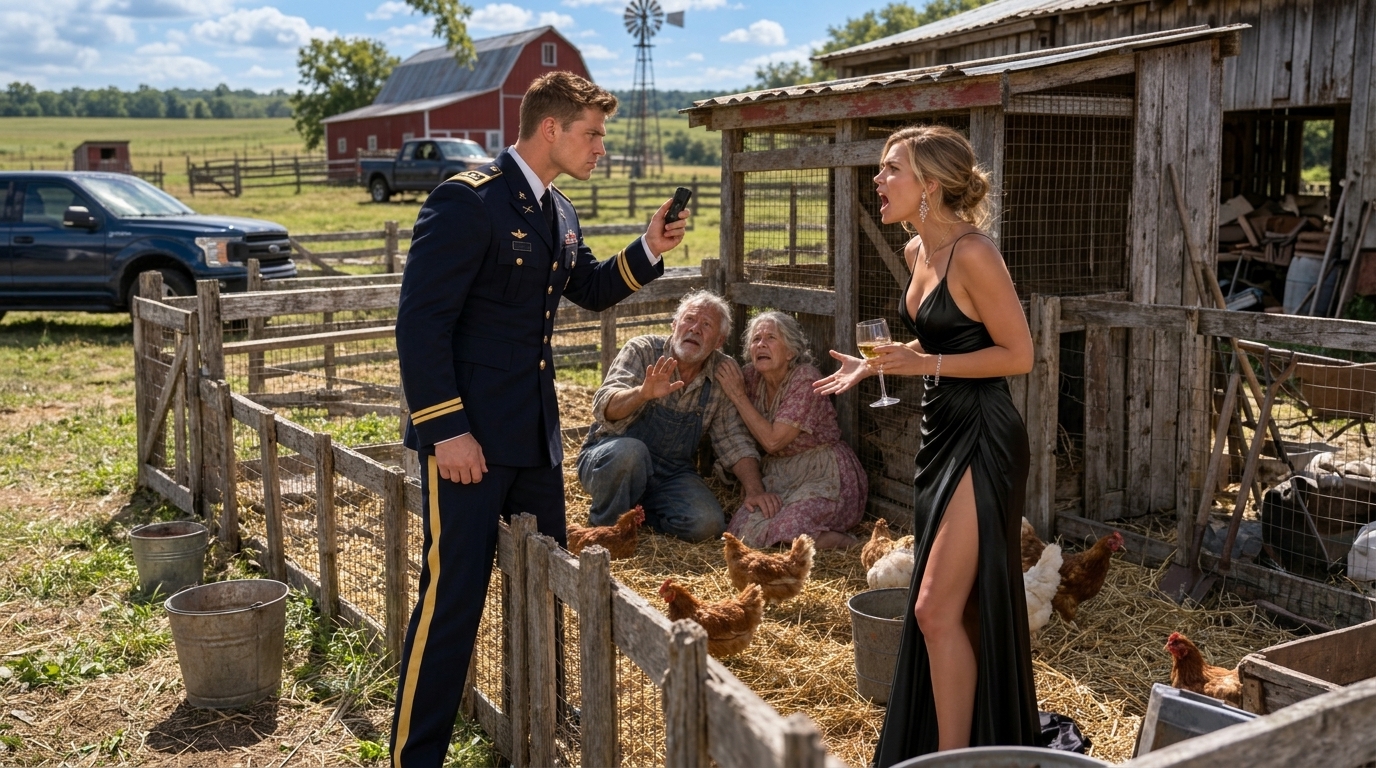
The sound of Claire’s wineglass shattering against
the porch boards was the first honest thing I’d heard from her since returning home.
For a moment, nobody moved.
The three strangers standing behind my wife stopped laughing.
Music continued playing inside the farmhouse,
some cheerful country song that suddenly sounded
obscene against the sight of my parents trembling inside a chicken coop.
Claire stared at the phone in my hand.
“What hidden camera?” she asked.
Her voice was different now.
The arrogance was gone.
I didn’t answer immediately.
Instead, I looked toward the barn, where a weather vane shaped like a running horse turned slowly in the afternoon wind.
Two years earlier, before leaving for deployment, I’d installed a discreet security system after several expensive pieces of farm equipment disappeared from neighboring properties.
The visible cameras were ordinary.
Claire knew where they were.
She even knew the password to the main monitoring application.
But my father had insisted on keeping a separate backup system because he didn’t trust technology that could be disabled with a single switch.
I’d laughed at him then.
Now I wanted to fall to my knees and thank him.
The backup system used an independent power supply and stored encrypted recordings remotely whenever the connection was available.
It covered the barn entrance, the chicken coop, the rear porch, and the gravel driveway.
And Claire had spent months committing her cruelty directly beneath it.
“Daniel,” she said carefully, “whatever you think you saw, there’s an explanation.”
I looked at my father’s swollen face.
Then at my mother’s trembling hands.
“An explanation?”
Claire stepped closer.
“Your parents have been difficult. Your father forgets things. Your mother gets hysterical. I’ve been dealing with them alone while you’ve been playing soldier overseas.”
Something inside me went cold.
“Don’t take another step.”
She stopped.
I pulled out my phone and called emergency services.
Claire’s eyes widened.
“Are you seriously calling the police on your own wife?”
“I’m calling an ambulance for my parents.”
“Daniel, don’t be ridiculous.”
I gave the dispatcher our address and explained that two elderly people had been confined, injured, and deprived of food.
When the dispatcher asked whether the person responsible was still present, I looked directly at Claire.
“Yes.”
Claire began shaking her head.
“You’re making a terrible mistake.”
I ignored her.
The dispatcher instructed me to keep everyone separated and avoid confronting Claire further.
I turned toward the three strangers.
“Leave the property. Now.”
One man raised both hands.
“Hey, we didn’t know anything about this.”
“Then tell the police what you saw when you arrived.”
They exchanged nervous glances.
One woman hurried toward her car.
The others followed.
Claire watched them leave, then turned back toward me with an expression I’d once mistaken for vulnerability.
“Baby, please.”
That word nearly made me sick.
For seven years, she’d called me that whenever she wanted forgiveness.
Now she was using it while my parents sat injured behind her.
“Don’t call me that.”
Her face hardened.
“You have no idea what it’s been like taking care of them.”
My father spoke from behind me.
“She never took care of us.”
His voice was barely audible.
“She sold our tractor, Daniel. The red one your grandfather bought. She sold your mother’s jewelry. She took money from our accounts.”
Claire spun toward him.
“Shut your mouth!”
My mother flinched so violently that I instinctively stepped between them.
And that was when I understood something horrifying.
My parents weren’t merely afraid of being hurt.
They had learned to expect punishment whenever they spoke.
I knelt beside my mother.
“Mom, look at me.”
She struggled to meet my eyes.
“You’re safe now.”
Her lips trembled.
“She said if we told anyone, you’d be killed overseas.”
The world seemed to tilt.
“What?”
My father lowered his head.
“She showed us messages. Said they came from your commanding officer. Said you were in trouble and that she could make things worse.”
Claire’s face drained of color.
I stared at her.
“You told them you could have me killed?”
She crossed her arms.
“I never said that.”
My mother began crying again.
“She said she knew people. She said accidents happen in war.”
I had spent two years surrounded by danger.
I’d slept through explosions, carried wounded friends, and wondered whether I’d ever see my family again.
But nothing had prepared me for discovering that the person I trusted most had used my deployment to terrorize the people I loved.
I wanted to scream.
Instead, I took my father’s hand.
“Nobody can hurt me because you tell the truth.”
He nodded weakly.
Then he whispered something that made my stomach tighten.
“Daniel, there’s more.”
Before he could continue, sirens sounded in the distance.
Claire immediately straightened her blouse.
She wiped her eyes.
And just like that, she became the woman everyone in town admired.
The devoted military wife.
The charming volunteer.
The woman who posted photographs of care packages and patriotic decorations.
By the time the first patrol car pulled into our driveway, Claire was crying convincingly.
“Officer, thank goodness,” she called. “My husband just came home from deployment, and he’s extremely upset. I think he’s having some kind of episode.”
I stared at her.
She wasn’t even going to deny what she’d done.
She was going to make me the problem.
Two officers stepped out.
The older one introduced himself as Sergeant Michael Reeves.
The younger officer immediately noticed the chicken coop.
“What’s going on back there?”
Claire hurried forward.
“My in-laws have been experiencing serious confusion. Daniel misunderstood a situation, and now he’s threatening me.”
I held up my phone.
“My parents were locked inside that building. They’re injured. I’ve called for medical assistance.”
Sergeant Reeves looked toward the coop.
His expression changed.
He walked past Claire without another word.
When he saw my parents, he stopped.
For several seconds, he said nothing.
Then he turned toward his partner.
“Get the medical team back here as quickly as possible.”
Claire tried to follow him.
“Officer, I can explain.”
“Ma’am, stay where you are.”
My father attempted to stand.
He couldn’t.
Sergeant Reeves crouched beside him.
“Sir, can you tell me what happened?”
My father looked toward Claire.
Even from several yards away, she managed to frighten him.
I saw it happen.
His shoulders tightened.
His mouth closed.
Sergeant Reeves noticed too.
He gently positioned himself so my father couldn’t see her.
“Take your time.”
My father swallowed.
“She locked us in here.”
“Who did?”
“My son’s wife.”
Claire shouted from the porch.
“He’s confused!”
Sergeant Reeves turned sharply.
“Ma’am, I told you to remain quiet.”
My mother began speaking.
At first, her words came in broken fragments.
No food.
No medicine.
Locked doors.
Threats.
A forged document.
Then she said something I would never forget.
“We thought we were going to die in there.”
Sergeant Reeves’s expression hardened.
The ambulance arrived minutes later.
Two paramedics brought stretchers across the yard.
My mother resisted when they tried to lift her.
“Please don’t separate us,” she whispered.
One paramedic gently reassured her.
“We’re taking you both to the hospital.”
My father reached for my hand.
“Don’t let her take the house.”
I leaned close.
“Forget the house, Dad. I need you alive.”
His eyes filled with tears.
“I promised your grandfather I’d protect it.”
“You protected us your whole life. Let me protect you now.”
As the paramedics worked, Sergeant Reeves asked whether I had evidence beyond my parents’ statements.
I opened the security application.
My hands were still trembling.
The first recording was dated four months earlier.
It showed Claire standing outside the barn with my father.
He was holding a folder.
She pointed toward the farmhouse.
Even without sound, her aggression was unmistakable.
Then the audio began.
“Sign the transfer, Harold.”
My father’s voice sounded weak.
“The farm belongs to our family.”
Claire stepped closer.
“Your family? Daniel is never here. I’m the one running everything.”
“That doesn’t make it yours.”
She slapped him.
Hard.
My father stumbled against the barn wall.
Sergeant Reeves leaned closer to the screen.
“Can you send me that file?”
“Yes.”
“Do you have more?”
I looked at the archive.
Hundreds of recordings.
“Months.”
Claire was watching from the porch.
She couldn’t hear the audio, but she saw Sergeant Reeves’s expression.
And for the first time since I’d known her, my wife looked genuinely afraid.
I opened another recording.
This one was from eleven days earlier.
My mother stood outside the chicken coop.
Claire held a plate of food.
“Please,” my mother begged. “Harold needs his medicine.”
Claire laughed.
“Then tell him to sign.”
“He doesn’t understand what you want.”
“He understands perfectly.”
Claire threw the plate into the dirt.
Food scattered across the ground.
My mother knelt to gather it.
Claire kicked the plate away.
Sergeant Reeves closed his eyes briefly.
Then he spoke into his radio.
“Request a supervisor and an investigator. Possible prolonged elder abuse, unlawful confinement, and financial exploitation.”
Claire heard those words.
She immediately began backing toward the farmhouse.
The younger officer stepped into her path.
“Ma’am, where are you going?”
“I need my medication.”
“We can arrange that. Please stay here.”
Claire looked at me.
And the hatred in her eyes was so intense that I barely recognized her.
“You planned this,” she whispered.
I almost laughed.
“I planned to come home to my family.”
She leaned closer.
“You have no idea what you’ve started.”
I looked toward the ambulance carrying my parents.
“Neither do you.”
But as the ambulance doors closed, my father suddenly grabbed the paramedic’s sleeve.
“Tell Daniel about the basement.”
The paramedic looked confused.
My father struggled to speak.
“The locked cabinet. Behind the furnace.”
I stepped closer.
“Dad, what cabinet?”
His breathing became shallow.
“She wasn’t working alone.”
Then the paramedic asked me to step back.
The ambulance pulled away.
I stood frozen in the driveway.
Claire had stopped crying.
She was staring at me with a strange, calculating expression.
And I realized the recordings might reveal something even worse than what I’d already seen.
Someone else had helped my wife destroy my parents.
Someone who knew exactly what she was doing.
And whatever was hidden behind our basement furnace was important enough that my father had used his remaining strength to warn me.
PART 4
By sunset, my parents were in separate hospital rooms.
My mother had three fractured ribs, severe dehydration, and signs of prolonged malnutrition.
My father had a fractured wrist, extensive bruising, and an untreated infection that doctors said could have become life-threatening.
Both were exhausted.
Both were terrified.
And both kept asking the same question.
“Is Claire coming?”
Every time, I gave them the same answer.
“No.”
But I knew reassurance alone couldn’t erase months of terror.
Sergeant Reeves had arranged for a detective to meet me at the hospital.
Her name was Rebecca Morgan.
She was in her early forties, with sharp eyes and the calm manner of someone who had learned that the worst crimes were often committed behind ordinary front doors.
She sat across from me in a small consultation room.
“Daniel, your wife has been detained while we investigate. The footage you’ve provided is significant, but we need to understand the full extent of what happened.”
I nodded.
“Whatever you need.”
She opened a notebook.
“Your father mentioned a cabinet in the basement.”
“Yes.”
“Do you know what’s inside?”
“No.”
“Does your wife have access to the basement?”
“She has access to the entire house.”
Detective Morgan leaned forward.
“Your parents’ medical conditions are serious. We believe there may be evidence of financial exploitation alongside the physical abuse.”
I remembered my father’s words.
The tractor.
The jewelry.
The accounts.
“How much did she take?”
“We don’t know yet.”
I stared at the floor.
For two years, I’d sent money home every month.
I believed Claire was using it to maintain the farm and help my parents.
I’d sent extra money for medical appointments.
For groceries.
For repairs.
When my father needed a new hearing aid, I’d transferred nearly three thousand dollars.
When my mother supposedly needed dental work, I’d sent another four thousand.
Claire always thanked me.
She sent photographs of home-cooked meals.
She told me my parents were comfortable.
And whenever I asked to speak to them, there was an excuse.
They were sleeping.
They were visiting neighbors.
The internet wasn’t working.
My father had misplaced his phone.
I remembered one particular video call.
It had been six months earlier.
Claire sat in the kitchen wearing a blue sweater I’d bought her before deployment.
Behind her, the farmhouse looked spotless.
Fresh flowers stood on the table.
She smiled into the camera.
“Everything’s wonderful here, sweetheart.”
I’d asked where Mom and Dad were.
She hesitated.
Then she said they’d gone to a church luncheon.
Now I wondered whether they’d been locked inside the chicken coop while she smiled at me.
The thought made me physically ill.
Detective Morgan watched my expression.
“Daniel?”
I looked up.
“I believed her.”
She spoke gently.
“People who abuse vulnerable family members often work very hard to control what outsiders see.”
I rubbed my face.
“Can I show you something?”
I opened the messages Claire had sent during my deployment.
Photographs of groceries.
Receipts.
Medical bills.
Bank transfer confirmations.
Detective Morgan studied them.
“May I have copies?”
“All of them.”
She examined one receipt more closely.
It supposedly came from a medical clinic in the next county.
“Interesting.”
“What?”
“The business name doesn’t match the address.”
I leaned forward.
She continued.
“We’ll verify it. But this may not be a genuine receipt.”
That was the moment I realized Claire hadn’t merely become cruel after I left.
She had built an entire system around deception.
Every message.
Every photograph.
Every excuse.
All designed to keep me sending money while my parents suffered.
The next morning, Detective Morgan called.
“We’ve obtained a search warrant for the farmhouse and outbuildings. We found the cabinet your father described.”
I sat upright.
“What was inside?”
“Documents. Bank records. Several identification cards. A collection of signed and unsigned property forms.”
She paused.
“And something else.”
“What?”
“A notebook containing names, payment amounts, and dates.”
I frowned.
“Whose names?”
“We’re still verifying them. But one name appears repeatedly.”
She told me.
Marcus Vale.
I knew him.
He was Claire’s older brother.
A real estate investor who always seemed to have expensive cars despite constantly complaining about money.
He’d visited our farm twice before my deployment.
Both times, he’d talked about how valuable the property could become if the county expanded the nearby highway.
I’d dismissed him as an opportunist.
Now I remembered his exact words.
“Harold is sitting on a gold mine and doesn’t even know it.”
I gripped the phone.
“Marcus helped her?”
“We have evidence suggesting his involvement. We need to establish precisely what he did.”
She explained that investigators had found draft transfer documents naming a company associated with Marcus.
The proposed sale price was astonishing.
One dollar.
My family’s farm consisted of nearly two hundred acres.
My grandfather had purchased the original property after returning from military service.
My father had spent his entire adult life expanding it.
The farmhouse had been built by three generations of Carters.
And Claire apparently intended to transfer it to her brother’s company for the price of a candy bar.
“Why?” I whispered.
Detective Morgan hesitated.
“There’s another document. A preliminary purchase proposal from a development group.”
“How much?”
“Approximately four million dollars.”
For several seconds, I couldn’t speak.
Four million dollars.
That was what my parents’ suffering had been worth to Claire.
Not a misunderstanding.
Not frustration.
Not the burden of caregiving.
Greed.
Cold, deliberate greed.
She wanted my parents to surrender their home so she and her brother could sell it.
And when they refused, she’d tried to break them.
I asked Detective Morgan whether Marcus had been arrested.
“Not yet. We’re pursuing additional evidence.”
I thanked her and ended the call.
Then I walked into my father’s hospital room.
He was awake, staring at the ceiling.
A bandage covered his wrist.
His bruises looked even darker beneath the fluorescent lights.
When he saw me, he attempted to smile.
“Hey, soldier.”
I pulled a chair beside his bed.
“Hey, Dad.”
He studied my face.
“You found it.”
I nodded.
“The cabinet.”
He closed his eyes.
“I hoped you would.”
“Why didn’t you tell someone?”
His expression changed.
“We tried.”
I leaned forward.
“What do you mean?”
He swallowed.
“Your mother got away once. About three months ago.”
My heart began pounding.
“She escaped?”
“Claire forgot to lock the back door. Your mother walked nearly two miles to the road.”
He stopped to catch his breath.
“She reached the gas station. Asked the clerk to call the sheriff.”
“What happened?”
“Marcus arrived before anyone could help.”
I stared at him.
“He told the clerk your mother had dementia. Said she wandered away from home.”
My father looked ashamed.
“She was confused from hunger. She couldn’t explain everything clearly.”
I took his hand.
“That doesn’t make it your fault.”
He continued.
“Marcus brought her back. Claire punished her.”
I felt a terrible pressure behind my eyes.
“What did she do?”
“Locked her in the coop for three days.”
My father began crying.
I’d seen him cry only twice before.
Once when my grandfather died.
And once when my younger sister was buried after a car accident.
Now this strong, stubborn man was crying because he couldn’t protect the woman he’d loved for fifty-three years.
I leaned forward and hugged him carefully.
“I’m here now.”
He gripped my shirt.
“I tried, Daniel.”
“I know.”
“I tried to keep her safe.”
“I know, Dad.”
He pulled away.
“There’s something else.”
I waited.
“Claire made us write letters.”
“What letters?”
“To you.”
My throat tightened.
“She said if we didn’t write what she wanted, she’d stop giving your mother her heart medication.”
I stared at him.
“Did she send them?”
“I don’t know.”
I remembered receiving a handwritten letter from my father eight months earlier.
It said they were doing well.
That they didn’t need me to worry.
That Claire had been a blessing.
I’d carried that letter in my uniform pocket for weeks.
Now I understood why the handwriting looked shaky.
My father had written it under threat.
I took out my wallet.
The folded letter was still there.
I handed it to him.
He recognized it immediately.
His face crumpled.
“She stood over me while I wrote that.”
I couldn’t speak.
He touched the paper.
“I wanted to tell you the truth.”
I folded the letter carefully.
“You just did.”
Later that afternoon, I visited my mother.
She was sitting upright with pillows supporting her back.
A nurse had brushed her hair.
For the first time since my return, she looked almost like herself.
When she saw me, she smiled.
“My handsome boy.”
I kissed her forehead.
She touched my cheek.
“You’re thinner.”
I laughed despite everything.
“Mom, you’re in the hospital, and you’re worried about whether I’ve been eating?”
“That’s what mothers do.”
Then her smile faded.
“Daniel, I’m sorry.”
I pulled up a chair.
“For what?”
“For not telling you.”
I shook my head.
“You don’t owe me an apology.”
She looked toward the window.
“Claire said you wouldn’t believe us.”
I felt my chest tighten.
“She said you’d think we were old and confused. She said you’d choose your wife.”
I took both her hands.
“Mom, listen carefully. There is no version of this story where I choose someone who hurts you.”
Tears rolled down her cheeks.
She whispered, “I prayed you’d come home.”
I leaned forward.
“I’m home.”
She squeezed my hands.
“Then promise me something.”
“Anything.”
“Don’t let what she did turn you into someone cruel.”
I looked at her.
She continued.
“Your father and I have lost enough. I don’t want to lose the son we raised.”
That broke something open inside me.
Because she was right.
I’d spent the last twenty-four hours imagining every possible way to make Claire suffer.
But my mother wasn’t asking for revenge.
She was asking for her family back.
I kissed her hand.
“I promise.”
That evening, Detective Morgan called again.
Her voice was unusually serious.
“Daniel, we found another recording.”
I stood.
“What recording?”
“It came from your backup archive. We recovered a file that wasn’t showing in your mobile application.”
My pulse quickened.
“What’s on it?”
“A conversation between Claire and Marcus.”
She paused.
“Daniel, I need you to prepare yourself.”
I sat down slowly.
“Tell me.”
“Your wife wasn’t simply planning to sell the farm.”
My mouth went dry.
“Then what?”
Detective Morgan’s next words changed everything.
“She and Marcus discussed what would happen if your parents died before the property transfer was completed.”
I closed my eyes.
“Did they threaten to kill them?”
“The recording contains statements that may support additional serious charges. I don’t want to characterize it beyond what the evidence establishes.”
Then she told me one sentence from the recording.
Claire had said:
“If Harold doesn’t sign before Daniel gets home, we’ll make sure there isn’t anyone left to object.”
For a long moment, I heard nothing except my own breathing.
My parents hadn’t merely survived cruelty.
They may have survived a plan that could have ended their lives.
And Claire had been smiling on the porch when I arrived.
As though she had nothing to fear.
As though she still believed she controlled everything.
But the evidence was growing.
And the truth was finally catching up with her.
PART 5
Three days after my return, Marcus Vale was arrested.
I learned about it while sitting beside my mother’s hospital bed.
Detective Morgan called just after nine in the morning.
“Daniel, we’ve taken Marcus into custody.”
I closed my eyes.
“Thank you.”
“We also recovered messages between him and Claire discussing the property documents, your parents’ confinement, and the planned sale.”
“Are they admitting anything?”
“Not at this stage.”
I looked toward my mother.
She was sleeping peacefully.
For the first time in months, nobody was standing over her demanding a signature.
Nobody was withholding food.
Nobody was threatening her son.
“Will they be held accountable?”
Detective Morgan answered carefully.
“We have substantial evidence. Prosecutors will determine the charges, and the courts will decide the outcome.”
It wasn’t the dramatic promise of revenge I might once have wanted.
But it was something better.
A process that Claire couldn’t control with tears, threats, or lies.
Over the following weeks, the investigation uncovered a trail of deception stretching back more than a year.
Claire had intercepted mail.
She had impersonated my mother during telephone calls.
She had used forged authorization forms to access financial information.
Investigators identified questionable withdrawals, transfers, and purchases.
Some money had gone toward luxury clothing.
Some toward expensive vacations.
And some had been transferred to a company connected to Marcus.
The most painful discovery came from a collection of messages between Claire and her brother.
In one conversation, Marcus complained that my father was being stubborn.
Claire replied:
“He’ll give in eventually. Old people always do when you take away their comfort.”
In another message, Marcus suggested that my parents might be easier to control if they were isolated.
Claire responded:
“Already handled.”
I read those words in Detective Morgan’s office.
Then I put the papers down.
Because I couldn’t bear the thought that my parents’ suffering had been discussed as casually as a business transaction.
Detective Morgan waited quietly.
Finally, I asked the question that had haunted me since coming home.
“Why didn’t anyone notice?”
She looked at me.
“Some people did.”
I raised my head.
She opened another folder.
“A neighbor reported concerns about your parents several months ago. The report didn’t result in enough evidence for immediate intervention.”
“Who?”
“Mrs. Evelyn Brooks.”
I knew her.
She lived on the adjoining property.
She’d been my mother’s closest friend for nearly thirty years.
Detective Morgan continued.
“She noticed your parents stopped attending church. She saw Claire selling farm equipment. She also heard shouting one afternoon.”
“What happened when she asked?”
“Claire told her your parents had moved into assisted living.”
I stared at the detective.
“She told everyone they were gone?”
“Several people, apparently.”
Suddenly, the pieces began fitting together.
Claire hadn’t simply hidden my parents inside the chicken coop.
She’d erased them from their own community.
To the neighbors, they were elderly people who had moved away.
To me, they were happy and comfortable at home.
To the bank, they were supposedly authorizing transactions.
And to Claire, they were obstacles standing between her and millions of dollars.
The farmhouse had become a stage set.
Every clean kitchen photograph.
Every cheerful holiday message.
Every smiling video call.
All of it concealed a nightmare happening just yards away.
I drove to Mrs. Brooks’s house that afternoon.
She opened the door and immediately began crying.
“Daniel.”
I hugged her.
She held on tightly.
“I knew something was wrong.”
“I know.”
“I tried to see your mother. Claire wouldn’t let me.”
I stepped inside.
Mrs. Brooks showed me a small box.
Inside were birthday cards, homemade cookies she’d never been allowed to deliver, and several letters she’d written to my mother.
Every envelope had been returned.
“I thought maybe your mother didn’t want to see me anymore,” she whispered.
I shook my head.
“She asked about you yesterday.”
Mrs. Brooks covered her mouth.
Then she began crying again.
We sat together for nearly an hour.
She told me how Claire had gradually isolated my parents.
At first, Claire said they were tired.
Then sick.
Then confused.
Finally, she claimed they’d moved.
Whenever someone asked questions, Claire became offended.
“After everything I do for them,” she’d say, “people still think I’m not taking proper care of them.”
And because she was charming, well dressed, and married to a deployed service member, many people believed her.
Mrs. Brooks hadn’t.
But suspicion wasn’t enough to open locked doors.
Before I left, she touched my arm.
“Tell your mother I’m coming to see her.”
I smiled.
“She’ll be waiting.”
Two weeks later, my parents were discharged from the hospital.
I didn’t take them back to the farmhouse immediately.
The doctors recommended rehabilitation, nutritional support, and counseling.
So I arranged for them to stay temporarily in a quiet recovery residence where they could receive proper care.
The first night, my father called me at eleven.
“Daniel?”
“What’s wrong, Dad?”
There was a long silence.
Then he asked something that nearly broke my heart.
“Are we allowed to eat the food in the refrigerator?”
I closed my eyes.
“Of course.”
“They told us we could take whatever we wanted.”
“Then take whatever you want.”
Another silence.
“Even at night?”
My throat tightened.
“Especially at night.”
He let out a shaky breath.
“Your mother wants some pudding.”
I laughed softly through my tears.
“Tell her to have two.”
He chuckled.
It was the first genuine laugh I’d heard from him since coming home.
After we hung up, I sat alone in my car for a long time.
I realized recovery wasn’t going to happen simply because Claire had been arrested.
My parents had spent months being taught that food was a privilege.
That speaking was dangerous.
That asking for help brought punishment.
Their bodies might heal in weeks.
Their sense of safety would take much longer.
And I intended to give them all the time they needed.
Meanwhile, I began the painful process of ending my marriage.
My attorney, Sarah Bennett, reviewed the financial records and helped me separate my accounts from Claire’s.
We documented my military pay, the money I’d sent home, and the property records.
The farm was legally owned by my parents, which meant Claire had never possessed the authority she’d claimed.
The forged transfers hadn’t successfully changed ownership.
The property remained in the Carter family.
But the financial damage was extensive.
Sarah explained that recovering every dollar might be difficult.
I told her I understood.
Then she asked what I wanted from the divorce.
I thought about the house.
The furniture.
The vehicles.
The wedding photographs still hanging in our bedroom.
And I realized none of it mattered anymore.
“I want a clean legal separation,” I said. “And I want my parents protected.”
Sarah nodded.
“We’ll focus on that.”
Claire tried contacting me through several people.
First came her cousin.
Then an old friend.
Then a letter from her attorney proposing that we discuss our marriage privately.
I declined.
A week later, I received a handwritten letter from Claire herself.
I almost threw it away.
Instead, I gave it to Sarah.
After reviewing it, she asked whether I wanted to read it.
I did.
The letter began with an apology.
But by the second paragraph, Claire was blaming stress.
By the third, she blamed my parents.
By the fourth, she blamed my deployment.
She wrote that she had felt abandoned.
That the farm had overwhelmed her.
That she’d made mistakes.
Then came the sentence that told me she still didn’t understand what she’d done.
“I hope you’ll remember that your parents were never easy people to live with.”
I folded the letter.
Handed it back to Sarah.
And said, “Please tell her attorney not to send me anything personal again.”
That was the last time I voluntarily read a message from my wife.
Months passed.
My father began walking without assistance.
My mother’s ribs healed.
They both attended counseling.
Some days were good.
Some were terrible.
My father occasionally woke from nightmares, convinced he was back inside the chicken coop.
My mother startled whenever someone closed a door too loudly.
But slowly, ordinary life began returning.
One afternoon, I visited them and found my mother making biscuits in the recovery residence’s shared kitchen.
Flour covered her hands.
My father sat nearby peeling apples.
They were arguing.
Not about anything serious.
About whether my mother had added enough cinnamon.
I stood in the doorway listening.
My father insisted she’d used too much.
My mother told him he’d complained about her cooking for fifty years and had somehow survived every meal.
Then they both laughed.
I had to step outside.
Because hearing them argue about cinnamon felt like witnessing a miracle.
By the time the criminal case reached court, the prosecution had assembled a substantial body of evidence.
Medical reports.
Financial records.
Witness statements.
Messages.
Documents.
And the recordings.
Claire’s defense initially suggested that my parents had exaggerated their injuries and that the footage lacked context.
But the recordings showed repeated incidents over several months.
They showed threats.
They showed deprivation.
They showed Claire demanding signatures.
And they showed my parents begging for food and medicine.
Marcus’s attorney argued that he had been involved only in legitimate property negotiations.
The prosecution presented messages and financial records challenging that claim.
I attended the proceedings whenever I could.
My parents testified with accommodations designed to reduce the strain on them.
My mother spoke first.
She wore a pale blue dress and the pearl earrings my grandfather had given her on her wedding day.
Her hands trembled as she took the witness stand.
But her voice was clear.
When asked what Claire had done, she described the locked doors, the hunger, and the threats.
Then the prosecutor asked why she hadn’t tried harder to escape.
My mother looked toward the jury.
“Because every time I tried, my husband suffered for it.”
The courtroom became silent.
She continued.
“I wasn’t afraid of dying. I’m old. I’ve lived a good life. But I was afraid of leaving Harold alone with her.”
I lowered my head.
Beside me, my father began crying.
My mother looked at him.
And smiled.
Even then.
Even after everything.
She smiled at the man she’d spent fifty-three years loving.
My father testified the following day.
He brought no dramatic speech.
No rehearsed accusations.
He simply told the truth.
He explained how Claire demanded the property.
How she confiscated their phones.
How she threatened my safety overseas.
How she used food and medicine to force compliance.
Then the prosecutor asked him why he hadn’t signed the documents.
My father looked down at his hands.
“Because my father built that farm.”
He paused.
“His father worked that land before him.”
Another pause.
“And my son grew up there.”
His voice cracked.
“I wasn’t going to give away three generations of sacrifice because somebody frightened me.”
I wiped my eyes.
The prosecutor gently asked whether he regretted refusing.
My father looked toward me.
Then toward my mother.
“Sometimes,” he admitted.
The courtroom went still.
“When I saw my wife hurting, I thought maybe I should have signed.”
He swallowed.
“But now I know it wasn’t really about the land.”
“What was it about?” the prosecutor asked.
My father answered quietly.
“She wanted us to believe we didn’t matter.”
I will remember those words for the rest of my life.
Because they explained the cruelty more clearly than any recording ever could.
Claire hadn’t merely wanted property.
She wanted power.
She wanted two elderly people to feel helpless.
And she’d used every weakness she could find to make them surrender.
The trial continued for several weeks.
I testified about my deployment, the financial transfers, and the day I returned home.
The defense questioned my memory and emotional state.
I answered calmly.
Then the prosecutor played a recording from the afternoon I arrived.
Claire’s voice filled the courtroom.
“They’re old, Daniel. They’re worthless.”
I watched the jury.
Several jurors looked toward my parents.
Claire stared at the table.
The prosecutor stopped the recording.
Then asked me one final question.
“Mr. Carter, when you returned home, what were you expecting to find?”
I looked at Claire.
Then at my parents.
“A family waiting for me.”
My voice shook.
“Instead, I found two people who had spent their lives protecting me begging me not to make their abuser angry.”
I paused.
“I don’t think I’ll ever forget that.”
The jury eventually returned guilty verdicts against Claire on multiple charges involving abuse, unlawful confinement, and financial exploitation.
Marcus was also convicted on charges connected to the conspiracy and fraudulent property scheme.
The court later imposed substantial prison sentences.
The precise years mattered less to me than the fact that my parents were finally believed.
At sentencing, the judge allowed victim impact statements.
My father declined to speak.
He said he’d already told the truth and wanted to go home.
My mother chose to address the court.
She stood slowly.
I moved to help her, but she gently shook her head.
She wanted to stand on her own.
She looked toward Claire.
For several seconds, neither woman spoke.
Then my mother said, “I welcomed you into my home because my son loved you.”
Claire lowered her eyes.
“I cooked for you. I prayed for you. I defended you when people said you were selfish.”
My mother’s voice trembled.
“And when my son went overseas, I believed you would be part of our family.”
She took a breath.
“You took our food. You took our medicine. You took our dignity.”
A tear rolled down her cheek.
“But there’s one thing you couldn’t take.”
Claire looked up.
My mother continued.
“You couldn’t make us stop loving each other.”
I felt my father’s hand tighten around mine.
My mother looked toward the judge.
“I don’t want revenge. I want to spend whatever years I have left without being afraid.”
Then she sat down.
And that was enough.
There was no applause.
No dramatic confrontation.
Just silence.
The kind of silence that follows a truth nobody can argue with.
Six months after the trial, I brought my parents back to the farm.
The farmhouse had been cleaned and repaired.
The locks had been replaced.
The damaged furniture was gone.
I removed the photographs of Claire.
I repainted the kitchen.
I restored my grandfather’s old rocking chair.
And I bought my mother a new set of curtains, exactly like the yellow ones she’d hung when I was a child.
But there was one building I couldn’t bear to look at.
The chicken coop.
It stood behind the barn, its rusted hinges creaking whenever the wind blew.
I wanted to tear it down.
Burn every board.
Erase every trace of what had happened.
One Saturday morning, I carried a toolbox toward it.
My father was sitting on the porch.
“Where are you going?”
“To take that thing apart.”
He watched me for a moment.
Then he stood.
“Wait.”
I turned.
He walked slowly toward me.
His wrist had healed, but he still moved carefully.
When he reached the coop, he studied it.
Then he said, “Don’t destroy it.”
I stared at him.
“Dad, why would you want to keep it?”
He touched the weathered wood.
“Because I don’t want that place to be the last word.”
I frowned.
He looked toward the orchard.
“Your mother always wanted a greenhouse.”
I blinked.
“A greenhouse?”
He nodded.
“She used to grow tomatoes behind the kitchen. Remember?”
I smiled faintly.
“She grew enough tomatoes to feed the entire county.”
My father chuckled.
“She wants to do it again.”
I looked at the chicken coop.
At the dirty straw.
The broken boards.
The door that had once been chained shut.
Then I understood.
He didn’t want to preserve the suffering.
He wanted to replace it.
So we dismantled the coop together.
Board by board.
Nail by nail.
We hauled away the ruined materials and cleaned the ground.
Then we built a greenhouse.
A beautiful one.
With clear panels, wide doors, raised planting beds, and a little bench where my parents could sit together.
My mother cried when she saw it.
Not the frightened tears I’d heard behind the barn.
Happy tears.
She walked inside and touched the wooden planting beds.
“Oh, Daniel.”
I smiled.
“Do you like it?”
She turned toward me.
“It’s beautiful.”
My father stood beside her.
“Now you can grow those terrible tomatoes again.”
She smacked his arm playfully.
He laughed.
And I laughed with him.
That spring, the greenhouse filled with life.
Tomatoes.
Cucumbers.
Peppers.
Basil.
Flowers.
My mother spent hours tending the plants.
My father built a little shelf for her gardening tools.
Sometimes I sat outside and watched them through the clear panels.
Two people who had survived something unimaginable.
Two people who were learning to feel safe again.
I eventually returned to military duty, but I arranged my next assignment so I could remain much closer to home.
I wanted to be present.
Not because my parents were helpless.
But because time had become precious.
I’d already lost two years believing everything was fine.
I wasn’t going to waste the years we had left.
One evening, nearly a year after my return, I found my father sitting on the porch.
The sun was setting over the fields.
He held two cups of coffee.
He handed me one.
We sat quietly.
After a while, he spoke.
“You know, Daniel, I used to think being strong meant never needing help.”
I looked at him.
He stared toward the barn.
“When Claire started hurting us, I kept thinking I could handle it.”
He paused.
“Then I couldn’t.”
I waited.
He turned toward me.
“I was ashamed.”
I set down my coffee.
“Dad, you have nothing to be ashamed of.”
He nodded slowly.
“I know that now.”
Then he smiled.
“Your mother keeps reminding me.”
I laughed.
“She usually knows what she’s talking about.”
He looked toward the greenhouse.
“She certainly thinks so.”
We sat together until the stars appeared.
Eventually, my mother called from the kitchen.
“Dinner!”
My father stood.
Then stopped.
He looked toward the greenhouse one last time.
“You know what I remember most about that day you came home?”
I swallowed.
“What?”
“Not the police.”
He shook his head.
“Not the camera.”
I waited.
He placed his hand on my shoulder.
“I remember you opening the door.”
My throat tightened.
He continued.
“For months, every time that door opened, something bad happened.”
His eyes filled with tears.
“But that day, it opened, and you were standing there.”
I couldn’t speak.
He squeezed my shoulder.
“That was the moment I knew we were going to live.”
I hugged him.
And for the first time since returning home, I allowed myself to cry without trying to hide it.
We stood beside the porch until my mother called again.
“Harold! Daniel! Your dinner is getting cold!”
My father chuckled.
“Better hurry. You know how she gets.”
We walked inside together.
The kitchen smelled of roasted chicken, fresh bread, and herbs from the greenhouse.
My mother had set three places at the table.
There was plenty of food.
The doors were unlocked.
Nobody was afraid.
And as I watched my parents laughing over dinner, I finally understood something I’d spent years learning in places far from home.
Sometimes courage means facing danger.
Sometimes it means telling the truth.
And sometimes, the greatest victory isn’t defeating the person who hurt you.
It’s helping the people you love reclaim the ordinary happiness that person tried to steal.
Claire had wanted the farm.
She had wanted the money.
She had wanted control.
Instead, she lost everything she’d tried to take.
My parents kept their home.
They kept their dignity.
And most importantly, they kept each other.
As for me, I kept the dog tags I’d been holding when I confronted Claire that afternoon.
I hung them beside a photograph of my parents standing inside their greenhouse, smiling beneath the spring sunlight.
Below the photograph, I placed a small wooden sign.
My father had carved the words himself.
“THIS HOME WAS BUILT WITH LOVE. FEAR WILL NEVER LIVE HERE AGAIN.”
And every morning, when I walked past that sign, I remembered the sound of my mother’s voice behind the barn.
I remembered the chain.
The bruises.
The hunger.
The fear.
But those were no longer the only memories that belonged to that place.
Now I remembered my mother’s laughter drifting from the greenhouse.
My father’s hands planting tomatoes.
Warm dinners.
Open doors.
And the simple, extraordinary blessing of coming home to people who were finally safe.
THE END THANK YOU FOR READING !!!



