PART 3
For a moment, I forgot how to breathe.
I stood in my sister Rachel’s kitchen,
four hours away from the house I’d purchased
with nearly every dollar I’d saved after my divorce,
listening to my attorney explain that someone had produced a document bearing my signature.
A signature dated three weeks before I even owned the property.
My ex-husband was inside my house.
His new wife was arranging furniture in my living room.
And my younger brother, Nathan,
was standing in my driveway holding paperwork
that apparently gave them permission to live there.
“Patricia,” I whispered, “I never signed anything like that.”
“I know,” she replied.
Her voice was calm, but I could hear the concern beneath it.
Your purchase wasn’t finalized until eleven days ago.
Any document claiming you transferred rights before closing deserves immediate scrutiny.
I looked down at my phone.
On the security camera, Mark was standing beside a police officer, gesturing angrily toward the house.
Vanessa had stopped carrying boxes.
Nathan was pacing near his SUV.
“Patricia, can they stay there?”
“That depends on what the officers determine and whether anyone has a legitimate claim of occupancy. But your deed, closing records, and the circumstances you’ve described are important evidence. I’m contacting the title company and preparing to send the police the documents.”
Rachel grabbed her car keys.
“We’re leaving now.”
I nodded.
My hands were shaking so badly I could barely close the camera application.
Then Patricia said something that stopped me.
“There’s another issue.”
I swallowed.
“What?”
“The document identifies Nathan as the manager of something called the Mercer Family Property Trust.”
I stared at the wall.
“Mercer?”
“Yes.”
That was my former married name.
For twenty-seven years, I’d been Elaine Mercer.
After the divorce, I’d returned to my maiden name.
Elaine Bennett.
My new house had been purchased under that name.
I had deliberately left the past behind.
But now someone had created a trust using the name I’d spent nearly three decades sharing with Mark.
“Patricia,” I said slowly, “I’ve never heard of that trust.”
“I suspected as much.”
“Then who created it?”
“We’re finding out.”
I looked at the security footage again.
Nathan was speaking to Mark.
They looked comfortable together.
Familiar.
Like men who had made plans and expected those plans to work.
And suddenly, I remembered something that made my stomach turn.
Three weeks earlier, Nathan had called to ask whether my divorce settlement had finally cleared.
I’d thought he was being protective.
He’d said, “I just want to make sure you’re financially secure, Elaine.”
Now I wondered whether he’d been checking how much money I had available.
Rachel and I left Louisville within fifteen minutes.
She insisted on driving.
I sat in the passenger seat with my phone, laptop, and a folder containing digital copies of my closing documents.
As we entered the highway, I called the police department handling the incident.
The dispatcher transferred me to an officer named Daniel Ruiz.
“Mrs. Bennett?”
“Yes.”
“I’m Officer Ruiz. We’re at your property.”
I gripped the phone.
“Are they still inside?”
“We’ve asked everyone to stop moving belongings while we determine what’s happening.”
“That’s my house.”
“I understand. We’ve received documentation showing you as the recorded owner.”
I closed my eyes.
“Thank God.”
“But your former husband has presented paperwork claiming permission to occupy the residence.”
My heart sank.
“It’s fraudulent.”
“That may be the case. We’re documenting the situation and reviewing the information available.”
I took a breath.
“Officer, I never gave him permission. He’s never lived there. I bought that house eleven days ago.”
“I understand.”
Then he asked, “Do you know a Nathan Bennett?”
My throat tightened.
“He’s my brother.”
“He says he was authorized to manage the property on your behalf.”
I stared through the windshield.
“No.”
My voice grew louder.
“No, he was not.”
Officer Ruiz paused.
“Did you give him access to the keypad?”
“He helped install it.”
“Did you give him permission to share the code?”
“Absolutely not.”
There was a brief silence.
Then the officer said, “Your brother claims you asked him to prepare the house for incoming occupants.”
I felt physically sick.
“That’s a lie.”
Rachel glanced at me.
I closed my eyes.
“Officer, I’m on my way. My attorney is sending documentation.”
“We’ll include everything in the report.”
I thanked him.
Then ended the call.
For several minutes, I stared at the road.
Finally, Rachel whispered, “Elaine, what has Nathan done?”
I shook my head.
“I don’t know.”
But I was beginning to understand something.
Mark hadn’t discovered my new address by accident.
He hadn’t guessed the keypad code.
And he hadn’t simply decided to move into an empty house.
Someone had given him everything he needed.
And that someone was my brother.
Nathan was forty-six.
Seven years younger than me.
When we were children, I’d practically helped raise him.
Our father worked long shifts at a manufacturing plant.
Our mother suffered from chronic migraines that sometimes kept her in bed for days.
I made Nathan breakfast.
Helped him with homework.
Walked him to school.
And defended him whenever he got into trouble.
He was charming.
Funny.
And remarkably good at convincing people that whatever disaster he’d created was someone else’s fault.
At sixteen, he borrowed Dad’s car without permission and damaged the bumper.
He blamed a neighbor.
At twenty-three, he borrowed money from me to start a landscaping business.
The business lasted four months.
He never repaid the loan.
At thirty-five, he convinced our mother to cosign a vehicle loan.
When he stopped making payments, she had to cover them.
But every time Nathan got into trouble, he arrived with an explanation.
A setback.
A misunderstanding.
Someone who had treated him unfairly.
And because he was my little brother, I kept forgiving him.
Even after Mom died, I felt responsible for him.
That was why I’d invited him to help with my new house.
He worked occasionally as a handyman.
He knew how to install smart locks.
And he’d sounded genuinely pleased when I told him I’d finally purchased a place of my own.
“Elaine, that’s fantastic,” he’d said.
“After everything Mark put you through, you deserve a fresh start.”
I remembered how grateful I’d felt.
Now I wondered whether he’d been gathering information from the moment I told him.
Two hours into the drive, Patricia called again.
“I’ve spoken with the title company.”
I sat upright.
“What did they say?”
“The recorded deed is in your name alone. There is no recorded transfer of ownership to this supposed trust.”
I exhaled.
“So the house is still mine.”
“Yes. The records we’ve reviewed support that.”
I pressed a hand against my chest.
“But there’s more,” Patricia continued.
“An individual contacted the title company shortly after closing, claiming to represent you.”
My stomach tightened.
“Who?”
“Nathan.”
I closed my eyes.
“What did he want?”
“He requested copies of certain closing documents and asked about the process for transferring the property into a trust.”
I stared at Rachel.
She glanced over.
Patricia continued.
“The title company declined to act on his instructions without appropriate authorization.”
I whispered, “So he tried to transfer my house?”
“He appears to have explored that possibility. We need more information before drawing conclusions about his precise intentions.”
I looked down at my phone.
There was a message from Nathan.
Elaine, please don’t overreact. Mark and Vanessa just need somewhere to stay temporarily. We can explain everything.
I stared at it.
Then another arrived.
You’re making this much bigger than it needs to be.
I felt a strange calm settle over me.
Those words.
I’d heard them from Mark for twenty-seven years.
Whenever I discovered an unexplained charge.
Whenever he made a decision without consulting me.
Whenever he invited relatives to stay without asking.
Whenever I objected to being treated like an inconvenience in my own home.
You’re overreacting.
You’re making a big deal out of nothing.
Can’t you just be reasonable?
For years, those phrases had worked.
I would argue.
He would dismiss me.
And eventually, I would apologize for being upset.
But that marriage was over.
And I wasn’t going to repeat it with my brother.
I typed one sentence.
You had no authority to give anyone access to my home. Do not contact me except through my attorney regarding this matter.
Then I sent it.
We arrived in Ohio shortly after three.
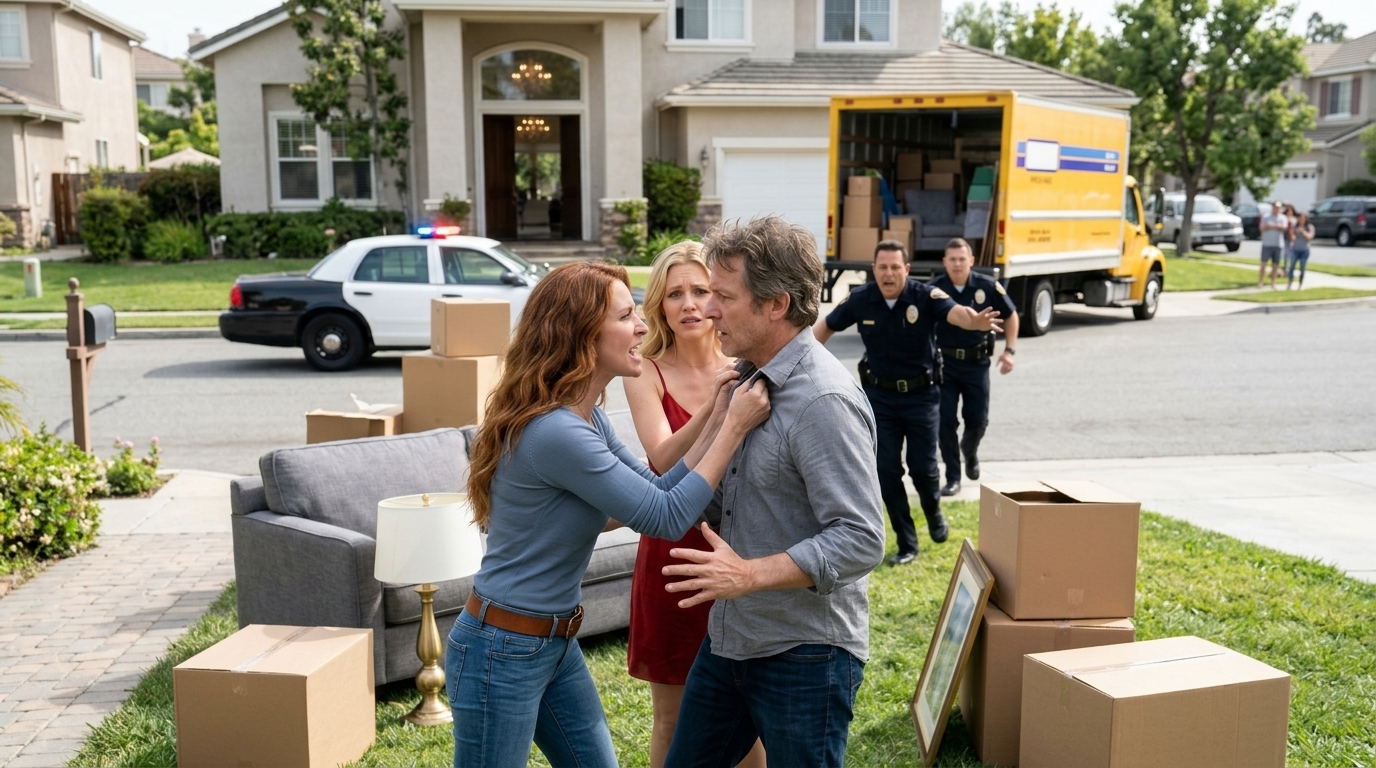
By then, the moving truck was still parked outside my house.
Two police cruisers remained nearby.
Mark stood on the sidewalk with his arms crossed.
Vanessa was sitting in the passenger seat of their SUV.
Nathan leaned against his vehicle, talking on the phone.
When Rachel pulled into the driveway, Mark immediately marched toward us.
“Elaine!”
I stepped out.
He pointed toward the house.
“What the hell is wrong with you?”
I looked at him.
For twenty-seven years, his anger had made me shrink.
Now it simply exhausted me.
“Mark, leave my property.”
He laughed.
“You can’t be serious.”
I glanced toward Officer Ruiz, who was approaching.
“I’m completely serious.”
Mark stepped closer.
“We have an agreement.”
“No, you have a document I never signed.”
His expression flickered.
Only for a second.
But I saw it.
Then he recovered.
“Nathan said everything was arranged.”
I looked toward my brother.
He had stopped talking on the phone.
I turned back to Mark.
“Then Nathan lied to you.”
Mark’s face reddened.
“You always have to make everything difficult.”
I smiled sadly.
“That’s what you used to say whenever I asked you to respect me.”
He opened his mouth.
I continued.
“The difference is that I don’t have to listen anymore.”
Officer Ruiz approached.
“Mrs. Bennett?”
“Yes.”
“We’ve reviewed the ownership documentation your attorney provided. At this point, we have no verified authorization permitting these individuals to occupy the property.”
I felt relief wash over me.
He continued.
“We’ve instructed them to remove the belongings they brought in today. We’ll document the disputed paperwork separately.”
Mark exploded.
“This is ridiculous!”
Officer Ruiz remained calm.
“Sir, lower your voice.”
Mark pointed at me.
“She agreed to this!”
I stared at him.
“When?”
He hesitated.
“Through Nathan.”
I looked at Officer Ruiz.
“I never authorized Nathan to make occupancy arrangements.”
The officer nodded.
“That’s noted.”
Vanessa finally stepped out of the SUV.
She was wearing expensive sunglasses and a cream-colored jacket.
She looked furious.
“Elaine, this is unbelievably selfish.”
I turned toward her.
“Excuse me?”
She gestured toward the house.
“Mark told me this place was available.”
I stared at her.
“It’s my home.”
She crossed her arms.
“We’ve already paid for movers.”
“Then I suggest you ask Mark to reimburse you.”
Her mouth fell open.
I continued.
“You cannot move into someone else’s house because moving out would be inconvenient.”
Nathan finally approached.
“Elaine, can we talk privately?”
I looked at him.
“No.”
His face tightened.
“Please.”
“You can speak in front of Officer Ruiz.”
He glanced toward the policeman.
Then lowered his voice.
“This is a misunderstanding.”
I stared at him.
“Did you give Mark my address?”
He hesitated.
“Yes.”
“Did you give him my keypad code?”
He looked down.
“Yes.”
“Did you prepare paperwork claiming you had authority over my property?”
His jaw tightened.
“I was trying to help.”
I felt tears burn behind my eyes.
“Help whom?”
He looked toward Mark.
Then back at me.
“Everyone.”
I shook my head.
“Not me.”
His expression hardened.
“Elaine, you’ve got a whole house to yourself. Mark and Vanessa are having financial problems.”
I stared at him.
“So?”
“They needed somewhere to stay.”
“And that entitled them to my house?”
He sighed dramatically.
“It’s temporary.”
I took a slow breath.
“Nathan, I bought this house because I wanted peace.”
He rolled his eyes.
“Don’t be so dramatic.”
I felt something inside me settle.
There it was again.
The same old pattern.
My needs were dramatic.
Their demands were reasonable.
My boundaries were selfish.
Their entitlement was family.
I looked directly at him.
“You are not welcome in my home.”
His face changed.
“Elaine—”
“And you will not receive another key, code, or document.”
He stared at me.
Then said something that made the entire situation suddenly more frightening.
“You can’t just shut me out. I already put money into this arrangement.”
I froze.
“What money?”
Nathan’s face drained of color.
Mark turned toward him sharply.
“Nathan, shut up.”
Officer Ruiz looked between them.
And I realized the moving truck was only the beginning.
Because my brother hadn’t simply helped Mark enter my house.
He had a financial stake in whatever they were planning.
Patricia arrived twenty minutes later.
She examined the documents Mark had presented.
Then she looked toward me.
“Elaine, we need to preserve copies of everything.”
I nodded.
Mark was pacing near the driveway.
Vanessa was arguing with the moving crew.
Nathan stood apart from everyone, staring at his phone.
Patricia lowered her voice.
“The agreement describes a twelve-month occupancy arrangement.”
My stomach dropped.
“Twelve months?”
“Yes.”
“With what rent?”
She looked at the page.
“One dollar.”
I stared at her.
“One dollar?”
She nodded.
“And it includes a clause stating that the occupants may seek reimbursement for improvements they make to the property.”
I felt sick.
“What improvements?”
“It’s broadly worded.”
I looked toward the moving truck.
Then toward Mark.
My ex-husband had spent our marriage finding ways to benefit from things I’d paid for.
Now he appeared to have planned a way to occupy my new home for almost nothing.
And possibly claim money for changes I never authorized.
Patricia turned another page.
Then her expression changed.
“Elaine.”
I looked at her.
“What?”
“This agreement isn’t the only document.”
She showed me a second page.
It was labeled:
PROPERTY MANAGEMENT AND BENEFICIAL INTEREST AGREEMENT
I stared at it.
“What does that mean?”
Patricia’s voice was careful.
“It appears to claim that Nathan would receive a financial interest in the property in exchange for arranging its use.”
I felt my stomach drop.
“How much?”
She looked directly at me.
“Twenty-five percent of the property’s net proceeds upon a future sale.”
I stared at my brother.
The little boy I’d helped raise.
The man I’d defended for forty-six years.
And suddenly, I understood why he’d been so eager to install my locks.
He wasn’t just opening the door for Mark.
He was trying to give himself a piece of my house.
PART 4
I didn’t scream.
I didn’t throw anything.
I didn’t even cry.
I simply looked at Nathan and asked one question.
“How much did Mark promise you?”
My brother stared at me.
“What?”
I held up the document.
“Twenty-five percent.”
His face went pale.
I continued.
“How much money were you expecting to make from my house?”
Mark stepped forward.
“Elaine, don’t start.”
I turned toward him.
“I’m not speaking to you.”
For the first time in our twenty-seven-year relationship, Mark actually stopped talking.
I looked back at Nathan.
“Answer me.”
He swallowed.
“It wasn’t like that.”
“Then explain it.”
He looked toward Patricia.
Then toward the police officer.
“I thought we could make an arrangement.”
“With my property?”
He didn’t answer.
I took a slow breath.
“Nathan, I paid $327,500 for this house.”
His eyes dropped.
“I know.”
“My name is on the deed.”
“I know.”
“And you created documents giving yourself twenty-five percent of something you don’t own?”
His voice rose.
“I was going to help manage it!”
I stared at him.
“Manage what?”
He gestured toward the house.
“Repairs. Maintenance. Tenants.”
I almost laughed.
“Tenants?”
He looked uncomfortable.
I turned toward Mark.
“Were you planning to pay rent?”
Mark crossed his arms.
“That’s between us and Nathan.”
I felt something inside me go cold.
“No, Mark.”
I stepped closer.
“Nothing involving my house is between you and Nathan.”
Patricia requested copies of the paperwork.
Nathan resisted at first.
Then Officer Ruiz explained that the documents were relevant to the reported incident.
Eventually, Nathan allowed copies to be made.
By late afternoon, the moving crew had removed the furniture they’d brought inside.
Vanessa complained continuously.
She insisted that she and Mark had been misled.
Mark blamed Nathan.
Nathan blamed Mark.
And both men blamed me for involving the police.
I watched them argue in my driveway.
It was almost surreal.
For twenty-seven years, I’d been the person who cleaned up Mark’s messes.
When he forgot bills, I paid them.
When he argued with neighbors, I apologized.
When he overspent, I adjusted the budget.
When he embarrassed me, I pretended everything was fine.
Now he was standing in my driveway, furious because I wouldn’t let him move into a house I owned.
And for the first time, I didn’t feel responsible for solving his problem.
After everyone left, Rachel and I entered the house with Patricia.
I had expected to feel relieved.
Instead, I felt violated.
My living room smelled faintly of unfamiliar perfume.
There were scuff marks on the floor.
One of my unpacked boxes had been moved.
A kitchen cabinet stood open.
Vanessa had placed a decorative bowl on my counter.
I stared at it.
Then picked it up.
It was heavy.
White ceramic.
With gold trim.
Something she’d apparently imagined would look beautiful in the kitchen she intended to occupy.
I carried it outside and placed it with the remaining items waiting for collection.
Then I returned to the living room.
Rachel stood beside me.
“Elaine?”
I looked at her.
She opened her arms.
And I finally began crying.
I cried for the marriage I’d lost.
For the years I’d spent trying to make Mark happy.
For the brother I’d trusted.
And for the fact that even after my divorce, even after buying a house entirely in my own name, the people who’d taken so much from me still believed they were entitled to more.
Rachel held me.
“You’re safe now.”
I shook my head.
“I don’t feel safe.”
She hugged me tighter.
“I know.”
I wiped my face.
“They knew the address.”
“Yes.”
“They knew the code.”
“Yes.”
“They had documents with my signature.”
Her expression hardened.
“And we’re going to find out how.”
That evening, a locksmith replaced the keypad and inspected the other locks.
I reset every security account.
Changed passwords.
Revoked old access codes.
And reviewed the list of devices connected to my home system.
I also contacted my internet provider and asked about securing the network.
Patricia advised me to preserve the security footage and avoid deleting any messages.
So I saved everything.
The moving truck.
Mark entering the code.
Vanessa carrying furniture.
Nathan arriving.
The police response.
Every message.
Every document.
Every time someone claimed I’d authorized something I hadn’t.
By midnight, my dining table was covered with records.
Rachel looked at the piles.
“You’re turning into an investigator.”
I smiled sadly.
“I think I have to.”
The next morning, Patricia called with news.
She’d identified the company that prepared the disputed property documents.
It was a small document-preparation business operating online.
The business wasn’t a law firm.
It offered templates and administrative services.
Nathan had submitted the information.
Including the trust name.
The proposed occupancy agreement.
And the property management arrangement.
The company had prepared documents based on what Nathan provided.
It hadn’t independently verified his authority to act for me.
I stared at Patricia.
“So he created all of it?”
“He appears to have supplied the information and requested the documents.”
I closed my eyes.
“What about my signature?”
“That remains under review.”
Then Patricia said something else.
“Elaine, the signature image on the documents may have come from an earlier file.”
I frowned.
“What file?”
“Possibly a document you signed for Nathan.”
My stomach tightened.
Then I remembered.
Eight months earlier, Nathan had asked me to sign a letter confirming that he’d completed repair work at my previous home.
He needed it for a contractor application.
I’d signed the letter.
Scanned it.
And emailed it to him.
My signature was at the bottom.
I sat down.
“Oh my God.”
Patricia was quiet.
I whispered, “I sent him my signature.”
“That doesn’t authorize him to place it on other documents.”
“I know.”
But I felt sick.
Because I’d trusted him.
And he’d apparently used that trust to create paperwork that could have caused enormous damage.
Over the following weeks, the investigation uncovered more.
Nathan had been struggling financially.
His handyman business had accumulated debts.
He owed money on equipment.
He was behind on several payments.
And he’d recently borrowed money from Mark.
I stared at that last detail.
“Mark loaned him money?”
Patricia nodded.
“According to the records Nathan provided during the investigation, yes.”
“How much?”
“Approximately $18,000.”
I felt my stomach tighten.
“And Nathan couldn’t repay it?”
“That appears to be the situation.”
I looked down.
Suddenly, the twenty-five-percent agreement made sense.
Nathan needed money.
Mark needed somewhere to live.
And both men believed my house could solve their problems.
Without asking me.
The financial arrangement was more complicated than I’d first understood.
Mark and Vanessa had been renting a townhouse after their wedding.
But Mark’s business had suffered.
He’d lost two major clients.
His income had fallen sharply.
They were struggling to cover the rent.
Then Mark learned that I’d purchased a house.
He contacted Nathan.
At first, Nathan claimed he only wanted to help.
But the messages obtained during the investigation told a different story.
One message from Mark read:
Elaine has more than enough money. She doesn’t need that whole house.
Another said:
If we can get established there, she won’t throw us out once we’re inside.
I stared at the words.
My hands began shaking.
Then I read Nathan’s reply.
I can handle access. I installed the keypad.
I closed my eyes.
There it was.
Not a misunderstanding.
Not a spontaneous decision.
A plan.
The next message made my blood run cold.
Mark had written:
We need paperwork so she can’t just call the cops.
Nathan replied:
I’ll get something prepared.
I stared at the screen.
Then looked at Patricia.
“They knew I’d object.”
She nodded.
“They anticipated it.”
I felt tears gathering.
“They planned around my refusal.”
Patricia’s expression softened.
“Yes.”
I leaned back.
For twenty-seven years, Mark had treated my boundaries as obstacles to overcome.
Not decisions to respect.
Now, even after our divorce, he was doing the same thing.
Only this time, he had recruited my brother.
There was another discovery.
One that explained why Nathan had been so interested in the timing of my purchase.
The messages showed that he’d asked Mark about the house weeks before closing.
Mark had responded:
Find out when she gets the keys.
Nathan had then contacted me.
He’d asked whether the sale was finalized.
Whether the house was empty.
Whether I planned to move in immediately.
And whether I’d be traveling that weekend.
I remembered answering every question.
Because he was my brother.
Because I trusted him.
Because I thought he was simply excited for me.
Then I saw the message Nathan sent Mark after I told him I was visiting Rachel.
She’s gone Saturday. Four-hour drive. We have time.
I felt physically sick.
Rachel covered her mouth.
“Elaine…”
I couldn’t speak.
They hadn’t merely taken advantage of my absence.
They’d planned their arrival around it.
The case moved slowly.
There were interviews.
Document reviews.
Questions about signatures.
And disputes over who had authorized what.
Patricia warned me that legal proceedings rarely unfolded as quickly or dramatically as people expected.
Some matters were civil.
Others involved potential criminal conduct.
The investigators had to establish intent and evidence.
I understood.
I didn’t need a dramatic courtroom scene.
I needed my house protected.
My ownership confirmed.
And the people responsible held accountable through the proper process.
Eventually, Nathan admitted that he had supplied the signature image and requested the documents.
He claimed he hadn’t intended to permanently take my house.
He said he believed Mark would eventually persuade me to agree.
He said he was desperate.
He said he needed money.
And he said he never expected me to call the police.
That last sentence stayed with me.
He never expected me to call the police.
Because he expected me to call him.
To argue.
To cry.
To plead.
To negotiate.
To give everyone another chance.
He expected the old Elaine.
The woman who always tried to keep the peace.
But that woman had spent twenty-seven years learning what peace wasn’t.
And she wasn’t coming back.
Mark continued denying that he’d done anything wrong.
He claimed Nathan had assured him the arrangement was legitimate.
But the messages contradicted parts of his account.
He knew I hadn’t personally agreed.
He knew the paperwork had been prepared without my direct involvement.
And he knew they were entering while I was away.
The legal process eventually resulted in consequences for the people involved, including a settlement of my civil claims and separate action concerning the false documents.
The exact outcomes differed for each person.
But one thing was clear.
None of them obtained any ownership or occupancy rights in my home.
The disputed agreements were not enforceable against me.
And my deed remained exactly as it had been on the day I closed.
Sole owner.
Elaine Bennett.
Vanessa eventually contacted me.
I was surprised.
She sent a message asking whether we could speak.
At first, I ignored it.
Then she sent another.
I didn’t know everything Mark and Nathan were doing.
I stared at the screen.
I didn’t know whether to believe her.
But I agreed to one conversation, with Patricia present.
We met in a conference room.
Vanessa looked different.
Less polished.
More tired.
She sat across from me and folded her hands.
“Elaine, I’m sorry.”
I waited.
She continued.
“Mark told me you had agreed to let us stay there temporarily.”
I looked at her.
“Did he tell you I’d signed paperwork?”
She nodded.
“Yes.”
“Did you ever speak to me?”
She looked down.
“No.”
I took a slow breath.
“Then why did you believe it?”
She hesitated.
“Because he said you were still angry about the divorce.”
I stared at her.
“And that you might pretend you hadn’t agreed.”
My stomach tightened.
There it was.
Mark had prepared her to distrust me before she ever met me.
Vanessa began crying.
“I thought you were trying to punish us.”
I looked at her.
“Vanessa, I bought that house after the divorce.”
She nodded.
“I know.”
“With my money.”
“I know.”
“And I never invited either of you inside.”
She wiped her cheeks.
“I understand that now.”
I studied her.
For a moment, I felt something unexpected.
Not friendship.
Not forgiveness.
But recognition.
Because I’d once believed Mark’s explanations too.
I’d once accepted his version of events even when my instincts told me something was wrong.
I looked at her.
“Vanessa, I hope you learn to ask questions sooner than I did.”
She began crying harder.
My relationship with Nathan was more complicated.
He was my brother.
The boy I’d helped raise.
The person I’d called when I needed someone to install a lock.
And the man who’d given my ex-husband the code to my new home.
He wrote me several letters.
Most were filled with explanations.
Financial pressure.
Bad judgment.
Mark’s influence.
His fear of losing his business.
Then, finally, one letter was different.
It was only two pages.
He admitted he’d taken advantage of my trust.
He acknowledged that he’d used information I gave him for a purpose I never authorized.
And he apologized without asking me to fix his problems.
I read it twice.
Then placed it in a drawer.
I wasn’t ready to forgive him.
But I was grateful he’d finally stopped pretending the situation was a misunderstanding.
Three months after the moving truck incident, I finished unpacking my house.
Every box.
Every book.
Every photograph.
I painted the living room a soft sage green.
Hung curtains.
Planted hydrangeas beside the porch.
And bought a comfortable reading chair for the front window.
For the first time, the house began feeling like mine.
Not simply because my name was on the deed.
But because I was filling it with choices nobody else had made for me.
Then one Sunday afternoon, Rachel came to visit.
She walked through the front door carrying a homemade apple pie.
She looked around.
“Elaine, it’s beautiful.”
I smiled.
“Thank you.”
She set down the pie.
Then looked toward the hallway.
“Can I ask you something?”
“Of course.”
She hesitated.
“Do you ever regret buying it?”
I thought about the moving truck.
The police.
The forged documents.
The sleepless nights.
The betrayal.
Then I looked around my living room.
The bookshelves.
The photographs.
The sunlight streaming through the windows.
And the quiet.
I smiled.
“No.”
Rachel looked surprised.
“Really?”
I nodded.
“Because the house wasn’t the mistake.”
I took a breath.
“Trusting the wrong people was.”
She hugged me.
And for the first time since that Saturday morning, I believed the worst was behind me.
But I still had one more thing to do.
I needed to visit the place where my marriage had ended.
And finally say goodbye to the woman I’d been before.
PART 5
Six months after the moving truck appeared in my driveway, I drove past my old marital home.
I hadn’t been there since the divorce.
The house stood on a quiet street lined with maple trees.
For twenty-seven years, it had been the center of my life.
I’d decorated every room.
Planted roses beside the front steps.
Hosted holidays.
Celebrated birthdays.
And spent countless evenings waiting for Mark to come home.
I parked across the street.
The house looked smaller than I remembered.
The front porch needed painting.
The flower beds were overgrown.
And the curtains I’d chosen years earlier were gone.
I sat in the car for a long time.
Then I began thinking about all the ways I’d changed.
When I married Mark, I was twenty-eight.
He was charming.
Confident.
And full of plans.
He told me we would build a beautiful life together.
Travel.
Buy a home.
Grow old.
And take care of each other.
For a while, I believed we were doing exactly that.
But slowly, our marriage became something different.
Mark made decisions without consulting me.
He controlled conversations.
Dismissed my concerns.
And treated my independence as an insult.
If I wanted to spend money, he questioned it.
If he wanted to spend money, he called it an investment.
If I disagreed, he said I was difficult.
If I cried, he said I was manipulative.
And if I tried to explain how hurt I felt, he accused me of making everything about myself.
I spent years trying to become easier to love.
Quieter.
More agreeable.
Less demanding.
But no matter how much I changed, the rules changed too.
Eventually, I stopped recognizing myself.
The divorce had been painful.
Not because I still wanted Mark.
But because ending a twenty-seven-year marriage meant admitting that the life I’d worked so hard to preserve was no longer a life I wanted.
I remember sitting in Patricia’s office after the settlement was finalized.
She handed me the documents.
I stared at them.
Then whispered, “What do I do now?”
She smiled gently.
“Whatever you want.”
I almost laughed.
Because I couldn’t remember the last time anyone had asked what I wanted.
Buying my new house was the first decision I made entirely for myself.
I chose the neighborhood.
The floor plan.
The kitchen.
The garden.
The color of the front door.
Everything.
I didn’t ask Mark.
Didn’t ask Nathan.
Didn’t ask anyone whether my choices were practical enough.
I simply found a house that felt peaceful.
And bought it.
Then eleven days later, Mark tried to move in.
It was almost symbolic.
As though the life I’d escaped had followed me to my new front door and demanded to be let inside.
But this time, I didn’t open it.
I sat outside the old house until the afternoon sunlight began fading.
Then I took a deep breath.
“Goodbye, Elaine Mercer.”
I whispered the words aloud.
Not because I hated the woman I’d been.
She had survived.
She had worked hard.
She had loved deeply.
And she had done the best she could with what she understood at the time.
But she had also spent too many years believing that keeping everyone else comfortable was more important than protecting herself.
I wanted to honor her.
Then let her rest.
I started the car.
And drove home.
Over the following year, my life became quieter.
Not empty.
Quiet.
There is a difference.
I joined a gardening club.
Started attending a weekly book discussion at the library.
And reconnected with friends I’d lost touch with during my marriage.
I took weekend trips with Rachel.
Learned how to make sourdough bread.
And adopted a rescue dog named Murphy.
Murphy was a golden-brown mixed breed with enormous ears and a talent for stealing socks.
The first night I brought him home, he curled up beside my bed.
I laughed.
“Well, Murphy, I suppose it’s just us.”
He wagged his tail.
And somehow, that little moment made the house feel more complete than any expensive furniture ever could.
I also became more careful about trust.
Not suspicious of everyone.
Not bitter.
Just thoughtful.
I stopped sharing private information simply because someone was related to me.
I learned that passwords and access codes were not signs of love.
They were security tools.
I learned that helping someone didn’t require giving them control.
And I learned that saying no could be a complete sentence.
One afternoon, Nathan called from a number I didn’t recognize.
I answered.
“Elaine?”
I recognized his voice.
My heart tightened.
“Nathan.”
There was a long pause.
Then he whispered, “I know you probably don’t want to talk to me.”
I looked toward the garden.
“I’m listening.”
He took a breath.
“I’ve been working.”
I said nothing.
“I got a steady job with a maintenance company.”
“That’s good.”
He swallowed.
“I’ve been paying off what I owe.”
I looked down.
He continued.
“And I’ve been going to counseling.”
I was surprised.
“Really?”
“Yes.”
His voice trembled.
“I realized I’ve spent my whole life expecting someone else to rescue me.”
I closed my eyes.
He continued.
“Mom did it.”
“Then you did.”
“And when Mark offered me money, I convinced myself it was okay because you had more than I did.”
My throat tightened.
He began crying.
“I was wrong, Elaine.”
I said nothing.
“I knew you hadn’t agreed.”
His voice broke.
“I knew you’d be furious.”
I stared at the garden.
“And I did it anyway.”
A tear slipped down my cheek.
Then he whispered, “I’m sorry.”
For a long moment, I couldn’t speak.
Finally, I said, “Nathan, you hurt me more than you understand.”
He began crying harder.
“I know.”
“You made me afraid inside my own home.”
His voice cracked.
“I know.”
“And you gave someone who had already hurt me a way to hurt me again.”
He sobbed.
“I know.”
I took a slow breath.
“I appreciate your apology.”
He whispered, “Does that mean you’ll forgive me?”
I looked toward the front door.
The one I’d chosen.
The one he’d helped Mark open.
Then I answered honestly.
“I don’t know yet.”
He was quiet.
“But I’m glad you’re taking responsibility.”
He sniffled.
“Thank you.”
I ended the call.
And sat quietly for a long time.
My relationship with Nathan didn’t return to what it had been.
Maybe it never would.
But I stopped feeling responsible for making that happen.
Trust isn’t restored because someone says the right words.
It’s restored through consistent behavior over time.
And sometimes, even when someone changes, the relationship remains different.
I was learning to accept that.
As for Mark, he eventually stopped contacting me.
Vanessa and he moved into another rental property.
I heard through mutual acquaintances that their marriage was strained.
I didn’t ask for details.
For years, I’d spent too much time trying to understand Mark.
Why he lied.
Why he controlled.
Why he always needed to win.
Now I understood something simpler.
His choices belonged to him.
And my life belonged to me.
I didn’t need to analyze every decision he made.
I didn’t need to prove I was happier without him.
I simply needed to live.
One spring morning, I was working in the garden when Rachel arrived.
She found me kneeling beside the hydrangeas, wearing old jeans and gardening gloves.
Murphy was digging enthusiastically in a patch of dirt nearby.
Rachel laughed.
“Your assistant doesn’t seem very helpful.”
I looked at Murphy.
“He’s enthusiastic.”
She laughed harder.
Then she handed me an envelope.
“What’s this?” I asked.
“Open it.”
Inside were two tickets.
A weekend trip to a small lakeside town.
I stared at them.
“Rachel…”
She smiled.
“You spent so much time dealing with everyone else’s chaos. I thought we deserved a little vacation.”
I laughed.
“We?”
“Of course. I’m coming too.”
I hugged her.
For a moment, I thought about the morning we’d been in her kitchen.
The security alert.
The moving truck.
The shock.
The fear.
And the way she’d grabbed her keys without hesitation.
She hadn’t asked whether I was overreacting.
She hadn’t told me to calm down.
She’d simply said, “We’re leaving now.”
I held her tighter.
“Thank you.”
She smiled.
“For what?”
“For believing me.”
Her expression softened.
“Elaine, you never had to earn that.”
I began crying.
Because after so many years of having my reality questioned, being believed felt like a gift.
That summer, I hosted my first dinner party in the new house.
Nothing elaborate.
Just Rachel, a few friends, and two neighbors I’d grown close to.
I made roast chicken.
Fresh vegetables.
And a lemon cake.
We ate on the patio beneath strings of warm lights.
Murphy wandered between chairs hoping someone would drop food.
Everyone laughed.
The evening was simple.
Comfortable.
And completely free of tension.
Nobody criticized the meal.
Nobody complained about the seating.
Nobody demanded control of the conversation.
When the guests left, I stood in the kitchen washing dishes.
Rachel helped dry them.
She looked around.
“Remember when you said you weren’t sure you’d ever feel safe here?”
I nodded.
“Yes.”
She smiled.
“How do you feel now?”
I looked toward the living room.
The bookshelves.
The photographs.
The soft green walls.
Murphy asleep beside the sofa.
And the front door, securely locked.
I smiled.
“Home.”
Today, I’m fifty-six years old.
I’m divorced.
I own my house.
And I live a life I once thought was impossible.
A peaceful one.
Not perfect.
Not free from disappointment.
But mine.
I wake up when I want.
Drink coffee in my garden.
Choose my own furniture.
And make plans without asking permission.
I have friends.
Family members I trust.
A ridiculous dog.
And a home filled with things that make me happy.
Sometimes I still think about that Saturday morning.
10:14 a.m.
The motion alert.
The yellow moving truck.
Mark stepping out.
Vanessa carrying furniture.
Nathan arriving with the folder.
The keypad turning green.
Click.
The sound of a door opening for people who had no right to enter.
At the time, I thought that moment would destroy my sense of security forever.
But it didn’t.
It forced me to build a different kind of security.
One based on boundaries.
Evidence.
Self-respect.
And the knowledge that I didn’t have to negotiate with people who refused to respect my decisions.
People sometimes ask whether I regret calling the police instead of confronting Mark myself.
I don’t.
Not for a second.
Because I knew what would happen if I called him.
He would argue.
He would explain.
He would tell me I was being unreasonable.
And eventually, I might begin questioning myself.
I’d spent twenty-seven years trapped in that pattern.
Calling the police wasn’t about revenge.
It was about refusing to enter the same argument again.
The facts were simple.
I owned the house.
I hadn’t given permission.
And people were entering it without my consent.
I didn’t need Mark’s approval to protect what belonged to me.
I also learned something painful about family.
Being related to someone doesn’t automatically make them trustworthy.
Shared childhood memories don’t excuse betrayal.
And love doesn’t require unlimited access.
Nathan was my brother.
I loved him.
I still do.
But loving him didn’t mean allowing him to control my home.
Mark had been my husband.
We’d shared twenty-seven years.
But those years didn’t give him a permanent claim over my future.
And Vanessa’s difficulties didn’t entitle her to a house I purchased after the divorce.
Their needs were real.
Their problems were real.
But none of those things made my property theirs.
Last week, I found an old photograph while organizing a box.
It showed Mark and me standing outside our first apartment.
I was twenty-eight.
He was thirty.
We were smiling.
I stared at the picture for a long time.
Then I placed it in an album.
I didn’t tear it up.
Didn’t throw it away.
Didn’t pretend those years never happened.
They were part of my life.
But they weren’t the whole story.
I had lived before Mark.
And I would continue living after him.
That evening, I sat on my front porch with a cup of tea.
Murphy lay beside my chair.
The hydrangeas were blooming.
The sky was turning pink.
And a soft breeze moved through the trees.
I looked toward the driveway.
The same driveway where the moving truck had appeared.
For a moment, I remembered the fear.
Then I looked at the house.
My house.
The one I’d bought after the divorce.
The one I’d fought to protect.
The one I’d filled with peace.
And I smiled.
Because the driveway was empty.
The doors were locked.
And nobody was making decisions about my life except me.
My name is Elaine Bennett.
For twenty-seven years, I believed that keeping the peace meant staying quiet.
I believed that being a good wife meant compromising even when I was the only one giving something up.
I believed that being a good sister meant rescuing Nathan whenever he made another mistake.
And I believed that protecting relationships meant avoiding conflict.
But I’ve learned that peace built on surrender isn’t peace.
It’s exhaustion.
I’ve learned that boundaries aren’t cruelty.
They’re clarity.
And I’ve learned that the people who truly love you don’t need to break into your life to prove they belong there.
Sometimes the most important door you’ll ever close isn’t the one on your house.
It’s the one you’ve left open for people who keep hurting you.
I closed that door.
I changed the locks.
And I stopped apologizing for protecting myself.
The day Mark and Vanessa tried to move into my home, they thought they were taking back control.
They thought I’d argue.
Cry.
Negotiate.
And eventually give in.
But they forgot something.
The woman who had spent twenty-seven years trying to keep Mark happy had already signed her divorce papers.
She had bought her own house.
And she was finally learning how to be happy without his permission.
They thought the keypad code gave them access to my future.
But the only person who had the right to decide who belonged in that future was me.
THE END THANK YOU FOR READING !!!



