PART 3
For twenty-nine years,
I believed I knew who my father was.
His name was Richard Stone.
He was the man who taught my sisters to ride bicycles,
paid for their expensive vacations,
and stood proudly beside them on their wedding days.
He was also the man who never attended my school plays,
forgot my birthdays, and told me that crying was a sign of weakness.
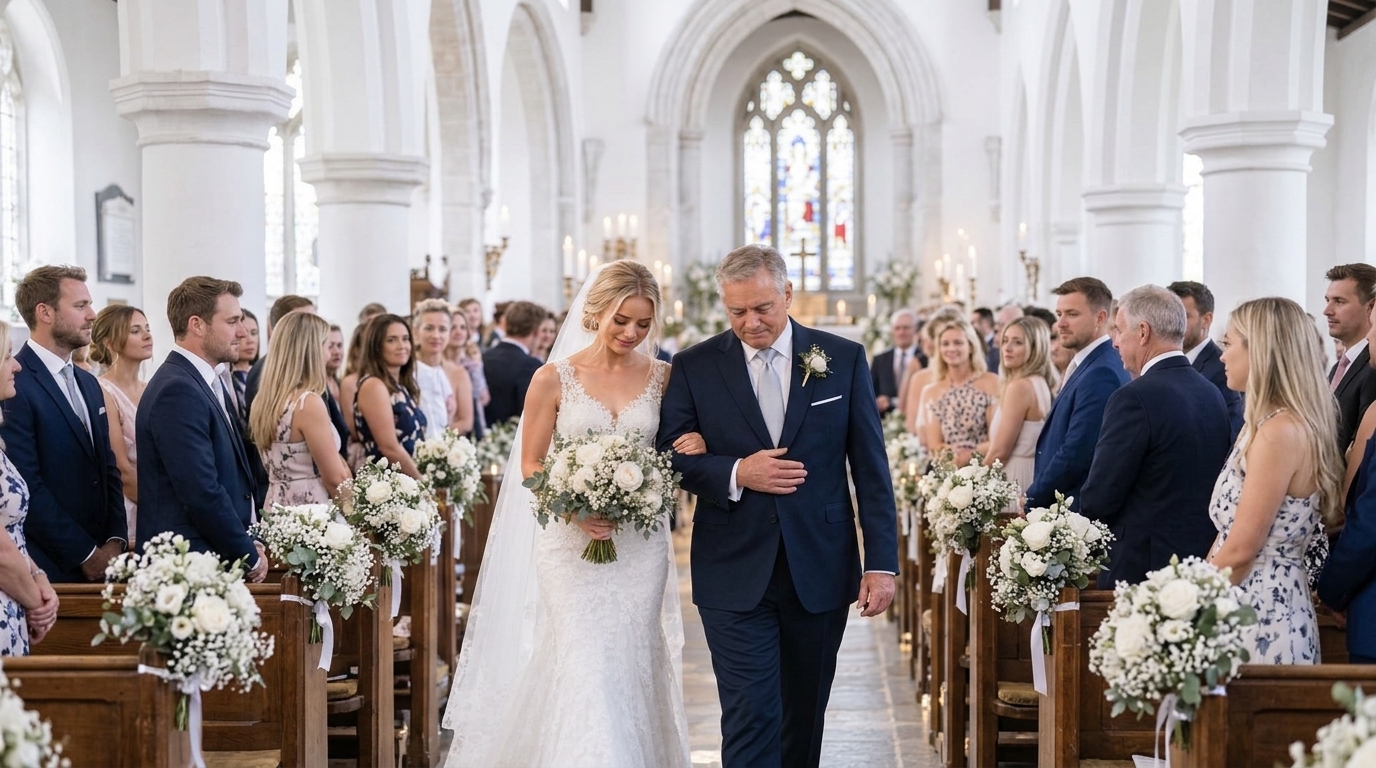
But standing halfway down the aisle in my wedding dress,
with two hundred guests staring at us,
I learned something that made every cruel memory of my childhood suddenly look different.
Richard Stone wasn’t my biological father.
And the man who was had died under circumstances my mother had spent two decades hiding.
Grandpa Arthur stood beside me, his wrinkled hand gripping mine.
The church was silent.
My mother, Margaret Stone, stood near the front pew, her face white beneath carefully applied makeup.
“Dad,” she whispered, “please don’t do this.”
Grandpa looked at her.
“Twenty years, Margaret.”
His voice trembled.
“I gave you twenty years to tell that child the truth.”
My father stepped forward.
“Arthur, this is neither the time nor the place.”
Grandpa struck his cane against the marble floor.
“Then when, Richard?”
His voice echoed through the church.
“When she’s forty? Fifty? When we’re all dead and she has nobody left to ask?”
My mother looked around desperately.
Guests were whispering.
Paige and Lauren stood beside her, their expressions no longer smug.
I felt Daniel’s hand settle against my back.
“Emma,” he whispered, “we can leave.”
I shook my head.
“No.”
My voice surprised me.
It was steady.
“I want to hear it.”
Grandpa turned toward me.
His eyes filled with tears.
“Sweetheart, your grandmother wanted you to know this years ago.”
He held out the sealed envelope.
I recognized the handwriting immediately.
Grandma Eleanor.
She’d died when I was seventeen.
She was the only person in my family who never made me feel like an inconvenience.
She baked cinnamon rolls when I was sad.
She attended my school performances.
And whenever Mom called me difficult, Grandma would pull me close and whisper, “Don’t ever let them make you smaller than you are.”
Now, twelve years after her death, I was holding a letter she’d written for me.
My fingers trembled.
I looked at Daniel.
He nodded.
“Whatever it says, I’m right here.”
I opened the envelope.
Inside were three photographs, a folded letter, and a certified copy of an old document.
The first photograph showed my mother when she was young.
She was standing beside a man with dark hair and kind brown eyes.
He had one arm around her shoulders.
They were smiling.
I had never seen him before.
The second photograph showed the same man holding a newborn baby.
On the back, in Grandma’s handwriting, were four words.
Michael Bennett and Emma.
My breath caught.
The baby was me.
The third photograph showed Michael standing outside a small brick house beside Grandpa Arthur.
They looked happy.
Like family.
I stared at the photographs.
Then looked toward my mother.
“Who is he?”
She closed her eyes.
“Emma, please.”
“Who is he?”
My voice cracked.
Grandpa answered.
“Your father.”
I felt the world tilt.
Richard stepped forward.
“I raised you.”
I turned toward him.
“You spent twenty-nine years reminding me I was a burden.”
His face hardened.
“That doesn’t change the fact that I provided for you.”
I looked at the photograph again.
Then whispered, “What happened to Michael?”
Nobody answered.
I looked toward Grandpa.
His eyes filled.
“Read the letter, sweetheart.”
My grandmother’s handwriting filled two pages.
My precious Emma,
If you’re reading this, then I am no longer here to tell you the truth myself.
I hoped your mother would find the courage to do it.
But if she hasn’t, I want you to know that the silence was never your fault.
My throat tightened.
Your father’s name was Michael Bennett.
He was a kind man, a gifted engineer, and the most devoted father I ever knew.
He loved you from the moment he learned you existed.
I pressed my hand against my mouth.
He painted your nursery yellow because he said every child deserved to wake up surrounded by sunshine.
He read stories to you before you were old enough to understand the words.
And he called you his little star.
Tears blurred the page.
Nobody had ever told me those things.
Not once.
Michael died when you were seven.
You were told he was a family friend who passed away in an accident.
That was a lie.
My hands began shaking.
I remembered being seven.
I remembered a funeral.
A photograph on a table.
And my mother telling me not to ask questions.
I remembered crying because I didn’t understand why everyone was sad.
Then I remembered Richard taking me outside and saying, “Stop making everything about yourself.”
I looked up.
“You told me he was Dad’s friend.”
My mother stared at the floor.
“Emma—”
“You told me he was just a friend.”
Grandpa’s hand tightened around mine.
I looked back at the letter.
After Michael died, there was a settlement involving his business interests and the circumstances surrounding his death.
There were also assets intended for you.
Your grandfather and I tried to protect them.
But we discovered too late that documents had been altered and money had been moved.
My heart began pounding.
Your mother and Richard knew far more than they admitted.
I wanted to go to the authorities immediately.
Your grandfather feared that exposing everything without sufficient evidence might leave you caught in an even more painful battle.
That was our mistake.
I stopped reading.
Grandpa looked down.
A tear slipped down his cheek.
“I’m sorry, Emma.”
I stared at him.
“You knew?”
He nodded slowly.
“Not everything. Not at first.”
I swallowed.
“But you knew he was my father.”
“Yes.”
The betrayal hurt more than I expected.
Even Grandpa.
Even the man who’d always defended me.
He had kept the truth.
I looked away.
He didn’t try to excuse himself.
“I should have told you sooner.”
My mother suddenly stepped into the aisle.
“Enough!”
Her voice shook.
“This is my daughter’s wedding!”
Grandpa looked at her.
“Then perhaps you should have treated her like your daughter.”
A gasp moved through the church.
Mom’s expression twisted.
“You don’t understand what I went through!”
Grandpa’s voice became cold.
“I understand that you spent twenty years punishing a child for reminding you of a man you betrayed.”
My stomach dropped.
“Betrayed?”
Richard moved toward Grandpa.
“That’s enough.”
Daniel stepped between them.
“Don’t touch him.”
Richard stopped.
Daniel was usually calm.
He worked as a civil engineer and rarely raised his voice.
But now his expression was harder than I’d ever seen.
“This is Emma’s decision,” he said.
“If she wants to hear the truth, you’re not stopping her.”
My mother stared at him.
Then turned toward me.
“Emma, sweetheart, let’s discuss this privately.”
I almost laughed.
Sweetheart.
She hadn’t called me that in years.
I looked at her.
“Privately?”
She nodded eagerly.
“Yes.”
I took a slow breath.
“You humiliated me in front of everyone.”
Her expression changed.
“You refused to walk me down the aisle because you called me your greatest regret.”
I felt tears slide down my cheeks.
“And now you want privacy?”
She opened her mouth.
I shook my head.
“No, Mom.”
My voice grew stronger.
“You don’t get to decide when the truth becomes inconvenient.”
I turned toward the guests.
Some looked horrified.
Others looked uncomfortable.
A few were crying.
I recognized several board members from my parents’ charitable foundation.
The Stone Family Foundation.
An organization that supposedly helped disadvantaged children pursue education.
The same foundation that had paid for lavish fundraising dinners.
Luxury hotel events.
And the expensive publicity campaigns that made my parents look generous.
For eighteen months, I’d been tracing suspicious transfers connected to that foundation.
I had discovered irregularities.
Unexplained payments.
Transfers between family-controlled entities.
And records that didn’t match the public financial statements.
But I hadn’t understood the source of some of the money.
Not until now.
I looked toward my mother.
“The $2.8 million.”
Her face tightened.
“Emma—”
“Was that mine?”
She said nothing.
I looked at Richard.
“Was it?”
He stared at me.
Then said, “You don’t understand how family finances work.”
I felt something inside me snap.
“I am a forensic accountant.”
My voice echoed through the church.
“I understand exactly how financial records work.”
Richard’s face reddened.
“And I understand that money doesn’t disappear simply because someone stops talking about it.”
Grandpa reached into his jacket.
He removed a second envelope.
“This contains copies of the records your grandmother preserved.”
He looked at me.
“She knew someone might eventually need them.”
I stared at the envelope.
“Why didn’t you give them to me?”
Grandpa swallowed.
“Because after Eleanor died, Richard told me you didn’t want contact with us.”
I frowned.
“What?”
“He showed me letters.”
My stomach tightened.
“What letters?”
“Letters supposedly written by you.”
I stared at him.
“I never wrote you letters saying that.”
Grandpa closed his eyes.
“I know that now.”
My mind raced.
For years, I’d believed Grandpa had stopped writing because he no longer cared.
I remembered waiting for his birthday cards.
Checking the mailbox.
Wondering what I’d done wrong.
Then, at twenty-six, I’d finally driven to his house myself.
He’d opened the door and stared at me as though he’d seen a ghost.
We’d both cried.
That was when our relationship began again.
Now I understood why.
Someone had deliberately kept us apart.
I looked toward Richard.
“You intercepted Grandpa’s letters?”
He said nothing.
Mom looked away.
I laughed bitterly.
“Of course.”
Then Grandpa revealed the final piece.
“Emma, your grandmother established a separate education fund for you.”
I stared at him.
“She funded it herself.”
My throat tightened.
“Where is it?”
Grandpa looked toward my mother.
“That’s one of the questions your parents need to answer.”
The church fell silent again.
I looked at Mom.
She stared at the floor.
Then Paige suddenly spoke.
“Mom?”
Her voice trembled.
“Is this true?”
Mom turned sharply.
“Paige, stay out of it.”
Lauren stepped forward.
“Did you use Emma’s money for our weddings?”
My mother closed her eyes.
Richard snapped, “This is not the place!”
But it was too late.
The perfect Stone family had begun falling apart in front of everyone.
And I was standing in the middle of the aisle, holding photographs of a father I’d never been allowed to remember.
I looked toward Daniel.
My heart was breaking.
This was supposed to be our wedding day.
The happiest day of our lives.
Instead, I was discovering that my childhood had been built on lies.
Daniel took both my hands.
“Emma,” he whispered, “look at me.”
I did.
His eyes were full of love.
“We can stop.”
I swallowed.
“We can go somewhere quiet.”
I shook my head.
“I don’t want them to ruin this.”
He brushed a tear from my cheek.
“Then don’t let them.”
I looked toward the altar.
The flowers.
The candles.
The guests.
The life waiting for us.
Then I turned toward Grandpa.
“Can you still walk me?”
His face crumpled.
“Sweetheart…”
I squeezed his hand.
“Please.”
He nodded through tears.
“Always.”
I looked toward my mother.
She was staring at me.
For the first time in my life, she looked uncertain.
I took a breath.
Then said something I’d wanted to say for twenty-nine years.
“You don’t get to decide whether I’m worthy of love.”
Her eyes filled.
I turned away.
Grandpa offered his arm.
The organist looked toward us.
Daniel returned to the altar.
And as the music began again, Grandpa whispered, “Your father would have been proud of you.”
I began crying.
But I kept walking.
Because whatever secrets my family had buried, they were not going to steal the one day I had chosen for myself.
PART 4
I married Daniel that afternoon.
Not because everything was fine.
Not because the pain had disappeared.
But because I refused to let my parents control one more important moment of my life.
Our ceremony was smaller than we’d planned.
Several guests quietly left after the confrontation.
My parents and sisters remained near the back of the church.
I barely noticed them.
All I saw was Daniel.
Standing beneath the stained-glass windows.
Waiting for me.
When I reached the altar, Grandpa kissed my forehead.
Then he placed my hand in Daniel’s.
“Take care of her,” he whispered.
Daniel smiled.
“I will.”
Grandpa looked at him.
“And remember, she’s stronger than she thinks.”
Daniel glanced at me.
“I already know.”
I began crying again.
But this time, they were different tears.
Not humiliation.
Not fear.
Relief.
Because for the first time, I wasn’t walking toward someone who expected me to earn love.
I was walking toward someone who gave it freely.
After the ceremony, Daniel and I made a decision.
We would postpone our honeymoon.
Not because my parents demanded anything.
Not because we wanted revenge.
But because I needed answers.
I wanted to know who Michael Bennett had been.
What had happened to him.
And where the money intended for me had gone.
Most importantly, I wanted to know why my mother had spent my entire life treating me like a mistake.
Three days after the wedding, Grandpa came to our apartment.
He brought two boxes.
Both were old.
Both had been sealed with brown packing tape.
He placed them on our dining table.
“These belonged to your grandmother.”
I stared at them.
“What’s inside?”
“Everything she managed to save.”
I opened the first box.
There were photographs.
Letters.
Old birthday cards.
Copies of bank statements.
And a small blue baby blanket.
I lifted the blanket.
It was soft with age.
A faded yellow star had been embroidered in one corner.
Grandpa smiled sadly.
“Michael bought that when you were born.”
My throat tightened.
“He did?”
Grandpa nodded.
“He was so excited.”
I pressed the blanket against my chest.
Then I found a photograph.
Michael was sitting in a rocking chair holding me.
I couldn’t have been more than a few weeks old.
He was smiling down at me.
The expression on his face was unmistakable.
Love.
Pure.
Uncomplicated.
Certain.
I stared at the photograph for a long time.
Then whispered, “Why didn’t Mom ever show me these?”
Grandpa looked down.
“Because she wanted you to forget him.”
I closed my eyes.
“But why?”
He took a slow breath.
“Because remembering Michael meant remembering what happened before he died.”
Grandpa explained that Michael Bennett had been a successful structural engineer.
He owned a small but growing consulting company.
My mother met him when she was twenty-four.
They married two years later.
I was born shortly afterward.
For several years, their marriage appeared happy.
But Michael’s business began expanding.
He spent long hours working.
Traveling.
Meeting clients.
And my mother became increasingly unhappy.
Then she met Richard Stone.
Richard was charming.
Ambitious.
And involved in commercial property development.
He also had business dealings with Michael.
At first, Richard was simply a colleague.
Then he became something more.
Grandpa looked at me.
“Your mother began seeing Richard while she was still married to Michael.”
I stared at him.
“She had an affair?”
He nodded.
“Yes.”
I looked down at the photograph.
Michael smiling at his baby daughter.
I felt sick.
Grandpa continued.
“Michael discovered the affair.”
My heart tightened.
“What happened?”
“He confronted them.”
Grandpa paused.
“There was a terrible argument.”
I swallowed.
“Did they divorce?”
“He filed for divorce.”
I stared at him.
“And then?”
Grandpa looked toward the window.
“Then he died.”
Michael’s death had been officially classified as an accident.
He was driving home from a business meeting when his car left a rural road and struck a tree.
The investigation found no conclusive evidence of criminal wrongdoing.
But there were questions.
Michael had reportedly argued with Richard earlier that evening.
Several business documents disappeared after his death.
And a major insurance payment was made to an entity connected to Michael’s company.
Grandpa was careful.
“We suspected things, Emma. But suspicion isn’t proof.”
I nodded.
As a forensic accountant, I understood that better than most people.
“Was Richard investigated?”
“Yes. He was questioned.”
“And?”
“Nothing was proven against him.”
I looked at Grandpa.
“Then why did you say he helped conceal a death?”
Grandpa’s expression darkened.
“Because after Michael died, Richard helped conceal financial records connected to the death and its aftermath. He also helped your mother hide Michael’s identity from you.”
I stared at him.
“So we don’t know whether he caused the accident.”
“No.”
Grandpa looked directly at me.
“And I don’t want you believing something we can’t prove.”
I nodded slowly.
It wasn’t the dramatic answer I’d expected.
But it was the truth.
And after twenty-nine years of lies, truth mattered more than drama.
The second box contained financial records.
I spread them across the dining table.
Daniel made coffee.
Grandpa sat beside me.
And for the next six hours, I did what I’d spent my career learning to do.
I followed the money.
The first documents concerned Michael’s company.
There were ownership agreements.
Insurance records.
A settlement agreement.
And documents showing that certain proceeds were supposed to be held for my benefit.
The total amount was substantial.
But the money hadn’t remained in one account.
It had moved.
Through trusts.
Family-controlled companies.
Investment accounts.
And transfers that became increasingly difficult to trace.
Then I found something familiar.
A company name.
Stone Heritage Holdings.
I stared at it.
I had seen that name during my investigation of my parents’ foundation.
It appeared in several transactions involving charitable funds.
I looked at Daniel.
“Bring me my laptop.”
He did.
I opened the spreadsheet I’d been building for eighteen months.
Hundreds of entries.
Dates.
Account numbers.
Transfer descriptions.
Supporting documents.
I searched for Stone Heritage Holdings.
Twenty-seven matches appeared.
My heart began pounding.
“Daniel.”
He leaned closer.
“What?”
I pointed at the screen.
“This company received money connected to Michael’s settlement.”
Grandpa looked confused.
“What does that mean?”
I swallowed.
“It means the money didn’t simply disappear.”
I opened another file.
“It was transferred into a business controlled by Richard.”
Over the next two weeks, I worked with an independent forensic accounting firm and an attorney experienced in trust litigation.
I didn’t want to rely only on my own conclusions.
I needed professionals who could review the records objectively.
We obtained additional documents through appropriate legal channels.
Some came from old bank archives.
Others from corporate filings.
And some from records Grandma had preserved.
Slowly, a pattern emerged.
Money intended for my benefit had been diverted into accounts controlled by my mother and Richard.
Some of it was used to acquire investment property.
Some was transferred into Stone Heritage Holdings.
And some appeared to have supported expenses that had nothing to do with my welfare.
There were payments connected to Paige’s wedding.
Lauren’s apartment.
Luxury travel.
And the Stone Family Foundation.
I stared at the findings.
For years, my mother had told me there wasn’t enough money for my education.
She’d refused to help when I applied to college.
She’d said I needed to learn independence.
I remembered working evenings at a grocery store.
Taking out student loans.
Skipping meals.
And crying in my dorm room because I couldn’t afford textbooks.
All while money intended for me had been used to fund my sisters’ luxuries.
I felt physically sick.
Then came the discovery that hurt the most.
My college fund.
Grandma had established it when I was born.
It was supposed to become available when I turned eighteen.
The original balance had been significant.
But by my eighteenth birthday, most of it was gone.
The records showed withdrawals made under authority that required further legal review.
Several were associated with my mother.
Others had been transferred into family accounts.
I stared at the dates.
One withdrawal occurred two weeks before Paige’s extravagant sixteenth birthday party.
Another occurred shortly before Lauren’s summer trip to Europe.
I remembered both events.
Paige’s party had been held at an expensive hotel.
There were hundreds of guests.
A live band.
A designer gown.
And a towering cake.
I had been fourteen.
Mom told me I couldn’t attend because I had a school project to finish.
Lauren’s trip to Europe happened two years later.
She returned with designer handbags and photographs from Paris.
I asked whether I could go on a school trip to Washington, D.C.
Mom said it was too expensive.
I stared at the bank statements.
And began crying.
Daniel sat beside me.
“Emma…”
I shook my head.
“It wasn’t the money.”
He took my hand.
“It was what they told you.”
I nodded.
“They made me feel selfish for asking.”
My voice broke.
“They told me I was ungrateful.”
Daniel pulled me into his arms.
I cried against his shoulder.
Because the worst part wasn’t discovering that money had been taken.
It was realizing how carefully my family had taught me to feel ashamed for needing anything.
A month after the wedding, my attorney sent formal notices to my parents.
The letters demanded preservation of relevant financial records and requested an accounting of the trusts and related assets.
They also outlined potential claims concerning unauthorized transfers and breaches of fiduciary duties.
My mother called immediately.
I didn’t answer.
Then Richard called.
I ignored him.
Then Paige sent a message.
Emma, what are you doing? Mom is hysterical.
I stared at the screen.
For a moment, I considered replying.
Then another message arrived.
You’re destroying the family.
I felt anger rise.
I typed back.
I’m asking where my money went.
Her response came quickly.
This isn’t about money. It’s about loyalty.
I stared at the words.
Then replied.
Loyalty doesn’t require me to accept theft.
I put down the phone.
The next day, Lauren called.
I almost ignored her.
But something made me answer.
“Emma?”
Her voice sounded different.
Uncertain.
“Hello, Lauren.”
There was a long silence.
Then she whispered, “I didn’t know.”
I closed my eyes.
“Know what?”
“About your college fund.”
I said nothing.
She continued.
“Mom told us Grandma never left you anything.”
I swallowed.
“She told us you were jealous because we had better opportunities.”
My throat tightened.
Lauren began crying.
“Emma, I swear I didn’t know.”
I looked toward the window.
For years, Lauren had laughed when Mom insulted me.
She’d called me dramatic.
Difficult.
Embarrassing.
Now she was telling me she’d believed the story our parents created.
I took a slow breath.
“Lauren, not knowing about the money doesn’t excuse how you treated me.”
She began crying harder.
“I know.”
I waited.
Then she whispered, “I’m sorry.”
I closed my eyes.
For a moment, I saw the little girl who used to crawl into my bed during thunderstorms.
Before Mom taught us to compete.
Before every family dinner became another opportunity to humiliate me.
I swallowed.
“Thank you for saying that.”
She sniffled.
“Can we fix things?”
I looked down.
“Maybe.”
I paused.
“But not by pretending nothing happened.”
The investigation continued.
And eventually, the findings reached the board of the Stone Family Foundation.
Several board members requested an independent review.
My parents had built their public reputation around generosity.
They hosted fundraisers.
Appeared in local newspapers.
Accepted awards.
And spoke about helping disadvantaged children.
Now the board was examining whether funds had been improperly transferred between charitable and family-controlled accounts.
The review identified serious accounting irregularities.
The foundation suspended my parents from their management roles while the matter was investigated.
Regulators were notified where required.
And several donors requested explanations.
My mother called me again.
This time, I answered.
“Emma!”
Her voice was sharp.
“Do you understand what you’ve done?”
I took a slow breath.
“Yes.”
“You’ve humiliated us!”
I looked at Daniel.
He sat beside me, quietly reading.
I turned toward the phone.
“Mom, I didn’t create those transactions.”
She went silent.
“I didn’t move the money.”
Her breathing became heavy.
“And I didn’t tell everyone the foundation was helping children while using it to support family expenses.”
She snapped, “You have no idea how much we’ve sacrificed!”
I felt something inside me settle.
“Then provide the records.”
She didn’t answer.
I continued.
“If everything was legitimate, the documents will show that.”
Then I ended the call.
The legal proceedings lasted more than a year.
There were depositions.
Accountings.
Expert reports.
And difficult negotiations.
Some records were incomplete.
Some transactions were too old to challenge easily.
And certain questions about Michael’s death remained unresolved.
But the financial evidence was substantial.
Eventually, the trust-related claims were resolved through a court-approved settlement.
My mother and Richard agreed to repay significant amounts and relinquish control over the remaining disputed assets.
The foundation’s separate investigation resulted in governance changes and financial corrections.
My parents’ reputations suffered.
But I didn’t celebrate.
I had never wanted public humiliation.
I wanted the truth.
And I wanted the money intended for me to be properly accounted for.
Then, nearly eighteen months after my wedding, Grandpa called.
His voice sounded weak.
“Emma, sweetheart?”
I sat up.
“Grandpa?”
“Could you come over?”
My heart tightened.
“Are you okay?”
He paused.
“I’m just tired.”
I drove to his house immediately.
When I arrived, he was sitting in his favorite armchair beside the window.
His black cane rested against the wall.
He smiled when he saw me.
“There she is.”
I knelt beside him.
“Grandpa, what’s wrong?”
He took my hand.
“I wanted to tell you something.”
I felt tears gathering.
“Tell me.”
He looked toward the photograph of Grandma on the mantel.
“I should have protected you sooner.”
My throat tightened.
“Grandpa…”
He shook his head.
“No. Let me say it.”
His voice trembled.
“Your grandmother and I knew things weren’t right.”
“We tried to help.”
“But we let fear stop us from doing enough.”
I began crying.
He squeezed my hand.
“I’m sorry, Emma.”
I pressed my forehead against his.
“I love you.”
His eyes filled.
“I love you too, sweetheart.”
Then he whispered, “And your father would have loved the woman you’ve become.”
I closed my eyes.
For the first time, hearing the word father didn’t make me think of Richard.
It made me think of Michael Bennett.
The man who painted my nursery yellow.
The man who called me his little star.
The man whose love had been hidden from me for twenty years.
And I realized something.
My mother could hide photographs.
Letters.
Money.
And memories.
But she couldn’t erase the truth forever.
PART 5
Grandpa Arthur lived another three years.
Three precious years.
Years filled with Sunday dinners, family photographs, and conversations we’d been denied for far too long.
He attended my first wedding anniversary dinner.
He helped Daniel and me choose our first house.
And when our daughter was born, he held her in his arms and cried.
We named her Eleanor.
After Grandma.
When Grandpa first saw her, he stared at her tiny face.
Then whispered, “She’s beautiful.”
I smiled through tears.
“She is.”
He looked at me.
“She has your eyes.”
I laughed.
“Everyone says that.”
He shook his head.
“No, sweetheart.”
His voice softened.
“She has Michael’s eyes.”
I began crying.
Grandpa kissed Eleanor’s forehead.
Then looked at me.
“Your father would have been so proud.”
I held his hand.
And for the first time, I believed it without feeling the need to prove anything.
After the legal settlement, my life changed in ways I hadn’t expected.
Some of the recovered money was placed into accounts for my benefit.
Other assets remained subject to long-term management arrangements.
I paid off my student loans.
Established an education fund for Eleanor.
And worked with independent advisers to create a responsible financial plan.
But I didn’t buy a mansion.
Didn’t purchase luxury cars.
Didn’t try to compete with my sisters.
I simply wanted security.
A home where nobody could tell me I didn’t belong.
A future where my daughter wouldn’t grow up believing love had to be earned through obedience.
And enough peace to enjoy the life Daniel and I were building.
I also made a decision about my career.
For years, I’d worked as a forensic accountant investigating financial misconduct.
I understood complicated records.
Trust structures.
Corporate transactions.
And the ways people could hide wrongdoing behind legitimate-looking paperwork.
But after what happened to me, I became particularly interested in financial exploitation within families.
I began volunteering with a legal aid organization.
I helped review financial documents for people who believed relatives had misused their assets.
Some were older adults.
Some were widows.
Some were young people whose inheritances had been mishandled.
Their stories were different.
But the pain often sounded familiar.
They had trusted someone.
They had asked questions.
And they’d been told they were selfish, confused, or ungrateful.
I recognized those words.
I had heard them my entire life.
One afternoon, a woman named Patricia came into the office.
She was seventy-two.
Her son had been managing her finances after her husband’s death.
She suspected money was missing.
But she was afraid to confront him.
“He’s my only child,” she whispered.
I sat beside her.
“I understand.”
Her eyes filled.
“What if I’m wrong?”
I looked at her.
“Then the records can help establish that.”
She swallowed.
“And if I’m right?”
I took a slow breath.
“Then you’ll have information you can use to protect yourself.”
She began crying.
“I don’t want to destroy my family.”
My heart tightened.
I remembered Paige’s message.
You’re destroying the family.
I looked at Patricia.
“Asking for honesty doesn’t destroy a family.”
She stared at me.
“Sometimes it reveals problems that were already there.”
She nodded slowly.
Then whispered, “Thank you.”
I smiled.
“You’re welcome.”
And in that moment, I knew I’d found a purpose beyond my own pain.
My relationship with Lauren improved gradually.
It wasn’t immediate.
Trust rarely returns simply because someone apologizes.
But she made an effort.
She stopped defending Mom’s behavior.
Stopped repeating the stories our parents had told about me.
And began acknowledging the ways she’d participated in my humiliation.
One afternoon, she came to my house carrying a small box.
Inside was a silver bracelet.
It wasn’t expensive.
It had a tiny star charm.
She looked nervous.
“I found this at Mom’s house years ago.”
I stared at it.
“What is it?”
Lauren swallowed.
“There was a note with it.”
She handed me a folded piece of paper.
I recognized Grandma’s handwriting.
For Emma, my little star. Love, Grandma.
My eyes filled.
Lauren looked down.
“Mom told me it was an old bracelet nobody wanted.”
I touched the charm.
My throat tightened.
“I think it was meant for you.”
I began crying.
Lauren stepped closer.
“Emma, I’m sorry.”
I looked at her.
She continued.
“For the wedding.”
“For the attic.”
“For all the times I laughed when Mom hurt you.”
Tears streamed down her cheeks.
“I should have been a better sister.”
I took a slow breath.
Then I hugged her.
Not because everything was fixed.
But because she was finally telling the truth.
Paige took longer.
For months, she refused to speak to me.
She claimed I’d ruined the family’s reputation.
She insisted the legal proceedings were unnecessary.
And she accused me of being obsessed with money.
Then something changed.
Her own marriage began struggling.
Her husband had lost his job.
They were forced to sell their expensive house.
And Paige discovered that the lifestyle she’d always considered normal wasn’t guaranteed.
One evening, she called.
I almost ignored her.
But I answered.
“Emma?”
Her voice was quiet.
“Hello, Paige.”
There was a long pause.
Then she whispered, “I owe you an apology.”
I closed my eyes.
“For what?”
She began crying.
“For being cruel.”
I waited.
She continued.
“I spent my whole life believing Mom when she said you were difficult.”
Her voice broke.
“I thought if I stayed on her good side, she’d always love me.”
My throat tightened.
“And I treated you badly because I was afraid she’d turn on me too.”
I stared at the wall.
For the first time, I understood something about my sisters.
They hadn’t simply been spoiled.
They’d grown up inside the same unhealthy family system.
They’d learned that love was conditional.
That pleasing Mom meant safety.
And that being the rejected child was something to fear.
That didn’t excuse their cruelty.
But it helped explain it.
I took a slow breath.
“Paige, I appreciate your apology.”
She sniffled.
“Can we start over?”
I looked toward the living room, where Daniel was playing with Eleanor.
I smiled sadly.
“We can start differently.”
She paused.
“What does that mean?”
“It means honesty.”
I swallowed.
“And no more pretending the past didn’t happen.”
She whispered, “Okay.”
My parents were another story.
Richard never truly apologized.
He continued insisting that he’d done what was necessary to protect the family business.
He blamed poor accounting.
Old records.
Misunderstandings.
And occasionally, Grandpa.
But he never fully accepted responsibility.
I stopped expecting him to.
Sometimes the people who hurt you are more committed to defending their actions than understanding their consequences.
I couldn’t change that.
I could only decide how much access they had to my life.
So I kept my distance.
Mom was harder.
For years, I’d wanted her approval more than anything.
I wanted her to look at me the way she looked at Paige and Lauren.
I wanted her to be proud of my achievements.
To remember my birthday.
To ask about my work.
To tell me I was beautiful on my wedding day.
But when she finally began reaching out after the settlement, I realized something painful.
I no longer wanted the relationship she’d always offered.
A relationship where she decided what I was allowed to feel.
Where I had to apologize for asking questions.
Where love was something she could withdraw whenever I displeased her.
I wanted something different.
Respect.
Honesty.
Accountability.
And if she couldn’t offer those things, I was prepared to live without her approval.
One afternoon, Mom asked to meet.
We chose a quiet café.
I arrived early.
She came ten minutes late wearing a cream-colored coat and carrying an expensive handbag.
She looked older than I remembered.
Her hair had more gray.
Her shoulders were slightly stooped.
For a moment, I felt a familiar urge to comfort her.
Then I reminded myself why we were there.
She sat across from me.
“Emma.”
“Hello, Mom.”
She looked at my wedding ring.
Then at the photographs of Eleanor on my phone.
“She’s getting big.”
I nodded.
“Yes.”
Mom smiled faintly.
“She looks like you.”
I said nothing.
Then she sighed.
“I suppose you expect me to apologize.”
I looked at her.
“I didn’t come here to demand anything.”
She folded her hands.
“I did what I thought was best.”
My stomach tightened.
“For whom?”
Her expression hardened.
“For the family.”
I took a slow breath.
“Was hiding my father’s identity best for me?”
She looked away.
“Was taking money intended for my education best for me?”
“Emma—”
“Was making me sleep in the attic while my sisters had everything they wanted best for me?”
Her eyes filled.
I continued.
“Was calling me your greatest regret on my wedding day best for me?”
She began crying.
“Do you have any idea how difficult my life was?”
I looked at her.
“I’m sure it was difficult.”
She stared at me.
“But that doesn’t explain why you chose to make mine painful.”
For a long time, she said nothing.
Then she whispered, “You reminded me of Michael.”
My heart stopped.
I stared at her.
She looked down.
“Every time I looked at you, I saw him.”
My throat tightened.
She continued.
“He was kind.”
Her voice trembled.
“He loved you.”
I felt tears gathering.
“And after he died, I couldn’t bear the guilt.”
I swallowed.
“So you blamed me?”
She covered her face.
“I know it was wrong.”
I stared at her.
For twenty-nine years, I’d wanted an explanation.
Now I had one.
And it was worse than I’d imagined.
She hadn’t rejected me because I was difficult.
Or ungrateful.
Or disappointing.
She’d rejected me because I reminded her of a man she’d betrayed.
A man who had loved me.
A man who died before he could protect me.
I wiped my cheeks.
“Mom, I was seven.”
She began crying harder.
“I know.”
“I didn’t cause his death.”
“I know.”
“I didn’t cause your affair.”
She shook her head.
“I know.”
“And I didn’t deserve to be punished for your guilt.”
She looked at me.
For the first time, she didn’t argue.
She simply whispered, “You’re right.”
I wish I could say that moment fixed everything.
It didn’t.
An apology doesn’t erase twenty-nine years of pain.
And admitting the truth doesn’t automatically rebuild trust.
But it was a beginning.
Mom eventually wrote me a letter.
Not asking for money.
Not demanding access to Eleanor.
Not blaming anyone else.
Just acknowledging what she’d done.
She apologized for hiding Michael’s identity.
For the financial misconduct.
For the favoritism.
And for the cruelty she’d shown me.
I read the letter carefully.
Then placed it in a drawer.
I didn’t forgive everything overnight.
But I stopped waiting for her to become the mother I’d needed as a child.
I began accepting that my healing didn’t depend on her transformation.
Grandpa Arthur passed away peacefully at eighty-four.
Daniel and I were beside him.
He had grown weaker over the previous months.
But his mind remained clear.
On his final evening, he asked to see Eleanor.
I brought her into his room.
She was three years old.
She climbed carefully onto the bed beside him.
“Grandpa Arthur?”
He smiled.
“Hello, little star.”
She giggled.
He touched her cheek.
Then looked at me.
His eyes filled.
“Emma.”
I leaned closer.
“Yes, Grandpa?”
He took my hand.
“Promise me something.”
My throat tightened.
“Anything.”
He looked toward Eleanor.
“Tell her the truth.”
I began crying.
He squeezed my hand.
“About where she comes from.”
“About the people who loved her.”
“And about the people who made mistakes.”
I nodded.
“I promise.”
He smiled faintly.
“Don’t let silence become another inheritance.”
Those were among the last words he spoke to me.
And I have carried them ever since.
At his funeral, I stood beside Daniel and Eleanor.
Paige and Lauren stood nearby.
Mom sat several rows behind us.
Richard attended quietly.
The service was simple.
Grandpa had requested no elaborate arrangements.
Just flowers.
Music.
And family.
When it was my turn to speak, I walked to the front holding his black cane.
The same cane he’d carried on my wedding day.
I placed it beside the podium.
Then looked out at the people gathered.
“My grandfather was not a perfect man.”
My voice trembled.
“He made mistakes.”
“He kept secrets he should have told sooner.”
I looked toward Mom.
“But when the moment came to choose between protecting a comfortable lie and standing beside someone who needed him, he chose to stand beside me.”
Tears filled my eyes.
“On my wedding day, he walked me down the aisle when my own mother refused.”
I paused.
“And he reminded me that I had never been a regret.”
My voice broke.
“He gave me something I had spent my entire childhood searching for.”
I looked toward his photograph.
“The certainty that I was worthy of love.”
After the funeral, I took Grandpa’s cane home.
I placed it beside a framed photograph from my wedding.
In the picture, Grandpa and I were standing halfway down the aisle.
His face was serious.
Mine was tearful.
But our hands were clasped tightly.
It wasn’t the wedding photograph I’d imagined having.
Yet it became my favorite.
Because it captured the moment everything changed.
The moment my family’s lies began unraveling.
The moment I learned who my father really was.
And the moment I stopped believing my mother’s rejection defined my worth.
Today, I am thirty-four years old.
Daniel and I have been married for five years.
We have a beautiful daughter.
A warm home.
And a life filled with ordinary happiness.
We cook dinner together.
Take walks.
Read bedtime stories.
And celebrate birthdays without turning them into competitions.
Eleanor has her own bedroom.
Not because she needs expensive things.
But because every child deserves a space where they feel safe.
Her room is painted yellow.
Just like the nursery Michael Bennett once painted for me.
On the wall above her bed hangs a small wooden star.
Daniel made it himself.
And every night, when I tuck her in, I tell her something I wish someone had told me when I was little.
“You are loved because you are you.”
Not because she’s obedient.
Not because she’s successful.
Not because she makes us look good.
Simply because she exists.
Sometimes Eleanor asks about the photographs in our hallway.
There’s one of Grandma Eleanor.
One of Grandpa Arthur.
One of Daniel and me on our wedding day.
And one of Michael Bennett holding me as a baby.
She points to it.
“Mommy, who’s that?”
I smile.
“That’s your Grandpa Michael.”
She looks at the photograph.
“He looks happy.”
I nod.
“He was.”
She points to the baby.
“Is that you?”
“Yes.”
She giggles.
“You were tiny!”
I laugh.
“I was.”
Then she asks, “Did he love you?”
And every time, my eyes fill with tears.
Because I can finally answer without uncertainty.
“Yes, sweetheart.”
I touch the photograph.
“He loved me very much.”
Last month, I visited Michael’s grave.
I’d been there many times since learning the truth.
But this visit felt different.
I brought yellow flowers.
Grandma’s favorite.
And a small photograph of Eleanor.
I knelt beside the headstone.
“Hi, Dad.”
The word still felt strange.
But beautiful.
I placed the photograph beside the flowers.
“I wish you’d met her.”
My voice trembled.
“She has your eyes.”
I smiled through tears.
“Grandpa Arthur said so.”
A breeze moved through the cemetery.
I looked at Michael’s name carved into the stone.
Then whispered, “I’m sorry I didn’t know.”
Tears slipped down my cheeks.
“I’m sorry they kept you from me.”
I paused.
“But I know now.”
I placed my hand against the headstone.
“And I’ll make sure your granddaughter knows too.”
When I think back to my wedding day, I no longer remember it as the day my mother humiliated me.
I remember it as the day Grandpa Arthur stood beside me.
The day he refused to let silence win.
The day Daniel waited at the altar while my world fell apart.
And the day I learned that the people who reject us don’t get to decide our value.
My mother called me her greatest regret.
For years, I believed her.
I thought there must be something wrong with me.
Something unlovable.
Something that made me less deserving than my sisters.
But the truth was never about my worth.
It was about her guilt.
Her secrets.
And the choices she refused to face.
I spent twenty-nine years trying to become the daughter she would finally love.
Then, on my wedding day, I discovered I had been loved all along.
By Michael.
By Grandma.
By Grandpa.
And by the man waiting for me at the altar.
People sometimes ask whether exposing the financial misconduct was worth the damage it caused.
I tell them the same thing.
The truth didn’t create the damage.
The wrongdoing did.
The lies did.
The favoritism did.
The years of silence did.
I didn’t destroy my family by asking questions.
I stopped allowing its secrets to destroy me.
And I learned something else.
Money can be stolen.
Documents can be hidden.
Letters can be intercepted.
But love, once you finally recognize it, can become stronger than the lies that tried to erase it.
Every year on our wedding anniversary, Daniel and I look through our wedding album.
We laugh at the photographs.
The crooked flowers.
The nervous bridesmaids.
The guests who didn’t know where to look after Grandpa’s announcement.
And the picture of me standing beside him in the aisle.
Last year, Eleanor climbed onto my lap while we were looking through the album.
She pointed at Grandpa.
“Mommy, why is he holding your hand?”
I smiled.
“Because he was helping me.”
She looked confused.
“Were you scared?”
I thought about that day.
The secrets.
The shock.
The pain.
The courage it took to keep walking.
Then I nodded.
“A little.”
She touched my cheek.
“Did he make you feel better?”
My eyes filled.
“Yes, sweetheart.”
She smiled.
“Good.”
Then she pointed toward Daniel in the photograph.
“And Daddy was waiting?”
I laughed through tears.
“Yes.”
She grinned.
“Then you weren’t alone!”
I held her close.
And whispered, “No, baby.”
I looked at the photograph.
At Grandpa.
At Daniel.
At the younger version of myself who had finally begun to understand her worth.
“I wasn’t alone.”
My name is Emma Bennett Stone.
I’m a wife.
A mother.
A forensic accountant.
And the daughter of a man who loved me enough to paint my nursery yellow.
I am also the granddaughter of an eighty-one-year-old man who stood in the middle of a church and refused to let my mother’s cruelty have the final word.
He couldn’t give me back the childhood I’d lost.
He couldn’t undo the lies.
And he couldn’t bring my father home.
But he gave me the truth.
And with it, he gave me the chance to build a different future.
One where love isn’t a reward.
One where children aren’t punished for adults’ mistakes.
And one where silence is never mistaken for peace.
My mother once looked at me in my wedding dress and said, “I refuse to walk my greatest regret to the altar.”
But Grandpa Arthur took my hand.
He looked into my eyes.
And reminded me of something I’ll never forget.
I was never anyone’s regret. I was a child who deserved to be loved.
And when the music began again, I walked toward my future.
Not as the daughter my mother rejected.
But as the woman who finally knew she had always been worthy.
THE END THANK YOU FOR READING !!!



