PART 3
My brother Richard stood so abruptly that his chair crashed against the wall.
“That’s enough!” he shouted.
The sound echoed through the attorney’s office.
Ethan flinched.
He was still sitting beside me,
holding the faded hospital bracelet between trembling fingers.
Our mother’s attorney, Mr. Harrison, remained perfectly calm.
“Richard,” he said, “I suggest you sit down.”
My brother pointed toward the wooden box.
“That belongs to our family!”
Mr. Harrison looked at him over his glasses.
It belonged to your mother.
She specifically instructed me to give it to Ethan.
Richard’s face turned crimson.
“He’s a stranger!”
I looked at Ethan.
His borrowed jacket was slightly too large.
His shoes were worn, and his backpack rested between his feet.
He looked more frightened than anyone in that room.
A stranger.
That was what Richard called the young man who had spent months helping our mother without asking for anything in return.
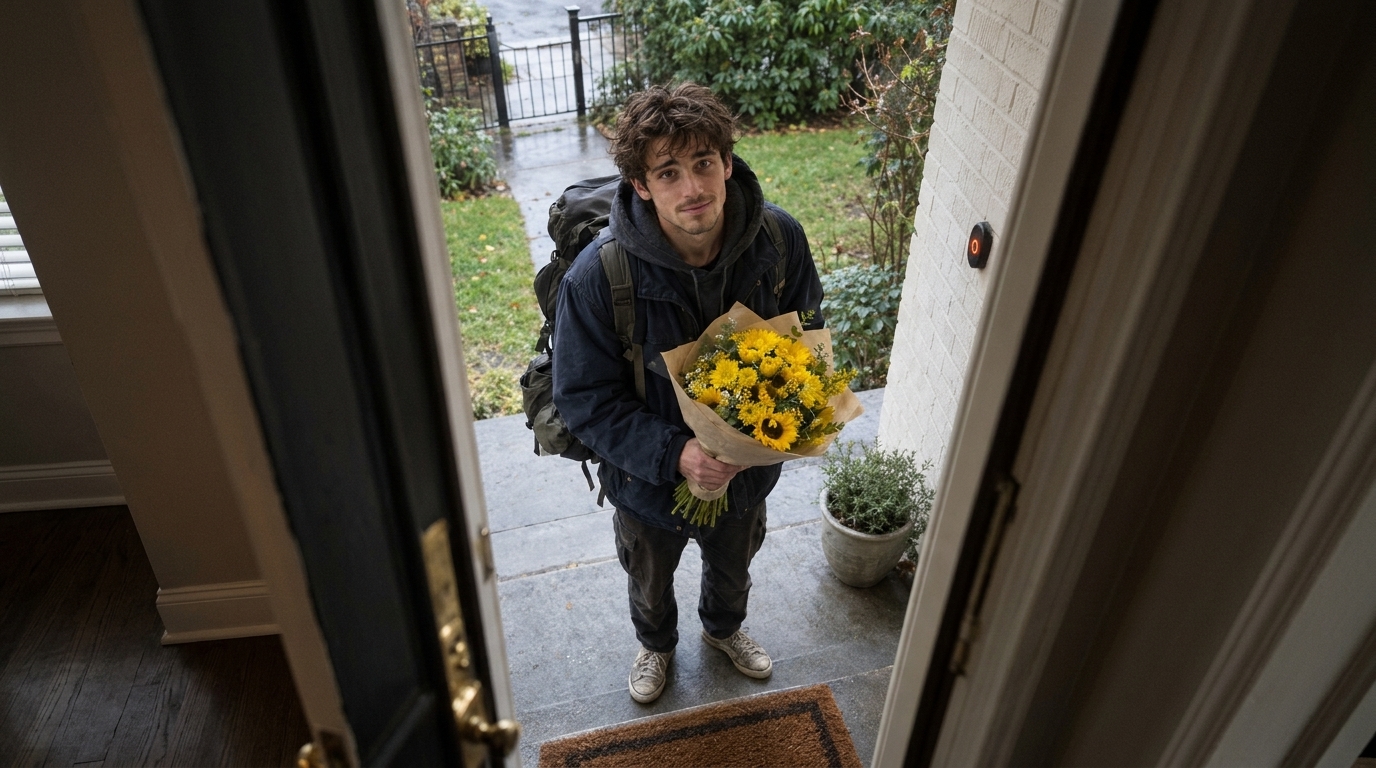
The same young man who had used his last twelve dollars to buy her yellow roses.
I turned toward my brother.
“Richard, sit down.”
He glared at me.
“Claire, you don’t understand what’s happening.”
“Then explain it.”
His mouth opened.
But no words came.
Mr. Harrison folded his hands.
“Perhaps I should explain.”
Richard stared at him.
The attorney reached for a sealed envelope.
“Your mother left detailed instructions concerning this meeting. She anticipated that certain information might be difficult for the family to hear.”
He glanced toward Ethan.
“Would you like me to continue?”
Ethan swallowed.
“Yes, sir.”
Mr. Harrison opened the envelope.
And began reading.
“My dear children, Claire and Richard, and my dear Ethan,
“If this letter is being read, then I am finally at peace.
“I have spent the last months of my life thinking about the things we leave behind.
“Some people leave money.
“Some leave property.
“Some leave memories.
“But sometimes, the most important thing we leave behind is the truth.”
I felt tears gathering in my eyes.
It sounded exactly like Mom.
Gentle.
Thoughtful.
But firm when something mattered.
Mr. Harrison continued.
“Twenty-four years ago, a young woman named Sarah Carter came to our home.
“She was nineteen years old.
“She had no parents to help her, no husband, and nowhere safe to take her newborn son.
“She was frightened.
“And she was very ill.”
Ethan pressed the hospital bracelet against his chest.
Mr. Harrison paused.
Then continued.
“Sarah had worked for our family while attending nursing school.
“She was bright, hardworking, and kind.
“She loved music.
“She loved yellow roses.
“And more than anything, she loved her baby.”
I stared at the attorney.
Yellow roses.
Mom had cried when Ethan brought them.
I’d assumed she was simply touched by his kindness.
Now I wondered whether those flowers had reminded her of someone she’d lost.
Mr. Harrison continued.
“Sarah died shortly after giving birth.
“But before she died, she asked me to make sure her son would be safe.
“I promised her I would.”
Ethan began crying silently.
I reached for his hand.
He didn’t pull away.
Then Mr. Harrison read the next paragraph.
“And I broke that promise.”
The room went still.
I stared at the attorney.
Mom?
My mother, who had spent her entire life helping neighbors?
The woman who volunteered at church, delivered meals to sick friends, and never forgot a birthday?
What promise had she broken?
Mr. Harrison continued reading.
“Sarah’s son was placed with a family through an adoption arrangement.
“I was told the placement was permanent and that the child would be loved.
“I was told the records were properly handled.
“And I believed it because the person arranging everything was someone I trusted.”
My stomach tightened.
I looked toward Richard.
He was staring at the carpet.
Mr. Harrison’s voice became quieter.
“That person was my son, Richard.”
Ethan inhaled sharply.
I felt as though the floor had shifted beneath me.
Richard?
Twenty-four years ago, my brother had been twenty-nine.
He was working with our father in the family property business.
He was ambitious.
Impatient.
Always talking about expanding the company.
But what did he have to do with Sarah’s baby?
I turned toward him.
“Richard?”
He didn’t look at me.
Mr. Harrison continued.
“Richard told us Sarah had signed documents allowing her son to be placed with a couple outside the state.
“He assured us the child would have a good home.
“He said the adoption was handled by professionals.
“And he asked us not to interfere.”
Ethan’s hand tightened around mine.
Then came the next sentence.
“Years later, I discovered that the story Richard told us was not true.”
Richard stood again.
“Mother was confused toward the end!”
I stared at him.
“Don’t you dare.”
He turned toward me.
“Claire, she was eighty!”
“And she remembered every detail of Dad’s funeral, every birthday, and every family argument.”
I pointed toward the letter.
“Let him finish.”
Richard’s jaw tightened.
But he sat down.
The attorney explained that Mom had spent the final year of her life reviewing old family records.
She’d found discrepancies in documents relating to Sarah.
There were adoption papers with conflicting dates.
Letters that had never been mailed.
And a copy of a document bearing Sarah’s signature that appeared to have been altered.
But the most troubling discovery involved our family’s lakeside property.
My father had owned seventy acres beside Lake Willow.
The land included a large farmhouse, several rental cabins, and a wooded section that stretched down to the water.
For years, Richard had wanted to sell it.
Developers had offered millions.
But Mom always refused.
She said Dad loved that land.
She said it should remain in the family.
I thought that was the entire reason.
Now I was learning there was another.
Mr. Harrison opened a second folder.
“Twenty-four years ago, your father established a trust involving a portion of the lakeside property.”
I frowned.
“A trust?”
He nodded.
“The trust was created after Sarah’s death.”
Ethan looked up.
“For me?”
Mr. Harrison’s expression softened.
“Yes.”
I stared at him.
“Why didn’t we know?”
“Your parents intended to keep the arrangement private until the child could be located and his identity confirmed.”
Richard made an angry sound.
“This is nonsense.”
Mr. Harrison ignored him.
“The trust documents named Sarah Carter’s son as the intended beneficiary of a defined interest in the property, subject to verification and the terms of the trust.”
Ethan looked stunned.
“I don’t understand.”
The attorney leaned forward.
“Ethan, your mother had worked for this family. Your grandmother—”
He stopped himself.
Then corrected gently.
“Mrs. Whitmore wanted to honor a promise to Sarah. Your late grandfather also wanted to provide for you.”
I felt my heart pounding.
“But why would Richard interfere?”
Mr. Harrison looked toward my brother.
“Because the trust restricted what could be done with part of the property.”
I stared at Richard.
And suddenly, his years of anger over the lake property began to make sense.
Richard had spent nearly a decade trying to persuade Mom to sell.
He claimed the cabins were too expensive to maintain.
He said property taxes were rising.
He argued that developers could turn the land into a luxury resort.
He’d even brought a buyer to Thanksgiving dinner three years earlier.
Mom had refused to discuss it.
Richard had been furious.
Now I understood why.
If Ethan’s trust held a valid interest in the land, Richard couldn’t simply treat the entire property as his future inheritance.
Mr. Harrison continued.
“Your mother discovered that certain trust documents had been omitted from later property records provided to her.”
He paused.
“She also found evidence that Richard had attempted to negotiate a sale without disclosing the trust’s interest.”
I turned toward my brother.
“Richard, is that true?”
He stared at the table.
“It’s complicated.”
“Did you know about Ethan?”
He didn’t answer.
“Richard!”
He slammed his hand against the desk.
“Yes!”
The word exploded through the room.
Ethan recoiled.
My brother stood.
“Yes, I knew about him!”
I stared at him.
For a moment, nobody moved.
Then Ethan whispered, “You knew where I was?”
Richard looked away.
“I knew where you were placed.”
Ethan’s eyes filled.
“Then why didn’t you tell her?”
His voice broke.
“Why didn’t you tell Mrs. Whitmore?”
Richard said nothing.
Ethan began crying.
“She kept saying I reminded her of someone.”
I closed my eyes.
He continued.
“She asked about my childhood. My parents. Where I grew up.”
He wiped his face.
“I told her I didn’t remember much.”
Then he looked at Richard.
“You knew.”
My brother stared at the wall.
And I realized the terrible truth.
Mom had spent months getting to know a young man who might have been the baby she’d promised to protect.
Richard had known the connection for years.
And he’d kept silent.
Mr. Harrison asked whether Ethan wanted a break.
Ethan shook his head.
“No.”
His voice trembled.
“I want to know everything.”
The attorney nodded.
He reached into the wooden box and removed another envelope.
Inside was a photograph.
A young woman stood beside my mother in our old kitchen.
She had dark hair, gentle eyes, and a shy smile.
In her arms was a newborn baby wrapped in a blue blanket.
I recognized Mom immediately.
She looked about fifty-six.
The woman beside her had to be Sarah.
Ethan stared at the photograph.
Then he touched the baby’s face.
“Is that me?”
Mr. Harrison nodded.
“Yes.”
Ethan’s shoulders began shaking.
I moved closer.
He held the photograph against his chest.
“I’ve never seen a picture of my mother.”
My heart broke.
He was twenty-four years old.
He had spent nights sleeping behind a closed bookstore.
He owned almost nothing.
And now he was holding the first photograph he’d ever seen of the woman who gave birth to him.
I put my arm around him.
He leaned against me and cried.
For several minutes, nobody spoke.
Even Richard remained silent.
Then Ethan lifted his head.
“Did she love me?”
I felt tears stream down my face.
Mr. Harrison’s voice softened.
“Very much.”
He opened the final letter.
“Your mother wrote something for you.”
Ethan stared at him.
“My mother?”
“Yes.”
The attorney handed him a small folded sheet of paper.
Its edges were yellow with age.
Ethan opened it carefully.
His lips moved as he read.
Then he covered his mouth.
I leaned closer.
At the top were four words.
To my beautiful boy.
Ethan began sobbing.
And when he finally managed to speak, he whispered something that silenced the entire room.
“She knew I would need this someday.”
PART 4
Ethan couldn’t read the letter aloud.
His hands shook too badly.
So he handed it to me.
“Would you?” he whispered.
I nodded.
My throat was tight.
I unfolded the paper.
Sarah’s handwriting was small and uneven.
She had written it while seriously ill.
I took a breath.
Then began.
“My sweet Ethan,
“If you are reading this, it means I didn’t get to watch you grow up.
“I wish more than anything that I could hold you when you’re frightened, kiss your forehead when you’re sick, and tell you every day how much I love you.
“But if I cannot be there, please remember this.
“You were wanted.
“You were loved before you took your first breath.
“And nothing that happens afterward will ever change that.”
Ethan covered his face.
I continued.
“I don’t have much to leave you.
“No money.
“No beautiful house.
“No expensive things.
“But I hope you inherit my courage.
“And I hope the world is kinder to you than it has been to me.
“If someone ever tells you that you are worthless, don’t believe them.
“If someone ever makes you feel unwanted, remember that your mother wanted you more than anything in this world.”
My voice broke.
I paused.
Then read the final lines.
“I hope someday someone gives you flowers.
“Yellow roses were always my favorite.
“And I hope you find people who love you simply because you are you.
“Forever and always,
“Mom.”
I lowered the letter.
Ethan was crying openly.
I was too.
Because suddenly, the yellow roses made sense in a way none of us could have imagined.
Ethan had spent his last twelve dollars buying flowers for an elderly woman who had shown him kindness.
He hadn’t known yellow roses were his mother’s favorite.
He hadn’t known that woman had once held him as a newborn.
And he hadn’t known that a promise made twenty-four years earlier was waiting to change his life.
When Ethan could finally speak, he looked at Mr. Harrison.
“What happened after my mother died?”
The attorney folded his hands.
“Your adoption records indicate that you were placed with a family in Pennsylvania.”
Ethan nodded slowly.
“I remember them.”
I looked at him.
He stared at the photograph.
“My adoptive mother died when I was nine.”
His voice trembled.
“My adoptive father started drinking after that.”
I swallowed.
“He wasn’t always cruel. But things got bad.”
Ethan looked down.
“When I was fourteen, I started staying with friends.”
He paused.
“By seventeen, I was mostly on my own.”
I felt sick.
He continued.
“I worked at a warehouse. Then a restaurant. Then a construction site.”
He gave a small, bitter laugh.
“I thought if I just worked hard enough, everything would be okay.”
He looked toward the window.
“Then I got hurt on a job. I couldn’t work for a while. I fell behind on rent.”
His eyes filled.
“And eventually, I ended up sleeping outside.”
I reached for his hand.
He squeezed mine.
Then whispered, “Mrs. Whitmore was the first person in a long time who asked whether I’d eaten.”
I began crying again.
Mom had never told me the full story of Ethan.
I knew she’d grown fond of him.
I knew he helped her.
I knew he came every Thursday.
But I hadn’t understood how much those visits meant to her.
After Dad died, Mom had become quieter.
She still attended church.
Still baked pies.
Still called me every Sunday.
But there was an emptiness in her voice.
Then Ethan appeared.
And suddenly, she had someone to talk to.
Someone who listened to stories about Dad.
Someone who didn’t rush her.
Someone who didn’t treat her as a burden.
He fixed her porch steps.
Carried her groceries.
Changed lightbulbs.
And sat at the kitchen table while she talked about the past.
He never asked for money.
Never demanded anything.
And when she offered him a place to stay, he hesitated because he didn’t want to take advantage of her.
I remembered the day Mom told me she’d asked him to marry her.
I’d been horrified.
“Mom, he’s fifty-six years younger!”
She’d smiled sadly.
“I know, Claire.”
I thought she was being foolish.
Now I understood.
She hadn’t been trying to create a romantic marriage.
She’d been searching desperately for a way to give Ethan security.
She wanted him to have a legal place in her life.
A home.
A future.
And perhaps, in her own imperfect way, she was trying to make up for a promise she’d failed to keep.
But Ethan had refused.
Because even when he had nothing, he wouldn’t use another person’s affection for his own benefit.
Mr. Harrison opened another folder.
“Your mother eventually realized marriage wasn’t necessary to provide for Ethan.”
He looked at the young man.
“She consulted me about establishing a trust and updating her estate plan.”
Ethan shook his head.
“I never asked her for anything.”
“I know.”
The attorney smiled gently.
“She made that very clear.”
Then he turned toward Richard and me.
“Your mother also wanted to address the unresolved issues involving the lakeside property.”
Richard leaned forward.
“This is where things get ridiculous.”
Mr. Harrison looked at him.
“Richard, you have had the opportunity to provide your explanation. The documents will now be reviewed through the appropriate legal process.”
My brother folded his arms.
The attorney continued.
“Your mother commissioned an independent review of the property records.”
I frowned.
“Why?”
“Because she discovered that documents relating to the trust had been omitted from information presented during negotiations with a developer.”
I stared at Richard.
He looked away.
Mr. Harrison explained that my father had placed a defined portion of the lakeside property’s beneficial interest into a trust intended for Sarah’s child.
The remaining interests were held separately.
The arrangement had been properly executed years earlier, but its administration had become complicated after my father’s death.
Richard had acted as a business manager for the property.
He had access to financial records.
He also had authority to negotiate certain maintenance and rental matters.
But he did not have unlimited authority to sell the land.
And he certainly did not have authority to disregard Ethan’s interest.
I looked at my brother.
“Did you try to sell the property knowing Ethan might have a claim?”
Richard stared at the desk.
Then he whispered, “Yes.”
My heart sank.
“Why?”
He looked up.
“Because the developer offered eight million dollars!”
I stared at him.
He continued.
“Eight million, Claire. Do you understand what that means?”
I shook my head.
“Apparently, it meant more to you than Mom’s wishes.”
His face reddened.
“You don’t understand the expenses. The taxes. The repairs. The cabins barely make enough to cover themselves.”
“Then why didn’t you tell us?”
He slammed his hand against the table.
“Because Mom would never have agreed!”
I stared at him.
There it was.
Not confusion.
Not misunderstanding.
He had hidden information because he knew the truth would stop him.
Mr. Harrison then revealed something else.
Mom had discovered that Richard had received substantial payments from the property’s rental accounts.
Some were legitimate management fees.
Others lacked adequate documentation.
An independent accountant had been asked to review the transactions.
The preliminary findings suggested that more than one hundred thousand dollars required explanation.
Richard’s face turned pale.
“You can’t prove I stole anything.”
Mr. Harrison remained calm.
“No final determination has been made. You will have the opportunity to provide records and explanations.”
Richard stared at him.
Then at me.
“Claire, you can’t believe this.”
I looked at my brother.
For years, I’d defended him.
Whenever Mom complained that Richard was pressuring her about the lake property, I told her he was only trying to be practical.
Whenever she said she didn’t trust his business decisions, I told her she was worrying too much.
Now I felt ashamed.
“Richard,” I whispered, “I don’t know what to believe anymore.”
His expression hardened.
Then he pointed toward Ethan.
“This is all because of him.”
Ethan flinched.
I stood.
“No.”
My voice surprised even me.
Richard stared at me.
I continued.
“Ethan didn’t create those documents.”
“He didn’t manage the property.”
“He didn’t hide information.”
“And he didn’t ask Mom for a single dollar.”
I took a breath.
“He bought her flowers.”
The room went silent.
“Twelve dollars’ worth of yellow roses.”
My voice broke.
“He spent his last money making our mother feel loved.”
I looked at Richard.
“And you’re sitting here acting as though he’s the problem.”
My brother looked away.
For the first time in my life, I saw him clearly.
Not as my older brother.
Not as the successful businessman who always knew what to do.
But as a man whose fear of losing money had made him willing to ignore another person’s humanity.
The meeting ended shortly afterward.
Mr. Harrison explained that the trust matters would require further legal review.
Ethan’s identity had to be formally verified.
The property interests needed to be confirmed.
And Richard’s financial management would be examined.
Nothing would be transferred simply because someone made an emotional claim.
The records had to support it.
Ethan nodded.
“I understand.”
Then he looked at me.
“Claire, I don’t want to cause trouble.”
My heart broke.
“Ethan, you haven’t caused any trouble.”
He looked down.
“I just wanted to say goodbye to Mrs. Whitmore.”
I took his hand.
“Then you did exactly what she wanted.”
Outside the attorney’s office, Ethan stood beside the sidewalk holding the wooden box.
Traffic moved past us.
People hurried along carrying coffee and briefcases.
The world continued as though nothing extraordinary had happened.
But Ethan looked completely overwhelmed.
I turned toward him.
“Where are you staying tonight?”
He hesitated.
“Same place.”
My chest tightened.
“Behind the bookstore?”
He nodded.
I looked at his backpack.
The worn straps.
The faded fabric.
Everything he owned.
Then I heard myself say something that felt both terrifying and absolutely right.
“Come home with me.”
Ethan stared at me.
“What?”
“I have a guest room.”
He shook his head immediately.
“Claire, I can’t.”
“Yes, you can.”
“I don’t want you to think I’m trying to get something.”
I felt tears fill my eyes.
“Ethan, you spent your last twelve dollars on flowers for my mother.”
He looked down.
I continued.
“You’ve already shown me who you are.”
His eyes filled.
“But I don’t want to be a burden.”
I stepped closer.
“Then don’t be one.”
He looked confused.
I smiled gently.
“Help me with the garden. Wash your dishes. Tell me when you’re hungry.”
A tear slipped down his cheek.
“And let me give you a safe place to sleep while you figure out what comes next.”
He stared at me.
Then whispered, “Why?”
I looked toward the sky.
Because Mom had asked me to invite him.
Because Dad had tried to protect him.
Because Sarah had wanted him to be loved.
And because I couldn’t bear the thought of sending him back to sleep behind a bookstore after everything we’d learned.
But I didn’t say all that.
I simply answered.
“Because you deserve one.”
Ethan began crying.
And for the first time, he allowed someone to help him without apologizing.
That night, I made chicken pot pie.
Mom’s recipe.
Ethan sat at my kitchen table wearing a clean sweater I’d found in my son’s old closet.
He ate slowly.
Carefully.
As though he expected someone to tell him he’d taken too much.
I watched him.
Then pushed the serving dish closer.
“There’s more.”
He smiled shyly.
“Thank you.”
After dinner, he helped wash the dishes.
Then he stood awkwardly in the hallway.
“Claire?”
“Yes?”
“Can I ask you something?”
“Of course.”
He looked down.
“Did your mother really care about me?”
My throat tightened.
I thought about Mom’s birthday.
The yellow roses.
The tears.
The way she’d smiled whenever Ethan’s name came up.
I stepped closer.
“Ethan, she loved you.”
His face crumpled.
I continued.
“Maybe she didn’t know how to explain it. Maybe she was trying to repair something from the past.”
I took his hand.
“But she loved you.”
He began crying.
And I hugged him.
Not because he was a beneficiary.
Not because he might inherit property.
But because he was a frightened young man who had spent most of his life wondering whether anyone wanted him.
Over the following weeks, Ethan slowly settled into my home.
At first, he woke before dawn.
He cleaned the kitchen.
Swept the porch.
And asked permission before taking food from the refrigerator.
I kept reminding him that he was a guest, not an employee.
He smiled.
But old habits were difficult to break.
One morning, I found him sitting at the kitchen table with the wooden box open.
He was looking at Sarah’s photograph.
I sat beside him.
He didn’t speak for a long time.
Then he whispered, “I wish I’d known her.”
I nodded.
“I know.”
He touched the photograph.
“Do you think she would have liked me?”
My eyes filled.
“Ethan, she loved you before she even knew who you’d become.”
He smiled sadly.
Then asked, “Do you think Mrs. Whitmore knew I was the baby?”
I took a slow breath.
“I think she suspected.”
He nodded.
“She used to look at me strangely sometimes.”
I smiled through tears.
“She probably saw your mother in your face.”
Ethan looked at the photograph again.
Then whispered, “I wish I’d had more time with her.”
I put my arm around his shoulders.
“So do I.”
Two months later, the legal verification was completed.
The records supported Ethan’s identity as Sarah Carter’s son.
Mr. Harrison contacted us.
He asked us to return to his office.
This time, Richard wasn’t invited to the private meeting.
When we arrived, the attorney smiled.
“Ethan, we have good news.”
Ethan sat down nervously.
Mr. Harrison opened a folder.
“The trust established for you has been confirmed.”
Ethan stared at him.
“What does that mean?”
“It means you’re entitled to the beneficial interest your late grandfather intended for you, subject to the trust’s terms.”
Ethan swallowed.
“How much?”
Mr. Harrison explained that the trust held a defined share of the lakeside property’s value, along with accumulated income.
The exact value would depend on an updated appraisal and final accounting.
But the preliminary estimate was substantial.
More than two million dollars.
Ethan stared at him.
Then he shook his head.
“No.”
Mr. Harrison smiled gently.
“Yes.”
Ethan looked at me.
“Claire?”
I nodded through tears.
“It’s real.”
He covered his mouth.
For a long moment, he couldn’t speak.
Then he whispered something that made me cry harder.
“Does this mean I can finally stop being afraid of where I’ll sleep?”
I reached for his hand.
“Yes, Ethan.”
My voice broke.
“Yes, sweetheart. It does.”
PART 5
Money didn’t change Ethan overnight.
In fact, for the first few weeks after learning about the trust, he seemed almost frightened of it.
He continued wearing his old clothes.
Still carried the same backpack.
Still asked whether he could help with chores.
And still insisted on buying groceries whenever he had a little money from temporary work.
One afternoon, I found him standing in a department store staring at a pair of winter boots.
He needed them.
His old shoes had holes near the toes.
I told him to buy the boots.
He looked at the price tag.
Then shook his head.
“Too expensive.”
I stared at him.
“Ethan, you have money now.”
He smiled sadly.
“I know.”
“Then why won’t you buy them?”
He looked down.
“Because I remember what it feels like not to have twelve dollars.”
I felt tears fill my eyes.
He wasn’t being foolish.
He was afraid.
Afraid that security could disappear as suddenly as it had arrived.
Afraid that one wrong decision could send him back to the street.
I put my arm around him.
“Ethan, you don’t have to spend money carelessly.”
He nodded.
“But you are allowed to take care of yourself.”
He looked at the boots again.
Then smiled.
“Okay.”
He bought them.
And wore them home.
Mr. Harrison helped Ethan establish a careful financial plan.
The trust remained professionally managed.
Ethan received appropriate support and distributions under its terms.
He also began learning about budgeting, investments, taxes, and long-term planning.
I encouraged him to take his time.
He didn’t need to prove anything.
Didn’t need to buy expensive things.
Didn’t need to impress anyone.
He needed stability.
And a chance to build a future.
Meanwhile, the investigation into Richard’s handling of the lakeside property continued.
The independent accountant reviewed years of transactions.
Some expenses were legitimate.
Others were poorly documented.
Several payments had been made to businesses connected to Richard.
The final accounting identified funds that had been improperly diverted or could not be justified.
Richard disputed the findings.
But eventually, the matter was resolved through legal proceedings and a settlement requiring repayment.
He also lost his management role over the property.
The court-approved arrangements placed the relevant assets under independent administration.
It wasn’t the dramatic punishment some people expected.
There were no police cars waiting outside his house.
No sudden arrest in the courtroom.
No television cameras.
Just documents.
Accountings.
Legal consequences.
And the slow unraveling of a story he’d told himself for years.
That the property belonged to him because he wanted it badly enough.
Richard stopped speaking to me for a while.
He told relatives I’d betrayed him.
He claimed Ethan had manipulated Mom.
He insisted the trust was unfair.
I listened to the complaints without arguing.
Then I asked one question.
“Did Ethan ever ask Mom for money?”
Nobody could answer yes.
“Did he know about the trust?”
No.
“Did he know who Sarah was?”
No.
“Then how exactly did he manipulate her?”
The room usually went quiet.
Because the truth was simple.
Ethan had helped an elderly woman because she was kind to him.
He carried her groceries.
Fixed her porch steps.
Listened to her stories.
And bought her flowers.
He did those things when he believed she had nothing to give him.
That was why Mom trusted him.
And why I did too.
One afternoon, several months after the trust was confirmed, Ethan came home carrying a folder.
He looked nervous.
“Claire, can we talk?”
I set down my book.
“Of course.”
He sat across from me.
Then handed me the folder.
Inside were brochures from a community college.
I smiled.
“Are you thinking about going back to school?”
He nodded.
“I’ve been looking at programs.”
“What kind?”
He hesitated.
“Construction management.”
I smiled.
“Really?”
He nodded.
“I liked working construction before I got hurt.”
His expression softened.
“I liked building things.”
I looked at him.
“Then why not study it?”
He swallowed.
“Because I don’t know if I’m smart enough.”
My heart tightened.
“Ethan.”
He looked down.
“I barely finished high school.”
I leaned forward.
“Being homeless didn’t make you unintelligent.”
He looked up.
“And struggling doesn’t mean you can’t learn.”
His eyes filled.
I continued.
“You’ve already shown that you’re hardworking, resourceful, and determined.”
He smiled faintly.
“Do you really think I could do it?”
I nodded.
“Absolutely.”
He stared at the brochures.
Then whispered, “I think I’d like to try.”
I smiled.
“Then let’s get you enrolled.”
Ethan started classes that autumn.
He was nervous.
He bought notebooks.
A laptop.
And a backpack.
A new one.
But he kept the old backpack in his bedroom.
When I asked why, he smiled.
“It reminds me where I came from.”
I nodded.
“Just don’t let it convince you that’s where you belong.”
He looked at me.
Then smiled.
“I won’t.”
The following spring, Ethan asked whether we could visit Mom’s grave.
Of course, I agreed.
We drove to the cemetery on a bright Saturday morning.
He carried a bouquet of yellow roses.
Twelve of them.
When we reached the headstone, he knelt.
For a long time, he said nothing.
Then he placed the flowers beside the stone.
“Hi, Mrs. Whitmore.”
His voice trembled.
I stood a few feet away.
He continued.
“I don’t know if you can hear me.”
He wiped his eyes.
“But I wanted to tell you something.”
He looked down.
“I’m not sleeping behind the bookstore anymore.”
My throat tightened.
“I have a room.”
He smiled through tears.
“A real bed.”
I covered my mouth.
“And I’m going to school.”
He paused.
“I’m trying to make something of myself.”
Tears streamed down his face.
“I wish you could see.”
I stepped closer.
Then Ethan whispered something that nearly brought me to my knees.
“Thank you for making me feel like I mattered when I had nothing.”
He placed his hand against the headstone.
“And thank you for the yellow roses.”
I began crying.
Because I knew Mom would have loved that moment.
Not the money.
Not the property.
Not the legal victory.
The fact that Ethan was safe.
That he had a future.
That he was no longer alone.
After the cemetery visit, we drove to Lake Willow.
The property was beautiful in spring.
The water shimmered beneath the sunlight.
Tall pine trees lined the shore.
The old farmhouse stood on a gentle hill overlooking the lake.
I hadn’t visited in years.
Richard had always controlled access.
Now the property was being managed independently, and Ethan had a recognized beneficial interest.
We walked down toward the dock.
Ethan stopped.
“It’s beautiful.”
I smiled.
“Dad loved this place.”
He looked around.
“Your father?”
I nodded.
“He used to bring us here every summer.”
I pointed toward the water.
“Richard and I learned to swim right there.”
Ethan smiled.
“And Mom used to make sandwiches for everyone.”
He looked toward the farmhouse.
“Do you think your parents would have wanted me here?”
I took a slow breath.
“Yes.”
His eyes filled.
I continued.
“Maybe they didn’t handle everything perfectly. Maybe they made mistakes.”
I looked toward the lake.
“But they wanted you protected.”
Ethan nodded.
Then he whispered, “I wish I could thank them.”
I smiled sadly.
“You already have.”
He looked confused.
I continued.
“By becoming the kind of person they hoped you’d be.”
Over the following months, Ethan became increasingly involved in discussions about the lakeside property.
He didn’t want to sell it immediately.
He wanted to understand its history.
Its expenses.
Its potential.
And its responsibilities.
Working with the trustees and property managers, he began studying ways to maintain the cabins responsibly.
He also developed an idea.
One that surprised me.
He wanted to use part of the property to support young adults experiencing homelessness.
Not as an unplanned shelter.
Not as a place where people could simply arrive without services.
But as a structured transitional housing program developed with experienced nonprofit partners.
He wanted residents to have access to job training.
Education.
Counseling.
And help finding permanent housing.
When he explained the idea, I stared at him.
“Ethan, that’s a big project.”
He nodded.
“I know.”
“It would take planning.”
“I know.”
“Legal approvals. Funding. Professional staff.”
He smiled.
“I know.”
I looked at him.
“Then why do you want to do it?”
His expression changed.
He looked toward the lake.
“Because I know what it’s like to be invisible.”
My throat tightened.
He continued.
“People walked past me every day.”
He swallowed.
“Some pretended they couldn’t see me.”
I felt tears gathering.
“Others looked at me like I was dangerous.”
He looked back at me.
“But your mother saw me.”
His voice broke.
“She dropped her groceries, and I helped her pick them up.”
I nodded.
“And after that, she remembered my name.”
I wiped my cheeks.
He continued.
“I want other people to know someone remembers theirs.”
I began crying.
Because in that moment, I saw exactly what Mom had seen.
Not a homeless young man.
Not a stranger.
Not someone who needed pity.
A person with a generous heart.
A person capable of doing extraordinary good.
The project took time.
There were meetings with nonprofit organizations.
Property assessments.
Zoning reviews.
Financial plans.
And long discussions about what could realistically be accomplished.
Not every idea worked.
Some had to be changed.
Others had to be postponed.
But Ethan didn’t give up.
He approached the work with the same determination he’d shown when fixing Mom’s porch steps.
One problem at a time.
One board.
One nail.
One careful decision.
Eventually, a portion of the property was approved for a small pilot program operated by an established housing nonprofit.
The program offered temporary housing and support services for a limited number of young adults.
Ethan insisted that it be named after two women.
Sarah Carter.
And my mother, Evelyn Whitmore.
The Sarah and Evelyn House.
When he told me, I began crying.
“Ethan…”
He smiled.
“They both tried to give me a home.”
I hugged him.
“And now you’re helping other people find one.”
The opening ceremony took place on a sunny September afternoon.
The renovated building stood near the edge of the lake.
It wasn’t enormous.
It wasn’t luxurious.
But it was warm.
Safe.
And welcoming.
There were comfortable bedrooms.
A shared kitchen.
A small library.
And a workshop where residents could learn practical skills.
Ethan stood beside the entrance wearing a navy suit.
He looked nervous.
I smiled.
“You look handsome.”
He laughed.
“Feels strange wearing this.”
I straightened his tie.
“You’ll get used to it.”
He looked toward the building.
“Do you think Mrs. Whitmore would be proud?”
I felt tears fill my eyes.
“Ethan, she’d be bursting with pride.”
He smiled.
Then whispered, “I hope so.”
During the ceremony, Ethan gave a short speech.
He stood before the small crowd holding a folded sheet of paper.
His hands trembled.
He cleared his throat.
“My name is Ethan Carter.”
He paused.
“Three years ago, I was homeless.”
The audience became quiet.
“I slept behind a closed bookstore.”
He looked down.
“I carried everything I owned in one backpack.”
His voice shook.
“And I thought nobody cared whether I lived or died.”
I wiped my eyes.
“Then one afternoon, I saw an elderly woman drop her groceries.”
He smiled faintly.
“I helped her pick them up.”
He looked toward me.
“That woman was Evelyn Whitmore.”
His eyes filled.
“She invited me to dinner.”
He paused.
“She remembered my birthday.”
A few people smiled.
“And when I brought her yellow roses on her eightieth birthday, she cried.”
His voice broke.
“I didn’t understand why.”
He swallowed.
“Now I do.”
The room was completely silent.
Ethan continued.
“Evelyn had made a promise to my mother before I was born.”
He looked toward the photograph displayed beside the entrance.
“She couldn’t keep that promise when I was a baby.”
He paused.
“But she never forgot.”
Tears streamed down his face.
“And when she found me again, she gave me something I hadn’t had in a very long time.”
He took a shaky breath.
“Hope.”
I began crying openly.
He continued.
“This building exists because I want other people to have that same chance.”
He looked around.
“Not because they’re perfect.”
“Not because they’ve never made mistakes.”
“But because everyone deserves somewhere safe to begin again.”
Then he folded his paper.
And said the words that brought everyone to their feet.
“Sometimes, all it takes to change a life is one person who refuses to walk past.”
After the ceremony, Ethan found me standing beside the lake.
I was looking at the water.
Thinking about Mom.
Dad.
Sarah.
And all the years that had led to this moment.
He approached quietly.
“Claire?”
I turned.
He smiled.
“Are you okay?”
I nodded through tears.
“I’m more than okay.”
He stood beside me.
For a while, we watched the sunlight move across the lake.
Then he said, “I wanted to ask you something.”
I looked at him.
“What?”
He hesitated.
“Would it be okay if I called you Aunt Claire?”
My heart nearly stopped.
I stared at him.
He looked embarrassed.
“I know we’re not related by blood.”
He swallowed.
“But you’ve been more like family to me than anyone I can remember.”
I covered my mouth.
Tears streamed down my face.
Then I opened my arms.
“Ethan, sweetheart, you can call me whatever makes you happy.”
He hugged me tightly.
“Thank you, Aunt Claire.”
I held him.
And in that moment, I felt something inside me heal.
Because Mom had left behind more than a will.
She had brought someone into my life who reminded me what family was supposed to mean.
Richard eventually contacted me again.
Nearly two years had passed since the reading of Mom’s will.
He’d repaid the amounts required under the settlement.
He’d lost control of the lakeside property.
And his relationship with the family had changed.
When he called, his voice sounded tired.
“Claire?”
“Hello, Richard.”
There was a long pause.
Then he whispered, “I’ve been thinking about Mom.”
I waited.
“And Ethan.”
I said nothing.
He took a breath.
“I was wrong.”
My throat tightened.
He continued.
“I knew about Sarah’s baby.”
“I knew Dad had tried to provide for him.”
“And I convinced myself it didn’t matter because the kid was gone.”
I closed my eyes.
He swallowed.
“Then when Mom started asking questions, I panicked.”
I looked toward the window.
“I thought if the truth came out, I’d lose everything.”
His voice broke.
“But I lost it anyway.”
For a long moment, neither of us spoke.
Then I said quietly, “Richard, you didn’t lose everything because Ethan existed.”
He began crying.
“You lost trust because you hid the truth.”
He whispered, “I know.”
I took a slow breath.
“Have you apologized to him?”
There was a pause.
“No.”
“Then that’s where you need to start.”
Richard eventually wrote Ethan a letter.
He didn’t ask for forgiveness.
He didn’t make excuses.
He admitted what he’d known.
Acknowledged the harm he’d caused.
And apologized for keeping the truth hidden.
Ethan read the letter carefully.
Then placed it in a drawer.
He didn’t answer immediately.
When I asked whether he was okay, he nodded.
“I think so.”
I sat beside him.
“You don’t have to forgive him before you’re ready.”
He smiled sadly.
“I know.”
Then he looked toward the lake.
“But I don’t want to spend my life being angry.”
I took his hand.
“Then don’t.”
He nodded.
“I just want to keep building something good.”
And that was exactly what he did.
Today, Ethan is twenty-eight years old.
He’s finishing his degree in construction management.
He helps oversee projects at the Sarah and Evelyn House.
And he has become the kind of man who notices people others overlook.
He still carries a backpack.
A newer one now.
But he keeps the original in his closet.
Inside it are a few old belongings.
A worn notebook.
A faded photograph.
And the tiny brass key Mom left him.
He says he’ll never throw it away.
Because it reminds him of the day his life changed.
As for me, I’m still learning how to live without Mom.
Some mornings, I reach for the phone before remembering she’s gone.
Sometimes I drive past her old house and imagine her standing on the porch.
And every year, on her birthday, I bring yellow roses to her grave.
Ethan comes with me.
We stand beside the headstone.
Tell her about our lives.
And thank her for the love she left behind.
Last year, Ethan brought twelve roses.
He placed them carefully beside the stone.
Then he smiled.
“Happy birthday, Mrs. Whitmore.”
His voice trembled.
“I have more than twelve dollars now.”
I began crying.
He continued.
“But I wanted you to know something.”
He knelt beside the grave.
“Those first flowers were the best thing I ever bought.”
I covered my mouth.
He looked at the headstone.
“Because they brought me to you.”
Then he whispered, “And you brought me home.”
People sometimes ask whether Ethan was lucky.
They hear about the trust.
The lakeside property.
The money.
And they say he was fortunate to meet my mother.
Of course he was.
But I think they miss something important.
Mom was fortunate too.
She was an eighty-year-old widow who missed her husband.
She lived alone.
Her days had become quiet.
And she was beginning to feel forgotten.
Then a young man stopped to help her pick up her groceries.
He didn’t know who she was.
He didn’t know what she owned.
He didn’t know about Sarah.
Or the trust.
Or the wooden box.
He simply saw someone who needed help.
And he stopped.
That small act of kindness gave Mom companionship during the final months of her life.
It gave her someone to laugh with.
Someone to share stories with.
Someone who remembered her birthday.
And someone who made her feel valued.
The twelve dollars mattered because they were all Ethan had.
Not because of what the flowers cost.
But because of what they represented.
Generosity without expectation.
Kindness without calculation.
Love without a demand for something in return.
When I think back to the day of the will reading, I remember Richard lunging toward the wooden box.
I remember Ethan’s trembling hands.
The faded hospital bracelet.
The photograph.
The letter.
And the tiny brass key.
At the time, I thought we were about to discover a secret about money.
But the real secret was much bigger.
It was about a promise.
A mother’s love.
A family’s mistakes.
And the extraordinary way kindness can bring people together after decades of separation.
Mom couldn’t undo everything that had happened twenty-four years earlier.
She couldn’t give Sarah more time with her son.
She couldn’t erase Ethan’s difficult childhood.
And she couldn’t force Richard to become a better man.
But she could tell the truth.
She could protect what remained.
And she could make sure Ethan knew that he’d been loved from the beginning.
That’s what she did.
A few weeks ago, I visited the Sarah and Evelyn House.
One of the residents was a twenty-year-old young man named Marcus.
He had recently started a job-training program.
He was quiet.
Nervous.
And uncertain about his future.
I watched Ethan help him assemble a bookshelf in the workshop.
Marcus struggled with one of the screws.
He became frustrated.
“I can’t do this.”
Ethan smiled.
“Sure you can.”
Marcus shook his head.
“I’m terrible at everything.”
Ethan put down his screwdriver.
Then said something that made me stop in the doorway.
“Hey, don’t talk about yourself like that.”
Marcus looked up.
Ethan continued.
“Just because life has been hard doesn’t mean you’re worthless.”
My eyes filled.
Because those words sounded so much like Mom.
The same woman who had once told Ethan he deserved flowers, warmth, and kindness.
Now he was passing that kindness to someone else.
And I realized her legacy was still growing.
Not in a bank account.
Not in a deed.
Not in a wooden box.
But in the way Ethan treated people.
That evening, I drove home thinking about my mother.
I remembered her hands.
The way she hummed while cooking.
The way she always insisted everyone take leftovers home.
The way she worried about people who had less than she did.
And the way she smiled when she told me Ethan had refused to marry her for a roof over his head.
At the time, I’d thought she was being foolish.
Now I understood.
She wasn’t trying to buy his affection.
She was trying to give him the security he’d never had.
And when he refused, she learned something about his character that no amount of money could have revealed.
He would rather sleep outside than take advantage of someone who cared about him.
That was the moment she knew he could be trusted.
Not with her money.
With her love.
My name is Claire Whitmore.
I’m fifty-nine years old.
I’m a daughter who misses her mother.
A sister who learned that family loyalty doesn’t mean ignoring wrongdoing.
And an aunt, by love rather than blood, to a remarkable young man named Ethan Carter.
I’ve learned that wealth doesn’t reveal a person’s character.
What they do when they have nothing often does.
I’ve learned that promises matter.
That truth can arrive decades late.
And that kindness is never wasted, even when nobody is watching.
Most importantly, I’ve learned that family isn’t always the people who share your last name.
Sometimes family is the person who stops when everyone else walks past.
The person who listens.
The person who remembers your birthday.
The person who spends his last twelve dollars on yellow roses because he believes an elderly widow deserves something beautiful.
Every year, Ethan and I visit Mom’s grave together.
And every year, he brings twelve yellow roses.
Not eleven.
Not thirteen.
Twelve.
Because he says some things should never change.
Last time, as we were leaving, he stopped and looked back at the headstone.
“Aunt Claire?”
“Yes?”
He smiled softly.
“Do you think she knew what those flowers would mean?”
I looked at the roses resting beside the stone.
Then at the young man standing next to me.
The man who had once slept behind a closed bookstore.
The man who now had a home, an education, a future, and a purpose.
I took his hand.
“No, sweetheart.”
My eyes filled.
“I don’t think she knew.”
He looked down.
Then I smiled.
“But I think she would have loved knowing.”
Ethan squeezed my hand.
And together, we walked toward the car.
Leaving behind twelve yellow roses.
A wooden box full of truth.
And a promise that had finally been kept.
Because sometimes the greatest inheritance isn’t the money someone leaves you. It’s the love that teaches you what to do with it.
THE END THANK YOU FOR READING !!!