PART 3
I stared at the letter until the words began to blur.
Darcy, if your father ever forgets
what it means to stand beside you,
I hope this reminds you who always did.
My grandfather had been dead for almost seven years.
Yet somehow,
standing in the middle of my wedding reception,
surrounded by nearly two hundred guests,
I felt as though he had reached across
those years and placed his hand on my shoulder.
I looked up at Frank.
“Where did you get this?”
His eyes were wet.
“Your grandfather gave it to me.”
I blinked.
“What?”
Frank nodded slowly.
“About eight months before he passed.”
I looked down at the wooden box.
It was made from dark cherry wood,
polished until the grain glowed beneath the reception lights.
Tiny lavender branches had been carved along the lid, and inside,
resting on a bed of cream-colored velvet, was a delicate silver bracelet.
Three small charms hung from it.
A flower.
A tiny house.
And a compass.
My grandfather had loved compasses.
He used to tell me that people could lose their way without losing their worth.
I remembered sitting beside him in his greenhouse when I was twelve, watching him transplant lavender seedlings into clay pots.
“Darcy,” he would say, “a plant doesn’t become worthless because somebody puts it in the wrong garden.”
At the time, I thought he was talking about flowers.
Now I wasn’t so sure.
“Frank,” I whispered, “how did you know my grandfather?”
Before he could answer, my father stepped forward.
“What is that?”
His voice was sharp enough to cut through the music.
I turned.
Dad stood beside us, his face pale and his jaw tight.
Mom hovered behind him, clutching her champagne glass.
Vanessa was a few feet away, pretending not to listen.
Frank looked at my father.
“It’s a wedding gift for Darcy.”
Dad’s eyes dropped to the letter.
“From whom?”
“Her grandfather.”
Something changed in my father’s expression.
For one brief moment, he looked frightened.
Then he reached toward the paper.
“Let me see that.”
I pulled it away.
“No.”
“Darcy, that’s my father’s handwriting.”
“I know.”
“I have a right to know what he wrote.”
I stared at him.
“A right?”
His jaw tightened.
“Yes.”
I looked toward the altar, where Marcus was speaking with his best man.
Then back at my father.
“Three days ago, you told me you wouldn’t walk me down the aisle because Vanessa might be upset.”
He glanced around nervously.
“Lower your voice.”
“No.”
Several nearby guests turned toward us.
Dad’s face reddened.
“This isn’t the place.”
“Then why did you approach me?”
He opened his mouth.
Nothing came out.
I held the letter against my chest.
“You don’t get to abandon me in private and demand respect in public.”
Frank stepped beside me.
“Darcy, sweetheart, you don’t have to do this right now.”
His voice was gentle.
Not controlling.
Not demanding.
Just offering me a way out.
I looked at him and nodded.
Then I turned back to my father.
“I’m going to enjoy my wedding.”
Dad stared at me.
“And we’ll discuss this another time.”
He looked offended.
As though I had somehow wronged him by refusing to let him ruin the afternoon.
Mom stepped forward.
“Darcy, your father is upset.”
I almost laughed.
“So was I.”
“Don’t start.”
I shook my head.
“No, Mom. That’s exactly what you told me three days ago. Don’t start. Don’t make drama. Smile.”
Her expression hardened.
“There’s no need to repeat private conversations.”
“Then stop pretending they didn’t happen.”
Vanessa finally approached.
“Oh, for heaven’s sake.”
I turned toward her.
She wore a burgundy dress that probably cost more than my wedding flowers.
Her blonde hair was arranged in an elaborate twist, and her diamond earrings caught the light whenever she moved.
She looked furious.
“Can we please stop making everything about Darcy?”
For several seconds, nobody spoke.
Then Marcus appeared beside me.
He slipped his arm around my waist.
“Actually,” he said calmly, “today is our wedding.”
Vanessa rolled her eyes.
“You know what I mean.”
Marcus smiled without warmth.
“I do. That’s the problem.”
My father looked at him.
“Marcus, this is a family matter.”
Marcus’s expression didn’t change.
“Darcy is my family.”
Frank placed a hand on his son’s shoulder.
“And mine.”
I felt tears sting my eyes.
Because in that moment, standing between the two men who had chosen to stand beside me, I realized how long I’d spent begging the wrong people for the smallest kindness.
My father looked from Marcus to Frank.
Then at the guests watching from nearby tables.
His shoulders dropped.
“Fine,” he muttered.
He turned and walked away.
Mom followed.
Vanessa remained for a moment, glaring at me.
Then she said quietly, “You always have to win, don’t you?”
I looked at her.
“No, Vanessa.”
I took Marcus’s hand.
“I just stopped agreeing to lose.”
The reception continued.
The string quartet gave way to a small jazz band.
Servers carried trays of roasted vegetables, herb chicken, and warm bread through the barn.
Candles flickered inside glass lanterns.
The copper vases I’d spent weeks arranging glowed beneath strands of fairy lights.
Everything looked exactly as I’d imagined.
But my hands were still shaking.
Marcus noticed.
“Want to step outside?”
I nodded.
We slipped through a side door into the courtyard.
The October air was cool.
Beyond the stone walls, the countryside stretched beneath a sky turning pale gold.
Marcus wrapped his jacket around my shoulders.
“You okay?”
I looked at him.
“I think so.”
He brushed a strand of hair away from my face.
“You don’t have to pretend.”
I smiled sadly.
“I know.”
For a moment, we stood in silence.
Then I opened the letter.
Grandfather’s handwriting filled the page.
My darling Darcy,
If you’re reading this on your wedding day, then I hope the man standing beside you is someone who understands what a remarkable woman he’s marrying.
I hope he sees your kindness without mistaking it for weakness.
I hope he respects your independence without feeling threatened by it.
And I hope he never makes you feel that love must be earned by becoming smaller.
I swallowed hard.
Marcus tightened his arm around me.
I continued reading.
There is something I wish I’d told you more often.
You were never the difficult child.
You were the child who noticed when things were unfair.
And in our family, that was often treated as the same thing.
Tears slipped down my cheeks.
My grandfather had seen it.
All those years.
He had seen what my parents did.
The way Vanessa’s feelings determined every family decision.
The way my accomplishments were minimized because they made my sister uncomfortable.
The way I was expected to apologize whenever I refused to be overlooked.
I read the next paragraph.
I know your father loves you. But love that refuses to show up when it matters can leave wounds just as deep as hatred.
I tried to teach him that.
I don’t know whether he listened.
My throat tightened.
Then came the sentence that made me stop breathing.
There is one more thing you should know about the land where you built your first garden.
I frowned.
The land?
My first garden had been behind my grandfather’s old farmhouse.
It was where he’d taught me to grow dahlias.
Where I’d learned to prune roses.
Where I’d discovered that working with my hands made me happier than anything else.
After he died, my father told me the farmhouse had been sold to settle estate expenses.
I hadn’t visited it since.
I looked at Marcus.
“What does he mean?”
Marcus shook his head.
“Keep reading.”
My hands trembled.
I never sold that land, Darcy.
And I never intended for it to belong to anyone who didn’t love it.
Years ago, I arranged for a portion of the property to be held for you.
The details are with my attorney.
I stared at the page.
Then I read the final sentence.
Your father knows.
I lowered the letter.
For a long moment, I couldn’t speak.
Marcus looked at me.
“Darcy?”
I stared toward the distant hills.
“My father told me Grandpa’s farm was gone.”
Marcus frowned.
“What?”
“He said it had been sold.”
I looked at the letter again.
“But Grandpa says he left part of it to me.”
Marcus’s expression changed.
“Does your dad know about this?”
I nodded slowly.
“Apparently.”
A cold feeling settled in my stomach.
Suddenly, my father’s reaction to the letter made sense.
He hadn’t looked angry because Frank had given me a gift.
He had looked frightened because he recognized something he’d hoped I would never see.
When we returned to the reception, Frank was waiting near the dance floor.
He smiled when he saw us.
“Everything all right?”
I held up the letter.
“Frank, I need to ask you something.”
His smile faded.
“Of course.”
“Did Grandpa really leave me part of his farm?”
Frank looked toward the tables.
Then back at me.
“Yes.”
I stared at him.
“You knew?”
He nodded.
“Your grandfather asked me to help him with some repairs about a year before he died. We became friends.”
I tried to process that.
“He never told me.”
“He wanted to.”
“Then why didn’t he?”
Frank sighed.
“Your father convinced him there would be trouble if Vanessa found out.”
Of course.
Even then.
Even while my grandfather was dying, my sister’s feelings had been more important than mine.
Frank continued.
“Your grandfather eventually decided he didn’t need your father’s permission.”
I looked at him.
“What did he do?”
“He met with an attorney and arranged for the garden property to be placed in a trust.”
I felt my heart pounding.
“What kind of trust?”
“One created for your benefit.”
I stared at him.
“Why didn’t anyone tell me?”
Frank looked uncomfortable.
“I didn’t know the full legal details. Your grandfather asked me to keep the letter until your wedding, and I promised him I would.”
“Why my wedding?”
Frank’s eyes softened.
“Because he said that would be the day you began building a new family. He wanted you to know you had something of your own to bring into it.”
My eyes filled again.
Then Frank reached into his jacket.
He removed a business card.
“His attorney’s name is Margaret Whitcomb. She’s retired now, but her office still handles the trust.”
I took the card.
My grandfather’s name was written on the back.
And beneath it was an address.
An address I knew by heart.
The old farmhouse.
I looked at Frank.
“Is it still there?”
He smiled gently.
“Yes, kiddo.”
I pressed my hand over my mouth.
“It’s still there?”
“Every stone. Every window. Every old apple tree.”
I began crying.
Frank pulled me into his arms.
And for a moment, I was twelve again, standing in Grandpa’s greenhouse with dirt on my hands and sunshine on my face.
Only now, I understood that the place I’d loved hadn’t disappeared.
Someone had simply allowed me to believe it had.
The father-daughter dance was announced twenty minutes later.
My father was still sitting at the third table near the front.
He had barely spoken since our confrontation.
Mom sat beside him, looking irritated.
Vanessa was scrolling through her phone.
The bandleader approached the microphone.
“And now, we’d like to invite our beautiful bride, Darcy, and the gentleman who escorted her down the aisle to share a special dance.”
A ripple of applause moved through the barn.
Frank stood.
My father looked up sharply.
I walked toward Frank.
He held out his hand.
“May I?”
I smiled through tears.
“Always.”
The music began.
It was an old song about fathers and daughters.
Frank placed one hand gently against my back.
I rested my hand on his shoulder.
For several moments, neither of us spoke.
Then he whispered, “Your grandfather would be proud of you.”
I swallowed.
“I wish he were here.”
Frank smiled sadly.
“Me too.”
We moved slowly beneath the hanging lights.
I could see Marcus watching from beside the head table.
He was smiling.
His eyes were wet.
And for the first time that day, I stopped thinking about my parents.
I stopped wondering whether Vanessa was angry.
I stopped worrying about what people might say.
I simply danced.
With a man who had chosen to show up.
When the song ended, the room erupted in applause.
Frank kissed my forehead.
“Welcome to the family, sweetheart.”
I hugged him tightly.
Then I looked toward my father’s table.
His chair was empty.
And my mother was staring at me with an expression I had never seen before.
Not anger.
Not irritation.
Fear.
Because she had finally realized that the letter wasn’t just about my wedding.
It was about a secret she’d helped keep for seven years.
PART 4
I didn’t confront my parents again that night.
I wanted my wedding to remain a celebration.
Not another family argument.
So when Vanessa approached me near the dessert table and demanded to know what Frank had given me, I smiled.
“A gift.”
She folded her arms.
“What kind of gift?”
“A personal one.”
Her eyes narrowed.
“Dad says Grandpa’s name was mentioned.”
I picked up a small plate.
“Then Dad heard correctly.”
“Darcy, don’t play games.”
I looked at her.
“I’m not.”
She stepped closer.
“Grandpa left everything equally. Whatever you’re thinking, you’re wrong.”
I stopped.
For a moment, the noise of the reception seemed to fade.
“How would you know what I’m thinking?”
Vanessa’s expression changed.
Just slightly.
But enough.
I put down the plate.
“Vanessa, did you know Grandpa left me part of the farm?”
Her eyes flickered.
Then she laughed.
“That’s ridiculous.”
“Is it?”
“Yes. Dad handled the estate.”
I studied her.
“And you trusted him?”
She looked offended.
“Of course.”
I nodded.
“Interesting.”
She leaned closer.
“Listen to me. You already got your perfect wedding. Don’t start inventing some inheritance drama because you need more attention.”
I looked at her.
For years, those words would have made me shrink.
I would have apologized.
Explained myself.
Promised I wasn’t trying to upset anyone.
But not anymore.
“Vanessa,” I said calmly, “you don’t get to decide what I’m allowed to know about my own grandfather.”
Her mouth tightened.
“You’re unbelievable.”
I smiled.
“Enjoy the cake.”
Then I walked away.
Marcus and I left the reception shortly after ten.
Our guests lined the courtyard holding sparklers.
The stone barn glowed behind them.
Frank hugged me one final time.
His wife, Helen, kissed my cheek.
“You looked beautiful, sweetheart.”
I smiled.
“Thank you.”
Then I turned toward my parents.
They stood near the entrance.
Dad looked exhausted.
Mom’s expression was stiff.
Vanessa had already left with her children.
For a moment, I considered walking past them.
Then Dad stepped forward.
“Darcy.”
I stopped.
He looked at Marcus.
“Could I have a word with my daughter?”
Marcus glanced at me.
I nodded.
He stepped back, remaining close enough that I knew I wasn’t alone.
Dad lowered his voice.
“Whatever Frank gave you, don’t let it ruin this family.”
I stared at him.
“Ruin this family?”
He sighed.
“Your grandfather was old. He made some decisions he didn’t fully understand.”
My chest tightened.
“He understood enough to write me a letter.”
Dad’s jaw hardened.
“Darcy, that property is complicated.”
“So it exists.”
He looked away.
I felt something cold settle inside me.
“You told me it was sold.”
“It was part of the estate.”
“That’s not what I asked.”
Mom stepped forward.
“Not tonight.”
I turned toward her.
“Why? Because tonight is my wedding, or because you don’t want anyone to hear the truth?”
She looked around nervously.
“Lower your voice.”
I almost smiled.
There it was again.
Their greatest concern.
Not whether they’d hurt me.
Not whether they’d lied.
Whether someone might notice.
Dad rubbed his forehead.
“We’ll discuss it later.”
I looked at him.
“No, Dad. We’ll discuss it with an attorney.”
His face changed.
“There’s no need for that.”
“Then you should have told me the truth seven years ago.”
I took Marcus’s hand.
“Good night.”
And we walked away.
Three days later, Marcus and I returned from our short honeymoon in the mountains.
I had spent most of those three days trying not to think about the farmhouse.
Marcus was patient.
He never told me to forget it.
He simply reminded me that we would handle everything one step at a time.
On Monday morning, I called Margaret Whitcomb’s former law office.
A woman named Susan answered.
When I explained who I was, there was a long silence.
Then she said, “Miss Hayes?”
“Darcy Bennett now.”
“Oh.”
Her voice softened.
“Congratulations on your marriage.”
“Thank you.”
Another pause.
Then she said something that made my stomach tighten.
“We’ve been trying to reach you for years.”
I sat down.
“What?”
“Your grandfather’s trust has remained active. Several notices were sent to the address we had on file.”
I stared at the wall.
“What address?”
She read it aloud.
My parents’ house.
The home where I’d lived until I was twenty-three.
The home where my father still collected the mail.
I closed my eyes.
Of course.
“Did anyone respond?”
Susan hesitated.
“Your father contacted us several times.”
My hands began shaking.
“What did he say?”
“He claimed you weren’t interested in the property and preferred not to be contacted.”
I felt sick.
“That isn’t true.”
“I understand.”
“No. I never knew the property existed.”
Susan’s tone became serious.
“Then I think you should come in.”
The law office occupied the second floor of an old brick building downtown.
Marcus came with me.
We were shown into a conference room with tall windows and dark wooden furniture.
A younger attorney named Daniel Price joined us.
He introduced himself as the lawyer now responsible for the trust.
Then he placed a thick folder on the table.
“Mrs. Bennett, your grandfather established the Arthur Hayes Family Garden Trust eight years ago.”
I stared at the name.
Arthur Hayes.
My grandfather.
The man who taught me how to grow lavender.
Daniel continued.
“The trust holds approximately eighteen acres of the original farm property, including the farmhouse, greenhouse, and surrounding gardens.”
My mouth fell open.
“Eighteen acres?”
“Yes.”
I looked at Marcus.
He looked equally stunned.
Daniel opened the folder.
“Your grandfather named you as the sole lifetime beneficiary of this portion of the property. The trust documents provide for the property to be transferred to you once certain conditions were satisfied.”
“What conditions?”
“The primary condition was your reaching the age of thirty.”
I blinked.
“I turned thirty four years ago.”
Daniel nodded.
“Yes.”
My stomach tightened.
“Then why wasn’t it transferred?”
He hesitated.
“Because the trustee repeatedly reported that you declined to participate.”
I stared at him.
“Who was the trustee?”
Daniel looked uncomfortable.
“Your father.”
The room went silent.
I could hear the faint hum of the air conditioner.
I looked down at the documents.
My father’s name appeared repeatedly.
Trustee.
Correspondence.
Maintenance approvals.
Financial reports.
I swallowed.
“Did he tell you I didn’t want the property?”
Daniel nodded.
“That’s what the records indicate.”
I looked at Marcus.
His jaw was tight.
Then I turned back to the attorney.
“Did anyone ever speak directly to me?”
Daniel paused.
“We have no record of a direct conversation.”
I took a long breath.
“Then my father lied.”
Daniel didn’t answer immediately.
Instead, he opened another section.
“There are additional concerns.”
My stomach dropped.
“What concerns?”
“Over the past several years, the trust paid certain maintenance expenses and collected income from leasing portions of the land.”
I frowned.
“Leasing?”
“Yes. A neighboring agricultural business has been using part of the acreage.”
I stared at him.
“And where did that money go?”
Daniel looked down.
“That’s one of the matters we’re reviewing.”
Marcus leaned forward.
“Are you saying her father may have used trust money improperly?”
Daniel chose his words carefully.
“We’ve identified transactions that require explanation and supporting records.”
I looked at the folder.
Then at the attorney.
“How much money?”
He opened a spreadsheet.
“Approximately sixty-eight thousand dollars in payments and transfers are currently under review.”
I felt my chest tighten.
Sixty-eight thousand dollars.
Money generated from property my grandfather intended for me.
Money I hadn’t even known existed.
I whispered, “Did Vanessa receive any of it?”
Daniel hesitated.
“We’ve identified payments associated with a business registered in her name.”
I closed my eyes.
There it was.
Even from beyond the grave, my grandfather’s gift had somehow been redirected toward my sister.
I didn’t cry until we reached the parking lot.
Marcus opened the passenger door.
I stood beside the car, holding the folder against my chest.
Then the tears came.
Not because of the money.
Not because of the land.
Because my father had looked me in the eye for seven years and allowed me to believe my grandfather’s beloved farmhouse was gone.
He had watched me struggle to establish my flower business.
He had watched me rent expensive greenhouse space.
He had listened when I complained about rising costs.
And all that time, there had been eighteen acres waiting for me.
A farmhouse.
A greenhouse.
Land where I could have built the business I’d dreamed of.
I pressed my hands over my face.
Marcus wrapped his arms around me.
“I don’t understand,” I whispered.
He held me.
“I know.”
“Why would he do this?”
Marcus was quiet.
Then he said, “Because telling you the truth would have meant disappointing Vanessa.”
I looked up.
And suddenly, everything made sense.
My father hadn’t just refused to walk me down the aisle.
He had spent years refusing to stand beside me whenever doing so might upset my sister.
The wedding was simply the first time everyone had witnessed it.
That evening, I called my father.
He answered on the third ring.
“Darcy.”
“We need to talk.”
He sighed.
“Is this about the wedding again?”
“No.”
I looked at the trust documents spread across my kitchen table.
“It’s about Grandpa’s farm.”
Silence.
Then he said, “What about it?”
“I met with the attorney.”
Another silence.
I continued.
“I know about the eighteen acres.”
Dad inhaled sharply.
“I know about the trust.”
“Darcy—”
“And I know you’ve been telling people I didn’t want the property.”
His voice changed.
“You don’t understand the situation.”
“Then explain it.”
He sighed.
“Your grandfather was trying to divide things fairly.”
“By leaving me the farmhouse?”
“Yes, but—”
“Then why did you tell me it was sold?”
He hesitated.
“Because Vanessa was upset.”
I stared at the wall.
Even now.
Even after everything.
Vanessa.
I whispered, “What?”
“She thought Grandpa was favoring you.”
I closed my eyes.
“So you lied to me?”
“I was trying to keep peace in the family.”
I felt something inside me break.
“Dad, you stole seven years of my life.”
“Don’t exaggerate.”
“I could have built my business there.”
“You had your workshop.”
“I rented that workshop!”
He went silent.
I continued.
“I spent years paying rent while Grandpa’s greenhouse sat empty.”
“It wasn’t empty.”
I froze.
“What?”
Dad hesitated.
Then he said, “Vanessa used it for storage.”
I couldn’t breathe.
“My sister used my grandfather’s greenhouse?”
“She needed space for her business.”
I stared at the wall.
Vanessa had started an event-planning company four years earlier.
She had rented equipment.
Stored decorations.
And occasionally complained about warehouse expenses.
Now I understood.
She had been using my property.
And my father had allowed it.
I whispered, “Did she know the land was mine?”
Dad didn’t answer.
“Dad.”
“Yes.”
The word hit me harder than I expected.
Because my sister had known.
All along.
She had known my grandfather left me something.
She had known my father kept it from me.
And she had benefited from the lie.
I took a trembling breath.
“I’m going to have the trust reviewed independently.”
Dad’s voice sharpened.
“Darcy, don’t threaten me.”
“I’m not threatening you.”
I looked at Marcus.
“I’m telling you what I’m going to do.”
He began talking quickly.
About family.
About fairness.
About how difficult Vanessa’s life had been.
About how I’d always been independent.
Then he said something that made me go completely still.
“You didn’t need the property as much as she did.”
I closed my eyes.
There it was.
The truth.
Not hidden behind excuses.
Not disguised as concern.
My father believed my sister deserved more because she demanded more.
And I deserved less because I had learned to survive without help.
I whispered, “Dad, you don’t get to decide that.”
He sighed.
“Darcy—”
“No.”
My voice steadied.
“Grandpa made his decision. You had no right to replace it with yours.”
Then I ended the call.
The next morning, Vanessa arrived at my workshop.
Without calling.
Without warning.
She marched through the door wearing expensive boots and carrying a designer handbag.
“We need to talk.”
I looked up from the flowers I was arranging.
“Good morning to you too.”
She slammed her handbag onto the counter.
“You’ve upset Dad.”
I put down my shears.
“I’m sure.”
“He barely slept.”
“Neither did I.”
She rolled her eyes.
“You always make everything so dramatic.”
I stared at her.
“Vanessa, did you know Grandpa left me the farm?”
She hesitated.
Then lifted her chin.
“Yes.”
The honesty surprised me.
“Since when?”
“Since he died.”
I felt sick.
“Seven years?”
She shrugged.
“Dad said it was complicated.”
I stared at her.
“And you used the greenhouse?”
“Yes.”
“Without telling me?”
“Dad gave me permission.”
I took a slow breath.
“He wasn’t entitled to give you that permission for his own purposes.”
Vanessa crossed her arms.
“You already had your flower business.”
“And you had your event company.”
She rolled her eyes.
“Mine needed space.”
I looked at her.
“Then you should have rented some.”
Her expression hardened.
“Grandpa always favored you.”
I felt something shift inside me.
There it was.
The resentment that had shaped our childhood.
The reason every accomplishment of mine had become an insult to her.
I looked at my sister.
“Grandpa spent time with me because I spent time with him.”
Vanessa scoffed.
“Oh, please.”
“I helped him in the garden. I visited him when he was sick. I drove him to appointments.”
“You always loved playing the perfect granddaughter.”
I shook my head.
“No, Vanessa. I loved him.”
She looked away.
For a moment, something uncertain crossed her face.
Then she said, “Dad promised me the greenhouse.”
I stared at her.
“And Grandpa left it to me.”
Her eyes filled with angry tears.
“You’re going to take everything.”
I looked around my workshop.
At the flowers I’d grown.
The shelves Frank had built.
The business I’d created without my parents’ support.
Then I looked back at her.
“No, Vanessa.”
I took a slow breath.
“I’m finally going to accept what was already mine.”
She stared at me.
Then grabbed her handbag.
“You’ll destroy this family.”
I felt a strange calm settle over me.
“No.”
I met her eyes.
“The lies already did that.”
She left without another word.
And for the first time in my life, I didn’t chase after her.
PART 5
The legal process took nearly a year.
I wish I could say everything was resolved quickly.
That one meeting with an attorney was enough.
That my father admitted what he’d done and immediately corrected it.
But life rarely works that way.
Especially when people have spent years convincing themselves that their choices were justified.
My father initially refused to provide complete financial records.
He insisted that every decision he’d made was intended to protect the family.
Vanessa claimed she had permission to use the greenhouse.
And my mother accused me of humiliating everyone over “a piece of old farmland.”
But the documents told a different story.
My grandfather’s trust was clear.
The property had been set aside for me.
The trustee had specific responsibilities.
And the trust income was supposed to be managed for my benefit.
My father had not followed those responsibilities.
The court eventually ordered a full accounting.
An independent professional reviewed the records.
Some expenses were legitimate.
The farmhouse needed repairs.
Property taxes had been paid.
Insurance had been maintained.
But other transactions couldn’t be justified.
Money had been transferred to Vanessa’s business.
Trust funds had covered expenses unrelated to the property.
And rental income had not been properly accounted for.
My father could no longer explain everything away as a misunderstanding.
The first time I returned to Grandpa’s farm, Marcus drove.
I sat in the passenger seat with my hands folded tightly in my lap.
The road was exactly as I remembered.
A narrow lane lined with old maple trees.
A weathered wooden fence.
And beyond it, rolling fields that turned golden in the late afternoon sunlight.
When we reached the gate, Marcus stopped the car.
I stared ahead.
The farmhouse stood at the end of the driveway.
White siding.
Green shutters.
A wide front porch.
The old stone chimney.
For a moment, I was twelve years old again.
I could almost see Grandpa standing on the porch wearing his faded straw hat.
He would have been holding a cup of coffee.
And he would have called out, “There she is! My little gardener!”
I covered my mouth.
Marcus reached for my hand.
“You okay?”
I nodded.
Then shook my head.
Then started crying.
He turned off the engine.
“Take your time.”
We sat there for several minutes.
Finally, I opened the door.
The gravel crunched beneath my boots.
I walked slowly toward the house.
The front steps creaked exactly as they always had.
The porch railing still bore the small mark where Grandpa accidentally struck it with his hammer.
And beside the door hung the old brass bell I used to ring whenever I arrived.
I reached up.
Pulled the rope.
The bell rang.
A clear, familiar sound.
And suddenly, the years disappeared.
Inside, the farmhouse smelled of old wood and dust.
Some furniture had been removed.
The curtains were faded.
The floors needed refinishing.
But the bones of the house were strong.
I walked through the living room.
Past the fireplace.
Into the kitchen.
The old wooden table was still there.
I ran my fingers along its surface.
Grandpa used to sit at that table every morning, reading the newspaper and drinking coffee from a chipped blue mug.
I remembered sitting across from him, asking endless questions.
Why roses had thorns.
Why some plants needed shade.
Why people sometimes said things they didn’t mean.
He always answered patiently.
Then I walked toward the greenhouse.
The glass panels were dusty.
Several had cracks.
The wooden benches needed repair.
But sunlight poured through the roof.
And beneath one of the tables, something green was growing.
I knelt.
A tiny lavender plant.
Wild.
Stubborn.
Alive.
I touched its leaves.
The familiar scent rose into the air.
And I began crying again.
Marcus knelt beside me.
“What is it?”
I smiled through tears.
“Grandpa’s lavender.”
He looked at the plant.
Then at me.
“Still growing.”
I nodded.
“Still growing.”
Frank visited the following weekend.
He arrived in his old pickup truck carrying a toolbox, work gloves, and enough lumber to rebuild half the greenhouse.
I met him in the driveway.
“Frank, you didn’t have to bring all this.”
He smiled.
“Didn’t have to. Wanted to.”
I laughed.
He looked toward the farmhouse.
For a moment, his expression softened.
“Arthur loved this place.”
I nodded.
“You really knew him well?”
Frank smiled.
“Better than you might think.”
We walked toward the greenhouse.
As we worked, he told me stories.
How Grandpa used to invite him over for coffee.
How they argued about woodworking techniques.
How Grandpa once spent an entire afternoon explaining the difference between twenty varieties of lavender.
I laughed.
“That sounds like him.”
Frank nodded.
“He talked about you constantly.”
I stopped sanding a wooden bench.
“He did?”
“All the time.”
Frank smiled.
“He said you were the only person in the family who understood why the garden mattered.”
My eyes filled.
Then Frank grew serious.
“He worried about you, Darcy.”
I looked up.
“Why?”
“Because he saw how often you were expected to give things up for Vanessa.”
I swallowed.
“He never said anything.”
Frank sighed.
“He tried speaking with your father.”
“What happened?”
“Your father always promised things would change.”
I looked down.
“They never did.”
“No.”
Frank placed a hand on my shoulder.
“But your grandfather knew you were strong.”
I shook my head.
“I didn’t always feel strong.”
Frank smiled gently.
“Strong people rarely do.”
We worked in silence for a while.
Then he reached into his toolbox.
He removed a small wooden plaque.
It was made from cherry wood.
The edges were carefully sanded.
Across the front, he’d carved four words.
DARCY’S GARDEN. ALWAYS YOURS.
I stared at it.
“Frank…”
He smiled.
“Thought it belonged above the greenhouse door.”
I began crying.
He pulled me into a hug.
And for the second time that year, I realized how much love could be expressed through a simple piece of wood.
The court eventually approved the transfer of the trust property into my name.
My father was removed as trustee during the process.
The financial accounting resulted in an order requiring repayment of improperly used funds.
Vanessa also had to resolve claims related to the benefit her business had received from the property.
The final financial outcome was complicated.
Some money was recovered.
Some expenses were disputed.
And not every dollar could be traced with certainty.
But the most important thing was settled.
The farmhouse was mine.
The greenhouse was mine.
The land was mine.
And nobody could take it away simply because Vanessa wanted it.
My mother called the day the property transfer was completed.
I was standing in the greenhouse, arranging trays of seedlings.
When I saw her name on my phone, I almost ignored it.
Then I answered.
“Hello, Mom.”
“Darcy.”
Her voice sounded tired.
“Your father is devastated.”
I closed my eyes.
“I’m sorry he’s hurting.”
She sighed.
“He feels like you’ve turned against him.”
I looked around the greenhouse.
At the cracked glass panels we were replacing.
The wooden benches Frank had repaired.
The seedlings Marcus and I had planted.
“Mom, I didn’t turn against Dad.”
“You took him to court.”
“I asked the court to enforce Grandpa’s wishes.”
She was silent.
Then she said, “Family shouldn’t do this to family.”
I felt a familiar ache.
For years, those words had controlled me.
Family shouldn’t embarrass family.
Family shouldn’t upset Vanessa.
Family should forgive.
Family should sacrifice.
But somehow, those rules had only ever applied to me.
I took a slow breath.
“Mom, where was that concern when Dad lied to me for seven years?”
She didn’t answer.
“Where was it when Vanessa used the greenhouse?”
Silence.
“Where was it when Dad refused to walk me down the aisle because my sister threatened to keep her children away?”
Her voice cracked.
“We were trying to keep everyone together.”
I looked toward the open greenhouse door.
“By pushing me out.”
She began crying.
“Darcy, that’s not fair.”
I felt tears sting my own eyes.
“No, Mom.”
I swallowed.
“It wasn’t.”
For a long time, neither of us spoke.
Then she whispered, “What do you want from us?”
I thought about it.
I wanted my father to have walked me down the aisle.
I wanted my mother to have been proud of me without worrying whether Vanessa was jealous.
I wanted my sister to celebrate my happiness instead of treating it like an insult.
I wanted the childhood I should have had.
But none of those things could be given to me now.
So I told her the truth.
“I want honesty.”
She sniffed.
“And?”
“Accountability.”
Another pause.
“And I want you to stop asking me to pretend everything is fine just because the truth makes you uncomfortable.”
Mom began crying harder.
“I don’t know how to fix this.”
I looked at the lavender seedlings.
“Neither do I.”
Then I added gently, “But pretending it never happened isn’t going to work anymore.”
My father didn’t contact me for four months.
Vanessa blocked me on social media.
My mother sent occasional messages about holidays and family gatherings.
I answered politely when I wanted to.
I didn’t chase anyone.
For the first time in my life, I allowed other people to be disappointed without making their disappointment my responsibility.
It felt strange.
Sometimes painful.
But also freeing.
Marcus noticed the change.
One evening, while we were painting the farmhouse kitchen, he looked at me and smiled.
“What?”
I laughed.
“Nothing.”
He shook his head.
“You’re different.”
I stopped painting.
“Different how?”
He thought for a moment.
“Lighter.”
I looked down at the paintbrush.
Then around the room.
The old cabinets were freshly painted.
The windows were open.
Music played softly from a speaker.
And outside, Frank was helping install new greenhouse doors.
I smiled.
“I think I finally stopped waiting for permission to be happy.”
Marcus crossed the room and kissed my forehead.
“Good.”
The following spring, we opened the farmhouse gardens to the public.
I named the business Arthur’s Garden.
In honor of Grandpa.
We sold fresh flowers.
Herb bundles.
Handmade wreaths.
And seasonal arrangements.
We also offered gardening workshops.
Frank built the display shelves.
Marcus handled the website.
Helen helped with the refreshments.
And Laura, my best friend since college, volunteered to manage the opening-day guest list.
The first Saturday was beautiful.
The sky was clear.
The fields were green.
And the greenhouse smelled of rosemary, lavender, and fresh soil.
More than one hundred people attended.
Some were old neighbors.
Some were customers from my workshop.
Others had heard about the new flower farm through social media.
I stood near the entrance, watching people walk through the gardens.
Children laughed.
Couples took photographs.
An elderly woman asked about the lavender varieties.
And for the first time, I felt completely at home in the place where I’d first discovered what I loved.
Then Laura approached.
“Darcy?”
I turned.
“There’s someone here to see you.”
I looked toward the gate.
My father stood beside the old wooden fence.
He wore a gray jacket and held a small paper bag.
For a moment, I couldn’t move.
He looked older than I remembered.
His shoulders were slightly hunched.
His hair had grown thinner.
And his expression was uncertain.
Laura touched my arm.
“You don’t have to talk to him.”
I took a slow breath.
“I know.”
Then I walked toward the gate.
Dad watched me approach.
“Hello, Darcy.”
“Hello, Dad.”
He looked around the property.
“You’ve done a lot of work.”
“Yes.”
He nodded.
“Looks beautiful.”
“Thank you.”
Silence settled between us.
Then he held out the paper bag.
“I brought something.”
I hesitated.
Then accepted it.
Inside was a small clay pot.
A lavender plant.
I stared at it.
“Your grandfather gave me a cutting from his garden years ago,” Dad said quietly.
I looked up.
“I kept it growing in the backyard.”
My throat tightened.
“I thought you might want it here.”
I looked down at the plant.
Its leaves were pale green.
Its stems healthy.
For a moment, I couldn’t speak.
Then Dad cleared his throat.
“I owe you an apology.”
I looked at him.
He swallowed.
“A real one.”
I remained silent.
He looked toward the farmhouse.
“I was wrong about the property.”
My eyes filled.
“I was wrong to keep it from you.”
He paused.
“And I was wrong to let Vanessa’s feelings determine how I treated you.”
I stared at him.
For years, I’d imagined hearing those words.
But now that he was saying them, I didn’t know what to feel.
Dad continued.
“I told myself I was keeping the family together.”
He shook his head.
“But I was really avoiding conflict.”
I looked down.
“And every time I avoided conflict with Vanessa, I created pain for you.”
Tears slipped down my cheeks.
He looked at me.
“I’m sorry, Darcy.”
I swallowed.
“Thank you.”
He nodded slowly.
Then his voice broke.
“And I’m sorry I didn’t walk you down the aisle.”
I closed my eyes.
That hurt most of all.
Not because the wedding had been ruined.
It hadn’t.
Frank had made it beautiful.
But because my father was finally acknowledging what he’d taken from me.
He continued.
“I thought you’d walk alone.”
I looked at him.
“I know.”
“I thought you’d understand.”
I wiped my cheeks.
“I understood exactly what you were doing.”
He lowered his head.
Then he whispered, “Seeing Frank walk beside you…”
His voice cracked.
“I realized I’d given away something I could never get back.”
I looked toward the greenhouse.
Frank stood near the entrance, speaking with Marcus.
He noticed us.
But he didn’t approach.
He simply gave me a small nod.
A reminder that I wasn’t alone.
I turned back to my father.
“You did give it away.”
Dad nodded.
“I know.”
“And Frank didn’t take anything from you.”
He looked up.
“He stepped into a place you chose to leave empty.”
My father began crying.
I didn’t rush to comfort him.
I let the truth stand between us.
Then I said quietly, “I appreciate your apology. But I need time.”
He nodded.
“I understand.”
I looked at the lavender plant.
“Thank you for bringing this.”
He gave a small, sad smile.
“Your grandfather would have loved what you’ve done here.”
I swallowed.
“I hope so.”
Dad looked around one final time.
Then he said, “I’m proud of you, Darcy.”
For a moment, the little girl inside me wanted to run into his arms.
The girl who had spent years waiting for those words.
But the woman I’d become knew that one sentence couldn’t erase a lifetime of choices.
So I smiled gently.
“Thank you, Dad.”
And that was enough for that day.
Over the following months, my father made an effort.
He called without asking for favors.
He visited the garden.
He listened when I spoke.
And when Vanessa complained that I was getting too much attention, he didn’t ask me to make myself smaller.
For the first time, he told her she was responsible for managing her own feelings.
It didn’t repair everything.
But it was a beginning.
My mother took longer.
She struggled to understand why I wouldn’t simply move on.
Eventually, after several difficult conversations, she began acknowledging her role.
Vanessa remained angry.
She believed the property should have been divided differently.
She believed Grandpa had favored me.
And she believed my father’s apology was a betrayal of her.
I couldn’t change that.
I stopped trying.
Her feelings were hers to manage.
And my life was mine to live.
On our first wedding anniversary, Marcus surprised me.
He told me to wear something comfortable and meet him in the greenhouse at sunset.
When I arrived, the doors were open.
Tiny lights hung from the rafters.
Candles glowed along the wooden benches.
And in the center of the greenhouse stood a small table set for two.
I laughed.
“Marcus, what is this?”
He smiled.
“Anniversary dinner.”
I looked around.
The lavender was blooming.
The air smelled of rosemary.
And the last sunlight streamed through the glass.
It was beautiful.
Then I noticed someone standing near the far door.
Frank.
He wore his usual denim apron.
And he was holding a small wooden frame.
I smiled.
“Frank?”
He walked toward me.
“Got something for you.”
He handed me the frame.
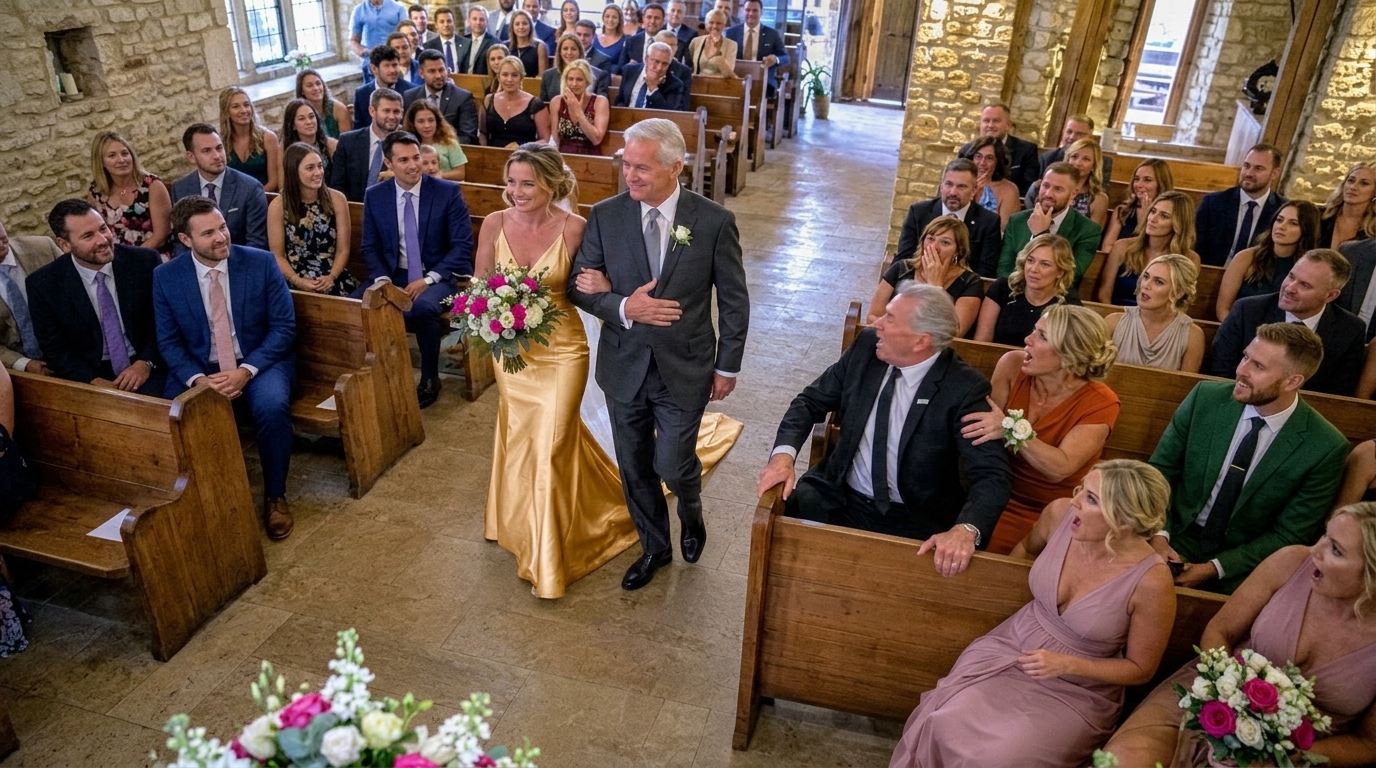
Inside was a photograph from our wedding.
The moment the oak doors opened.
Frank standing beside me.
My bouquet in one hand.
My other hand resting on his arm.
Both of us smiling.
Beneath the photograph, he’d carved a sentence into the wood.
FAMILY IS WHO SHOWS UP.
I stared at it.
Then I began crying.
Frank pulled me into a hug.
“Happy anniversary, kiddo.”
I held him tightly.
“Thank you.”
He smiled.
“For what?”
I looked up.
“For being there.”
His eyes filled.
“Always.”
Later that evening, after Frank left, Marcus and I sat together beneath the greenhouse lights.
He poured sparkling cider into two glasses.
We toasted our first year of marriage.
Then he asked, “Do you ever think about how different everything might have been if your dad had walked you down the aisle?”
I thought about it.
For a long time.
Then I shook my head.
“I used to.”
Marcus looked at me.
“And now?”
I smiled.
“Now I think about how lucky I was that Frank did.”
He squeezed my hand.
I looked around the greenhouse.
At the flowers.
The wooden shelves.
The warm lights.
The place my grandfather had loved.
And I realized something.
For years, I had measured love by the people who withheld it.
My father’s approval.
My mother’s attention.
My sister’s acceptance.
I had spent so much time trying to earn what should have been freely given.
But on my wedding day, when my father chose not to stand beside me, another man stepped forward without hesitation.
Frank didn’t ask whether Vanessa would be upset.
He didn’t worry about family politics.
He didn’t make me prove I deserved the honor.
He simply opened his arms and said it would be the greatest privilege of his life.
And in doing so, he taught me something my own father never had.
Love isn’t just something people say.
It’s something they do.
It’s the person who arrives when you’re frightened.
The person who keeps a promise.
The person who builds shelves for your workshop because they know your dream matters.
The person who stands beside you when everyone else expects you to stand alone.
I looked at Marcus.
Then at the framed photograph.
And I smiled.
Because the day my father refused to walk me down the aisle, I thought I was losing something precious.
I thought I was being abandoned.
Humiliated.
Rejected.
But I hadn’t been left alone.
I’d been given the chance to see clearly who had already been standing beside me.
And that changed everything.
A few weeks later, I hung Frank’s photograph in the farmhouse hallway.
Directly beneath it, I placed Grandpa’s letter.
The silver bracelet rested in a small display box nearby.
Sometimes customers asked about the photograph.
They would smile and say, “Is that your father?”
And I would smile back.
Then I’d answer, “That’s Frank.”
Most people didn’t ask further.
But occasionally, someone would say, “He looks so proud.”
And I would feel my heart fill with warmth.
Because he was.
He had been proud of me when I had nothing.
When I rented a tiny workshop.
When my business barely covered expenses.
When I doubted myself.
And when I finally walked down the aisle.
He didn’t become proud of me because I inherited a farm.
He didn’t love me because I succeeded.
He loved me before any of that.
And that was what made his presence so meaningful.
Today, Arthur’s Garden is thriving.
The greenhouse has been restored.
The farmhouse is filled with life again.
We host flower-arranging workshops, small weddings, and seasonal markets.
Every autumn, we hold a harvest celebration in Grandpa’s memory.
Children run through the gardens.
Families gather beneath the apple trees.
And couples take photographs beside the lavender fields.
Sometimes I stand on the porch and imagine Grandpa watching.
I think he’d smile.
Then he’d probably complain that I’d planted the rosemary too close together.
And I’d laugh.
Because I can still hear his voice.
I still wear the silver bracelet Frank gave me.
The flower charm reminds me of Grandpa.
The house reminds me of the home he left behind.
And the compass reminds me that even when people try to make you feel lost, you can still find your way.
My relationship with my parents is different now.
There are boundaries.
There are conversations we still need to have.
There are wounds that may never disappear completely.
But I’ve stopped pretending everything is fine simply to make other people comfortable.
And I’ve stopped apologizing for being happy.
Vanessa and I rarely speak.
I wish her well.
I hope one day she finds peace.
But I no longer believe it’s my responsibility to sacrifice mine so she can have it.
Last month, Frank came to the garden early one Saturday morning.
I was pruning roses near the greenhouse.
He walked over carrying two cups of coffee.
“Morning, kiddo.”
I smiled.
“Morning, Frank.”
He handed me a cup.
Then he looked toward the farmhouse.
“Your grandfather would be proud.”
I laughed softly.
“You keep saying that.”
He smiled.
“Because it’s true.”
We stood together for a while.
Watching the sun rise over the fields.
Then I looked at him.
“Frank?”
“Yeah?”
“Can I ask you something?”
“Anything.”
I hesitated.
“Did you ever feel uncomfortable walking me down the aisle?”
He turned toward me.
“Uncomfortable?”
“Because my father was sitting there.”
Frank looked surprised.
Then he shook his head.
“Darcy, I didn’t walk you down that aisle to embarrass your father.”
“I know.”
“I walked you down because you asked me.”
My eyes filled.
He smiled gently.
“And because I love you.”
I looked down.
Then whispered, “I love you too.”
He put his arm around my shoulders.
And we stood there together as the morning sunlight warmed the garden.
For a moment, I remembered the little girl who used to wonder why she was never enough.
Why Vanessa’s feelings always mattered more.
Why her own happiness seemed to require permission.
I wished I could go back and tell that girl something.
I’d tell her that she wasn’t difficult.
She wasn’t selfish.
She wasn’t too sensitive.
She was simply growing up in a family that had mistaken her independence for an absence of need.
I’d tell her that being strong didn’t mean she deserved less love.
That being capable didn’t mean she should always be the one who sacrificed.
And that one day, she would walk through a pair of oak doors wearing a wedding dress she loved, carrying flowers she’d grown herself.
She would look toward the man she was marrying.
And beside her would be someone who was genuinely proud to hold her arm.
Not because he had to.
Not because someone threatened him.
Not because he wanted credit.
But because he wanted to be there.
And that would be enough.
People sometimes ask whether I regret not having my biological father walk me down the aisle.
My answer surprises them.
“No.”
Not anymore.
Because the truth is, I didn’t lose my father on my wedding day.
I simply stopped pretending he was someone he hadn’t yet learned to be.
And in that moment, I recognized the fatherly love that had been quietly present all along.
Frank never tried to replace anyone.
He never demanded a title.
He never asked me to choose between him and my parents.
He simply loved me.
Steadily.
Quietly.
Without conditions.
And when the moment came, he showed up.
That is what I’ll remember for the rest of my life.
Not my mother’s cold instruction to smile.
Not Vanessa’s angry expression.
Not my father’s empty chair.
I’ll remember the warm autumn sunlight streaming through the barn doors.
The sound of the string quartet.
The scent of lavender in my bouquet.
The steady arm beneath my hand.
And Frank’s voice whispering:
“Ready, kiddo?”
I’ll remember answering:
“I am now.”
Because I was.
I was ready to marry Marcus.
Ready to build a life with someone who loved me.
Ready to stop chasing approval from people who used it as a reward.
And ready to understand that family isn’t defined only by blood.
Family is defined by the people who show up when it matters.
The people who keep their promises.
The people who celebrate your happiness without making it a competition.
The people who refuse to let you stand alone when they have the chance to stand beside you.
My father gave up the honor of walking me down the aisle because he was afraid of upsetting my sister.
Frank accepted that honor because he was proud to love me.
And that difference taught me more about family than thirty-four years of trying to earn my parents’ approval ever had.
Today, whenever I walk past that framed wedding photograph, I smile.
Because I no longer see a bride who was abandoned.
I see a woman who finally learned her worth.
I see a father who chose love over convenience.
And I see the beginning of a life where I no longer have to make myself smaller to belong.
My father refused to walk me down the aisle. But the man who took his place showed me that I had never been unworthy of being chosen.
And that was the greatest wedding gift I could ever have received.
THE END THANK YOU FOR READING !!!



