PART 3
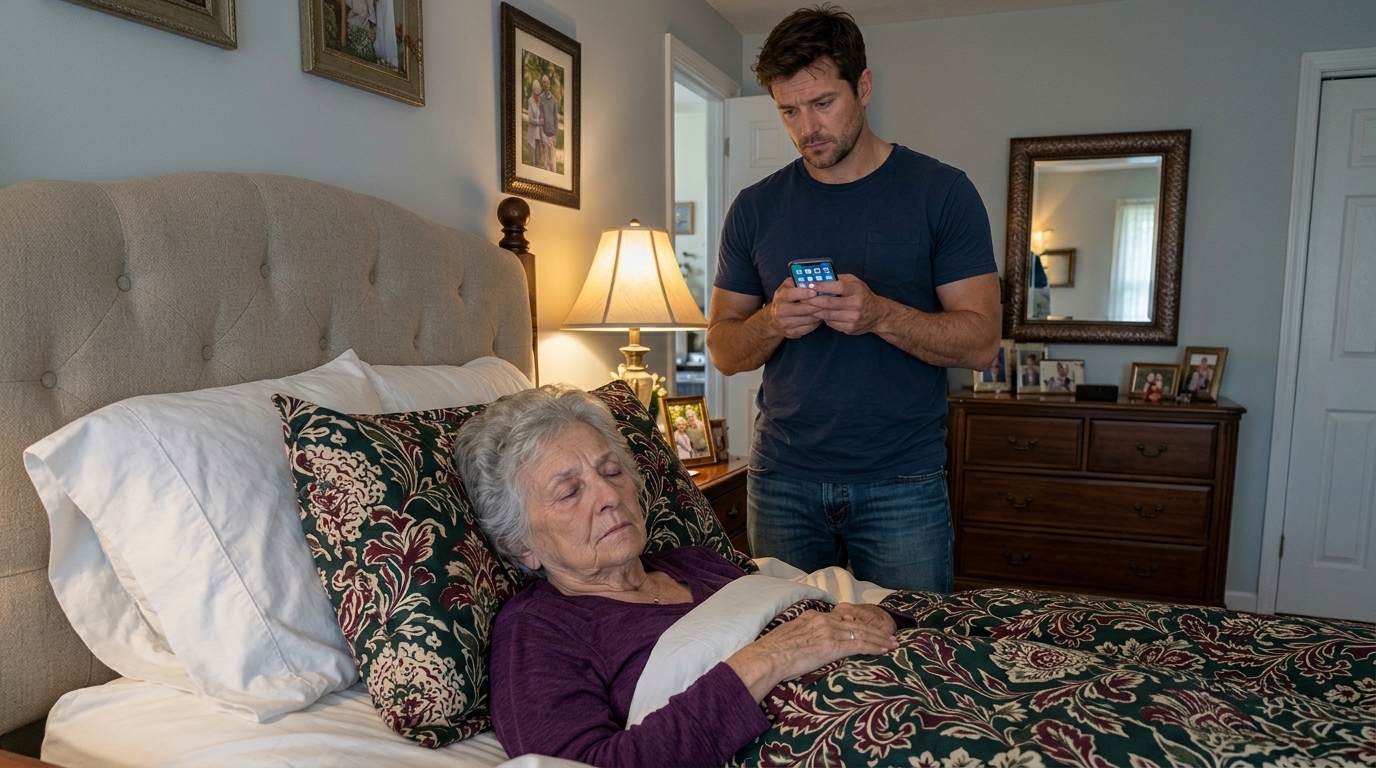
Mark stood in the hallway, staring at the phone in my hand.
For the first time in months,
my forty-year-old son looked like the frightened
little boy who used to come running
into my bedroom after a nightmare.
Except this time,
I wasn’t going to hold him and promise everything would be all right.
“Mom,” he whispered, “what are you talking about?”
I looked at him carefully.
His face was pale, his hair disheveled,
and his hands trembled slightly.
“You heard me, Mark. Get dressed.”
He glanced toward the guest bedroom.
“Clare’s at the bank. Something happened.”
“I know.”
His eyes widened.
“How could you possibly know?”
“Because I was expecting her.”
He opened his mouth, then closed it.
I stepped past him and walked toward the kitchen.
“Coffee?” I asked.
“Mom, this isn’t funny.”
“I wasn’t joking.”
I filled the kettle and placed it on the stove.
For thirty-seven years, I had been a mother.
For twenty-two of those years, I had also been a wife.
My husband, Thomas, died six years earlier after a sudden heart attack.
He had been a patient man,
the kind who believed that a person’s character was revealed by what they did when nobody was watching.
I had often thought about that lesson since Mark and Clare moved into my home.
Now, standing in my kitchen at four in the morning,
I wondered what Thomas would have said if he’d heard our son planning to steal my retirement savings.
Mark followed me.
“Mom, please. Just tell me what’s happening.”
I turned.
“Three weeks ago, Clare photographed my bank card.”
He froze.
“What?”
“Front and back.”
“That’s impossible.”
“Is it?”
“She wouldn’t do that.”
I studied his face.
Less than an hour earlier, I had heard him telling her my PIN.
And now he was pretending he knew nothing.
“Mark, I heard your conversation at 3:15.”
The color drained from his face.
“What conversation?”
“The one where you told your wife to empty my account.”
He looked toward the floor.
I continued.
“The one where you said I had more than eighty thousand dollars saved. The one where you said I slept too soundly to notice.”
His mouth opened.
Nothing came out.
I waited.
For once, I wanted him to experience the discomfort of silence.
Finally, he whispered, “You misunderstood.”
I almost laughed.
“Did I?”
“Yes. Clare and I were talking about—”
“Choose your next words carefully.”
He stopped.
I folded my arms.
“Because I have spent months listening to the two of you discuss my money as though it belongs to you. Tonight, I heard you planning to take it.”
He swallowed.
“Mom, we’re desperate.”
There it was.
Not an apology.
Not a denial.
An excuse.
I nodded slowly.
“Desperate enough to steal from your mother?”
He rubbed his face.
“You don’t understand what we’re dealing with.”
“Then explain it.”
He hesitated.
“Clare made some financial mistakes.”
“What kind of mistakes?”
“Credit cards. Loans. Things got out of control.”
“How much?”
He looked away.
“Mark.”
“About forty thousand.”
I stared at him.
“Forty thousand dollars?”
He nodded.
“And you thought stealing eighty thousand from me would solve that?”
He didn’t answer.
I turned off the kettle.
Suddenly, I didn’t want coffee.
I wanted the truth.
All of it.
“Where is Clare right now?” I asked.
“At the bank.”
“Why?”
“She said she needed to speak to someone.”
I looked at him.
“Before five in the morning?”
His expression changed.
He realized his mistake.
The bank branch wasn’t open.
Clare had gone to an ATM vestibule first, then contacted a bank representative after the card was declined. A security employee had directed her to wait until staff arrived to review the suspicious activity.
Her attempted withdrawal had triggered the restrictions I arranged weeks earlier.
And the forged authorization documents she had prepared were already being reviewed.
Mark’s phone vibrated.
He glanced at the screen.
Clare.
He answered immediately.
“Where are you?”
I could hear her crying.
“Mark, they know.”
“Know what?”
“Everything!”
He looked at me.
I said nothing.
Clare continued.
“They have the photographs. They have the messages. They even have the paperwork.”
Mark turned away.
“Calm down.”
“Don’t tell me to calm down! Your mother set us up!”
I stepped closer.
“No, Clare,” I said loudly enough for her to hear. “You set yourselves up.”
The phone went silent.
Then Clare whispered, “Eleanor?”
“Yes.”
“How—”
“You should have asked permission before going through my handbag.”
Mark closed his eyes.
Clare began sobbing again.
“Please, Eleanor. We can explain.”
“You can explain to the investigators.”
I took the phone from Mark’s trembling hand.
“And Clare?”
“Yes?”
“Don’t destroy anything. Not the messages, not the documents, and not the photographs.”
Her breathing quickened.
“Why?”
“Because I have copies.”
Then I ended the call.
Mark stared at me.
“What have you done?”
I placed the phone on the table.
“What I should have done months ago.”
The security footage I had mentioned wasn’t from a camera hidden in the guest bedroom.
It came from the hallway camera I’d installed after several packages disappeared from my front porch.
Mark and Clare knew the camera existed.
They simply assumed it stopped recording at night.
It didn’t.
Three weeks earlier, the footage showed Clare leaving the guest bedroom at 1:42 a.m.
She walked into the kitchen.
Opened my handbag.
Removed my wallet.
And photographed my bank card.
Then she returned everything exactly where she’d found it.
The entire incident lasted less than three minutes.
When I first watched the recording, I sat at my dining table for almost an hour.
I couldn’t believe it.
I had welcomed Clare into my family eight years earlier.
I had helped pay for their wedding reception when they couldn’t afford the venue they wanted.
I had cooked meals when they were sick.
I had driven across town to help whenever they needed something.
And when they lost their apartment, I had opened my home without hesitation.
Now I had proof that my daughter-in-law was stealing my financial information.
I wanted to confront her immediately.
But something stopped me.
Two days before discovering the footage, I’d noticed Mark searching through the drawer where I kept my important documents.
When I asked what he needed, he claimed he was looking for an old insurance policy.
I didn’t believe him.
So instead of confronting either of them, I contacted my bank.
I spoke with a fraud specialist named Patricia Morgan.
She listened carefully.
Then she asked a question I hadn’t expected.
“Mrs. Hayes, has anyone recently asked you to sign documents involving your accounts or property?”
I thought about it.
Clare had mentioned estate planning several times.
Mark had suggested adding his name to my accounts.
And two weeks earlier, Clare had brought home a packet of papers she claimed would make things easier if I ever became ill.
I hadn’t signed them.
Patricia advised me to bring every document I could find.
The next morning, I went to the bank.
And what we discovered frightened me more than the missing bank card photographs.
Someone had already attempted to access my online banking.
Three times.
Someone had also requested information about adding an authorized signer to one of my accounts.
The requests hadn’t been completed.
But the contact information used matched an email address Clare had once asked me to use for a family shopping account.
Patricia recommended immediate protective measures.
I agreed.
My old card was canceled.
A new card was issued.
My online banking credentials were changed.
Additional verification was required for large withdrawals and account changes.
And a warning was placed on my customer profile about possible attempted financial exploitation.
I left the bank feeling shaken.
But I also felt something I hadn’t felt in months.
Control.
Back in my kitchen, Mark watched the hallway footage on my phone.
His expression shifted from shock to anger.
“Why were you recording Clare?”
I stared at him.
“That’s your question?”
He looked uncomfortable.
“I’m just saying—”
“Your wife stole my card information, and you’re upset that a security camera recorded her?”
He said nothing.
I opened another file.
“This is what I wanted you to see.”
It was a screenshot from a message thread Clare had left open on a tablet she sometimes borrowed from me.
I had noticed it when the screen lit up on my kitchen counter.
At the time, I hadn’t understood what I was looking at.
Now I did.
The conversation was between Clare and someone saved as “D.”
The first message read:
He still thinks the money is for our debts.
The next said:
Once Eleanor’s account is empty, I’ll have enough to leave.
I watched Mark read it.
His face changed.
“What?”
I scrolled down.
Another message appeared.
Mark doesn’t know about the apartment. Keep it that way until I get the money.
Mark grabbed the edge of the table.
“Who is D?”
“I was hoping you could tell me.”
He shook his head.
“No.”
I showed him another screenshot.
It was a photograph of Clare standing beside a man outside an apartment building.
The man had one arm around her waist.
Mark stared at it.
“That’s Derek.”
“Who is Derek?”
He swallowed.
“Her old boyfriend.”
I remained silent.
Mark looked at the photograph again.
Then he whispered, “She told me he moved to Arizona.”
I watched him slowly sit down.
The confidence he’d displayed while discussing my savings had vanished.
But I didn’t feel satisfaction.
I felt sadness.
Because even now, I could see him trying to make sense of the woman he’d married.
And I understood that feeling better than he realized.
I had spent months doing the same thing with him.
Mark read the messages again.
Then he looked up.
“She was going to leave me?”
“It appears that way.”
“With your money?”
“Yes.”
He shook his head.
“No. She wouldn’t.”
I sat across from him.
“Mark, less than an hour ago, you were planning to steal from me. You knew it was wrong, and you were willing to do it anyway.”
He flinched.
“Don’t pretend this is only about Clare.”
He looked down.
I continued.
“You made your own choices. Whatever Clare was planning doesn’t erase them.”
For the first time, his eyes filled with tears.
“Mom, I messed up.”
I nodded.
“Yes, you did.”
He covered his face.
“I thought we were going to lose everything.”
I looked around my kitchen.
The refrigerator I’d repaired twice.
The curtains I’d sewn myself.
The dining table Thomas and I had bought when Mark was six.
The home where I’d raised him.
“You were willing to take everything from me so you wouldn’t have to face your own problems.”
Mark began crying.
I wanted to reach for him.
Every instinct I’d developed as a mother told me to comfort my child.
But Mark wasn’t a child anymore.
He was forty.
And I was sixty-four.
If I kept rescuing him from the consequences of his decisions, I would never be safe.
I stood.
“Get your coat.”
He looked up.
“Where are we going?”
“To speak with the authorities.”
His expression changed.
“Mom, please.”
I picked up my handbag.
“I’m not asking.”
By the time we arrived at the police station, the sky was beginning to lighten.
Mark sat beside me in silence.
I had called ahead and explained that I wanted to provide information related to an attempted theft and suspected financial exploitation.
An officer took us into a small interview room.
His name was Detective Samuel Brooks.
He appeared to be in his early fifties, with tired eyes and a calm manner.
He listened without interrupting as I explained what had happened.
I showed him the footage.
The screenshots.
The account security alerts.
And the documents Clare had left in my kitchen drawer.
Then he asked Mark whether he wanted to make a statement.
Mark looked at me.
I didn’t speak for him.
After several seconds, he nodded.
“Yes.”
The detective asked me to wait outside while they spoke privately.
I sat on a bench in the hallway.
My hands were trembling.
Not from fear anymore.
From exhaustion.
I had been awake since three in the morning.
And in those few hours, my entire relationship with my son had changed.
I thought about Thomas.
He used to say that love without boundaries eventually becomes resentment.
I hadn’t understood that when I was younger.
I understood it now.
Twenty minutes later, Detective Brooks came into the hallway.
“Mrs. Hayes, there’s something else we need to discuss.”
I stood.
“What?”
He held a document inside a clear folder.
It was a photocopy of a form.
My name appeared at the top.
Below it was a signature.
A signature that looked almost exactly like mine.
I stared at it.
“What is that?”
The detective’s expression was serious.
“It’s a document someone attempted to use to authorize financial access on your behalf.”
I looked closer.
The date was from two weeks earlier.
And beside my forged signature was another name.
Mark Hayes.
My knees nearly gave way.
Because I had expected Clare to betray me.
But I hadn’t expected to discover how far my son had already gone.
PART 4
I stared at the paper until the words blurred.
Mark Hayes.
My son.
My only child.
His name appeared on a document that could have given him access to money I’d spent decades saving.
For a moment, I couldn’t breathe.
Detective Brooks pulled out a chair.
“Mrs. Hayes, please sit down.”
I did.
My legs felt weak.
“Did Mark sign this?”
“We’re still determining who prepared and submitted the document.”
I looked at him.
“But his name is there.”
“Yes.”
I pressed my hands together.
“Does he know?”
The detective hesitated.
“He’s told us some things we need to verify.”
I looked toward the interview room.
Through the narrow window, I could see Mark sitting with his head lowered.
I remembered the first time I’d held him.
Seven pounds, three ounces.
A tiny fist wrapped around my finger.
Thomas had cried when the nurse placed Mark in his arms.
“We made him,” he’d whispered, laughing through his tears.
For years, I’d believed being a good mother meant protecting my child from pain.
Now I was learning that sometimes protecting someone meant refusing to shield them from the truth.
I looked back at Detective Brooks.
“I didn’t sign that document.”
He nodded.
“That’s important.”
“And I never authorized Mark or Clare to access my savings.”
“We’ll include that in your statement.”
I swallowed.
“Then I want the investigation to continue.”
He studied me.
“Are you certain?”
I thought about the eighty thousand dollars.
The years of work.
The nights I came home with swollen feet.
The vacations Thomas and I postponed.
The money we’d saved because we wanted security in our later years.
Then I thought about Mark whispering through the bedroom wall.
Empty the account.
I nodded.
“Yes.”
I returned home shortly after eight that morning.
Mark didn’t come with me.
He remained at the station for further questioning, and I had arranged for him to collect his belongings later under conditions that would keep us separated.
The house was quiet when I opened the front door.
For months, I’d complained about the noise.
Clare talking loudly on her phone.
Mark watching television until midnight.
Arguments behind closed doors.
Cupboards slamming.
Now the silence felt unfamiliar.
I walked into the kitchen.
Two coffee mugs sat in the sink.
A jacket hung over the back of a chair.
Clare’s expensive handbag rested on the counter.
I looked at it for a long moment.
Then I called Laura Bennett, my oldest friend.
Laura and I had known each other since we were twenty.
We’d worked together at the same medical office for nearly thirty years.
She knew almost everything about my life.
Except this.
She answered immediately.
“Eleanor? Is everything all right?”
I tried to speak.
Instead, I started crying.
Twenty minutes later, she was at my door.
She didn’t ask questions.
She simply hugged me.
And for the first time since hearing Mark’s conversation, I allowed myself to fall apart.
We sat at the kitchen table while I told her everything.
Laura listened quietly.
When I finished, she looked toward the guest bedroom.
“They need to leave.”
I nodded.
“I know.”
“No, Eleanor. I mean permanently.”
I looked down.
“They have nowhere to go.”
Laura sighed.
“And you have nowhere else to retire if they steal your savings.”
The words stung.
Because they were true.
She reached across the table.
“You’ve spent your entire life putting everyone else first. Thomas knew that. Mark knows that. Clare took advantage of it.”
I wiped my eyes.
“I keep wondering where I went wrong.”
Laura shook her head.
“You raised a son. You didn’t make his decisions for him.”
I looked toward the window.
“Thomas would be heartbroken.”
“Yes,” she said softly. “But he’d also want you to protect yourself.”
We sat quietly for a while.
Then Laura asked whether I’d contacted an attorney.
I hadn’t.
She gave me the number of a lawyer named Margaret Ellis, who handled elder financial exploitation and property matters.
I called that afternoon.
Margaret listened to my story.
Then she explained that I needed to protect both my finances and my home.
She recommended changing the locks when legally permitted, securing my documents, reviewing any authority Mark or Clare might claim, and following the proper legal process to end their occupancy.
I was disappointed to learn I couldn’t necessarily remove them immediately simply because the house belonged to me.
But Margaret was clear.
“Mrs. Hayes, we can do this properly. The important thing is not to give them an opportunity to turn your reasonable efforts to protect yourself into another dispute.”
I agreed.
For the first time in months, I had a plan.
That evening, my phone rang.
Clare.
I almost ignored it.
Then I answered.
“Hello?”
“Eleanor.”
Her voice sounded exhausted.
I didn’t respond.
“Please don’t hang up.”
“I’m listening.”
She began crying.
“I made a terrible mistake.”
I looked out the window.
“Which one?”
She hesitated.
“What?”
“Photographing my bank card? Forging my signature? Trying to withdraw my savings? Or planning to leave Mark with the money?”
Silence.
Then she whispered, “You saw those messages.”
“Yes.”
“Eleanor, it’s not what you think.”
I closed my eyes.
I was so tired of hearing those words.
“Then explain.”
“Derek and I were just talking.”
“About an apartment?”
She said nothing.
“About using my retirement money to start a new life?”
Clare began sobbing harder.
“I was confused.”
I almost laughed.
“Confused?”
“My marriage has been difficult.”
“Then you should have sought help, separated, or filed for divorce.”
I paused.
“You don’t get to steal from me because you’re unhappy with my son.”
She was quiet.
Then her tone changed.
“Mark was involved too.”
“I know.”
“He knew about the money.”
“I know.”
“He gave me the PIN.”
“I heard him.”
She hesitated.
Then she said something I hadn’t expected.
“He didn’t know about Derek.”
I stared at the wall.
“No, Clare. Apparently he didn’t.”
She began crying again.
“Please don’t tell him everything.”
I felt my patience disappear.
“You’re asking me to protect your secrets after you tried to steal my savings?”
“I’m begging you.”
I took a slow breath.
“Clare, I have spent months feeding you, housing you, and helping you. I treated you like a daughter.”
Her crying stopped.
“And you treated me like an obstacle standing between you and my money.”
“Eleanor—”
“Whatever happens next will be handled through the proper channels. Do not contact me again except through the attorney.”
Then I ended the call.
My hands shook afterward.
But I didn’t regret it.
Three days later, Margaret called with another discovery.
She had reviewed the paperwork Clare left in my house.
One document was particularly concerning.
It was a draft durable financial power of attorney.
My name appeared as the person granting authority.
Mark was listed as the agent.
The signature page had been prepared but was not validly executed.
Margaret explained that the draft alone did not give Mark any authority.
But the attempt to create it, combined with the forged bank paperwork, raised serious concerns.
Then she asked whether I’d ever signed anything for Clare during the previous six months.
I thought carefully.
There had been a form.
Something about insurance.
Clare had brought it to me after dinner.
She said Mark needed updated information for an employment benefits application.
I remembered signing a page.
My stomach tightened.
“Margaret, I may have signed something.”
She became serious.
“Do you have a copy?”
“No.”
“Then we’ll need to find out exactly what it was.”
I sat down.
“What are you thinking?”
“I’m thinking we shouldn’t assume the bank account was their only target.”
I looked around my living room.
At the walls.
The windows.
The staircase where Mark had once slid down the banister.
The home Thomas and I had spent thirty years paying for.
And suddenly, I understood.
“My house,” I whispered.
Margaret didn’t answer immediately.
Then she said, “We’re going to check the property records.”
The next morning, Margaret called again.
“Eleanor, I need you to come to my office.”
My heart sank.
“What happened?”
“Someone submitted paperwork involving your property.”
I gripped the phone.
“What kind of paperwork?”
“A mortgage application.”
I couldn’t speak.
She continued.
“The application appears to have used your personal information and represented that you had authorized the transaction.”
I felt sick.
“How much?”
Margaret hesitated.
“One hundred and forty thousand dollars.”
I closed my eyes.
My house was worth considerably more than that.
But it was paid off.
Thomas and I had made the final mortgage payment seven years before he died.
We’d celebrated with takeout Chinese food and a bottle of inexpensive champagne.
He’d framed the payoff letter.
It still hung in my office.
Now someone had tried to borrow against the house without my knowledge.
I whispered, “Did they get the money?”
“No. The application was flagged during verification. No loan was funded, and we haven’t found a recorded lien arising from it.”
Relief washed through me.
But it was quickly replaced by anger.
“Who submitted it?”
Margaret took a breath.
“The contact information leads back to Clare.”
I stared at the floor.
“And Mark?”
“His name appears in supporting paperwork, but we need to determine exactly what he knew.”
I closed my eyes.
I thought the bank account had been the target.
I thought they wanted eighty thousand dollars.
But Clare had apparently been planning something much bigger.
And my son had helped open the door.
The investigation uncovered the rest over the following weeks.
Clare had accumulated debts far beyond what Mark understood.
There were personal loans.
Credit cards.
Unpaid bills.
And money she’d borrowed from people who had begun demanding repayment.
Mark knew about some of it.
But not all.
He believed Clare needed approximately forty thousand dollars to clear their debts.
In reality, investigators found obligations totaling nearly ninety thousand.
Then there was Derek.
The former boyfriend.
He had been helping Clare look for apartments in another city.
Their messages suggested they planned to leave together after obtaining money from my accounts.
Derek later told investigators that Clare claimed the money was an inheritance she was entitled to receive.
When I heard that, I sat in silence for a long time.
An inheritance.
From a woman who was still alive.
A woman who had fed her, housed her, and welcomed her into the family.
Apparently, Clare had already decided my money belonged to her.
And my existence was simply an inconvenience.
Mark called me eleven days after the attempted withdrawal.
I had ignored his earlier messages.
But this time, I answered.
“Mom?”
His voice sounded different.
Quieter.
“Hello, Mark.”
There was a long silence.
Then he said, “I know about Derek.”
I closed my eyes.
“I’m sorry.”
He gave a bitter laugh.
“She was going to leave me.”
“Yes.”
“With your money.”
“Yes.”
He began crying.
“I ruined everything.”
I didn’t answer.
“Mom, I didn’t know about the house.”
I looked out the window.
“Did you know about the bank account?”
He hesitated.
“Yes.”
“Did you give Clare my PIN?”
“Yes.”
“Did you tell her to take my savings?”
His voice broke.
“Yes.”
I swallowed.
“Then you knew enough.”
He began sobbing.
“I thought we could pay it back.”
“How?”
“I don’t know.”
“Mark, you were going to take more than eighty thousand dollars. You had no savings, no stable income, and debts you couldn’t manage.”
He said nothing.
“How exactly were you going to pay it back?”
“I wasn’t thinking.”
I closed my eyes.
“No. You were thinking about yourself.”
He cried harder.
Then he whispered, “Do you hate me?”
The question hurt more than I expected.
Because despite everything, he was still my son.
I remembered his first steps.
His school plays.
His graduation.
The day he married Clare.
I remembered every birthday cake I’d baked.
Every scraped knee I’d cleaned.
Every time he’d called me because he needed help.
And I realized something painful.
I could love him and still refuse to trust him.
“No, Mark,” I whispered. “I don’t hate you.”
He began crying harder.
“But I don’t trust you anymore.”
Silence.
Then I added, “And love doesn’t mean you get to hurt me without consequences.”
He whispered, “I understand.”
I hoped he did.
But understanding would have to become action.
Because I wasn’t going to risk my future on another promise.
The criminal investigation continued.
Clare was formally charged with offenses related to the attempted fraud and forged documents.
Mark also faced charges connected to his participation in the plan.
The exact legal consequences would be determined by the court.
I didn’t celebrate.
I didn’t call my neighbors.
I didn’t post about it online.
I simply continued protecting myself.
Margaret helped me review my estate documents.
I updated my financial arrangements.
I secured my home.
I removed access that Mark and Clare no longer had permission to use.
And after the required legal process, their right to occupy my house ended.
The day their remaining belongings were collected, I stood on the porch.
A moving truck was parked in the driveway.
Mark avoided my eyes.
Clare didn’t come.
He carried two boxes outside.
Then he returned for a suitcase.
When he reached the front door, he stopped.
“Mom?”
I looked at him.
“Can I ask you something?”
“Yes.”
“Will you ever forgive me?”
I took a long breath.
“I don’t know.”
His face fell.
“But I do know this,” I continued. “If you want a relationship with me someday, it will have to be built on honesty. Not money. Not guilt. Not promises you make because you’re afraid of losing something.”
He nodded slowly.
“I understand.”
I looked at the driveway.
“Then start by taking responsibility for what you’ve done.”
He wiped his eyes.
“I will.”
I watched him walk toward the truck.
And for the first time in my life, I let my son leave without trying to fix his problems.
It was one of the hardest things I’d ever done.
But it was also the beginning of something I desperately needed.
Peace.
PART 5
Six months passed.
The seasons changed.
The leaves turned orange and gold.
The mornings became colder.
And my house slowly began to feel like mine again.
At first, the silence was difficult.
I’d become accustomed to having Mark and Clare around.
Even when their presence made me uncomfortable, the house had been full of noise.
Now I could hear the ticking of the old clock above the fireplace.
The refrigerator humming.
The wind brushing against the porch railing.
Sometimes, I caught myself listening for footsteps in the hallway.
Then I remembered.
They were gone.
And I was safe.
That realization brought relief.
But it also brought grief.
Because I’d lost something that couldn’t be measured in dollars.
I’d lost the easy trust I’d once had in my son.
The first thing I did after the house became quiet was clean the guest bedroom.
Not because it was dirty.
Because I needed to reclaim it.
Clare had filled the closet with clothes.
Mark had left old electronics scattered across the desk.
There were scratches on the dresser and stains on the carpet.
I opened the windows.
Washed the curtains.
Repainted the walls a soft cream color.
And replaced the heavy bedspread with a pale blue quilt.
Then I stood in the doorway.
For months, that room had been the center of my anxiety.
It was where I’d heard Mark whispering about my money.
Where I’d listened to him planning to betray me.
Where I’d lain awake wondering whether the people sleeping across the hallway were searching through my belongings.
Now sunlight poured across the clean floor.
And I made a decision.
The room would no longer be a reminder of what happened.
It would become a place for something good.
I moved the old desk beneath the window.
Brought in a comfortable reading chair.
And placed a small bookshelf against the wall.
Then I took out the sewing machine Thomas had bought me for our twentieth anniversary.
I’d barely used it since he died.
He used to tease me about collecting fabric.
“Eleanor, we have enough material in this house to make curtains for the entire neighborhood.”
I smiled at the memory.
Then I sat down at the machine.
For the first time in years, I began sewing again.
My friend Laura suggested I join a local quilting group.
At first, I refused.
“I don’t need another hobby.”
She laughed.
“Eleanor, you’ve spent the last six months worrying about lawyers, bank statements, and your son. You need something that belongs to you.”
She was right.
So I went.
There were eight women in the group.
Some were widows.
Some were retired teachers.
One was a former nurse.
We met every Wednesday afternoon at a community center.
We made quilts for families facing difficult circumstances.
At first, I barely spoke.
I simply cut fabric and listened.
Then, slowly, I began sharing stories.
Not about Mark.
Not about Clare.
About Thomas.
About the places I’d traveled.
About the books I loved.
About the things I wanted to do before I turned seventy.
One afternoon, a woman named Helen asked whether I’d ever been to Maine.
I shook my head.
“Always wanted to.”
She smiled.
“Then go.”
I laughed.
“Just like that?”
“Why not?”
I opened my mouth to answer.
Then stopped.
Why not?
For decades, I’d saved money because I was afraid of emergencies.
Afraid of getting sick.
Afraid of losing my home.
Afraid of needing help.
Those were reasonable concerns.
But somewhere along the way, I’d forgotten that money could also be used to live.
Not recklessly.
Not carelessly.
But joyfully.
I went home that afternoon and opened my savings spreadsheet.
For the first time in months, I looked at the balance without fear.
The money was still there.
Every dollar.
The bank had protected the account before Clare could take it.
And after reviewing my finances with a qualified adviser, I realized I could afford a modest trip without threatening my retirement security.
So I booked five days in Maine.
Alone.
I stayed in a little inn overlooking the water.
Every morning, I drank coffee on the porch.
I walked along the harbor.
Ate fresh seafood.
Visited bookstores.
And took photographs of lighthouses.
One afternoon, I sat on a bench watching fishing boats return to shore.
An elderly man sat beside me.
He introduced himself as Walter.
He was seventy-one.
A retired carpenter.
His wife had died four years earlier.
We talked for almost an hour.
He told me about the house he’d built.
His grandchildren.
The garden he maintained.
Then he asked about my family.
I hesitated.
For a moment, I considered giving the usual answer.
One son.
Married.
Living nearby.
Everything fine.
Instead, I told him the truth.
Not every detail.
But enough.
Walter listened quietly.
When I finished, he looked toward the water.
“Children can break your heart in ways strangers never could.”
I nodded.
“Yes.”
He was silent for a moment.
Then he said, “But their choices don’t get to decide whether the rest of your life is worth living.”
I looked at him.
He smiled gently.
“You’ve still got plenty of life left, Eleanor.”
I didn’t know why those words affected me so deeply.
Maybe because I’d spent months feeling old.
Vulnerable.
Disposable.
As though my only value to my family was the money in my bank account.
Now a stranger was reminding me that I was still a person.
Not just a mother.
Not just a widow.
Not just someone with savings.
A woman with dreams.
Preferences.
Memories.
And a future.
I returned home feeling lighter than I had in years.
The legal proceedings involving Mark and Clare continued.
Eventually, both accepted responsibility through separate agreements with the court.
Clare received a sentence that included a period of incarceration for her role in the fraud.
Mark received a different sentence involving supervised probation, restitution-related obligations, and mandatory financial counseling.
The judge considered the extent of each person’s involvement.
Neither outcome erased what they’d done.
But the legal process was finally moving toward an end.
Derek was investigated as well.
Authorities determined that he had been involved in planning to receive money Clare expected to obtain, although the extent of his criminal responsibility required separate consideration.
I didn’t follow every development.
I’d spent enough of my life worrying about people who didn’t worry about me.
Margaret kept me informed of matters that directly affected my safety and finances.
Otherwise, I focused on rebuilding my life.
One evening, nearly a year after that terrible night, Mark wrote me a letter.
It arrived in a plain white envelope.
His handwriting was familiar.
For a long time, I didn’t open it.
Then I sat at my kitchen table and unfolded the pages.
He began with an apology.
But this time, it was different.
He didn’t blame Clare.
He didn’t blame their debts.
He didn’t say he’d been desperate.
He wrote:
Mom, I’ve spent most of my life believing that whenever something went wrong, you would find a way to make it right.
I paused.
Then continued.
When I lost my job, you helped me.
When I couldn’t pay rent, you opened your home.
When I made mistakes, you forgave me.
Somewhere along the way, I stopped seeing your kindness as a gift and started treating it like something I was entitled to.
My eyes filled with tears.
He continued.
I knew taking your money was wrong.
I knew you had worked your entire life for it.
And I knew that if you found out, it would break your heart.
But I convinced myself that my problems mattered more than your security.
I wiped my cheeks.
Then I read the next paragraph.
Clare betrayed me, but that doesn’t excuse what I did to you.
I betrayed you first.
I closed my eyes.
For months, I’d wondered whether Mark would ever truly understand.
Not just that he had broken the law.
But that he had broken something between us.
The letter continued.
I’m working now.
It’s not a great job, but it’s honest.
I’m attending counseling.
I’m learning how to manage money.
And I’m learning that being sorry doesn’t mean much unless I change my behavior.
Then came the words that made me cry hardest.
I don’t expect you to trust me again.
I don’t expect you to let me move back.
And I don’t expect you to give me another dollar.
I just want you to know that I finally understand what I took from you.
It wasn’t money.
It was peace.
I sat at the table for a long time.
Then I folded the letter.
I didn’t call him immediately.
I needed time.
But for the first time since the betrayal, I felt a small possibility that something between us might eventually heal.
Not return to what it had been.
That was impossible.
But become something different.
Something more honest.
Three weeks later, I agreed to meet Mark for coffee.
We chose a small café halfway between our homes.
I arrived early.
Mark was already there.
He stood when he saw me.
“Hi, Mom.”
“Hello, Mark.”
He looked thinner.
Older.
There were dark circles beneath his eyes.
But he also looked more grounded.
He wasn’t wearing the expensive watch Clare had given him.
He wasn’t talking about business opportunities.
He wasn’t asking for help.
He simply looked nervous.
We sat down.
For several minutes, we discussed ordinary things.
The weather.
His job.
My trip to Maine.
Then he looked at me.
“Did you get my letter?”
“Yes.”
He nodded.
“I meant every word.”
“I hope so.”
He looked down.
“I’m not asking you to forget.”
“Good.”
“Or forgive me today.”
I took a sip of coffee.
“Mark, I want you to understand something.”
He looked up.
“I love you.”
His eyes filled with tears.
“I love you too, Mom.”
“But love doesn’t automatically restore trust.”
He nodded.
“I know.”
“And I won’t be giving you access to my accounts, my documents, or my home.”
“I understand.”
“You won’t be moving back.”
“I know.”
“And if we rebuild a relationship, it will happen slowly.”
He wiped his eyes.
“That’s more than I deserve.”
I shook my head.
“This isn’t about what you deserve. It’s about what I’m willing to offer.”
He looked at me.
“And what is that?”
I took a slow breath.
“A chance to show me that you’ve changed.”
He began crying.
I reached across the table and squeezed his hand.
Just once.
Then I let go.
Because I was learning that being a mother didn’t mean holding on so tightly that neither of us could grow.
Over the following year, Mark kept his word.
He maintained steady employment.
Continued counseling.
Paid his own bills.
And never asked me for money.
Sometimes we spoke on the phone.
Sometimes we met for lunch.
There were boundaries.
He respected them.
I didn’t give him a key to my house.
I didn’t add him to my accounts.
I didn’t make him responsible for my financial affairs.
And I stopped apologizing for those decisions.
One afternoon, he came to help me repair a loose porch railing.
We worked together for nearly two hours.
When we finished, I brought out lemonade.
We sat on the porch steps.
The neighborhood was quiet.
A few children rode bicycles along the sidewalk.
Mark looked toward the street.
“Dad used to make me fix things like this.”
I smiled.
“He said every man should know how to repair a railing before trying to build a life.”
Mark laughed softly.
“Sounds like him.”
We sat in silence.
Then he said, “I wish he were here.”
I looked down.
“Me too.”
Mark swallowed.
“He’d be ashamed of me.”
I thought about Thomas.
His kindness.
His patience.
His belief in responsibility.
Then I said, “He would have been deeply disappointed in what you did.”
Mark nodded.
“I know.”
“But he’d also want you to become better than the man you were that night.”
Mark looked at me.
“Do you think I can?”
I took a long breath.
“I think that’s something you have to prove to yourself.”
He nodded slowly.
Then he looked toward the garden.
“I planted some flowers at Dad’s grave last week.”
I smiled sadly.
“What kind?”
“Yellow roses.”
My eyes filled with tears.
Thomas had always loved yellow roses.
He said they reminded him of the flowers I carried on our first date.
For a moment, I felt his absence so strongly it hurt.
Then Mark said quietly, “I’m trying, Mom.”
I looked at him.
“I can see that.”
And for the first time in a long while, I meant it.
On my sixty-sixth birthday, I invited a few friends over for dinner.
Laura came.
Helen from the quilting group came.
Two neighbors brought homemade desserts.
And Mark arrived with a small bouquet of yellow roses.
No expensive gifts.
No dramatic speeches.
Just flowers.
He handed them to me at the door.
“Happy birthday, Mom.”
I smiled.
“Thank you.”
Then he gave me a card.
Inside, he’d written:
Thank you for teaching me that love and accountability can exist together.
I read it twice.
Then I placed it on the mantel beside Thomas’s photograph.
That evening, we ate dinner around the old wooden table.
The same table where Mark had once asked for money.
The same table where I’d confronted him about the theft.
The same table where I’d cried over his letter.
But now it was filled with laughter.
Laura told a ridiculous story about our first job.
Helen showed photographs of her grandchildren.
Mark helped clear the dishes.
And nobody mentioned my bank account.
Not once.
I noticed.
And I was grateful.
Later that night, after everyone had gone home, I sat alone in the living room.
The house was quiet.
A small lamp glowed beside the sofa.
The birthday flowers rested on the mantel.
I looked around at everything Thomas and I had built.
The photographs.
The furniture.
The little imperfections we’d never bothered fixing.
And I thought about the night that changed my life.
3:15 a.m.
My son’s voice through the wall.
“Empty the account.”
I remembered the fear.
The disbelief.
The terrible realization that someone I’d loved since birth was willing to take away my security.
But I also remembered what happened afterward.
I protected myself.
I told the truth.
I asked for help.
And I refused to let guilt make my decisions.
For years, I’d believed a good mother should sacrifice everything for her children.
Now I understood that a good mother could also say no.
A good mother could set boundaries.
A good mother could hold her child accountable.
And a good mother could protect the life she’d worked so hard to build.
I walked into my office and opened the drawer where I kept my important papers.
Inside was the framed letter confirming that Thomas and I had paid off our mortgage.
I took it out.
On the back, in Thomas’s handwriting, were words I’d forgotten he’d written.
For Eleanor. We worked hard for this. Promise me you’ll enjoy it.
I pressed the frame against my chest.
“Oh, Thomas,” I whispered.
“I finally understand.”
The following spring, I did something I’d wanted to do for years.
I bought a small camper.
Nothing fancy.
Just a comfortable little travel trailer with a tiny kitchen, a bed, and enough room for my sewing supplies.
Laura laughed when she saw it.
“Eleanor Hayes, what are you planning?”
I smiled.
“Living.”
We took our first trip together to a lakeside campground.
We spent three days walking, reading, and watching sunsets.
I made coffee every morning.
Laura complained about the mosquitoes.
We laughed until our stomachs hurt.
And for the first time in decades, I didn’t feel guilty about spending money on myself.
Not because I was careless.
But because I’d finally learned that saving for the future shouldn’t mean forgetting to enjoy the present.
One evening, sitting beside the lake, Laura asked me a question.
“Do you ever wish you’d confronted Mark that night?”
I thought about it.
The darkness.
The whispered conversation.
The PIN.
The plan to steal everything.
Then I shook my head.
“No.”
“Why not?”
“Because if I’d confronted him immediately, he would have denied it.”
Laura nodded.
“And Clare?”
“She would have cried. Told me I misunderstood. Promised she loved me.”
I looked toward the water.
“And I probably would have believed them.”
Laura was quiet.
I continued.
“I needed to see the truth clearly enough that I couldn’t talk myself out of it.”
She smiled sadly.
“You’ve always had a soft heart.”
I nodded.
“Yes.”
Then I looked at her.
“But a soft heart doesn’t require an open wallet.”
Laura burst out laughing.
And I laughed with her.
Today, my savings are still protected.
My house is still mine.
My retirement is secure.
And my relationship with Mark is slowly becoming something healthier.
Not perfect.
Not uncomplicated.
But honest.
I don’t know whether we’ll ever have the closeness we once shared.
Some wounds leave scars.
And some forms of trust take years to rebuild.
But I’ve stopped measuring my life by what other people choose to do.
I’ve stopped believing that saying no makes me selfish.
And I’ve stopped confusing generosity with obligation.
Clare made her choices.
Mark made his.
And I made mine.
Theirs nearly cost me everything.
Mine helped me keep the life I’d earned.
Sometimes, people ask whether I regret involving the authorities.
My answer is always the same.
I regret that it became necessary.
I regret that my son believed stealing was easier than facing his problems.
I regret that my daughter-in-law saw my kindness as weakness.
But I don’t regret protecting myself.
Not for one second.
Because that eighty thousand dollars wasn’t just money.
It was thirty years of early mornings.
Late shifts.
Missed vacations.
Careful decisions.
And sacrifices nobody else saw.
It was the security Thomas and I worked to build.
It was the freedom to remain independent.
And it was the promise I’d made to myself that I would never become helpless simply because I grew older.
I still keep Thomas’s mortgage letter in my office.
Sometimes I read the words on the back.
Promise me you’ll enjoy it.
And I smile.
Because I finally am.
Last Sunday, Mark came over for lunch.
We sat on the porch afterward, drinking iced tea.
He told me about a promotion at work.
I congratulated him.
Then he looked at me and smiled.
“Mom, can I ask you something?”
I raised an eyebrow.
“Depends what it is.”
He laughed.
“Fair enough.”
Then he grew serious.
“Are you happy?”
The question surprised me.
For years, people had asked whether I was comfortable.
Whether I needed anything.
Whether I was lonely.
But nobody had asked whether I was happy.
I looked at the garden.
The yellow roses blooming beside the fence.
The little birdhouse Thomas had built.
The sunlight stretching across the lawn.
Then I looked at my son.
“Yes,” I said.
“I really am.”
His eyes softened.
“Good.”
We sat quietly.
Then he said, “I’m glad you didn’t let us take your money.”
I turned toward him.
He swallowed.
“I know that sounds strange.”
“A little.”
He looked down.
“But if we’d gotten away with it, I don’t think I ever would have faced what I’d become.”
I thought about his words.
Then I nodded.
“Maybe.”
He looked at me.
“Thank you for stopping me.”
I reached over and squeezed his hand.
“Mark, I didn’t stop you.”
He frowned.
“What do you mean?”
I smiled gently.
“I stopped letting you hurt me.”
He was quiet for a long moment.
Then he nodded.
“I understand.”
And this time, I believed he did.
When he left that afternoon, I stood on the porch and watched his car disappear around the corner.
Then I went inside.
I locked the door.
Made myself a cup of tea.
And settled into my favorite chair.
The house was peaceful.
The bank account was safe.
My future belonged to me.
And I finally understood something I wished every parent could learn before it was too late.
You can love your children with your whole heart without handing them control of your life.
You can help them without financing their mistakes.
You can forgive them without forgetting what they did.
And you can be generous without allowing yourself to be used.
Because growing older doesn’t make you less deserving of respect.
Being a parent doesn’t mean surrendering your independence.
And having money saved doesn’t mean anyone else is entitled to take it.
At 3:15 that morning, I thought I was losing my son.
What I didn’t realize was that I was finally finding myself.
And the most valuable thing I protected that night wasn’t the eighty thousand dollars in my bank account.
It was something money could never replace.
My dignity. My independence. And my right to live the rest of my life in peace.
THE END THANK YOU FOR READING !!!