PART 3
For five years,
I had believed the worst thing about losing
Arthur was waking up every morning without him beside me.
I was wrong.
The worst thing was discovering how quickly
the people we had raised together could
forget everything we had taught them.
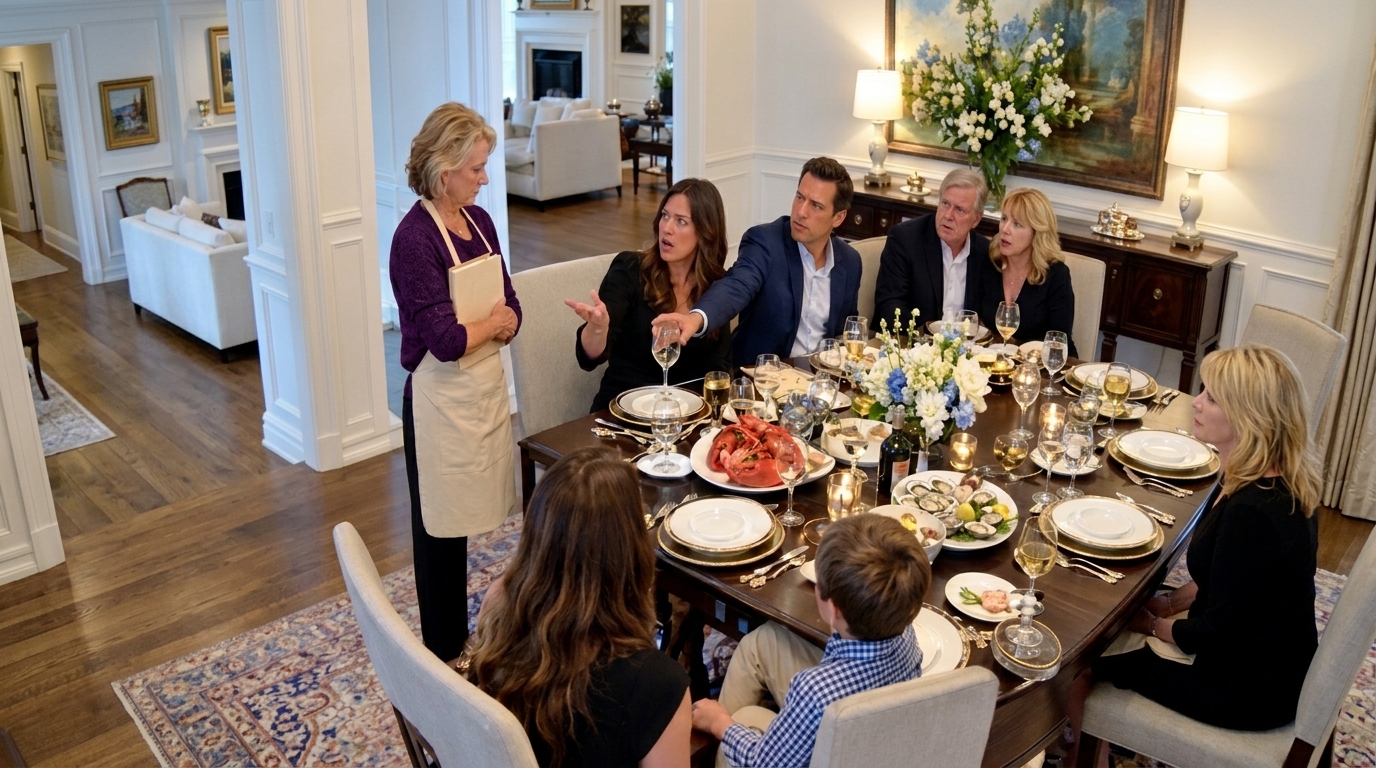
And on the night of my sixtieth birthday,
sitting at the dining table where I had served thousands of family meals,
I finally understood why my husband had left that sealed envelope behind.
Ryan stood across from me, clutching the property deed.
His face had gone from pale to an angry shade of red.
“Mom, what exactly are you trying to pull?”
I looked at him.
I’m not trying to pull anything, Ryan.
I’m showing you something you should have understood five years ago.
Megan reached for the document.
“Let me see that.”
Ryan handed it over.
She studied the first page, then flipped to the second.
“This doesn’t make sense,” she muttered. “Arthur told us the house would stay in the family.”
“It has stayed in the family,” I replied. “It’s mine.”
Megan gave a sharp laugh.
“Technically, maybe. But Ryan is Arthur’s only son.”
I looked at her.
“And I’m Arthur’s wife.”
The words hung in the air.
For the first time that evening, Megan’s mother, Patricia, seemed uncomfortable.
She set down her wineglass.
“Megan, perhaps you should let Helen explain.”
But Megan wasn’t interested in explanations.
She was interested in the property.
“This house is worth at least six hundred thousand dollars,” she said. “Ryan has spent years maintaining it.”
I nearly laughed.
Maintaining it?
The same Ryan who hadn’t replaced a lightbulb in the hallway for eight months?
The same son who called a plumber whenever the sink leaked, then expected me to wait at home and pay the bill?
I folded my hands.
“Ryan, when was the last time you paid the property taxes?”
He blinked.
“What?”
“The property taxes.”
He looked at Megan.
She frowned.
“We contribute to household expenses.”
“That wasn’t my question.”
Ryan shifted uncomfortably.
I continued.
“When was the last time either of you paid the homeowners insurance?”
Silence.
“The mortgage was paid off twelve years before Arthur died. I’ve paid the taxes and insurance ever since. I’ve paid for the roof repairs, the furnace replacement, and the new water heater.”
Megan crossed her arms.
“We pay for plenty of things.”
“Yes,” I said. “You pay for your cars, your vacations, and the expensive furniture you bought for the living room without asking me.”
Ryan slammed the deed onto the table.
“Enough, Mom!”
I didn’t flinch.
That surprised him.
For years, raising his voice had been enough to make me apologize.
Not tonight.
I picked up Arthur’s letter.
“Your father left this with his attorney shortly before he died.”
Ryan’s expression changed.
“What attorney?”
“Daniel Mercer.”
Megan leaned forward.
“Why would Arthur leave a letter with an attorney?”
“Because he wanted certain things explained after his death.”
I carefully unfolded the paper.
Arthur’s handwriting was unmistakable.
Strong, slightly slanted letters.
The same handwriting that had filled birthday cards, grocery lists, and little notes he used to leave beside my morning coffee.
I swallowed.
Then I began reading.
My dearest Helen,
If you are reading this, something has happened that I hoped would never happen.
I have spent the last few months thinking about our family, our home, and what will happen when I am no longer here to help you.
I know you will try to keep everyone together.
You have always been the one who forgives first, sacrifices most, and asks for the least.
But there is something you need to know about Ryan.
My son stopped breathing for a moment.
I continued.
Six months ago, Ryan came to me asking for seventy-five thousand dollars.
He said he and Megan were struggling financially and needed help keeping their business afloat.
I agreed to lend him the money because he promised to repay it within two years.
I asked him to sign a written agreement.
He became angry.
He said fathers should trust their sons.
I told him trust was exactly why I wanted everything documented.
Ryan’s face tightened.
“Dad told you about that?”
I looked up.
“No. He didn’t.”
I returned to the letter.
Eventually, Ryan signed the agreement.
But three months later, I discovered that he had misrepresented why he needed the money.
The business was not facing an emergency.
Instead, Ryan and Megan had used much of the money toward a luxury vehicle and a down payment on an investment property.
Megan’s chair scraped against the floor.
“This is ridiculous!”
Patricia stared at her daughter.
“Investment property?”
Megan ignored her.
I kept reading.
When I confronted Ryan, he told me the money would come back eventually.
Then he asked me for another fifty thousand dollars.
I refused.
He became furious and said that since he would inherit the house someday, I should simply give him the money now.
That was the moment I realized my son had begun thinking of our home as something he was entitled to rather than something we had built.
I stopped.
My hands were trembling.
Ryan stared at the table.
Megan’s father, Harold, slowly set down his fork.
I looked at my son.
“Seventy-five thousand dollars?”
Ryan rubbed his forehead.
“Mom, that was years ago.”
“Did you repay it?”
He said nothing.
“Ryan?”
He looked away.
“No.”
I felt a sharp ache in my chest.
Arthur had spent the last months of his life carrying this disappointment alone.
And I had never known.
I unfolded the second page.
Helen, I have made arrangements with Daniel Mercer to ensure the house remains yours.
Our estate documents reflect that decision.
Ryan’s loan is separately documented. It does not give him any ownership interest in our home.
If he ever tells you otherwise, please contact Daniel.
And if anyone makes you feel that you must surrender your home to deserve love, remember that you have already given this family more than enough.
I pressed the letter against my chest.
My eyes filled.
But I wasn’t finished.
There was one final paragraph.
I have also left instructions concerning the money from the sale of my workshop property.
That money is for you, Helen.
Not Ryan.
Not Megan.
You.
Use it to live the life we always talked about.
Travel.
Paint.
Visit the mountains.
Buy yourself flowers.
And please, my darling, stop believing that being a good mother means allowing everyone else to decide how you spend your life.
Forever yours, Arthur.
The room was silent.
I lowered the letter.
For several seconds, nobody moved.
Then Megan spoke.
“How much money?”
I stared at her.
Of all the things Arthur had written, that was what she wanted to know.
“How much did the workshop property sell for?” she repeated.
I looked at Ryan.
He looked at the floor.
I answered quietly.
“Three hundred and eighty thousand dollars.”
Megan’s mouth fell open.
Patricia gasped.
Ryan looked up so quickly his chair nearly tipped backward.
“Three hundred and eighty thousand?”
“Yes.”
“Where is it?”
I folded the letter.
“Somewhere safe.”
His expression hardened.
“Mom, you can’t just hide that kind of money from your family.”
I looked at him for a long moment.
Then I said something I should have said years earlier.
“Ryan, you are my family. But my money does not belong to you.”
Megan stood.
“This is unbelievable.”
I turned toward her.
“What’s unbelievable, Megan?”
“That you’ve been sitting on hundreds of thousands of dollars while we struggle to pay bills!”
I looked around the dining room.
At the lobster shells.
The expensive wine.
The designer handbag hanging from Megan’s chair.
The diamond bracelet she had bought herself the previous month.
Then I looked directly at her.
“If you’re struggling financially, perhaps you should stop spending money you don’t have.”
Her face went crimson.
Ryan stepped forward.
“Mom, don’t insult my wife.”
I stood.
Slowly.
My knees ached from hours of cooking.
But my voice was steady.
“Your wife insulted me all evening. You sat beside her and helped.”
He opened his mouth.
I raised my hand.
“No, Ryan. Tonight you will listen.”
I pointed toward the recorder.
“Everything you said is on that device. Every demand. Every insult. Every suggestion that I should surrender my pension in exchange for permission to stay in my own home.”
Megan looked suddenly nervous.
“You can’t record private conversations without permission.”
I met her eyes.
“I’ll let my attorney determine what can legally be done with it. But I don’t need a recording to remember how you treated me.”
Harold finally spoke.
“Helen, I had no idea things were like this.”
I looked at him.
“You were sitting right here.”
His face fell.
Patricia began crying.
Megan rolled her eyes.
“Oh, for heaven’s sake.”
That was when I realized the conversation was finished.
Not because they understood.
But because I finally did.
I picked up the property folder.
Then I looked at Ryan and Megan.
“You have thirty days to begin making arrangements to live somewhere else. Daniel will handle the appropriate written notices and legal procedures.”
Ryan stared at me.
“What?”
“This house is mine. And I want my life back.”
He laughed.
“You’re throwing your own son out?”
I shook my head.
“No, Ryan.”
My voice broke.
“I’m asking my grown son to stop treating his mother like a servant.”
Megan grabbed her handbag.
“Fine. If that’s what you want, don’t expect to see Leo again.”
The words hit me harder than anything else that evening.
My grandson.
The little boy I had raised almost as much as his parents had.
I looked toward him.
He was sitting quietly at the end of the table, staring at his plate.
I swallowed.
Then I said, “I love Leo. Nothing will change that. But I won’t surrender my home because you’re threatening to keep him away.”
Megan looked shocked.
She had expected me to beg.
I knew because I had done it before.
But not this time.
Ryan pushed back his chair.
“You’re going to regret this, Mom.”
I looked at him.
“Perhaps.”
Then I added, “But I already regret the last five years.”
He stormed out of the dining room.
Megan followed.
And for the first time since Arthur died, I didn’t run after my son.
I remained standing beside the table.
Surrounded by dirty dishes.
Half-empty wineglasses.
And the remains of a birthday dinner nobody had bothered to celebrate.
Then I reached behind me.
Untied my apron.
Folded it carefully.
And placed it on the table.
I was finished serving.
But what happened the following morning proved that Ryan and Megan weren’t ready to let me go.
Because at 8:15 a.m., my bank called.
And the woman on the phone asked a question that made my blood run cold.
“Mrs. Whitmore, did you authorize your son to access your investment account yesterday?”
PART 4
I was standing in my kitchen when the bank called.
For the first time in five years, I had slept until seven.
No pancakes.
No green smoothies.
No rushing downstairs to make Ryan’s coffee.
I had made myself one piece of toast and sat beside the window watching sunlight spread across the garden.
Then the phone rang.
“Mrs. Whitmore?”
“Yes?”
“This is Caroline from North Valley Financial. I’m calling about an attempted account access request.”
My stomach tightened.
“What request?”
“Someone submitted documentation yesterday seeking authority to transfer funds from one of your investment accounts.”
I gripped the kitchen counter.
“Who?”
There was a pause.
“The request identified your son, Ryan Whitmore, as an authorized representative.”
I closed my eyes.
For a moment, I couldn’t speak.
Then I asked, “Was any money transferred?”
“No, ma’am. The request was flagged for additional verification. We have not released funds.”
I let out a breath.
“Thank goodness.”
Caroline continued.
“We need to confirm whether you signed a financial power of attorney authorizing this transaction.”
“No.”
“Are you certain?”
“Absolutely.”
She paused.
“Mrs. Whitmore, the documentation includes what appears to be your signature.”
My heart began pounding.
I stared at the kitchen doorway.
Ryan had come home late the previous evening.
I had heard him moving around downstairs.
At the time, I thought he was angry and unable to sleep.
Now I wondered what he had been doing.
“I didn’t sign anything,” I said firmly.
Caroline’s voice softened.
“Then we need to treat this as a potentially unauthorized request. We can place additional security restrictions on the account while our team investigates.”
“Please do.”
She explained the next steps.
I wrote everything down.
Then I hung up.
For several minutes, I stood motionless.
My son had threatened me.
Humiliated me.
Demanded my pension.
And now someone had apparently attempted to use my name to access money I had never offered.
I walked upstairs.
Opened the locked drawer in my bedroom.
And checked the folder containing my financial documents.
Everything appeared to be there.
But something was different.
The papers were not in the order I remembered.
I sat on the edge of my bed.
Then I called Daniel Mercer.
He answered immediately.
“Helen?”
“Daniel, I think Ryan tried to access my account.”
His tone changed.
“Tell me exactly what happened.”
I explained.
When I finished, he was quiet for a moment.
Then he said, “Don’t confront him yet. Preserve the information from the bank, and don’t sign anything. I’ll come over.”
I looked toward the hallway.
“Daniel, I’m frightened.”
His voice softened.
“I understand. Are you safe right now?”
“I think so.”
“Then stay somewhere you feel secure until we can review this properly. If you feel threatened, call the police.”
I thanked him.
Then I called Ruth.
My old coworker answered on the third ring.
“Helen! How was your birthday?”
I tried to speak.
But the moment I heard her cheerful voice, I began crying.
“Oh, Helen,” she whispered. “What happened?”
I told her.
Everything.
The dinner.
Arthur’s letter.
The seventy-five-thousand-dollar loan.
The money from the workshop.
The bank call.
Ruth listened without interrupting.
When I finished, she said, “I’m coming over.”
“You don’t have to.”
“Yes, I do.”
“Ruth—”
“Helen, you’ve spent five years taking care of everybody. It’s time someone took care of you.”
I cried harder.
Because those were almost the same words Arthur had written.
Ruth arrived with coffee, muffins, and a fierce expression.
She walked into my kitchen, set everything on the counter, and hugged me.
Then she looked around.
“Where are they?”
“Ryan’s at work. Megan took Leo to school.”
“Good.”
She pulled out a chair.
“Sit.”
I obeyed.
Ruth had always been like that.
Even when we worked together at the hospital cafeteria twenty years earlier, she was the one who could calm a room full of angry people with one raised eyebrow.
She poured coffee.
Then she said, “Tell me something, Helen.”
“What?”
“When was the last time you did something because you wanted to?”
I thought.
And thought.
Then I realized I couldn’t remember.
Ruth’s expression softened.
“That’s what I was afraid of.”
I looked down.
“I thought I was helping.”
“You were.”
“Then why does it feel like I failed?”
She reached across the table.
“Because you confused keeping everyone happy with keeping everyone healthy.”
I stared at her.
She continued.
“Ryan is a grown man. Megan is a grown woman. They are responsible for their household. You’ve been carrying responsibilities that belong to them.”
I wiped my eyes.
“But Leo—”
“Leo needs a grandmother who is happy and respected. Not one who is exhausted and afraid.”
I looked toward the window.
Outside, Arthur’s roses were beginning to bloom.
He had planted them beside the fence twenty years earlier.
Every spring, they returned.
Even after he was gone.
Ruth followed my gaze.
“You know what Arthur would say?”
I smiled sadly.
“He’d tell me to stop worrying.”
“No.”
She shook her head.
“He’d tell you to stop apologizing for being alive.”
I laughed through tears.
And for the first time in months, the laughter felt real.
Daniel arrived shortly after noon.
He brought a colleague who specialized in financial exploitation cases involving older adults.
Her name was Rebecca Shaw.
She was calm, precise, and immediately made me feel less helpless.
We sat at the dining table.
The same table where Ryan and Megan had humiliated me the previous night.
But now, instead of serving dinner, I was discussing my rights.
Rebecca reviewed the property documents.
Then Arthur’s letter.
Then the bank information.
Finally, she looked at me.
“Helen, the first thing I want you to understand is that you are not required to surrender control of your finances simply because you’re sixty.”
I gave a weak smile.
“Megan seems to think sixty is practically ancient.”
Rebecca smiled.
“Sixty is not a legal disability.”
Then she became serious.
“We need to determine whether any documents were altered or submitted without your authorization. We should also review who has access to your accounts, devices, and personal information.”
I nodded.
We spent the next two hours reviewing everything.
My pension.
My savings.
The investment account funded by the workshop sale.
The house deed.
My insurance policies.
And the estate documents Arthur had prepared.
Rebecca helped me organize the records and identify security changes to make with the financial institutions.
We also discussed the recording.
She explained that recording laws varied by jurisdiction and that we needed to confirm whether the conversation had been lawfully recorded before considering any legal use.
I appreciated that.
I wasn’t interested in making mistakes.
I wanted to protect myself properly.
Then Daniel opened another folder.
“Helen, there’s something about Arthur’s estate that I think you should see.”
I looked up.
“What?”
He removed a copy of the promissory note Ryan had signed.
The seventy-five-thousand-dollar loan.
I recognized Ryan’s signature.
Daniel pointed to a paragraph.
“Arthur instructed us to preserve this document. The debt was an asset of his estate, and its treatment was addressed in the estate administration.”
I frowned.
“What does that mean?”
“It means Ryan’s debt wasn’t simply forgotten when Arthur died.”
I stared at the page.
Daniel continued.
“The estate records show that the unpaid balance was accounted for when the estate was settled. Ryan received the required information at the time.”
I looked at him.
“Ryan knew?”
“Yes.”
I felt something twist inside me.
For five years, Ryan had acted as though Arthur promised him the house.
He had allowed Megan to call it their home.
He had spoken about renovations and future plans.
But he had known the truth.
I looked at Daniel.
“Why didn’t he tell me?”
Daniel’s expression was sympathetic.
“I can’t answer that.”
Rebecca leaned forward.
“Helen, there’s something else.”
She pointed to a financial statement.
“The investment account currently holds approximately four hundred and twelve thousand dollars.”
I stared at her.
“Four hundred and twelve?”
She nodded.
“The original proceeds from the workshop property were invested, and the balance has changed over time.”
I swallowed.
I had known about the account.
I had received statements.
But after Arthur died, I had avoided thinking about the money.
It felt like something I shouldn’t touch.
Something connected to losing him.
For five years, I had lived on my pension and used it to buy groceries for Ryan’s family.
Meanwhile, Arthur had left me enough financial security to make my own choices.
I covered my mouth.
Rebecca waited.
Then I whispered, “I could have left.”
She nodded gently.
“Yes, Helen.”
I stared at the table.
“I could have had my own life all this time.”
Ruth reached for my hand.
And suddenly, the tears came.
Not because of the money.
Because of the years.
Five years of waking before sunrise.
Five years of missing friends.
Five years of canceling plans.
Five years of believing that if I stopped being useful, I would stop being loved.
I cried for the woman I had become.
And for the woman Arthur had hoped I would remain.
When I finally stopped, Daniel said quietly, “Helen, you still have time.”
I looked at him.
He smiled.
“You’re sixty. Your life isn’t over.”
I took a breath.
Then I said something that surprised even me.
“I want to see Willow Creek.”
Ruth’s face lit up.
“The retirement community?”
I nodded.
“Yes.”
Rebecca smiled.
“That’s entirely your choice.”
I looked around the dining room.
At the furniture.
The photographs.
The walls Arthur and I had painted together.
For years, I had believed leaving this house would mean leaving him.
But now I understood.
Arthur wasn’t trapped in these walls.
He was in my memories.
In the roses outside.
In the courage he’d tried to give me.
And perhaps the best way to honor him was finally to live.
We visited Willow Creek the following afternoon.
It was nothing like the nursing home Megan had once threatened to send me to if I became too difficult.
Willow Creek was an independent-living community.
Small cottages.
Walking paths.
A community garden.
A library.
An art studio.
And a bright kitchen where residents could volunteer or work part-time if they wished.
Ruth introduced me to the director, a cheerful woman named Caroline Bennett.
Caroline showed me around.
We passed a group of women painting watercolors.
Two men playing chess.
A couple walking their dog.
And a small garden filled with roses.
I stopped.
“They have roses.”
Caroline smiled.
“Do you like gardening?”
“My husband loved roses.”
“Then you’ll love the garden club.”
We continued toward the community kitchen.
The smell of fresh bread filled the hallway.
A woman wearing a blue apron waved at Ruth.
“Another recruit?”
Ruth laughed.
“Maybe.”
Caroline turned toward me.
“Helen, Ruth says you worked in food service for years.”
I nodded.
“Twenty-three.”
“Would you be interested in helping with our community meals a few days a week?”
I looked around.
The kitchen was bright.
Clean.
Full of people chatting and laughing.
Nobody was shouting orders.
Nobody was telling me to hurry because I was old.
Nobody was treating me like an inconvenience.
I smiled.
“I think I’d like that.”
Caroline handed me a brochure.
Then she showed me a small cottage overlooking the garden.
It had two bedrooms.
A sunny kitchen.
A little porch.
And a room that would be perfect for painting.
I stood in the doorway.
For a moment, I imagined waking up there.
Making coffee for myself.
Walking to the garden.
Working a few hours because I wanted to.
Meeting Ruth for lunch.
Taking an art class.
Living.
I turned toward Caroline.
“How soon could I move in?”
She smiled.
“We have an opening next month.”
I looked at Ruth.
She was grinning.
Then I said, “I’d like to apply.”
When I returned home, Ryan was waiting in the living room.
Megan stood beside him.
Both looked furious.
“Where have you been?” Ryan demanded.
I set my handbag down.
“Out.”
Megan crossed her arms.
“You didn’t pick Leo up from school.”
I looked at her.
“You didn’t ask me to.”
“You always pick him up on Thursdays!”
“I told you yesterday that things were changing.”
Ryan stepped forward.
“Mom, you can’t just stop helping without warning.”
I looked at him.
“Ryan, I have spent five years helping you.”
He sighed.
“Here we go again.”
“No.”
I met his eyes.
“Not again. Not anymore.”
Megan pointed toward the kitchen.
“And what are we supposed to eat tonight?”
I almost smiled.
“Whatever you decide to cook.”
She stared at me.
Then Ryan said something that made me realize how little he understood.
“Mom, you need us more than we need you.”
I looked at him.
For a long moment, I said nothing.
Then I reached into my handbag.
Pulled out the Willow Creek brochure.
And placed it on the table.
“Actually, Ryan,” I said quietly, “I think we’ve both been mistaken about that.”
He picked it up.
His expression changed.
“What is this?”
“My new home.”
Megan laughed.
“You can’t afford that.”
I smiled.
“Your father made sure I could.”
Ryan stared at me.
And for the first time, I saw genuine fear in his eyes.
Not fear for my well-being.
Fear that the life he’d built around my labor was about to disappear.
Then Megan grabbed the brochure.
And when she saw the move-in date, she screamed.
“YOU CAN’T LEAVE US WITH ONLY FOUR WEEKS TO FIGURE EVERYTHING OUT!”
I looked at her calmly.
“That’s why you’re receiving formal notice through my attorney, and any move-out deadline will follow the law.”
Ryan stepped closer.
“Mom, please.”
I looked at my son.
And finally, after five years, I asked the question that mattered most.
“Ryan, if I stopped cooking, cleaning, babysitting, and paying your bills, would you still want me here?”
He opened his mouth.
Then closed it.
And his silence answered everything.
PART 5
The next four weeks changed my life.
Not because everything suddenly became easy.
It didn’t.
Ryan was angry.
Megan was furious.
Leo was confused.
And I spent more than one night crying in the bedroom I had shared with Arthur.
But something important had changed.
For the first time in five years, I stopped allowing other people’s disappointment to determine my decisions.
I woke when I wanted.
Made breakfast for myself.
Visited Ruth.
Attended appointments.
And began sorting through thirty-two years of memories.
Every object seemed to carry a story.
Arthur’s old fishing hat.
The blue ceramic bowl Ryan had made in elementary school.
Our wedding album.
The first painting I’d ever completed.
A small landscape of mountains beneath a pink sky.
Arthur had framed it.
He told everyone I was an artist.
I had laughed.
“It’s just a hobby.”
He shook his head.
“Helen, you’re allowed to be good at something that doesn’t involve taking care of us.”
I remembered those words now.
And I cried.
Because Arthur had understood something I had forgotten.
I was more than a wife.
More than a mother.
More than a grandmother.
I was a person.
And I still had dreams.
The legal situation concerning the house took longer than I expected.
Daniel explained that owning a property didn’t mean I could simply change the locks or remove people who had been living there for years.
Ryan and Megan had occupancy rights that needed to be addressed through the appropriate procedures.
So I followed the law.
Written notices were delivered.
Dates were documented.
And when Ryan refused to cooperate, Daniel prepared the necessary court filings.
I didn’t enjoy any of it.
Every document felt like another piece of our family breaking apart.
But I reminded myself that protecting my home wasn’t an act of cruelty.
It was an act of responsibility.
Meanwhile, the bank’s investigation continued.
The attempted transfer had been stopped.
The institution reviewed the submitted authorization documents and confirmed that the request would not be processed.
The matter was referred for further investigation because of the disputed signature.
I provided the information requested.
Ryan was informed that the documents were being reviewed.
He didn’t speak to me for eleven days.
Then one evening, he appeared outside my bedroom.
“Mom?”
I was folding clothes.
“Yes?”
He stood in the doorway.
For the first time in weeks, he wasn’t angry.
He looked exhausted.
“Can we talk?”
I nodded.
“Of course.”
He sat on the edge of the chair beside my dresser.
For several moments, he stared at the floor.
Then he said, “Megan and I found an apartment.”
I folded another blouse.
“That’s good.”
“It’s smaller.”
“I imagine.”
“Two bedrooms.”
“That should be enough for the three of you.”
He nodded.
Then he looked up.
“Mom, I don’t understand why you’re doing this.”
I stopped folding.
“What don’t you understand?”
“Why you suddenly want to leave.”
I sat across from him.
“Ryan, I didn’t suddenly want to leave.”
He frowned.
“I’ve been unhappy for years.”
He stared at me.
“Why didn’t you say something?”
I almost laughed.
“I did.”
He looked confused.
I continued.
“I told you I was tired. You said I needed exercise.”
“I told you I missed my friends. You said I could see them when Leo didn’t need me.”
“I told you I wanted to travel. You said vacations were expensive and someone had to stay home.”
My voice trembled.
“I told you I felt invisible. You said I was being dramatic.”
Ryan looked down.
I took a breath.
“Then on my sixtieth birthday, you told me to hurry up and serve dessert.”
His eyes filled.
“Mom—”
“No, sweetheart. Please listen.”
He nodded.
I continued.
“Your father and I raised you to be kind. Responsible. Honest. We wanted you to have a good life.”
I looked at him.
“But somewhere along the way, you started believing that having a good life meant someone else should make it easy for you.”
He wiped his eyes.
“I didn’t mean to hurt you.”
“I believe you didn’t wake up every morning intending to hurt me.”
I paused.
“But you hurt me anyway.”
He began crying.
I had seen Ryan cry many times.
When he broke his arm at eight.
When his first girlfriend left him.
When Arthur died.
But this was different.
He wasn’t asking me to fix a problem.
He was finally listening.
“I miss Dad,” he whispered.
My throat tightened.
“So do I.”
“I keep thinking about what he’d say.”
I looked toward Arthur’s photograph.
“He’d tell you to take responsibility.”
Ryan nodded.
“I know.”
Then he whispered, “I think I’ve been a terrible son.”
I reached for his hand.
“You’ve made terrible choices, Ryan. That doesn’t mean you can’t make better ones.”
He looked up.
“Can you forgive me?”
I thought carefully.
“Forgiveness is possible. But trust will take time.”
He nodded.
“I understand.”
I wasn’t certain he did.
Not yet.
But for the first time, he seemed willing to try.
Megan didn’t apologize.
Not immediately.
She remained furious about the move.
She complained about the apartment.
The rent.
The smaller kitchen.
The fact that she would need to arrange childcare.
And the cost of groceries.
One afternoon, she stood in my kitchen and said, “Do you have any idea how expensive daycare is?”
I looked at her.
“Yes.”
She blinked.
“What?”
“I know exactly how expensive childcare is. I’ve been providing it without charge for five years.”
Her face reddened.
“That was different.”
“Why?”
“Because you’re his grandmother.”
I smiled sadly.
“Yes. And I love being his grandmother.”
I paused.
“But being a grandmother doesn’t make me a full-time employee.”
She looked away.
I continued.
“I will always love Leo. I will spend time with him when we make plans together. But I won’t organize my entire life around your schedule anymore.”
Megan shook her head.
“You’re selfish.”
For years, that word would have crushed me.
Now I simply nodded.
“If taking care of myself makes me selfish in your eyes, then I suppose we’ll have to disagree.”
She stormed out.
And I went back to packing.
Leo was the hardest part.
He was eight years old.
Too young to understand legal notices, property ownership, or financial exploitation.
All he knew was that Grandma was moving away.
One evening, he came into my bedroom while I was wrapping Arthur’s photographs.
“Grandma?”
I smiled.
“Hello, sweetheart.”
He climbed onto the bed.
“Are you leaving because I was bad?”
My heart broke.
I put down the photograph.
“Oh, Leo. No.”
He looked at me with wide eyes.
“Mommy said you don’t want to live with us anymore.”
I took his hands.
“Sweetheart, grown-ups sometimes need different places to live. That doesn’t mean they stop loving each other.”
He looked confused.
“But you always make my breakfast.”
I smiled through tears.
“I know.”
“Who’s going to make it now?”
“Your mom and dad will.”
He frowned.
“Dad burns toast.”
I laughed.
“Then he’ll have to practice.”
Leo giggled.
Then he became serious again.
“Will you still be my grandma?”
I pulled him into my arms.
“Oh, darling. Always.”
He hugged me tightly.
“Promise?”
“I promise.”
We sat together for a long time.
Then I showed him photographs of Willow Creek.
The garden.
The walking paths.
The little cottage.
He studied them carefully.
“Can I visit?”
“Of course.”
“Can we bake cookies?”
“Absolutely.”
He smiled.
Then he pointed to the art studio.
“Can I paint?”
I kissed his forehead.
“As much as you want.”
And for the first time, he seemed excited.
I realized that loving my grandson didn’t require me to live under the same roof.
It required me to be present.
Patient.
Kind.
And honest.
Those were things I could give him from anywhere.
The day I moved to Willow Creek, the sky was clear.
Ruth arrived early with coffee.
Daniel came to help organize the final paperwork.
And two movers carried my furniture into the truck.
I took Arthur’s favorite armchair.
Our wedding photographs.
My painting supplies.
The blue ceramic bowl Ryan had made as a child.
And the small wooden box containing Arthur’s letters.
I left most of the furniture behind temporarily while the property arrangements were completed.
The house would remain mine.
I hadn’t decided whether to sell it or rent it.
For now, I simply needed distance.
Ryan stood on the porch as the movers loaded the final boxes.
He looked uncomfortable.
Megan stayed inside.
Leo stood beside him holding a drawing.
“Grandma!”
I turned.
He ran toward me.
“This is for your new house.”
I knelt.
He handed me a picture.
It showed a little cottage.
A garden.
A bright yellow sun.
And two stick figures holding hands.
One was labeled GRANDMA.
The other was LEO.
At the top, in uneven letters, he had written:
GRANDMA’S HAPPY HOUSE.
I began crying.
“Oh, sweetheart.”
He hugged me.
“Don’t forget me.”
I held him tightly.
“Never.”
Ryan stepped closer.
“Mom?”
I looked up.
He held out a small envelope.
“It’s not much.”
I opened it.
Inside was a check for five hundred dollars.
I stared at him.
“What’s this?”
He swallowed.
“Toward what I owe you.”
I looked at the check.
Then at my son.
It wasn’t seventy-five thousand dollars.
It wasn’t five years of groceries.
It wasn’t an apology for every cruel word.
But it was the first time Ryan had offered to repay something without asking me for more.
I nodded.
“Thank you.”
He looked relieved.
Then he whispered, “I’m going to keep trying.”
I touched his cheek.
“I hope you do.”
We hugged.
And for the first time in years, I didn’t feel that hugging my son meant surrendering my independence.
Then I climbed into Ruth’s car.
As we pulled away, I looked back at the house.
Thirty-two years of memories.
Arthur’s roses.
The porch where we’d watched thunderstorms.
The kitchen where we’d danced while dinner cooked.
I cried.
Of course I cried.
But beneath the sadness was something else.
Hope.
My first morning at Willow Creek was extraordinary.
Not because anything dramatic happened.
Because nothing did.
Nobody knocked on my door at five.
Nobody demanded coffee.
Nobody complained about breakfast.
Nobody handed me a list of chores.
I woke at seven-thirty.
Lay in bed for another fifteen minutes.
Then walked into my kitchen.
I made toast.
Coffee.
And scrambled eggs.
For one person.
Me.
I carried my breakfast onto the porch.
The garden was filled with sunlight.
Birds sang in the trees.
A woman walking her dog waved.
“Good morning, Helen!”
I waved back.
“Good morning!”
Then I sat down.
And cried.
Not from sadness.
From relief.
I had forgotten what peace felt like.
Now it surrounded me.
Two weeks later, I started working part-time in the community kitchen.
Three mornings a week.
Four hours each morning.
I helped prepare lunches.
Organized supplies.
And occasionally taught cooking classes.
The first time someone thanked me for making soup, I nearly cried.
A woman named Eleanor smiled after tasting my vegetable stew.
“Helen, this is wonderful.”
I laughed.
“It’s just soup.”
She shook her head.
“No. It’s delicious.”
I stood there holding the ladle.
For five years, cooking had been something people demanded.
Now it was something I chose.
And people appreciated it.
That difference changed everything.
I also joined the watercolor class.
At first, I was nervous.
My hands shook when I picked up the brush.
I hadn’t painted in nearly fifteen years.
But the instructor, a gentle man named Samuel, encouraged me.
“Don’t worry about making it perfect,” he said. “Just enjoy the colors.”
So I painted.
Mountains.
Rivers.
Flowers.
And one afternoon, I painted Arthur’s roses.
When Samuel saw the painting, he smiled.
“Have you considered displaying your work?”
I laughed.
“Oh, no.”
“Why not?”
“I’m sixty.”
He raised an eyebrow.
“And?”
I stared at him.
Then I began laughing.
Because for the first time, I heard how ridiculous my own excuse sounded.
Sixty wasn’t the end of my life.
It was the beginning of something I had almost forgotten existed.
Freedom.
Three months after I moved, Daniel called with an update.
Ryan and Megan had moved into their apartment.
The house was vacant.
The occupancy matter had been resolved through the proper legal process.
And the financial institution had completed its review of the disputed account authorization.
The attempted transaction had not gone through.
The documentation had been found to contain serious irregularities, and the matter had been referred to the appropriate authorities.
I didn’t celebrate.
I didn’t want my son punished.
But I also understood that protecting him from every consequence had helped create the man who believed he could take whatever he wanted.
Daniel asked what I wanted to do with the house.
I thought about it.
Then I said, “Sell it.”
He was quiet.
“Are you sure?”
I looked around my little cottage.
At the paintings on the walls.
At the flowers on the table.
At the sunlight coming through the windows.
“Yes.”
The house had given Arthur and me a beautiful life.
But I no longer needed to live inside those memories.
I could carry them with me.
The property was listed.
And six weeks later, an offer came.
Six hundred and forty thousand dollars.
I stared at the number.
Then I called Ruth.
“Guess what?”
“What?”
“I sold the house.”
She gasped.
“Helen!”
I laughed.
“I know.”
“What are you going to do?”
I looked toward my painting easel.
Then I smiled.
“Something Arthur always wanted me to do.”
That autumn, I traveled to Italy.
Not alone.
Ruth came with me.
We spent twelve days exploring Florence, Rome, and the countryside.
I stood in front of paintings I had only seen in books.
Ate pasta in little restaurants.
Walked through gardens.
And watched the sun set over ancient buildings.
One afternoon, we sat at a café in Florence.
Ruth raised her glass.
“To Helen.”
I laughed.
“What did I do?”
“You finally started living.”
I looked around.
At the beautiful square.
The people laughing.
The warm sunlight.
Then I raised my glass.
“To Arthur.”
Ruth smiled.
“To Arthur.”
I thought about my husband.
About his letter.
About the way he had tried to protect me.
And I whispered, “I’m doing it, darling.”
For the first time since his death, remembering him didn’t feel only painful.
It felt like gratitude.
When I returned home, there was a letter waiting for me.
From Ryan.
I recognized his handwriting immediately.
I sat at my kitchen table and opened it.
Dear Mom,
I’ve spent the last few months thinking about what happened on your birthday.
At first, I was angry.
I told myself you were being unfair.
I told myself you were abandoning us.
But then I started doing the things you used to do.
Making breakfast.
Packing Leo’s lunch.
Cleaning.
Shopping.
Paying bills.
And I realized something.
You were doing the work of three adults.
And we treated it like nothing.
I stopped reading.
My eyes filled.
Then I continued.
I remember the morning you asked me to say happy birthday.
I told you not to nag me.
I have replayed that moment a thousand times.
You weren’t asking for money.
You weren’t asking for a party.
You just wanted your son to remember you.
And I couldn’t even give you that.
I pressed the letter against my chest.
Then continued.
I’ve started counseling.
I’ve also been working with Daniel to address the financial issues.
I know there are consequences I can’t avoid.
I’m not asking you to make them disappear.
I just want you to know that I’m ashamed of the way I treated you.
I love you, Mom.
And I hope someday I can become the kind of son Dad wanted me to be.
Love, Ryan.
I sat there for a long time.
Then I cried.
Not because everything was fixed.
It wasn’t.
Trust had been damaged.
The financial matters were still being resolved.
And Megan had not apologized.
But for the first time, Ryan seemed to understand that love required responsibility.
I picked up my phone.
And called him.
He answered immediately.
“Mom?”
“Hello, sweetheart.”
There was a pause.
“Did you get my letter?”
“Yes.”
His voice trembled.
“I’m sorry.”
I closed my eyes.
“I know.”
“Can you forgive me?”
I thought about it.
Then I said, “I can begin.”
He started crying.
I did too.
And for the first time in years, our tears weren’t about money.
They were about something far more important.
The possibility of becoming a family again.
One year after my sixtieth birthday, I celebrated my sixty-first at Willow Creek.
Ruth organized a small party.
There were flowers.
A chocolate cake.
And a banner across the community room.
HAPPY 61ST BIRTHDAY, HELEN!
My friends from the kitchen came.
So did the watercolor class.
Daniel stopped by with a card.
And Leo arrived carrying a bouquet of yellow roses.
“Grandma!”
I opened my arms.
He ran toward me.
“Happy birthday!”
I hugged him tightly.
“Thank you, sweetheart.”
Behind him stood Ryan.
He looked nervous.
Megan wasn’t there.
I had invited her, but she declined.
I accepted that.
Relationships couldn’t be forced.
Ryan approached slowly.
“Happy birthday, Mom.”
I smiled.
“Thank you.”
He handed me a small wrapped package.
I opened it.
Inside was a wooden picture frame.
Arthur had taught Ryan woodworking when he was young.
The frame wasn’t perfect.
One corner was slightly uneven.
But it was beautiful.
Inside was a photograph of Arthur and me standing in our garden twenty years earlier.
We were laughing.
Arthur had his arm around my shoulders.
Beneath the photograph, Ryan had carved:
THANK YOU FOR TEACHING ME WHAT LOVE SHOULD LOOK LIKE.
My hands trembled.
“Oh, Ryan.”
He looked down.
“I made it myself.”
I smiled through tears.
“Your father would have loved it.”
Ryan’s eyes filled.
“I hope so.”
I touched his cheek.
“I think he would.”
Then Leo tugged my sleeve.
“Grandma?”
“Yes, darling?”
“Are you happy here?”
I looked around.
At the flowers.
The paintings.
The friends who had become family.
The little boy holding my hand.
And my son, who was slowly learning to become a better man.
I smiled.
“Yes, sweetheart.”
He grinned.
“Good. Because I like your happy house.”
I laughed.
“So do I.”
That evening, after everyone left, I sat alone on my porch.
The air was warm.
The garden smelled of roses.
A gentle breeze moved through the trees.
I held Arthur’s letter in my lap.
The same letter that had changed everything one year earlier.
I read the final paragraph again.
Live for yourself, Helen.
Travel.
Paint.
Laugh.
And remember that you deserve happiness too.
I looked toward the sky.
The first stars were appearing.
For five years, I had believed being a good mother meant giving everything.
My time.
My money.
My energy.
My happiness.
I had believed that if I stopped serving, I would stop being loved.
But I had learned something important.
Love that requires you to disappear isn’t love.
It’s control.
Family should never make you feel that your value depends on how useful you are.
And growing older should never mean surrendering your right to make your own choices.
I thought about my sixtieth birthday.
The expensive dinner.
The cruel words.
The recorder hidden in my apron.
The property folder.
Arthur’s letter.
And the moment I finally untied my apron and placed it on the table.
At the time, I thought I was losing my family.
But what I had really been doing was finding myself.
I had lost five years.
I couldn’t get them back.
But I could decide what happened to the years ahead.
And that was enough.
I stood.
Walked into my cottage.
And placed Arthur’s letter beside the photograph Ryan had given me.
Then I looked around my home.
My paintings hung on the walls.
Fresh flowers stood on the kitchen table.
A half-finished watercolor rested on the easel.
And tomorrow morning, I would wake whenever I wanted.
Not because someone needed breakfast.
Not because someone expected me to clean.
Not because I had to prove I deserved a place in the world.
But because I had another beautiful day waiting for me.
I smiled.
Then I whispered toward Arthur’s photograph, “You were right, darling.”
The room was quiet.
But I could almost hear his familiar voice.
I know, Helen.
I laughed.
Then I switched off the light.
And for the first time in years, I went to bed without worrying about what anyone would demand of me the following morning.
My son and daughter-in-law thought turning sixty meant I should start earning my keep.
What they never understood was that I had already earned the right to live with dignity, peace, and happiness.
And the greatest birthday gift I received wasn’t the house.
It wasn’t Arthur’s money.
It wasn’t even the beautiful life waiting for me at Willow Creek.
It was the courage to finally say:
“I have spent my whole life taking care of everyone else. Now it’s my turn.”
THE END THANK YOU FOR READING !!!



