PART 3
I had been married to my husband,
Thomas, for forty-two years before cancer took him from me.
In all those years,
I had learned to recognize the difference between a man
who was nervous and a man who was hiding something.
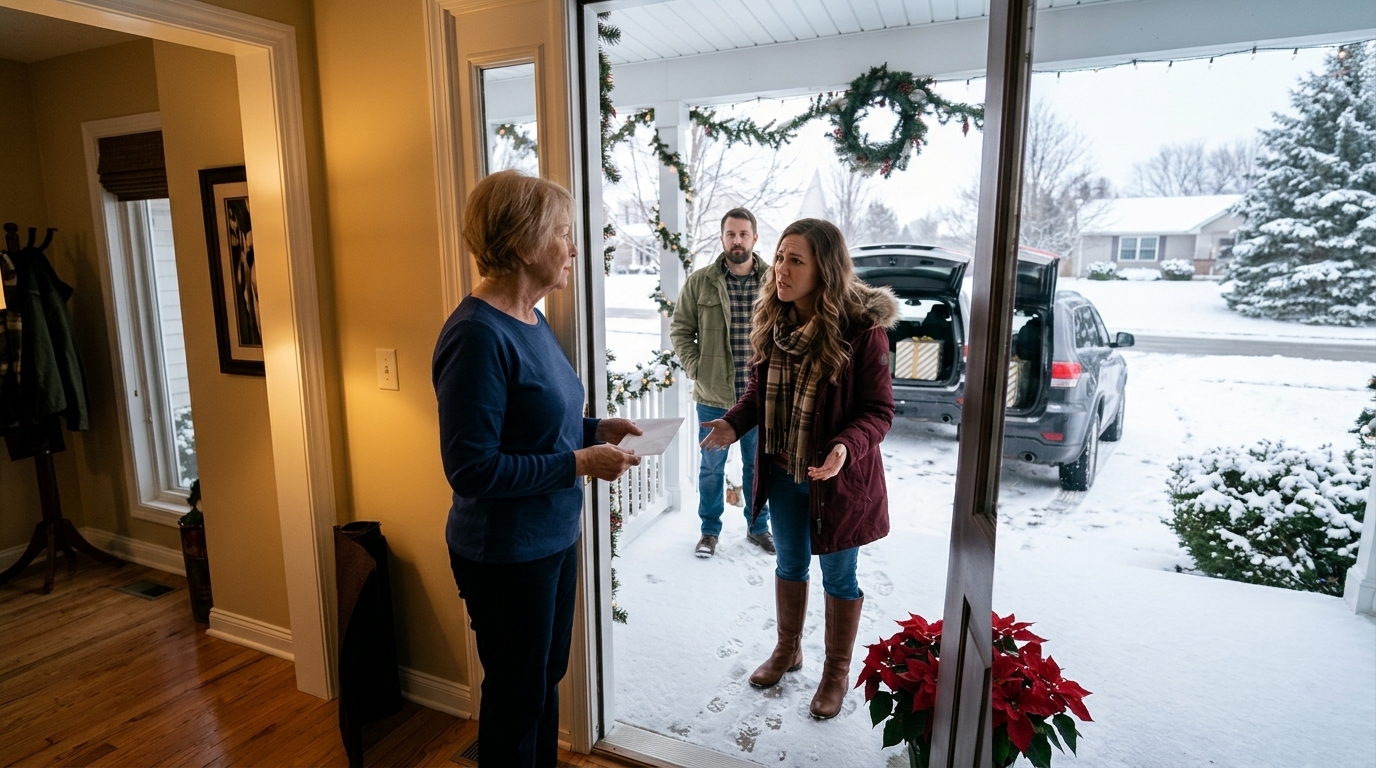
Standing on my front porch that Saturday morning,
I saw both expressions on my son’s face.
Carter held the folded bank statement between
two fingers as though it might burn him.
Yvette stood beside him, her lips pressed together,
watching his every movement.
“Carter,” I said quietly,
what does your father’s life insurance have to do with any of this?
He looked at his wife.
She nodded sharply.
“Tell her.”
I stepped aside.
“Come inside.”
We entered the living room where Thomas and
I had spent countless winter evenings watching
the St. Lawrence River freeze beneath the moonlight.
The Christmas tree stood beside the window.
I had decorated it the previous Sunday.
White lights.
Silver ornaments.
And the little wooden angel Thomas had carved during our first Christmas together.
Carter sat on the sofa.
Yvette remained standing.
I took my usual chair beside the fireplace.
“Now,” I said, “show me.”
Carter unfolded the paper.
It was a bank statement from an account I didn’t recognize.
The name at the top was his.
The balance circled in red was $84,730.
I frowned.
“Is this your savings?”
He swallowed.
“Part of it.”
“Then why are you showing it to me?”
He looked toward Yvette.
She crossed her arms.
“Because you need to understand that we haven’t exactly been living comfortably.”
I glanced at the number again.
“Eighty-four thousand dollars doesn’t look like financial hardship to me.”
Yvette’s cheeks reddened.
“That’s not the point.”
“Then what is?”
Carter leaned forward.
“Mom, Dad left me money.”
I stared at him.
“Yes. I know.”
Thomas had purchased two life insurance policies.
One named me as beneficiary.
The other named Carter.
We had arranged them that way years earlier.
Thomas wanted to make certain I would have financial security after his death, while also leaving something directly to our son.
I received my policy proceeds after Thomas died.
Carter received his.
There had never been a secret about that.
“Your father left you ninety thousand dollars,” I said. “He told me before he died.”
Carter nodded.
“Yes.”
“So what am I supposed to be surprised about?”
He looked down.
“I told you we used most of it to pay off our mortgage.”
I remembered the conversation.
It had happened about six months after Thomas’s funeral.
Carter had come over for dinner and proudly announced that he and Yvette had made a large payment toward their mortgage.
I’d been happy for them.
Thomas would have been happy too.
But now Carter’s expression told me that something was wrong.
“We didn’t,” he whispered.
I sat very still.
“You didn’t pay down the mortgage?”
“No.”
“Then where did the money go?”
Yvette interrupted.
“Some of it was invested.”
I looked at her.
“In what?”
She hesitated.
“Family opportunities.”
I raised an eyebrow.
“Whose family?”
Silence.
Then Carter said, “Yvette’s mother.”
I looked from one to the other.
“What about her?”
Carter rubbed his forehead.
“She needed help buying a condominium in Florida.”
I stared at him.
“A condominium?”
Yvette stepped forward.
“It was an investment, Rosalind.”
I ignored her.
“Carter, are you telling me you gave your father’s life insurance money to your mother-in-law?”
He shook his head.
“Not exactly.”
“Then explain.”
He took a deep breath.
“We put sixty thousand dollars toward her down payment. She said she’d repay us when she sold her old house.”
I felt my stomach tighten.
“When was this?”
“Almost three years ago.”
Three years.
Just months after Thomas died.
While I was struggling to get through mornings without hearing his footsteps in the kitchen, my son had been using his inheritance to help Yvette’s mother buy a vacation property.
I tried to understand.
It was his money.
Thomas had left it to him.
He was entitled to spend it however he wished.
But what bothered me wasn’t the purchase.
It was the secrecy.
The lies.
And the fact that they had continued asking me to pay for family vacations while claiming they couldn’t afford ordinary expenses.
“Did she repay you?” I asked.
Carter hesitated.
“Some.”
“How much?”
“About fifteen thousand.”
I looked at the bank statement again.
“Then where did the eighty-four thousand come from?”
Yvette’s expression changed.
Carter looked at the floor.
And suddenly, I knew the answer was going to hurt.
“Carter?”
He whispered, “Mom, you remember when you gave us money to help with the children’s education?”
Of course I remembered.
Two years earlier, I’d given Carter and Yvette thirty thousand dollars.
Fifteen thousand for each grandchild.
My grandchildren, Oliver and Grace, were twelve and nine.
I wanted them to have a head start when they eventually went to college.
I’d been very clear about what the money was for.
“Don’t spend it on anything else,” I’d told Carter.
He’d hugged me.
“Never, Mom. We’ll put it straight into their education accounts.”
I looked at my son.
“Where is that money?”
He didn’t answer.
I felt my fingers tighten around the armrests.
“Carter, where is the money I gave you for Oliver and Grace?”
Yvette spoke quickly.
“We moved it temporarily.”
I turned toward her.
“Moved it where?”
She lifted her chin.
“Into a joint investment account.”
I stared at her.
“An investment account belonging to whom?”
“Us.”
The room seemed to grow colder.
I looked at Carter.
“You told me the children’s money was in education accounts.”
He nodded miserably.
“I know.”
“Was that true?”
“No.”
I closed my eyes.
For a moment, I couldn’t speak.
The Christmas gifts suddenly seemed insignificant.
The Surface Pro.
The headphones.
The iPad.
Those were merely the latest examples of a much larger problem.
I had trusted my son with money intended for my grandchildren.
And he had lied to me.
“Why?” I whispered.
Carter looked up.
“Because Yvette said we could invest it and earn more before the kids needed it.”
Yvette threw up her hands.
“Don’t put this all on me!”
Carter turned toward her.
“You were the one who wanted to combine everything!”
“Because you agreed it was a good idea!”
I raised my hand.
“Enough.”
They stopped.
I looked at Carter.
“Is the money still there?”
He nodded.
“Most of it.”
“Most?”
He swallowed.
“We used some for expenses.”
“What expenses?”
Yvette looked away.
And suddenly, I remembered her mother’s Christmas video.
The expensive electronics.
The designer shopping bags.
The proud announcement that Carter had chosen everything.
I stared at my daughter-in-law.
“Did you buy those gifts using money I gave you for my grandchildren?”
She opened her mouth.
Then closed it.
Carter whispered, “Some of it.”
I felt something inside me break.
Not loudly.
Not dramatically.
It was the quiet, terrible sound of trust collapsing.
I stood and walked toward the window.
Outside, the river moved slowly beneath sheets of ice.
Thomas had loved this view.
He used to stand beside me with his morning coffee and say, “Rosie, we’re lucky. We have enough.”
Enough.
That had always been our philosophy.
We weren’t wealthy.
We saved.
We planned.
We lived carefully.
And when we had extra, we shared it.
But we never confused generosity with entitlement.
Behind me, Carter said, “Mom, I’m sorry.”
I turned.
“Are you sorry you used the money, or sorry I found out?”
His face crumpled.
Yvette stepped forward.
“This is exactly why we didn’t tell you. You make everything emotional.”
I looked at her.
“Emotional?”
“Yes. We made financial decisions for our family.”
I walked back to my chair.
“Then why did you need my money?”
She stared at me.
“Excuse me?”
“If you wanted to invest for your children, why didn’t you use your own savings?”
“We did!”
“Then why did you accept thirty thousand dollars from me under the promise that it would go directly into education accounts?”
She had no answer.
I looked at Carter.
“Your father worked forty years to build a secure life for us. I gave you that money because I wanted his grandchildren to benefit from our sacrifices.”
Tears filled my eyes.
“And you used it to buy Christmas presents for someone who already has more than enough.”
Carter lowered his head.
Yvette’s expression hardened.
“You’re acting like my mother doesn’t deserve nice things.”
I stared at her.
“Your mother deserves whatever you can afford to give her with your own money.”
Then I added quietly, “But she doesn’t deserve my grandchildren’s education fund.”
For the first time, Yvette looked uncomfortable.
I reached for my phone.
“I’m calling Emily.”
Carter looked up.
“Emily?”
“My financial adviser.”
Yvette frowned.
“Why?”
“Because I want an independent review of every financial arrangement I’ve made for this family.”
Carter’s face went pale.
“Mom, please.”
I looked at him.
“I’m not asking your permission.”
Then I made the call.
And twenty minutes later, I discovered that the thirty thousand dollars wasn’t the only money that had disappeared.
PART 4
Emily Foster had been my financial adviser for nearly eleven years.
She was forty-six, practical, and possessed the kind of patience that made complicated financial matters seem manageable.
Thomas trusted her.
So did I.
When I called that Saturday, she was at home preparing Christmas cookies with her daughters.
But the moment I explained what Carter had admitted, her tone changed.
“Rosalind, do you have the paperwork from the education gifts?”
“Yes.”
“Good. Keep it. Don’t sign anything or transfer any more money until we review the records.”
I glanced toward Carter.
He was sitting on the sofa, staring at his hands.
Yvette had moved into the kitchen.
“There’s something else,” Emily continued.
My stomach tightened.
“What?”
“Do you remember the authorization form Carter brought you last February?”
I frowned.
“Which form?”
“The one concerning the joint investment account.”
I searched my memory.
Then I remembered.
Carter had visited one afternoon carrying a folder.
He said he and Yvette were updating their financial arrangements and needed confirmation of a family gift I’d made.
I had signed a document acknowledging the thirty thousand dollars.
At least, that was what he’d told me.
“Why?” I asked.
Emily hesitated.
“Because I received an inquiry about it from a financial institution several months ago.”
My heart began beating faster.
“What kind of inquiry?”
“Someone was attempting to use documentation of your past gifts to support a request for additional family financing.”
I stared at the wall.
“Additional financing?”
“Yes.”
“Did you approve anything?”
“Absolutely not. I told them I had no authority to confirm any new commitment from you.”
I closed my eyes.
Then I asked the question I was beginning to dread.
“Emily, was someone trying to borrow money using my name?”
“That’s what we need to determine.”
I looked at Carter.
He was watching me now.
His face had lost all color.
“Carter,” I said, “what did you do with the paper I signed last February?”
He stood.
“Mom—”
“What did you do?”
Yvette hurried back into the room.
“What’s happening?”
I looked at her.
“Apparently, someone tried to use my name to arrange financing.”
Yvette froze.
Carter whispered, “It wasn’t supposed to go through.”
The words landed like stones.
I stared at him.
“What wasn’t supposed to go through?”
He covered his face.
Yvette began speaking rapidly.
“Rosalind, you have to understand, the investment was supposed to pay off.”
“What investment?”
Neither answered.
I felt suddenly exhausted.
“Sit down,” I said.
They sat.
I remained standing.
“I’m going to ask you one question, and I expect the truth.”
Carter looked up.
“Have either of you signed my name, used my identity, or represented that I agreed to guarantee a loan?”
Yvette stared at the floor.
Carter began crying.
And I knew.
I knew before he spoke.
“Yes,” he whispered.
For several seconds, I couldn’t move.
I was seventy-four years old.
I had buried my husband.
Survived a frightening surgery.
Helped raise two grandchildren.
And believed I understood the people closest to me.
But nothing had prepared me for hearing my own son admit that he’d used my identity without permission.
“What loan?” I asked.
Carter wiped his eyes.
“Forty-five thousand dollars.”
My knees weakened.
I sat down.
Yvette leaned forward.
“We were going to repay it.”
I looked at her.
“With what?”
She didn’t answer.
“Yvette, with what money?”
She began crying.
“The Florida condominium was supposed to sell for a profit.”
I stared at her.
“What?”
Carter explained.
His mother-in-law, Denise, had bought the condominium with their help.
But the property had become more expensive to maintain than expected.
Association fees increased.
Repairs were needed.
And Denise had struggled to keep up with the payments.
Instead of selling, she had asked Carter and Yvette for more help.
They had already used most of their savings.
Then they’d borrowed.
And when that wasn’t enough, they had attempted to obtain additional financing using documents that falsely suggested I was willing to support the debt.
I listened without interrupting.
Finally, I asked, “Does Denise know?”
Yvette looked away.
“Know what?”
“That you used money intended for my grandchildren and tried to involve me in a loan without my permission.”
She hesitated.
“She knows we borrowed money.”
“Does she know how?”
Silence.
I looked at Carter.
He shook his head.
I sat back.
There it was.
The truth beneath the Christmas gifts.
Denise had been showered with expensive electronics while the people paying for her lifestyle were drowning in debt.
And I had been told they couldn’t afford a Christmas present.
I almost laughed.
Not because anything was funny.
But because the absurdity was overwhelming.
“Yvette,” I said, “why did you tell me money was tight?”
She looked confused.
“Because it is.”
“Then why did you spend thousands on your mother’s Christmas gifts?”
Her cheeks reddened.
“She’s done so much for us.”
I stared at her.
“And I haven’t?”
She opened her mouth.
Then stopped.
I continued.
“I watched Oliver and Grace for two weeks while you took your mother to Portugal.”
Yvette looked down.
“I paid for the children’s summer camp when you said you couldn’t afford it.”
Carter closed his eyes.
“I helped with your car repairs. I paid for family holidays. I bought school supplies. I covered the emergency dental bill when Grace broke her tooth.”
My voice trembled.
“And I did those things because I loved you. Not because I expected repayment.”
I looked at my son.
“But I never imagined you would take that love and turn it into permission to deceive me.”
Carter began sobbing.
“Mom, I didn’t know how to tell you.”
“You could have started with the truth.”
Yvette stood abruptly.
“This is ridiculous. You’re acting like we’ve committed some terrible crime.”
I looked at her.
“You admitted using my identity without permission to support a loan.”
She froze.
I continued.
“That’s not a family misunderstanding.”
Carter whispered, “We can fix it.”
I looked at him.
“Then you will cooperate with my adviser and an attorney. Every document will be reviewed. Any unauthorized obligation will be challenged through the proper channels.”
Yvette’s eyes widened.
“An attorney?”
“Yes.”
“You’re going to sue your own son?”
I looked at Carter.
“I hope we can resolve the financial damage without a lawsuit. But I will not accept responsibility for a debt I never agreed to.”
She shook her head.
“This family is unbelievable.”
I stood.
“Then perhaps it’s time you went home.”
Carter looked up.
“Mom—”
“I need space.”
He nodded slowly.
Yvette grabbed her coat.
As they reached the door, she turned.
“What about Christmas?”
I stared at her.
“What about it?”
“The chalet. The children. Are you seriously going to ruin Christmas over money?”
I felt a strange calm settle over me.
“No, Yvette.”
I opened the door.
“I’m going to stop pretending that Christmas requires me to pay for people who lie to me.”
They left.
And for the first time in years, I didn’t feel guilty watching their car disappear down the driveway.
On Monday morning, I met Emily Foster and an attorney named Jonathan Mercer.
We reviewed the documents carefully.
Some of the money I’d given Carter and Yvette had been a completed gift.
That meant I couldn’t simply demand control over it because I disliked how they’d spent it.
But the false statements made about my willingness to guarantee a loan were a different matter.
Jonathan helped me dispute any unauthorized obligation and preserve the relevant records.
The financial institution opened a review.
I also obtained copies of the original gift correspondence, bank transfers, and messages Carter had sent promising to deposit the money into education accounts.
I wanted to understand exactly what had happened.
Not because I wanted revenge.
But because I refused to remain ignorant about my own finances.
Emily helped me update my financial plan.
I reviewed my accounts.
Changed passwords.
Removed unnecessary access permissions.
And made sure no one could use my name in future financial arrangements without my direct involvement.
Then we discussed the money I’d intended for Oliver and Grace.
I had already moved part of the unused Christmas budget into education savings accounts under my control.
Now I decided to establish a more structured plan.
The children would still benefit from my generosity.
But their parents would no longer be able to redirect those funds.
I signed the documents.
Then I sat back.
For the first time since Friday night, I felt able to breathe.
Jonathan closed his folder.
“Rosalind, there’s one more thing you should consider.”
“What?”
“Your estate plan.”
I looked at him.
Thomas and I had prepared wills years earlier.
After his death, I’d updated mine.
Most of what remained would eventually go to Carter and Cordelia.
Jonathan continued.
“Given what’s happened, you may want to review whether the current arrangements still reflect your wishes.”
I thought about Carter.
About Yvette.
About Cordelia, who called every Sunday without asking for anything.
About Oliver and Grace.
And about Thomas.
Then I nodded.
“Yes. I think it’s time.”
Cordelia arrived that afternoon.
She was forty-one, a high school librarian, and the kind of woman who remembered birthdays without needing a reminder.
She lived about ninety minutes away with her husband, Nathan.
When she walked into my kitchen, she hugged me so tightly I nearly lost my balance.
“Mom, what happened?”
I made tea.
Then I told her everything.
The Instagram video.
The chalet.
The education money.
The unauthorized financing documents.
Cordelia listened in stunned silence.
When I finished, she put down her cup.
“Mom, why didn’t you tell me things were getting this bad?”
I sighed.
“Because I didn’t know.”
She reached across the table.
“You shouldn’t have to deal with this alone.”
I smiled sadly.
“I know that now.”
She looked toward the Christmas tree.
“Are we still going to the chalet?”
I laughed.
“Of course.”
“Just us?”
“Us, Nathan, the children, and whoever else was already included in the smaller booking.”
She nodded.
Then she hesitated.
“What about Oliver and Grace?”
My smile faded.
That was the part that hurt most.
The children had done nothing wrong.
They didn’t know about the money.
They didn’t know about the lies.
They were simply excited about Christmas.
“I don’t want them punished for their parents’ behavior,” I said.
Cordelia nodded.
“Then don’t punish them.”
I looked at her.
“What do you suggest?”
She thought for a moment.
“Maybe you could arrange something separate with them. Something that doesn’t require you to spend five days trapped in a chalet with Carter and Yvette.”
I smiled.
“That sounds sensible.”
So I called Carter.
He answered immediately.
“Mom?”
“I want to see Oliver and Grace before Christmas.”
He was quiet.
“Okay.”
“I’ve bought them presents. I’d like to spend an afternoon with them.”
“Of course.”
I paused.
“And Carter?”
“Yes?”
“This doesn’t mean we’ve resolved everything.”
“I know.”
“I’m still reviewing the financial documents.”
“I understand.”
He sounded different.
Less defensive.
More tired.
Then he whispered, “Mom, I’m really sorry.”
I closed my eyes.
“I hope you understand what you’re apologizing for.”
“I do.”
I wasn’t sure whether I believed him yet.
But I wanted to.
Because he was still my son.
And love, I was learning, could survive disappointment without requiring me to surrender my judgment.
Three days before Christmas, I met Oliver and Grace at a small café near the river.
Carter brought them.
Yvette didn’t come.
Oliver ran toward me.
“Grandma!”
I hugged him.
Grace wrapped her arms around my waist.
“Are we still having Christmas?”
I smiled.
“Of course, sweetheart.”
She looked worried.
“Mommy said you’re mad at us.”
My heart tightened.
I looked at Carter.
He closed his eyes.
I knelt beside Grace.
“I’m not angry with you, darling. Not even a little.”
She looked relieved.
“Then why aren’t we going skiing?”
I took her hands.
“Sometimes grown-ups have disagreements, and plans change. But that doesn’t mean anyone stops loving you.”
Oliver frowned.
“Is it because we did something wrong?”
“No.”
I looked at both children.
“You have done absolutely nothing wrong.”
Grace hugged me again.
I held her tightly.
Then I gave them their gifts.
Books.
Winter scarves.
A small telescope for Oliver.
An art set for Grace.
And handwritten cards explaining that I had started special education savings accounts for their futures.
They didn’t understand the financial details.
They didn’t need to.
They only needed to know that their grandmother loved them.
Before leaving, Oliver leaned close.
“Grandma?”
“Yes?”
“Dad’s been sad.”
I looked at Carter.
He stood near the counter, pretending not to listen.
“I know, sweetheart.”
“Can you make him happy?”
The question nearly broke me.
I stroked Oliver’s hair.
“Your dad has some things he needs to work through. I love him, but I can’t fix everything for him.”
Oliver nodded slowly.
Then he hugged me.
And I realized that was the difference between helping someone and rescuing them.
One offered support.
The other prevented responsibility.
For years, I had confused the two.
Not anymore.
Christmas Eve arrived beneath a sky full of snow.
The Laurentian mountains were breathtaking.
Pine trees stood covered in white.
The chalet fireplace crackled.
Cordelia and Nathan prepared dinner while their children played board games on the rug.
I sat near the window with a cup of hot chocolate.
For the first time since Thomas died, Christmas felt peaceful.
Not perfect.
Not free from sadness.
But peaceful.
After dinner, Cordelia handed me a small wrapped box.
“Mom, this is from all of us.”
I smiled.
“You didn’t need to get me anything.”
“I know.”
I opened it.
Inside was a silver locket.
On one side was a photograph of Thomas.
On the other was a picture of me holding all four grandchildren.
My eyes filled with tears.
Cordelia sat beside me.
“We wanted you to have something that reminds you how loved you are.”
I held the locket against my chest.
For a long moment, I couldn’t speak.
Then I whispered, “Thank you.”
Nathan raised his glass.
“To Rosalind.”
Everyone smiled.
“To Grandma!”
I laughed through tears.
And as the snow fell beyond the windows, I understood something I’d forgotten.
Christmas wasn’t about expensive gifts.
It wasn’t about who spent the most.
It wasn’t even about making every family member happy.
It was about being surrounded by people who made you feel valued.
And for the first time in years, I didn’t feel like the person paying for the celebration.
I felt like someone who belonged to it.
But the most important Christmas gift arrived two days later.
And it came from the last person I expected.
PART 5
The envelope was waiting in my mailbox when I returned from the Laurentians.
It was plain white.
No return address.
My name was written across the front in familiar handwriting.
Carter’s.
I carried it into the kitchen and placed it beside my teacup.
For several minutes, I simply stared at it.
Part of me didn’t want to open it.
I’d spent the previous week feeling something I hadn’t experienced in a long time.
Peace.
I didn’t want another argument.
Another explanation.
Another request for money.
But finally, I picked up the envelope.
Inside was a four-page handwritten letter.
And a cashier’s check.
The check was for $12,000.
I stared at it.
Then I unfolded the letter.
Dear Mom,
I don’t know whether you’ll want to read this, but I need to write it anyway.
I’ve spent the past week thinking about everything you said.
At first, I was angry.
I told myself you were being unfair.
I told myself you were punishing us over Christmas presents.
But then I looked at the bank statements.
Really looked at them.
And I realized something I should have understood years ago.
You weren’t angry because Yvette didn’t buy you a gift.
You were hurt because we had been taking from you while making you feel unimportant.
I stopped reading.
Tears blurred the page.
I took a breath.
Then continued.
When Dad died, I told myself I needed to become the man of the family.
But I didn’t act like a man.
I acted like a child who believed his mother would always rescue him.
Every time we needed money, I knew I could call you.
Every time we wanted a vacation, I knew you would pay.
Every time I made a bad financial decision, I told myself you had enough savings to help.
I never stopped to think about what you had sacrificed to build those savings.
I looked toward Thomas’s photograph on the mantel.
He was smiling in the picture.
Standing beside the river in his favorite fishing jacket.
I could almost hear his voice.
Let him finish, Rosie.
So I kept reading.
I also owe you an apology for what happened with the education money.
You trusted me.
I lied.
There is no excuse for that.
I’ve started working with a financial counselor. I’ve also spoken with the lender about the documents involving your name.
I will cooperate fully with the review.
I know saying sorry doesn’t erase what happened.
But I want to begin making it right.
The enclosed check is the first repayment toward the money we used from the children’s education gifts.
I’m not asking you to forgive me immediately.
I’m not asking you to change the chalet plans.
And I’m not asking you for another dollar.
I just want you to know that I’m finally taking responsibility.
Love, Carter.
I sat at the table for a long time.
Then I cried.
Not because the money solved everything.
It didn’t.
Not because the letter erased the lies.
It couldn’t.
But because, for the first time, my son seemed to understand that the damage wasn’t measured only in dollars.
It was measured in trust.
And trust, once broken, required more than a beautiful apology.
It required changed behavior.
I placed the check beside the letter.
Then I picked up my phone.
I called Emily Foster.
“Rosalind?”
“Hello, dear.”
“How was Christmas?”
“Lovely.”
“I’m glad.”
I looked at the check.
“Carter sent me a repayment.”
Emily was quiet.
“How much?”
“Twelve thousand.”
“That’s a meaningful start.”
“Yes.”
“Do you want to discuss how to handle it?”
I nodded.
“I want it documented properly and credited toward the children’s education money.”
“Of course.”
I paused.
“And Emily?”
“Yes?”
“I think my son might finally be growing up.”
She didn’t laugh.
She simply said, “Then let his actions show you.”
I smiled.
“That sounds exactly right.”
The following months were not easy.
I wish I could say Carter apologized, Yvette changed overnight, and our family returned to normal.
But life rarely works that way.
Carter and Yvette argued.
A lot.
Denise, Yvette’s mother, was furious when she learned that Carter intended to stop providing financial support for her condominium.
She accused him of abandoning her.
Yvette accused him of choosing his mother over his wife.
And Carter, for the first time in his adult life, had to decide what he was willing to do without expecting someone else to pay for it.
He called me one evening in January.
“Mom, can I ask you something?”
“Of course.”
“Do you think I’m a terrible husband?”
I sat down.
“Why are you asking?”
“Yvette says I’m destroying our marriage because I won’t keep helping her mother.”
I considered my answer.
“Carter, supporting family members can be a good thing when it’s affordable and freely chosen.”
He sighed.
“But?”
“But you can’t build generosity on money you don’t have.”
He was quiet.
“And you certainly can’t use someone else’s money without permission.”
“I know.”
I looked out the window.
“Your marriage is something you and Yvette need to work through together. Perhaps with professional help.”
He nodded, though I couldn’t see him.
“We started counseling.”
“That’s good.”
He hesitated.
“Mom?”
“Yes?”
“Are you still angry?”
I thought about it.
“Sometimes.”
He exhaled.
“I understand.”
“But I’m also hopeful.”
“Really?”
“Yes. Because you’re doing something different.”
There was a long silence.
Then he whispered, “Thanks, Mom.”
After we hung up, I sat quietly.
I wasn’t going to rescue him.
I wasn’t going to interfere in his marriage.
But I could support his efforts to become more responsible.
That was a kind of love I was still learning.
By March, the review of the unauthorized financing documents had progressed.
Jonathan Mercer helped me provide the required statements and evidence.
The financial institution confirmed that I would not be held responsible for the disputed obligation.
Carter cooperated with the investigation and worked with the lender to address the consequences of the false documentation.
There were fees.
Repayment arrangements.
And difficult conversations.
I didn’t shield him from them.
He had made choices.
Now he needed to face the results.
The money intended for Oliver and Grace was another matter.
Carter continued making repayments.
Every month, he transferred an agreed amount.
Sometimes it was only a few hundred dollars.
Sometimes more.
But he never missed a payment.
And he never asked me to stop keeping records.
That mattered.
Because responsibility wasn’t proven by one dramatic gesture.
It was proven by consistency.
Meanwhile, I continued funding the children’s new education accounts directly.
I didn’t tell Carter how much I contributed.
I didn’t need to.
The accounts were for Oliver and Grace.
Not for their parents.
And I wanted to keep it that way.
In April, Cordelia invited me to lunch.
We met at a small restaurant overlooking the river.
She ordered soup.
I ordered a chicken salad.
For a while, we talked about ordinary things.
Her work.
The grandchildren.
The garden I planned to plant when the weather warmed.
Then she set down her spoon.
“Mom, can I ask you something?”
“Of course.”
“Why did you always do so much more for Carter?”
The question surprised me.
I stared at her.
“What do you mean?”
She looked uncomfortable.
“I don’t mean it badly.”
“Tell me.”
Cordelia took a breath.
“You paid for his vacations. Helped with his bills. Watched his children whenever he asked. You were always there.”
I felt a knot form in my stomach.
She continued.
“I know you love me too. I’ve never doubted that.”
I reached for her hand.
“But sometimes,” she said quietly, “it felt like being responsible meant I got less of your attention.”
I stared at her.
The restaurant seemed suddenly very quiet.
I had never considered that.
Cordelia had always been independent.
She worked hard.
Managed her finances.
Rarely asked for help.
And because she didn’t need rescuing, I had assumed she didn’t need as much from me.
“Oh, sweetheart,” I whispered.
She smiled sadly.
“I’m not asking for money.”
“I know.”
“I just wanted you to understand.”
Tears filled my eyes.
“I’m sorry.”
She shook her head.
“Mom—”
“No. You’re right.”
I squeezed her hand.
“I spent so much time helping Carter that I forgot to notice how often you were taking care of yourself.”
Cordelia looked down.
“I know you meant well.”
“I did.”
I took a breath.
“But good intentions don’t erase the way something feels.”
She smiled.
Then she reached across the table and hugged me.
And I realized that my generosity had created another imbalance.
Not because I loved Carter more.
But because I had confused need with deservingness.
Cordelia deserved attention.
Appreciation.
Time.
Not because she demanded it.
But because she was my daughter.
That afternoon, I made a promise to myself.
I would stop measuring love by how much money someone needed.
And start paying closer attention to the relationships that had quietly sustained me.
Summer arrived slowly along the St. Lawrence River.
The ice disappeared.
The trees turned green.
And the water sparkled beneath long afternoons of sunlight.
I began walking every morning.
Sometimes alone.
Sometimes with a neighbor.
Sometimes with Cordelia when she visited.
I planted roses near the porch.
Repainted the kitchen a soft cream color.
And finally sorted through Thomas’s old fishing equipment.
For three years, I had been unable to open the storage cabinet where he kept his rods.
But one Saturday morning, I felt ready.
Inside were tackle boxes.
A worn fishing hat.
Several photographs.
And a little notebook filled with his handwriting.
I sat on the floor and opened it.
Most pages contained notes about fishing spots and weather conditions.
But near the back, I found something unexpected.
A short list titled:
Things I Hope Rosalind Does After I’m Gone.
My breath caught.
There were only five items.
Travel somewhere beautiful.
Keep laughing.
Don’t let grief make the house too quiet.
Spend time with people who appreciate her.
Remember that she deserves happiness too.
I pressed the notebook against my chest.
Then I cried.
Thomas had known me better than anyone.
He knew I would spend my life taking care of others if nobody reminded me to take care of myself.
And somehow, even after death, he was still reminding me.
That evening, I called Cordelia.
“Would you like to go to Italy with me next spring?”
She laughed.
“Mom, what?”
“Italy.”
“Are you serious?”
“Completely.”
She was quiet for a moment.
Then she whispered, “I’d love that.”
I smiled.
“Good. We’ll plan it together.”
For the first time in years, I was arranging a trip because I wanted to go.
Not because someone expected me to pay.
Not because I was afraid of disappointing anyone.
Simply because life was still waiting for me.
By September, Carter had repaid more than half of the money diverted from the children’s education gifts.
He had sold his expensive pickup truck.
Yvette had returned several luxury purchases.
And Denise had finally put the Florida condominium on the market.
The sale didn’t solve every financial problem.
But it allowed the family to reduce some of the debt.
Carter and Yvette continued marriage counseling.
I didn’t ask for details.
Those were their private matters.
But I noticed changes.
Carter called without asking for anything.
He asked how I was feeling.
He remembered the anniversary of Thomas’s death.
He invited me to Oliver’s school concert.
And when I attended, he introduced me to the other parents with genuine pride.
“This is my mom, Rosalind.”
Not the person who paid for everything.
Not the grandmother who babysat whenever needed.
Just his mother.
It was a small thing.
But it meant more than he realized.
Yvette remained distant for a while.
I didn’t force a reconciliation.
I had learned that boundaries didn’t require hostility.
Sometimes they simply required distance.
Then, one afternoon in October, she called.
“Rosalind?”
I was surprised.
“Hello, Yvette.”
She hesitated.
“Could we meet?”
I considered it.
“For what?”
“I owe you an apology.”
I was quiet.
Then I said, “All right.”
We met at a café the following Saturday.
Yvette arrived early.
She looked nervous.
There were no designer shopping bags.
No expensive jewelry.
Just a woman sitting across from me with a cup of coffee she barely touched.
“Thank you for coming,” she said.
I nodded.
She took a breath.
“I’ve been thinking about what happened last Christmas.”
I waited.
“I was angry when you canceled our part of the chalet trip.”
“I know.”
“I thought you were being cruel.”
I said nothing.
“But Carter and I have been talking about the way we treated you.”
Her eyes filled.
“And I realized something.”
“What?”
“I expected you to give us everything because you always had.”
I looked at her.
She continued.
“My mother taught me that family should always help family. But somehow, I turned that into believing you were obligated to help us.”
I nodded slowly.
“Generosity is different from obligation.”
“I know that now.”
She wiped her eyes.
“And I was unfair to you.”
I felt my throat tighten.
Yvette looked directly at me.
“You were always kind to my children. You helped us when we needed it. And I treated your kindness like something I was entitled to.”
She paused.
“I’m sorry, Rosalind.”
I studied her face.
For the first time, she wasn’t making excuses.
She wasn’t blaming Carter.
She wasn’t bringing up Denise.
She was taking responsibility for her own behavior.
“Thank you,” I said quietly.
She looked relieved.
Then she hesitated.
“Do you think we can start over?”
I thought carefully.
“I think we can build something better.”
She nodded.
“But it will take time,” I added.
“I understand.”
“And I won’t be financing your household anymore.”
She gave a small, embarrassed smile.
“I know.”
We talked for another hour.
About the children.
About work.
About ordinary things.
It wasn’t a perfect reconciliation.
But it was a beginning.
And sometimes, beginnings are enough.
When Christmas came around again, I did something different.
I didn’t rent a chalet.
I didn’t book an expensive restaurant.
I didn’t purchase ski passes.
Instead, I invited the family to my house for Christmas Eve dinner.
Everyone was welcome.
But there was one condition.
We would all contribute.
Not necessarily money.
Time.
Effort.
Something meaningful.
Cordelia volunteered to make dessert.
Nathan offered to cook the turkey.
Carter said he’d handle the decorations.
Yvette offered to prepare the side dishes.
The grandchildren wanted to make place cards.
And I agreed to provide the house, the kitchen, and Thomas’s famous cranberry sauce recipe.
That was enough.
On Christmas Eve, the house filled with laughter.
The kitchen smelled of roasted turkey and cinnamon.
Snow fell softly beyond the windows.
Oliver and Grace raced through the hallway carrying handmade decorations.
Cordelia stood beside the stove.
Nathan carved the turkey.
And Carter climbed a stepladder to hang the wooden angel Thomas had made so many years ago.
I watched him carefully position it near the top of the tree.
Then he stepped down.
“Mom?”
“Yes?”
“Does that look right?”
I smiled.
“Perfect.”
He looked at the ornament.
Then at me.
“Dad really loved Christmas.”
“He did.”
Carter’s eyes softened.
“I miss him.”
I reached for his hand.
“So do I.”
We stood together for a moment.
No arguments.
No demands.
No financial calculations.
Just a mother and son remembering someone they both loved.
Later, after dinner, everyone gathered around the tree.
The gifts were modest.
Books.
Handmade scarves.
Family photographs.
Small things chosen with care.
When it was my turn, Carter handed me a rectangular package wrapped in silver paper.
I smiled.
“What’s this?”
“Open it.”
Inside was a framed photograph.
It showed Thomas and me standing beside the St. Lawrence River on our fortieth wedding anniversary.
I remembered the day.
The wind had been strong.
My hair was blowing across my face.
Thomas had his arm around my shoulders.
We were laughing.
Beneath the photograph, Carter had placed a small engraved plaque.
It read:
“Thank you for teaching us that love is something we give, not something we take.”
I covered my mouth.
Tears spilled down my cheeks.
Carter knelt beside my chair.
“Mom,” he whispered, “I know I can’t undo what happened.”
I looked at him.
“But I want you to know that I understand now.”
I touched his cheek.
“I hope you do, sweetheart.”
He nodded.
“And I’m going to keep showing you.”
I hugged him.
For the first time in a long time, I believed we had a chance to become a healthier family.
Not because everything had been forgiven.
But because people were finally willing to take responsibility.
After everyone left, I sat beside the Christmas tree.
The house was quiet.
The fire had burned down to glowing embers.
Outside, the river moved slowly beneath the winter moon.
I held Thomas’s photograph in my lap.
And I thought about the previous Christmas.
The message from Yvette.
The expensive electronics.
The chalet reservation.
The angry confrontation on my doorstep.
At the time, I had believed the problem was that my daughter-in-law valued her mother more than me.
But I had learned something deeper.
The real problem wasn’t the difference in Christmas gifts.
It was the difference between being loved and being used.
I had spent years trying to keep everyone happy.
Paying for vacations.
Covering bills.
Providing childcare.
Giving generously whenever someone asked.
And somewhere along the way, I had allowed my family to believe that my generosity had no limits.
That my time had no value.
That my savings existed to solve their problems.
That my feelings could be ignored because I would always forgive them.
But I was more than a bank account.
More than a babysitter.
More than the widow of a man who had worked hard and left me financially secure.
I was Rosalind.
A mother.
A grandmother.
A woman who had loved deeply, lost painfully, and still had a life worth living.
I deserved respect.
Not because I had money.
Not because I could provide expensive gifts.
But simply because I was a person.
I looked toward the wooden angel hanging near the top of the tree.
Thomas had carved it more than forty years earlier.
One wing was slightly crooked.
He had always joked that it made the angel more interesting.
I smiled through tears.
Then I whispered, “I think I finally figured it out, Tom.”
The room was silent.
But in my heart, I could almost hear his answer.
About time, Rosie.
I laughed softly.
Then I placed his photograph on the mantel.
Next spring, Cordelia and I would travel to Italy.
The grandchildren’s education accounts were secure.
Carter was continuing his repayments.
And our family was learning to build relationships based on something more meaningful than money.
I didn’t know what the future would bring.
There would probably be disagreements.
Difficult conversations.
Moments when old habits threatened to return.
But I knew one thing.
I would never again confuse sacrificing my happiness with proving my love.
I would give when I wanted to give.
Help when I could genuinely help.
And say no when no was the right answer.
Because generosity should come from love.
Not guilt.
And family should be the people who value your presence, not merely your financial support.
I switched off the Christmas tree lights.
Then I stood beside the window, watching snow drift across the frozen river.
A year earlier, my daughter-in-law had told me they couldn’t afford to buy me a Christmas present.
And for a moment, I’d believed that meant I wasn’t worth remembering.
But now I understood.
My worth had never depended on what anyone bought me.
And my love had never needed to be proven by what I could afford to give.
The greatest gift I received that Christmas wasn’t wrapped beneath the tree.
It was the freedom to love my family without allowing them to take advantage of me.
And at seventy-five years old, I finally understood that sometimes the most loving thing you can say is simply:
“I love you. But this time, the answer is no.”
THE END THANK YOU FOR READING !!!



