PART 3
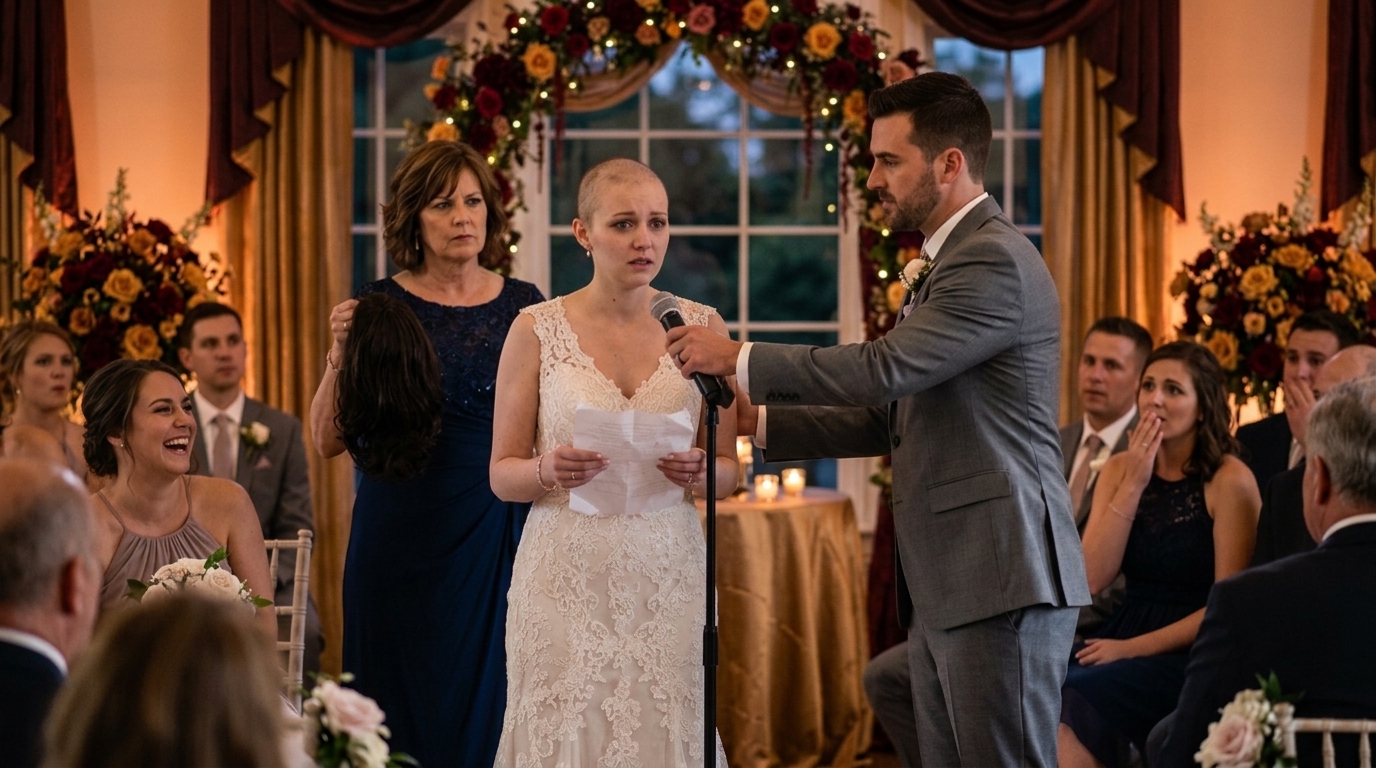
I reached for the microphone.
For a moment, Silas didn’t let go.
Not because he wanted to stop me.
Because he was giving me
one last opportunity to decide whether
I wanted to turn the most painful moment of
my wedding into something even bigger.
His eyes searched mine.
“Are you sure?” he whispered.
I looked past him.
My mother stood beside the altar, still holding my wig.
Her emerald gown shimmered beneath the glass conservatory’s afternoon sunlight.
Her diamond earrings caught the light every time she moved her head.
She looked magnificent.
That had always been important to her.
Even now, after humiliating her daughter in front of 114 people,
she seemed more concerned about how she appeared than what she’d done.
Khloe stood beside the front row, her lips pressed together.
She wasn’t laughing anymore.
I looked back at Silas.
“Yes,” I whispered. “I’m sure.”
He released the microphone.
I turned toward the guests.
My hands were trembling, but my voice was surprisingly steady.
“Before I say anything else, I want everyone here to understand something.”
The conservatory was completely silent.
“I didn’t invite my mother and sister here because they helped me survive cancer.”
I swallowed.
“I invited them because some part of me still hoped they might eventually love me the way I needed them to.”
A woman near the second row began crying.
I recognized her immediately.
Nurse Amelia Carter.
She’d held my hand during my first chemotherapy infusion,
when I was so frightened that I couldn’t stop shaking.
I looked at her.
Then at Dr. Evans.
Then at Sarah Jenkins, my closest friend and lead engineer.
Most of you know what happened during my treatment.
You know how sick I was.
You know how hard I worked to keep my company operating.
I paused.
“But there’s something most of you don’t know.”
Mother suddenly stepped forward.
Claire, sweetheart, you’re emotional. Let’s not make this worse.
I turned toward her.
“Don’t call me sweetheart.”
She froze.
The words surprised me as much as they surprised her.
For thirty-two years, I’d allowed her to use affection whenever she wanted to regain control.
She could call me worthless one moment and sweetheart the next.
And somehow, I’d always accepted it.
Not anymore.
I faced the guests again.
“While I was receiving chemotherapy, my mother charged me rent to live in the basement of her house.”
Several people gasped.
“She told her boutique customers I was away on a wellness retreat because she didn’t want anyone knowing her daughter had cancer.”
I heard someone whisper, “Oh my God.”
I continued.
“When I lost my hair, she told me not to come upstairs when visitors were present.”
Mother’s face reddened.
“That’s not what happened!”
I looked at her.
“You told me I frightened people.”
She opened her mouth.
I continued.
“You said nobody wanted to look at a sick woman while shopping for wedding dresses.”
Khloe shifted uncomfortably.
Mother glanced around the room.
“Claire, we discussed this privately.”
I nodded.
“Yes. We did.”
I looked at the wig in her hand.
“And apparently, you decided to discuss it publicly.”
A murmur moved through the guests.
Mother lowered her eyes.
For the first time in my life, I watched her struggle to find an answer.
But I wasn’t finished.
“Three months ago, I discovered that someone had opened business credit accounts using my personal information.”
Silas stood quietly beside me.
I continued.
“At first, I thought it was identity theft by a stranger.”
My throat tightened.
“Then I learned the applications were connected to my mother’s bridal boutique.”
Mother’s head snapped upward.
“Claire!”
I ignored her.
“Documents submitted to the lenders included financial information from my engineering company,
even though Emerald Infrastructure had never authorized those loans.”
Sarah stood straighter.
She knew how carefully we’d protected the company.
She knew every contract represented years of work.
And she knew what it meant for someone to use our company’s financial records without permission.
I looked at Mother.
“Did you think I wouldn’t notice?”
Her face had gone pale.
She whispered, “I was going to explain.”
I stared at her.
“When?”
No answer.
“Before or after you pulled off my wig?”
Silas gently touched my arm.
“Claire, you don’t have to explain everything here.”
I nodded.
“I know.”
Then I looked at the guests.
“And I’m not going to turn my wedding into a courtroom. The financial matters are being handled through the proper channels.”
Mother visibly relaxed.
Only slightly.
But enough for me to notice.
Then I added, “However, everyone deserves to know that my mother’s behavior today is not an isolated misunderstanding.”
Her relief disappeared.
I turned toward her.
“Mom, give me my wig.”
She looked at the hairpiece.
Then at me.
For a moment, I thought she might refuse.
Finally, she extended her arm.
I took it.
The wig had cost nearly two thousand dollars.
It had been custom-fitted after chemotherapy.
I remembered sitting in the specialist’s chair, crying as the stylist carefully adjusted it around my scalp.
I remembered the first time I looked in the mirror and recognized something familiar.
But standing there in the conservatory, holding it in my hands, I realized something strange.
I didn’t want to put it back on.
Not because there was anything wrong with wearing a wig.
There wasn’t.
It had helped me feel comfortable during a difficult time.
But my mother had just tried to use it as a weapon.
And I wasn’t going to let her decide what my uncovered head meant.
I handed the wig to Sarah.
“Could you hold this for me?”
Her eyes filled.
“Of course.”
Then I turned back toward Silas.
He was smiling.
Not because the situation was funny.
Because he understood.
I looked at him.
“I’m ready.”
He took my hand.
And in front of everyone, I continued my vows.
“Silas,” I began, my voice trembling, “when we met, I was afraid to believe anyone could love me without wanting me to become someone else.”
He squeezed my fingers.
“I thought I needed to be healthier. Prettier. More successful. Less complicated.”
Tears slid down my cheeks.
“But you never asked me to change.”
I swallowed.
“You sat beside me when I was too exhausted to speak. You learned the names of my medications. You celebrated every good scan without pretending the difficult days hadn’t happened.”
Silas’s eyes filled.
“And when I was afraid my cancer would return, you didn’t promise something you couldn’t control.”
My voice broke.
“You promised I wouldn’t face that fear alone.”
A quiet sob came from the second row.
I smiled through my tears.
“So today, I promise you the same thing.”
I took a breath.
“I promise to love you when life is beautiful and when it is frightening. I promise to tell you the truth, even when it’s difficult. And I promise never to let anyone convince me that being loved by you is something I have to earn by hiding who I am.”
Silas brought my hand to his lips.
Then he took the microphone.
“Claire, I fell in love with you in a research pavilion where you spent forty minutes explaining why rural water systems fail when maintenance plans ignore local conditions.”
A ripple of laughter moved through the guests.
I laughed too.
“You had three notebooks, two broken pens, and a coffee you forgot to drink.”
He smiled.
“And I remember thinking I’d never met anyone so passionate about making other people’s lives better.”
My chest tightened.
He continued.
“I didn’t fall in love with your hair.”
He touched my cheek.
“I fell in love with your mind, your courage, your kindness, and the way you keep showing up for people even when you’re exhausted.”
His voice deepened.
“I loved you during chemotherapy. I love you in remission. And whatever the future brings, I choose you.”
I began crying again.
Then he added, “Not despite what you’ve survived. I love the whole person standing in front of me.”
The officiant wiped her eyes.
She waited until we were ready.
Then she smiled.
“Shall we continue?”
I nodded.
“Please.”
When she asked whether I took Silas to be my husband, I answered without hesitation.
“I do.”
When she asked Silas, he looked directly into my eyes.
“I absolutely do.”
The room erupted in applause.
He kissed me.
And for a few beautiful seconds, my mother disappeared from my thoughts entirely.
The applause had barely faded when Beatrice stepped forward.
“Claire, we need to talk.”
I turned.
She was trying to smile.
That familiar smile.
The one she used whenever customers complained about alterations or delayed deliveries.
Polished.
Controlled.
Completely false.
“Not now,” I said.
She glanced at Silas.
“Surely we can settle this privately.”
I looked at her.
“You had your opportunity to behave privately.”
Her face tightened.
“Don’t be dramatic.”
Silas stepped beside me.
“Mrs. Bennett, the ceremony is over. Please leave.”
Mother stared at him.
“Excuse me?”
“You heard me.”
Khloe hurried forward.
“You can’t throw us out. We’re family.”
Sarah approached with the venue coordinator.
Dr. Evans remained nearby.
Silas looked at Khloe.
“Family doesn’t give you permission to humiliate someone.”
Mother’s voice rose.
“I am the bride’s mother!”
I answered quietly.
“And I am the bride.”
That stopped her.
I took a breath.
“This is my wedding. And I’m asking you to leave.”
Her eyes widened.
“You would embarrass me like this?”
I stared at her.
For a moment, I couldn’t believe she’d actually said it.
Then I laughed.
Not because anything was funny.
Because after everything she’d done, she still believed she was the victim.
“Mom,” I said, “you pulled my wig off in front of 114 people.”
Her mouth opened.
I continued.
“You announced my cancer diagnosis like it was something shameful.”
She looked away.
“And you’re worried about being embarrassed?”
Khloe grabbed her arm.
“Come on, Mom.”
But Beatrice wasn’t finished.
She leaned toward me.
Her voice dropped.
“You’ll regret this.”
I looked at her.
“No.”
Then I said the words I’d been afraid to say for most of my life.
“I regret how long I let you treat me this way.”
Mother stared at me.
Then turned sharply.
Khloe followed her.
And with the venue coordinator accompanying them, they walked out of the conservatory.
The doors closed.
For several seconds, nobody spoke.
Then Sarah reached for my hand.
“Claire?”
I looked at her.
She smiled through her tears.
“Are you ready for your reception?”
I glanced at Silas.
He grinned.
“Only if there’s cake.”
I laughed.
And somehow, despite everything, the happiest part of my wedding day finally began.
But I didn’t yet know that while we were celebrating, my mother was making a phone call that would expose the last secret she’d been hiding.
PART 4
The first thing I remember about our reception is laughter.
Real laughter.
The kind that fills a room without anyone forcing it.
Sarah gave a speech about the first time she met me.
Apparently, I’d interviewed her for Emerald Infrastructure while wearing mismatched shoes because I’d spent the previous night repairing a failed prototype.
She told everyone I hadn’t noticed the shoes until lunch.
I buried my face in my hands.
The guests laughed.
Silas laughed harder than anyone.
Then Dr. Evans stood.
He raised his glass.
“I’ve treated thousands of patients,” he began. “And one thing I’ve learned is that illness does not define a person’s character.”
The room quieted.
He looked at me.
“Claire faced treatment with understandable fear, but also with remarkable determination. She asked questions. She advocated for herself. And she never lost her concern for others.”
My eyes filled.
He continued.
“Today, I want to celebrate something beyond her recovery.”
He smiled.
“Her right to live fully, without apology.”
Everyone raised their glasses.
I looked around the room.
For years, Mother had told me I was difficult to love.
Yet here were 112 people who had stayed after she and Khloe left.
People who knew me.
People who respected me.
People who had never asked me to hide in a basement.
And for the first time, I understood how small my mother’s world had been.
She measured love through appearances.
These people measured it through actions.
At 8:43 that evening, while Silas and I were cutting the cake, my phone vibrated.
I ignored it.
Then it vibrated again.
And again.
Eventually, Sarah approached.
“Claire, I think you should look at this.”
She held out her phone.
A message from Helen Marsh.
Helen had worked as my mother’s boutique accountant for almost eleven years.
She’d been one of the few adults who treated me kindly when I was younger.
When I was hospitalized during chemotherapy, she’d sent flowers.
Mother later told me Helen had been fired for mishandling paperwork.
I’d believed her.
The message read:
Claire, I’m sorry to contact you on your wedding day. I heard what happened. There’s something you need to know about the loans. Your mother didn’t tell you everything.
My stomach tightened.
I showed Silas.
He read it carefully.
Then looked at me.
“We can deal with this tomorrow.”
I hesitated.
Another message appeared.
I have copies of the records. I should have spoken sooner.
I felt cold.
Silas took my hand.
“Claire, whatever this is, you don’t have to handle it tonight.”
I looked toward the dance floor.
Our friends were laughing.
The music was playing.
The cake was waiting.
I took a breath.
“You’re right.”
I typed a reply.
Thank you, Helen. Please send everything to my attorney tomorrow. I appreciate you reaching out.
Then I put my phone away.
And danced with my husband.
The next morning, Silas and I woke in the small guest cottage beside the conservatory.
Sunlight spilled across the bedroom floor.
My wedding dress hung beside the window.
My wig rested on its stand near the dresser.
I lay beneath the blankets, looking at the ceiling.
Silas was still asleep.
For a while, I simply listened to him breathe.
Then he opened one eye.
“Good morning, Mrs. Thorne.”
I smiled.
“Good morning, Dr. Thorne.”
He reached for my hand.
“How are you feeling?”
I thought about the question.
Not physically.
Emotionally.
I felt exhausted.
Embarrassed.
Angry.
Grateful.
And strangely free.
“Like I got married yesterday,” I said.
He laughed.
“That does sound serious.”
I rolled toward him.
“Silas?”
“Yes?”
“Thank you.”
He frowned.
“For what?”
“For not hesitating.”
His expression softened.
“Claire, there was nothing to hesitate about.”
I swallowed.
“When she pulled off my wig, I thought for one second that everyone would see me the way she does.”
He touched my cheek.
“And what did they see?”
I looked at him.
He smiled.
“My wife.”
I began crying.
He pulled me close.
And I let myself cry.
Not because Mother had won.
But because she’d finally lost the power to define me.
Two days later, I met with my attorney, Caroline Brooks.
Silas came with me.
Helen Marsh was already waiting in the conference room.
She looked nervous.
When I entered, she stood.
“Claire.”
I smiled faintly.
“Hello, Helen.”
Her eyes filled.
“I saw the wedding video.”
My stomach tightened.
Someone had posted a short recording of the ceremony.
It showed Mother pulling off my wig.
Khloe laughing.
Silas stepping forward.
And the guests standing in solidarity.
The video had spread far beyond our original guest list.
I hadn’t wanted it shared.
But several people had already seen it before we could request that the original poster remove it.
Helen shook her head.
“I’m so sorry.”
I took a breath.
“Thank you.”
She sat.
Then opened a folder.
“I should have come to you months ago.”
Caroline leaned forward.
“Let’s begin with what you personally know.”
Helen nodded.
She explained that Beatrice’s bridal boutique had been struggling financially.
For years, it had relied on expensive inventory, high-end renovations, and constant promotional events.
Business had slowed.
But Mother refused to reduce expenses.
Instead, she borrowed money.
Then borrowed more.
Eventually, several lenders refused additional financing.
That was when my name entered the picture.
Helen slid a document across the table.
I stared at it.
A business credit application.
My name appeared as a guarantor.
Claire Bennett.
My former surname.
Below it was a signature.
I felt sick.
“I never signed this.”
Caroline nodded.
“We’ve already disputed several documents. This appears to be another.”
Helen looked ashamed.
“Your mother told me you’d agreed to help.”
I stared at her.
“Why would she say that?”
Helen swallowed.
“She said you owed the family because she’d supported you during your illness.”
For several seconds, I couldn’t speak.
Then I laughed bitterly.
“Supported me?”
Helen looked down.
“I know.”
I stared at the paper.
Mother had charged me rent while I was receiving chemotherapy.
She’d hidden me from visitors.
She’d told people I was away on a wellness retreat.
And now she was claiming she’d supported me financially.
I looked at Caroline.
“How much?”
She checked the documents.
“The disputed applications we’ve identified so far total approximately six hundred and forty thousand dollars in requested credit.”
My mouth went dry.
“Six hundred and forty thousand?”
She nodded.
“That doesn’t mean the entire amount was advanced. We’re tracing the actual disbursements and outstanding obligations.”
I stared at the documents.
Then Helen handed over another page.
“This is the part I wanted you to see.”
It was an internal email.
Mother had written it to Khloe.
The subject line read:
CLAIRE’S SITUATION.
I began reading.
If the lenders ask about Claire’s health, emphasize that she’s recovering and that the family is handling her financial affairs.
My chest tightened.
The next sentence made my hands go numb.
We can explain any signature discrepancies as a result of treatment-related confusion.
I stared at the words.
Treatment-related confusion.
My mother had planned to use my cancer treatment as an excuse for documents I hadn’t signed.
I felt physically sick.
Silas reached for my hand.
I kept reading.
Once the boutique stabilizes, we’ll clean everything up before she notices.
I slowly lowered the paper.
For several seconds, nobody spoke.
Then I whispered, “She used my illness.”
Caroline’s expression was serious.
“The documents raise significant concerns. We’ll preserve them, verify their authenticity, and provide them to the appropriate parties.”
I looked at Helen.
“Did Khloe know?”
Helen hesitated.
Then nodded.
“She helped prepare some of the promotional materials used in the financing presentations.”
My stomach dropped.
“What promotional materials?”
Helen opened another folder.
Inside were screenshots from Khloe’s social media accounts.
Luxury hotel rooms.
Designer handbags.
Private airport lounges.
Expensive restaurants.
Then I saw invoices.
Payments from the boutique.
Payments to Khloe’s influencer management company.
Payments for trips described as brand-development expenses.
I stared at the totals.
“She was using the boutique to finance her lifestyle?”
Helen looked at Caroline.
“Some expenses were recorded that way. I can’t say which were legitimate without a complete review.”
Caroline nodded.
“We’ll let the records establish that.”
I sat back.
My mother had told me she couldn’t afford to help with my medical expenses.
She’d told me chemotherapy was making me selfish.
She’d insisted I pay rent because everyone had to contribute.
Meanwhile, she’d been financing Khloe’s luxury travel brand.
And apparently using my identity to support the debt.
I felt something inside me go quiet.
Not numb.
Clear.
For years, I’d wondered why Mother treated us differently.
Why Khloe deserved everything.
Why I was always expected to give.
Why my illness was an inconvenience while Khloe’s social media career was treated like a family emergency.
Now I understood.
Mother didn’t value us according to what we needed.
She valued us according to what she could use.
Khloe helped her look successful.
I helped her obtain money.
And when I stopped cooperating, I became a problem.
Caroline began taking action.
The disputed credit accounts were formally challenged.
Relevant lenders were notified.
My identity records were secured.
Emerald Infrastructure’s financial systems were reviewed to ensure no unauthorized company obligations had been created.
A forensic accountant was retained.
And the matter was referred to the appropriate investigators.
I also instructed my attorney to communicate with Mother on my behalf.
I didn’t want another private conversation where she’d cry, accuse me of betrayal, and demand I forgive her before she’d admitted what happened.
Three days later, Mother called anyway.
I let it go to voicemail.
Then she sent a message.
CLAIRE, YOUR LAWYER IS DESTROYING MY BUSINESS.
I stared at it.
Another arrived.
DO YOU WANT YOUR OWN MOTHER TO LOSE EVERYTHING?
Then a third.
AFTER ALL I DID FOR YOU DURING CANCER?
I closed my eyes.
That final sentence hurt more than I expected.
Not because I believed it.
Because she still believed she could rewrite history.
I handed the phone to Silas.
He read the messages.
Then looked at me.
“What do you want to do?”
I took a breath.
“Nothing.”
He nodded.
“Then we do nothing.”
And for the first time, I understood that silence could be a boundary instead of a punishment.
Two weeks later, Khloe appeared outside my office.
I was reviewing a municipal filtration proposal when Sarah knocked.
“Claire?”
I looked up.
“What’s wrong?”
Sarah hesitated.
“Your sister is downstairs.”
I sighed.
“Did she make an appointment?”
“No.”
“Then I’m unavailable.”
Sarah nodded.
But before she could leave, my office phone rang.
Reception.
I answered.
“Claire Thorne.”
A nervous voice replied.
“Ms. Thorne, your sister says she needs to speak with you urgently.”
I closed my eyes.
“What about?”
There was a pause.
Then I heard Khloe shouting in the background.
“Tell her Mom’s boutique is collapsing!”
I took a breath.
“Please tell her any financial matters must go through counsel.”
Then I hung up.
Ten minutes later, my phone vibrated.
A message from Khloe.
You think you’re so much better than us now.
I didn’t answer.
Another followed.
You ruined Mom’s business because you’re jealous of me.
I stared at the screen.
Then typed one sentence.
I did not authorize anyone to use my identity or my company’s information to obtain financing. Please direct further communication about these matters to my attorney.
I sent it.
Then blocked her number.
My hands shook afterward.
I hated that.
I hated that setting a reasonable boundary still made me feel like a frightened child.
But Sarah came into my office carrying two coffees.
She placed one on my desk.
“Rough morning?”
I smiled faintly.
“You could say that.”
She sat across from me.
Then said something I’ll never forget.
“Claire, you don’t have to become cruel just because you’ve stopped allowing cruelty.”
I looked at her.
She smiled.
“You can still be kind. Just not available for abuse.”
I stared at my coffee.
Then nodded.
“Thank you.”
Over the following months, the investigation revealed a complicated pattern of financial misconduct.
Some transactions had been properly authorized.
Others had not.
Several signatures were disputed.
Certain expense descriptions did not match the supporting records.
And the use of my personal information became a central issue.
Mother’s boutique faced serious financial consequences.
Lenders reviewed their positions.
Business relationships deteriorated.
Some customers canceled orders after the wedding video spread.
But I refused to celebrate that.
There were employees at the boutique who had done nothing wrong.
Seamstresses.
Receptionists.
Alteration specialists.
People who depended on their paychecks.
I knew what it meant to run a business.
I knew how easily innocent employees could suffer because of an owner’s decisions.
So when Helen told me several workers were worried about unpaid wages, I asked Caroline whether there was a lawful way to help them without interfering with the investigation.
She connected me with a local worker-support organization.
I made a private donation.
No announcement.
No photographs.
No social media post.
I didn’t tell Mother.
I didn’t tell Khloe.
Because helping people wasn’t supposed to be a performance.
Then, almost five months after the wedding, I received a letter.
It wasn’t from Mother.
It was from a woman named Evelyn Pierce.
She had worked at the bridal boutique for seventeen years.
The letter was handwritten.
Dear Claire,
I don’t know whether you remember me. I used to work in alterations when you were a teenager. You sometimes came downstairs after school and helped me carry garment bags.
I smiled faintly.
I remembered Evelyn.
She’d been kind.
She always kept peppermint candies in her sewing drawer.
I continued reading.
I want you to know that many of us saw how your mother treated you. We didn’t always speak up. I’m ashamed of that.
My eyes filled.
When you were sick, I asked where you were. Your mother told me you didn’t want visitors. I believed her.
I swallowed.
I learned later that you were downstairs, alone, while we were working above you.
Tears slid down my face.
I should have checked.
I pressed my hand over my mouth.
Then I reached the final paragraph.
Your mother always said you were the difficult daughter. But I remember a young woman who helped carry dresses, fixed our broken printer, and stayed late to help us finish an order when nobody asked her to.
You were never difficult, Claire.
You were simply someone she couldn’t control.
I folded the letter.
Then cried harder than I had in months.
Because sometimes the deepest wounds don’t come from what people say.
They come from the years you spend wondering whether they’re right.
And that letter helped silence a voice inside me that had sounded like my mother for far too long.
PART 5
One year after our wedding, Silas and I returned to Oak Ridgerest.
Not for another ceremony.
Not to recreate what had happened.
We went because the conservatory had invited us to attend a charity dinner supporting patients recovering from serious illness.
The event was organized in partnership with the Thorne Medical Foundation.
Silas had been involved in the research side of the foundation for years.
I had recently begun working with a nonprofit that helped medical facilities improve water reliability in underserved communities.
It was a cause that brought our professional worlds together.
And for the first time, I was excited to return to the place where my mother had humiliated me.
I stood in front of the mirror that evening.
My hair had grown back.
Not completely to its old length.
It was shorter now.
Soft brunette curls framed my face.
There were still days when I looked in the mirror and remembered chemotherapy.
Days when a headache frightened me.
Days when I worried about future scans.
But my doctors continued to monitor me, and I was learning to live without allowing fear to control every ordinary moment.
Silas appeared in the doorway.
He wore a charcoal suit.
His tie was slightly crooked.
I smiled.
“Come here.”
He approached.
I straightened it.
He looked at my reflection.
“You look beautiful.”
I laughed softly.
“You say that every day.”
“That’s because you’re beautiful every day.”
I rolled my eyes.
He kissed my forehead.
Then asked, “Ready?”
I looked at myself one last time.
A year earlier, I had walked into that conservatory wearing a custom wig because I wanted to feel like myself on my wedding day.
There had been nothing wrong with that choice.
And there was nothing wrong with the short curls I wore now.
Both versions of me deserved respect.
I took Silas’s hand.
“Ready.”
The charity dinner was beautiful.
White flowers decorated the tables.
Soft lights hung beneath the glass ceiling.
A small orchestra played near the entrance.
As we walked inside, I recognized several people from our wedding.
Dr. Evans.
Nurse Amelia.
Sarah and her husband.
Members of my engineering team.
Friends who had stood when Mother tried to humiliate me.
Amelia hurried toward us.
“Claire!”
She hugged me.
I laughed.
“It’s so good to see you.”
She stepped back and studied my hair.
“I love the curls.”
I smiled.
“Thank you.”
Then she lowered her voice.
“How are you doing?”
I understood what she meant.
Not just physically.
Everything.
I took a breath.
“Better.”
She smiled.
“I’m glad.”
And for once, I believed it when I said it.
The financial case involving Mother’s boutique had continued through much of that year.
The disputed loans were reviewed.
Certain obligations were corrected after the unauthorized use of my identity was established through the relevant processes.
Other claims remained contested.
The boutique eventually closed.
The financial consequences were substantial.
Mother sold several personal assets.
Khloe’s influencer business lost sponsorships after questions arose about its financial relationship with the boutique.
Their lifestyle changed.
But I didn’t spend my days checking their social media accounts.
I didn’t need to.
The investigation and legal proceedings were being handled by professionals.
I had a company to run.
A marriage to enjoy.
A life to live.
And I was no longer willing to organize that life around Mother’s latest crisis.
One afternoon, Caroline called with an update.
“Claire, there’s been progress on the remaining civil matters.”
I listened carefully.
She explained that a settlement had been reached concerning several disputed financial obligations.
The agreement included corrections to records, repayment arrangements, and restrictions designed to prevent further misuse of my information.
It didn’t erase everything.
It didn’t undo the humiliation.
It didn’t restore the years I’d spent feeling unwanted.
But it protected my financial interests and my company.
When the call ended, I sat quietly at my desk.
Then I opened a drawer.
Inside was a photograph from my wedding.
Not the moment Mother pulled off my wig.
Not the moment Khloe laughed.
A photograph taken twenty minutes later.
Silas and I stood beneath the conservatory’s glass ceiling.
My head was uncovered.
His arms were around me.
We were laughing.
Behind us, our friends were applauding.
I studied it for a long time.
Then I placed it on my desk.
That was the wedding I wanted to remember.
Several months later, Mother sent me a letter.
The envelope was thick.
Her handwriting was unmistakable.
For a long time, I left it unopened.
Then one Sunday afternoon, I sat beside Silas on the sofa and finally read it.
The first paragraph was about the boutique.
How hard she’d worked.
How much she’d lost.
How unfairly she’d been treated.
The second paragraph blamed Khloe.
Apparently, Khloe had encouraged some of the financial decisions.
The third paragraph blamed her former accountant.
The fourth blamed the lenders.
By the fifth, Mother finally mentioned me.
Claire, I know the wedding incident upset you.
I stared at the sentence.
Upset me.
As though she’d accidentally spilled wine on my dress.
As though she hadn’t ripped off my wig and mocked my cancer diagnosis in front of everyone I loved.
I continued.
I was emotional because I felt excluded from your wedding planning.
I stopped reading.
Silas looked at me.
“Do you want to finish?”
I shook my head.
“No.”
He nodded.
I folded the letter.
Then placed it back in the envelope.
I didn’t respond.
Not because I wanted revenge.
But because an apology that explained away the harm without taking responsibility wasn’t the beginning of healing.
It was another attempt to make me responsible for Mother’s feelings.
And I was finished carrying that burden.
Khloe tried a different approach.
She contacted Sarah.
Then Amelia.
Then a cousin I hadn’t spoken to in years.
She told everyone she wanted to reconcile.
She said she missed me.
She said the family had been torn apart.
Eventually, Sarah asked whether I wanted her to pass along a message.
I thought about it.
Then said, “Tell her I hope she gets the help she needs.”
Sarah nodded.
“Anything else?”
I shook my head.
“No.”
I didn’t hate Khloe.
That surprised me.
For years, I’d thought anger would be the hardest emotion to release.
But eventually, I realized I wasn’t angry every day anymore.
I was simply unwilling to return to the same relationship.
Khloe had laughed when Mother humiliated me.
She’d helped benefit from financial arrangements involving my identity.
And she had repeatedly chosen Mother’s approval over basic decency.
If she ever genuinely changed, perhaps there could be a conversation.
But change would have to be demonstrated.
Not announced.
Meanwhile, Emerald Infrastructure continued growing.
Our decentralized solar-powered filtration system completed a major pilot project in a rural community.
The system used modular filtration units powered by solar energy, with monitoring equipment designed to help local operators identify maintenance problems early.
It wasn’t perfect.
We made adjustments.
Replaced components.
Improved the control software.
And worked closely with the community to ensure the system could be maintained without constant outside intervention.
But the project succeeded.
And the municipality approved a broader deployment.
The day we signed the contract, Sarah burst into my office.
“Claire!”
I looked up.
“What?”
She held up the agreement.
“We got it!”
I stood so quickly my chair rolled backward.
“You’re kidding.”
She laughed.
“I’m not!”
We hugged.
Then we both started crying.
Because we’d worked on that system through everything.
Through my diagnosis.
Through chemotherapy.
Through the nights I could barely stay awake.
Through the months I worked from the basement of Mother’s house.
Through the wedding.
Through the financial investigation.
Through all of it.
And now it was helping people.
Real people.
Families who needed safe, reliable water.
I thought about the little girl I had once been.
The one who preferred engineering textbooks to fashion magazines.
The one Mother called boring.
The one Khloe mocked for spending weekends building prototypes.
I wished I could tell her something.
One day, the things people laugh at you for may become the very things that allow you to change lives.
That autumn, the Thorne Medical Foundation invited me to speak at its annual fundraising gala.
The topic was resilience.
At first, I refused.
“I’m an engineer,” I told Silas. “Not a motivational speaker.”
He laughed.
“You speak to municipal boards all the time.”
“About filtration systems.”
“Then talk about what you know.”
I frowned.
“What do you mean?”
He sat beside me.
“Talk about rebuilding.”
I looked at him.
He smiled.
“You’re good at that.”
I thought about it for several days.
Then agreed.
The gala was held in a large ballroom overlooking the river.
More than three hundred people attended.
Doctors.
Researchers.
Business leaders.
Patients.
Survivors.
Families.
I stood backstage, holding my notes.
My hands were shaking.
Silas appeared beside me.
“Nervous?”
“Terrified.”
He smiled.
“You’ll be wonderful.”
I looked at him.
“How do you know?”
He kissed my forehead.
“Because you’re speaking about something you’ve lived.”
Then the host introduced me.
I walked onto the stage.
The lights were bright.
The room seemed enormous.
For a moment, I remembered standing at my wedding altar.
The cold air hitting my scalp.
The sound of Khloe laughing.
Mother holding my wig.
My heart began racing.
Then I looked toward the front row.
Silas was there.
Sarah.
Dr. Evans.
Amelia.
People who had stood beside me when I needed them.
I took a breath.
And began.
“Good evening. My name is Claire Thorne, and I’m an environmental engineer.”
I smiled.
“I design water systems. Which means I spend a surprising amount of time thinking about what happens when something breaks.”
A few people laughed.
I continued.
“In engineering, we don’t assume a system is worthless because a component fails.”
I paused.
“We study what happened. We identify what can be repaired. We strengthen what remains.”
The room grew quiet.
“When I was diagnosed with lymphoma, I felt as though my entire life had failed.”
I swallowed.
“My body was changing. My plans were interrupted. And I was frightened of a future I couldn’t predict.”
I looked across the audience.
“But I learned that being vulnerable doesn’t make a person less valuable.”
Several people nodded.
I continued.
“And I learned that the people who truly love you don’t demand that you hide your suffering to make them comfortable.”
My eyes filled.
“Sometimes the most important rebuilding happens after we recognize that the environment around us is unsafe.”
I took a breath.
“Sometimes we need to change our surroundings.”
I thought of Mother’s basement.
The locked door.
The footsteps overhead.
The loneliness.
Then I thought of Silas.
Sarah.
Amelia.
The people who had shown up.
“Sometimes we need help.”
I smiled.
“And sometimes we need to stop apologizing for needing it.”
The room was silent.
I looked down at my notes.
Then set them aside.
“One of the hardest things I learned was that survival and living are not the same thing.”
My voice trembled.
“Survival was getting through chemotherapy.”
I paused.
“Living was allowing myself to dream again.”
I looked toward Silas.
“Survival was making it through the worst days.”
My eyes filled.
“Living was believing I deserved joy afterward.”
I took a breath.
“And survival was learning how to endure cruelty.”
I looked across the audience.
“Living was learning I didn’t have to.”
For several seconds, nobody moved.
Then someone began clapping.
Another person joined.
Then another.
Soon the entire ballroom was on its feet.
I stood behind the podium, crying.
Not because I felt exposed.
Because I finally felt seen.
After the gala, a young woman approached me.
She couldn’t have been older than twenty-five.
She wore a blue dress and a soft headscarf.
Her eyes were red.
“Dr. Thorne?”
I smiled.
“Just Claire is fine.”
She laughed nervously.
“My name is Hannah.”
I shook her hand.
“It’s nice to meet you.”
She hesitated.
Then whispered, “I’m going through treatment.”
My heart tightened.
“I’m sorry you’re dealing with that.”
She nodded.
“My family keeps telling me I need to stay positive.”
I listened.
“They don’t like when I cry.”
Her voice broke.
“They say I’m making everything harder.”
I felt an ache in my chest.
I recognized that loneliness.
The pressure to make other people comfortable while your own world was falling apart.
I took her hand.
“Hannah, you’re allowed to be frightened.”
Her eyes filled.
“Really?”
“Of course.”
I smiled gently.
“You’re allowed to have difficult days. You’re allowed to cry. And you’re allowed to ask for help.”
She began crying.
I hugged her.
For a moment, I thought about the young woman I’d been during chemotherapy.
The one sitting alone in a basement bedroom.
The one who believed she had to be strong enough not to inconvenience anyone.
I wished someone had told me those words sooner.
Three years after my wedding, Silas and I returned to the conservatory again.
This time, we weren’t attending a formal event.
We were visiting because the venue coordinator, Olivia, had invited us to see the newly renovated garden.
She met us at the entrance.
“Claire!”
I hugged her.
“It’s wonderful to see you.”
She smiled.
“You too.”
We walked through the gardens.
White roses climbed the trellises.
A fountain murmured beside the path.
The glass conservatory glowed in the afternoon sunlight.
Eventually, Olivia stopped near the entrance.
“I wanted to show you something.”
She opened a small album.
Inside were photographs from weddings held at the venue over the years.
Then she turned to a page near the back.
There we were.
Silas and me.
Standing beneath the glass ceiling.
My head uncovered.
My hands in his.
Both of us smiling.
I stared at the photograph.
Olivia looked nervous.
“I hope you don’t mind. We wanted to include a picture of your ceremony in our private anniversary collection. We wouldn’t use it publicly without your permission.”
I smiled.
“It’s beautiful.”
She relaxed.
Then said, “Your wedding is one our staff still remembers.”
I laughed softly.
“I imagine it is.”
She shook her head.
“Not because of what happened with your mother.”
I looked at her.
“Then why?”
Olivia smiled.
“Because of what happened afterward.”
I felt my throat tighten.
She continued.
“I’ve worked hundreds of weddings. I’ve seen beautiful dresses, expensive flowers, enormous cakes, and ceremonies that cost more than most people earn in a year.”
She looked at the photograph.
“But I’ve rarely seen a room full of people stand together like that.”
My eyes filled.
Olivia smiled.
“That was the part we remembered.”
On our way home, Silas reached for my hand.
“What are you thinking about?”
I looked out the window.
“The wedding.”
He smiled.
“Good thoughts or bad ones?”
I considered the question.
Then answered honestly.
“Both.”
He nodded.
I continued.
“I used to wish I could erase what Mother did.”
He glanced at me.
“And now?”
I looked at him.
“Now I wish it hadn’t happened. But I don’t wish away everything that followed.”
He squeezed my hand.
I smiled.
“That day taught me something I should have known years earlier.”
“What?”
I turned toward him.
“I wasn’t difficult to love.”
His eyes softened.
I continued.
“I was just asking the wrong people to love me properly.”
He brought my hand to his lips.
Then smiled.
“I think that’s the smartest thing you’ve ever said.”
I laughed.
“Really? Smarter than my filtration system?”
He pretended to think.
“Almost.”
I laughed harder.
And as we drove home, I realized I hadn’t thought about Mother’s expression in months.
Not her anger.
Not her disappointment.
Not the way she used to look at me as though I were something embarrassing.
Her voice was finally becoming quieter in my memory.
And my own was becoming stronger.
I still have the wig.
It’s stored carefully in its original box.
Sometimes people ask why I kept it.
They assume I want a reminder of the worst moment of my wedding.
But that’s not why.
I kept it because it belonged to me.
It was something I chose during a difficult chapter of my life.
Something that helped me feel comfortable when my body was changing.
My mother tried to turn it into a symbol of shame.
She failed.
Because there was never anything shameful about losing my hair.
There was never anything shameful about having cancer.
And there was never anything shameful about wanting to feel beautiful on my wedding day.
The shame belonged to the people who tried to use my illness against me.
Not to me.
Last spring, I was invited to speak to a group of young women studying engineering.
Afterward, one student approached me.
She asked how I’d learned to stop caring what other people thought.
I smiled.
Then told her the truth.
“I haven’t.”
She looked surprised.
I continued.
“I still care sometimes. I still get nervous. I still wonder whether people approve of me.”
She nodded.
“But I’ve learned that their approval isn’t the same thing as my worth.”
I paused.
“And I’ve learned to be careful about whose opinions I allow to guide my life.”
She smiled.
Then asked, “What if the people criticizing you are your family?”
My heart tightened.
I thought of Mother.
Khloe.
The basement.
The wedding.
Then I answered.
“Being related to someone doesn’t make their cruelty true.”
The young woman stared at me.
I continued.
“You can love people and still protect yourself from them.”
She nodded slowly.
“And if they refuse to respect your boundaries?”
I smiled gently.
“Then your boundaries become even more important.”
On our fourth wedding anniversary, Silas surprised me with dinner at home.
He cooked pasta.
Burned the garlic bread.
And insisted the smoke detector was being dramatic.
I laughed so hard I nearly cried.
After dinner, he handed me a small velvet box.
I frowned.
“Silas, we agreed no expensive gifts.”
He smiled.
“Open it.”
Inside was a silver necklace.
A delicate pendant hung from the chain.
It was shaped like a tiny water droplet.
On the back were four engraved words.
Nothing about you is missing.
I stared at it.
My eyes filled.
Silas reached across the table.
“Do you remember what you said the first time we met?”
I shook my head.
He smiled.
“You apologized because you weren’t wearing your wig.”
I looked at him.
He continued.
“You said you hoped I didn’t mind.”
I swallowed.
“I remember.”
He took my hand.
“I told you I didn’t.”
I nodded.
“And you looked surprised.”
Tears slipped down my cheeks.
Silas smiled.
“I wanted you to have something that reminds you that you never needed to apologize for being yourself.”
I leaned across the table and kissed him.
Then I put on the necklace.
It rested against my chest.
Small.
Simple.
Beautiful.
Sometimes I think back to the exact moment my mother ripped off my wig.
The sharp pull.
The cold air.
The laughter.
The silence.
I remember standing there, holding my vows, wondering whether the worst fear I’d carried through cancer treatment was about to come true.
That the people I loved would see me differently.
That my illness had made me less beautiful.
Less desirable.
Less worthy.
But then Silas stepped forward.
And the people who had supported me stood together.
Not to hide me.
Not to rescue me from being seen.
But to make it clear that I had nothing to be ashamed of.
My mother wanted everyone to stare at my bare head.
Instead, they saw her cruelty.
She wanted my groom to hesitate.
He didn’t.
She wanted my wedding to become a public humiliation.
Instead, it became the day I finally stopped begging for her approval.
And the man standing beside me made a promise I will never forget.
He didn’t promise that life would always be easy.
He didn’t promise I’d never be sick again.
He didn’t promise we’d never be frightened.
He promised we’d face whatever came together.
That was enough.
More than enough.
Because love isn’t proven by how someone treats you when you’re perfectly healthy, beautifully dressed, and smiling for photographs.
It’s proven in the hospital waiting rooms.
The difficult conversations.
The frightening nights.
The moments when you don’t feel strong.
And the moments when someone tries to convince you that you’re unworthy.
My mother pulled off my wig because she thought the truth about my illness would make my husband stop loving me. What she revealed instead was the truth about herself.
And when Silas reached for that microphone, he didn’t simply defend his bride.
He reminded me of something I’d spent my entire life trying to believe.
I was never the daughter who wasn’t good enough. I was the daughter who finally learned she didn’t have to prove she was.
THE END THANK YOU FOR READING !!!



