PART 3
The name on Jared’s phone was
Northbridge Senior Care Management, LLC.
For several seconds, I forgot about the cold apartment,
the canned soup, and even
Lauren standing beside my front door.
I knew that company.
Or, more accurately, I knew the man behind it.
Twenty-one years earlier,
when I was still working as a corporate auditor,
I had helped investigate a financial
services executive named Victor Sloane.
He had been involved in a scheme
that redirected company funds through
businesses that existed mostly on paper.
The records had been deliberately confusing.
Payments passed through consulting companies,
management accounts,
and supposed service providers
before reaching their final destinations.
Victor was eventually convicted of financial fraud.
I remembered his face because he had smiled during our first interview.
He had looked me directly in the eyes and said, “Mr. Blake, numbers only tell the story people want them to tell.”
I had answered, “Not when someone knows how to read them.”
Now, twenty-one years later, a company associated with his name appeared on my son’s phone.
And somehow, nearly three hundred thousand dollars intended for my care had been directed toward it.
I looked at Lauren.
“Where did you find Northbridge?”
She didn’t answer.
Jared turned toward her.
“Lauren?”
She took a slow breath.
“Can we please discuss this somewhere private?”
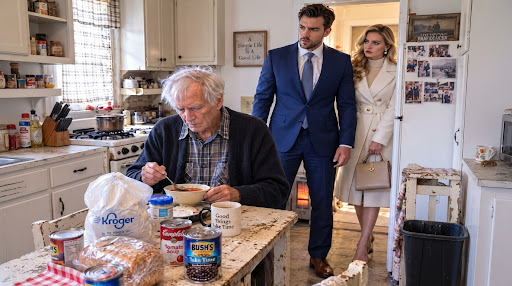
I looked around my apartment.
The peeling wallpaper.
The old kitchen table.
The radiator that barely worked.
“Private from whom?” I asked. “There are only three of us here.”
Lauren glanced toward the hallway.
“Your neighbors can hear everything.”
“Then perhaps we should speak quietly.”
Jared held up his phone.
“I want an explanation.”
Lauren’s expression hardened.
“You’re making this sound criminal.”
“I haven’t said anything about a crime.”
“You’re implying it.”
Jared stared at her.
“My father has been eating food from a church pantry while I’ve been sending eight thousand dollars a month for his care. What exactly am I supposed to think?”
She folded her arms.
“Your father refused the arrangements I made.”
I blinked.
“What arrangements?”
“The senior residence.”
“Lauren, nobody ever offered me a senior residence.”
She looked directly at me.
“Oscar, you don’t remember our conversations?”
The question hung in the room.
I felt something cold settle in my stomach.
It wasn’t the first time Lauren had suggested my memory was failing.
Six months earlier, during a family dinner, she had corrected me when I mentioned an old vacation.
She claimed I had confused two separate trips.
Three months later, she told Jared I had forgotten an appointment that I had never scheduled.
I had dismissed those incidents.
I was seventy-two.
Sometimes I misplaced my glasses.
Sometimes I walked into a room and forgot why.
But I had spent forty years examining financial records.
I knew the difference between ordinary forgetfulness and someone attempting to rewrite events.
“Lauren,” I said, “tell me the name of the residence.”
She hesitated.
“Lakeview Manor.”
“Address?”
“I don’t remember the exact street.”
“Telephone number?”
“Oscar, really?”
“Who handled my admission?”
Her cheeks reddened.
“Why are you interrogating me?”
“Because I never signed an admission agreement, never toured a residence, and never received a bill.”
Jared looked at her.
“Did Dad ever move into Lakeview Manor?”
She didn’t answer.
“Lauren.”
She raised her voice.
“I did what I thought was best!”
Jared stepped backward.
I had seen that reaction before.
A person facing a question they couldn’t answer sometimes attacked the questioner instead.
It didn’t prove guilt.
But it told me the conversation was no longer about facts.
I stood slowly.
“Jared, sit down.”
He looked at me.
“Dad—”
“Please.”
Something in my voice made him obey.
Lauren remained standing.
I walked toward the small cabinet beside the refrigerator and removed an old yellow legal pad.
My hands were stiff from the cold, but my mind was suddenly clearer than it had been in months.
I wrote three headings.
Money sent.
Money received.
Services provided.
Then I turned the pad toward them.
“Jared, you say you sent eight thousand dollars each month?”
“Yes.”
“For how long?”
“Thirty-six months.”
“From what account?”
“The family trust account.”
“Who authorized the payments?”
“I did initially. Lauren handled the administration afterward.”
“Did you review statements?”
He looked ashamed.
“No.”
I nodded.
“Did you receive reports?”
“Quarterly summaries.”
“Who prepared them?”
He slowly turned toward his wife.
“Lauren.”
I wrote her name beneath the third heading.
Then I asked another question.
“What did those summaries say?”
Jared swallowed.
“That you were living in a senior residence with private transportation, meals, medical assistance, and housekeeping.”
I looked around my apartment.
A cockroach disappeared beneath the radiator.
On the kitchen table sat two cans of vegetable soup and half a loaf of bread from the pantry.
I hadn’t seen a dentist in eighteen months.
My winter boots had a hole near the left heel.
“Son,” I said quietly, “the most expensive thing in this apartment is the space heater.”
Jared covered his mouth.
For a moment, he looked like the boy who had cried when he broke our kitchen window at thirteen.
“Dad, I didn’t know.”
I believed him.
But belief wasn’t enough.
Not anymore.
I looked at Lauren.
“Who owns Northbridge?”
She stared at me.
“It’s a legitimate management company.”
“That wasn’t my question.”
“I don’t know who owns every company we use.”
“Then who recommended it?”
Silence.
Jared stood.
“Lauren, answer him.”
She grabbed her handbag.
“This is ridiculous. I’m not standing here while you both accuse me of stealing.”
She moved toward the door.
Jared didn’t stop her.
But I spoke before she could leave.
“Lauren, don’t delete anything.”
She froze.
I continued.
“Emails. Statements. Contracts. Messages. Anything connected to my care.”
She turned.
“Are you threatening me?”
“No. I’m telling you that records matter.”
Her face changed.
For one brief second, I saw genuine fear.
Then she opened the door and left.
The apartment fell silent.
Jared stared after her.
I looked down at the legal pad.
And suddenly, I felt seventy-two years old.
Not because of my knees.
Not because of the cold.
But because the truth was beginning to take shape, and I knew it might destroy my son’s marriage.
Jared sat heavily.
“Dad, what do we do?”
I pulled out the chair opposite him.
“We find out what happened.”
He shook his head.
“I trusted her.”
“I know.”
“I gave her access because she said she’d take care of everything.”
“I know.”
He looked around the room.
“Why didn’t you tell me things were this bad?”
That question hurt.
Because the answer wasn’t simple.
I had hidden my poverty.
He had hidden his wealth behind a system he didn’t supervise.
And somewhere between those two decisions, someone had apparently taken advantage.
“I didn’t want to be a burden,” I admitted.
Jared’s eyes filled.
“Dad, you sold your house to help me.”
I looked away.
“That’s what parents do.”
“No,” he whispered. “That’s what you did.”
For the first time in years, we sat together without pretending everything was fine.
Then Jared reached for his phone.
“I’m calling my attorney.”
I nodded.
“Good.”
“And Dad?”
“Yes?”
“I’m getting you out of this apartment.”
I looked at him.
“Jared, don’t make decisions for me.”
He stopped.
I continued.
“I appreciate the offer. But I spent too many years being told what was best for me without anyone asking.”
His expression softened.
“Then what do you want?”
I looked toward the radiator.
“First, I’d like some heat.”
He laughed through his tears.
It was a small sound.
But it was the first hopeful thing I’d heard all day.
That evening, Jared arranged for a licensed heating technician to inspect the apartment with my permission.
The technician found a dangerous problem with the old radiator system and advised that it required professional repair.
Jared contacted the landlord.
Then he helped me pack a bag.
I agreed to stay at a hotel while the heating issue was addressed.
Before leaving, I picked up the two cans of soup.
Jared watched me.
“Dad, you don’t need those.”
I looked at him.
“Son, when you’ve spent three years wondering whether you’ll have enough food next week, you don’t stop thinking that way overnight.”
His face crumpled.
He took one of the cans from my hand.
And quietly placed it inside my bag.
The next morning, Jared’s attorney called.
Her name was Caroline Brooks.
She specialized in trusts, business disputes, and financial litigation.
She asked whether I would meet with her and a forensic accountant.
I said yes.
Then she said something that made my stomach tighten.
“Mr. Blake, we’ve already discovered an inconsistency in the trust records.”
I gripped the phone.
“What kind?”
“The quarterly reports your son received show payments to a residential care provider.”
“Yes.”
“But the bank records identify a different recipient.”
I closed my eyes.
“Northbridge.”
“Yes.”
She paused.
“And Mr. Blake?”
“What?”
“The company appears to have changed ownership twice in the last five years.”
I looked toward the hotel window.
“Who owns it now?”
Caroline hesitated.
“We’re still verifying the records.”
I waited.
Then she added, “But one of the listed managers is someone your daughter-in-law knows personally.”
I felt the old auditor inside me wake completely.
“Who?”
Caroline answered.
“Her brother.”
And suddenly, the missing money wasn’t just a mystery.
It was a family business.
PART 4
Lauren’s brother was named Nathan Whitcomb.
He was forty-one years old, handsome in a polished sort of way, and always seemed to be starting a new company.
Over the years, I had heard about his investments in medical technology, luxury transportation, commercial property, and private consulting.
Every venture sounded impressive.
None lasted very long.
At Thanksgiving two years earlier, Nathan had spent twenty minutes telling me about a revolutionary retirement-services platform.
He said it would change how wealthy families cared for aging relatives.
I remembered asking him how the company would handle fiduciary responsibilities.
He had laughed.
“Oscar, you’re thinking like an accountant.”
I had answered, “That’s usually how people avoid losing money.”
He didn’t speak to me again that evening.
Now I understood why that conversation mattered.
Northbridge Senior Care Management had been linked to Nathan.
And Northbridge had received payments supposedly intended to support me.
At Caroline’s office, the following afternoon, we gathered around a conference table.
Jared sat beside me.
Across from us were Caroline and a forensic accountant named Priya Desai.
Priya was in her late thirties, with a quiet manner and the kind of careful attention to detail I recognized immediately.
She reminded me of myself twenty years earlier.
She opened a spreadsheet on the conference-room screen.
“Mr. Blake,” she said, “we’ve completed a preliminary review of the available records.”
I leaned forward.
“Show me.”
She pointed to the first column.
Thirty-six monthly payments.
Eight thousand dollars each.
Total authorized disbursements:
$288,000.
The second column showed the recipient.
Northbridge Senior Care Management.
The third listed the descriptions appearing in the quarterly reports.
Residential accommodation.
Meals.
Personal assistance.
Transportation.
Medical coordination.
Care administration.
I stared at the screen.
Every month, the same pattern.
Every month, money leaving the trust.
Every month, reports describing services I had never received.
Priya clicked to another page.
“We contacted the senior residence identified in the reports.”
Jared looked up.
“Lakeview Manor?”
“Yes.”
“And?”
“They confirmed that Mr. Blake has never been a resident.”
My son closed his eyes.
Priya continued.
“They also found no record of an application or admission agreement in his name.”
I nodded.
That matched what I knew.
Then she displayed another document.
A purported service agreement.
It contained my printed name.
My old address.
My date of birth.
And a signature.
I stared at it.
My signature.
Or something intended to resemble it.
“That’s not mine,” I said.
Caroline looked at me.
“Are you certain?”
“Yes.”
“How can you tell?”
I pointed toward the last letter.
“I’ve signed Oscar Blake the same way for more than fifty years. The tail on my final letter curves underneath the name. This one doesn’t.”
Priya enlarged the image.
I continued.
“And look at the date.”
The agreement was dated March 14.
Three years earlier.
“I was in the hospital that day,” I said.
Jared turned toward me.
“What?”
“I had pneumonia. I spent four days at St. Anthony’s.”
Caroline immediately wrote something down.
“Do you have records?”
“I can request them.”
“Please do.”
I leaned back.
For forty years, I had examined questionable signatures.
I knew that visual differences alone didn’t establish forgery.
But the date gave investigators something concrete to verify.
Priya opened another document.
“This is where the situation becomes more concerning.”
The spreadsheet showed transfers from Northbridge to several other accounts.
Some payments appeared to be ordinary operating expenses.
Others required further explanation.
One recipient was Whitcomb Advisory Group.
Nathan’s company.
Another was a luxury vehicle leasing business.
A third was a real estate holding company.
Jared stared at the screen.
“What does this mean?”
Priya answered carefully.
“It means funds paid to Northbridge were subsequently transferred to other entities. We need more records to establish the purpose of those transfers.”
I nodded.
That was exactly right.
Suspicious transactions weren’t automatically criminal.
But the pattern demanded explanation.
Then Priya displayed a property record.
A condominium in downtown Chicago.
Purchase price:
$612,000.
Ownership listed through a limited liability company associated with Nathan.
The acquisition had occurred approximately eighteen months earlier.
Caroline looked at Jared.
“Does your wife have any connection to this property?”
He shook his head.
“Not that I know of.”
I looked at the photograph.
Floor-to-ceiling windows.
Marble countertops.
A private rooftop terrace.
The kind of apartment I had only seen in real estate magazines.
Then something caught my eye.
A painting above the fireplace.
Blue and gold.
Abstract.
Familiar.
I leaned forward.
“Can you enlarge that?”
Priya did.
I stared.
I had seen that painting before.
In a photograph Lauren posted on social media.
She had described the apartment as a friend’s beautiful new place.
I remembered because Jared had commented beneath the picture.
“Looks amazing!”
I looked at my son.
“Jared, have you ever been there?”
He studied the screen.
“No.”
“Has Lauren?”
He hesitated.
“I think so.”
“Why?”
He swallowed.
“She said Nathan had an investment property downtown.”
Caroline made a note.
Priya closed the image.
“We can’t conclude that trust funds purchased the condominium without tracing the relevant transactions. But the timing and account connections justify further investigation.”
I nodded.
For the first time in years, I felt the familiar rhythm of an audit.
Follow the records.
Confirm the dates.
Identify the authorizations.
Trace the money.
Separate facts from assumptions.
And never let emotion change the numbers.
But this time, the emotion was impossible to ignore.
Because every questionable payment represented another month I had spent cold and hungry.
Another walk to the church pantry.
Another night wondering whether I could afford medication.
Another telephone conversation in which Jared assured me that Lauren was taking care of everything.
I looked at the total again.
$288,000.
I whispered, “Diane would have been heartbroken.”
Jared looked toward me.
“Dad.”
I shook my head.
“Your mother spent her entire life making sure nobody went hungry in our house.”
I thought about her standing in our kitchen, making extra sandwiches for neighborhood children.
She used to say there was always room for one more person at the table.
And after she died, I had spent years eating alone.
Not because my son couldn’t afford to help.
But because someone had apparently diverted the help he was trying to provide.
Jared began crying.
“I should have checked.”
I looked at him.
“Yes,” I said.
He stared at me.
I continued.
“You should have.”
He lowered his head.
I wasn’t trying to punish him.
But I refused to pretend his carelessness had no consequences.
“You built a company worth millions,” I said. “You review contracts, budgets, and financial projections every day.”
He nodded.
“And you trusted quarterly summaries about your father’s care without ever visiting the place you thought I lived.”
His face crumpled.
“I know.”
“Why?”
He wiped his eyes.
“Lauren told me you wanted privacy.”
I waited.
“She said you were embarrassed about needing help. She said you didn’t want me involved.”
I stared at him.
“And you believed her?”
“Yes.”
“Without asking me?”
He looked down.
“Yes.”
The room was quiet.
Then Jared whispered, “I thought respecting your independence meant staying out of it.”
I took a slow breath.
“Independence means allowing someone to make their own decisions. It doesn’t mean never checking whether they’re safe.”
He nodded.
For the first time, I saw him beginning to understand.
Not just what Lauren might have done.
But what he had failed to do.
That evening, Caroline arranged for formal preservation requests and began pursuing the appropriate legal remedies to protect the trust and obtain records.
Jared revoked Lauren’s authority to initiate further disbursements where he had the legal power to do so.
The financial institutions were notified of the disputed transactions.
Independent professionals were brought in to review the trust administration.
I consented to the investigation of records concerning my supposed care.
Everything moved carefully.
No dramatic confrontation.
No threats.
No attempts to seize private accounts.
Just lawful procedures and evidence.
Then Lauren called me.
I was sitting in Jared’s guest room, reading an old newspaper.
Her name appeared on my phone.
I almost ignored it.
Instead, I answered.
“Oscar.”
Her voice was soft.
Almost affectionate.
“Lauren.”
“I think we need to talk.”
“About what?”
“Jared is overreacting.”
I looked toward the window.
“Is he?”
“Yes. He’s treating this like some terrible betrayal.”
I remained silent.
She continued.
“I was trying to manage a complicated situation.”
“What situation?”
“Your care.”
I glanced at the comfortable guest room.
The clean sheets.
The warm radiator.
The glass of water beside my bed.
“Lauren, I wasn’t receiving care.”
She sighed.
“You don’t understand how these arrangements work.”
“Then explain them.”
Silence.
I waited.
Finally, she said, “There were administrative expenses.”
“Eight thousand dollars a month?”
“Not all of it.”
“How much?”
She didn’t answer.
I continued.
“Which services did Northbridge provide?”
“Oscar, please.”
“Who signed the agreement?”
Her breathing changed.
“Why are you doing this?”
I closed my eyes.
“Because I spent forty years finding missing money. And now I need to know where mine went.”
She began crying.
At least, it sounded like crying.
“I never wanted to hurt you.”
I didn’t answer.
She continued.
“Nathan said the money would be invested temporarily. He promised it would all be replaced.”
I sat upright.
“What?”
She stopped.
For several seconds, neither of us spoke.
Then she whispered, “I shouldn’t have said that.”
My heart hammered.
“Lauren, what did Nathan tell you?”
“I can’t talk about this.”
“Did you know the money wasn’t being used for my care?”
She began breathing rapidly.
“Oscar, please don’t tell Jared what I said.”
I stared at the phone.
There it was.
Not a full confession.
Not proof of every transaction.
But a statement that raised a serious question about whether she had knowingly permitted trust funds to be used for something else.
I spoke carefully.
“Lauren, you need to speak with your attorney.”
She began crying harder.
“I’ll lose everything.”
I looked down at my hands.
Hands that had spent forty years working.
Hands that had held my wife’s during her final hours.
Hands that had opened food pantry bags because I couldn’t afford groceries.
“Lauren,” I said, “I nearly lost everything while you told my son I was living comfortably.”
She whispered, “I’m sorry.”
I felt no satisfaction.
Only exhaustion.
“Then tell the truth.”
She hung up.
I sat motionless.
Then I called Caroline and accurately recounted the conversation.
I had not recorded it.
I had no intention of pretending otherwise.
But I documented the time, duration, and exact words as best I remembered them.
Caroline listened carefully.
When I finished, she said, “Oscar, this is important.”
“I know.”
“We’ll handle it properly.”
I thanked her.
Then I went downstairs.
Jared was sitting alone at the kitchen island.
His laptop was open.
But he wasn’t working.
He looked up.
“Dad?”
I sat beside him.
“Lauren called.”
His face tightened.
“What did she say?”
I told him.
Every word I could remember.
He listened without interrupting.
When I finished, he stared at the wall.
Then he whispered, “Nathan.”
I looked at him.
“What?”
Jared slowly closed his laptop.
“Three years ago, Nathan asked me to invest in his retirement-services company.”
My stomach tightened.
“What did you say?”
“I refused.”
“Why?”
“Because the business plan didn’t make sense.”
I stared at him.
Jared continued.
“Lauren was furious. She said I never supported her family.”
I felt a cold realization settle over me.
Three years.
The same period during which the trust payments began.
The same period during which Northbridge started receiving money.
The same period during which I moved into my freezing apartment.
Jared covered his face.
“Oh, God.”
I placed a hand on his shoulder.
And for the first time, I wondered whether Lauren had redirected my support payments not simply to enrich herself, but to finance the very business Jared had refused to support.
Then Caroline called.
Her voice was serious.
“Oscar, we’ve located additional records.”
“What kind?”
“Documents showing that Northbridge may have submitted invoices for services supposedly provided to you.”
I closed my eyes.
“And?”
“One invoice lists a private nurse assigned to your residence.”
I stared at the wall.
“I’ve never had a private nurse.”
“I understand.”
She paused.
“There’s a name on the invoice.”
“Whose?”
Caroline answered.
“Diane Blake.”
For a moment, the room seemed to tilt.
My wife’s name.
My dead wife’s name.
On a document dated eight years after her funeral.
And that was when I knew this wasn’t merely missing money.
Someone had been using the memory of my wife to make the lie look legitimate.
PART 5
I didn’t sleep that night.
I sat in the guest room with the lamp on, staring at a photograph of Diane that Jared had placed beside the bed.
She was smiling.
Her hair was silver.
Her eyes were bright.
The picture had been taken during our final anniversary together.
I remembered that day clearly.
She had been too weak to go out.
So I cooked dinner at home.
Spaghetti.
Garlic bread.
A small chocolate cake.
We ate at the kitchen table while rain tapped against the windows.
Afterward, she held my hand and said, “Oscar, promise me you’ll let Jared take care of you someday.”
I laughed.
“Diane, that boy can barely take care of his houseplants.”
She smiled.
“He’ll grow.”
I kissed her forehead.
“I promise.”
But after she died, I couldn’t keep that promise.
I didn’t know how to accept help.
I had spent my entire life being the provider.
The husband.
The father.
The man who fixed problems.
And when I finally needed help, I convinced myself that asking for it would make me weak.
Now I understood how dangerous that pride had become.
Because while I struggled in silence, Jared believed I was comfortable.
And someone had apparently exploited the distance between us.
The next morning, Caroline called.
The invoice bearing Diane’s name had been examined more closely.
It listed a supposed private nurse named Diane Blake.
But there was no evidence that such a nurse had provided services to me.
The name appeared on several invoices.
Each included charges for in-home medical assistance.
I had never received those services.
The documents were being preserved for further review.
Caroline explained that investigators would need to determine who created the invoices, who approved them, and whether the entries were knowingly false.
I appreciated her caution.
In my career, I had seen innocent clerical errors look suspicious.
I had also seen elaborate fraud disguised as clerical errors.
The difference came from evidence.
And we were finally collecting it.
Over the following weeks, the investigation widened.
Financial institutions provided records through appropriate legal channels.
Accountants traced transfers.
Attorneys reviewed the trust documents.
And authorities examined whether the transactions involved financial exploitation, false billing, or other offenses.
Nathan Whitcomb retained an attorney.
Lauren did the same.
Both initially denied wrongdoing.
But the records were difficult to explain.
Northbridge had received payments intended for my care.
The company had issued invoices for services I never received.
Some of those invoices used my deceased wife’s name.
And money had moved from Northbridge into accounts associated with Nathan’s businesses.
The investigators continued following the funds.
Eventually, the evidence supported allegations that substantial portions of the money had been diverted for purposes unrelated to my care.
Lauren had participated in approving the arrangement.
Nathan had controlled important parts of the receiving business.
The precise amounts and responsibilities were established through the legal process.
I didn’t celebrate when I heard the findings.
I felt sick.
Because I remembered Lauren bringing flowers to Diane’s grave.
I remembered her helping me carry boxes after I sold my house.
I remembered her calling me Dad.
And I remembered all the times she had assured Jared that I was being looked after.
I wondered whether she had ever thought about me standing in line at the church pantry.
Whether she had imagined me shivering beside the radiator.
Whether she had considered that every dollar redirected from my care represented something real.
Food.
Heat.
Medicine.
Dignity.
Jared struggled even more.
For weeks, he moved through his house like a man walking through fog.
He stopped attending social events.
He canceled vacations.
He spent hours reviewing old messages, trying to understand when his marriage had become something he no longer recognized.
One evening, I found him sitting alone in his office.
The lights were off.
His computer screen glowed in the darkness.
“Son?”
He looked up.
“Dad.”
I stepped inside.
“Are you all right?”
He laughed bitterly.
“No.”
I sat across from him.
He stared at the desk.
“I built a company from nothing.”
I nodded.
“I know.”
“I trusted Lauren with everything.”
I waited.
“And I trusted her with you.”
His voice broke.
“That was the worst part.”
I looked at him.
“Jared, you made a mistake.”
He covered his face.
“I abandoned you.”
“No.”
“Yes, I did.”
I took a slow breath.
“You failed to check on me. You accepted explanations without asking questions. And that hurt me.”
He nodded through his tears.
“But you didn’t intend for me to suffer.”
“How can you forgive me?”
I looked toward the photograph of Diane on his bookshelf.
“Because forgiveness isn’t the same as pretending nothing happened.”
He wiped his eyes.
I continued.
“You can acknowledge what you did wrong and still become better.”
He stared at me.
“What if I can’t fix it?”
“You can’t change the past.”
He looked down.
“But you can change what happens next.”
For a long time, neither of us spoke.
Then Jared stood.
He walked around the desk and hugged me.
Not the quick, awkward hug we’d exchanged at birthdays.
A real hug.
The kind he used to give me when he was little.
I held him.
And for the first time in years, I felt like his father again.
Not a responsibility.
Not a distant relative.
Not a problem someone else was managing.
His father.
A few months later, Jared filed for divorce.
It wasn’t a decision I encouraged or discouraged.
That marriage belonged to him.
But he told me he could no longer remain with someone he believed had knowingly misused money intended to protect his father.
The divorce proceedings were difficult.
There were disputes over assets.
Financial disclosures.
Legal negotiations.
And painful conversations about trust.
Lauren eventually acknowledged through the legal process that she had authorized payments to Northbridge without ensuring the represented care services were actually being provided.
Nathan’s role in the transactions also became the subject of legal proceedings.
The authorities pursued charges supported by the evidence.
Some allegations were resolved through negotiated pleas and restitution arrangements.
Other financial issues continued through civil proceedings.
I won’t pretend the process was quick.
It wasn’t.
Nor did every dollar return immediately.
Financial recovery rarely works that way.
But the court-ordered and negotiated remedies established a path toward repayment.
And more importantly, the diversion stopped.
The trust was placed under independent administration with clear reporting requirements.
I received direct access to information about funds intended for my benefit.
No more mysterious summaries.
No more third-party explanations.
No more assumptions.
And no more decisions about my life made without my knowledge.
Then Jared surprised me.
One Saturday morning, he drove me to a quiet neighborhood near Lake Michigan.
The streets were lined with mature trees.
Small brick houses stood behind neatly trimmed lawns.
He parked in front of a modest two-bedroom home with a blue front door.
I looked at him.
“Whose house is this?”
He smiled nervously.
“It’s available.”
“For what?”
“For you.”
I stared at him.
“Jared.”
“Before you say anything, hear me out.”
He handed me a folder.
Inside were photographs, inspection reports, and information about the property.
It had a bright kitchen.
A small garden.
A fireplace.
A ground-floor bedroom.
And a covered porch.
I looked at the photographs.
Then at him.
“Son, this is too much.”
He shook his head.
“No. What’s too much is knowing you spent three years freezing while I thought you were comfortable.”
I opened my mouth.
He raised a hand.
“I’m not asking you to accept it because I feel guilty.”
“Then why?”
“Because I want you to have choices.”
I looked at him.
He continued.
“You can stay in your apartment if you want. You can choose another place. You can rent. You can buy. You can tell me no.”
He smiled faintly.
“But I want you to know you don’t have to live somewhere unsafe because you’re afraid of being a burden.”
I stared at the blue front door.
For a moment, I imagined Diane standing on the porch.
Holding a cup of coffee.
Smiling at the garden.
Then I looked at Jared.
“Can we go inside?”
His face lit up.
“Of course.”
The house smelled like fresh paint and polished wood.
Sunlight poured through the living room windows.
The kitchen had enough space for a proper dining table.
And the back garden contained a small maple tree.
I walked from room to room.
Slowly.
Carefully.
Then I stopped beside the fireplace.
“Your mother would have liked this.”
Jared nodded.
“I thought so too.”
I looked at him.
“I’ll consider it.”
He smiled.
“That’s all I’m asking.”
Three weeks later, after reviewing the arrangement with independent legal advice, I decided to move.
Not because Jared demanded it.
Not because I had surrendered control.
But because I wanted a warm home.
A safe home.
A place where I could invite friends for dinner without worrying whether the radiator would work.
I contributed what I comfortably could, and Jared helped with the remaining costs under a clearly documented arrangement.
The home was placed in my name.
That mattered to me.
Not because I distrusted my son.
But because I had learned the importance of clarity.
The day I moved in, Jared arrived carrying boxes.
He wore jeans and an old sweatshirt.
No expensive coat.
No business suit.
Just my son.
We spent the afternoon unpacking.
He assembled a bookshelf.
I arranged dishes in the kitchen.
We argued good-naturedly about where the coffee mugs belonged.
And for the first time in years, we laughed without something painful hanging between us.
That evening, he ordered dinner.
I insisted on paying.
He protested.
I gave him the same look Diane used to give us both.
He laughed and surrendered.
We ate Chinese takeout at my new kitchen table.
Afterward, Jared looked around.
“Dad, are you happy?”
I considered the question.
Then I smiled.
“Yes.”
He looked relieved.
“Really?”
“Really.”
I glanced toward the window.
The maple tree moved gently in the breeze.
The house was warm.
The refrigerator was full.
And for the first time in years, I wasn’t afraid of the next utility bill.
But the greatest change wasn’t financial.
It was the relationship between my son and me.
We began having Sunday dinner together.
Sometimes at my house.
Sometimes at his.
He called because he wanted to talk.
Not because he was checking an obligation off a list.
And I stopped pretending I never needed anything.
If I needed help carrying groceries, I asked.
If I wanted company, I called.
If I had a problem, I told him.
And he listened.
One afternoon, we visited the church pantry that had helped me survive.
The volunteers recognized me immediately.
Mrs. Patterson, the woman who had slipped extra bread into my grocery bag during the worst winter, came around the counter and hugged me.
“Oscar! Look at you!”
I smiled.
“It’s good to see you.”
She looked at Jared.
“And who’s this handsome young man?”
“My son.”
Jared shook her hand.
“Thank you for helping my dad.”
Mrs. Patterson smiled.
“We help each other here.”
Jared looked around the pantry.
The shelves.
The donated groceries.
The volunteers sorting cans.
The elderly people waiting patiently with shopping bags.
His eyes filled.
Later, outside, he stood beside his car without speaking.
Finally, he said, “Dad, I had no idea places like this did so much.”
I nodded.
“They do.”
He looked toward the church.
“I want to help.”
I studied him.
“Then help because the work matters. Not because you feel guilty.”
He nodded.
“I understand.”
Over the following months, Jared began supporting the pantry through a properly administered charitable program.
He didn’t demand publicity.
He didn’t put his name on the building.
He simply helped fund groceries, heating assistance, and transportation for older residents.
I volunteered twice a week.
Not because I needed food anymore.
But because I remembered what it felt like to need someone.
And because I wanted to be the person who made another frightened, embarrassed older man feel welcome.
One afternoon, a gentleman named Harold came into the pantry.
He was seventy-eight.
His coat was worn.
His hands shook slightly as he reached for a bag.
He looked embarrassed.
“I’ve never had to do this before,” he whispered.
I smiled.
“Neither had I.”
He looked at me.
“Really?”
“Really.”
I helped him choose groceries.
Then I sat beside him while he drank coffee.
We talked about baseball.
The weather.
Our wives.
The strange loneliness that can arrive after retirement.
Before leaving, he shook my hand.
“Thank you, Oscar.”
I watched him walk toward the door.
And I realized something.
For years, I had believed that accepting help made me less valuable.
Now I understood that allowing others to help was part of being human.
Nobody should have to earn the right to be cared for.
Not through wealth.
Not through sacrifice.
Not through years of service.
And certainly not through silence.
The following Father’s Day arrived beneath a bright Chicago sky.
Jared came to my house carrying a small wrapped box.
He looked nervous.
“Dad, I got you something.”
I smiled.
“Son, you already helped me get a house.”
“This is different.”
I opened the box.
Inside was an old wristwatch.
Diane’s father’s watch.
I recognized it immediately.
It had disappeared years earlier when we sold the family home.
I looked up.
“Where did you find this?”
Jared smiled.
“I tracked it down through an antique dealer.”
I held the watch carefully.
The leather strap was worn.
The face had tiny scratches.
But the hands still moved.
I felt tears rise.
“Your grandfather wore this every day.”
“I know.”
Jared sat beside me.
“I remember you telling me he gave it to you when you married Mom.”
I nodded.
“He said time was the one thing you could never earn back.”
Jared looked down.
“I wish I’d understood that sooner.”
I placed the watch on my wrist.
Then I took his hand.
“We’re here now.”
He nodded.
We sat quietly for a moment.
Then he asked, “Dad, do you ever think about that first Father’s Day?”
I knew exactly which one he meant.
The freezing apartment.
The canned soup.
Lauren walking through the door.
The question about eight thousand dollars.
I looked toward the kitchen.
“Yes,” I said.
“Does it still hurt?”
I considered my answer.
“Sometimes.”
He lowered his eyes.
I continued.
“But I don’t think about it the way I used to.”
“How?”
“At first, I thought about the money.”
He nodded.
“Two hundred and eighty-eight thousand dollars.”
“Yes.”
I looked at him.
“Then I realized the money wasn’t the most important thing I lost.”
He swallowed.
“What was?”
“Time with you.”
His eyes filled.
I continued.
“For three years, we were living in the same city, and we barely knew what was happening in each other’s lives.”
He wiped his face.
“I know.”
“But we changed that.”
He nodded.
“Yes, we did.”
I smiled.
“And that’s worth more than the money.”
We sat together until the afternoon light began turning golden.
Then Jared stood.
“Come on, Dad.”
“Where are we going?”
“Dinner.”
I raised an eyebrow.
“Some expensive restaurant?”
He laughed.
“No.”
“Then where?”
He grinned.
“Your favorite diner.”
I laughed.
The same diner where Diane and I used to take him for pancakes when he was little.
We drove there together.
The waitress brought coffee.
Jared ordered a burger.
I ordered meatloaf.
And when the check arrived, he reached for it.
I reached faster.
“Dad!”
I smiled.
“I’m buying dinner.”
He shook his head.
“You’re impossible.”
I laughed.
“Runs in the family.”
We walked outside afterward.
The evening air was warm.
Chicago traffic hummed in the distance.
And for the first time in many years, Father’s Day felt exactly as it should.
Not like a celebration of how much money someone had.
Not like an obligation.
Not like a performance.
Just a father and son spending time together.
Before we parted, Jared hugged me.
“I love you, Dad.”
I held him tightly.
“I love you too, son.”
Then he whispered something I will never forget.
“Thank you for giving me another chance.”
I stepped back.
“Jared, I’m your father. I never stopped loving you.”
He nodded.
“But you taught me something.”
“What?”
“That loving someone means showing up.”
I smiled.
“Your mother would’ve liked that.”
He laughed softly.
“Yeah. She would have.”
When I returned home, I placed my grandfather’s watch beside Diane’s photograph.
I stood there for a long time.
Thinking about the strange path that had brought me from a freezing apartment to a warm home.
From canned soup to Sunday dinners.
From financial betrayal to hard-earned trust.
I had spent forty years auditing corporations.
I had uncovered missing payments, false invoices, and questionable transactions.
I knew how to trace money through complicated accounts.
But the most important lesson of my life had nothing to do with accounting.
It was about dignity.
About speaking up when something is wrong.
About accepting help without shame.
And about understanding that financial security means very little if the people you love never take the time to see how you’re really living.
Lauren and Nathan had believed they could hide behind paperwork.
They had believed that a wealthy son would never question the reports.
They had believed an elderly father would remain too proud to ask for help.
For three years, those assumptions protected their scheme.
Until one Father’s Day, my son walked into my apartment and asked a simple question.
“Dad, are you managing okay?”
And I finally told him the truth.
That question uncovered missing money.
But it also uncovered something far more important.
The distance that had grown between us.
A distance we had both allowed.
And a distance we finally chose to close.
I looked at Diane’s photograph.
Her familiar smile seemed almost alive in the warm lamplight.
“You were right, sweetheart,” I whispered.
“Jared grew up.”
Then I smiled.
“And so did I.”
Because sometimes the greatest inheritance a father can leave his son isn’t money, property, or a successful business.
It’s the understanding that love must be measured in attention, honesty, and the willingness to show up when someone needs you.
And sometimes, the most valuable thing a millionaire can give his father is not eight thousand dollars a month.
It’s an ordinary Sunday afternoon, a warm meal, and the simple words:
“Dad, I’m here. And this time, I’m listening.”
THE END THANK YOU FOR READING !!



