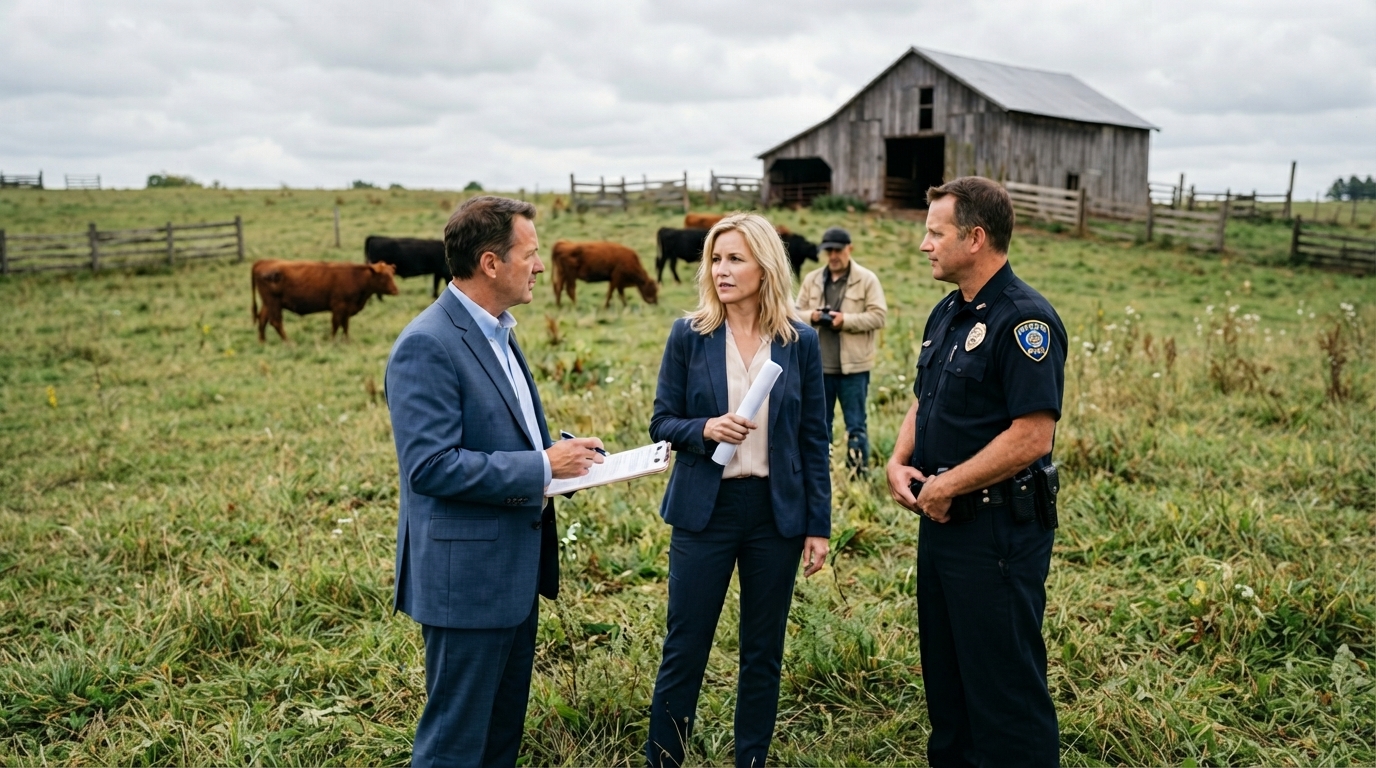
PART 3
The moment Sheriff Daniel Mercer
stepped out of his patrol vehicle,
my father’s confident smile disappeared.
Not completely.
Not at first.
Dad had spent sixty-three years believing
that confidence could carry
him through almost any situation.
He was the kind of man who could walk into a
room where he had no authority,
speak loudly enough, and convince half
the people present that he owned the building.
Unfortunately for him, Montana property law
didn’t care how convincing he sounded.
Neither did Sheriff Mercer.
“Good morning,” the sheriff said,
adjusting his hat against the freezing wind.
“I’m looking for the person who authorized this locksmith to enter the property.”
My father stepped forward.
“That would be me.”
“And your name?”
“Richard Caldwell.”
The sheriff nodded.
“Mr. Caldwell, do you own this ranch?”
Dad hesitated.
“My daughter owns it, technically.”
“Technically?”
“Well, it’s family property.”
The sheriff glanced toward the gate.
“That’s not what the county records show.”
My stepmother, Diane, immediately intervened.
“Officer, this is a family misunderstanding. There’s no reason to make a scene.”
“I’m not making a scene, ma’am. I’m asking a question.”
My brother Tyler stood behind them, hands shoved into the pockets of his expensive winter coat.
He looked annoyed rather than concerned.
“Can we just get this over with?” he muttered. “The realtor has another appointment.”
The realtor, a woman named Allison Reed, shifted uncomfortably.
She had been standing beside a silver SUV, holding a leather portfolio.
Until that moment, she had apparently believed she was attending a legitimate property showing.
Sheriff Mercer turned toward her.
“Ma’am, what were you told about this property?”
Allison swallowed.
“That Mr. Caldwell was authorized to represent the owner.”
“Did you verify that?”
“I was provided documents.”
The sheriff held out his hand.
“Would you mind showing me?”
My father immediately stepped between them.
“Now hold on. You can’t just demand private business papers.”
The sheriff remained calm.
“I’m investigating a complaint concerning possible unauthorized entry and questionable documents. Ms. Reed can decide whether to cooperate voluntarily.”
Allison opened her portfolio.
Dad’s expression tightened.
“Those are confidential.”
She looked at him.
“Richard, you told me everything was legitimate.”
“It is.”
“Then there shouldn’t be a problem.”
I watched the entire exchange from the security monitor inside my kitchen.
My coffee sat untouched beside me.
The camera above the gate captured every movement.
Every expression.
Every nervous glance.
And the longer I watched, the more I understood that my father hadn’t come to ask for help.
He had come to take what he believed I owed him.
My phone rang.
It was Sheriff Mercer.
“Ma’am, I’m at your gate. Are you comfortable speaking with me?”
“Yes, Sheriff.”
“Would you like to come outside?”
I looked at my father.
At Diane.
At Tyler.
Then at the realtor who had unknowingly walked into the middle of my family’s latest disaster.
“I’ll be there in two minutes.”
I hung up, pulled on my winter coat, and walked toward the front door.
Before opening it, I glanced at the framed photograph hanging beside the hallway mirror.
It showed me at twenty-three, standing beside my Army unit after completing my first overseas deployment.
My father hadn’t attended the ceremony when I returned.
He said Tyler had a basketball tournament.
That was the pattern of my childhood.
Tyler needed something.
I was expected to understand.
Tyler made a mistake.
I was expected to help.
Tyler received praise for ordinary accomplishments.
I was expected to achieve extraordinary things without making anyone uncomfortable.
And now, after twenty years of military service, I had finally bought something entirely my own.
A ranch.
A home.
A place where I didn’t have to earn permission to exist.
My father had decided that belonged to Tyler too.
I opened the door.
The Montana air hit my face like broken glass.
Snow crunched beneath my boots as I walked toward the gate.
My father saw me first.
“There she is,” he announced, as though I were a troublesome employee arriving late to a meeting.
“Finally.”
I stopped several feet from him.
“Good morning, Dad.”
He spread his arms.
“Are you satisfied? You’ve got the sheriff involved over a simple family arrangement.”
I looked at the locksmith.
Then the realtor.
Then the documents in Allison’s hands.
“What arrangement?”
Dad sighed dramatically.
“We’ve discussed this.”
“No, we haven’t.”
“Don’t start.”
I folded my arms.
“Dad, I haven’t spoken to you since Christmas.”
Diane rolled her eyes.
“Here we go again.”
I turned toward her.
“Yes, Diane. Here we go again.”
Sheriff Mercer stepped closer.
“Ma’am, I understand you’re the recorded owner?”
“Yes, sir.”
“Can you confirm your full name?”
“Major Rebecca Caldwell.”
My father made a dismissive sound.
“She always has to mention the military.”
I ignored him.
I handed the sheriff my identification and a copy of the recorded deed.
He examined both.
Then he looked toward my father.
“Mr. Caldwell, your daughter is the owner of record. Do you have her permission to enter or market this property?”
Dad lifted his chin.
“I have a signed authorization.”
I looked at him.
“No, you don’t.”
His face hardened.
“Rebecca.”
“You have a document bearing a signature that resembles mine. That doesn’t mean I signed it.”
The realtor went pale.
Sheriff Mercer opened the folder he had brought.
“That’s what we’re here to discuss.”
My father glanced toward Tyler.
For the first time, my brother looked nervous.
And that told me something important.
Tyler already knew.
Maybe not every detail.
But enough.
The sheriff showed me a copy of the document.
It was titled:
LIMITED PROPERTY MANAGEMENT AND SALE AUTHORIZATION.
Beneath the heading was a paragraph claiming I had appointed my father to manage, market, negotiate, and execute certain documents concerning the ranch.
The document included my printed name.
My military rank.
My property address.
And a signature.
A signature that looked almost exactly like mine.
Almost.
The final stroke curved upward.
Mine always curved down.
Thomas Caldwell, my grandfather, had taught me to sign my name when I was seven.
He used to say a person’s signature should be as distinctive as their character.
My father had apparently forgotten that lesson.
Or perhaps he never learned it.
“Where did you get this?” I asked.
Dad crossed his arms.
“You signed it.”
“When?”
“Last month.”
“Where?”
“At the house.”
I stared at him.
“Dad, I was stationed in North Carolina last month.”
He blinked.
“Then you emailed it.”
“Which is it?”
His jaw tightened.
“Don’t interrogate me.”
Sheriff Mercer spoke.
“Mr. Caldwell, these questions matter.”
Diane stepped forward.
“Rebecca, your father was trying to help your brother.”
I looked at her.
“By selling my home?”
“Tyler is in trouble.”
“That doesn’t give anyone the right to take my property.”
She threw up her hands.
“Everything is always about rights with you.”
I almost laughed.
Because that was the first honest thing she’d said.
Yes.
It was about rights.
The right to own something without having it taken.
The right to say no.
The right to be treated as a person rather than a resource.
And the right to spend Christmas somewhere I was actually wanted.
Tyler finally spoke.
“Becca, you’re being selfish.”
I turned toward him.
“Explain that.”
“You have a military pension coming. You’ve got savings. You’ve got this whole place.”
“And?”
“And I need help.”
“With what?”
He looked toward Dad.
Dad shook his head slightly.
I caught it.
“Tyler,” I said, “what kind of trouble are you in?”
He stared at the snow.
“Business trouble.”
“What business?”
“My construction company.”
I knew Tyler had started a contracting business two years earlier.
Dad had invested money.
Diane had encouraged him.
Everyone had celebrated his entrepreneurial spirit.
Meanwhile, when I bought my ranch, nobody even sent a congratulations card.
“How much do you owe?” I asked.
Tyler didn’t answer.
“Tyler.”
He looked up.
“Four hundred and eighty thousand.”
For a moment, the only sound was wind moving through the pine trees.
Nearly half a million dollars.
And my father had apparently decided the solution was to sell my ranch.
I looked at him.
“You planned to use the proceeds to pay Tyler’s debts.”
Dad didn’t deny it.
“Family takes care of family.”
I nodded slowly.
“Funny. I remember sitting outside your house on Christmas Eve, watching you celebrate without me.”
Diane sighed.
“Not this again.”
“Yes,” I said. “This again.”
Dad’s face reddened.
“We didn’t invite you because you make everything uncomfortable.”
I stared at him.
“By existing?”
“By acting superior.”
I looked down at my boots.
The same boots I’d worn while repairing the barn roof the previous weekend.
The same boots covered in mud, snow, and sawdust.
“Dad, I spent twenty years earning everything I have. I don’t think I’m superior to anyone.”
Tyler muttered, “Then why won’t you help?”
I looked at my brother.
“Because you didn’t ask.”
He opened his mouth.
I continued.
“You came to my property with a realtor, a locksmith, and a document I never signed.”
The sheriff closed the folder.
“Mr. Caldwell, at this point, no one has authorization to enter the property except the owner and those she permits.”
Dad stepped closer.
“This is ridiculous.”
“Sir,” the sheriff said firmly, “I’m asking you to step back.”
My father froze.
For the first time in my life, someone had told Richard Caldwell no.
And he couldn’t simply shout his way past it.
Allison Reed turned toward me.
“Major Caldwell, I apologize. I was told this was a family-approved sale.”
I nodded.
“I understand.”
She looked at Dad.
“I’m withdrawing from this listing until ownership and authorization are independently verified.”
Dad’s face turned crimson.
“You can’t do that!”
“I can,” Allison answered. “And I am.”
The locksmith had already returned his tools to the truck.
He clearly wanted nothing more to do with the situation.
Sheriff Mercer looked toward my father.
“Mr. Caldwell, I need you to understand that attempting to sell property without the owner’s authorization is a serious matter.”
Dad pointed at me.
“She’ll drop this.”
I met his eyes.
“No, Dad.”
His expression changed.
“What?”
“I won’t.”
And that was when Tyler made the mistake that turned a suspicious document into something much more serious.
He shouted, “Dad, you said the notary wouldn’t be a problem!”
Silence fell across the driveway.
My father slowly turned toward him.
Diane covered her mouth.
Allison stopped moving.
And Sheriff Mercer opened his notebook.
“Mr. Caldwell,” he said, looking at Tyler, “I think we need to talk about that.”
PART 4
My brother’s face drained of color.
He looked from the sheriff to our father, then back again.
“I didn’t mean anything.”
Sheriff Mercer remained calm.
“What did you mean when you said the notary wouldn’t be a problem?”
Tyler swallowed.
“Nothing. I was just upset.”
Dad immediately stepped forward.
“My son isn’t answering any more questions.”
The sheriff nodded.
“That’s his choice.”
Then he turned toward me.
“Major Caldwell, would you be willing to provide a formal statement?”
“Yes.”
Dad looked furious.
“Rebecca, you’re not seriously going to press charges against your own father.”
I looked at him.
“I’m going to tell the truth.”
“You’ll destroy this family.”
The words struck me harder than I expected.
Not because they frightened me.
Because I’d heard them before.
When I enlisted instead of joining Dad’s insurance business, I was abandoning the family.
When I refused to send Tyler money after his first failed business venture, I was betraying the family.
When I missed Thanksgiving because I was deployed overseas, I was choosing strangers over the family.
But when they excluded me from Christmas?
That was apparently nothing.
And when they tried to sell my property?
That was family helping family.
I finally understood the pattern.
In my father’s mind, family loyalty meant everyone sacrificing for Tyler.
Especially me.
“Dad,” I said quietly, “you made this decision. Not me.”
He looked away.
Sheriff Mercer asked the visitors to leave the property.
The realtor and locksmith departed immediately.
Diane followed after several minutes of angry whispers.
Tyler climbed into his truck.
But Dad remained standing near the gate.
He looked at me with an expression I hadn’t seen since I was seventeen and told him I wanted to attend college on an Army scholarship.
Disappointment.
Contempt.
And something that looked almost like fear.
“You think you’re better than us now,” he said.
I shook my head.
“No. I just finally believe I deserve better than this.”
His jaw tightened.
Then he climbed into his vehicle and drove away.
I stood in the snow until the taillights disappeared.
Sheriff Mercer approached.
“You okay?”
I nodded.
Then shook my head.
“I don’t know.”
He looked toward the ranch house.
“Families can make things complicated.”
I gave a tired laugh.
“That’s one way to put it.”
He handed me his business card.
“Come by the office tomorrow. We’ll take your statement and review what we have.”
“I will.”
“And Major?”
“Yes?”
“Don’t confront them about the document. Let the investigation proceed.”
I nodded.
“Understood.”
He glanced toward the gate camera.
“Keep those recordings.”
“I already have copies.”
He smiled slightly.
“Thought you might.”
After he left, I returned to the house.
The coffee on the counter had gone cold.
I poured it down the sink.
Then I sat at the kitchen table and stared at the mountains beyond the window.
The ranch had been my answer to rejection.
My escape from a lifetime of feeling like the extra person in my own family.
Now the same people who hadn’t wanted me at Christmas wanted the land I’d purchased afterward.
I should have been furious.
Instead, I felt exhausted.
My phone rang.
It was Captain Sarah Mitchell, a former Army judge advocate and one of my closest friends.
Sarah had reviewed my purchase documents when I bought the ranch.
She now practiced civilian law in Montana.
I had jokingly continued calling her my JAG attorney, although she was no longer serving in that role.
“Rebecca,” she said, “I just received your message.”
“It’s worse than I expected.”
“Tell me everything.”
I explained the attempted sale.
The locksmith.
The forged-looking authorization.
Tyler’s comment about the notary.
Sarah listened without interrupting.
When I finished, she asked one question.
“Do you have the original purchase records?”
“Yes.”
“Good. And the title insurance policy?”
“In the safe.”
“Excellent. Don’t send your family anything. Don’t sign anything. And don’t make any private agreements.”
I rubbed my forehead.
“Sarah, my father really thought he could sell my ranch.”
“People sometimes confuse what they want with what they’re legally entitled to.”
“He raised me.”
“I know.”
“He taught me to tell the truth.”
Sarah was quiet.
Then she said, “That doesn’t mean he’s incapable of lying.”
I closed my eyes.
The truth hurt.
But I needed to hear it.
The following morning, I drove to the sheriff’s office.
I brought copies of my deed, purchase agreement, title insurance documents, mortgage payoff information, and security recordings.
I also brought a detailed timeline.
The Christmas exclusion.
The purchase.
The first suspicious phone call from a realtor two weeks earlier.
The strange email asking me to confirm an authorization I had never granted.
And the morning my family arrived at the gate.
Sheriff Mercer reviewed everything.
Then he showed me something I hadn’t seen.
A copy of the notarized authorization.
The notary’s name was printed beneath the signature.
Linda Parker.
I frowned.
“Do you know her?” the sheriff asked.
“No.”
“She’s a notary in Ohio.”
My stomach tightened.
Ohio.
The state where my father lived.
“Have you been to Ohio since purchasing the ranch?”
“No.”
“Have you met Linda Parker?”
“Never.”
He made a note.
“We’ll need to verify the notarial record and how the document was created.”
I looked at the signature again.
It was close.
Very close.
But not mine.
“Sheriff, whoever did this had access to my signature.”
He nodded.
“Possibly.”
I thought about the Christmas cards I’d sent Dad.
The birthday checks.
The military paperwork I’d once mailed home.
Then I remembered something.
Three months earlier, Dad had asked me to send a copy of my driver’s license.
He claimed he needed it to update family emergency records.
I had sent it.
My stomach dropped.
“I think I know how they got my information.”
I explained the request.
Sheriff Mercer wrote it down.
“Preserve those messages.”
I nodded.
Then he said something that surprised me.
“Major, I also want you to know we received a call about your ranch before this morning.”
I looked up.
“From whom?”
“A man claiming to represent a prospective buyer.”
“When?”
“Last week.”
“What did he want?”
“He asked whether there were any known access disputes or law enforcement issues involving the property.”
I stared at him.
“Why would he ask that?”
“That’s what we’re trying to determine.”
He closed the folder.
“For now, the important thing is that your ownership is recorded and you’ve clearly denied authorization.”
I left the office with more questions than answers.
That afternoon, Sarah arrived at the ranch.
She brought a laptop, two legal pads, and enough determination to make me grateful she was on my side.
We spread the documents across the dining room table.
She examined the authorization carefully.
“This is sloppy,” she said.
I raised an eyebrow.
“It looks convincing.”
“To someone who doesn’t know what to look for.”
She pointed toward the document.
“The language is inconsistent. It claims broad authority to sell, but references a property management agreement that isn’t attached.”
She turned another page.
“And the notarial certificate needs verification.”
I leaned back.
“So what happens?”
“We cooperate with the investigation. We also notify the title company and take steps to make sure nobody can record additional unauthorized instruments without us finding out.”
“Can they still sell the ranch?”
“Not lawfully without your authorization. But we should address any cloud on title immediately.”
I nodded.
Sarah studied me.
“Rebecca, are you okay?”
I looked toward the window.
“I keep thinking about Christmas.”
She waited.
“I sat outside their house like a fool.”
“You weren’t a fool.”
“I drove two hours because I thought maybe Dad had forgotten to include me.”
Sarah’s expression softened.
“You wanted your family.”
I swallowed.
“Apparently, they only wanted my property.”
She reached across the table.
“Then let’s make sure they don’t get it.”
Over the next week, the investigation moved forward.
The notary was contacted.
The realtor provided copies of the documents she had received.
The locksmith gave a statement.
The security footage was preserved.
And Sarah helped me address the suspicious authorization through the appropriate county recording and title procedures.
Then came the first major revelation.
Linda Parker, the Ohio notary whose seal appeared on the document, told investigators she had never met me.
She also reported that the notarial certificate appeared to contain information inconsistent with her records.
The document had not been properly executed in her presence.
That raised serious questions about who had created it and how her seal had been used.
But the biggest surprise came from the realtor.
Allison Reed contacted Sarah.
She wanted to provide additional emails.
According to those messages, my father had represented that I was temporarily unavailable because of military obligations.
He claimed I had already agreed to sell the ranch.
He also said the proceeds would be used to purchase a smaller property closer to family.
I read that sentence three times.
Closer to family.
The same family that had excluded me from Christmas.
The same family that had ignored my calls.
The same family that had arrived at my gate with a locksmith.
Sarah watched my face.
“Rebecca?”
I shook my head.
“He wasn’t just planning to sell it.”
“What do you mean?”
“He was planning to tell everyone I wanted this.”
Sarah nodded grimly.
“That appears to be the story he gave the realtor.”
Then she showed me another email.
This one was from Tyler.
It contained a proposed distribution of sale proceeds.
First, repayment of his business debts.
Second, payment of transaction costs.
Third, a reserve for what he called family expenses.
And finally, whatever remained would supposedly be available for my relocation.
I stared at the numbers.
The ranch had been listed at $825,000.
Tyler’s debts totaled approximately $480,000.
The proposed family reserve was $150,000.
After commissions, costs, and other deductions, I would have received only a fraction of the value of property I had purchased with my own savings.
They had planned to take nearly everything.
And they had called it helping me.
I stood up so quickly that my chair scraped the floor.
Sarah looked at me.
“Rebecca?”
I walked toward the fireplace.
For several seconds, I couldn’t speak.
Then I said, “I want to know how long they’ve been planning this.”
Sarah closed the laptop.
“That’s a question for the investigation.”
I turned toward her.
“No. I mean before the ranch.”
She frowned.
“What do you mean?”
I looked at the photograph on the mantel.
It showed my mother holding me when I was four.
She had died when I was nine.
Dad married Diane two years later.
Tyler was born the following spring.
And from that moment forward, everything changed.
“Sarah,” I whispered, “I think my father has been treating my life like something he could redistribute for years.”
She didn’t answer.
She didn’t need to.
Because three days later, I received an email from Diane.
The subject line read:
YOU’RE DESTROYING YOUR FATHER.
Inside was a long message accusing me of selfishness, cruelty, and disloyalty.
She said Tyler could lose everything.
She said Dad’s health was suffering.
She said I had embarrassed the family.
Then came the sentence that made me stop reading.
“Your mother would be ashamed of what you’ve become.”
I stared at those words.
For thirty years, Diane had used my mother’s memory whenever she wanted to hurt me.
But this time, something inside me finally refused to bend.
I opened a new message.
I typed one sentence.
“My mother taught me that love doesn’t require surrendering what belongs to me.”
Then I blocked her number.
I thought that would be the end of it.
But the next morning, Sheriff Mercer called.
“Major Caldwell, we need to speak.”
My stomach tightened.
“What’s happened?”
“We’ve received additional information concerning the authorization.”
I sat down.
“What kind of information?”
He paused.
“Your brother has requested an interview through his attorney.”
I closed my eyes.
“And?”
“He says your father told him the sale was already approved.”
I stared at the wall.
For the first time, the story was beginning to split.
Dad blamed Tyler.
Tyler blamed Dad.
Diane blamed me.
And somewhere between them was a document carrying a signature that wasn’t mine.
Sheriff Mercer continued.
“There’s something else.”
“What?”
“Your brother says he has messages showing when the plan began.”
I gripped the phone.
“How long ago?”
The sheriff answered carefully.
“According to what he’s provided, before you closed on the ranch.”
For a moment, I couldn’t breathe.
Before I even owned the land, my father had already been planning how to use it.
And that meant the Christmas exclusion might not have been the beginning.
It might have been part of the plan.
PART 5
I sat at my kitchen table for nearly an hour after Sheriff Mercer ended the call.
Outside, snow fell across the pasture.
The mountains stood dark against the gray sky.
Everything looked peaceful.
But inside me, years of unanswered questions were finally beginning to connect.
My father had known I was looking for property.
I’d mentioned it during a phone call the previous autumn.
At the time, I was still considering several states.
Montana was only one possibility.
Dad had sounded unusually interested.
“How much are you planning to spend?” he’d asked.
I told him I hadn’t decided.
“Cash or financing?”
“Probably mostly cash.”
He had paused.
Then said, “Well, that’s a lot of money tied up in land.”
I hadn’t thought anything of it.
Now I remembered every word.
He had also asked whether I intended to keep the ranch long-term.
Whether I planned to retire there.
Whether I would ever consider selling.
At the time, I thought he was finally taking an interest in my life.
Now I wondered whether he had simply been calculating how much I was worth.
Sarah arrived that afternoon.
She found me sitting beside the fireplace with a stack of old photographs.
“Rebecca?”
I looked up.
“I think I finally understand.”
She sat beside me.
“Tell me.”
I showed her a photograph from Christmas when I was twelve.
Tyler was three.
He sat in front of a mountain of presents.
I stood beside the tree holding a single wrapped box.
My father had told me that year that money was tight.
Tyler needed more because he was younger.
I had accepted it.
Then came birthdays.
College.
Cars.
Weddings.
Business loans.
Every major family decision seemed to revolve around Tyler.
I was the dependable one.
The independent one.
The one who didn’t need help.
And because I didn’t need help, they decided I didn’t deserve consideration.
“Sarah,” I said, “I’ve spent my entire life being punished for being capable.”
She looked at me.
“Then stop accepting the punishment.”
I wiped my eyes.
“I don’t know how.”
“Yes, you do.”
She gestured toward the window.
“You bought this place. You protected it. You called the sheriff when something was wrong. You’re already doing it.”
I looked outside.
At the barn.
The fences.
The wide Montana sky.
For the first time, I realized that buying the ranch hadn’t simply been an act of escape.
It had been an act of self-respect.
And now I had to finish what I started.
Over the next several months, the investigation continued.
Tyler cooperated through his attorney.
He provided messages, emails, and financial records showing how the proposed sale had been discussed.
Some communications suggested Dad had encouraged Tyler to view my ranch as a solution to his business problems.
Others showed that Tyler had actively participated in arranging the realtor and obtaining documents.
The evidence did not support the simple story either man initially wanted to tell.
Both had made choices.
Both had responsibilities.
And both would have to answer for their actions.
Eventually, investigators referred their findings to prosecutors for review.
The authorities examined possible offenses related to the false authorization and attempted property transaction.
I did not demand a particular charge.
I did not ask for special treatment because of my military service.
I simply cooperated.
I gave statements.
I preserved records.
And I refused to withdraw the complaint simply because the people involved shared my last name.
The legal process took time.
There were interviews.
Hearings.
Negotiations.
And more than one attempt by my family to persuade me to make everything disappear.
Dad sent a handwritten letter.
For the first time in years, he addressed me as Rebecca instead of Becca.
He wrote that he had only been trying to keep Tyler from losing his business.
He said he never intended to hurt me.
He claimed he believed I would eventually agree.
Then he wrote:
“I thought you would understand because you’ve always been the strong one.”
I stared at that sentence.
The strong one.
The one who could endure being forgotten.
The one who could survive without help.
The one whose achievements were expected and whose sacrifices were taken for granted.
I folded the letter.
And placed it in a drawer.
I didn’t respond.
Two weeks later, Tyler called from a number I didn’t recognize.
I answered before realizing who it was.
“Becca?”
My stomach tightened.
“Tyler.”
He sounded exhausted.
“Can we talk?”
I looked toward the barn.
“About what?”
“Everything.”
I remained silent.
He continued.
“Dad says you’re trying to send him to prison.”
I closed my eyes.
“Tyler, I’m not a prosecutor.”
“You know what I mean.”
“No. I don’t think I do.”
He sighed.
“I just need you to tell them it was a misunderstanding.”
I looked at the snow melting along the fence.
“Was it?”
He didn’t answer.
“Did you bring a realtor to my property?”
“Yes.”
“Did you know I hadn’t agreed to sell?”
Silence.
“Tyler?”
“Yes.”
“Did you know the authorization wasn’t genuine?”
He began crying.
“I didn’t know exactly how Dad got it.”
“That isn’t what I asked.”
He took a shaky breath.
“I knew you hadn’t signed anything in front of us.”
I closed my eyes.
There it was.
The truth.
Not complete.
Not enough to resolve every legal question.
But enough to tell me my brother had known something was wrong.
“Why?” I whispered.
He sounded confused.
“What?”
“Why would you do that to me?”
He began speaking quickly.
The business was failing.
Creditors were calling.
Employees needed wages.
Dad had promised a solution.
Diane said I had more than enough.
Everyone believed I would eventually forgive them.
I listened.
Then I asked one question.
“Did you ever consider asking me?”
He went quiet.
I waited.
Finally, he whispered, “I thought you’d say no.”
I looked toward the mountains.
“Then you already knew you didn’t have my permission.”
He began crying harder.
“I’m sorry.”
I wanted to believe him.
Part of me did.
But apologies couldn’t erase decisions.
“Tyler,” I said, “I hope you get your life together. I really do.”
“Then help me.”
I felt the familiar pull.
The old responsibility.
The instinct to solve his problem so Dad would finally approve of me.
Then I looked around my kitchen.
My ranch.
My home.
My peace.
“No,” I said.
He stopped crying.
“What?”
“I won’t pay your debts. I won’t surrender my property. And I won’t lie to protect you.”
His voice hardened.
“So that’s it?”
“Yes.”
“You’re choosing land over family.”
I shook my head.
“No, Tyler. I’m choosing not to let family steal my land.”
He hung up.
For several minutes, I sat motionless.
Then I walked outside.
The air was cold and clean.
A horse grazed near the fence.
The mountains stretched toward the horizon.
And I realized something remarkable.
I didn’t feel guilty.
Not anymore.
The following summer, the criminal case reached a resolution.
My father and brother, represented by separate attorneys, entered negotiated pleas to offenses arising from their participation in the false property authorization and attempted transaction.
The court considered their conduct, the evidence, and the applicable law.
They received sentences that included supervised probation, financial penalties, and conditions prohibiting further interference with my property.
The false authorization was formally addressed through the proper legal and recording procedures.
The ranch remained mine.
There was no dramatic courtroom speech.
No judge declaring me a hero.
No moment when the entire world applauded.
Just paperwork.
Consequences.
And the quiet satisfaction of knowing my home was secure.
Dad avoided looking at me during the hearing.
Tyler looked ashamed.
Diane sat behind them, glaring at me as though I had personally caused everything.
I didn’t glare back.
I simply listened.
When the hearing ended, Sarah touched my arm.
“Ready?”
I nodded.
“More than ready.”
We walked outside together.
The sky was bright.
The air smelled like summer rain.
For the first time in months, I felt as though I could breathe without carrying my family’s expectations on my shoulders.
Sarah smiled.
“What are you going to do now?”
I thought for a moment.
“Go home.”
She laughed.
“That’s it?”
I looked toward the parking lot.
“That’s everything.”
And it was.
Because home had become something entirely different from what it meant when I was a child.
It wasn’t the place where I waited to be invited.
It wasn’t the table where everyone else had a seat.
It wasn’t the house where I had to pretend rejection didn’t hurt.
Home was the place I had built for myself.
A place nobody could take simply because they believed I owed them.
That autumn, I began making changes to the ranch.
I repaired the old barn.
Replaced several sections of fencing.
Installed a new water system.
And hired a local ranch hand named Caleb Foster to help manage the livestock.
Caleb was twenty-six, hardworking, and recently separated from the Army.
He had struggled to find steady employment after returning home.
One afternoon, while we were repairing a gate, he mentioned that several veterans in the area were facing similar difficulties.
Some needed work.
Others needed temporary housing.
A few simply needed a place where they could feel useful again.
That conversation stayed with me.
A month later, I contacted a local veterans’ organization.
We discussed the possibility of using part of the ranch for a small agricultural training program.
Nothing elaborate.
Just practical work.
Animal care.
Equipment maintenance.
Land management.
Basic business skills.
A chance for people transitioning out of military service to gain experience and rebuild confidence.
The organization was interested.
Sarah helped me establish the appropriate agreements and liability protections.
By spring, we welcomed our first small group of participants.
I watched them repair fences, learn to operate equipment, and laugh around a picnic table outside the barn.
Some had served overseas.
Some had never deployed.
Some carried invisible burdens that didn’t disappear when they removed their uniforms.
But they all deserved a place where their efforts mattered.
One evening, a young veteran named Marcus approached me.
“Major Caldwell?”
“Yes?”
“Can I ask you something?”
“Of course.”
“Why do you do this?”
I looked toward the pasture.
“Because somebody once gave me a chance when I needed one.”
He nodded.
Then he said something I would never forget.
“This is the first place I’ve felt like I belonged since leaving the Army.”
I swallowed.
For a moment, I remembered sitting in my truck outside Dad’s house on Christmas Eve.
Watching everyone celebrate without me.
Feeling invisible.
Unwanted.
Unnecessary.
And now, on land my family had tried to take, I was helping other people find the belonging I had once begged for.
Life has a strange way of bringing things full circle.
That December, nearly a year after the attempted sale, I received another message from Dad.
“Christmas dinner is at six. You’re welcome to come.”
I stared at the screen.
No apology.
No acknowledgment.
No mention of what had happened.
Just an invitation.
As though a year of legal proceedings could be erased by setting an extra plate at the table.
I thought about driving back.
I thought about seeing the old house.
The Christmas lights.
The dining room.
The family photographs.
Then I looked around my ranch kitchen.
Caleb was helping prepare dinner.
Marcus was hanging lights along the porch.
Two other veterans were bringing firewood inside.
Sarah had promised to arrive with dessert.
Sheriff Mercer and his wife were coming after their family gathering.
And several neighbors had accepted my invitation to join us.
The table was already full.
Not with people who expected something from me.
But with people who respected me.
I typed a reply.
“Thank you for the invitation. I’ll be spending Christmas at home.”
Dad responded almost immediately.
“You mean the ranch?”
I smiled.
“Yes, Dad. My home.”
He didn’t reply.
And for once, his silence didn’t hurt.
Christmas Eve arrived beneath a sky filled with stars.
Snow covered the pasture.
Warm light glowed through the windows.
The smell of roasted turkey filled the kitchen.
Laughter drifted from the dining room.
I stood on the porch for a moment, looking toward the gate.
A year earlier, I had sat outside my father’s house, watching Christmas happen without me.
Now I stood outside my own home, listening to people call my name because they wanted me inside.
“Major!” Caleb shouted from the doorway. “We’re waiting on you!”
I laughed.
“Coming!”
When I entered the dining room, everyone was seated.
There was an empty chair at the head of the table.
Mine.
Not because I demanded it.
Not because I had more money.
Not because I outranked anyone.
But because the people around that table wanted me there.
Sarah raised her glass.
“To Rebecca.”
I shook my head.
“Oh, don’t start.”
She grinned.
“To the woman who turned an old ranch into a place where people can begin again.”
Everyone raised their glasses.
I felt tears rising.
“Thank you,” I whispered.
Then I looked around the table.
At Caleb.
Marcus.
Sarah.
Sheriff Mercer.
The neighbors.
The veterans.
People who had entered my life because I finally stopped trying to earn love from people who treated it like a reward.
I stood.
“I want to say something.”
The room quieted.
“A year ago, I spent Christmas Eve alone.”
Sarah looked at me gently.
“I thought being excluded meant something was wrong with me.”
I paused.
“But I learned something important.”
I looked around the room.
“Family isn’t always the people who share your last name. Sometimes it’s the people who show up, respect your boundaries, and make room for you without being asked.”
Marcus nodded.
Caleb smiled.
I continued.
“This ranch started as a place for me to heal. Now it’s become a place where other people can find a new beginning.”
I raised my glass.
“To everyone who has ever felt unwanted.”
The room grew quiet.
“And to finding a place where you never have to beg for a seat.”
Everyone raised their glasses.
“To new beginnings.”
We ate.
We laughed.
We exchanged gifts.
Someone played old Christmas music on a battered speaker.
Marcus burned the dinner rolls.
Caleb insisted they were supposed to be that dark.
Sarah laughed so hard she nearly spilled her drink.
And for the first time in years, Christmas felt peaceful.
Later that night, after everyone had gone home or settled into the guest rooms, I stepped outside.
Snow was falling gently.
The barn lights glowed across the yard.
Beyond the fence, the mountains rose beneath the stars.
I thought about my father.
I thought about Tyler.
I thought about all the years I had spent wondering what I needed to do to be loved equally.
And I finally understood the answer.
Nothing.
There had never been anything wrong with me.
I had simply been asking the wrong people to recognize my worth.
My father had tried to sell my ranch because he believed my success belonged to the family.
He thought I would surrender it the same way I had surrendered so many things before.
My time.
My money.
My holidays.
My feelings.
But this time, I had said no.
And the world hadn’t ended.
My life had begun.
I looked toward the gate where Dad had stood with the realtor and locksmith.
The same gate where Sheriff Mercer had arrived with the folder.
The same gate where my family learned that my boundaries were no longer negotiable.
I smiled.
Then I walked back toward the house.
Inside, the fireplace was still burning.
The Christmas tree glowed beside the window.
And a handwritten sign hung above the dining room doorway.
Caleb had made it from a piece of reclaimed barn wood.
It read:
“THERE IS ALWAYS ROOM AT THIS TABLE.”
I stood beneath those words for a long time.
Then I laughed softly.
Because that was the difference between the home I’d come from and the home I’d built.
At my father’s house, belonging had always been conditional.
At mine, kindness was expected.
Respect was required.
And nobody had to prove they deserved to be included.
I switched off the kitchen light.
Then I looked back once more at the Christmas table.
The plates had been cleared.
The chairs were empty.
But the warmth remained.
And I knew I would never again spend Christmas waiting outside someone else’s window.
My father excluded me from Christmas because he thought I didn’t matter.
Then he tried to sell my ranch because he thought what I owned mattered more than who I was.
He was wrong about both.
Because I didn’t need his invitation to build a family.
I didn’t need his approval to own my future.
And I certainly didn’t need his permission to call a place home.
The ranch was mine.
The life was mine.
And the peace I’d finally found was worth more than anything my father had ever offered.
Sometimes the best revenge isn’t making the people who rejected you regret their decision.
It’s building a life so full of peace, purpose, and genuine love that you no longer need them to understand what they lost.
And that Christmas, surrounded by people who had chosen to be there, I finally understood something I wished I’d learned years earlier.
You don’t have to keep knocking on a door that was deliberately closed to you.
Sometimes you buy your own land, build your own home, and open a better door for people who know how to love without conditions.
THE END THANK YOU FOR READING !!!



